Here come the Millennials!

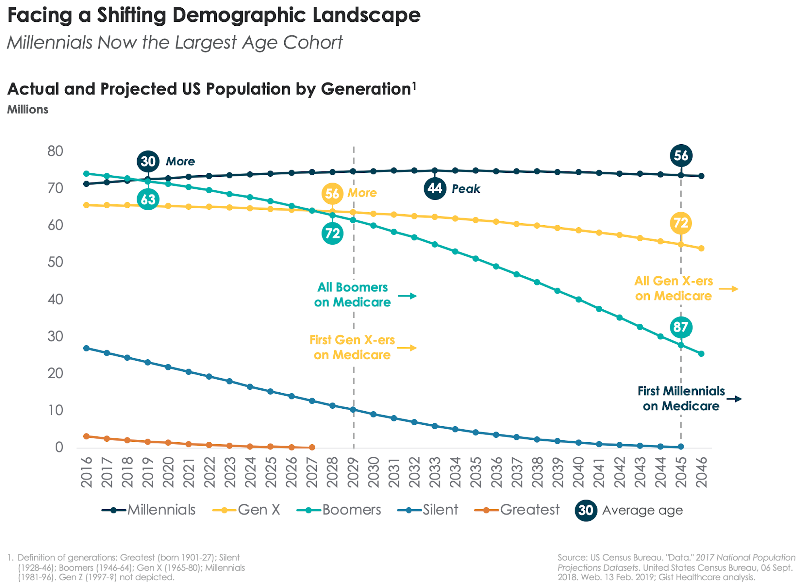
We spend an awful lot of time in healthcare talking about the Baby Boomers. No surprise, America has spent decades—six-and-a-half of them, to be exact—contending with the impact of this historically large generation on nearly every aspect of our national life. From politics to economics to culture, the Baby Boom reshaped almost every facet of our society, and healthcare has been no exception. The fact that over 10,000 Boomers join the Medicare ranks every day means they’ll have a transformative effect on how healthcare is delivered and paid for—up to and including the sustainability of the Medicare program itself. So it may come as a shock to Boomers to learn that, starting in 2019, it’s no longer All About Them. This year America passes a new milestone: Baby Boomers are now outnumbered by Millennials. As the chart below shows, Boomers (whose average age is now 63), will be surpassed this year by America’s new Largest Generation. Born between 1981 and 1996, the Millennials are now 30 years old on average, and there are 72.5M of them, compared to 72.0M Boomers—a gap that will continue to widen. (Thanks to immigration, we have another 14 years until we hit “peak” Millennial, according to Census Bureau projections.)

This demographic achievement alone ought to earn Millennials a participation trophy—obviously, not their first. (Forgive the sarcasm…we’re Gen X-ers, it’s what we do.) But this changing demographic landscape brings big implications for healthcare. Boomers are just entering their peak “senior care” consumption years now, and we’ll have a quarter-century or more of very expensive care to fund for a generation that is by all indications more riven with chronic disease but more likely to live into very old age than previous cohorts. That creates the imperative for population health approaches that allow care for seniors to be delivered in lower-acuity settings. At the same time, however, Millennials are really just entering the healthcare system. For the next several years, most of their care needs will be driven by having babies and caring for growing families. But just as the last of the Boomers get their Medicare cards in 2029, the Millennials will begin to enter their “upkeep” years—demanding a variety of diagnostics, surgeries, and procedures to keep them thriving. Who will pay for all of that specialty care, and where will it be delivered? Today’s health system planners would do well to begin to look ahead to future capacity needs, and economic models.

The Millennials bring dramatically different service expectations as well. This is a generation raised in the era of Amazon. One-click purchases, same-day delivery, frictionless transactions, personalized offerings, low institutional loyalty—all of that will shape the way this generation thinks about consuming healthcare, with huge implications for providers. This is a high-information generation, whose adult years have seen a pervasive shift from physical to digital commerce, and they’ll expect healthcare to follow that trend. Ask today’s pediatric providers how different the Millennials are as parent-consumers—you’ll quickly get the picture. Even as physicians, hospitals and others scramble to retool care delivery to more efficiently manage the swelling ranks of seniors, they’ll need to keep a close eye on the preferences of Millennials, upon whom their future fortunes will rely, and who won’t tolerate the hurry-up-and-wait ethos that still pervades American medicine.

(Spoiler alert: waiting in the wings is Gen Z, digital natives born in 1997 and after. Guess what? There’s even more of them!)


Testing a new role for ambulance services

https://www.cms.gov/newsroom/fact-sheets/emergency-triage-treat-and-transport-et3-model?utm_source=The+Weekly+Gist&utm_campaign=41103e2ef1-EMAIL_CAMPAIGN_2019_02_14_09_16&utm_medium=email&utm_term=0_edba0bcee7-41103e2ef1-41271793

Related image

On Thursday, the Center for Medicare & Medicaid Innovation (CMMI) announced the launch of a new payment pilot that would pay ambulance providers to deliver an expanded range of care services, and to transport patients to alternative care settings. Expected to launch next year, the Emergency Triage, Treat and Transport Model (ET3) is a five-year, voluntary payment model that would reimburse care such as onsite and telemedicine-enabled assessment, transport to an alternative care site, or treatment in place in response to a 911 call. The model will require ambulance providers and local governments responsible for 911 dispatch to cooperate on triage and care delivery and will provide funds to assist in integrating services. The agency also plans to invite state Medicaid programs and private insurers to collaborate in model adoption.
We’ve long been impressed by programs that use “community paramedics” to provide in-home assessment of homebound patients with complex care needs. As one participant told us, paramedics are ideally suited to assess a home situation; they have “seen everything” so nothing fazes them, and patients who frequently call 911 are comfortable with letting a paramedic in their home and are often willing to engage with them on broader care issues. Yet few of these programs have enjoyed sufficient funding to scale services. At first blush, the ET3 program could be one of the most innovative payment models CMMI has yet proposed, with the potential not only to eliminate thousands of unnecessary ED visits and provide more appropriate care in a lower-cost setting, but also to link at-risk patients with ongoing care management and social resources.


Market Concentration and Potential Competition in Medicare Advantage

https://www.commonwealthfund.org/publications/issue-briefs/2019/feb/market-concentration-and-potential-competition-medicare

Market concentration and competition

ABSTRACT

  • Issue: Medicare Advantage (MA), the private option to traditional Medicare, now serves roughly 37 percent of beneficiaries. Congress intended MA plans to achieve efficiencies in the provision of health care that lead to savings for Medicare through managed competition among private health plans.
  • Goal: Two elements are needed for savings to accrue: a sound payment policy and effective competition among the private plans. This brief examines the latter.
  • Methods: We use data from 2009–17 to describe market structure in MA, including the insurers offering plans and enrollment in each U.S. county. We measure both actual and potential competitors for each county for each year.
  • Key Findings and Conclusions: MA markets are highly concentrated and have become more concentrated since 2009. From 2009–17, 70 percent or more of enrollees were in highly concentrated markets, dominated by two or three insurers. Since the payment system used to reimburse insurers selling in the MA market relies on competition to spur efficiency and premiums that more closely reflect insurers’ actual costs, these developments suggest that taxpayers and beneficiaries will overpay. We also find an average of six potential entrants into MA markets, which points to a source of competition that may be activated in MA. To tap into potential competition, further research is needed to understand the factors affecting entry into MA markets.

Introduction

Medicare Advantage (MA), the private option to traditional Medicare (TM), now serves roughly 37 percent of beneficiaries through health care plans. Federal subsidy of the premiums of MA plans is intended to create a “level playing field,” so that the government pays MA plans based on what beneficiaries would typically cost in TM. This approach is based on Alain Enthoven’s concept of “managed competition,” wherein private plans that provide better benefits and higher-quality care at a lower price than TM would attract beneficiaries. Two elements are needed for this approach to work: a sound payment policy and effective competition among the private plans. This issue brief examines the latter.

Recent data show that many MA markets are served by just one or a small number of insurers.1 In 2012, 97 percent of county markets in the MA program were designated as highly concentrated according to the definitions used by the Federal Trade Commission (FTC) and the U.S. Department of Justice (DOJ), with a Hirschman-Herfindahl Index (HHI) of greater than 2,500.2 In 2016, the Medicare Payment Advisory Commission observed that local markets for MA plans were becoming increasingly concentrated.3 Recently, courts have blocked mergers that would further erode competition within the MA market.4

This issue brief updates information about the market structure in the MA program. We report on traditional measures of market structure, such as concentration ratios and the HHIs, and a simple count of the number of insurers offering plans in a market. We also include the “two-firm concentration ratio,” or the share of enrollment accounted for by the top two firms. We also offer new perspectives on competition in MA. First, we comment on competition and choice from the standpoint of a beneficiary by examining the number of plans available. Second, we introduce the idea of “potential competition” in an MA market. Potential competition, like actual competition, can constrain market power. Third, we consider the role of TM in constraining the market power of MA insurers.

Actual and Potential Competition

News stories about consumers’ choices among Medicare Advantage plans often begin with a statement such as “On average, seniors will have a choice of 21 plans, although at least 40 plans will be accessible in some counties and large metropolitan areas of the country.”5 But such accounts give a misleading indication of competition in the MA program, because many insurers offer multiple health plan products in the same market. In this issue brief, we measure the number of MA plans but also focus on the number of different insurers in the market to assess competition at the insurer level.

An insurer needs to be wary of potential as well as actual competitors. Insurers that set premiums high may enable competitors to gain footholds in a market. A market is said to be “contestable” if it is relatively easy for a potential entrant to contest for market share.6Barriers to entry, the magnitude of one-time entry costs, and the availability of comparably efficient technology all influence contestability of a market. Here, we identify “potential competitors,” or insurers that are in a position to contest a county-defined market and therefore pose a competitive threat to incumbents. Insurers licensed to operate MA plans in a state have already crossed some local regulatory barriers and contract with some local providers. We therefore measure potential competition by the number of health insurers participating in some MA markets within the state but not in a particular county.

Data and Measurement

We use data from 2009–17 to describe market structure in MA, including the insurers offering plans in each county and the level of enrollment by county and plan. From these data we measure both actual and potential competitors for each county for each year. Actual competitors are those insurers that participate in MA in a specific county; potential competitors are the insurers participating in MA in a state but not in the county of interest. These data also allow us to compute concentration ratios and the HHI for each county and in each year. In some analyses we categorize the counties according to the HHI corresponding to the FTC/DOJ classifications of concentration: 1) not concentrated, HHI <1,501; 2) moderately concentrated, HHI=1,501–2,500; and 3) highly concentrated, HHI >2,500.

Results

As shown in Exhibit 1, in 2017 Medicare beneficiaries could choose from a relatively large number of private plans (roughly seven) by the standards of the private insurance market. The number of insurers declined from 2009 to 2011 then remained steady through 2017, averaging 2.5 in 2017. For comparison, in 2017, the average metropolitan area had two insurers competing in the health insurance marketplaces created by the Affordable Care Act.

Insurer concentration increased from 2009 to 2011 (the number of insurers selling MA plans fell from 4.5 to 2.9) then remained at about the same, high level of concentration. The two-firm concentration ratio was already high in 2009 (81%); it rose to 91 percent by 2011 and stayed there through 2017. The average county-level HHI was 4,914 in 2009, rising to 6,360 in 2013, and declining slightly to 6,285 in 2017. To put this in perspective, a market with two equal-size health plans would have an HHI of 5,000. The average MA market is therefore even more concentrated than that. Notably, the number of potential competitors also fell over the same period. Nevertheless there are now more potential than actual competitors in each county.

Exhibit 2 shows that 70 percent or more of MA enrollees were in highly concentrated markets (HHI>2,500). Few MA enrollees were able to choose a plan in a market not dominated by two or three insurers.

Virtually all Medicare enrollees face MA markets that are moderately to highly concentrated. Exhibit 3 shows the distribution of all Medicare enrollees (in MA and TM) by the levels of MA concentration. We stratify markets (i.e., counties) into quartiles according to the size of the total population of Medicare beneficiaries. The table reports mean population and mean HHI for each quartile of the total Medicare population. Among sparsely populated markets, which are largely rural, the mean HHI is 6,684 — indicating that they are highly concentrated. This is in part because of the difficulty that managed care plans, like HMOs and PPOs, have in establishing provider networks in rural areas where providers are scarce and provider markets are highly concentrated. In highly populated markets, the average HHI shows that they too are highly concentrated HHI = 3,774), but the index value is considerably lower than in sparsely populated markets.

Exhibit 4 shows the average numbers of potential entrants in counties grouped by the three HHI ranges. In recent years, there has been little difference in the number of potential competitors in areas with high or low concentration, implying that potential competitors are no more attracted to highly concentrated markets and may not discipline competition any more strongly in areas with few actual competitors. This was not true in earlier years, during which the number of potential competitors was higher in areas with less current competition. The number of potential competitors in moderately concentrated counties has remained steady over the nine-year period.

While Medicare beneficiaries have a choice between TM and MA, in assessing the competitive forces on MA plans we assume that the actual or potential competition from other MA plans matters most. The market position of an MA insurer in relation to TM received examination in connection with two recently proposed mergers, between Aetna and Humana and between Anthem and Cigna. The U.S. Department of Justice challenged these mergers on antitrust grounds, arguing that the proposed consolidations would threaten effective competition in MA. In the Aetna-Humana case, Judge Bates observed: “The weight of the evidence presented at trial indicates ‘industry [and] public recognition’ of a distinct market for Medicare Advantage. Competition within that market, between Medicare Advantage plans, is far more intense than competition with products outside of it.”7 While the role of traditional Medicare in affecting competition in the MA market deserves further analysis, competition among MA plans is where most of market discipline is likely to arise. While the presence of TM likely affects the conduct of MA plans, existing evidence suggests that the primary drivers of consumer choices are differences in the premiums, quality of care, and benefits among MA plans.8

Implications of MA Market Concentration

Even though 37 percent of all Medicare beneficiaries are enrolled in private plans, when compared with employer-based health insurance Medicare’s transition to managed care has been slow. Traditional Medicare is the last major bastion of open-network, fee-for-service health insurance, although the fee-for-service component is beginning to change with the spread of accountable care organizations. Competition or lack thereof of in a market plays a role in accelerating or attenuating this shift. Consumer choices tend to be driven by the better value (premiums and quality) that can turn more favorable with increased competition.

Several forces may have driven greater concentration in MA markets since 2009. First, consolidation in the health insurance industry generally may have affected the MA market structure.9 Concentration in provider markets also has been increasing, which has made price negotiations for health care services more difficult for insurers, especially smaller ones.10 Medicare policy changes over these years may have inadvertently limited the supply and market entry of MA insurers. When Medicare rules were changed to require all MA plans to create networks of providers, the effect of provider concentration was heightened and some health insurers were less willing to remain in and/or enter MA markets. This effect may have been especially significant in rural areas.11 At the same time, there appears to be a substantial number of potential MA insurer entrants in most moderate to highly concentrated markets, yet there appears to have been little clear impact on market outcomes in terms of premiums and quality.

Together, the confluence of these forces continues to push MA markets in the direction of greater concentration. Since the payment system used to reimburse insurers selling in the MA market relies on competition to drive premiums toward insurers’ actual costs, these developments suggest that taxpayers and beneficiaries will overpay for MA products, compared with what they might have paid in markets with more robust competition.

Need for Further Analysis

A competitive market is intended to deliver good products to consumers at low prices. Ultimately, the effect of Medicare Advantage market power on prices or quality of care needs to be assessed empirically. There is some, but limited, evidence on the exercise of MA market power.12 Further research is needed to understand how potential competitors affect the actions of existing competitors. It also will be important to understand the barriers to market entry for potential competitors, especially those that might be lowered to spur greater competition.


The Fiscal Case for Medicaid Expansion

https://www.commonwealthfund.org/blog/2019/fiscal-case-medicaid-expansion

Fiscal Case for Medicaid Expansion 21x9

After a two-and-a-half-year lull in which no state took up the Affordable Care Act’s (ACA) provision to expand Medicaid eligibility to more Americans living in poverty, 2019 has already ushered in an expansion in Virginia. And as many as six more states are waiting in the wings. In November, voters in Idaho, Nebraska, and Utah overwhelmingly approved state ballot initiatives to expand Medicaid. And in January, new governors supportive of expansion took office in Kansas and Wisconsin. The prospect of Medicaid expansion in these five states plus Maine, where implementation is finally under way following a 2017 ballot referendum, means that as many as 300,000 uninsured Americans may gain coverage this year.

But concerns about the cost of expanding eligibility for Medicaid have been a roadblock to implementation in these states, along with the dozen others that have yet to expand the program. Here, we look at the cost to states of expanding eligibility for Medicaid, and what expansion means in practice for state budgets.

The Federal Government Pays 90 Percent of the Total Cost of Medicaid Expansion

Beginning in 2014, the ACA offered states the option to expand eligibility for Medicaid to individuals with incomes up to 138 percent of the federal poverty level, or roughly $17,000 per year for a single person. (Previously, the federal government required Medicaid be available only to children, parents, people with disabilities, and some people over age 65, and gave states considerable discretion at setting income eligibility levels.) While Medicaid is a jointly funded partnership between the federal government and the states, the ACA provided 100 percent federal funding to cover the costs of newly eligible enrollees until the end of 2016 in states that took up the expansion. The federal government currently pays 93 percent of the total costs, and this year alone will provide an estimated $62 billion to fund expansion, according to the Congressional Budget Office.

In 2020, the federal share will drop to 90 percent where, barring a change to the law, it will stay. This leaves states on the hook for at most 10 percent of the total cost of enrollees in the new eligibility category — considerably less than the roughly 25 percent to 50 percent of the cost that states pay for enrollees eligible for Medicaid under pre-ACA criteria.

States Realize Savings from Expansion

Opponents of Medicaid expansion in states that have yet to implement it worry that even a 10 percent contribution to the cost of extending Medicaid coverage to more people will result in a large increase in state spending. But the experience of a long list of states suggests otherwise. That’s because expansion allows states to realize savings by moving adults who are in existing state-funded health programs into expansion coverage. Expansion also allows states to reduce their spending on uncompensated care as uninsured people gain coverage.

The table below offers a snapshot of what this looked like in Montana, where Medicaid expansion took effect in January 2016. In FY2017, the total cost of Medicaid expansion was $576.9 million. Because the federal match was 95 percent to 100 percent during this time, the state’s share was $24.5 million. But the state then experienced a series of offsets, or savings it realized from not spending money on separate health-related programs fully funded by the state, such as substance use disorder programs. The state also realized savings when some groups who were previously covered under existing Medicaid were moved to the expansion population, which has a higher federal matching rate. Taken together, these offsets added up to $25.2 million, leaving Montana with a surplus of $700,000 in FY2017. One study found that Arkansas and Kentucky amassed enough surplus because of offsets during the first two years of expansion, when the federal government was footing the entire bill, to cover the costs of expansion through FY2021.

Net Costs Are a Minuscule Portion of States’ Overall Budgets

It’s also worth noting that even if Montana had been responsible for 10 percent of the total cost in FY2017, or $57.7 million, after offsets were applied, the net cost to the state — or the amount it actually spent on Medicaid expansion — would have been $32.5 million, only about 1 percent of Montana’s general fund expenditures of $236.5 billion in FY2017. In Nebraska1 and in Kansas, two of the states that may be among the next to implement expansion, estimates have shown that the state cost after offsets is less than 1 percent of the general fund.

Paying the Balance

Of the 32 states that, along with the District of Columbia, have implemented Medicaid expansion, nine are using taxes — on cigarettes; alcohol; or hospital, provider, or health plan fees — to help pay for it. The ballot initiative approved by voters in Utah in November increased the state’s sales tax by 0.15 percent with the requirement that the new revenue be used to pay for the cost of expansion there. (Even so, earlier this week, Utah Governor Gary Herbert signed into law a bill approved by the Republican-led legislature that will scale back the full Medicaid expansion that voters approved.)

States that expand Medicaid also realize economic benefits beyond increased federal funds. For example, a Commonwealth Fund-supported study found that as a result of new economic activity associated with Medicaid expansion in Michigan, including the creation of 30,000 new jobs mostly outside the health sector, state tax revenues are projected to increase $148 million to $153 million a year from FY2019 through FY2021.

A U.S. Senate bill cosponsored by Senator Doug Jones (D–Ala.), who has advocated for his state to adopt expansion, could help reassure states skittish about expanding because of the impact on their budget. The legislation would grant states, regardless of when they adopt expansion, the same levels of federal matching funds that states that expanded the program in 2014 received (100% federal funding for the first three years, phasing down over three more years to 90%).

Indeed, a national study confirmed that during the two years when the federal government paid all of the costs for newly eligible enrollees, Medicaid expansion did not lead to any significant increases in state spending on Medicaid or to reductions in spending on other priorities such as education. But even at a lesser percent match, the fiscal case for expansion is compelling.

A future To the Point post will examine the broader economic benefits associated with Medicaid expansion.


The Health 202: Jayapal to roll out sweeping Medicare-for-All bill by month’s end

https://www.washingtonpost.com/news/powerpost/paloma/the-health-202/2019/02/14/the-health-202-jayapal-to-roll-out-sweeping-medicare-for-all-bill-by-month-s-end/5c6496121b326b71858c6b85/?noredirect=on&utm_term=.3b80663a6c98

Image result for medicare at 50

Rep. Pramila Jayapal (D-Wash.) is seeking buy-in from more fellow Democrats for a sweeping Medicare-for-all bill she is poised to release near the end of the month.

It’s a proposal that has become a rallying cry for progressives and 2020 presidential candidates, but it is also exposing deep rifts in the Democratic Party over exactly how to achieve universal health coverage in the United States.

The Medicare for All Act of 2019, which Jayapal had planned to roll out this week but delayed because she was seeking more co-sponsors, would create a government-run single-payer health system even more generous than the current Medicare program. Her office hasn’t publicly released the details of the upcoming measure, but Democratic members told me it would cover long-term care and mental health services, two areas where Medicare coverage is sparse.

The bill also proposes to add dental, vision, prescription drugs, women’s reproductive health services, maternity and newborn care coverage to plans that would be available to people of all ages and would require no out-of-pocket costs for any services, according to a letter Jayapal sent to colleagues on Tuesday asking them to consider co-sponsoring the effort.

“Medicare for All is the solution our country needs,” the letter said. “Patients, nurses, doctors, working families, people with disabilities and others have been telling us this for years, and it’s time that Congress listens.”

The 150-page bill had 93 co-sponsors as of Tuesday, although Jayapal spokesman Vedant Patel said more Democrats have signed on since then. That’s still fewer than the 124 Democrats who co-sponsored a much less detailed Medicare-for-all proposal from then-Rep. John Conyers (D-Mich.) last year. A strategist who has been working with Democrats on health-care ideas told me there have been some frustrations that more members haven’t yet signed on to Jayapal’s bill, despite the fact that there are 40 more Democrats in the House this year.

But Jayapal said she’s confident she’ll have 100 co-sponsors by the time of the bill’s planned Feb. 26 release, explaining she’s not surprised members would take more time to consider it given its length.

“It’s a 150-page bill … it’s not an eight-page resolution,” Jayapal told me yesterday. “Now we’re actually putting detail into it, and so we feel confident we will continue to add cosponsors even after introduction.”

Patel also noted it’s still early in the year, saying he “disagrees” with the notion that it’s taking a long time to bring Democrats on board.

“It’s the second week of February and we are at more than 95 co-sponsors,” he said. “Coalition building is a process, but we are on track to introduce this historic legislation with resounding support at the end of the month.”

Yet differences are emerging among Capitol Hill Democrats over how to expand coverage, part of a larger debate roiling the party as 2020 candidates, many of them senators, and a new class of freshmen House Democrats move the party left not only on health care but also on the environment.

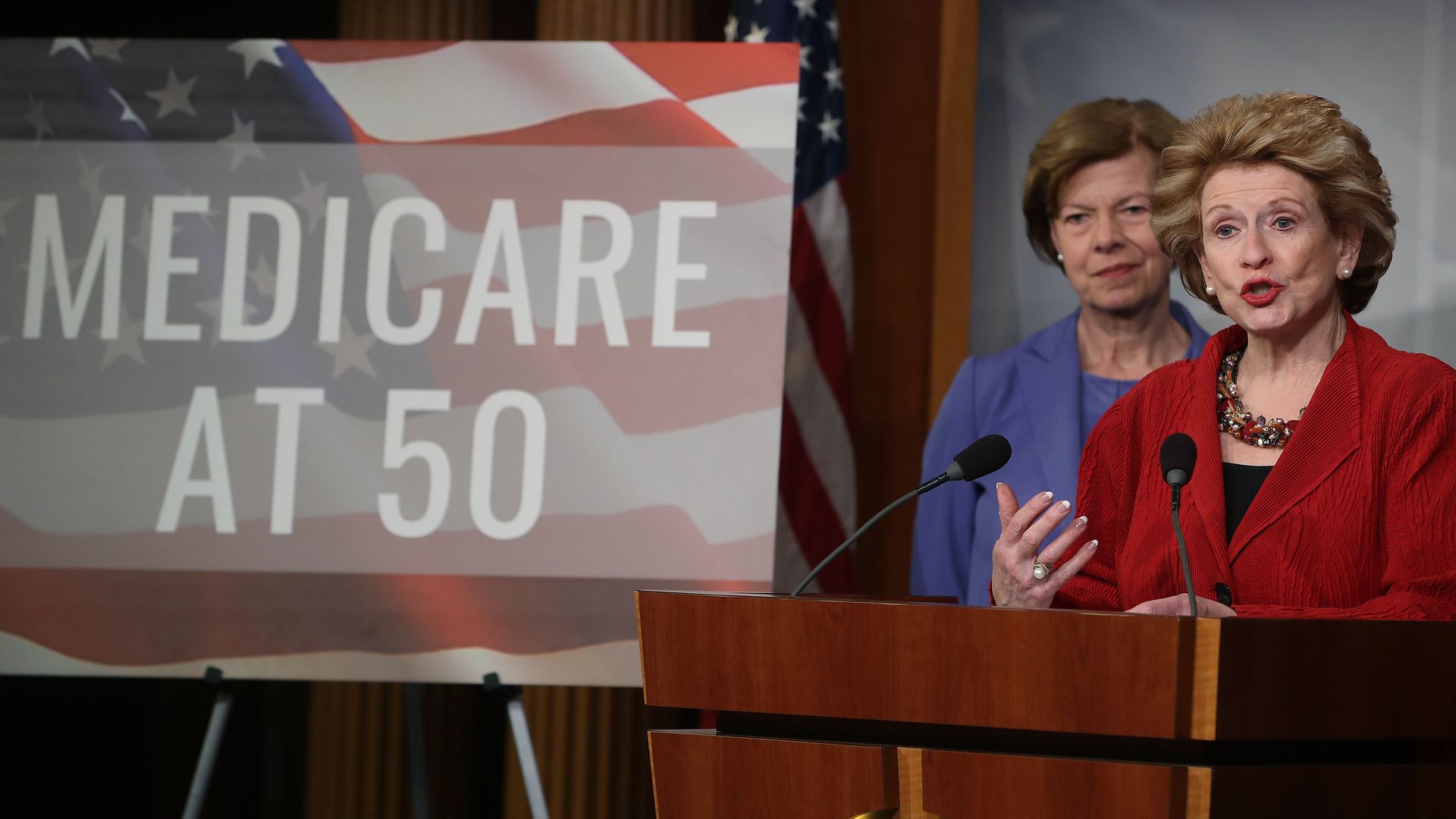
The cracks were especially apparent yesterday, as a separate group of lawmakers gathered to re-introduce their own proposal to allow people to buy in to Medicare starting at age 50. That measure, offered by Sen. Debbie Stabenow (D-Mich.) and Rep. Brian Higgins (D-N.Y.), would take a more incremental approach to expanding health coverage — one that could play better with voters who would stand to lose private coverage under a single-payer program.

Their bill, dubbed the “Medicare at 50 Act,” would allow people to buy Medicare plans instead of purchasing private coverage on the Obamacare marketplaces if they are uninsured or prefer it to coverage offered in their workplace.

And today, Sen. Brian Schatz (D-Hawaii) and Rep. Ben Ray Luján (D-N.M.) are reintroducing their State Public Option Act, which allows people to buy a Medicaid plan regardless of their income. That measure has broad backing from not just lawmakers (20 senators co-sponsored it last year) but also well-known health policy wonks including former Centers for Medicare and Medicaid Services Administrator Andy Slavitt.

Higgins is one of several Democrats on the House Budget Committee who have proposed a total of three separate and contrasting bills to expand Medicare to more people. The others are Reps. Rosa DeLauro (D-Conn.) and Jan Schakowsky (D-Ill.), who have a bill to expand Medicare to all ages while still preserving employer-sponsored coverage, and Jayapal.

Once Jayapal rolls out her legislation, the Congressional Budget Office is expected to release an analysis of how much it would cost by the end of March or the beginning of April, Budget Committee Chairman John Yarmuth (D-Ky.) told me. At that point, the committee will hold a hearing with the CBO to go over the cost and its potential impact on the federal budget.

That’s where Jayapal could run into roadblocks.Given the extensive benefits she’s proposing, her bill would probably come at a steep cost to taxpayers — and paying for things is almost always Congress’s trickiest task. Of course, supporters of the legislation stress its benefits would fill in much-needed gaps in coverage under the current Medicare program.

“The biggest change I give her so much credit for is it has long-term care,” said Rep. Ro Khanna (D-Calif.), who is a co-sponsor of Jayapal’s Medicare-for-all bill. “This is huge.”

And then there’s also the question of how voters might react if told they would lose their current coverage. Sen. Kamala Harris (D-Calif.), who has gone the furthest of all the 2020 candidates in pushing for an overhaul of the U.S. health-care system, attracted widespread attention recently when she suggested she’d be fine with entirely eliminating private coverage in favor of government-run plans.

“We’re very aware that there is anxiety about — however imperfect — a system you know and doctors you know, and that is going to be all part of the hearing process, public input into: How do we build a system in this country that really cares about all Americans?” said Rep. Katherine Clark (D-Mass.), another co-sponsor of the Jayapal bill.


Soaking the Sick to Make the Rich Even Richer

https://www.realclearhealth.com/articles/2019/02/13/pbms_soaking_the_sick_to_make_the_rich_even_richer_110866.html?utm_source=morning-scan&utm_medium=email&utm_campaign=mailchimp-newsletter&utm_source=RC+Health+Morning+Scan&utm_campaign=db14e4ebca-MAILCHIMP_RSS_EMAIL_CAMPAIGN&utm_medium=email&utm_term=0_b4baf6b587-db14e4ebca-84752421

Related image


Congressional Democrats have quickly lined up to oppose the Trump Administration’s proposal to eliminate regulations that make it illegal for drug companies to reduce – or eliminate – what Medicare consumers pay for prescriptions under the Part D program.

Instead, they are pushing plans to give health insurers and the pharmacy benefit management (PBM) companies they run and own even more control over what medicine consumers can choose and how much they cost.  In doing so, Democrats are backing a government-sanctioned drug pricing cartel that extorts nearly a quarter of trillion dollars a year from prescription drug rebates, discounts, and patients (in the form of out-of-pocket costs), and shares a pittance with the patients who need medicines the most. Eighty percent of drug benefits are managed by the 3 largest PBMs, which in turn are owned by or in part by the 3 largest insurance companies.

Current Medicare regulations makes it illegal for any firm other than PBMs to handle drug prices and distribution.  Specifically, PBMs are given free rein to determine what medicines patients can and can’t use.  This power allows them to reduce the list price of drugs by obtaining rebates in exchange for encouraging the use of some treatments while discouraging the use of other medicines.  PBMs either require patients to try drugs that generate the most rebates first or force people to pay part or all of the list price of medicines that don’t generate much money.

As a result, of $140 billion Medicare Part D spent on medicines, $64 billion was pocketed by PBMs and health plans.  And of the $460 billion all Americans spent on drugs in 2018 nearly $166 billion went to discounts and rebates.

Parroting the PBM/insurer talking points, Nancy Pelosi’s health policy advisor, Wendell Primus, said prices – not rebates – are the cause of high drug costs, and savings from rebates negotiated by pharmacy benefit managers go toward reducing insurance premiums.

In fact, PBMs keep Part D premiums artificially low by collecting rebates and other fees at the retail counter. Because Medicare starts paying for 80 percent of drug costs after seniors shell out over $4500 at the pharmacy, plumping up the retail price with rebates means PBMs and insurers reduce premiums by shifting more cost to the government and ultimately by forcing seniors to pay more for medicines.

Moreover, PBMs are using rebates extracted from the medicines the most seriously ill patient uses to subsidize the drug spending and premiums of everyone else. People with cancer, HIV, Parkinson’s, autoimmune diseases are only 2 percent of the population. But in 2017 the drugs they use generated $53 billion, or 32 percent of all rebates and discounts.

These rebates could be used to reduce out-of-pocket costs of even the most expensive drugs to 50 dollars or less.  Instead PBMs and plans actually make seniors pay a large percentage of the retail cost of the rebated drugs  In fact, as rebates have increased, plans have made more consumers of these so-called specialty drugs to pay up to 50 percent of the retail price of medicines instead of a small copay.  Nearly 25 percent of all consumers now pay full price for drugs. As an IQVIA report found: “people who use specialty medicines are 10 times more likely to pay full price for the most expensive medicine. On average, they are 10 times more likely to pay over $2500.”

In 2017, 2 percent of the most vulnerable consumers paid PBMs and health plans $16 billion in out-of-pocket costs.  Soaking the sick to make the rich even richer.  The quickest way to cut the cost of medicines to what they are in Europe is to eliminate the PBM protection racket and give drug companies the freedom to dramatically reduce the out-of-pocket cost for the most expensive medicines.  To be sure, a growing number of drug firms and insurers are working together to eliminate out-of-pocket costs as part of programs to improve health by reducing barriers to access.  Indeed, because PhRMA and BIO have stated that consumers should pay less, the Trump proposal is truly a ‘put up or shut up’ moment for the industry.

Under the current rules, it doesn’t pay for PBMs and insurers to choose a drug with lower out-of-pocket costs, and drug companies have no incentive to tie out-of-pocket costs to better care.  Under current rules, patients are unable to afford the medicines that keep them alive. The Trump proposal would change all that.  It’s up to Democrats to explain why, instead of cutting drug costs dramatically and directly, they want to line the pockets of big corporations with money from the sickest patients.


1 big thing: Everything will be a fight

https://www.axios.com/newsletters/axios-vitals-d6671137-65fb-49a1-a603-d7e53ab977de.html?utm_source=newsletter&utm_medium=email&utm_campaign=newsletter_axiosvitals&stream=top

Manny Pacquiao Fight GIF - Find & Share on GIPHY

Insurers and hospitals came out swinging yesterday against Democrats’ proposal to let people older than 50 buy into Medicare — a reminder that almost any expansion of public health coverage will provoke a battle with the health care industry.

Between the lines: Politically, an age-restricted Medicare buy-in is about as moderate as it gets for Democrats in the age of “Medicare for All.”

  • It is not a proposal for universal coverage, and it’s a far cry from trying to eliminate private insurance. It would be optional, only a relatively small slice of people would have the option, and they would need to pay a monthly premium.

Yes, but: Being on the more moderate end of the political spectrum does not shield you from a fight.

  • Expanding Medicare would hurt hospitals’ bottom lines, because Medicare pays hospitals less than private insurance does.
  • That’s why the Federation of American Hospitals said yesterday that the idea “would harm more Americans than it would help.”
  • The buy-in plan would primarily compete with employer-based health coverage (that’s what people between 50 and 65 are likely to have). And America’s Health Insurance Plans said the idea “is a slippery slope to government-run health care for every American.”

The bottom line: Any proposal that would compete with (never mind eliminate) private coverage, particularly employer coverage, will meet this kind of resistance.

That’s why Medicaid is the public program Democrats and industry can agree to love. Expanded access to Medicaid has rarely been an alternative to commercial insurance — it’s usually an alternative to being uninsured.

  • The uninsured were the primary beneficiaries of the Affordable Care Act’s Medicaid expansion, and the Medicaid buy-in proposals now popping in the states are aimed at the people who are most likely to be foregoing private ACA coverage because of its cost.


‘Outrageous giveaway to Big Pharma’: A political ‘bomb’ over drug prices may threaten NAFTA 2.0

https://www.japantimes.co.jp/news/2019/02/13/business/outrageous-giveaway-big-pharma-political-bomb-drug-prices-may-threaten-nafta-2-0/#.XGR6YlVKi1s

Image result for big pharma

The clash over free trade in North America has long been fought over familiar issues: low-paid Mexican workers. U.S. factories that move jobs south of the border. Canada’s high taxes on imported milk and cheese.

But as Democrats in Congress consider whether to back a revamped regional trade pact being pushed by President Donald Trump, they’re zeroing in on a new point of conflict: drug prices. They contend that the new pact would force Americans to pay more for prescription drugs, and their argument has dimmed the outlook for one of Trump’s signature causes.

The president’s proposed replacement for the 25-year-old North American Free Trade Agreement is meant to win over Democrats by incentivizing factories to hire and expand in the United States. Yet the pact would also give pharmaceutical companies 10 years’ protection from cheaper competition in a category of ultra-expensive drugs called biologics, which are made from living cells.

Shielded from competition, critics warn, the drug companies could charge exorbitant prices for biologics.

“This is an outrageous giveaway to Big Pharma,” Rep. Rosa DeLauro, a Connecticut Democrat, said in an interview. “The government guarantees at least 10 years of market exclusivity for biologic medicine. It’s a monopoly. It’s bad policy.”

The objections of DeLauro and other Democrats suddenly carry greater potency. The need to curb high drug prices has become a rallying cry for voters of all political stripes. Trump himself has joined the outcry. The revamped North America trade deal must be approved by both chambers of Congress, and Democrats have just regained control of the House.

Rep. Earl Blumenauer of Oregon, the new chairman of the House Ways and Means subcommittee on trade, told The Associated Press that “I don’t think candidly that it passes out of my trade subcommittee” with the biologics provision intact.

“The biologics are some of the most expensive drugs on the planet,” Blumenauer said.

Still, the politics of NAFTA 2.0 are tricky for Democrats and not necessarily a sure-fire winner for them.

The original NAFTA, which took effect in 1994, tore down most trade barriers separating the United States, Canada and Mexico. Like Trump, many Democrats blamed NAFTA for encouraging American factories to abandon the United States to capitalize on lower-wage Mexican labor and then to ship goods back into the U.S., duty-free.

Having long vilified NAFTA, Trump demanded a new deal — one far more favorable to the United States and its workers. For more than a year, his top negotiator, Robert Lighthizer, held talks with Canada and Mexico. Lighthizer managed to insert into the new pact provisions designed to appeal to Democrats and their allies in organized labor. For example, 40 percent of cars would eventually have to be made in countries that pay autoworkers at least $16 an hour — that is, in the United States and Canada and not in Mexico — to qualify for duty-free treatment.

The new deal also requires Mexico to encourage independent unions that will bargain for higher wages and better working conditions.

Late last year, the three countries signed their revamped deal, the U.S.-Mexico-Canada Agreement. But it wouldn’t take effect until their three legislatures all approved it. In the meantime, the old NAFTA remains in place.

The question now is: Are Democrats prepared to support a deal that addresses some of their key objections to NAFTA and thereby hand Trump a political victory? Some Democrats have praised the new provisions that address auto wages, though many say they must be strengthened before they’d vote for the USMCA.

Protection for drug companies is another matter. Many Democrats had protested even when the Obama administration negotiated eight years of protection for biologics— from cheap-copycat competitors called “biosimilars” — in a 12-country Pacific Rim trade pact called the Trans-Pacific Partnership, or TPP.

Trump abandoned the TPP in his first week in office. But the pharmaceutical industry is a potent lobby in Washington, and Trump’s negotiators pressed for protection for U.S. biologics in the new North American free trade deal. They ended up granting the drug companies two additional years of protection in the pact.

Top biologics include the anti-inflammatory drug Humira, the cancer fighter Rituxan and Enbrel, which is used to treat rheumatoid arthritis.

The administration and drug companies argue that makers of biologics need time to profit from their creations before biosimilars sweep in, unburdened by the cost of researching and developing the drugs. Otherwise, they contend, the brand-name drug companies would have little incentive to invest in developing new medicines.

They note that a 2015 law authorizing presidents to negotiate trade deals requires American officials to push other countries toward U.S.-level protections for intellectual property such as biologic drugs. (The same law, somewhat contradictorily, directs U.S. negotiators to “promote access to medicines.”)

Supporters also note that existing U.S. law gives makers of biologics 12 years’ protection. So the new pact wouldn’t change the status quo in the United States, though it would force Mexico to expand biologics’ monopoly from five years and Canada from eight years. In fact, supporters of the biologics monopoly argue that the pact might cut prices in the United States because drug companies would no longer face pressure to charge Americans more to compensate for lower prices in Canada and Mexico.

But critics say that expanding biologics’ monopoly in a trade treaty would prevent the United States from ever scaling back the duration to, say, the seven years the Obama administration once proposed.

“By including 10 years in a treaty, we are locking ourselves in to a higher level of monopoly protection for drugs that are already taking in billions of dollars a year,” said Jeffrey Francer, general counsel for the Association for Accessible Medicines, which represents generic drug companies. “The only way for Congress to change it is to back out of the treaty. … Does the United States want to be in violation of its own treaty?”

For Democrats, higher drug prices are shaping up as a powerful political argument against approving the president’s new North American trade deal. In December, Stanley Greenberg, a leading Democratic pollster and strategist, conducted focus groups in Michigan and Wisconsin with Trump voters who weren’t affiliated with the Republican Party. Some had previously voted for Barack Obama. Others called themselves political independents. They’re the kinds of voters Democrats hope to attract in 2020.

Greenberg said he was “shocked” by the intensity of their hostility to drug companies — and to the idea that a trade pact would shield those companies from competition.

“It was like throwing a bomb into the focus group,” said Greenberg, who is married to DeLauro. He said the voters’ consensus view was essentially: “The president was supposed to go and renegotiate (NAFTA) so that it worked for American workers. But it must be that these lobbyists are working behind the scenes” to sneak in special-interest provisions.

That perception gives Democrats reason to reject the new pact as the 2020 election approaches.

“Democrats have no incentive to do this,” said Philip Levy, a senior fellow at the Chicago Council on Global Affairs and a White House economist under President George W. Bush. “Before you know it, the presidential election season is going to be upon us.”

U.S. trade rules are designed to force Congress to give trade agreements an up-or-down vote — no nitpicking allowed. Still, there are ways to bypass those restrictions. Congressional Democrats could, for example, push the administration to negotiate so-called side letters with Canada and Mexico to address their concerns. President Bill Clinton did this with the original NAFTA.

“Lighthizer and his team are very creative,” said Blumenauer, chair of the House trade subcommittee. “This is something that can be handled.”


Health Insurance Coverage Eight Years After the ACA

https://www.commonwealthfund.org/publications/issue-briefs/2019/feb/health-insurance-coverage-eight-years-after-aca

Fewer Uninsured Americans and Shorter Coverage Gaps, But More Underinsured

What does health insurance coverage look like for Americans today, more than eight years after the Affordable Care Act’s passage? In this brief, we present findings from the Commonwealth Fund’s latest Biennial Health Insurance Survey to assess the extent and quality of coverage for U.S. working-age adults. Conducted since 2001, the survey uses three measures to gauge the adequacy of people’s coverage:

  • whether or not they have insurance
  • if they have insurance, whether they have experienced a gap in their coverage in the prior year
  • whether high out-of-pocket health care costs and deductibles are causing them to be underinsured, despite having continuous coverage throughout the year.

As the findings highlighted below show, the greatest deterioration in the quality and comprehensiveness of coverage has occurred among people in employer plans. More than half of Americans under age 65 — about 158 million people — get their health insurance through an employer, while about one-quarter either have a plan purchased through the individual insurance market or are enrolled in Medicaid.1Although the ACA has expanded and improved coverage options for people without access to a job-based health plan, the law largely left the employer market alone.2

Survey Highlights

  • Today, 45 percent of U.S. adults ages 19 to 64 are inadequately insured — nearly the same as in 2010 — though important shifts have taken place.
  • Compared to 2010, many fewer adults are uninsured today, and the duration of coverage gaps people experience has shortened significantly.
  • Despite actions by the Trump administration and Congress to weaken the ACA, the adult uninsured rate was 12.4 percent in 2018 in this survey, statistically unchanged from the last time we fielded the survey in 2016.
  • More people who have coverage are underinsured now than in 2010, with the greatest increase occurring among those in employer plans.
  • People who are underinsured or spend any time uninsured report cost-related problems getting care and difficulty paying medical bills at at higher rates than those with continuous, adequate coverage.
  • Federal and state governments could enact policies to extend the ACA’s health coverage gains and improve the cost protection provided by individual-market and employer plans.

The 2018 Commonwealth Fund Biennial Heath Insurance Survey included a nationally representative sample of 4,225 adults ages 19 to 64. SSRS conducted the telephone survey between June 27 and November 11, 2018.3 (See “How We Conducted This Study” for more detail.)

WHO IS UNDERINSURED?

In this analysis, we use a measure of underinsurance that accounts for an insured adult’s reported out-of-pocket costs over the course of a year, not including insurance premiums, as well as his or her plan deductible. (The measure was first used in the Commonwealth Fund’s 2003 Biennial Health Insurance Survey.*) These actual expenditures and the potential risk of expenditures, as represented by the deductible, are then compared with household income. Specifically, we consider people who are insured all year to be underinsured if:

  • their out-of-pocket costs, excluding premiums, over the prior 12 months are equal to 10 percent or more of household income; or
  • their out-of-pocket costs, excluding premiums, over the prior 12 months are equal to 5 percent or more of household income for individuals living under 200 percent of the federal poverty level ($24,120 for an individual or $49,200 for a family of four); or
  • their deductible constitutes 5 percent or more of household income.

The out-of-pocket cost component of the measure is only triggered if a person uses his or her plan to obtain health care. The deductible component provides an indicator of the financial protection the plan offers and the risk of incurring costs before someone gets health care. The definition does not include other dimensions of someone’s health plan that might leave them potentially exposed to costs, such as copayments or uncovered services. It therefore provides a conservative measure of underinsurance in the United States.

Compared to 2010, when the ACA became law, fewer people today are uninsured, but more people are underinsured. Of the 194 million U.S. adults ages 19 to 64 in 2018, an estimated 87 million, or 45 percent, were inadequately insured (see Tables 1 and 2).

Despite actions by the Trump administration and Congress to weaken the ACA, our survey found no statistically significant change in the adult uninsured rate by late 2018 compared to 2016 (Table 3). This finding is consistent with recent federal surveys, but other private surveys (including other Commonwealth Fund surveys) have found small increases in uninsured rates since 2016 (see “Changes in U.S. Uninsured Rates Since 2013”).

While there has been no change since 2010, statistically speaking, in the proportion of people who are insured now but have experienced a recent time without coverage, these reported gaps are of much shorter duration on average than they were before the ACA. In 2018, 61 percent of people who reported a coverage gap said it has lasted for six months or less, compared to 31 percent who said they had been uninsured for a year or longer. This is nearly a reverse of what it was like in 2012, two years before the ACA’s major coverage expansions. In that year, 57 percent of adults with a coverage gap reported it was for a year or longer, while one-third said it was a shorter gap.

There also has been some improvement in long-term uninsured rates. Among adults who were uninsured at the time of the survey, 54 percent reported they had been without coverage for more than two years, down from 72 percent before the ACA coverage expansions went into effect. The share of those who had been uninsured for six months or less climbed to 20 percent, nearly double the rate prior to the coverage expansions.

Of people who were insured continuously throughout 2018, an estimated 44 million were underinsured because of high out-of-pocket costs and deductibles (Table 1). This is up from an estimated 29 million in 2010 (data not shown). The most likely to be underinsured are people who buy plans on their own through the individual market including the marketplaces. However, the greatest growth in the number of underinsured adults is occurring among those in employer health plans.

WHY ARE INSURED AMERICANS SPENDING SO MUCH OF THEIR INCOME ON HEALTH CARE COSTS?

Several factors may be contributing to high underinsured rates among adults in individual market plans and rising rates in employer plans:

  1. Although the Affordable Care Act’s reforms to the individual market have provided consumers with greater protection against health care costs, many moderate-income Americans have not seen gains. The ACA’s essential health benefits package, cost-sharing reductions for lower- income families, and out-of-pocket cost limits have helped make health care more affordable for millions of Americans. But while the cost-sharing reductions have been particularly important in lowering deductibles and copayments for people with incomes under 250 percent of the poverty level (about $62,000 for a family of four), about half of people who purchase marketplace plans, and all of those buying plans directly from insurance companies, do not have them.4
  2. The bans against insurers excluding people from coverage because of a preexisting condition and rating based on health status have meant that individuals with greater health needs, and thus higher costs, are now able to get health insurance in the individual market. Not surprisingly, the survey data show that people with individual market coverage are somewhat more likely to have health problems than they were in 2010, which means they also have higher costs.
  3. While plans in the employer market historically have provided greater cost protection than plans in the individual market, businesses have tried to hold down premium growth by asking workers to shoulder an increasing share of health costs, particularly in the form of higher deductibles.5 While the ACA’s employer mandate imposed a minimum coverage requirement on large companies, the requirement amounts to just 60 percent of typical person’s overall costs. This leaves the potential for high plan deductibles and copayments.
  4. Growth in Americans’ incomes has not kept pace with growth in health care costs. Even when health costs rise more slowly, they can take an increasingly larger bite out of incomes.

It is well documented that people who gained coverage under the ACA’s expansions have better access to health care as a result.6 This has led to overall improvement in health care access, as indicated by multiple surveys.7 In 2014, the year the ACA’s major coverage expansions went into effect, the share of adults in our survey who said that cost prevented them from getting health care that they needed, such as prescription medication, dropped significantly (Table 4). But there has been no significant improvement since then.

The lack of continued improvement in overall access to care nationally reflects the fact that coverage gains have plateaued, and underinsured rates have climbed. People who experience any time uninsured are more likely than any other group to delay getting care because of cost (Table 5). And among people with coverage all year, those who were underinsured reported cost-related delays in getting care at nearly double the rate of those who were not underinsured.

There was modest but significant improvement following the ACA’s coverage expansions in the proportion of all U.S. adults who reported having difficulty paying their medical bills or said they were paying off medical debt over time (Table 4). Federal surveys have found similar improvements.8 However, those gains have stalled.

Inadequate insurance coverage leaves people exposed to high health care costs, and these expenses can quickly turn into medical debt. More than half of uninsured adults and insured adults who have had a coverage gap reported that they had had problems paying medical bills or were paying off medical debt over time (Table 6). Among people who had continuous insurance coverage, the rate of medical bill and debt problems is nearly twice as high for the underinsured as it is for people who are not underinsured.

Having continuous coverage makes a significant difference in whether people have a regular source of care, get timely preventive care, or receive recommended cancer screenings. Adults with coverage gaps or those who were uninsured when they responded to the survey were the least likely to have gotten preventive care and cancer screenings in the recommended time frame.

Being underinsured, however, does not seem to reduce the likelihood of having a usual source of care or receiving timely preventive care or cancer screens — provided a person has continuous coverage. This is likely because the ACA requires insurers and employers to cover recommended preventive care and cancer screens without cost-sharing. Even prior to the ACA, a majority of employer plans provided predeductible coverage of preventive services.9

Conclusion and Policy Implications

U.S. working-age adults are significantly more likely to have health insurance since the ACA became law in 2010. But the improvement in uninsured rates has stalled. In addition, more people have health plans that fail to adequately protect them from health care costs, with the fastest deterioration in cost protection occurring in the employer market. The ACA made only minor changes to employer plans, and the erosion in cost protection has taken a bite out of the progress made in Americans’ health coverage since the law’s enactment.

Both the federal government and the states, however, have the ability to extend the law’s coverage gains and improve the cost protection of both individual-market and employer plans. Here is a short list of policy options:

  • Expand Medicaid without restrictions. The 2018 midterm elections moved as many as five states closer to joining the 32 states that, along with the District of Columbia, have expanded eligibility for Medicaid under the ACA.10 As many as 300,000 people may ultimately gain coverage as a result.11 But, encouraged by the Trump administration, several states are imposing work requirements on people eligible for Medicaid — a move that could reverse these coverage gains. So far, the U.S. Department of Health and Human Services (HHS) has approved similar work-requirement waivers in seven states and is considering applications from at least seven more. Arkansas imposed a work requirement last June, and, to date, more than 18,000 adults have lost their insurance coverage as a result.
  • Ban or place limits on short-term health plans and other insurance that doesn’t comply with the ACA. The Trump administration loosened regulations on short-term plans that don’t comply with the ACA, potentially leaving people who enroll in them exposed to high costs and insurance fraud. These plans also will draw healthier people out of the marketplaces, increasing premiums for those who remain and federal costs of premium subsidies. Twenty-three states have banned or placed limits on short-term insurance policies. Some lawmakers have proposed a federal ban.
  • Reinsurance, either state or federal. The ACA’s reinsurance program was effective in lowering marketplace premiums. After it expired in 2017, several states implemented their own reinsurance programs.12  Alaska’s program reduced premiums by 20 percent in 2018. These lower costs particularly help people whose incomes are too high to qualify for ACA premium tax credits. More states are seeking federal approval to run programs in their states. Several congressional bills have proposed a federal reinsurance program.
  • Reinstate outreach and navigator funding for the 2020 open-enrollment period. The administration has nearly eliminated funding for advertising and assistance to help people enroll in marketplace plans.13 Research has found that both activities are effective in increasing enrollment.14 Some lawmakers have proposed reinstatingthis funding.
  • Lift the 400-percent-of-poverty cap on eligibility for marketplace tax credits. This action would help people with income exceeding $100,000 (for a family of four) better afford marketplace plans. The tax credits work by capping the amount people pay toward their premiums at 9.86 percent. Lifting the cap has a built in phase out: as income rises, fewer people qualify, since premiums consume an increasingly smaller share of incomes. RAND researchers estimate that this policy change would increase enrollment by 2 million and lower marketplace premiums by as much as 4 percent as healthier people enroll. It would cost the federal government an estimated $10 billion annually.15 Legislation has been introduced to lift the cap.
  • Make premium contributions for individual market plans fully tax deductible. People who are self-employed are already allowed to do this.16
  • Fix the so-called family coverage glitch. People with employer premium expenses that exceed 9.86 percent of their income are eligible for marketplace subsidies, which trigger a federal tax penalty for their employers. There’s a catch: this provision applies only to single-person policies, leaving many middle-income families caught in the “family coverage glitch.” Congress could lower many families’ premiums by pegging unaffordable coverage in employer plans to family policies instead of single policies.17

REDUCE COVERAGE GAPS

  • Inform the public about their options. People who lose coverage during the year are eligible for special enrollment periods for ACA marketplace coverage. Those eligible for Medicaid can sign up at any time. But research indicates that many people who lose employer coverage do not use these options.18 The federal government, the states, and employers could increase awareness of insurance options outside the open-enrollment periods through advertising and education.
  • Reduce churn in Medicaid. Research shows that over a two-year period, one-quarter of Medicaid beneficiaries leave the program and become uninsured.19 Many do so because of administrative barriers.20 By imposing work requirements, as some states are doing, this involuntary disenrollment is likely to get worse. To help people stay continuously covered, the federal government and the states could consider simplifying and streamlining the enrollment and reenrollment processes.
  • Extend the marketplace open-enrollment period. The current open-enrollment period lasts just 45 days. Six states that run their own marketplaces have longer periods, some by as much as an additional 45 days. Other states, as well as the federal marketplace, could extend their enrollment periods as well.

IMPROVE INDIVIDUAL-MARKET PLANS’ COST PROTECTIONS

  • Fund and extend the cost-sharing reduction subsidies. The Trump administration eliminated payments to insurers for offering plans with lower deductibles and copayments. Insurers, which by law must still offer reduced-cost plans, are making up the lost revenue by raising premiums. But this fix, while benefiting enrollees who are eligible for premium tax credits, has distorted both insurer pricing and consumer choice.21 In addition, it is unknown whether the administration’s support for the fix will continue in the future, creating uncertainty for insurers.22 Congress could reinstate the payments to insurers and consider making the plans available to people with higher earnings.
  • Increase the number of services excluded from the deductible.Most plans sold in the individual market exclude certain services from the deductible, such as primary care visits and certain prescriptions.23As the survey data suggest, these types of exclusions appear to be important in ensuring access to preventive care among people who have coverage but are underinsured. In 2016, HHS provided a standardized plan option for insurers that excluded eight health services — including mental health and substance-use disorder outpatient visits and most prescription drugs — from the deductible at the silver and gold level.24 The Trump administration eliminated the option in 2018. Congress could make these exceptions mandatory for all plans.

IMPROVE EMPLOYER PLANS’ COST PROTECTIONS

  • Increase the ACA’s minimum level of coverage. Under the ACA, people in employer plans may become eligible for marketplace tax credits if the actuarial value of their plan is less than 60 percent, meaning that under 60 percent of health care costs, on average, are covered. Congress could increase this to the 70 percent standard of silver-level marketplace plans, or even higher.
  • Require deductible exclusions. Congress could require employers to increase the number of services that are covered before someone meets their deductible. Most employer plans exclude at least some services from their deductibles.25 Congress could specify a minimum set of exclusions for employer plans that might resemble the standardized-choice options that once existed for ACA plans.
  • Refundable tax credits for high out-of-pocket costs. Congress could make refundable tax credits available to help insured Americans pay for qualifying out-of-pocket costs that exceed a certain percentage of their income.26
  • Protect consumers from surprise medical bills. Several states have passed laws that protect patients and their families from unexpected medical bills, generally from out-of-network providers.27A bipartisan group of U.S. senators has proposed federal legislation to protect consumers, including people enrolled in employer and individual-market plans.

Health care costs are primarily what’s driving growth in premiums across all health insurance markets. Employers and insurers have kept premiums down by increasing consumers’ deductibles and other cost-sharing, which in turn is making more people underinsured. This means that policy options like the ones we’ve highlighted above will need to be paired with efforts to slow medical spending. These could include changing how health care is organized and providers are paid to achieve greater value for health care dollars and better health outcomes.28 The government also could tackle rising prescription drug costs29 and use antitrust laws to combat the growing concentration of insurer and provider markets.30