A Deep Dive Into 4 GOP Talking Points On Health Care

http://khn.org/news/a-deep-dive-into-4-gop-talking-points-on-health-care/

Image result for Talking Points

Republican leaders have a lengthy list of talking points about the shortcomings of the health law. Shortly before his inauguration last month, President Donald Trump said that it “is a complete and total disaster. It’s imploding as we sit.” And they can point to a host of issues, including premium increases averaging more than 20 percent this year, a drop in the number of insurers competing on the Affordable Care Act marketplaces and rising consumer discontent with high deductibles and limited doctor networks.

Yet a careful analysis of some of the GOP’s talking points show a much more nuanced situation and suggest that the political fights over the law may have contributed to some of its problems. Here is an annotated guide to four of the most common talking points Republicans have been using. 


What will become of MACRA, Obamacare, health IT? HIMSS boss weighs in (podcast)

What will become of MACRA, Obamacare, health IT? HIMSS boss weighs in (podcast)

HIMSS Chicago 2015

The annual Healthcare Information and Management Systems Society (HIMSS) conference gets under way Monday in Orlando, Florida, with numerous preconference activities starting Sunday.

As more than 40,000 people descend on Central Florida for the grueling event, MedCity News talked to HIMSS CEO and President H. Stephen Lieber for what has become an annual ritual, at least for this reporter. As usual, it’s on tape.

HIMSS17 is the last HIMSS conference with Lieber in charge; he announced in December that he would retire at the end of 2017.

Lieber is preparing to depart at a time when health IT is at a crossroads.

Healthcare organizations in the U.S. have spent the better part of the last 10 years installing and now optimizing electronic health records, though they continue to lag when it comes to sharing data across systems. And they continue to gripe about EHR usability and Meaningful Use requirements.

Providers in recent years also have grappled with updates to HIPAA regulations and the conversion to ICD-10 coding. Now, they face some new regulations affecting health IT.

Notably, the 2016 Medicare Access and CHIP Reauthorization Act (MACRA) is coming into force for ambulatory care. The rise of accountable care is “certainly having an impact already in terms of how care is not only delivered,” as well as how payers calculate reimbursements, Lieber noted.

They also face the uncertainty that comes with a change in administration in Washington.

Still, some things do remain relatively constant in health IT.

“The ongoing challenge in dealing with security, there is going to be an even greater focus this year as we try to bring more attention, more focus on what it takes to make sure that we’re handling data in a secure way,” Lieber said.

Clinical analytics has become a normal course of business in the field as well, though it has changed from merely clinical decision support and retrospective analytics to predictive analytics and machine learning. “As the field evolves, we’re evolving the programming with it.” Lieber noted.

Policy seems to be where a lot of intrigue is right now. It’s easy to make assumptions about what the new Trump administration might do, but assumptions are just that.

GOP Medicaid Block Grants Cut Costs … and Care

http://www.realclearhealth.com/articles/2017/02/20/gop_medicaid_block_grants_cut_costs__and_care_110453.html?utm_source=RealClearHealth+Morning+Scan&utm_campaign=43886a5bc1-EMAIL_CAMPAIGN_2017_02_20&utm_medium=email&utm_term=0_b4baf6b587-43886a5bc1-84752421

Image result for GOP Medicaid Block Grants Cut Costs … and Care

Most people have heard the aphorism, “if it sounds too good to be true, it probably is.” Referring to the GOP’s cure for Medicaid, “If it sounds too good to be true, it might be true; but guaranteed, it won’t be good.”

A Feb. 6, 2017 report on Medicaid makes this point perfectly. The GOP commissioned a study by Avalere Health, a health care consulting group, to assess the fiscal impact of federal block grants to state Medicaid programs. They evaluated two funding approaches: a lump sum to be negotiated and a per capita, i.e., per enrollee, formula.

Their study showed that block grants could save Washington between $110 billion and $150 billion over five years depending on which formula was used. Roughly half the states would get a small increase in their federal contribution and half would get less, sometimes a lot less. The biggest loser, Arizona Medicaid, would receive 62 percent less than it is currently receiving from Washington.

With the present Medicaid state-federal matching scheme, the more a state spends, the more money it gets from Washington. This produces a classic perverse incentive: rewarding the outcome you don’t want. We want states to reduce spending, yet Washington rewards them—with federal dollars—when they spend more! With a block grant, this perverse incentive goes away. This is a good thing.

Medicaid block grants could save $110-150 billion and would eliminate the perverse incentive. Sounds like a great idea. It makes wonderful sound bytes, and the GOP seems to want to run with it.

There is just one teeny, tiny problem with block grants as proposed: no health care.

Where Are All the New Diabetes Drugs?

http://www.realclearhealth.com/2017/02/20/where_are_all_the_new_diabetes_drugs_275278.html?utm_source=RealClearHealth+Morning+Scan&utm_campaign=43886a5bc1-EMAIL_CAMPAIGN_2017_02_20&utm_medium=email&utm_term=0_b4baf6b587-43886a5bc1-84752421

Image result for Where Are All the New Diabetes Drugs?

As oncologists race forward with new treatments verging on science fiction and biotech companies press on with drugs for once-hopeless rare disorders, one of the world’s most pervasive diseases looks like it’s been left behind.

There are few new drugs on the horizon for diabetes, which affects about 29 million Americans. Most of the treatments in late-stage development are simply improved versions of what’s out there — taken weekly versus daily, or orally instead of by injection.

So has pharma run out of ideas in diabetes?

http://thehill.com/policy/healthcare/320286-kasich-house-gop-medicaid-plan-very-bad-idea

Kasich: House GOP Medicaid plan ‘very bad idea’

Kasich: House GOP Medicaid plan 'very bad idea'

Republican Ohio Gov. John Kasich on Sunday criticized the House Republicans’ plan to phase out ObamaCare’s expansion of Medicaid.

“I’m in Munich, but I understand that there was an initial effort by House Republicans to, for example, phase out Medicaid expansion, which means phasing out coverage,” Kasich said on CNN’s “State of the Union.” “That is a very, very bad idea, because we cannot turn our back on the most vulnerable. We can give them the coverage, reform the program, save some money and make sure that we live in a country where people are going to say, ‘At least somebody is looking out for me.’”

An outline of an ObamaCare replacement plan put forward by House Republicans on Thursday called for phasing out the Medicaid expansion by lowering the federal share of the cost back down to its traditional level, meaning that states would have to pour more of their own money into the program if they wanted to keep the expansion, a tall order.


Medicaid’s Role for Medicare Beneficiaries

Medicaid’s Role for Medicare Beneficiaries

Figure 2: Health and functioning of Medicare beneficiaries who receive Medicaid compared to other Medicare beneficiaries

Key Takeaways
 This brief describes the role that Medicaid plays for 10 million Medicare beneficiaries to help inform upcoming debates about proposals to restructure Medicaid financing in ways that could reduce federal funding.What is Medicaid’s Role for Medicare Beneficiaries?

  • Medicaid covers needed services that Medicare does not, such as long-term care in nursing homes and the community.  Medicaid also helps make Medicare affordable by covering Medicare premiums and/or cost-sharing, which can be high for people with low incomes.

Who are the Medicare Beneficiaries Who Receive Medicaid?

  • Nearly three in four Medicare beneficiaries who receive Medicaid have three or more chronic conditions, such as diabetes or heart disease, which can require regular doctor appointments, medication, and/or medical tests.
  • Over 60% of Medicare beneficiaries who receive Medicaid need help with daily self-care activities, such as eating, bathing, or dressing, which are important for independent living.
  • Nearly six in 10 Medicare beneficiaries who receive Medicaid have a cognitive or mental impairment, such as dementia, which can create the need for supports to live safely at home.

How Much Does Medicaid Spend on Medicare Beneficiaries? 

  • Medicare beneficiaries account for 14% of Medicaid enrollment but 36% of Medicaid spending, as a result of their more intensive health needs and service use compared to other Medicaid beneficiaries.
  • Nearly three-quarters of states devote more than 30% of their total Medicaid spending to Medicare beneficiaries, and spending for Medicare beneficiaries comprises more than 45% of Medicaid budgets in six states.

Looking Ahead

Because Medicaid spending for Medicare beneficiaries is disproportionate to their enrollment, policy changes that lead states to limit per enrollee Medicaid spending or cut costly services could especially affect these beneficiaries.  Medicare beneficiaries who receive Medicaid are poorer than other Medicare beneficiaries, and many have intensive medical and long-term care needs as a result of old age, disability, and chronic illness.  Medicare beneficiaries rely on Medicaid to cover expensive but necessary services, especially long-term care in the community and nursing homes, that are generally not available through Medicare or private insurance.  They also depend on Medicaid to make Medicare affordable because Medicare’s out-of-pocket costs can be high for those with low incomes.  In addition, because the share of state Medicaid budgets devoted to Medicare beneficiaries varies by state, any changes that limit federal Medicaid financing will impact individual states differently. Because changes to Medicaid’s financing structure could have significant consequences for enrollees and states, the potential implications warrant careful consideration for their impact on Medicare beneficiaries.

Pre-ACA Market Practices Provide Lessons for ACA Replacement Approaches

Pre-ACA Market Practices Provide Lessons for ACA Replacement Approaches

Image result for Pre-ACA Market Practices Provide Lessons for ACA Replacement Approaches

Significant changes to the Affordable Care Act (ACA) are being considered by lawmakers who have been critical of its general approach to providing coverage and to some of its key provisions. An important area where changes will be considered has to do with how people with health problems would be able to gain and keep access to coverage and how much they may have to pay for it.  People’s health is dynamic. At any given time, an estimated 27% of non-elderly adults have health conditions that would make them ineligible for coverage under traditional non-group underwriting standards that existed prior to the ACA. Over their lifetimes, everyone is at risk of having these periods, some short and some that last for the rest of their lives.

One of the biggest changes that the ACA made to the non-group insurance market was to eliminate consideration by insurers of a person’s health or health history in enrollment and rating decisions.  This assured that people who had or who developed health problems would have the same plan choices and pay the same premiums as others, essentially pooling their expected costs together to determine the premiums that all would pay.

Proposals for replacing the ACA such as Rep. Tom Price’s Empowering Patients First Act and Speaker Paul Ryan’s “A Better Way” policy paper would repeal these insurance market rules, moving back towards pre-ACA standards where insurers generally had more leeway to use individual health in enrollment and rating for non-group coverage.1  Under these proposals, people without pre-existing conditions would generally be able to purchase coverage anytime from private insurers.  For people with health problems, several approaches have been proposed: (1) requiring insurers to accept people transitioning from previous coverage without a gap (“continuously covered”); (2) allowing insurers to charge higher premiums (within limits) to people with pre-existing conditions who have had a gap in coverage; and (3) establishing high-risk pools, which are public programs that provide coverage to people declined by private insurers.

The idea of assuring access to coverage for people with health problems is a popular one, but doing so is a challenge within a market framework where insurers have considerable flexibility over enrollment, rating and benefits.  People with health conditions have much higher expected health costs than people without them (Table 1 illustrates average costs of individuals with and without “deniable” health conditions). Insurers naturally will decline applicants with health issues and will adjust rates for new and existing enrollees to reflect their health when they can.  Assuring access for people with pre-existing conditions with limits on their premiums means that someone has to pay the difference between their premiums and their costs.  For people enrolling in high-risk pools, some ACA replacement proposals provide for federal grants to states, though the amounts may not be sufficient.  For people gaining access through continuous coverage provisions, these costs would likely be paid by pooling their costs with (i.e., charging more to) other enrollees.  Maintaining this pooling is difficult, however, when insurers have significant flexibility over rates and benefits.  Experience from the pre-ACA market shows how insurers were able to use a variety of strategies to charge higher premiums to people with health problems, even when those problems began after the person enrolled in their plan.  These practices can make getting or keeping coverage unaffordable.

Discussion

There were many aspects of the pre-ACA non-group market that made it difficult for people with health problems to get and keep non-group coverage.  Any proposal for replacing the ACA will have to determine which, if any, of these previous insurance practices will once again be permitted.  Medical screening was the most obvious barrier, combined with high premium costs for people who were HIPAA-eligible.  Even people who purchased coverage when they were healthy sometimes were unable to keep it because certain rating approaches could cause their premiums to spiral.  Returning to a less structured, less regulated non-group market raises questions about how people with health problems will be treated in terms of access to and cost of coverage.  Health insurance underwriting and rating is complex, and reviewing how the pre-ACA market operated provides information about the types of issues that people with health problems may confront if the ACA market structure is replaced.


Understanding the Intersection of Medicaid and Work

http://kff.org/medicaid/issue-brief/understanding-the-intersection-of-medicaid-and-work/

Figure 3: Industries with largest number of workers covered by Medicaid, 2015

Issue Brief

Medicaid is the nation’s public health insurance program for people with low incomes. Overall, the Medicaid program covers more than 70 million Americans, or 1 in 5, including many with complex and costly needs for care. Historically, nonelderly, non-disabled adults accounted for a small share (27%) of Medicaid enrollees; however, the enactment and implementation of the Affordable Care Act (ACA) has expanded coverage to nonelderly adults with income up to 138% FPL, or $16,394 for an individual in 2016. As of January 2017, 32 states have implemented the ACA Medicaid expansion. By design, the expansion extended coverage to the working poor (both parents and childless adults), most of whom do not otherwise have access to affordable coverage. With the expansion to more “able-bodied” adults, questions have arisen about tying work to eligibility.

President Trump may consider waiver proposals with a work requirement, and the Administration and leaders in Congress are considering proposals to repeal the ACA and to transform Medicaid from an entitlement program with guaranteed federal matching dollars for states to a block grant with no entitlement and capped funding. Such proposals would grant states additional flexibility to design and administer their programs and potentially include an option to allow states to impose a work requirement for Medicaid beneficiaries, which is not allowed under current law.  This issue brief examines the work status of non-elderly, non-disabled adults with Medicaid coverage to understand the potential implications of work requirement proposals in Medicaid.

Key Takeaways
This brief provides an overview of work status of non-disabled, adult Medicaid enrollees and examines some of the policy proposals around tying Medicaid coverage to work.

  • Among non-disabled, non-elderly Medicaid adults (including parents and childless adults — the group targeted by the Medicaid expansion) nearly 8 in 10 live in working families, and a majority are working themselves. However, nearly half of working Medicaid enrollees are employed by small firms, and many work in industries with low ESI offer rates.
  • Among the non-disabled, non-elderly adult Medicaid enrollees who were not working, most report major impediments to their ability to work.
  • Under current law, states cannot impose a work requirement as a condition of Medicaid eligibility, but some states have sought to impose a work requirement for the Medicaid expansion population through waivers; the prior administration did not approve these requests.  The issue of work requirements may be re-examined by the new administration and may be debated in Congress as part of broader efforts to restructure Medicaid financing and core federal requirements.


Compare Key Elements of ACA Repeal and Replace Proposals with New Interactive Tool

Compare Key Elements of ACA Repeal and Replace Proposals with New Interactive Tool

sbs-image-2.jpg

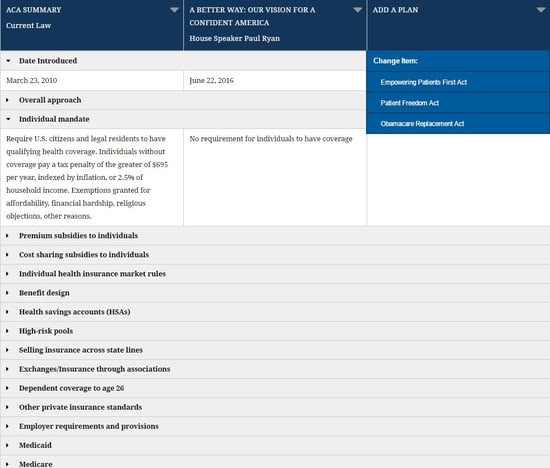
President Trump and Republicans in Congress have committed to repealing and replacing the Affordable Care Act. A new interactive tool from the Kaiser Family Foundation enables users to create side-by-side comparisons of major ACA alternative plans, now including 2017 proposals from Sen. Rand Paul and from Sen. Bill Cassidy.

With the tool, users can compare the plans’ approaches to more than a dozen key areas of health policy, including individual insurance market rules, requirements and provisions for employers, benefit design, Medicaid, and Medicare.

Detailed summaries of the Affordable Care Act and the following proposals are included:

  • Sen. Rand Paul’s Obamacare Replacement Act, 2017
  • Sen. Bill Cassidy’s Patient Freedom Act, 2017
  • House Speaker Paul Ryan’s A Better Way: Our Vision for a More Confident America, 2016
  • Empowering Patients First Act, 2015, introduced by Rep. Tom Price before he became secretary of Health and Human Services

Summaries of major new plans and updates to existing proposals will be added as they’re introduced.

Compare Proposals to Replace The Affordable Care Act