White House pitch to bolster Obamacare includes tough trade-offs for Democrats

https://www.politico.com/story/2018/03/06/obamacare-democrats-white-house-insurance-stable-388816
The White House is pictured. | Getty

The White House is seeking a package of conservative policy concessions — some of which are certain to antagonize Democrats — in return for backing a legislative package bolstering Obamacare markets, according to a document obtained by POLITICO.

The document indicates the administration will support congressional efforts to prop up the wobbly marketplaces, in exchange for significantly expanding short-term health plans and loosening other insurance regulations.

The document also makes severalreferences to abortion language that will be problematic for Democrats. A potential stumbling block in passing any stabilization package is whether conservatives will insist on including language prohibiting the use of government dollars to pay for abortions.

“Although congressional efforts to provide taxpayer money to prop up the exchanges is understandable, any such efforts must also provide relief to middle-class families harmed by the law and protect life,” the document states.

The source of the document provided to POLITICO isn’t identified and it isn’t dated. The White House declined to comment on the document but didn’t question its authenticity. A spokesperson for HHS said the department does not comment on leaked documents.

Two health policy experts who have been in contact with White House officials indicated that the document is consistent with ideas the administration has discussed for creating more stability and flexibility in the insurance markets.

“It’s legit,” said one former White House policy official.

Republican and Democratic lawmakers have been in delicate negotiations over a stabilization package that could clear the House and Senate. Democrats want to bolster the federal health care law after Republicans failed in their efforts to repeal it last year.

The list of White House policy requests includes allowing insurers to charge older enrollees up to five times as much as their younger counterparts, as opposed to the current three-to-one cap. That policy would require amending the Affordable Care Act.

The White House is also seeking to allow short-term plans — which offer skimpier benefits with lower premiums — to be renewed. Short-term plans, exempt from Obamacare rules, can deny people coverage or charge them more based on a health condition, in a process known as underwriting. The Trump administration recently proposed expanding the maximum length of these plans from three months to one year. However, the White House document envisions allowing people to renew this coverage “without those individuals going through health underwriting.”

The document doesn’t include support for reinsurance, which insurers have been pushing to shield them from the costs of particularly expensive customers.

The document also reiterates that the administration supports funding for cost-sharing reduction payments, which Trump cut off in October. The president’s budget proposal including funding for the payments, which help insurers reduce out-of-pocket costs for low-income Obamacare customers.

There is at least one item on the White House list that could garner bipartisan support: Expanding the use of health savings accounts. Last week, a bipartisan group of House members introduced a package of potential changes, and business groups have been pushing for HSA proposals to be part of the appropriations package Congress must pass by March 23.

Republicans fear another year of eye-popping premium increases will hit voters just before Election Day — and that they’ll get the blame this time since they’re now in charge.

But the White House asks could further unsettle those talks. In particular, the emphasis on abortion language tripped up earlier negotiations.

Democrats have been seeking a very different list of policies to boost the markets. They want to increase the subsidies provided to Obamacare customers, reinstate funding for outreach and marketing, and prevent the executive branch from expanding the availability of what they deride as “junk” insurance plans.

“People nationwide are looking at higher premiums and out-of-pocket costs as a direct result of the damage President Trump has done on health care,” said Sen. Patty Murray (D-Wash.), who has been in the middle of negotiations over a stabilization package, in a statement to POLITICO. “I certainly hope the president and Republican leaders won’t once again sabotage an opportunity to undo some of the damage they’ve done by choosing to play politics with women’s health and making last-minute, harmful demands that would raise families’ costs even more and place an age tax on seniors.”


UPDATE: CMS seeks expansion of short-term plans to sidestep ACA

https://www.healthcaredive.com/news/cms-seeks-expansion-of-aca-skirting-short-term-plans/517399/

Image result for Out of Pocket expenses

Dive Brief:

  • HHS issued a proposed rule on Tuesday that expands the availability of short-term health insurance by allowing the purchase of plans providing coverage for up to 12 months, the latest in the Trump administration’s plans to weaken the Affordable Care Act. The action builds off a request for information by HHS last June on ways to increase affordability of health insurance.
  • The current maximum period for such plans is less than three months, a change made by the Obama administration in 2016. The proposed rule would mark a return to the pre-2016 era, but CMS noted that it is seeking comment on offering short-term plans for periods longer than 12 months.
  • Short-term plans are not required to comply with federal rules for individual health insurance under the ACA, so the plans could charge more for those with preexisting conditions and not provide what the ACA deemed essential health benefits like maternity care.

Dive Insight:

The proposed rule builds off of an executive order President Donald Trump signed in October, which instructed the federal government to explore more access to association health plans, expanding short-term limited duration plans and changes to health reimbursement arrangements or HRAs.

Consumers buying these short-terms plans could lose access to certain healthcare services and providers and experience an increase in out-of-pocket expenditures for some patients, according to the proposal.

The short-term plans “would be unlikely to include all the elements of ACA-compliant plans, such as the preexisting condition exclusion prohibition, coverage of essential health benefits without annual or lifetime dollar limits, preventive care, maternity and prescription drug coverage, rating restrictions and guaranteed renewability,” according to the proposed rule.

The Trump administration argues that expanding access to short-term plans is increasingly important due to rising premiums in the individual markets.

But if young and healthy people leave the individual market for short-term plans, it could contribute to an unbalanced risk pool. HHS itself states that the exodus of young and healthy exchange members could contribute to rising premiums within the ACA exchange markets.

“If individual market single risk pools change as a result, it would result in an increase in premiums for the individuals remaining in those risk pools,” the proposed rule stated.

But when asked about concerns that the idea might hurt the stability of the ACA marketplaces by siphoning healthy people away, CMS Administrator Seema Verma argued there would be little impact.

“No, we don’t think there’s any validity to that — based on our projections only a very small number of healthy people will shift from the individual market to these short-term limited duration plans. Specifically, we estimate that only 100,000 to 200,000 people will shift. And this shift will have will have virtually no impact on the individual market premiums,” Verma said on a press call.

But the insurance lobby cautioned that the action could increase insurance prices for the most vulnerable.

The American Hospital Association and Association for Community Affiliated Plans also slammed the short-term plans, saying they would increase the cost of comprehensive coverage.

“Short-term, limited-duration health plans have a role for consumers who experience gaps in coverage. They are not unlike the small spare tire in a car: they get the job done for short periods of time, but they have severe limitations and you’ll get in trouble if you drive too fast on them,” ACAP CEO Margaret Murray said in a statement.

“While we are reviewing the proposed rule to understand its impact on the people we serve, we remain concerned that expanded use of short-term policies could further fragment the individual market, which would lead to higher premiums for many consumers, particularly those with pre-existing conditions,” said Kristine Grow, SVP of communications at America’s Health Insurance Plans.

HHS anticipates most individuals switching from individual market plans to short-term coverage plans would be relatively young or healthy and not eligible to receive ACA’s premium tax credits.

CMS said the proposal is one to help the 28 million Americans without health insurance, pointing to the 6.7 million who chose to pay the individual mandate penalty in 2015 as evidence that ACA-compliant plans are too expensive.

“In a market that is experiencing double-digit rate increases, allowing short-term, limited-duration insurance to cover longer periods gives Americans options and could be the difference between someone getting coverage or going without coverage at all,” Verma said in a statement.

Senate HELP Committee Chair Lamar Alexander, R-Tenn., praised the action, but cautioned that states still have a responsibility to protect consumers.

“Millions of Americans who are between jobs and who pay for their own insurance will welcome this extended option for lower-cost, short-term policies. States will have the responsibility for making sure these policies benefit consumers,” Alexander said in a statement.

Democrats largely oppose the move, arguing it will further destabilize the market for millions of Americans in the ACA exchanges. “Widespread marketing of these bare bones, junk plans will further destabilize health insurance markets, and will lead to higher premiums for everyone,” a group of House Democrats said in a joint statement.

As Republicans are not likely to take up ACA repeal again any time soon, the Trump administration has been working to pare back the law in the past several months. It halved the enrollment period and stopped paying cost-sharing reduction payments to insurers. Also, the recent tax overhaul included a repeal of the law’s requirement that most people have coverage.

California confronts the complexities of creating a single-payer healthcare system

http://www.latimes.com/business/hiltzik/la-fi-hiltzik-singlepayer-20180209-story.html

California confronts the complexities of creating a single-payer healthcare system

California Assembly Speaker Anthony Rendon may have expected to torpedo the idea of a statewide single-payer healthcare system for the long term last June, when he blocked a Senate bill on the issue from even receiving a hearing in his house.

He was wrong, of course. His shelving of the Senate bill created a political uproar (including the threat of a recall effort), forcing him to create a special committee to examine the possibility of achieving universal health coverage in the state. On Monday and Wednesday, the Select Committee on Health Care Delivery Systems and Universal Coverage held its final hearings.

The panel ended up where it started, with the recognition that the project is hellishly complex and politically daunting but still worthwhile — yet can’t happen overnight. “I’m anxious to see what it is that we can actually be working on this year,” committee Co-Chair Jim Wood (D-Healdsburg) said toward the end of Wednesday’s seven-hour session. “Some of the logistics and the challenges we have to deal with are multiyear challenges.”

The No. 1 experience missing from the American healthcare system is peace of mind.

Little has changed since last year, when a measure sponsored by the California Nurses Assn., SB 562, passed the Senate in June and was killed by Rendon (D-Paramount) in the Assembly. The same bill, aimed at universal coverage for all residents of the state, including undocumented immigrants, is the subject of the select committee’s hearings and the template for statewide reform.

Backers of the Healthy California program envisioned by the bill feel as if they’re in a race with federal officials intent on dismantling healthcare reforms attained with the Affordable Care Act, and even those dating from the 1960s with enactment of Medicare and Medicaid.

In just the last few weeks, the U.S. Department of Health and Human Services has approved adding a work requirement to Medicaid in Kentucky and begun considering a plan to place lifetime limits on Medicaid benefits — profound changes in a program traditionally aimed at bringing healthcare to needy families.

The Republican-controlled Congress effectively repealed the individual mandate in the Affordable Care Act. That is likely to drive up premiums for unsubsidized middle-income insurance buyers and has prompted California and other states to consider implementing such a mandate on their own. (Idaho is moving distinctly in the opposite direction from California, proposing to allow “state-based health plans” that allow insurers to discriminate against applicants with pre-existing conditions.

Healthy California would be the most far-reaching single-state project for universal health coverage in the nation. That’s to be expected, since the state’s nation-leading population (39 million) and gross domestic product ($2.6 trillion) provide the impetus to solve big social and economic issues on its own.

The program would take over responsibility for almost all medical spending in the state, including federal programs such as Medicare and Medicaid, employer-sponsored health plans, and Affordable Care Act plans. It would relieve employers, their workers and buyers in the individual market of premiums, deductibles and co-pays, paying the costs out of a state fund.

All California residents would be eligible to obtain treatment from any licensed doctor in the state. Dental and vision care and prescription drugs would be included. Insurance companies would be barred from replicating any services offered by the program.

Doctors and hospitals would be paid rates roughly analogous to Medicare reimbursements, and the program would be expected to negotiate prices with providers and pharmaceutical companies, presumably by offering them access to more than 39 million potential patients.

Wood stressed that the goal of reform is to lower healthcare prices, or at least to slow the rate of growth. Yet that may mean focusing on the wrong challenge.

The mechanics of cost reduction aren’t much of a mystery. As several witnesses at the latest hearings observed, the key is reducing unit prices — lower prices per dose of drug, lower reimbursements for physicians and hospitals, all of which are higher in the U.S. than the average among industrialized countries. It will also help to remove insurance industry profit and overhead (an estimated 15% of healthcare spending), not to mention the expenses they impose on billing departments at medical offices and hospitals, from the system.

The real challenge, however, lies in the politics of transitioning to a new healthcare system. Advocates of reform often overlook an important aspect of how Americans view the existing system. Although it’s roundly cursed in the abstract, most people are reasonably satisfied with their coverage.


That’s because most people seldom or never experience difficult or costly interactions with the healthcare system. Horror stories of treatments denied and astronomical bills charged are legion. But the truth is that annual healthcare spending is very heavily concentrated among a small number of people.

The top 5% of spenders account for half of all spending, the top 20% of spenders for about 80%. According to the National Institute for Health Care Management, the bottom 50% of spenders account for only about 3% of all spending.

These are annual figures, so over a lifetime any person may have more contacts with the system. But that may explain why it’s hard to persuade Americans to abandon a system many consider to be just good enough for something entirely new, replete with possibilities that it could turn out to be worse.

The nurses association is pegging its reform campaign to the uncertainties built into the existing system. “The experience of most Americans is that they’re satisfied with what they’re getting, but there’s a great deal of anxiety,” says Michael Lighty, the group’s director of public policy. “The No. 1 experience missing from the American healthcare system is peace of mind. People are not afraid that what they have will be taken away, but that what they have will not be adequate for what they need.”

In terms of funding, the idea is for the state to take over the $370 billion to $400 billion a year already spent on healthcare in California. (The higher estimate is from the state Legislative Analyst’s Office, the lower from the nurses association.) That includes $200 billion in federal funds, chiefly Medicare, Medicaid, and Obamacare subsidies; and an additional $150 billion to $200 billion in premiums for employer insurance and private plans and out-of-pocket spending by families.

University of Massachusetts economist Robert Pollin, the nurses’ program consultant, estimates that the program will be about 18% cheaper than existing health plans, thanks to administrative savings, lower fees for drugs, physicians, and hospitals, and a step up in preventive services and a step down in unnecessary treatments.

That would leave about $106 billion a year, as of 2017, needed to replace the employer and private spending that would be eliminated. Pollin suggests doing so through an increase of 2.3% in the sales tax and the addition of a 2.3% gross receipts tax on businesses (or a 3.3% payroll tax, shared by employers and workers), instead of the gross receipts tax. Each levy would include exemptions for small businesses and low-income families.

Anyone with experience in California tax politics knows this is a potential brick wall. Taxes of this magnitude will generate intense opposition, despite the nurses’ argument that relief from premiums and other charges means that families and business will come out ahead.

But that’s not the only obstacle. A workaround would have to be found for California Constitution requirements that a portion of tax revenues be devoted to education. A California universal coverage plan would require “a high degree of collaboration between the federal government and the state,” Juliette Cubanski of the Kaiser Family Foundation told the committee Monday. Waivers from Medicare and Medicaid rules would have to be secured from the Department of Health and Human Services; redirecting Medicare funds to the state might require congressional approval.

A federal law that preempts state regulations of employee health benefits might limit how much California could do to force employer plans into a state system.

Obtaining the legal waivers needed from the federal government to give the state access to federal funds would take two to three years “with a friendly administration,” Wood said. “We don’t have a friendly administration now.”

Advocates of change are understandably impatient in the face of rising healthcare costs and the federal government’s hostility to reform. Shocked gasps went up from the hearing audience Wednesday when Wood casually remarked, “It is absolutely imperative that we slow this down.” Startled by the reaction, he quickly specified that he meant “slow the costs down.”

The desire to pursue the goal of universal coverage, whether through a single-payer model or a hybrid, plainly remains strong in Sacramento, in the face of the vacuum created by the Republican Congress and Trump White House.

As Betsy Estudillo, a senior policy manager for the California Immigrant Policy Center put it at Wednesday’s hearing, “The nation needs California’s leadership, now more than ever.”


Prime for Disruption

Prime for Disruption

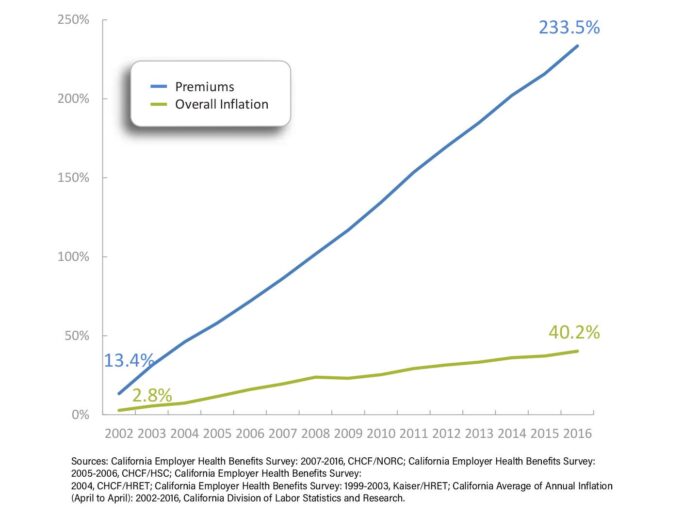
A line graph titled "Cumulative Growth Compared to Inflation."


Earlier this week, Amazon.com Inc., JPMorgan Chase & Co., and Berkshire Hathaway Inc. jolted Wall Street with their announcement of a joint venture designed to reduce health care costs for their combined one million US employees. It is exciting to see innovative private sector companies lend their intellectual and financial capital to a seemingly intractable issue that has plagued the American economy for decades. About 18 percent of our nation’s financial output is now devoted to health care. For decades, health care costs have outpaced overall economic growth, and the gap is projected to remain to remain at three percentage points a year.

How the High Cost of Care Affects Employers – and Everyone Else

Employees directly and indirectly shoulder these costs. The average premium that employers and their workers pay for a family plan in California now exceeds $1,600 a month. Employer-based family health insurance premiums in the state have increased by 234% over the last 15 years, nearly six times the increase in the state’s overall inflation rate. Every dollar spent on health care is a dollar unavailable for something else, such as education, affordable housing, and environmental protection.

Sixty-six percent of working California families face a deductible of $2,000 or more for their employer-based coverage, including many without high-deductible health plans linked to tax-advantaged health savings accounts.

Increasingly, health care is unaffordable for all of us—not just businesses like Amazon and its workers, but for retirees, the self-employed, people seeking employment, and low-income Californians who aren’t eligible for public coverage. The Affordable Care Act (ACA) attempted to address the cost burden for those with employer coverage by creating disincentives for employers to simply pass on unaffordable premiums, and by capping the share of premiums health plans spent on overhead and profit. For people who shop for insurance coverage on the individual market, the ACA provided federal tax credits to offset premium and cost sharing.

While these and other efforts have helped, more work is needed. Too many families still struggle to afford health care. In 2017, 37% of Americans with health insurance found it difficult to afford premiums each month. Forty-three percent said it was hard to meet their deductibles before coverage kicked in. Among California workers with an aggregate family deductible, 66% faced a deductible of $2,000 or more in 2016.

At least 40% of adults say they worry about being able to afford health care services, losing their insurance, or being able to afford prescription drugs.

What We Already Know About Reducing Health Care Costs

Addressing the affordability of care in California and throughout the country requires lowering the underlying cost of care across market segments. Many efforts are already underway. Health insurance companies, large self-funded employers, and public purchasers of care often deploy management strategies to reduce the use of expensive tests, high-cost prescription drugs, and duplicative services. The most common strategies include prior authorization, patient education for better clinical decisionmaking, chronic disease initiatives, and pushing the cost to employees through deductibles and other cost-sharing tools.

To date, the results of these initiatives have been mixed. The findings are consistent with a growing body of academic research that suggests the real driver of health care costs is price, not increased demand. If that is the case, the solution might be to create a market that rewards high-value providers and cost-effective drugs. This type of strategy would rely on tools like reference pricing (individual drugs are grouped by therapeutic class and payment is limited to the price of the cheapest drugs in each class), value-based insurance design (copayments are reduced or eliminated for the most efficient, effective services), or high-deductible health plans.

Unfortunately, consumer-driven approaches have also had limited impact. While companies like Amazon might develop new technologies to enable patients to easily compare, shop for, and purchase health care services in a competitive marketplace, to date these types of tools have not succeeded in reducing costs or changing provider behavior in California. More to the point, introducing blunt consumer-facing financial incentives may run counter to the overall goal of affordability. Everyone should have access to the care they need at a price they can afford and not face care that is rationed by their ability to pay for it.

The Promise of Scale

Perhaps the biggest advantage of the new joint venture is its size and reach. The most promising solutions today are found in large, integrated delivery systems. They have consistently shown that the best approach is to give providers simple, strong financial incentives to make care more efficient and effective. Because this type of model works best on a large scale, the ideal approach is for multiple public and private purchasers of care to come together to align quality reporting requirements, reward value, and support investments in improving health outcomes across entire groups of people. We are already seeing this happen in California and other states.

No one group or slice of the private health care market has the power to really drive down health care costs for everyone. It will take many, many players in the private and public sectors working together to align their efforts. The foundation of payment and delivery reform laid by the Affordable Care Act is a good place to start. Technology is critical and necessary – but it is not by itself sufficient. Leaders also need to pull policy levers, fix payment systems, and spark collaboration between purchasers. Innovators like Amazon, JPMorgan Chase, and Berkshire Hathaway will no doubt make material contributions. Their leadership, in tandem with that of other large purchasers, offers a prime opportunity to make care more affordable for everyone.

House GOP warming to ObamaCare fix

House GOP warming to ObamaCare fix

Image result for aca stabilization

Key House Republicans are warming to a proposal aimed at bringing down ObamaCare premiums, raising the chances of legislative action this year to stabilize the health-care law.

House GOP aides and lobbyists say that top House Republicans are interested in funding what is known as reinsurance. The money could be included in a coming bipartisan government funding deal or in another legislative vehicle.

Any action from Republicans to stabilize ObamaCare would be a major departure from the party’s long crusade against the law, but after having failed to repeal the Affordable Care Act last year, the discussion is shifting.

Rep. Ryan Costello (R-Pa.) is one of the leaders of the push in the House and is sponsoring a bill to provide ObamaCare stability funding in 2019 and 2020. He notes the relatively short-term nature of his measure.

“That reflects the political reality that we are not going to be doing some large, sweeping health-care bill in the next year,” said Costello, who faces a competitive reelection race this year.

“I am optimistic that it would be under serious consideration for inclusion in the omnibus,” he added.

Speaker Paul Ryan (R-Wis.) noted the possibility of action on an ObamaCare stability measure, particularly funding for reinsurance, at an event in Wisconsin in January, saying he thought there could be a “bipartisan opportunity” on the issue.

Action on the reinsurance payments is far from certain; conservative opposition to what some view as a bailout of ObamaCare insurers could stop the proposal in its tracks. But there is growing momentum for the idea, and Republicans said the proposal would likely be discussed more at the GOP retreat this week in West Virginia.

The push on reinsurance matches up with one of the ObamaCare bills that Sen. Susan Collins (R-Maine) has been pushing in the Senate.

Senate Majority Leader Mitch McConnell (R-Ky.) gave Collins a commitment to support a reinsurance bill as well as another stability measure from Sens. Lamar Alexander (R-Tenn.) and Patty Murray (D-Wash.) in exchange for Collins’s support for tax reform in December.

Opposition in the House has always been the major impediment to those measures moving forward. But it now appears some of that resistance is softening, at least on the reinsurance measure, now that Republicans have repealed ObamaCare’s individual mandate through the tax bill.

Importantly, House Energy and Commerce Committee Chairman Greg Walden (R-Ore.), whose panel has jurisdiction, is supporting the ObamaCare stabilization efforts and backs Costello’s bill.

“Chairman Walden is supportive of Rep. Costello’s efforts to help states repair their insurance markets that have been damaged by Obamacare,” an Energy and Commerce spokesperson wrote in an email. “Rep. Costello’s bill is a fair approach to granting states greater flexibility to help patients and lower costs.”

Rep. Cathy McMorris Rodgers (R-Wash.), the fourth-ranking Republican in House leadership, is also a co-sponsor of Costello’s stabilization bill.

While House conservatives have opposed propping up ObamaCare, Rep. Mark Meadows (R-N.C.) did not dismiss the payments out of hand on Tuesday.

“If it lowers premiums, I’m willing to listen to any ideas,” said Meadows, who is chairman of the House Freedom Caucus.

He warned that he did not want a proposal to be an “insurance bailout,” but noted that he has been talking to colleagues in the House and Senate about the issue.

Another obstacle for an ObamaCare fix is a dispute over abortion. Republicans are adamant that a stabilization measure must include restrictions on the new funding being used to cover abortion services, a notion that is problematic for Democrats.

Reinsurance funding is used to help insurers cover the costs of especially sick patients, which helps relieve pressure on premiums for the broader group of enrollees.

The other main stabilization measure, from Alexander and Murray, would fund ObamaCare payments that reimburse insurers for giving discounts to low-income enrollees, known as cost-sharing reductions (CSRs).

Republican sources say there is less momentum in the House for funding CSRs than there is for the reinsurance measure. But even some Democrats are now questioning whether funding CSRs still makes sense, given that through a quirk in the law, President Trump’s cancellation of the payments last year actually led to increased subsidies and lower premiums for many enrollees.

Rep. Phil Roe (R-Tenn.), for example, a leading House Republican on health-care issues as co-chairman of the GOP Doctors Caucus, said Tuesday that he feels negatively about the idea of funding CSRs but likes the idea of reinsurance.

Roe pushed back on the idea that the funding would be propping up ObamaCare, saying that the repeal of the individual mandate had changed the discussion because people no longer were forced to buy coverage.

Roe said he runs into people in his district paying more than $1,000 per month in premium costs.

“We’re going to have to do something,” he said.

66% of Americans are stressed about health insurance costs: 3 things to know

https://www.beckershospitalreview.com/payer-issues/66-of-americans-are-stressed-about-health-insurance-costs-3-things-to-know.html

Image result for stress over health insurance

Across all income levels, two-thirds of U.S. adults cite health insurance costs as a stressor, according to a report from the American Psychological Association.

APA’s report, “Stress in America: Uncertainty About Health Care,” examines responses from 3,440 adults who completed an online survey by The Harris Poll from Aug. 2 to Aug. 31, 2017.

Here are three things to know from the report.

1. Sixty-three percent of adults said uncertainty about their future health and the health of others is a stressor.

2. Personal health concerns or health problems affecting family members reflect a “very” or “somewhat” significant source of stress for 60 percent of respondents.

3. On a 10-point scale, where 1 is “little or no stress” and 10 is “a great deal of stress,” uninsured respondents reported average stress levels of 5.6. This is compared to insured adults, who reported average stress levels of 4.7.

Association health plan proposal: Experts wary of weak consumer protections, oversight issues

https://www.fiercehealthcare.com/regulatory/association-health-plans-consumer-protections-tim-jost?mkt_tok=eyJpIjoiTjJRNU5qUXlZVEJqWmpjNCIsInQiOiJOR2V2bEp4NkdoeVB3VndhZE43TVBjZXdaTGJcLzk1Z3hBd1wvZ05teDMrcjZ5UzJhb0tzUkpQbWlaSmVvUmJFazVDcERmajBTREhCTXJxR3BBaGtoY1MrZlVtQW5xeXRSbFwvYVhPOE44VE9uYUhNZWNnbGtoR3c3S0xHUlp5SlwvS2kifQ%3D%3D&mrkid=959610

stethoscope, coins and calculator

The new proposal to expand association health plans promises to provide more affordable insurance options for small-business owners and employees. But some experts aren’t convinced that this is the right solution.

For one, the proposal’s promises of consumer protections aren’t as strong as they seem, said Timothy Jost, a Washington and Lee University professor emeritus who closely follows the ACA.

Association health plans can’t charge higher premiums or deny coverage based on health status, according to the Department of Labor (DOL). But because AHPs would be subject to large-employer market rules, they wouldn’t have to cover the list of essential health benefits that the Affordable Care Act mandates.

The upshot, Jost told FierceHealthcare, is that insurers could legally weed out those with costly conditions while still complying with regulations that bar them from denying those individuals coverage or hiking their premiums.

“If you can’t exclude someone because they have cancer, it’s easy to just not cover chemotherapy,” he said. “Or if you can’t exclude people who have mental illness, it’s easy to just not cover mental health care.”

And Larry Levitt, senior vice president of the Kaiser Family Foundation, pointed out in a Twitter post that insurers could still hike premiums based on factors other than health status:

 The association health plan regulation prohibits variation in premiums based on health. It does not prohibit premium variation based on any other factor, such as gender, age, industry or occupation, or business size.
 Cherry-picking enrollees

Association health plans are also likely to be marketed toward the healthiest, youngest individuals, Jost noted.

“I doubt anybody is going to be out there writing association coverage for occupations that are predominantly people who are older or have chronic health problems,” he said.

The problem, then, is that AHPs would siphon more low-risk consumers out of the individual marketplaces—thus skewing that risk pool and likely causing insurers to raise premiums.

“I think everybody understands that this is going to undermine the market for ACA-compliant plans,” Jost said.

Andy Slavitt, the former Centers for Medicare & Medicaid Services acting administrator, laid out his own criticisms in a Twitter thread—including pointing out that breaking up risk pools goes against the proposal’s stated purpose of giving small businesses more clout:

 The regulation aims to push the idea of what can be considered an association.

Someone I talked to today referred to it as being able to create an “air breathers association.” Essentially, making it as rude-less as possible.

 Many of the premises of AHPs have been shown not to work in the past.

For example, the rule says AHPs will create “increased buying power”. Breaking up pools does exactly the opposite.

Instead, a “Runners’ Association” just sends a clear signal that these are healthy people.

Limited impact

Merrill Matthews, Ph.D., a resident scholar at the right-leaning Institute for Policy Innovation, praised the new proposed rule, noting that it allows small businesses to do what large employers have long been able to: self-insure.

“Self-insured employers have been able to avoid many of the state and federal mandates imposed on the small group and individual markets, which helped employers keep down the cost of coverage,” he said.

But even Matthews acknowledged that the impact of the proposed policy changes is likely to be limited, as it will only apply to small employers and possibly some self-employed individuals. Since the proposed changes are “unlikely to provide much relief” for those affected by high premiums in the individual market, he said, “Congress still needs to repeal the Affordable Care Act.”

Questions about oversight

Perhaps the biggest issue that Jost saw with the new proposal was the fact that AHPs have had past issues with insolvency, bankruptcy and even fraud.

“There’s just a long history of association health plans being formed that are thinly capitalized, that pay large salaries and expenses for their owners, and disappear when the going gets rough,” he said.

For its part, the DOL said it will “closely monitor these plans to protect consumers.” But Jost pointed out that the agency has experienced staff and budget cuts that might undermine that goal.

Even the DOL itself said in the proposed rule that “the flexibility afforded AHPs under this proposal could introduce more opportunities for mismanagement or abuse, increasing potential oversight demands on the department and state regulators.”

Ultimately, what plays out will largely be decided by how states respond to the new regulations once they are implemented, Jost added.

“In states that try to take an aggressive approach to regulating them, there won’t be that much activity,” he said. “And in states that take a hands-off approach and let anything go, there will be probably quite a bit of activity until [AHPs] start going belly up.”


Tax Bill Is Likely to Undo Health Insurance Mandate, Republicans Say

Image result for Tax Bill Is Likely to Undo Health Insurance Mandate, Republicans Say

House and Senate negotiators thrashing out differences over a major tax bill are likely to eliminate the insurance coverage mandate at the heart of the Affordable Care Act, lawmakers say.

But a deal struck by Senate Republican leaders and Senator Susan Collins of Maine to mitigate the effect of the repeal has been all but rejected by House Republicans, potentially jeopardizing Ms. Collins’s final yes vote.

“I don’t think the American people voted for bailing out big insurance,” said Representative Dave Brat, Republican of Virginia, who opposes a separate measure to lower insurance premiums that Ms. Collins thought she had secured.

The sweeping tax overhaul approved Saturday by the Senate would eliminate penalties for people who go without insurance, a change not in the tax bill passed last month by the House. But the House has voted many times to roll back the mandate, most recently in a bill to dismantle the Affordable Care Act, and House members were enthusiastic about going along.

“Mandating people to buy a product was a bad idea to begin with,” said Representative Rob Woodall, Republican of Georgia. “We made people do something that was supposed to be good for them. But they are telling us by the millions how much they dislike the mandate.”

The individual mandate was originally considered indispensable to the Affordable Care Act, a way to induce healthy people to buy insurance and thus to hold down insurance premiums for sicker customers. The Obama administration successfully defended the mandate in the Supreme Court. But recent economic research suggests that the effect of the mandate on coverage is somewhat smaller than previously thought.

With little more than a week remaining until the annual open enrollment period ends, 3.6 million people have selected health plans for 2018 in the 39 states that use the federal marketplace, the Trump administration reported Wednesday. That is 22 percent higher than at this point last year, despite uncertainty about the mandate’s future and efforts by Republicans and the administration to undermine the law.

But because the sign-up period is only half as long, it appears likely that enrollment will end up lower than in the last period.

Without a mandate, some healthy people are likely to go without coverage, leaving sicker people in the market, and prices are likely to rise more than they otherwise would. The Congressional Budget Office said last month that repealing the individual mandate would increase average premiums on the individual market about 10 percent, and it estimated that the number of people without health insurance would rise by 13 million.

Regardless, the requirement has proved to be one of the most unpopular parts of the 2010 law, and House Republicans were happy to see it go. Representative Richard Hudson, Republican of North Carolina, called the Senate provision “a great move.”

The repeal also frees up money that Congress can use to reduce tax rates. The budget office said it would save the federal government more than $300 billion over 10 years — mainly because fewer people would have Medicaid or subsidized private insurance.

The mandate repeal’s effect on health insurance markets did concern Ms. Collins, and to win her vote for the Senate tax bill, the Senate majority leader, Mitch McConnell of Kentucky, offered her a deal, in writing: He would support two bipartisan bills to stabilize markets and hold down premiums, in the absence of the individual mandate.

One bill would provide money to continue paying subsidies to insurance companies in 2018 and 2019 to compensate them for reducing out-of-pocket costs for low-income people. President Trump cut off the “cost sharing” subsidies in October, more than a year after a federal judge ruled that the payments were unconstitutional because Congress had never explicitly provided money for them. The payments would resume under this measure, drafted by Senators Lamar Alexander, Republican of Tennessee, and Patty Murray, Democrat of Washington State.

The second bill would provide $5 billion a year for grants to states in 2018 and 2019. States could use the money to help pay the largest health claims, through a backstop known as reinsurance, or to establish high-risk pools to help cover sick people.

Ms. Collins has released a copy of her agreement with Mr. McConnell in which he pledged to support passage of the two measures before the end of the year. His signature was displayed prominently at the top of the first page. But the deal has landed with a thud in the House, where Republicans appear loath to support legislation that they view as propping up a health law that they have pledged to repeal.

“Our members wince at voting to sustain a system that none of them supported,” said Representative Tom Cole, Republican of Oklahoma.

The Senate could attach the Alexander-Murray legislation to a government funding measure, hoping that Republicans in the House would be willing to swallow it as part of a measure to avoid a government shutdown. But Mr. Cole said House Republicans would be “very offended” at such an approach.

“I don’t think we’re in the mood to be blackmailed by anybody,” he said.

Mr. Brat, a member of the conservative Freedom Caucus, assailed the deal with Ms. Collins as an example of horse trading that is characteristic of the Washington swamp that he said voters had repudiated.

Likewise, Representative Mark Walker of North Carolina, the chairman of the conservative Republican Study Committee, said of the Alexander-Murray bill, “There’s no appetite for that over here.”

Ms. Collins said on Wednesday that she believed the House would “take a serious look” at the two bills intended to hold down insurance premiums and that Mr. Trump, in several recent meetings, had assured her that he also supported those bills.

“I don’t think this effort is over by any means,” Ms. Collins said.

For Democrats, eliminating the insurance mandate penalties provides yet another reason to oppose the tax bill.

“The individual mandate is at the heart of the Affordable Care Act,” said Representative James E. Clyburn, Democrat of South Carolina. “Repealing it, as the G.O.P. tax scam does, is a deliberate attempt to undercut the law, create chaos in the health insurance marketplaces, increase premiums and decrease choice and coverage.”

Ms. Murray indicated that even if Ms. Collins secures her deal, Democrats would remain steadfast.

“Our bill, the Alexander-Murray bill, was designed to shore up the existing health care system,” not to “solve the new problems in this awful Republican tax bill,” she said.

Meanwhile, the damage to the Affordable Care Act may already have been done. Daniel Bouton, an enrollment counselor in Dallas, said he worried that the Trump administration’s decision to cut advertising for open enrollment had prevented millions of people from learning about the shortened sign-up period. He also said that the Senate’s recent vote to undo the individual mandate as part of its tax bill would discourage people from signing up.

“You’re going to have people who say, ‘Well, perfect, I don’t have to buy insurance anymore,’” Mr. Bouton said.


ACA mandate repeal may be less popular than GOP thinks

https://www.axios.com/individual-mandate-repeal-may-be-less-popular-than-republicans-think-2514871844.html

The tax bill that just passed the Senate eliminates the Affordable Care Act’s individual mandate, and the House is likely to go along when Congress writes the final version. With the tax legislation moving so quickly and the mandate lost in the maze of so many other consequential provisions, we are not likely to have much public debate about this big change in health policy.

Why it matters: If we did, even though the mandate has never been popular, our polling shows that the public does not necessarily want to eliminate it as part of tax reform legislation, once they understand how it works and what the consequences of eliminating it might be.

The back story: Republicans have targeted the ACA mandate because they want the $318 billion in savings the Congressional Budget Office says they would get to help them pay for their tax cuts. (The change would save money because fewer people would get federal subsidies on the ACA marketplaces or apply for Medicaid coverage.)

They have also targeted the mandate because they think it’s so unpopular. Our polls have consistently shown that the mandate is the least popular element of the ACA and in the abstract, more Americans (55%) would eliminate the mandate than keep it (42%).

Yes, but: When people know how the mandate actually works, and are told what experts believe is likely to happen if it’s eliminated, most Americans oppose repealing it in the tax plan.

  • When people learn that they will not be affected by the mandate if they already get insurance from their employer or from Medicare or Medicaid, 62% oppose eliminating it.
  • When people are told that eliminating the mandate would increase premiums for people who buy their own coverage, as the CBO says it will, they also flip, with 60% opposing eliminating the mandate.
  • And when they’re told that 13 million fewer people will have health coverage – another CBO projection – 59% oppose eliminating the mandate.

The bottom line: Many people change their minds when they learn more about facts and consequences, which happens as the lights shine brighter on them in legislative debates. This happened to the “skinny repeal” proposal, and it would happen to single payer.

But as the tax legislation rushes through Congress and heads to the final negotiations, there is almost no chance for the public to grasp the tradeoffs that would come from eliminating the mandate and who is affected and who is not. If they did, the polling suggests, eliminating the mandate might prove far less popular than Republicans seem to think it is.