From premiums to politics: 5 predictions for the health insurance industry in 2018

https://www.fiercehealthcare.com/payer/year-preview-predictions-politics-aca-mergers?mkt_tok=eyJpIjoiTnpreE9HSTFPVFJqWldZMSIsInQiOiJNM0NTa1ZBZW1kU001bkx4SEcwNmtSeEFVNG9oZnpUbEF2UVpMY1lDUWNZYm8zZTFuejJNUGpPOTJuYVlXTlZwWHdXU1hrRm50Z1NFbHJGRjdUMld6U1JoYWo0enNaUlEzNldab2tcL3hxV3NPaTBlK2xKbmVSQmgwMTE2NFZpYzgifQ%3D%3D&mrkid=959610

Businessman uses a crystal ball

After the demise of two major insurer mergers and multiple Affordable Care Act repeal attempts, few could argue that 2017 wasn’t an eventful year for the health insurance industry.

But 2018 is shaping up to be just as interesting—complete with more political wrangling, M&A intrigue and evidence that, despite all this uncertainty, insurers are pushing ahead and embracing innovation.

Read on for our predictions about what’s in store for the industry in the coming months.

1. The CVS-Aetna deal will have a domino effect in the healthcare industry

While the lines between payer, provider and pharmacy benefits manager have been blurring for a while now, CVS’ $69 billion deal to purchase Aetna is undoubtedly a game-changer.

The move was likely motivated by a desire to compete with UnitedHealth’s thriving Optum subsidiary, which has its own PBM and an increasing presence in care delivery. So it stands to reason that other major insurers will try to strike deals of their own that mimic that scale and level of diversification.

Already, Humana has made a bid to purchase part of hospice- and home-health giant Kindred Healthcare. There’s also been speculation that it is preparing to be acquired—possibly by Cigna, or in a deal that would mimic CVS-Aetna, Walmart or Walgreens.

Other insurers may also seek to build PBM capabilities, following in the footsteps of UnitedHealth, a combined CVS-Aetna and Anthem, which announced in October that it would team up with CVS to create an in-house PBM called IngenioRx.

It’s certainly possible, however, that CVS’ purchase of Aetna will not pass regulatory muster. While it would require less divestment than the ill-fated Anthem-Cigna and Aetna-Humana deals, the DOJ’s decision to block another vertical deal—between AT&T and Time Warner—doesn’t bode well for its chances.

2. Republicans and Democrats will be forced to work together on ACA fixes

With one less Republican senator—thanks to Alabama’s election of Democrat Doug Jones—the GOP likely won’t have the votes to pass a repeal bill without bipartisan support. Senate Majority Leader Mitch McConnell acknowledged as much before Congress’ holiday recess, though he clarified the next day that he would be happy to pass an ACA repeal bill if there are enough votes for it.

McConnell also owes Sen. Susan Collins, R-Maine, as he had promised her he’d pass her reinsurance bill and a bill that would fund cost-sharing reduction payments this year. While Collins held up her end of the bargain—voting for the GOP tax bill—the ACA fixes didn’t make it into the stopgap spending bill Congress passed on Dec. 21.

Democrats, meanwhile, will also be motivated to reach across the aisle. The repeal of the individual mandate will likely put the ACA on more unstable footing, lending more urgency than ever to the task of shoring up the exchanges.

Both parties will also likely face pressure from the healthcare industry’s biggest lobbying groups to get some sort of ACA fix passed. The push to do so, however, will be complicated by the full slate of legislative priorities Congress is facing in the new year, including reauthorizing funding for the Children’s Health Insurance Program.

3. There will be more premium hikes and insurer exits in the individual market

The individual mandate is now gone, and arguments about its effectiveness aside, that was one of the mechanisms that encouraged healthy people to buy insurance and stay covered. Even if the effect on coverage levels is minimal, the move is probably going to be enough to push risk-averse insurers to raise rates and even exit more rating areas in 2019.

There is also little indication that large insurers that have exited will come back anytime soon. After all, why invest resources in an unstable market when there are far more steady and lucrative markets like Medicare Advantage?

Adding to the policy uncertainty for the remaining insurers, there is no guarantee that Congress will authorize short-term funding for cost-sharing reduction payments. Many insurers raised their 2018 rates to account for the possibility of them disappearing—which turned out to be a wise move—so it stands to reason they’d have to do the same for 2019.

Perhaps the best harbinger of what’s to come came from a study conducted in November, which noted that the actions insurers and state regulators took to fill in “bare counties” on the ACA exchanges are “temporary and unsustainable without long-term federal action.” And with Republicans in charge, federal action to patch up the exchanges is unlikely.

4. Federal agencies will start to carry out Trump’s executive order—and states will push back

Although it was overshadowed by all the repeal-and-replace drama, Trump’s healthcare-focused executive order has huge implications for the industry. Put simply, it paves the way for expanded use of association health plans, short-term health plans and employer-based health reimbursement arrangements.

In 2018, we’re likely to see the relevant agencies start issuing rules to implement the order, which could dramatically change the individual market as we know it—and not for the better. Such rulemaking would also set the stage for a power struggle between the federal government and left-leaning states.

In fact, a coalition of healthcare organizations have urged state insurance commissioners to take steps to override any rules resulting from the executive order. For example, states could restore the three-month limit on short-term health plans if agencies unwind that Obama-era rule on the federal level.

Since only certain states are likely to heed these suggestions, the upshot of Trump’s executive order will be to create a patchwork of individual market rules across the country. If that sounds strangely like what the individual insurance markets were like before the ACA, well, that’s precisely the point.

5. Payers’ move to value-based payment models will continue, with or without the feds leading the way

On the one hand, the Trump administration clearly wants to scale back the federal government’s role in pushing payers and providers away from fee-for-service payment models. The surest sign was CMS’ announcement late last year that it would endmandatory bundled payment models for hip fractures and cardiac care.

Some have worried that moving away from those mandatory programs would be a setback for the move to value-based payments, given that the feds play a powerful role in galvanizing the industry to change. In addition, the administration wants to take the Center for Medicare and Medicaid Innovation in a “new direction”—one that CMS Administrator Seema Verma said would “move away from the assumption that Washington can engineer a more efficient healthcare system from afar.”

But even if the federal government will take a lighter touch in the move from volume to value, it’s not likely that the private sector will take that as a cue to reverse course. On the payer side, especially, too many industry-leading companies have invested heavily in alternative payment models to turn back now. And they have compelling business reasons to keep investing in those models, given their potential to lower costs and improve care quality.


10 things for healthcare executives to note as they head into 2018

https://www.beckershospitalreview.com/hospital-management-administration/2017-the-year-that-was-10-things-for-healthcare-executives-to-note-as-they-head-into-2018.html

Disruption got real. Hospital-insurer negotiations heated up. Activist shareholders shook up legacy hospital operators. Healthcare and the government failed to effectively communicate. These and six other trends that shaped the year in healthcare — and the lessons executives can take from them into 2018.

1. Disruption got real. After years of speculation about who or what would become the “Uber of healthcare,” the tectonic plates of the industry shifted substantially in the past year — and there’s reason to believe this will only continue in 2018. A number of mergers illustrate the blurring line between healthcare and other industries, such as retail and insurance. Consider the combinations of CVS and Aetna or Optum and DaVita and Surgical Care Affiliates. As for what’s to come, Apple and Amazon have both shown interest in expanding their healthcare footprint. In fact, just last month, we reported Amazon was in talks to move into the EHR space.

Executive’s takeaway: Executives grew skeptical of the term ‘disruptor’ when it was used as generously as it was circa 2011-2016. But now disruption is actually unfolding at a rapid clip, and executives are paying close attention to who/what poses the greatest threat to their business models.

2. Hospital-insurer negotiations heated up. Previously, a health system and a commercial insurer occasionally hit a snag in the contract negotiation process, resulting in a dispute palpable enough to consumers that it warranted headlines. These impasses generally lasted a matter of weeks before outside pressure drove the parties to compromise. The nature of these conflicts has since changed. This past year brought regular coverage of strained provider-payer talks. In fact, we now do a weekly compilation of payer-provider disputes and resolutions to stay abreast of these conflicts as they occur and subside. In 2017, we saw lawmakers intervene in payer-provider disputes, a health system executive’s meant-to-be-private email about an insurance company go public, and a children’s hospital go out of network with a commercial insurer — affecting 10,000 kids.

Executive’s takeaway: Health system executives are growing increasingly vocal with their thoughts about commercial insurers. In the past, executives took great lengths to observe discretion in these relationships. Now the gloves are off — or at least one is. We’re sure we haven’t seen the worst of a payer-provider dispute yet, but the number we see on a weekly basis, and their tone, indicates that disputes are both more frequent and more serious than in years past.

3. Investments in value-based care, once a somewhat safe bet, became debatable. In a final rule issued in November, CMS officially canceled the hip fracture and cardiac bundled payment programs and rolled back some mandatory requirements in the Comprehensive Care for Joint Replacement Model. This will continue to have a ripple effect on payers, providers and health system strategy. For hospitals and health systems that made significant investments to support excellence under the program, this news is difficult to take — especially since no investment is made lightly amid thin margins. Although CMS says it is still committed to value-based care as a concept, the mandatory nature of the bundles program acted as a pedal-to-the-metal force that made hospitals act. Since commercial payers follow Medicare, the fate of the program will likely influence the adoption of bundles among private insurers, too. 

Executive’s takeaway: Most all executives tell us they want to be on the leading edge, not bleeding edge, of value-based care. Without a “do it or lose it” approach to bundles, the industry lost a major impetus toward value-based care, in which many health systems and physicians would take the plunge together. Providers have never had a clearly paved path for their “journey toward value-based care.” At best, it was a dirt trail. Now it could be compared to a dirt trail covered in snow. This leaves executives questioning the value of their current and future investments in value-based care.

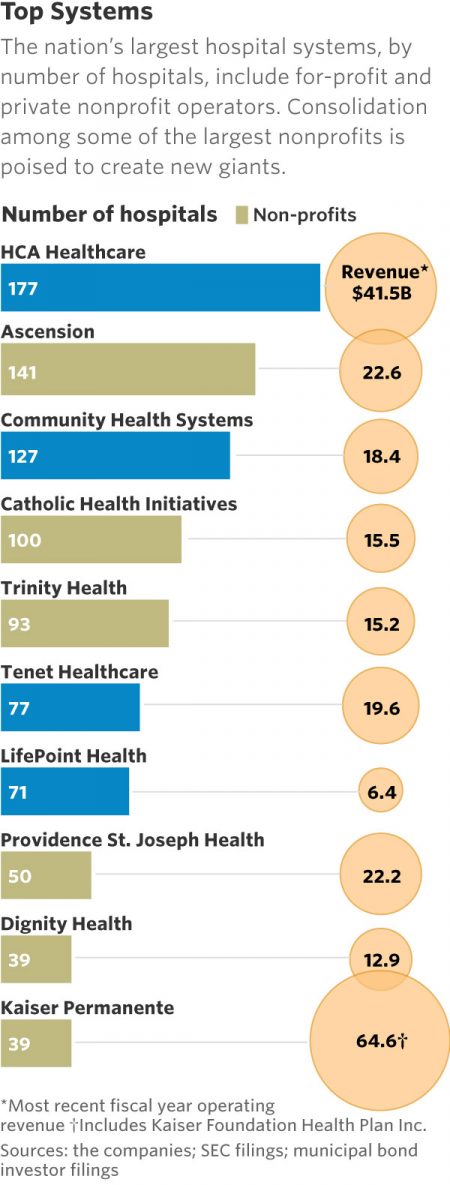
4. Big systems want bigger. Just when you thought you had a handle on what a “big” health system looked like in the United States, a few major players rewrote (or are attemping to rewrite) the playbook. After more than a year of talks, Catholic Health Initiatives and Dignity Health signed a definitive agreement in December to create a 139-hospital, $28.4 billion health system. Soon after came reports of St. Louis-based Ascension and Renton, Wash.-based Providence St. Joseph discussing a merger, which would result in a 191-hospital, $44.8 billion operation. Although both of these deals trail Oakland, Calif.-based Kaiser Permanente and its nearly $65 billion in revenue, they illustrate how the composition of nonprofit American health systems is continuing to change from local and regional entities to corporate national networks. For example, if Ascension and Providence combine, they will outsize the largest for-profit health system today — Nashville, Tenn.-based HCA Healthcare — which includes 177 hospitals in 20 states and Britain.

Executive’s takeaway: Executives may want to reevaluate the oft-spoken phrase “all healthcare is local” in light of 2017’s M&A activity. Hospitals will continue to serve as economic engines in their respective communities, but the organization of health systems is moving in a direction where they are viewed as ubiquitous brands as opposed to regional hubs for health. For example, San Francisco-based Dignity and Englewood, Colo.-based CHI are basing the corporate headquarters for their new enterprise in Chicago. Ascension and Providence would have footprints in 27 states if they merge.

5. Many health systems that were new players in the health plan business got out of it. Provider-sponsored health plans always carried a great amount of risk. Of the 37 health plans launched by hospitals and health systems since 2010, only four were found profitable in 2015, according to research published this past year by the Robert Wood Johnson Foundation. As major health insurers reduced their individual coverage options and rolled back from the public exchanges this year, we also saw several health systems decide to scale back or shut down their health plans. New Hyde Park, N.Y.-based Northwell Health shared plans in August to wind down its health insurance business, CareConnect, over the next year. Dayton, Ohio-based Premier Health is selling its health plan to Evolent Health, a Washington, D.C.-based value-based care platform. Louisville, Ky.-based Baptist Health plans to shut down its health plan operation in 2018. Late last year, Dallas-based Tenet Healthcare revealed plans to scale back its insurance business in 2017 after officials attributed lukewarm earnings to its health plan business.

Executive’s takeaway: When even the big five health insurers — so well-equipped with analytic tools, data, infrastructure, utilization management experience and risk analysis talent — have a difficult time accounting for risk, it is not surprising many green health systems made their move for the door this past year. This is not an opportune time for health systems with little experience managing risk to build or buy a health plan. 

6. Activist shareholders shook up legacy hospital operators. Board room issues within the major for-profit hospital operators are typically opaque, but 2017 brought a rash of investor-prompted activity that resulted in ousted CEOs, overhauled boards of directors, poison pills and new governance rules. Tenet Healthcare underwent significant change in 2017 under intense pressure from its largest shareholder, Glenview Capital Management. When two Tenet board members, both employed by Glenview, resigned over what they described as “irreconcilable differences,” they made it known that Glenview would possibly “evaluate other avenues” to be a constructive owner of Tenet on or after Sept. 1. By Aug. 31, Tenet announced it would replace CEO Trevor Fetter, “refresh” the composition of its board of directors and implement a short-term shareholder rights plan. Mr. Fetter resigned in October, before a successor was named, after 14 years with the system. In August, an investor in Franklin, Tenn.-based Community Health Systems called for the resignationof CEO Wayne Smith, who has led the 127-hospital system since 1997, over what the investor described as missteps in strategy resulting in financial trouble for the system. At this time, Mr. Smith still holds his job, but CHS may be bracing for more investor activity. Chinese billionaire Tianqiao Chen has gradually been ramping up his stock in the hospital operator since 2016. At time of publication, he holds nearly 23 percent of CHS stock. Finally, directors of HCA Healthcare made a change in late 2017 to allow established investors to participate in the board seat nomination process, a move made in response to an activist investor.

Executive’s takeaway: The fact that two of the largest U.S. for-profit hospital operators faced calls for CEO resignations in 2017 is part of a sweeping trend across industries in which activist investors start campaigns for change by targeting top management. Between January and May 2017, activist shareholders were responsible for ousting CEOs at three high-profile S&P 500 companies — American International Group, CSX and Arconic, according to The Wall Street Journal. Investors were attempting to oust six other CEOs in the same time frame. It’s worth noting that CEOs feel the heat at the launch of campaigns versus as a last resort. The WSJ characterized this trend as “a new level of aggressiveness for a group already known for its bold actions.” 

7. As the average health system C-suite grew, a few systems reduced administrative roles. While the number of practicing physicians in the U.S. grew 150 percent between 1975 and 2010, the number of healthcare administrators increased 3,200 percent in the same period. Yet in 2017, we saw a few major health systems go against the grain and not only lay off administrators, but eliminate their roles completely. In June, Houston-based MD Anderson Cancer Center eliminated executive vice president roles and gave senior vice presidents more focused areas of responsibility. Valley Medical Center, part of Seattle-based UW Medicine, got rid of the COO position in May, and Charleston, S.C.-based Roper St. Francis did the same in August. In December, San Diego-based Scripps Health shared plans to eliminate the CEO position in its four hospitals in favor of a regional CEO model. 

Executive’s takeaway: This past year contained several isolated incidents in which executive or administrative jobs were not immune from the financial pressures mounting on hospitals and health systems. There is reason to believe “right-sizing” (or at least reducing) administrative staffing at health systems will continue throughout 2018. Chris Van Gorder, president and CEO of Scripps Health, recently shared that layoffs at the system will likely include administrative and leadership roles while the system continues to hire caregivers. His reasoning, an excerpt of which follows, is applicable to many health systems today: “Healthcare is changing rapidly with huge growth in ambulatory care and reduced utilization of inpatient hospitals — and given the elimination of the individual mandate under the Affordable Care Act, the uninsured will once again be growing nationally. … We’ve got to shift our organizational structures around to be able to deal with the new world of healthcare delivery, find ways of lowering our costs significantly. If we don’t, we will not be able to compete.”

8. Healthcare and the government failed to effectively communicate. In 2017, the opportunities for the Trump administration, Congress and healthcare leaders to convene about healthcare legislation and policy came and went. CEOs from the five largest nonprofit health systems in the country took pen to paper, urging President Donald Trump and Congress to meet with them and exchange ideas. In the end, the closest thing we saw to healthcare reform in 2017 were bills — the American Health Care Act, Better Care Reconciliation Act of 2017 (or Skinny Repeal package), the Graham-Cassidy healthcare bill — that received significant opposition from major healthcare stakeholders, which are not historically liberal. Yet even an avalanche of nays from the American Medical Association, American Hospital Association, Federation of American Hospitals, American Psychiatric Association, Association of American Medical Colleges and several other groups did not sway Congress. All but three Republican Senators voted to pass the Skinny Repeal package, illustrating how the bipartisan nature of our political process is overriding expertise and informed lawmaking. 

Executive’s takeaway: A bipartisan approach is the most effective way when attempting to redesign a $3 trillion industry that influences life-or-death decisions. These efforts also require input from a variety of seasoned healthcare experts who can challenge ideas, anticipate repercussions and identify blind spots. This holds true no matter which party holds control of the White House, Congress or both. Although healthcare stakeholders and government officials did not productively connect in 2017, health system leaders must persist in their attempts to influence public policy and exercise greater creativity in their advocacy efforts. Strategies that worked in the past can no longer be counted on in 2018 and beyond. 

9. Fed up, nurses walked off the job. While nurses’ strikes are not a novel event, there is a reason many demanded wider attention and transcended local business news to become national headlines. The most noteworthy strike of the year took place July 12, when approximately 1,200 nurses at Boston-based Tufts Medical Center began a 24-hour strike — the first nursing strike Boston saw in 31 years. Roughly 120 miles from Boston, approximately 800 nurses at Berkshire Medical Center in Pittsfield, Mass., participated in a one-day strike in October. Across the country in California, nurses organized rallies and protests at more than 20 Kaiser Permanente sites to protest what they called inadequate staffing levels. In September, nurses and other hospital personnel unionized with SEIU walked off their jobs at Riverside University Health System – Medical Center in Moreno Valley, Calif., for three days. The county footed the $1.5 million bill for temporary replacement nurses for those 72 hours. Speaking of a bill, Minneapolis-based Allina Health tallied the costs of two 2016 strikes — one lasting six weeks — called by the Minnesota Nurses Association. The system put the figure in the ballpark of $149 million, which anchored Allina’s operating loss of $30 million for fiscal year 2016. 

Executive’s takeaway:  Although it is tempting to reduce labor strikes to events fueled by local market forces and politics, hospital and health system executives should pause and consider that striking nurses’ arguments — that they are expected to work demanding jobs with too few staff, resulting in unsafe conditions, high stress and burnout — is a description that applies to many, if not most, U.S. hospitals. Gender dynamics may also yield greater influence on administrator-nurse affairs in the coming year. As the nation comes to terms with troubling events that went unaddressed after women’s claims and voices were not met with the attention they deserved, health system executive teams are wise to change the approach taken in years past and pay closer attention to the female-dominated field of nursing. As one representative with the MNA told The Nation“[Management is] a male institution thinking they can snub 1,200 women and pretend their opinions about healthcare don’t count.”

10. The year healthcare became very, extremely, incredibly difficult. Was any component of healthcare ever easy? Those who have spent years in the industry would say no. Yet 2017 was the year in which officials and lawmakers reminded the American public that healthcare is complicated. While true, this narrative functioned as a sound bite to normalize Congressional dysfunction. 

Executive’s takeaway: What’s concerning here is whether this throwaway statement will make its way from Capitol Hill to hospital board rooms, executive offices, clinician lounges and medical school lecture halls and, over time, nurture a climate that fosters and condones inaction. It is unproductive to constantly point out the complicated nature of healthcare and/or bask in this acknowledgement. To do so is not the behavior of an effective leader. It goes without saying that healthcare is complicated. Healthcare is also necessary, expensive, life-saving, honorable, slow, inaccessible, urgent, flawed, and never going away. What are you doing to make it better? 

The Pennsylvania health care battle

https://www.axios.com/the-pennsylvania-health-care-battle-2519142732.html

Image result for The Pennsylvania health care battle

Highmark Health, a powerful Blue Cross Blue Shield insurer that also owns a hospital network in Pennsylvania, and academic system Penn State Health signed an agreement last week to build a health care network in central Pennsylvania.

The deal sounds like a merger, but it’s not. It also adds another layer to the turf war between Highmark and UPMC — the two have feuded for years, and UPMC recently embarked on a hospital buying spree. I spoke with executives from Highmark and Penn State to explain what their deal is and why it matters.

The details: Highmark and Penn State Health are investing $1 billion to build out a network of doctors and health care facilities, but the organizations aren’t disclosing how much each side is contributing. Penn State Health CEO Craig Hillemeier said the deal is a strategic partnership, not a merger of assets. Here’s a condensed version of the conversation:

You all are talking a lot about “value-based care.” But what will you do specifically to fulfill the promise that this deal will lower health care costs for people in your region?

Highmark CEO David Holmberg: “This is about making sure that we design insurance products so that when a member has to make a decision, they have access to care near where they live. (Penn State’s academic medical center) is also more affordable and more effective than many of the other academic systems.”

So how much did UPMC play into this? UPMC has bought a lot of hospitals this year, and I have to imagine that name came up multiple times in discussions.

Penn State Health CFO Steve Massini: “We’ve had a strategy for a number of years to build out this community-based network and support the academic center. We felt that having an insurance partner like Highmark was a very valuable piece of that strategy … what others do is not what we tend to get hung up on.”

Holmberg: “We’re in this for the long term. We’re not going to worry about what the other guys do.”

Will you create health plans that, for example, have cheaper premiums but limited networks where people can only go to Penn State doctors and hospitals?

Highmark President Deborah Rice-Johnson: “We have those in the market today. It’s not new to the industry. We’ll still have broad-network products … but we have absolutely seen premiums and care costs moderate very differently (in limited-network plans) than the broad-network products.”

Can you guarantee that premiums for those types of narrow plans won’t rise faster than the rate of inflation?

Rice-Johnson: “We have done that, yes.” But employers need to sign multiyear agreements with Highmark to get those capped rates.


Still no deal as UNC Health Care and Carolinas HealthCare continue secret talks

http://www.newsobserver.com/news/business/article191010834.html

Image result for Still no deal as UNC Health Care and Carolinas HealthCare continue secret talks

A UNC special committee missed its first deadline to review whether a proposed partnership between UNC Health Care System and Carolinas HealthCare would be good for the residents of North Carolina.

The UNC system’s Board of Governors formed the special committee in November to review the mega-deal that would transform the state’s health care landscape and raise questions about the future operations of UNC Health Care System and UNC’s School of Medicine, which are owned by the state. The special committee had planned to meet as often as necessary to complete its review by Wednesday and previously conducted several meetings in closed session.

As of Wednesday, however, Chapel Hill-based UNC and Charlotte-based Carolinas had not submitted a proposed business agreement for the special committee to review. The sensitive negotiations are being conducted in utmost secrecy.

“We hope we can finalize deal terms by the end of the first quarter of 2018,” UNC Health Care spokesman Phil Bridges said by email. “This is a complicated deal, and we are taking our time to get things right for both entities.

“We understand, however, that the Board of Governors’ special committee has adjusted its deadline to complete the review by the end of January,” he said. “We are not behind schedule.”

The hospital partnership, proposed in August, would create one of the largest health care systems and academic research centers in the country, with more than 50 hospitals and 90,000 employees. The two organizations say that legally it would not be a merger because they would not transfer assets out of the state’s control.

The joint operating company would be overseen by an independent board of directors whose members would be nominated by Carolinas HealthCare and by UNC Health Care. Bill Roper, CEO of UNC Health Care, would be the executive chairman of the new independent board; Gene Woods, CEO of Carolinas HealthCare, would be CEO of the new joint operating company.

UNC spokesman Joshua Ellis was unable to provide answers on Wednesday about the status of the negotiations.

This month, the special committee hired Texas health care attorney Jerry Bell Jr. to help vet the proposed joint operating company. Bell represents hospitals, academic medical centers, medical schools and other health care networks on a wide variety of matters, including mergers and acquisitions, business transactions, as well as federal and state regulatory issues.

It’s unclear what authority UNC’s Board of Governors has to review, or potentially to block, the formation of the proposed joint operating committee if it were to conclude that the proposed arrangement would harm the UNC Health Care System and UNC’s medical school. Roper has said the decision on whether to combine with Carolinas rests with UNC Health Care System’s board of directors, of which he is a member.

But the formation of the special committee by UNC’s Board of Governors suggests they expect to play some role. Under state law, the UNC Health Care System reports to the Board of Governors, which appoints the system’s CEO and half of the 24 members of its board of directors. But the UNC Board of Governors would not have direct control of the independent board that would oversee the UNC-Carolinas joint operating company.

The special committee’s members come from UNC’s Board of Governors: auto parts magnate O. Temple Sloan III; health care attorney Carolyn Coward; Leo Daughtry, a Smithfield lawyer and former longtime state lawmaker; Doyle Parrish, founder of Summit Hospitality Group, a hotel management business in Raleigh; Randall Ramsey, founder and president of Jarrett Bay Boatworks in Beaufort; and corporate lawyer W. Louis Bissette Jr.

Because the details of the proposal are not known, the partnership has evoked only general concerns over higher health care prices. Such worries are typical when hospitals consolidate because giant hospital networks have more leverage in negotiating higher reimbursement rates from health insurance companies. The insurers pass on those higher costs to their customers.

North Carolina’s attorney general Josh Stein has said he is examining whether the proposed deal would harm health care competition in the state, but state lawmakers have largely been silent on the issue.

After the deal was announced at the end of August, Republican state Sen. Jeff Tarte expressed concerns that the partnership was the prelude to a full merger that would one day leave UNC Health Care owned by the larger Carolinas HealthCare. But earlier this month, Tarte, a retired health care business consultant from Cornelius, said the issue is not a topic of discussion among lawmakers, unless “it’s very high up and only a few people” are involved.

When asked if the legislature will review the deal, N.C. Senate President Pro Tem Phil Berger’s press secretary, Amy Auth, emailed: “We’d prefer not to put the cart before the horse.”


Is M&A the Cure for a Failing Health Care System?

https://hbr.org/2017/12/is-ma-the-cure-for-a-failing-health-care-system

Image result for Is M&A the Cure for a Failing Health Care System?

The U.S. health care system is begging for disruption. It costs way too much ($3.3 trillion last year) and delivers too little value. Hundreds of millions of Germans, French, English, Scandinavians, Dutch, Danish, Swiss, Canadians, New Zealanders, and Australians get comparable or better health services for half of what we pay. For most Americans, care is not only expensive but is also fragmented, inconvenient, and physically inaccessible, especially to the sickest and frailest among us.

It should come as no surprise, then, that when titans of our private, for-profit health care sector — like Aetna, CVS, UnitedHealth Group (UHG), and DaVita — strike out in new directions, stakeholders react with fascination and excitement. Could this be it? Is free-market magic finally bringing Amazon-style convenience, quality, and efficiency to health care? Are old-guard institutions, like hospitals and nursing homes, on the verge of extinction?

The answer, frustratingly, is that it depends. It depends above all on the results. To be the change that many desire, these new mergers and acquisitions, and the others that will likely follow, must produce a higher-quality product for consumers (and satisfy physicians and other health professionals) at an affordable price. The details are crucial, and the details in health care — as our political leaders have recently learned — are complicated.

Even a high level look at two apparently similar deals suggests the importance of getting under the hoods of these arrangements. Both CVS’s planned $69 billion acquisition of Aetna and UnitedHealth’s $4.9 billion deal to buy DaVita Medical Group, bring together a very large national insurer and a large provider of health care services. Combining an insurance function with a delivery system has ample precedent in health care. Some of the nation’s most innovative, high-performing non-profit health care organizations use this formula.  These include the Kaiser Health Plans, Intermountain Healthcare in Utah and Idaho, the Geisinger System in Pennsylvania, the Henry Ford Health System in Detroit, and HealthPartners in Minnesota and Wisconsin, among others.

The reason this formula works is that when care-delivery systems also act as insurers, they assume financial responsibility for the care they provide. This tends to focus doctors, nurses, and other health professionals on the value of what they do — finding the most cost-effective approach to managing their patients’ problems. The result can be a culture of economy and quality that is very hard to replicate in the prevailing fee-for-service environment, where health professionals get rewarded for the volume rather than the value of services.

So the big question is whether these bold new combinations of insurer and provider can generate promising partnerships similar to a Kaiser or an Intermountain, or find some other equally powerful formula for disruption. The answer is far from certain, and the uncertainties differ for the two mergers.

In the CVS-Aetna case, the care provider, a pharmaceutical retailer and pharmaceutical benefit manager, provides a very limited set of health services: drugs, drug purchasing, and selected, basic, routinized primary care at more than 1,100 local Minute Clinics  located in communities around the United States. To become a Geisinger or an Intermountain equivalent, Aetna-CVS would have to acquire — or develop — seamless relationships with legions of primary care and specialty physicians and hospitals. It would have to turn its stores into medical clinics, with exam rooms, diagnostic laboratories, and x-ray suites. And it would have to install and link electronic health records with other providers in its communities. Having done all this, CVS would have to excel at the very challenging task of managing physicians and other health professionals — something that daily confounds even the most experienced, long-time, care-delivery systems. The challenge would be unprecedented, the expense considerable, and the outcome uncertain.

The CVS-Aetna partnership seems likely, instead, to set off in a very different, and intriguing, direction: offering an augmented suite of preventive and population health services for high-cost chronically-ill patients through its convenient, community-based outlets. CVS staff will serve as local case managers and coordinators for patients who might otherwise skip needed preventive services, have trouble getting to their primary care physicians’ offices, or just need help taking their medicines. The hope is that this will reduce patients’ use of more expensive emergency, hospital, and specialty services, thereby reducing Aetna’s bills and making its product more competitive. Aetna would incent its clients to use CVS services by exempting these from the normal deductibles and copays that most insurers charge, thus incidentally, increasing CVS’s business more generally. This strategy could attract customers to both CVS and Aetna, add health care value, and even drive up profits.

But uncertainties remain. In addition to those I’ve mentioned, one of the biggest challenges will be coordinating with traditional care providers, both primary care and specialists. Seamless teamwork is critical to effective care of complex, high-cost patients. And by adding another player to our already-fragmented health care system, the CVS-Aetna project could actually undermine coordination of services. And while better care for complex patients is clearly part of the solution to our cost and quality problems, it may not be the systemic disruption that some are hoping for.

The UnitedHealth-DaVita deal, in contrast, seems more likely at first glance to accomplish the insurer-provider partnership that has characterized Kaiser-style organizations in the past. The DaVita Medical group employs 2,000 primary care and specialist physicians in nearly 300 medical clinics, 35 urgent-care centers, and six outpatient surgery centers in six states. Among the group’s divisions is the formerly independent HealthCare Partners, which, as this Commonwealth Fund case study makes clear, has a long history of accepting and managing financial risk, using advanced information systems, and promoting quality-improvement programs.

That said, no one should underestimate the challenge of growing the UnitedHealth acquisition of dispersed physician groups into a national system capable of disrupting our floundering health system. Health care is a very local affair, and the organizations providing it tend to be creatures of their localities and histories. It can take generations for a provider-insurer partnership to develop a culture of trust, collaboration, and value orientation that has made existing examples of these combinations so uniquely effective. If the new entity seeks to grow, it will find that recruiting and training physicians who can leave the fee-for-service mentality behind is a challenge, as is finding leadership that can gain and keep health professionals’ trust. Kaiser has failed in several attempts to spread to new locations. And though UnitedHealth’s Optum division, which will run the partnership, has some limited experience managing selected specialty health services, making this new enterprise work could prove daunting.

Even if the Aetna-CVS and UnitedHealth-DaVita ventures contain the seeds of transformative health system change, it will take time for those seeds to germinate. But Wall Street is not a patient audience. The involved companies will face short-term pressure to prove the profitability of the new arrangements. From this standpoint, it does not bode well that DaVita was anxious to sell its medical groups because they were not performing financially.

The excitement about these two bold new health care arrangements says as much about the desperation with our current health care systems as it does about the promise of the mergers themselves. They may have compelling short-term business value to shareholders — though that, too, remains to be proven. As fundamental health care disrupters, however, they face challenging and uncertain futures.


Illinois hospitals’ financial struggles likely to continue into 2018

http://www.chicagotribune.com/business/ct-biz-hospital-financial-struggles-20171215-story.html

Image result for Illinois hospitals' financial struggles likely to continue into 2018

he list reads like a who’s who of hospital systems in the Chicago area: Advocate Health Care, Edward-Elmhurst Health, Centegra Health System.

But it’s a list of hospitals systems that cut jobs this year to deal with financial pressures — not a list any hospital is eager to join.

Hospitals in Illinois and across the country faced financial stresses this year and are likely to continue feeling the squeeze into 2018 and beyond, experts say. Those pressures could fuel more cuts, consolidation and changes to patient care and services.

“We have many hospitals doing their best just to survive,” said A.J. Wilhelmi, president and CEO of the Illinois Health and Hospital Association.

Moody’s Investors Service recently downgraded its outlook for not-for-profit health care and public health care nationally from stable to negative, with the expectation that operating cash flow will fall by 2 percent to 4 percent over the next 12-18 months. About three-fourths of Illinois hospitals are not-for-profit.

“(For) almost every hospital and health system we talk to, (financial pressure) is at the top of their list in terms of ongoing issues,” said Michael Evangelides, a principal at Deloitte Consulting.

A number of factors are to blame.

Leaders of Illinois systems say reimbursements from government insurance programs, such as Medicaid and Medicare, don’t cover the full cost of care. And with baby boomers growing older, many hospitals’ Medicare populations are on the rise. It doesn’t help that payments to hospitals from the state were delayed amid Illinois’ recently resolved, two-year budget impasse, Wilhelmi said.

Unpaid medical bills, known as bad debt, are also increasing as more patients find themselves responsible for large deductibles. Payments from private insurers are no longer helping hospitals as much as they once did. Though those payments tend to be higher than reimbursements from Medicare and Medicaid, they’re not growing as fast as they used to, said Daniel Steingart, a vice president at Moody’s.

Growing expenses, such as for drugs and information technology services, also are driving hospitals’ financial woes. And hospitals are spending vast sums on electronic medical record systems and cybersecurity, Steingart said.

Many also expect that the new federal tax bill, passed Wednesday, may further strain hospital budgets in the future. That bill will do away with the penalty for not having health insurance, starting in 2019. Hospital leaders worry that change will lead to more uninsured people who have trouble paying hospital bills and wait until their conditions become dire and complex before seeking care.

With so much going on, it can be tough for hospitals to meet revenue goals.

“You’re talking about a phenomenon taking place across the country,” said Advocate President and CEO Jim Skogsbergh. Advocate announced in May that it planned to make $200 million in cuts after failing to meet revenue targets. In March, Advocate walked away from a planned merger with NorthShore University HealthSystem after a federal judge sided with the Federal Trade Commission, which had challenged the deal. Advocate is now hoping to merge with Wisconsin health care giant Aurora Health Care, although the hospital systems say financial issues aren’t driving the deal.

“Everybody is seeing declining revenues, and margins are being squeezed. It’s a very challenging time,” Skogsbergh said.

Hospitals in Illinois have responded to the pressures in a number of ways, including with job reductions. Advocate laid off about 75 workers in the fall; Centegra announced plans in September to eliminate 131 jobs and outsource another 230; and Edward-Elmhurst laid off 84 employees, eliminating 234 positions in all, mostly by not filling vacant spots.

Hospitals also are changing some of the services they offer patients and delaying technology improvements, said the Illinois hospital association’s Wilhelmi.

Centegra Hospital-Woodstock earlier this year stopped admitting most overnight patients, one of a number of changes meant to save money and increase efficiency. As a result, the system “achieved our goal of keeping much-needed services in our community,” spokeswoman Michelle Green said in a statement.

Many Illinois hospitals have also cut inpatient pediatric services, citing weak demand, and are instead investing in outpatient services.

The challenge is saving money while improving care and patient outcomes, said Evangelides of Deloitte. Hospitals are striving to do both at the same time.

Advocate, for example, opened its AdvocateCare Center in 2016 on the city’s South Side to treat Medicare patients with multiple chronic illnesses and conditions. The clinic offers doctors, pharmacists, physical therapists, social workers and exercise psychologists. It has helped reduce hospital admissions and visits among its patients, said Dr. Lee Sacks, Advocate executive vice president and chief medical officer.

Advocate didn’t open the clinic primarily to help its bottom line. The goal was to improve patient care while also potentially reducing some costs.

But such moves are becoming increasingly important to hospitals.

“It really does impact everyone,” Evangelides said of the financial pressures facing hospitals. “We all have a giant stake in helping and hoping that the systems across the country … can ultimately survive and thrive.”


Penn State Health, Highmark Health sign $1B value-based care network deal

https://www.fiercehealthcare.com/finance/penn-state-health-highmark-health-new-partnership?mkt_tok=eyJpIjoiTkRNMlpEbGlNRE14TkRBMSIsInQiOiJqOUkyVmdwaVwvZGVYODBOK2h5ZHhIT1UxS1owUTdheXJXU1pkeU1VQVNXTTFjOWpCNTlwNml1Uk81YlBjb2FjWkVtd21CMjJFR3pneURrN0NvdXlWbG5reFh5Y2VpUXVsbDZKRVRMeUtxVnFhNEFvWHlIdXkwSUtKMzVQU1BFVEQifQ%3D%3D&mrkid=959610

Business executives shaking hands

Penn State Health and Highmark Health have inked a $1 billion deal to form a value-based community care network that aims to improve population health and protect market share by keeping more patients in the region, especially for complex care.

Anchored by the Milton S. Hershey Medical Center, the plan also calls for collaboration with community physicians and will include new facilities and co-branded health insurance products.

The move doesn’t affect existing agreements: Penn State Health can still partner with other health insurance companies, and Highmark will continue to partner with other providers.

“Penn State Health will offer more primary, specialty and acute care locations across central Pennsylvania so that [patients] will have easier access to our care, right in the communities where they live,” A. Craig Hillemeier, CEO of Penn State Health, said in an announcement. “Our two organizations share the belief that people facing life-changing diagnoses should be able to get the care they need as close to home as possible.”

Highmark Health will join Penn State as a member of Penn State Health with a minority interest. The payer will get up to three seats on the 15-member board of directors.

“We want to collaborate with forward-thinking partners who, like us, are committed to creating a positive healthcare experience for members and patients,” Highmark Health CEO David Holmberg said in the announcement.

Value-based care and population health continue to drive deals such as this one, including in the competitive Pennsylvania market. Earlier this year, PinnacleHealth announced that it would partner with the University of Pittsburgh Medical Center, the state’s largest integrated health system, and also agreed to acquire four Central Pennsylvania hospitals from Community Health Systems.


When hospitals merge, you pay the bill

https://www.usatoday.com/story/opinion/2017/12/17/when-hospitals-merge-you-pay-editorials-debates/953998001/

Image result for large hospital mergers


Mega medical chains could be hazardous to your health: Our view

Health insurers are not the most beloved companies. They deny claims, bury people in paperwork, and generally make life more difficult.

But a good case can be made that America’s health care woes lie more with its providers than its insurers. Some communities are served by a single hospital or group of specialists. Some patients are reliant on a single drug. That gives these businesses enormous leverage to hike prices.

In theory, insurance companies hold down costs by driving hard bargains with providers. In reality, they find it difficult to do so.

OPPOSING VIEW: Health care mergers benefit patients

UnitedHealth Group is the largest private health insurer, with about 11% of the overall market. Everyone else is less than 10% (though in local and regional markets there is more concentration).

That makes these insurers plenty big enough to beat up on consumers, but too small to take on powerful providers.

The result: In the USA, 18 cents of every dollar spent goes to health care each year. In other developed countries, health care expenditures are much less, in the range of 10 to 12 cents per dollar.

Which makes recent trends in the hospital industry all the more troubling. Two major hospital chains, Ascension and Providence St. Joseph Health, are in talks to merge, a move that would create a 191-hospital colossus operating in 27 states.

This comes on top of a raft of other hospital mergers and announced mergers. That they have been in the non-profit space, including a proposed chain of 139 Catholic-run hospitals, does not change the economics.

These massive businesses run much as their for-profit brethren — and will put pressure on for-profits to merge as well. That won’t be good for consumers, or the ridiculously high premium the American economy pays for a health care system that lacks effective cost controls.

Not all mergers in health care are problematic. The proposed combination of CVS, the owner of drug stores and walk-in clinics, with Aetna, a major insurer, holds intriguing possibilities for efficiencies and more comprehensive tracking of health care decisions.

It could also be argued that there should be more consolidation among insurance companies. This might not be a hugely popular concept, but it would give them more leverage to say no to costly increases demanded by hospitals and other potent health care providers.

At the very least, it’s time to take a critical eye to the mega hospital empires being erected. They could be very hazardous to your health.

Will Getting Bigger Make Hospitals Get Better?

https://tincture.io/will-getting-bigger-make-hospitals-get-better-d3c565223670

Image result for Will Getting Bigger Make Hospitals Get Better?


This month, two hospital mega-mergers were announced between Ascension and Providence, two of the nation’s largest hospital groups; and, between CHI and Dignity Health.

In terms of size, the CHI and Dignity combination would create a larger company than McDonald’s or Macy’s in terms of projected $28 bn of revenue. (Use the chart of America’s top systems to do the math).

For context, other hospital stories this week discuss layoffs at Virtua Health System in southern New Jersey. And this week, the New Jersey Hospital Association annual report called the hospital industry the “$23.4 billion economic bedrock” of the state.

Add a third important item to paint the state-of-the-U.S. hospital-industry picture: Moody’s negative ratings outlook for non-profit hospital finances for 2018.

So will getting bigger through merger and consolidation make the hospital business better?

In the wake of the CVS-Aetna plan to join together, the rationale to go big seems rational. Scale matters when it comes to contracting with health insurance plans at the front-end of pricing and financial planning for the CFO’s office, and to managing population health by controlling more of provider elements of care from several lenses: influencing physician care; crafting inpatient hospital care; doing smarter, cheaper supply purchasing; and leaning out overhead budgets for things like marketing and general management.

But the Wall Street Journal warned today the “serious condition” of U.S. hospitals, despite these big system mergers.

Health Populi’s Hot Points: In the past two years, I’ve had the amazing opportunity of speaking about new consumers and patients growing into healthcare payors with leadership from hospitals in over 20 states, some more rural, some more urban, and all in some level of financial crisis mode.

After describing the state of this consumer in health and healthcare, and how she/he got here, I have challenged hospital leadership to think more like marketers with a fierce lens on consumer experience and values. That equal proportions of U.S. consumers trust large retail and digital companies to help them manage their health is a jarring statistic to these hospital executives. The tie-up between CVS and Aetna marries the retail health/healthcare segments and responds to this consumer trust issue.

But then, I remind them that nurses, pharmacists, and doctors are the three most-trusted professions in America.

These three professional clinicians are the human capital that comprise the heart of a hospital in a community.

Hospitals should be mindful that trust is necessary for patient/health engagement. And the trust is with hospitals if the organization chooses to leverage that goodwill for a value-exchange. Hospitals are economic engines in their local communities — often, the largest employer in town. “Everyone” in most communities knows someone who works in a hospital.

And hospital employees spend money in communities, bolstering local employment and tax bases.

Partnering with patients means empathizing with them as both clinical subjects and consumers. For the latter, refer to the sage column from JAMA which recommends that Value-Based Healthcare Means Valuing What Matters to Patients. This means thinking about the value-chain of the patient journey, from keeping people well in their communities through to managing sticker-shock in the financial office. The financial toxicity of healthcare is one risk factor threatening the hospital-patient relationship with the patient-as-payor.

As Mufasa told Simba in The Lion King, “You are more than what you have become. Remember who you are.”


What all these health care mergers mean for patients

The health care industry is on a mergers-and-acquisitions bender right now. But, as my colleague Bob Herman reports this morning, it’s not clear whether all of that consolidation will leave patients any better off.

  • Five proposed megamergers have been announced just within the past few weeks. They would create the top two largest non-profit hospital systems in the country. The proposed CVS-Aetna deal alone would be creating a giant pharmacy chain, clinic operator, pharmacy benefit manager and health insurer — all under one roof.

Why now? As more Baby Boomers age into Medicare and more low-income families gain coverage through the ACA’s Medicaid expansion, hospitals are taking on a lot more patients whose bills get paid by the government.

  • Merging into bigger, more concentrated health systems gives them more bargaining power with private insurance, where they can command higher rates than what they get from Medicare and Medicaid

Yes, but: The risk to the broader system is that health care companies might see savings from mergers, but people won’t feel the benefits.

  • “If you become too big, you don’t have the incentives to turn that into lower prices for consumers. That’s sort of the sticking point for when the merger gets out of hand for its size and scope,” says Tim Greaney, a former Department of Justice antitrust official who’s now a health law professor at the UC Hastings.

Image result for axios