How the elections could put the brakes on anti-ACA plans

https://www.axios.com/how-the-elections-could-put-the-brakes-on-anti-aca-plans-2508099820.html

Image result for How the elections could put the brakes on anti-ACA plans


The most important issue in an election is sometimes, but seldom, the factor that actually determines the outcome of the election. That’s what we saw happen in Virginia this week. Health was the top issue in the Virginia race, according to exit polls, but it was only one of many factors that drove the election.

The bottom line: The election may have been more of a referendum on President Trump than health care — but the results in Virginia and in the Maine referendum on Medicaid expansion will still have a practical impact on what happens next, including the appetite for Affordable Care Act repeal and for cutting Medicaid to pay for tax cuts.

The details: Voters in Virginia named health care as far and away their top issue in the election in the network exit poll. It’s not surprising that the issue was at the top of their minds; they have been hearing all about the ACA in the news for months and about Medicaid expansion in their state.

Yes, but: Notably, the exit poll did not include the economy on the list of issues voters could choose. Fox News did ask about the economy and, as the chart shows, it and health were statistically tied in their poll.

Between the lines: When voters rank health care as a top issue in an election, it does not necessarily mean health care drove their vote. Voters’ views of the candidates themselves are generally a bigger factor. The candidates were also proxies for voters’ feelings about President Trump, and many more voters in Virginia said they were voting to express opposition to Trump than their support for him (34% vs. 17%).

Most voters who chose health care as their top issue in Virginia voted for Northam, possibly signaling that Democrats may be able to campaign on health care and the ACA in upcoming elections.

What to watch: The Maine vote on Medicaid expansion was a different story. Maine voters cast their ballots on a specific referendum to expand the Medicaid program, and it won resoundingly. The result speaks to a lesson learned in the repeal and replace debate: Medicaid and Medicaid expansion are far more popular than Republicans seem to think they are, largely because Medicaid now covers 74 million Americans and matters to a broad cross section of the American people.

The impact: The immediate political implication is that it will be much tougher to cut Medicaid to help pay for tax cuts. Another lesson is that expanding Medicaid could be a winner in other states, especially with the federal government picking up 90 percent of the costs and the Trump administration ready to let red states put a conservative stamp on their programs. Medicaid is not Social Security or Medicare yet, but politically it is a lot closer than Republicans may realize.

A lot can and probably will happen between now and 2018. But for now, the prominence of health care in the Virginia election could throw a scare into moderate Republicans about continuing to pursue ACA repeal. And the Maine referendum on Medicaid expansion could make them more cautious about cutting Medicaid.

Virginia’s Electoral Changes Boost Medicaid Expansion Odds

https://www.nytimes.com/aponline/2017/11/09/us/ap-us-medicaid-expansion.html?_r=0&utm_campaign=KHN%3A%20First%20Edition&utm_source=hs_email&utm_medium=email&utm_content=58310492&_hsenc=p2ANqtz-8FETd55dWOAkXIqN9VEtDM5B0mIguwSbSdPof0YgErwa4jr8wshN4WOfBp1I5pAQyyzUMjVyOy3fpdQpPQ1XKv3bg5rQ&_hsmi=58310492

Related image

This week’s groundswell of political change in Virginia has improved the odds of Medicaid expansion becoming law there. The long-stalled liberal priority gained new life after Democrats nearly wiped out Republicans’ overwhelming majority in the House of Delegates.

For years Medicaid expansion, a key part of former President Barack Obama’s health care law, has been a non-starter in the Old Dominion. Republicans, who controlled two-thirds of Virginia’s House seats, have fiercely rejected expansion. Democrats have only made perfunctory pushes on the issue since 2014, when they lost a months-long showdown with the GOP.

That all changed Tuesday as Democrats won at least 15 House seats. Control of the chamber is still up in the air as a couple of close races have yet to be called — an outcome few but the most optimistic Democrats were expecting.

Democratic House Leader David Toscano said the election has “totally changed the dynamic” on Medicaid expansion, shifting it from a lost cause to something with serious momentum.

“It’s not dead on arrival anymore,” he said.

Toscano said expansion is by no means guaranteed but he believes Democrats could swing the needed handful of Republicans even if the GOP maintained slight control of the House.

Democratic Gov.-elect Ralph Northam, who made Medicaid expansion a part of his campaign platform, said Wednesday he’s eager to work with GOP lawmakers to get it approved. Republican state Sen. Emmett Hanger has previously expressed support for expansion. That theoretically provides enough votes to get it passed in the narrowly spilt state Senate.

But Republican leaders in both chambers said Thursday the election has not changed their opposition to the expansion. They say it would be fiscally irresponsible, even with the federal government promising to cover most of the new costs.

“Free and guaranteed money from Washington is neither free nor guaranteed,” said Parker Slaybaugh, a spokesman for Republican House Leader Kirk Cox.

Supporters of Medicaid expansion, including the state’s hospitals and much of the medical community, say it will boost the state’s economy in addition to helping poor people. Julian Walker, spokesman for the Virginia Hospital and Healthcare Association, said his group “stands ready to work” with lawmakers “to enhance coverage and alleviate the impact of uncompensated care of the state.”

The issue is gaining traction outside of Virginia.

In a public referendum Tuesday, Maine voters defied their state’s Republican governor and decided they wanted to expand Medicaid to some 70,000 citizens. Maine would join 31 other states in expanding the program. Similar referendum campaigns are planned in at least three other states.

At the federal level, Republicans have had little success trying to undo Medicaid expansion, despite President Donald Trump’s campaign promises to “repeal and replace” his predecessor’s law. GOP bills that would have repealed Medicaid expansion and limited future federal financing for the entire Medicaid program failed to pass Congress and drew opposition from some Republican governors.

Overall, about 11 million people in the country have gotten health coverage through the expansion of Medicaid.

Medicaid Is Great, but Rural Maine Needs Hospitals, Too

Image result for rural hospital

This week Maine voted to become the 32nd state to expand Medicaid despite opposition by Gov. Paul LePage, who had vetoed five previous expansion bills passed by the state legislature and has now threatened to block the results of the ballot initiative. Unless Mr. LePage succeeds, about 80,000 more Mainers will be eligible for coverage, a victory in an unsettling year for health care in America.

With the Affordable Care Act under constant threat from the Trump administration and out-of-pocket costs rising faster than wages, health care topped the list of the most important issues facing Americans this year.

However, Maine and other rural states face a health care crisis that Medicaid expansion can’t fix on its own. It’s not about affordable coverage; it’s about access: For too many rural areas, doctors and hospitals are scarce.

In the postwar era, America made hospital construction and modernization a priority. On Aug. 13, 1946, Harry Truman signed the Hill-Burton Act,giving communities grants and loans for hospital construction. By 1975, almost one-third of American hospitals owed their creation to the law. Financing for Hill-Burton health care construction ended in 1997, but one rule from the original bill still applied: These hospitals had to give free or reduced care to people who couldn’t afford services. As rural areas aged and the population shrank because of manufacturing’s decline and the rise of a technology-driven economy centered on urban areas, hospitals struggled to stay in operation.

Under the Affordable Care Act, hospitals started shutting down at worrisome rates because of an increase in financial penalties for noncompliance with A.C.A. mandates, the cost of tighter reporting standards and smaller reimbursements for certain procedures. Since the A.C.A. became law in 2010, over 80 rural hospitals have closed nationwide. Maine alone has lost three hospitals in that time, about 10 percent of its rural total.

If closings continue at this rate, 25 percent of America’s rural hospitals will have disappeared in the decade after Obamacare’s passage. This does not take into account facility deterioration, doctor departures or department closures.

This is a big problem for Maine, which has the highest percentage of rural residents in the country, according to the most recent census data. Calais Regional Hospital in Down East Maine recently oversaw its last childbirth. The obstetrics department closed in late summer, forcing women in labor to drive 50 minutes to deliver their babies. Despite an opioid crisis that increases the chance of high-risk pregnancies, this same privately owned hospital shut down its pediatrics wing and intensive care unit in recent years, because of financial pressure from the management company halfway across the country in Tennessee.

This was hardly an isolated example in Maine. The town of Jackman closed its 24-hour emergency room in September, and Boothbay lost its only hospital in 2013. Rangeley, where my wife’s family lives, is an hour away from the nearest hospital and has no doctor in town.

Meanwhile, Maine Med in Portland, Maine’s largest city, is about to break ground for a $512 million addition just a few years after it finished a $40 million renovation. While rural Maine’s hospitals and departments are closing because of large losses, Maine Med had, for 2016, a $61 million surplus.

Medicaid expansion is a welcome source of new revenue to rural hospitals in Maine because more insured patients mean fewer uncompensated treatments. Still, it comes nowhere close to fixing the problem or, politically, putting any meaningful points on the Democratic scoreboard.

In 2016, Donald Trump won Maine’s rural congressional district by a 10-point margin and rural counties in America at large by a 26-point marginon a message of repealing and replacing Obamacare. As Maggie Elehwany of the National Rural Health Association said in an NPR interview this year, rural Americans voted for Mr. Trump in part because of health care. “They see their hospitals closing,” she noted. “And one hospital C.E.O. described it as a three-pronged stool. It’s the churches, the hospitals and the schools. If you lose one of those legs of that stool, the whole community collapses.”

Since President Trump hasn’t been able to deliver on any meaningful legislation to support rural voters, it is the Democrats’ time to deliver. One good step is a bill sponsored by the Democratic senators Tim Kaine of Virginia and Michael Bennet of Colorado called Medicare-X. It would give a public option to Americans in rural counties where limited competition has yielded higher-priced health insurance options.

It still doesn’t solve the heart of the rural problem. Democrats can’t just lower premiums and expand Medicaid. We must strengthen rural communities by making access to high-quality health care services a priority of any proposal. In any future legislation, we should demand grants for new hospitals, funds to modernize crumbling ones and financial incentives for top doctors to work in these areas. This will not only make rural communities healthier, but also more welcoming for growth and new business.

No person suffering from a heart attack should die because a hospital is too far. No pregnant mother should have to risk the health of her baby because she can’t make it to a delivery room in time. As Democrats, we believe that health care is a right. It would be a big mistake to expand health care insurance but offer no place to use it.

Lawsuit: Epic’s software double-bills Medicare, Medicaid for anesthesia services

https://www.beckershospitalreview.com/finance/lawsuit-epic-s-software-double-bills-medicare-medicaid-for-anesthesia.html

Image result for false claims act

Health IT giant Verona, Wis.-based Epic Systems has been hit with a False Claims Act lawsuit that alleges the company’s software double-bills Medicare and Medicaid for anesthesia services, resulting in the government being overbilled by hundreds of millions of dollars.

The lawsuit, which was filed under the qui tam provision of the False Claims Act in 2015 and made public Thursday, alleges Epic’s billing software’s default protocol is to charge for both the applicable base units for anesthesia provided on a procedure and the actual time taken for the procedure. This results in the provider being reimbursed twice for the base unit component, according to the lawsuit.

The whistle-blower who filed the lawsuit, Geraldine Petrowski, worked at Raleigh, N.C.-based WakeMed Health from September 2008 through June 2014. In her role as supervisor of physician’s coding, Ms. Petrowski served as the hospital liaison for Epic’s implementation of its software at WakeMed Health.

Ms. Petrowski claims she provided examples to Epic representatives illustrating the double-billing practice, and the company initially ignored her complaints. “It was only after relator, Petrowski, reiterated her direction to fix this software setting that [Epic] relented and fixed it only for the WakeMed Health facility,” according to the lawsuit.

The lawsuit alleges the unlawful billing protocol has resulted “in the presentation of hundreds of millions of dollars in fraudulent bills for anesthesia services being submitted to Medicare and Medicaid as false claims.”

In a statement to Healthcare IT News, an Epic spokeswoman said, “The plaintiff’s assertions represent a fundamental misunderstanding of how claims software works.”

The Department of Justice declined to intervene in the case, and the whistle-blower will move forward in the case without the government.

Maine Medicaid expansion vote seen as ‘Obamacare’ referendum

https://www.apnews.com/59f70b01af374560baccce244cca0b3d/Maine-Medicaid-expansion-vote-seen-as-‘Obamacare’-referendum

Image result for maine

The roiling national debate over the government’s proper role in health care is coming to a head in a state more commonly known for moose, lobster and L.L. Bean.

On Nov. 7, voters in Maine will decide whether to join 31 other states and expand Medicaid under former President Barack Obama’s Affordable Care Act. It is the first time since the law took effect nearly four years ago that the expansion question has been put to voters.

The ballot measure comes after Maine’s Republican governor vetoed five attempts by the politically divided Legislature to expand the program and take advantage of the federal government picking up most of the cost.

It also acts as a bookend to a year in which President Donald Trump and congressional Republicans tried and failed repeatedly to repeal Obama’s law.

Activists on both sides of the issue are looking at the initiative, Maine Question 2, as a sort of national referendum on one of the key pillars of the law, commonly known as Obamacare. Roughly 11 million people nationwide have gained coverage through the expansion of Medicaid, the state-federal health insurance program for lower-income Americans.

Republican consultant Lance Dutson called Maine’s initiative a national bellwether in which the needs of the people could trump political ideology.

A pillar of former President Barack Obama’s health care law faces a test in Maine, where voters will decide whether to expand Medicaid. If voters pass the initiative, Maine would become the 32nd state to accept the expansion. (Oct. 31)

“People believe there are good parts to Obamacare and bad parts to Obamacare. And without taking Medicaid expansion, we are leaving one of the good parts on the table while still suffering from the bad parts of it,” said Dutson, who supports Question 2.

Maine may not be the last state to put the Medicaid question before voters. Expansion proponents in Idaho and Utah have launched similar efforts in those states aimed at the 2018 ballot.

If the initiative passes, an estimated 70,000 people in Maine would gain health coverage. The issue is personal to many in an aging, economically struggling state with a population that is smaller than the city of San Diego.

Nature painter Laura Tasheiko got dropped from Medicaid three years ago after successfully battling breast cancer. Since then, she has relied on the charitable services of a hospital near her home in Northport, a seaside village of less than 2,000 people about 100 miles northeast of Portland.

She worries about having another serious health problem before she is eligible for Medicare when she turns 65 next year.

“Some of the after-effects of the chemo can be severe, like heart failure,” she said. “Having no insurance is really scary.”

Maine’s hospitals support the Medicaid expansion and say charity care costs them over $100 million annually. The initiative’s supporters have reported spending about $2 million on their campaign, with hundreds of thousands of dollars coming from out-of-state groups. By comparison, the lead political action committee established to oppose the measure has spent a bit less than $300,000.

Among those who say Maine will benefit from the expansion is Bethany Miller. She said her adult son, Kyle, needed Medicaid because he couldn’t afford subsidized monthly insurance premiums even though he was working.

She remembers watching as her son’s eyes went hollow and his body turned skeletal in the weeks before he died, at age 25, from a diabetic coma a year ago.

“He had a job, but he didn’t make enough money to pay for his basic needs and his insulin, and he couldn’t live without his insulin,” said Miller, who lives in Jay, a small paper mill town about 70 miles north of Portland.

LePage, a Trump supporter, is lobbying furiously against the initiative. He and other critics warn that the expansion will be too costly for Maine, even with the federal government picking up most of the tab. After 2020, the state’s share of paying for the expansion population would be 10 percent.

LePage warns that he would have to divert $54 million from other programs — for the elderly, disabled and children — to pay for Medicaid expansion.

“It’s going to kill this state,” he said.

LePage said he considers Medicaid another form of welfare and wants to require recipients to work and pay premiums.

Maine currently serves about 268,000 Medicaid recipients, down from 354,000 in 2011. LePage credits the drop to his administration’s tightened eligibility restrictions.

If Question 2 passes, the Medicaid expansion would cover adults under age 65 with incomes at or below 138 percent of the federal poverty level. That’s $16,643 for a single person or $22,412 for a family of two.

State Rep. Deborah Sanderson, a Republican, said Maine is already struggling to serve its rapidly aging population as nursing homes shutter and rural hospitals struggle.

“I get accused on occasion of trying to pit one population of folks against another,” she said. “It’s a case of only having a certain amount of resources to take care of a large number of needs.”

Finances are a concern in a state marked by factory closures and sluggish wage growth.

But with more people living on the margins, advocates of the expansion say that is all the more reason to extend the benefits of Medicaid. About 8 percent of Maine residents do not have insurance, a little less than the national percentage.

Democratic Sen. Geoffrey Gratwick, a retired rheumatologist, said he has seen many patients throughout his career who did not have health insurance and came to him with a disease already in its late stages. He voted for all five Medicaid expansion attempts.

“They are just as good people as you or I, but their lives will be shorter and they will be sicker,” he said. “Compassion, common sense and our economic interest demand that we get them the health care they need.”

Nathalie Arruda and her husband, Michael, are in that group that is sometimes without insurance. They live in the farming community of Orland, halfway between New Hampshire and the state’s eastern border with New Brunswick, Canada.

The couple run a computer business and rely on herbal teas and locally grown greens to stay healthy as they fall in and out of Medicaid eligibility. LePage restricted Medicaid eligibility for adults with dependents, like the Arrudas.

“There have absolutely been times when my husband or I have put off getting something looked at that we probably should have because we didn’t have coverage,” Arruda said.

In Miller’s view, her son would still be alive if LePage had signed one of the Medicaid expansion bills sent to him by the Legislature.

When Kyle turned 21, he was one of thousands who lost MaineCare coverage under the governor’s reforms. She said he juggled construction jobs but couldn’t afford his $80 subsidized monthly premium for private insurance.

He struggled to pay medical bills from emergency room visits, Miller said.

Before Kyle died last November, he had landed a steady job at a plastics factory that promised health insurance. He didn’t live long enough to get the coverage, falling into a diabetic coma.

“He started rationing his insulin so he could buy food,” his mother said. “And it cost him his life.”

Medicaid enrollment flat in 2017, but managed care keeps gaining steam

http://www.fiercehealthcare.com/cms-chip/medicaid-enrollment-pwc-managed-care?mkt_tok=eyJpIjoiWlRaa01EZzJZakk1WmpkaSIsInQiOiJMcEZmcHJyY1VuSUtMZVhjMXkrZ2NnSDZNTkVoVTErWExDd0x2SjNcLzQrbVpobTFJeVhIb3M0MUZFYWt3b1p2MXRpNlFqQVVaWDhUY1VhTGxaRGFySjJySzN3bFR2WnFtbmJCTWNJcERrc1pLZDJac0J5UkIwOFc5WFBWSW9WU0YifQ%3D%3D&mrkid=959610&utm_medium=nl&utm_source=internal

Image result for Medicaid

For the first time in four years, overall enrollment in Medicaid did not grow significantly in 2017—though managed care continues to become more prevalent.

PwC’s annual report (PDF) on the state of the program—released this week to coincide with the Medicaid Health Plans of America conference—found that total enrollment in 2017 was 74.8 million. That’s just 98,000 above the enrollment total in 2016.

The reasons for that flattening growth include the fact that no new states expanded Medicaid this year, a strengthening economy, and some states’ moves to “aggressively redetermine eligibility status.”

By comparison, total enrollment was 72.9 million in 2015, 66.6 million in 2014 and 57.1 million in 2013. Thanks to that steady growth over the past five years, 23.2% of the U.S. population is now enrolled in Medicaid.

On the state level, enrollment changes in 2017 were more varied than in years past, the report notes. Twenty-two states reported declines, while 28 states and the District of Columbia saw increases—including a 23% rise in Alaska and a 20% rise in Montana tied to the states’ decision to expand Medicaid.

Looking at the last five years, divergent enrollment trends in Nevada and Maine offer a prime example of how powerful an effect state decision-making can have on Medicaid programs.

Nevada, whose leaders embraced the Affordable Care Act, has seen its program grow by 105% since 2013. But Maine has seen its Medicaid enrollment decline by 18% since 2013. The primary reason? Maine’s anti-ACA governor Paul LePage, who has vetoed the state legislature’s attempt to expand Medicaid five times.

Policy decisions at the national level can also have a big impact on Medicaid enrollment, the PwC report’s author, Ari Gottlieb, said during the MHPA conference. For example, the Trump administration’s ACA outreach cuts and conflicting information about whether the individual mandate will be enforced will affect more than just the individual insurance market.

Gottlieb predicted that total Medicaid enrollment might be lower next year because of those factors.

Meanwhile, the number of enrollees in private managed care plans continued its steady rise.

In 2017, 73% of Medicaid beneficiaries were in managed care plans, an increase of 1.9% year over year, or an additional 1 million Americans. In addition, 12 states now have at least 90% of their Medicaid populations covered by private plans, compared to just nine last year and four in 2013.

Over the past five years, an additional 20.9 million people were served by a managed care plan, while 3.1 million fewer were served by Medicaid fee-for-service.

But while the past year was mostly a stable one for Medicaid managed care, “the future is going to be more complicated,” Gottlieb said.

One reason is that all the talk about changing Medicaid, while not likely to result in major coverage reductions, will likely result in changes to how it’s paid for, which could prove challenging for health plans.

Further, the trend of consolidation in the managed care industry shows no signs of abating.

That means, according to Gottlieb, that “you’re going to need more scale to participate in the Medicaid of the future.”

Opioid Commission Unveils Blueprint To Fight Crisis, But Passes Funding Buck To Congress

Image result for show me the money

The group’s 56 recommendations include tightening prescription practices and expanding drug courts, prevention efforts, treatment access and law enforcement tactics.

President Trump’s bipartisan commission on the opioid crisis made dozens of final recommendations on Wednesday to combat a deadly addiction epidemic, ranging from creating more drug courts to vastly expanding access to medications that treat addiction, including in jails.

The commissioners did not specify how much money should be spent to carry out their suggestions, but they pressed Congress to “appropriate sufficient funds” in response to Mr. Trump’s declaration last week of a public health emergency.

The 56 recommendations — which covered opioid prescribing practices, prevention, treatment, law enforcement tactics and funding mechanisms — did not so much advocate a new approach as expanding strategies already being used.

Reaction from treatment advocates was mixed, with many expressing frustration that the commission had not called for a specific level of funding. Chuck Ingoglia, a senior vice president at the National Council for Behavioral Health, which represents treatment providers, said that his group agreed with many of the recommendations, but that the report “starves the country for the real resources it needs to save American lives.”

Although the commission did not put a dollar amount on its recommendations, it had specific ideas for how federal money should be funneled to states. Its top recommendation was to streamline “fragmented” federal funds for addiction prevention and treatment into block grants that would require each state to file only a single application instead of seeking grants from dozens of programs scattered across various agencies.

The commission also appealed to the Trump administration to track more carefully the huge array of interdiction, prevention and treatment programs it is funding and to make sure they are working. “We are operating blindly today,” its report said.

Regina LaBelle, who was chief of staff in the White House Office of National Drug Control Policy under President Barack Obama, said the recommendations recognized “the importance of proper and appropriate treatments” for addiction, particularly medications that help people avoid cravings and symptoms of withdrawal. But, she added, “There needs to be more funding for this.”

The head of the commission, Gov. Chris Christie of New Jersey, a Republican, suggested in a television interview Sunday that Mr. Trump would soon ask Congress to allocate far more money for fighting the nation’s addiction problem. “I would say that you’re going to see this president initially ask for billions of dollars to deal with this,” he said on ABC’s “This Week.”

The White House issued a statement thanking the commission and saying it would review the recommendations.

It is hard to determine how much money is truly needed. When Senate Republicans added $45 billion in addiction treatment funds to an Obamacare repeal bill that ultimately failed, Gov. John Kasich of Ohio, a Republican, said that amount was akin to “spitting in the ocean.”

Richard Frank, a health economics professor at Harvard Medical School who worked in the Obama administration, estimated that it could cost roughly $10 billion a year to provide medication and counseling to everyone with opioid use disorder who is not already in treatment. Treating opioid-dependent newborns, meeting the needs of children in foster care because of their parents’ addiction and treating hepatitis C and other illnesses common among opioid addicts would cost “many billions more,” Mr. Frank said.

Mr. Frank also cautioned that block grants would not work if the administration decided to include federal Medicaid funding for addiction treatment in them. “When one starts to carve out certain services as grants, as opposed to insurance funding, one undermines the insurance,” he said. “It is a method of killing Medicaid with 1,000 nicks.”

Some of the commission’s other recommendations included making it easier for states to share data from prescription drug monitoring programs, which are electronic databases that track opioid prescriptions, and requiring more doctors to check the databases for signs of “doctor shopping” before giving a patient opioids.

The commission encouraged the federal Centers for Medicare and Medicaid Services to review policies that it claimed discouraged hospitals and doctors from prescribing alternatives to opioids, especially after surgery. According to the commission’s report, C.M.S. pays a flat, “bundled” payment to hospitals after patients undergo surgery, which includes treatment for pain. Because they get a flat fee, hospitals are encouraged to use cheap products – and most opioid medications are generic and inexpensive.

“Purchasing and administering a non-opioid medication in the operating room increases the hospital’s expenses without a corresponding increase in reimbursement payment,” the report said.

More broadly, the report said the federal government as well as private insurers should do a better job of covering a range of pain-management and treatment services, such as non-opioid medicationsphysical therapy and counseling. And it recommended that the Department of Health and Human Services and other federal agencies eliminate any reimbursement policies that limit access to addiction medications and other types of treatment, including prior authorization requirements and policies that require patients to try and fail with one kind treatment before getting access to another.

One prevention measure the commission did not embrace is expanding syringe exchange programs, which public health experts say save money and lives by reducing the spread of H.I.V. and hepatitis C with contaminated syringes.

“I was hoping to see that in this report,” Ms. LaBelle said.

The commission’s members – Mr. Christie, Gov. Charlie Baker of Massachusetts, a Republican; Gov. Roy Cooper of North Carolina, a Democrat; Pam Bondi, the Republican attorney general of Florida; Patrick Kennedy, a former Democratic congressman from Rhode Island and Bertha Madras, a Harvard professor – all voted for the final recommendations, which came about a month later than expected.

His voice quaking with emotion, Mr. Kennedy said during the commission’s meeting Wednesday that Congress needed to appropriate sufficient funds for the initiative, suggesting at least $10 billion.

”This town doesn’t react unless it hears from real people“ who will vote in the next election, he said, nodding to guests who had testified about their families’ searing experiences with addiction, stigma, lack of treatment options and the refusal of insurance companies to cover treatment.

Mr. Kennedy also noted that insurance coverage is crucial to fighting addiction; in another commission meeting earlier this year, he took Republicans to task for working to repeal the Affordable Care Act and cut Medicaid.


Trump suggests repealing ObamaCare mandate in tax bill

Trump suggests repealing ObamaCare mandate in tax bill

Related image

President Trump on Wednesday suggested using the GOP tax bill to repeal ObamaCare’s individual mandate.

“Wouldn’t it be great to Repeal the very unfair and unpopular Individual Mandate in ObamaCare and use those savings for further Tax Cuts,” Trump tweeted.

The idea is being pushed by Sen. Tom Cotton (R-Ark.) and also has the backing of House Freedom Caucus Chairman Mark Meadows (R-N.C.).

Meadows said Wednesday he supports repealing the mandate in tax reform and thinks “ultimately” it will be included because he is going to push for it. He said he has been talking to Cotton about it.

A Cotton spokeswoman told The Hill that Cotton and Trump spoke by phone about the idea over the weekend and “the President indicated his strong support.”

Senate Finance Committee Chairman Orrin Hatch (R-Utah) this week said that he wouldn’t rule out including repeal of the mandate in the tax legislation.

But other top Republicans have rejected the idea, including House Ways and Means Committee Chairman Kevin Brady (R-Texas), Senate Majority Whip John Cornyn (R-Texas) and Sen. John Thune (R-S.D.). They fear adding the ObamaCare change would jeopardize tax reform.

“Look, I want to see that individual mandate repealed,” Brady said during an interview with radio host Hugh Hewitt on Tuesday. “I just haven’t seen, no one has seen, 50 votes in the Senate to do it.”

Brady added that he would be open to adding a repeal of the mandate to the House bill if the Senate passed it first.

Asked Wednesday about the president’s tweet, Senate Majority Whip John Cornyn (R-Texas) threw cold water on the idea.

“I think tax reform is complicated enough without adding another layer of complexity,” Cornyn told The Hill.

Thune, meanwhile, said mandate repeal is “not currently a part of our deliberations.”

But Thune added that some members have expressed interest in the idea and said he was “somewhat” interested in it because of the revenue implications.

Sen. Mike Rounds (R-S.D.) on Tuesday also dismissed adding a repeal of the mandate to tax reform.

“If there was a way to do it, I’d be open to it, but I’m not going to pitch it because I want to focus on taxes in the tax reduction plan,” Rounds told reporters.

The Congressional Budget Office has estimated that repealing the mandate would save the government $416 billion over a decade.

The mandate requires people, with some exceptions, to pay a fine to the IRS if they do not have health insurance.

Experts have said repealing the mandate would result in massive premium spikes and a major increase in the number of uninsured people.

It could also send ObamaCare exchanges into a “death spiral” because it would discourage healthy younger individuals to sign up for insurance.

Asked about it on Wednesday after Trump’s tweet, Hatch again did not rule out the move, but cautioned that he wants to keep health care separate from tax reform, a point echoed by GOP aides.
“I think we ought to do tax reform. If they want to do something on health care they can do that separate,” Hatch said. It was not clear who “they” referred to.
“I’d have to really look at all sides of that. I’ve never been very excited about the individual mandate,” Hatch said.

Top 5 Concerns of Healthcare CFOs

http://www.healthleadersmedia.com/finance/top-5-concerns-healthcare-cfos#

Planning for a HealthLeaders Media gathering of hospital and health system chief financial officers reveals the weightiest issues on their minds.

Preoccupying the minds of healthcare financial executives are prevailing problems engulfing the industry’s business climate: uncertainty about healthcare reform, declining public and private reimbursement, accelerating operating expenses, and access to capital.

This August, 50 healthcare finance leaders will collaborate on fortifying their organizations’ fiscal health at the 2017 HealthLeaders CFO Exchange in La Jolla, CA.

In pre-event planning calls, CFO Exchange attendees, representing integrated health systems, academic medical centers, community hospitals, and safety net providers, have mentioned some of the struggles they’d like to know how others are tackling.

During the two-day event, a series of moderated, peer-to-peer roundtables will explore how organizations are addressing the top five issues.
1. Dismantling of the Affordable Care Act

CFOs foresee the negative financial impact a repeal will generate and are interested in knowing how others are preparing for anticipated changes in Medicaid for expansion and non-expansion states.

2. Enhancing and Supporting Population Health

CFOs are concerned about building the right infrastructure to support population health, including integrating physicians, retooling their workforce, realigning the financial tracking of population health efforts, incorporating behavioral health in primary care, and determining how much payer risk to assume.

Executives expressed their concerns about knowing how and when to invest resources in a relatively uncharted path.

In addition, they are interested in how to bring disparate goals together to align with population health efforts.

3. Curtailing Clinician Costs

Optimizing access and productivity to ensure profitability among acquired physician practices, reducing clinical practice variation and cost-per-case, and lowering costs associated with filling in with agency labor due to the nursing shortage are challenges for senior executives.

Organizations will be requesting and sharing strategies for seizing the reigns on clinician expenses.

4. Increasing Revenue

Overcoming reimbursement struggles, uncovering innovative ways to cut costs, and ascertaining solutions to avoiding readmission penalties are common goals for CFOs.

5. Determining Gaps and Opportunities

Another goal shared by CFOs is the desire to share the most useful data analytics and business intelligence platforms for improving quality-of-care and outcomes.

In addition to their larger concerns, participants at the invitation-only event will talk about consumerism, direct contracting for healthcare with employers, charting a financial strategy on value-based care, and ideas about what competition will look like in the future.

Keeping the Alexander-Murray health care bill in context

https://www.axios.com/keeping-the-alexander-murray-health-care-bill-in-context-2498670199.html

Image result for Keeping the Alexander-Murray health care bill in context


As debate continues about a bipartisan fix for the Affordable Care Act marketplaces, Drew Altman’s latest Axios column describes the scale of the problems in the ACA marketplaces and the public’s confusion about whether they are impacted. He says that the news media, experts and policy makers can do more to put the marketplace problems and fixes in context as debate evolves.

As the debate unfolds about the bipartisan bill by Senators Lamar Alexander and Patty Murray to repair the Affordable Care Act marketplaces, the public could be just as confused as they have been about the ACA’s marketplaces. That’s why it’s important to debate it in the right context: It’s aimed at an urgent problem affecting a relatively small sliver of the health insurance system, not all of the ACA and not the entire health system.

The bottom line: It’s a limited measure that will never give conservatives or liberals everything they want.

Reality check: Many people will think it affects their insurance when, in actuality, it will have no impact on the vast majority of Americans who get their coverage outside of the relatively small ACA marketplaces.

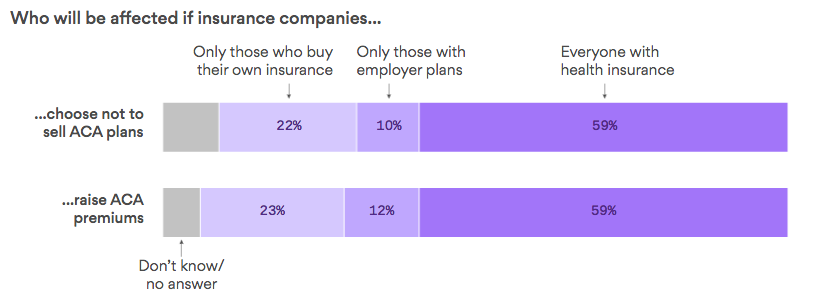
The chart based on our new Kaiser Tracking Poll shows the confusion. Just 23% of the American people know that rising premiums in the ACA marketplaces affect only people who buy their own insurance. More than seven out of 10 wrongly believe rising premiums in the marketplaces affect everyone or people who get coverage through their employer.

The public will be susceptible to spin and misrepresentation of the limited goals of Alexander-Murray: a bipartisan effort to stabilize the marketplaces by funding the cost-sharing reduction subsidies, providing more resources for open enrollment outreach, and expediting state waivers.

President Trump has added to the confusion. He recently pronounced the ACA “dead”, adding, “there is no such thing as Obamacare anymore.” Possibly that’s because he wishes it was dead. More likely, he was referring to the problems in the ACA marketplaces, which he has exaggerated.

Like thinking your whole house is falling down when just a part of the foundation needs shoring up, both he and the American people have an inaccurate picture of where the marketplaces fit in the ACA and where the ACA fits in the health system.

A few facts:

  • There are just 10 million people enrolled in the ACA marketplaces.
  • The law’s larger Medicaid expansion and consumer protections are popular and working well.
  • The far larger Medicare and Medicaid programs and employer based health system combined cover more than 250 million people, and are largely unaffected by developments in the ACA marketplaces.
  • Premiums for the 155 million people who get coverage through their employers rose a very modest 3% in 2017.

Some conservatives in Congress will hold out for repeal, and they’ll resist any legislation that they view as propping up Obamacare. But for everyone else, it’s important to understand the problem and get the facts.