


Tag Archives: Medicare
Top 8 challenges physicians face

Healthcare CEO gets 10 years for fraud that led to 2 patient deaths
How Small Ideas Are Helping to Bend the Health Care Cost Curve
http://www.thefiscaltimes.com/2016/04/10/How-Small-Ideas-Are-Helping-Bend-Health-Care-Cost-Curve

Even as overall U.S. health care spending grew by 5.3 percent in 2014 – reaching a jaw-dropping $3 trillion — the healthcare industry has made some important strides in trying to bend the overall cost curve in the coming years, according to some experts. Since the advent of the Affordable Care Act in 2010, for instance, the move away from so-called fee-for-service that maximizes costs for insurers and patients by encouraging excessive billings has begun to make some inroads in overall spending.
Consulting firm president gets 5-year prison term for role in kickback scheme

According to evidence presented at trial, Mr. Nerey referred Medicare beneficiaries to two home healthcare companies in return for kickbacks. Some of the patients he referred did not qualify for home healthcare services. Mr. Nerey was involved in the kickback scheme from October 2014 to September 2015, according to the DOJ.
In addition to his prison term, Mr. Nerey was ordered to pay more than $2.3 million in restitution.
Clinton’s Plan to Extend Medicare Raises Red Flags

Hillary Clinton last month dusted off a long-standing proposal of hers to expand health care coverage by allowing uninsured people 55 and older to qualify for Medicare – the government health care program for the elderly.
Her proposal potentially could help nearly 13 million Americans below the age of 65 who are currently without insurance. It also provided the former secretary of state with a rejoinder to rival Sen. Bernie Sanders’ call for supplanting Obamacare with a European-style national health insurance program he called “Medicare for All.”
Biggest healthcare frauds in 2016: Running list
http://www.healthcarefinancenews.com/slideshow/biggest-healthcare-frauds-2016-running-list?p=0

Healthcare fraud is not new to the pages of Healthcare Finance. In a $3 trillion industry, Medicare, payer and patient fraud is bound to happen and the responsible parties are also bound to be caught.
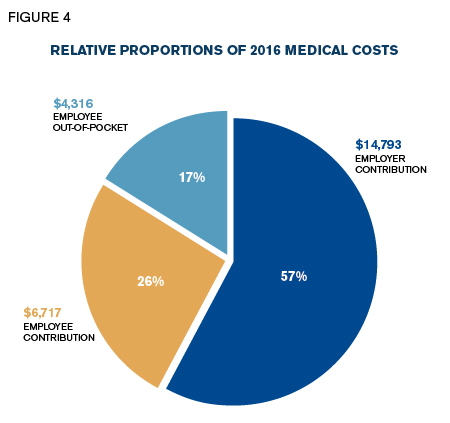
Health Care Costs for Average American Family Now Exceed $25,000 a Year

Justice Department accuses Ontario-based hospital chain of cheating Medicare system
http://www.latimes.com/business/la-fi-prime-healthcare-20160525-snap-story.html
The U.S. Justice Department has joined a whistle-blower case against Prime Healthcare Services, adding significant weight to allegations of widespreadMedicare overbilling at 14 of the company’s hospitals in California. A Los Angeles magistrate judge granted the agency’s request to intervene in the case Tuesday, one day after the government declared in a court filing that its investigation of the Ontario- hospital operator has “yielded sufficient evidence” that the facilities “submitted or caused the submission of claims to Medicare for unnecessary inpatient stays.” Prime finds itself under federal scrutiny because of a whistle-blower complaint submitted in 2011 by Karin Berntsen, a registered nurse and director of quality and risk management at Alvarado Hospital in San Diego. Berntsen’s lawsuit accuses Prime of routinely making Medicare patients’ illnesses seem more severe than they really were in order to justify billing for additional services and increasing hospital admissions.
How Health Care Factors Into the Presidential Campaign
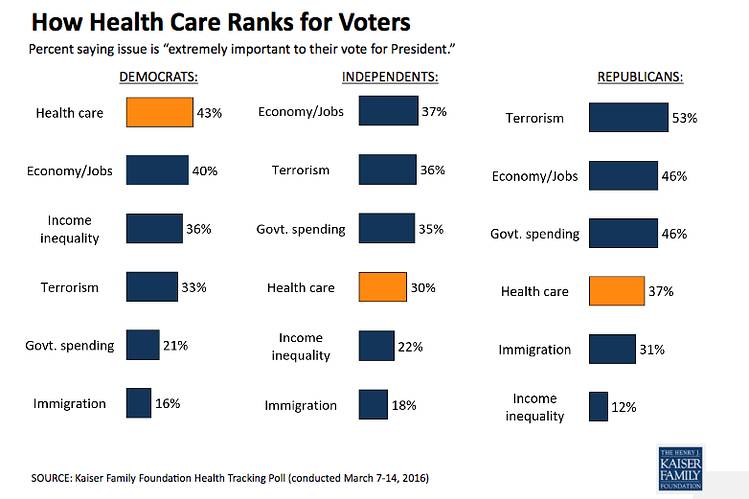
Health care has faded into the background of the election campaign as Donald Trump himself has become the issue on the Republican side and the debate between Hillary Clinton and Bernie Sanders over health care has shifted to other topics. This doesn’t mean that health will be the No. 1 or No. 4 factor when Democrats and Republicans vote in November. As the chart also shows, issue priorities are closely bunched, and my experience has been that voters cast ballots in presidential elections on the basis of their overall views of the candidates rather than candidates’ specific positions on issues.
When people say health care is an extremely important voting issue, they aren’t always thinking of the ACA. Among Republicans who say health is “extremely important” to their vote, about equal shares are thinking about the ACA as are thinking about issues such as access to care and health-care costs. Nor are Democrats always intending to support the ACA when they cite health as a voting issue. They are more likely to cite improving access or addressing costs generally as their reason for naming health a top voting issue.

