How Medicare Advantage steers the Silver Tsunami into coordinated, value-based care

https://www.healthcarefinancenews.com/news/how-medicareadvantage-steers-silver-tsunami-coordinated-value-based-care

CMS and other health insurers are using the program to deliver innovative and unique value to customers, both in terms of cost and quality.

Today’s Medicare Advantage plans are flourishing and the Silver Tsunami is among the reasons.

“Over the last four years, Medicare Advantage enrollment increased by more than 30 percent, while the number of people eligible for Medicare grew by about 18 percent,” said Steve Warner, vice president of Medicare Advantage Product for UnitedHealthcare Medicare and Retirement.

Other reasons for the growth: Innovative models from big insurers and upstarts alike that improve care for health plan members and drive revenue for payers as they look beyond fee-for-service.

IT STARTS WITH THE CONSUMER

Consumers are finding unique value in MA, both in terms of the quality of care and in the financial value.

Medicare Advantage, in fact, makes it easier for consumers to navigate the healthcare system and choose providers, in a way that traditional Medicare does not, said those interviewed.

“Actually it’s pretty hard to navigate the healthcare system on your own,” said Tip Kim, chief market development officer at Stanford Health Care. “Most Medicare Advantage plans have some sort of care navigation.”

Warner of UnitedHealth’s Warner added that Medicare Advantage also offers value and simplicity.

“It provides the convenience of combining all your coverage into one plan so you have just one card to carry in your wallet and one company to work with,” Warner said. “Most plans also offer prescription drug coverage and additional benefits and services not available through original Medicare, including dental, vision and fitness.”

REBRANDING FOR THE NEW ERA

MA plans did not emerge out of thin air. By another name, Medicare Advantage is managed care, a term that was the bane of healthcare during the height of HMOs in the 1980s.

“Medicare Advantage has rebranded ‘managed care’ to ‘care coordination,'” said consultant Paul Keckley of The Keckley Report. “Humana and a lot of these folks have done a pretty good job. Coordinating care is a core competence. Managed care seems to be working in this population.”

MA came along at the right time for CMS’s push to value-based care.

“I would suggest on the providers’ side, embracing Medicare Advantage is an opportunity to get off the fee-for-service mill,” said Jeff Carroll, senior vice president of Health Plans for Lumeris, which recently paired with Stanford Health Care on the Medicare Advantage plan, Stanford Health Care Advantage.

“Provider-sponsored Medicare Advantage plans are a way to put teeth into an accountable care organization,” Keckley added. “Medicare Advantage success is a silver tsunami among major tsunamis. Obviously it’s a profitable plan for seniors and profitable for underwriters. The winners in the process will get this to scale.”

MA is an innovative model that is not a government-run system, but a privately-run system essentially funded by the government.

PAYERS IN THE MA GAME

UnitedHealthcare has the largest MA market share of any one insurer.  Twenty-five percent of Medicare Advantage enrollees are in a UnitedHealthcare MA plan, followed by 17 percent in Humana, 13 percent in a Blue Cross Blue Shield and 8 percent in Aetna, according to the Kaiser Family Foundation.

Numerous insurers, in fact, have gotten into the MA market, including Clover Health in San Francisco, a five-year-old startup which has Medicare Advantage as its only business.

Clover is a tech-oriented company that boasts machine learning models that can accurately predict and identify members at risk of hospitalization.

Because Clover focuses only on MA, it can do a better job at problem solving the needs of an older population, said Andrew Toy, president and CTO of Clover Health.

“The problems we face in Medicare Advantage are very different from a younger generation,” Toy said.

Forty percent of the older population is diabetic. Most seniors will be dealing with a chronic disease as they get older.

In other insurance, whether its individual or commercial, the lower cost of the healthier population offsets the cost of the sicker population. MA has no way to offset these costs. Plans can’t cherry-pick consumers or raise premiums for a percentage of the population.

What MA plans can do is design plans that fit the varying needs of the population. A plan can be designed for diabetics. For younger seniors or those not dealing with a chronic disease, a plan can be designed that includes a gym membership.

“All these plans are regulated,” Toy said. “We have the flexibility to move dollars around. We can offer a higher deductible plan, or a nutrition plan. The incentives for us in Medicare Advantage are different than the incentives in Medicare. CMS has explored giving us more leeway for benefits. Consumers have a choice while still having the guarantees of Medicare.”

Toy believes regular Medicare is more expensive because MA offers a more affordable plan based on what an individual needs.

“When you need it, we get more involved in that care,” Toy said, such as “weight control issues for diabetics.”

The drawbacks are narrower networks, though Toy said Clover offers an out-of-network cost sharing that is pretty much in line with being in-network.

UnitedHealthcare’s Medicare Advantage LPPO plans offer out-of-network access to any provider who accepts Medicare, Warner said.

UnitedHealthcare also offers a wide variety of low and even zero-dollar premium Medicare Advantage plans and annual out-of-pocket maximums, Warner said. By contrast, original Medicare generally covers about 80 percent of beneficiaries’ healthcare costs, leaving them to cover the remaining 20 percent out-of-pocket with no annual limit.

“From a consumer value proposition, it makes Medicare Advantage a better deal,” Kim said. “One is Part B, 20 percent of an unknown number. Knowing what the cost will be in a predictable manner is a preferable manner.”

Stanford Health Care launched a Medicare Advantage plan in 2013. Lumeris owned and operated its own plan, Essence Healthcare, for more than eight years. Stanford and Lumeris partnered on Stanford Health Care Advantage in northern California, using Lumeris technology to help manage value-based reimbursementand new approaches to care delivery through artificial intelligence-enabled diagnostic tools and other methods.

“We are not a traditional insurance company,” Kim said. “We’re thinking about benefits from a provider perspective. It’s a different outlook than an insurance company. By definition we’re local.”

MA MARKET STILL HAS ROOM TO GROW

While the Medicare Advantage market is competitive, it is also under-penetrated, Brian Thompson, CEO for UnitedHealthcare Medicare & Retirement, said during a 2018 earnings report.

Currently, about 33 percent of all Medicare beneficiaries are in an MA plan, he added, but UnitedHealth sees a path to over 50 percent market concentration in the next 5-10 years.

It’s a path not so subtly promoted by the Centers for Medicare and Medicaid Services.

As a way to encourage insurers to take risk and get in the market, around 2009, CMS gave MA insurers 114 percent of what it paid for fee-for-service Medicare. The agency began decreasing those payments so that by 2017, traditional Medicare and MA became about even.

MA insurers instead thrive on their ability to tailor benefits toward wellness, coordinate care and contain costs within the confines of capitated payments, the essence of value-based care.

They have received CMS support in recent rate notices that gives them the ability to offer supplemental benefits, such as being able to target care that addresses the social determinants of health. Starting in 2020, telehealth is being added to new flexibility for these plans.

WHAT THE FUTURE MAY HOLD FOR MA

Medicare Advantage plans have expanded and, in so doing, opened innovative new options for plans and their customers alike at the same time that the ranks of people eligible for Medicare continues to swell.

So where is it all going?

Medicare Advantage is changing the way healthcare is paid and delivered to the point that Keckley and Toy agreed the future may not lie in Medicare for All, but in Medicare Advantage for all.

“I think a reasonable place to end, is in some combination where the government is involved in price control, combined with the flexibility of Medicare Advantage,” Toy said. “That’s really powerful.”


FURTHER MEDICARE EXPANSION COULD DIMINISH HOSPITAL REVENUES, BUT ACTION REQUIRED

https://www.healthleadersmedia.com/finance/further-medicare-expansion-could-diminish-hospital-revenues-action-required?utm_source=silverpop&utm_medium=email&utm_campaign=ENL_190321_LDR_FIN%20(1)&spMailingID=15334448&spUserID=MTY3ODg4NTg1MzQ4S0&spJobID=1601649422&spReportId=MTYwMTY0OTQyMgS2

Medicare for All

Potential Medicare expansion plans would drastically impact the financial standing of health systems, though some may be more pragmatic solutions than others.


KEY TAKEAWAYS

Implementing Medicare for All as a single payer healthcare system is estimated to create a 22.1% negative impact on a mid-size regional provider’s net margin.

However, a voluntary buy-in plan, also known as ‘Medicare for more,’ might result in only a slight dip to the net margin compared to the status quo.

Regardless, some amount of legislative action regarding Medicare expansion will be necessary in the next five years, according to the study’s authors.

Hospital and health systems should remain aware of the financial impact that several Medicare expansion proposals could have on their respect organizations, according to a Navigant study released Friday afternoon.

Fresh off the 2018 midterm elections where healthcare played a critical role in the electoral shift that saw Democrats retake the House of Representatives, 2020 presidential candidates are heralding sweeping policy proposals to expand coverage through Medicare. 

While several versions of Medicare for All legislation exist, other policy proposals such as ‘Medicare for more’ or the public option have drawn consideration from lawmakers as potentially more viable or pragmatic solutions to America’s healthcare problems.

In its analysis, Navigant found a medium-sized, nonprofit, multi-hospital system with revenues of more than $1 billion and a current operating margin of 2.3% would endure vastly different financial implications under several proposed federal healthcare policy changes.

Medicare for All would reduce revenues by around $330 million, a margin drop of just over 22%, the public option proposal would cause revenue declines in the neighborhood of $153 million, a margin impact of -6.3%, and the ‘Medicare for more’ expansion plan is estimated to have a neutral impact compared to the status quo.

Still, Navigant’s study points out that if Congress does not act on Medicare expansion until after the next presidential election, hospitals could face a scenario with a financial impact comparable to the public option proposal.

Using the model health system as an example, status quo projections without any cost reduction initiatives would see the organization’s net margin decline from 2.3% to negative 6.2% from 2018 to 2023, with operating costs rising between 4.5% to 5% per year and revenues growing at 2.5% to 3% per year.

“There’s going to be a need to control hospital cost structures going forward, regardless of whether it’s in the status quo with baby boomers aging into Medicare and payer mix shifts occurring, or in a scenario that has limited expansion, moderate expansion, or robust Medicare for All,” Jeff Leibach, director at Navigant, told HealthLeaders in an interview. “There are obviously varying degrees of impact on hospitals, but all of them are going to require a level of attention and and management of revenue strategy and cost structure that I think hospital CFOs are struggling with today and will benefit from through continued focus on performance improvement and revenue strategy.”

PLANS, DETAILS, AND IMPACT:

‘Medicare for more’

  • Voluntary buy-in at age 50 and over
  • In one scenario, choice between employer coverage and Medicare
  • No Medicare payment relief
  • No reduction in revenue cycle management operations compared to the status quo
  • 15% reduction in current disproportionate share hospital payments

Public option

  • All lives covered regardless of age
  • Choice between employer coverage and Medicare
  • Range from no Medicare payment relief to payments at 110% of Medicare rate
  • 1.5% reduction in revenue cycle management operations compared to the status quo
  • 70% reduction in current disproportionate share hospital payments

Medicare for All

  • All lives covered regardless of age
  • Single payer healthcare coverage
  • Range from no Medicare payment relief to payments at 120% of Medicare rate
  • 2.5% reduction in revenue cycle management operations compared to the status quo
  • 100% reduction in current disproportionate share hospital payments

Leibach said that the analysis arrives at the early part of the conversation surrounding widespread Medicare expansion at the federal level, which makes it difficult to gauge how health system leaders will react to Navigant’s findings.

Some may be hesistant to support plans that are projected to create such a negative material impact on their respective bottom lines, but others may be willing to consider a policy proposal that significant decreases or even eliminates bad debt costs associated with a large uninsured population.

Even before the report was released, however, the American Hospital Association declined to voice support for Medicare for All late last month. 

Leibach added that he was surprised by the “nominal impact” of the voluntary buy-in plan, arguing that could hospital leaders may rally around that proposal as a compromise to expanding Medicare without fully deteriorating their financial standing.

This approach would also be the least disruptive to the commercial insurance market, according to Leibach, assuming that the Medicare for All proposal would be a true single-payer platform that eliminates private insurers.


HBO’s Elizabeth Holmes Theranos documentary exposes American health care

https://www.cnet.com/news/hbo-documentary-on-elizabeth-holmes-theranos-lie-exposes-american-health-care/?utm_source=Sailthru&utm_medium=email&utm_campaign=Issue:%202019-03-20%20Healthcare%20Dive%20%5Bissue:19979%5D&utm_term=Healthcare%20Dive

Image result for HBO's Elizabeth Holmes Theranos documentary exposes American health care

“The health care system has become horribly perverted,” says Alex Gibney, director of The Inventor: Out for Blood in Silicon Valley.

Nobody likes having a needle stuck in their arm. And nobody likes having money sucked out of their wallet, either. So when smart young entrepreneur Elizabeth Holmes emerged from Silicon Valley claiming to have a cure for a broken health care system, politicians and journalists and investors couldn’t wait to shower her with praise and money.

But the story of Holmes’ company comes with a sting. Her black outfits helped create an image of a new Steve Jobs-esque voice in Silicon Valley, but after faking demos and lying about patient treatment Holmes and her partners are now awaiting trial on charges of fraud.

The Theranos fraud exposes fundamental problems with Silicon Valley, the health care industry and the myth of the genius inventor from Thomas Edison to Steve Jobs. New documentary The Inventor: Out for Blood in Silicon Valley, now available to stream on HBO, reveals the whole bloody mess.

I asked the film’s Oscar-winning director, Alex Gibney, if we fetishize the idea of a genius inventor. “We do,” he told me by phone from San Francisco, “and it’s bullshit.” Having tackled corruption and deceit in films about Enron, the Church of Scientology and the White House, Gibney describes Holmes as “a variation on a theme” of the type of people he’s seen before. “Elizabeth was afflicted with the notion that the end justifies the means,” Gibney says. “She thought she was entitled to make mistakes because her intention was pure and worthy and socially vital. But the mind plays tricks with you when you start down that path, as you rationalize your behavior in ways that can become quite dangerous and delusional.”

Big-name investors from both inside and outside Silicon Valley fell for Holmes’ delusion, including Rupert Murdoch, who invested $125 million into Theranos. But the question remains whether the profit-driven private sector is even suited to solving health care problems. “Reports show the health care system in the US has become horribly perverted,” says Gibney, “through this patchwork system of insurance and private enterprise and then also government legislative initiatives. Medicare is not allowed to negotiate directly with drug companies, how crazy is that?”

Everyone can agree that fixing problems in health care is a noble cause, but relying on Silicon Valley and the private sector also lined up with other political agendas for the politicians who backed her. “This notion of the entrepreneur lets government off the hook,” Gibney says.

The director does credit Holmes with highlighting problems in the laboratory testing industry. “They’re incredibly opaque with their pricing,” he points out. Patients don’t pay directly for blood tests, so depending on the circumstances, the illness or even the state, lab companies can charge outrageous prices to insurance companies to complete the test.

The health care system “is designed to enrich companies rather than to serve the health of patients,” says Gibney. “It’s full of all sorts of bad incentives.”

While things clearly need to be improved, the Silicon Valley style of disruptive innovations may not be what we as patients need. Taking control of your own health is a “a very cool-sounding libertarian notion,” but Gibney cautions that “we’re not doctors.” He’s concerned about the idea of treating patients as customers, seducing us with promises of competitive prices and greater choice. “That’s good for sneakers,” he says, “but I’m not sure a consumer/producer relationship is necessarily good for health care. You want a patient/doctor relationship, and blood testing is part of it.”

Silicon Valley has adapted the credo of “move fast and break things,” which means iterating and making mistakes until you find the right path. But you can’t make mistakes when people’s lives are at stake. And real people were put at risk when Theranos pushed ahead with a contract with Walgreens to carry out blood tests for ordinary people.

“That was a line Elizabeth crossed,” says Gibney. “If she had just wasted a lot of investors’ money on a machine that didn’t work, there wouldn’t really be a story here. It was when she put people at risk, that was the problem.”

Gibney is concerned that Holmes will be portrayed as a one-off, “one rotten apple in an otherwise pristine barrel.” But he thinks the Theranos fraud shows cracks across Silicon Valley, the health care industry and capitalism as a whole. “I tried to indicate there are bigger problems in Silicon Valley in terms of lying, in terms of becoming disruptors in ways that may make people a lot of money but may not always be a good thing.”

Within Theranos, a culture of silence and paranoia couldn’t suppress the lies forever. And so Theranos employees blew the whistle on the deceit.

“I think all of us should be aware that there are certain cultural, and also legal, impediments to hearing the bad news,” says Gibney, who highlights the use of nondisclosure agreements to gag employees. These legal contracts are supposed to protect trade secrets, but they can also be used to prevent insiders from calling out corruption. “Look at Harvey Weinstein,” Gibney says. “NDAs are rapaciously used by people to cover up misdeeds.” 

Yet for some reason, we have a strange relationship with those insiders who do come forward. “It’s sort of like they’re showing us up,” says Gibney. He recalls being asked the same two questions over and over after making The Smartest Guys in the Room, his film about the corruption within Enron: “One was about this guy who got away with it, sailed off with $200 million and married a stripper. But the other question was about Sharon Watkins, the whistleblower, and it was always, ‘Who does she think she is? How come she’s so holier-than-thou?’ Of all the lessons to take away from Enron, she’s not really the malefactor, but it seemed to really get under people’s skin.”

Gibney has made a career out of exposing corruption from the business sector to the CIA to the White House. “Part of us is secretly thrilled by people who are conning the game,” he says. “But we always at the end want to see them punished, so it’s kinda like a double pleasure. You wanna see ’em sneak around — and then you wanna see the hammer come down.”

“I’ve been spending a lot of time on problems,” Gibney says as we wrap up the interview. “I’m starting to think about doing films about people who are coming up with solutions.”


Congress Warns Against Medicaid Cuts: ‘You Just Wait for the Firestorm’

Image result for Congress Warns Against Medicaid Cuts: ‘You Just Wait for the Firestorm’

WASHINGTON — If President Trump allows states to convert Medicaid into a block grant with a limit on health care spending for low-income people, he will face a firestorm of opposition in Congress, House Democrats told the nation’s top health official on Tuesday.

The official, Alex M. Azar II, the secretary of health and human services, endured more than four hours of bipartisan criticism over the president’s budget for 2020, which would substantially reduce projected spending on Medicaid, Medicare and biomedical research. Democrats, confronting Mr. Azar for the first time with a House majority, scorned most of the president’s proposals.

But few drew as much heat as Mr. Trump’s proposed overhaul of Medicaid. His budget envisions replacing the current open-ended federal commitment to the program with a lump sum of federal money for each state in the form of a block grant, a measure that would essentially cap payments and would not keep pace with rising health care costs.

Congress rejected a similar Republican plan in 2017, but in his testimony on Tuesday before the Health Subcommittee of the House Energy and Commerce Committee, Mr. Azar refused to rule out the possibility that he could grant waivers to states that wanted to move in that direction.

Under such waivers, Mr. Azar said, he could not guarantee that everyone now enrolled in Medicaid would keep that coverage.

“You couldn’t make that kind of commitment about any waiver,” Mr. Azar said. He acknowledged that the president’s budget would reduce the growth of Medicaid by $1.4 trillion in the coming decade.

Representative G. K. Butterfield, Democrat of North Carolina, said that “block-granting and capping Medicaid would endanger access to care for some of the most vulnerable people” in the country, like seniors, children and the disabled.

Mr. Trump provoked bipartisan opposition by declaring a national emergency to spend more money than Congress provided to build a wall along the southwestern border. If the president bypasses Congress and allows states to convert Medicaid to a block grant, Mr. Butterfield said, he could face even more of an outcry.

“You just wait for the firestorm this will create,” Mr. Butterfield said, noting that more than one-fifth of Americans — more than 70 million low-income people — depend on Medicaid.

As a candidate, Mr. Trump said he would not cut Medicare, but his new budget proposes to cut more than $800 billion from projected spending on the program for older Americans in the next 10 years. Mr. Azar said the proposals would not harm Medicare beneficiaries.

“I don’t believe any of the proposals will impact access to services,” Mr. Azar said. Indeed, he said, the cutbacks could be a boon to Medicare beneficiaries, reducing their out-of-pocket costs.

After meeting an annual deductible, beneficiaries typically pay 20 percent of the Medicare-approved amount for doctor’s services and some prescription drugs administered in doctor’s offices and outpatient hospital clinics.

Mr. Azar defended a budget proposal to impose work requirements on able-bodied adults enrolled in Medicaid. Arkansas began enforcing such requirements last year under a waiver granted by the Trump administration. Since then, at least 18,000 Arkansans have lost Medicaid coverage.

Mr. Azar said he did not know why they had been dropped from Medicaid. It is possible, he said, that some had found jobs providing health benefits.

Representative Joseph P. Kennedy III, Democrat of Massachusetts, said it would be reckless to extend Medicaid work requirements to the entire country without knowing why people were falling off the rolls in Arkansas.

If you are receiving free coverage through Medicaid, Mr. Azar said, “it is not too much to ask that you engage in some kind of community engagement.”

Representative Fred Upton, Republican of Michigan, expressed deep concern about Mr. Trump’s proposal to cut the budget of the National Cancer Institute by $897 million, or 14.6 percent, to $5.2 billion.

Mr. Azar said the proposal was typical of the “tough choices” in Mr. Trump’s budget. He defended the cuts proposed for the National Cancer Institute, saying they were proportional to the cuts proposed for its parent agency, the National Institutes of Health.

The president’s budget would reduce funds for the N.I.H. as a whole by 12.6 percent, to $34.4 billion next year.

Mr. Azar was also pressed to justify Mr. Trump’s proposal to cut federal payments to hospitals serving large numbers of low-income patients. Representative Eliot L. Engel, Democrat of New York, said the cuts, totaling $26 billion over 10 years, would be devastating to “safety net hospitals” in New York and other urban areas.

Mr. Azar said that the Affordable Care Act, by expanding coverage, was supposed to “get rid of uncompensated care” so there would be less need for the special payments.

While Democrats assailed the president’s budget, Mr. Azar relished the opportunity to attack Democrats’ proposals to establish a single-payer health care system billed as Medicare for all.

Those proposals could eliminate coverage provided to more than 20 million people through private Medicare Advantage plans and to more than 155 million people through employer-sponsored health plans, he said.

But Mr. Azar found himself on defense on another issue aside from the president’s budget: immigration. He said he was doing his best to care for migrant children who had illegally entered the United States, were separated from their parents and are being held in shelters for which his department is responsible.

He said he was not aware of the “zero tolerance” immigration policy before it was publicly announced in April 2018 by Attorney General Jeff Sessions. If he had known about the policy, Mr. Azar said, “I could have raised objections and concerns.”

Representative Anna G. Eshoo, Democrat of California and the chairwoman of the subcommittee, summarized the case against the president’s budget.

“The Trump administration,” she said, “has taken a hatchet to every part of our health care system, undermining the Affordable Care Act, proposing to fundamentally restructure Medicaid and slashing Medicare. This budget proposes to continue that sabotage.”


Trump continues his war on Americans’ health care to pay for his tax cuts

https://www.americanprogress.org/issues/economy/news/2019/03/11/467108/trumps-fy-2020-budget-exposes-false-promises-misplaced-priorities/

Image result for medicare cuts

After repeatedly trying and failing to repeal the ACA legislatively, President Trump and congressional Republicans have resorted to attacking and weakening the law through executive action, federal waivers to the states to undermine Medicaid expansion, and budget proposals to gut funding levels.

Once again, Trump’s budget proposes massive cuts—$777 billion over 10 years—from repealing the ACA and slashing Medicaid.

Like in his previous two budgets, Trump goes beyond these two measures to attack traditional Medicaid, seeking to restrict federal funding on a per-beneficiary basis or transition to block grant funding. Both of these things would lead to a significant decrease in federal funding and could cause millions of people to lose their health care coverage.

Like in last year’s budget, he encourages states to take Medicaid away from jobless and underemployed Americans, including laid-off workers, people who are going to school, and those who are taking care of children or family members. Medicaid is a lifeline for millions of Americans—including children, veterans, people with disabilities, and individuals affected by the opioid crisis. Tearing down this vital program will make it more difficult for people to access the health care they need to find work, including by preventing people with disabilities from accessing the long-term services and supports they need to participate in the labor market.

After he repeatedly promised to protect Medicare as a candidate, Trump makes changes to Medicare that would shrink the program by $845 billion over the coming decade.


Trump’s 2020 budget proposal: 5 healthcare takeaways

https://www.beckershospitalreview.com/finance/trump-s-2020-budget-proposal-5-healthcare-takeaways.html

Image result for medicaid cuts

President Donald Trump released his $4.75 trillion budget for fiscal year 2020 on March 11. The proposal, titled “A Budget for a Better America: Promises Kept. Taxpayers First,” calls for reductions to Medicare and Medicaid over 10 years and includes provisions related to drug pricing and many other health-related issues.

Below are five healthcare-related proposals in the president’s budget:

1. Discretionary funding for HHS. The budget requests $87.1 billion in discretionary spending for HHS, a 12 percent decrease from 2019 funding levels.

2. Efforts to curb HIV. Keeping with President Trump’s promise in his State of the Union address to end the spread of HIV in the U.S. over the next decade, the budget plan calls for HHS to receive $291 million next year to help curb the spread of the virus. A large portion of the funding — $140 million — would go to the CDC to improve diagnosis and testing for HIV in areas of the U.S. where the virus is continuing to infect people not getting proper treatment.

3. Broad overhaul of Medicaid. Under the budget, nearly $1.5 trillion would be cut from Medicaid over 10 years. However, the budget seeks $1.2 trillion over the next decade for block grants or per-person caps that would start in 2021, according to The Washington Post. The budget plan would also end funding for Medicaid expansion.

4. Medicare funding changes. Under the budget, Medicare spending would be reduced by an estimated $800 billion over 10 years. The budget would reduce the growth of various Medicare provider payments and includes changes aimed at addressing waste and abuse in healthcare and lowering drug prices, according to The Washington Post.

5. Medical research. The plan includes a proposal to cut $897 million from the National Cancer Institute’s budget and an additional $1 billion in cuts to other institutes that do medical research, according to Politico.

Read the full budget plan here.


Segment 3 – Healthcare Reform Successes & Failures

Segment 3 – Healthcare Reform Successes & Failures

Slide15

In Segment 2, we looked at the history of medical care in the U.S. until 1965, the year Congress enacted Medicare and Medicaid.

In Segment 3 we will look at reform movements, starting with Medicare and Medicaid. We will look at why later reforms failed and where that leaves us now.

By the early 1960s, nearly all employees were covered by Blue Cross/Blue Shield.

But problems emerged. First, low-wage workers were often not covered by their small businesses, and elderly retirees were not covered. Costs were going up because pre-paid insurance increased patient demand for services. Harry Truman had proposed national health insurance after he surprisingly was re-elected in 1948. But the AMA launched a multi-million-dollar publicity campaign to deride the plan as “Communism” and “socialized medicine.” Truman’s public insurance plan failed.

The next attempt at reform was successful – the 1965 passage of Medicare and Medicaid. Lyndon Johnson succeeded because coverage targeted the uninsured poor-and- elderly, leaving the rest of the private for-profit health system unaffected.

Senator Teddy Kennedy tried in 1971 to extend Johnson’s success to build a single-payer system, and won support from President Nixon. But this plan was derailed by the Watergate scandal.

The next attempt came from Bill and Hillary Clinton. After Clinton took office in 1992, Hillary and expert panels devised a plan for universal coverage including essential benefits and pre-existing conditions with mandated employer insurance and expanded Medicaid. This plan failed because the insurance industry launched a stinging publicity campaign featuring a down-home couple named “Harry and Louise.” Americans also balked at the tax increases needed to fund it.

The Clinton’s failure made it necessary to find another solution to rising costs. Managed care, which had first appeared in 1973, became that solution. And it did work, slowing growth to under 6%. But around the year 2000 came a backlash over mammograms and so-called “drive-by” deliveries, which undermined the ability of managed care to control costs.

What do we make of this history? Here are the main take-aways that help us understand our present health system. First, there has always been a tension between the profit motive in the free marketplace and a health promotion motive. Second, Americans have given special treatments to the health industry in return for medical advances. And third, powerful vested interests (doctors, hospitals, insurance, drug companies) have often used polemics and ideological arguments to defend their favored status, not necessarily actual health outcome data.

Slide09

So, this leaves the US with the largest, most expensive healthcare system in the world. In 2011 shown here it took in payments of 2.7 trillion dollars, mostly private insurance, Medicare, Medicaid and out-of-pocket. The figure for 2015 was 3.2 trillion dollars, representing 1/6 of the entire economy of the entire Gross Domestic Product. Government’s share of payments was almost 50% in 2016.

Slide10

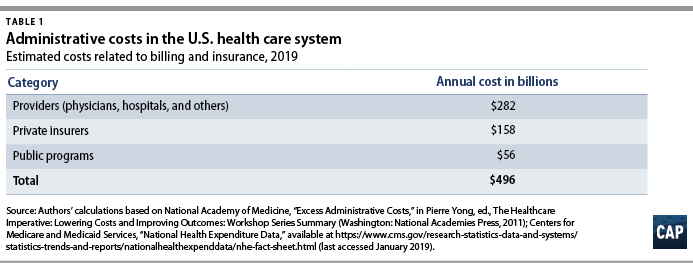
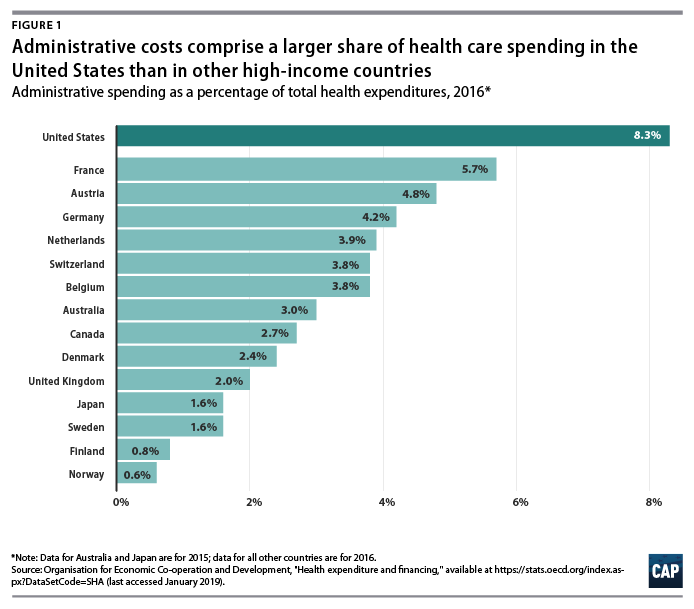
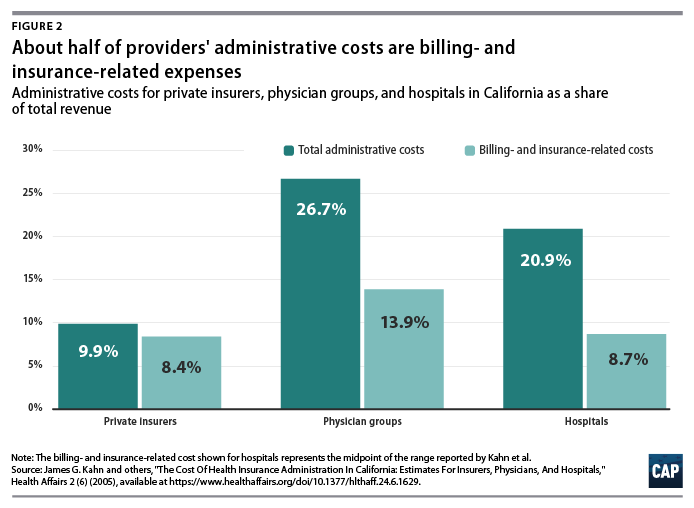
This graph shows the dollars spent in 2011 – mostly on hospitals, doctors, drugs, long-term care. Remember that 25% of this pie graph actually goes to administrative costs, not medical services.

Slide11

In defense of U.S. healthcare, in 2012 then-House-Speaker John Boehner and then Senate Minority Leader Mitch McConnell famously said, “the U.S. has the finest health care system in the world,” and further that “wealthy foreigners flock to the U.S. because of its cutting edge facilities.”

2017-10-13-boehner-mcconnell.png

However, the World Health Organization rates the U.S. 15th in performance (life expectancy and delays in care), and only 37th in overall attainment (including financial and service fairness).

In 2015 the Kaiser Foundation compared the US with 10 other developed countries. Here are their results showing areas in which US is better, equal or lacking.

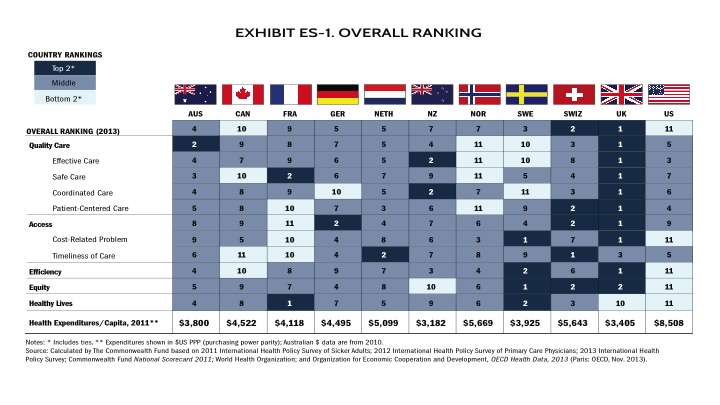
Here are the Commonwealth Fund’s 20-11 rankings – US is in the middle of the pack for most areas but dead last on several others and overall rank.

Slide14Source: http://www.commonwealthfund.org/publications/fund-reports/2014/jun/mirror-mirror

What about “foreigners flocking-for-care”? This pertains to highly specialized treatments available only in certain centers such as Mayo, Cleveland Clinic or Hopkins. Some centers in Florida and Texas do market to wealthy foreigners, who pay the full charge in cash, not discounted insurance rates like the rest or us. Boehner and McConnell pointed to Canadians coming to Michigan hospitals, but the Commonwealth study found that Canada is worst in timeliness and 10th worst overall, just ahead of the US in 11th place, so not surprising.

The further truth is that, according to Centers for Disease Control, 3/4 million Americans go abroad each year for medical treatments, such as for holistic care or dental care, but mostly seeking lower cost.

In the next Segment we will talk about cost, namely how the rising cost of healthcare is affecting our economy, our politics, our society – and some say our very existence.

I’ll see you then.


Market Concentration and Potential Competition in Medicare Advantage

https://www.commonwealthfund.org/publications/issue-briefs/2019/feb/market-concentration-and-potential-competition-medicare

Market concentration and competition

ABSTRACT

  • Issue: Medicare Advantage (MA), the private option to traditional Medicare, now serves roughly 37 percent of beneficiaries. Congress intended MA plans to achieve efficiencies in the provision of health care that lead to savings for Medicare through managed competition among private health plans.
  • Goal: Two elements are needed for savings to accrue: a sound payment policy and effective competition among the private plans. This brief examines the latter.
  • Methods: We use data from 2009–17 to describe market structure in MA, including the insurers offering plans and enrollment in each U.S. county. We measure both actual and potential competitors for each county for each year.
  • Key Findings and Conclusions: MA markets are highly concentrated and have become more concentrated since 2009. From 2009–17, 70 percent or more of enrollees were in highly concentrated markets, dominated by two or three insurers. Since the payment system used to reimburse insurers selling in the MA market relies on competition to spur efficiency and premiums that more closely reflect insurers’ actual costs, these developments suggest that taxpayers and beneficiaries will overpay. We also find an average of six potential entrants into MA markets, which points to a source of competition that may be activated in MA. To tap into potential competition, further research is needed to understand the factors affecting entry into MA markets.

Introduction

Medicare Advantage (MA), the private option to traditional Medicare (TM), now serves roughly 37 percent of beneficiaries through health care plans. Federal subsidy of the premiums of MA plans is intended to create a “level playing field,” so that the government pays MA plans based on what beneficiaries would typically cost in TM. This approach is based on Alain Enthoven’s concept of “managed competition,” wherein private plans that provide better benefits and higher-quality care at a lower price than TM would attract beneficiaries. Two elements are needed for this approach to work: a sound payment policy and effective competition among the private plans. This issue brief examines the latter.

Recent data show that many MA markets are served by just one or a small number of insurers.1 In 2012, 97 percent of county markets in the MA program were designated as highly concentrated according to the definitions used by the Federal Trade Commission (FTC) and the U.S. Department of Justice (DOJ), with a Hirschman-Herfindahl Index (HHI) of greater than 2,500.2 In 2016, the Medicare Payment Advisory Commission observed that local markets for MA plans were becoming increasingly concentrated.3 Recently, courts have blocked mergers that would further erode competition within the MA market.4

This issue brief updates information about the market structure in the MA program. We report on traditional measures of market structure, such as concentration ratios and the HHIs, and a simple count of the number of insurers offering plans in a market. We also include the “two-firm concentration ratio,” or the share of enrollment accounted for by the top two firms. We also offer new perspectives on competition in MA. First, we comment on competition and choice from the standpoint of a beneficiary by examining the number of plans available. Second, we introduce the idea of “potential competition” in an MA market. Potential competition, like actual competition, can constrain market power. Third, we consider the role of TM in constraining the market power of MA insurers.

Actual and Potential Competition

News stories about consumers’ choices among Medicare Advantage plans often begin with a statement such as “On average, seniors will have a choice of 21 plans, although at least 40 plans will be accessible in some counties and large metropolitan areas of the country.”5 But such accounts give a misleading indication of competition in the MA program, because many insurers offer multiple health plan products in the same market. In this issue brief, we measure the number of MA plans but also focus on the number of different insurers in the market to assess competition at the insurer level.

An insurer needs to be wary of potential as well as actual competitors. Insurers that set premiums high may enable competitors to gain footholds in a market. A market is said to be “contestable” if it is relatively easy for a potential entrant to contest for market share.6Barriers to entry, the magnitude of one-time entry costs, and the availability of comparably efficient technology all influence contestability of a market. Here, we identify “potential competitors,” or insurers that are in a position to contest a county-defined market and therefore pose a competitive threat to incumbents. Insurers licensed to operate MA plans in a state have already crossed some local regulatory barriers and contract with some local providers. We therefore measure potential competition by the number of health insurers participating in some MA markets within the state but not in a particular county.

Data and Measurement

We use data from 2009–17 to describe market structure in MA, including the insurers offering plans in each county and the level of enrollment by county and plan. From these data we measure both actual and potential competitors for each county for each year. Actual competitors are those insurers that participate in MA in a specific county; potential competitors are the insurers participating in MA in a state but not in the county of interest. These data also allow us to compute concentration ratios and the HHI for each county and in each year. In some analyses we categorize the counties according to the HHI corresponding to the FTC/DOJ classifications of concentration: 1) not concentrated, HHI <1,501; 2) moderately concentrated, HHI=1,501–2,500; and 3) highly concentrated, HHI >2,500.

Results

As shown in Exhibit 1, in 2017 Medicare beneficiaries could choose from a relatively large number of private plans (roughly seven) by the standards of the private insurance market. The number of insurers declined from 2009 to 2011 then remained steady through 2017, averaging 2.5 in 2017. For comparison, in 2017, the average metropolitan area had two insurers competing in the health insurance marketplaces created by the Affordable Care Act.

Insurer concentration increased from 2009 to 2011 (the number of insurers selling MA plans fell from 4.5 to 2.9) then remained at about the same, high level of concentration. The two-firm concentration ratio was already high in 2009 (81%); it rose to 91 percent by 2011 and stayed there through 2017. The average county-level HHI was 4,914 in 2009, rising to 6,360 in 2013, and declining slightly to 6,285 in 2017. To put this in perspective, a market with two equal-size health plans would have an HHI of 5,000. The average MA market is therefore even more concentrated than that. Notably, the number of potential competitors also fell over the same period. Nevertheless there are now more potential than actual competitors in each county.

Exhibit 2 shows that 70 percent or more of MA enrollees were in highly concentrated markets (HHI>2,500). Few MA enrollees were able to choose a plan in a market not dominated by two or three insurers.

Virtually all Medicare enrollees face MA markets that are moderately to highly concentrated. Exhibit 3 shows the distribution of all Medicare enrollees (in MA and TM) by the levels of MA concentration. We stratify markets (i.e., counties) into quartiles according to the size of the total population of Medicare beneficiaries. The table reports mean population and mean HHI for each quartile of the total Medicare population. Among sparsely populated markets, which are largely rural, the mean HHI is 6,684 — indicating that they are highly concentrated. This is in part because of the difficulty that managed care plans, like HMOs and PPOs, have in establishing provider networks in rural areas where providers are scarce and provider markets are highly concentrated. In highly populated markets, the average HHI shows that they too are highly concentrated HHI = 3,774), but the index value is considerably lower than in sparsely populated markets.

Exhibit 4 shows the average numbers of potential entrants in counties grouped by the three HHI ranges. In recent years, there has been little difference in the number of potential competitors in areas with high or low concentration, implying that potential competitors are no more attracted to highly concentrated markets and may not discipline competition any more strongly in areas with few actual competitors. This was not true in earlier years, during which the number of potential competitors was higher in areas with less current competition. The number of potential competitors in moderately concentrated counties has remained steady over the nine-year period.

While Medicare beneficiaries have a choice between TM and MA, in assessing the competitive forces on MA plans we assume that the actual or potential competition from other MA plans matters most. The market position of an MA insurer in relation to TM received examination in connection with two recently proposed mergers, between Aetna and Humana and between Anthem and Cigna. The U.S. Department of Justice challenged these mergers on antitrust grounds, arguing that the proposed consolidations would threaten effective competition in MA. In the Aetna-Humana case, Judge Bates observed: “The weight of the evidence presented at trial indicates ‘industry [and] public recognition’ of a distinct market for Medicare Advantage. Competition within that market, between Medicare Advantage plans, is far more intense than competition with products outside of it.”7 While the role of traditional Medicare in affecting competition in the MA market deserves further analysis, competition among MA plans is where most of market discipline is likely to arise. While the presence of TM likely affects the conduct of MA plans, existing evidence suggests that the primary drivers of consumer choices are differences in the premiums, quality of care, and benefits among MA plans.8

Implications of MA Market Concentration

Even though 37 percent of all Medicare beneficiaries are enrolled in private plans, when compared with employer-based health insurance Medicare’s transition to managed care has been slow. Traditional Medicare is the last major bastion of open-network, fee-for-service health insurance, although the fee-for-service component is beginning to change with the spread of accountable care organizations. Competition or lack thereof of in a market plays a role in accelerating or attenuating this shift. Consumer choices tend to be driven by the better value (premiums and quality) that can turn more favorable with increased competition.

Several forces may have driven greater concentration in MA markets since 2009. First, consolidation in the health insurance industry generally may have affected the MA market structure.9 Concentration in provider markets also has been increasing, which has made price negotiations for health care services more difficult for insurers, especially smaller ones.10 Medicare policy changes over these years may have inadvertently limited the supply and market entry of MA insurers. When Medicare rules were changed to require all MA plans to create networks of providers, the effect of provider concentration was heightened and some health insurers were less willing to remain in and/or enter MA markets. This effect may have been especially significant in rural areas.11 At the same time, there appears to be a substantial number of potential MA insurer entrants in most moderate to highly concentrated markets, yet there appears to have been little clear impact on market outcomes in terms of premiums and quality.

Together, the confluence of these forces continues to push MA markets in the direction of greater concentration. Since the payment system used to reimburse insurers selling in the MA market relies on competition to drive premiums toward insurers’ actual costs, these developments suggest that taxpayers and beneficiaries will overpay for MA products, compared with what they might have paid in markets with more robust competition.

Need for Further Analysis

A competitive market is intended to deliver good products to consumers at low prices. Ultimately, the effect of Medicare Advantage market power on prices or quality of care needs to be assessed empirically. There is some, but limited, evidence on the exercise of MA market power.12 Further research is needed to understand how potential competitors affect the actions of existing competitors. It also will be important to understand the barriers to market entry for potential competitors, especially those that might be lowered to spur greater competition.


1 big thing: Everything will be a fight

https://www.axios.com/newsletters/axios-vitals-d6671137-65fb-49a1-a603-d7e53ab977de.html?utm_source=newsletter&utm_medium=email&utm_campaign=newsletter_axiosvitals&stream=top

Manny Pacquiao Fight GIF - Find & Share on GIPHY

Insurers and hospitals came out swinging yesterday against Democrats’ proposal to let people older than 50 buy into Medicare — a reminder that almost any expansion of public health coverage will provoke a battle with the health care industry.

Between the lines: Politically, an age-restricted Medicare buy-in is about as moderate as it gets for Democrats in the age of “Medicare for All.”

  • It is not a proposal for universal coverage, and it’s a far cry from trying to eliminate private insurance. It would be optional, only a relatively small slice of people would have the option, and they would need to pay a monthly premium.

Yes, but: Being on the more moderate end of the political spectrum does not shield you from a fight.

  • Expanding Medicare would hurt hospitals’ bottom lines, because Medicare pays hospitals less than private insurance does.
  • That’s why the Federation of American Hospitals said yesterday that the idea “would harm more Americans than it would help.”
  • The buy-in plan would primarily compete with employer-based health coverage (that’s what people between 50 and 65 are likely to have). And America’s Health Insurance Plans said the idea “is a slippery slope to government-run health care for every American.”

The bottom line: Any proposal that would compete with (never mind eliminate) private coverage, particularly employer coverage, will meet this kind of resistance.

That’s why Medicaid is the public program Democrats and industry can agree to love. Expanded access to Medicaid has rarely been an alternative to commercial insurance — it’s usually an alternative to being uninsured.

  • The uninsured were the primary beneficiaries of the Affordable Care Act’s Medicaid expansion, and the Medicaid buy-in proposals now popping in the states are aimed at the people who are most likely to be foregoing private ACA coverage because of its cost.


Kamala Harris’ ‘Medicare for all’ would mean massive disruption for healthcare, and the industry is prepared to fight it

https://www.washingtonexaminer.com/policy/healthcare/kamala-harris-medicare-for-all-would-mean-massive-disruption-for-healthcare-and-the-industry-is-prepared-to-fight-it

Image result for Kamala Harris' 'Medicare for all' would mean massive disruption for healthcare, and the industry is prepared to fight it

Democratic presidential contender Sen. Kamala Harris wants to “move on” from the current healthcare system in favor of a plan that would roll everyone in the U.S. onto a government plan known as “Medicare for all,” doing away with private health insurance.

As the California Democrat and others in her party make their case, however, they will face considerable opposition not only in the insurance industry, but across the healthcare sector, which would see massive upheaval from the plan. And polling suggests that the public, roughly half of which relies on private insurance, isn’t quite on board.

Drug companies, insurers, doctors, and hospitals have united in recent months to fight national government healthcare. One healthcare industry group, called the Partnership for America’s Health Care Future, has launched a five-figure digital ad campaign arguing that “Medicare for all” would cause massive disruption, higher taxes, lower quality care, and less choice for patients. It plans to spend six figures bashing “Medicare for all” over the course of 2019.

“Whether it’s called Medicare for all, single payer, or a public option, one-size-fits-all healthcare will mean all Americans have less choice and control over the doctors, treatments, and coverage,” said Lauren Crawford Shaver, the group’s executive director.

Other candidates for the Democratic nomination, such as Sens. Elizabeth Warren of Massachusetts and Kirsten Gillibrand of New York, are, like Harris, co-sponsors of the Medicare for All Act, legislation led by Sen. Bernie Sanders, I-Vt. Although it has “Medicare” in the name, the bill would go much further than current Medicare, which covers adults 65 and older and people with disabilities. It would pay for emergency surgery, prescription drugs, mental healthcare, and eye care without a copay.

Children would be enrolled in the government plan soon after the the bill’s passage, and the rest would be gradually phased in after four years. This would mean that roughly half of the U.S. population, the 177 million people in the U.S. covered by private health insurance mostly through work, would be moved onto a government plan. Employers would pay higher taxes rather than pay for private plans.

In defending the need for a government system, Sanders has blasted insurance companies, saying upon unveiling the bill that they “make billions of dollars in profits and make industry CEOs extremely wealthy.”

But healthcare providers, not just insurers, benefit from the current fragmented system, in which insurance is purchased by employers, the government, and individuals. They charge private insurers more to make up for the gap left by patients who are uninsured or are on government programs, which pay less for their services.

If all privately insured individuals were to have Medicare instead, and if it were to pay the same rates it does now, then doctors and hospitals would see big losses caring for patients who moved from private coverage to the government plan. Healthcare providers have said that if taxes don’t go up to pay for the difference, then doctors and hospitals will face pay cuts and layoffs, leading to facility closures and long lines for care.

Hospitals serve as the main employer in many communities. For patients, that would mean losing not only a healthcare plan they might be satisfied with, but also doctors they worked with for years or hospitals they relied on in their communities.

The Medicare for All Act has not been scored by the Congressional Budget Office, but analyses from the Mercatus Center at George Mason University and the left-leaning Urban Institute found it would raise government spending over a decade by $32.6 trillion.

Overall healthcare spending, though, would actually fall by $2 trillion, as private spending on healthcare would collapse. The cut would be achieved, however, through paying 40 percent less to providers than what they were getting from private insurance.

Another obstacle to “Medicare for all” is the fact that the public isn’t fully convinced by the idea of nixing private insurance, a recent poll from the Kaiser Family Foundation shows. Initially, 56 percent of those polled favored the Medicare for All Act, but then when they learned it would do away with private health insurance, the support fell to 37 percent.

Candidates are going to face pushback within their party. House Speaker Nancy Pelosi and other Democratic leaders have not embraced government healthcare, instead pushing for adding funding to Obamacare.

But proponents of allowing the government to have a more extensive role in healthcare point out that waste is prevalent in the current system. Patients receive unnecessary medical care, such as repeated tests or surgeries that either don’t make them healthier or even make them worse.

These proponents agree with Harris that health insurance companies are unnecessary. Wendell Potter, an advocate of a government-financed healthcare system and president of the Business Initiative for Health Policy, said in a statement that polling results show the healthcare industry’s misinformation campaign to spread “fear, uncertainty, and doubt” was effective. He said that commercial health insurance companies don’t have an incentive to lower healthcare costs and make sure patients can access care.

Potter, a former health insurance executive, described how the information campaign worked, saying the goal was to “make people believe that private health insurance companies were a necessary part of the healthcare system, and to scare them into thinking that a ‘Medicare for all’ system was expensive and impractical, and that it would cause a significant drop off in the quality of care.”