The 5 drivers pointing toward the decentralization of healthcare

http://www.healthcaredive.com/news/decentralization-health-care-health-2-0-keynote/506377/

Health 2.0 co-chairs Indu Subaiya and Matthew Holt said these factors pose big questions to healthcare companies, including “What is your job in the new healthcare ecosystem?”

The Three Most Critical Issues for Today’s Board Directors

https://www.kornferry.com/institute/three-critical-board-issues-nacd?mkt_tok=eyJpIjoiT0RNd1pUVXpPRGczWmpjeiIsInQiOiJQVlRySWxNSnNoVDNzT0JVeDM4ZkhxcXV4TkRBN1ZCUDBGMERFM1N5R0daSmJFTUhMbUErdDJsSWtRXC9GYmNkUHl0MXFrUFwvaGZwYmZVd2JpTzFGQUs4cWZaTWxzYWRrY2hoMnhQODhMVm5BMHNNZjJHajFDc0JIZk9VYTYzcVJlIn0%3D

During this week’s National Association of Corporate Directors summit in Washington, DC, there will be lots of time spent on shareholder activism, executive compensation, and several other key in-the-moment issues. But Jane Stevenson, Korn Ferry’s vice chairman of the firm’s Board & CEO Services practice, says that those issues overshadow three, considerably more existential issues modern board directors have to address. Before her own panel presentation, Stevenson laid out what she thinks board directors should have on their minds.

1. Risk Management: Figure out what’s an opportunity and what’s a threat.

In today’s global and active economy, the lines between competitive markets have never been blurrier.

is Amazon a consumer company, for example, since it sells everything from groceries to garage door openers? Or is it a technology company, since it owns and operates the legions of computer servers that make e-commerce—its own and others—possible? With all the crossover, it’s very difficult for board members to assess whether all the disruptions are accelerators to the organization’s growth, or roadblocks.

2. Talent Alignment: Close the gaps between strategy and talent.

This is a huge topic because of the rapid pace of change and needs of leadership with the onset of artificial intelligence and the changing nature of commerce, as our society potentially moves from an exchange of goods to a thought exchange. Typically, there is a good amount of lead time for any transformational innovation, but once it takes hold it tends to be exponential. Boards really need to be able to see around hairpin turns and to fly at a high enough elevation to anticipate appropriately.

Boards needs to step up in a different way and think with a different level of expansiveness, involvement and opportunity building. The day of boards just evaluating based on what’s happening today is not enough, it takes years to build those outcomes. It’s not just about identifying problems, but also about awareness. Boards need to ask the right questions (not just regulatory) that help to improve leadership. Boards need to look at the world and create a lens that the CEO would not have complete access to without the directors.

One way to think about it is: Do you have the right board to pick the next CEO? Do you have the right CEO in place to have the right leaders? Are the right leaders the ones to really define the right workforce of the future? How much of that workforce is human and how much of it is evolving into artificial intelligence and robots?

3. Information Overload: Everyone has information, learn how to connect the dots better.

Access to information used to be a huge cost for businesses. That has gone down enormously. Today, the real questions are: What does the information say? What does it mean? And how do we use it? Whole businesses are changing. The boards have to adapt. What boards have to do is to step up to a different kind of leadership, anticipating what will create value, how that impacts the organization, and evaluating if the right leadership is in place to make those pivotal operating decisions on a day-to-day basis. Boards of the future must look forward in a different way and think with a different level of expansiveness, involvement and opportunity building.

In the end, it all comes back to talent and succession, which are tightly aligned. Talent starts with the board and goes down to the lowest level of employees. It will take different kinds of thinking in the boardroom to effectively anticipate all of these issues. The need for diversity in the boardroom to do that effectively and anticipate things effectively has never been higher, not because it’s a do-good cause but because it will require nimbleness in thinking and diversity of perspectives to make that happen.

Debt Sickened a Hospital Giant. Now the Doctors Are Revolting

https://www.bloomberg.com/news/articles/2017-09-21/debt-sickened-a-hospital-giant-now-the-doctors-are-revolting?


The standoff over Lutheran shows how for-profit chain CHS, once the nation’s largest, allowed its facilities to decay, compromising care and destroying investor value.

Four doctors from Lutheran Hospital in Fort Wayne, Ind., showed up at parent company Community Health Systems Inc. in May with a message for Chief Executive Officer Wayne Smith and his board. Physicians were in widespread revolt, they said. Facilities were cash-strapped and crumbling. Powerful locals wanted CHS to reinvest or leave.

The doctors urged Smith to sell the eight-hospital Lutheran Health Network to their physician group, which already owned a 20 percent stake, and an investor partner, for $2.4 billion—triple CHS’s current market value. The combative 71-year-old CEO denied authorizing cost cuts in Fort Wayne and demanded the names of those who did, say people in the meeting. The board refused the offer, and rather than pursue the budget-cutters, Smith fired Lutheran’s CEO, who’d sided with the doctors.

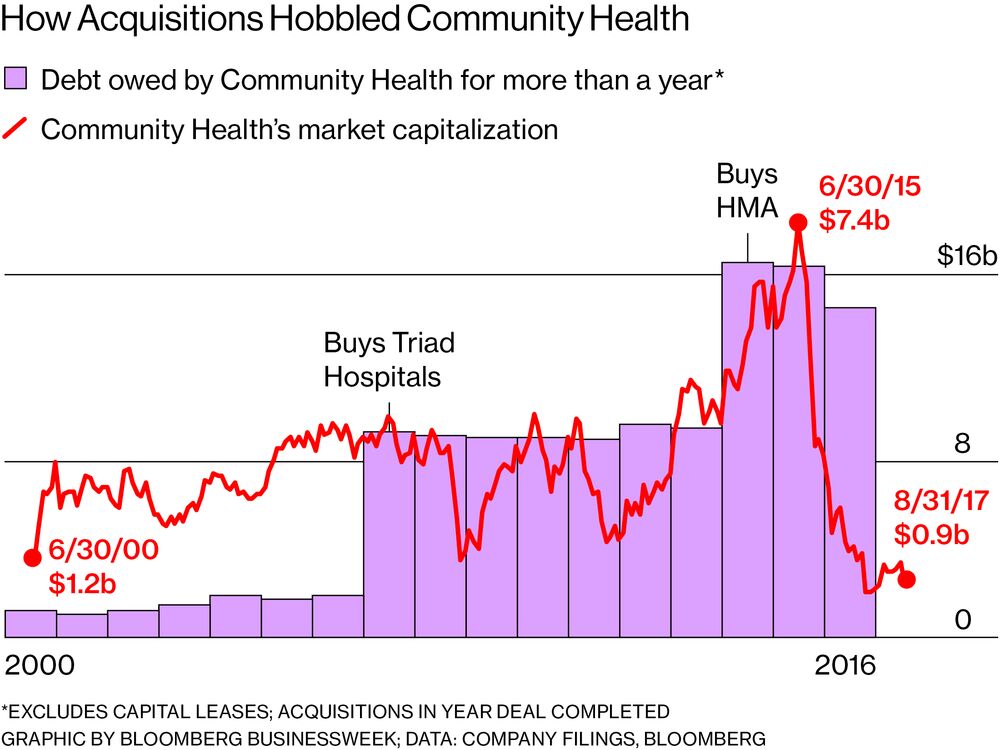
The standoff over Lutheran provides a window into how CHS, once the largest for-profit hospital chain in the U.S., has allowed facilities to languish, possibly compromising care and destroying investor value in the process. Smith presided over a decade-long acquisition binge that saddled CHS with total debt of almost eight times its earnings and a network of underperforming facilities. The company lost $2 billion in the past six quarters, during which doctors from Key West to Spokane have accused the chain of pinching pennies and regulators have fined it for overcharging Medicare. Says Indiana Republican Representative Jim Banks, who’s sided with the Fort Wayne doctors: “It’s buy, squeeze, and repeat.”

“At some point you reach a dead end, and you can’t cut the expenses anymore”

Smith took CHS public in 2001, just four years after coming to the company from Humana Inc., where he’d been head of hospital operations. The big acquisitions began in 2007, when the chain bought Texas-based Triad Hospitals Inc. for $6.4 billion, more than quadrupling its debt. Smaller deals followed. By the end of 2014, CHS had nearly doubled its debt again to finance its buyout of Health Management Associates LLC (HMA), a Florida-based group of mostly rural facilities that required costly upgrades.

Smith’s plan was to try to increase doctor productivity and slash costs, often replacing experienced doctors with loyal patients for younger ones who were willing to work longer hours. Like most for-profit operators, “they focused on cost control,” says Joshua Nemzoff of Nemzoff & Co., who advises hospitals on sale transactions. “At some point you reach a dead end, and you can’t cut the expenses anymore.”

Along with the rest of the hospital industry, CHS expected the Affordable Care Act to provide a windfall of insurance money from the newly covered. Investor enthusiasm soured when 19 states—including Florida and Texas, two key CHS markets—declined to expand Medicaid eligibility, leaving many low-income people without coverage. At the same time, insurers and other government programs began working to divert patients from hospitals into doctors’ offices, outpatient clinics, and other less expensive venues. The combined effect was particularly hard on rural hospitals, a large share of CHS’s network.

Raising prices while slashing costs has been a hallmark of CHS under Smith. In Fort Wayne, Lutheran charges more than rival Parkview Medical Center Inc. for 8 of 10 common medical procedures. During the first half of this year, patients were placed in beds in Lutheran’s emergency room hallways because the wards they should have been moved to were understaffed, and a leaking air conditioner in the neonatal care unit was dripping water on infants’ beds, according to people familiar with the conditions. While Parkview invested in its cancer and cardiac units, Lutheran doctors said at the board meeting that the CHS hospital was using lower-priced monitors they feared would miss potentially fatal heart rhythms.

Company spokeswoman Tomi Galin said in an email that many other hospitals use the same monitors. Nevertheless, CHS plans to spend $500 million on improvements and will recruit new doctors at Lutheran, she wrote, adding that employee retention there is rising.

Other critics of Smith have taken their complaints to court. After Gregg Becker quit his job as chief financial officer of CHS’s Rockwood Clinic in Spokane, Wash., in 2012, he filed a whistleblower claim with the U.S. Department of Labor, saying his superiors told him to reduce the facility’s forecast loss from $12.8 million to $4 million and threatened to fire him if he didn’t. Becker was awarded a settlement of almost $1.9 million by an administrative law judge, according to court documents. CHS has appealed the case to the Washington Supreme Court and the federal Arbitration and Review Board. (CHS sold Rockwood earlier this year.)

In 2014, CHS agreed to pay $98.15 million to the Department of Justice to settle lawsuits in five different districts accusing the company of charging for higher-cost inpatient services at hospitals, including Lutheran, when less expensive outpatient services would have been sufficient. CHS didn’t admit wrongdoing. But the DOJ in a statement said the company had “engaged in a deliberate corporate-driven scheme to increase inpatient admissions of Medicare, Medicaid, and the Department of Defense’s Tricare program.”

With losses mounting and the stock down more than 80 percent from its peak in June 2015, Smith has resorted to selling hospitals to pay off debt. One result: CHS will soon be about the same size it was before it attempted to digest HMA. Hedge fund ASL Strategic Value, a CHS shareholder, sent a letter to the board on Aug. 8 asking directors to replace Smith. Tom Kelley, a Fort Wayne car dealer whose employees rely on Lutheran for care, quit the Lutheran board in July and says he’s reviewing his employee medical plan. He tried and failed to broker a peace deal between the doctors and Smith.

“He’s a street fighter,” Kelley says of Smith. “He has survived government actions against him. He has survived lawsuits. He has survived all of this by being a tough SOB.”

BOTTOM LINE – Community Health Systems used acquisitions to become a major for-profit hospital operator. But the added heft wasn’t matched by profitability gains.


Kaufman Hall: 1 in 4 hospitals have no cost reduction goals for the next 5 years

http://www.beckershospitalreview.com/finance/kaufman-hall-1-in-4-hospitals-have-no-cost-reduction-goals-for-the-next-5-years.html

Click to access 2017-State-of-Cost-Transformation-in-U.S.-Hospitals.pdf

Image result for cost cutting

Approximately 25 percent of hospital and health system executives have no cost reduction goals for their organizations over the next five years, despite 96 percent of executives noting that transforming costs is a “significant” or “very significant” need for their organization, according to survey findings published by Kaufman Hall.

As hospitals and health systems face a myriad of pressures, including regulatory challenges, the rise of narrow networks and consumer demands, healthcare organizations need to reach a cost position that is equal or lower to competitors. For the majority of hospitals and health systems, achieving such a position will require a 25 percent to 30 percent reduction of costs over the next five years, according to Kaufman Hall.

The report, titled “2017 State of Cost Transformation in U.S. Hospitals: An Urgent Call to Accelerate Action,” presents the results of an online survey of more than 150 senior executives from U.S. hospitals and health systems to determine where the industry stands with transforming the cost of care.

Here are six insights from the report.

1. While almost all (96 percent) of executives identified cost reduction as a “significant” of “very significant” need, more than half (51 percent) of respondents said they have no cost reduction goal or a goal of only 1 percent to 5 percent in the next five years.

2. Only 5 percent of hospitals or health systems have a cost reduction goal of more than 20 percent over the next five years.

3. Seventy-five percent of executives indicated that their cost transformation success is average or below average.

4. Nearly 70 percent of executives acknowledged that they must close the discrepancy between their current operating performance and financial plan.

5. Almost 80 percent of respondents noted that they must proactively revise their cost structure with the industry switch to value-based care.

6. According to the report, a lack of accurate data, along with a lack of insight into costs and savings opportunities, may be the reason for limited cost reduction measures.

Relevance is King, and “The Top of the Funnel” is Most Relevant to The Most People

http://thinkrevivehealth.com/2017/09/relevance-is-king-and-the-top-of-the-funnel-is-most-relevant-to-the-most-people/


CVS’ recent announcement that the company is expanding its reach in chronic care management is the latest sign that the market has never been more competitive or complicated. (Are you asking yourself, “which market?”) CVS isn’t just protecting its PBM business and driving sales for its retail business. The company has plans to provide one-on-one support and coaching — in a store, via phone, or video — to people who have diabetes, asthma, hypertension, hypercholesterolemia, or high cholesterol, and depression.

This, of course, follows in the footsteps of other companies encroaching on traditional provider-territory, like Optum. OptumCare, the care delivery arm of the company, has 22,000 physicians in 30 markets and 200 surgery centers in 33 states. The combination of the two presents a formidable continuum that could provide consumers with most of the outpatient services they’ll ever need. In other words, the health system brand defined by superior service lines will continue to be less and less relevant as the “top of the funnel” becomes more competitive and more important.

Despite the fierce competition, many health systems continue to focus a large majority of marketing dollars on down-funnel service line care, such as chronic disease treatments and surgeries. There’s logic to that strategy: market and differentiate the services that are most profitable and keep you in business. The problem is that logic doesn’t work in a digital age when consumers have more choices and less patience. Their healthcare mindshare is occupied by a host of companies — like CVS Health and OptumCare — that are more relevant to their daily life than heart surgery or cancer care.

HEALTH SYSTEMS MUST ESTABLISH (AND MAINTAIN) CONTROL OVER THE TOP OF THE FUNNEL

Therein lies the problem for health systems. When Joe Public interacts with your brand, relevance is king. And as we all know, specialty care isn’t relevant to the vast majority of people most of the time. When the competitive field wasn’t as crowded and consumers weren’t showered with more than 5,000 ads every day, it was easier to make an impression that might not be relevant in the moment but could be recalled later when it mattered. That day has passed. The emphasis must shift from awareness and impressions to real engagement.

Health systems — just like any other brands — must be relevant and provide value as often as possible to stay engaged with consumers. Think about your continuum of services as a funnel (Figure 1). Primary care, urgent care, ER, and health & wellness programs sit at the top as these are the services most often used, and represent the most common entry point into your system.

They are also more subject to cost and convenience scrutiny. To maximize the path to specialty and surgical care in the middle of the funnel, health systems can’t just rely on people who go through the side of the funnel – those who did their research to determine which hospital had the best cardiovascular outcomes in the region. For most health systems, the vast majority of their down-funnel, inpatient service line volume — more than 75% — comes from prior top of the funnel activity, not from out of the blue. Health systems need to get as many people in the top of the funnel to build brand, build engagement, and feed all service lines.

Why? Because this is the best way to engage consumers and build brand loyalty. Brand loyalty develops as consumers repeatedly engage with a service over time, and they become repeat customers if they are satisfied. A good experience at the top of the funnel can lead to more profitable business in the middle of the funnel. In fact, our research and work with hundreds of health systems across the country reveals that most people who receive specialty care at a health system had at least one prior experience. And where does most engagement with the healthcare system occur? At the top of the funnel.

Back to CVS. Health systems run the risk of being expensive specialty factories if they cede control of the top of the funnel to competitors — especially competitors who are not other hospitals. The strongest relevance is at the top of the funnel, which is where prescriptions and chronic care management live along with a host of other more frequently used services. CVS Health, Optum, Walgreens, Amazon, and even Google present formidable, well-resourced companies vying for the top of the funnel in some capacity.

What’s your strategy?

Independence Is Not a Strategy for Health Systems

http://www.healthleadersmedia.com/leadership/independence-not-strategy-health-systems?spMailingID=11725844&spUserID=MTY3ODg4NTg1MzQ4S0&spJobID=1221639238&spReportId=MTIyMTYzOTIzOAS2#

Image result for john gribbin centrastate

There are ways to keep going it alone in the face of massive consolidation, says one health system’s CEO. It’s not a strategy, but a means to end, he says.

Afraid your hospital or health system can’t compete because you lack size and scale?

A merger might help, but it’s not the only possible answer to your problems. Freehold, NJ-based CentraState Healthcare System’s top leader is certain it’s not the best solution for his organization.

Consolidation continues to upend the acute and post-acute healthcare industry. In fact, in a recent HealthLeaders Media survey, some 87% of respondents said that their organization is exploring potential deals, completing deals already under way, or both.

But CentraState isn’t among them, says John Gribbin, its president and CEO.

On a continuum basis, CentraState is already diversified. That’s one of the potential selling points of an M&A deal.

Anchored by the 248-bed CentraState Medical Center in Freehold, NJ, the 2,300-employee organization also contains three senior care facilities—one assisted living, one skilled-nursing facility, and a continuing care retirement community.

It can be argued that CentraState may not possess the scale to compete with multifacility, multistate large health systems that can take advantage of a hub-and-spoke strategy for referrals. Nor may it be able to afford expensive interconnected IT systems.

But there ways other than mergers to achieve scale and collaboration, says Gribbin.

Means to an End

Gribbin insists that he and CentraState’s board, which supports and encourages independence, are not dogmatic about it.

“Independence is not a strategy,” he says. “It’s a means to an end. The moment that ceases to be worthwhile is the moment we’ll consider another way to achieve our mission.”

Change is part of that strategy, he says, adding that healthcare in 2017 needs to be far more collaborative, not only with patients and family, but with other healthcare organizations. That’s a big difference from previous generations.

“Our real strategy is scale and relevancy,” he says.

And there are ways to create scale short of taking on all the legacy costs and “baggage,” as Gribbin calls it, inherent in any merger.

“There’s a lot of costs involved in merging… and while mergers work in some instances, they don’t work in all, and in many communities, they are increasing costs to the consumer,” he says.

In addition to the commonly stated goals of improving the community’s health and wellness, patient costs are extremely important in fulfilling CentraState’s mission, Gribbin argues.

Many mergers involve replacing hospitals and adding patient towers and high-cost equipment. That adds to their cost structure means they have to extract higher pricing, says Gribben.

“That’s the vicious circle you find yourself in. I prefer to create scale in a different manner.”

Focus on the Mission

Gribbin, who has led CentraState for 17 years, prefers to solve that challenge in part through a strong network of physicians unburdened by excessive administrative overhead.

He says the health system has to increasingly take on value-based contracting and financial risk. To be successful under such value-based reimbursement, partnerships with physicians are increasingly important, as is a redefinition of the relationship with the patient.

“We used to look at our relationship with the patient as a typical hospital stay,” says Gribbin. “What we’re preaching now is that hospital stay is a temporary interruption in our relationship. What happens before or after defines the relationship’s success.”

With its physician alliance and clinically integrated network in place, CentraState, unlike many hospitals, has been able to avoid, in large part, expensive physician practice acquisitions that can be a financial challenge.

“I’ve done it in the past, and may do it again, but we’ve tried to avoid it,” he says. Instead, contracts define the relationships and incentives.

As an example of those relationships, CentraState partners with a major patient-centered medical home primary care practice on four performance and three utilization measures.

As a result of the shared savings generated in the first year, which came largely from hospital-based savings, the physicians in that group referred 59% of their patients to CentraState.

This year they’ve referred 71% of their patients to CentraState because of its low costs, which help drive financial reward for both parties under the contract.

“On one hand, we’re keeping people appropriately out of acute care, but on the other hand, they’re sending [more] people here. So we’re experiencing higher but more appropriate volume. In this scenario, everyone wins,” Gribbin says.

A New Deal with Physicians

In order to avoid the need to acquire physician practices, Gribbin says it helps to have a suite of services to offer them as a starting point.

“Most don’t want to sell their practice, but they feel like they have to, he says. “If you give them the opportunity to stay independent, they’ll take it.”

Helping them with access to better revenue cycle management, malpractice insurance, and risk management, and helping them create the ability to enter into risk-based contracts is another big help with defining a new relationship based on shared goals with physicians that ultimately benefit the patient, he says.

Physicians can establish a relationship with CentraState through its independent practice association, or a physician hospital association, and avoid surrendering their autonomy, he says.

“The physicians got paid better, the payer saved money even including the bonus, the hospital won because it’s high value care, and the patient’s winning too,” he says. “It’s a microcosm of what we’re trying to accomplish.”

As a small organization, both Gribbin and the board worry about being frozen out of narrow networks. Much of the energy they’ve expended in being a low-cost organization is wasted, he says, if they can’t get the big payers to include them in contracting.

“As long as the market isn’t rigged against us, we’re OK, because we’re a high-value organization.”

Cartoon – Why do I always get the Hard Part?

Image result for cartoon harmful leadership

Shift in physician workforce towards specialists fuels primary care shortage, potential spending growth

http://www.healthcarefinancenews.com/news/shift-physician-workforce-towards-specialists-fuels-primary-care-shortage-potential-spending?mkt_tok=eyJpIjoiTXpOa01qUXhaVGd5TnpkaiIsInQiOiJudFozOHVLS1VVNXZZRE42Y0RmTWdIZHpkOU0yNERUSmlXU0VCMlJDMEFyMmVTUUc4aVwvcXRVc0gzXC9ndUdJVjhHT1drZkkzdDhBVFhHZ3BHVjI1NmhIVHY1RmNXSENVdWtwb3RVVnVtaFNWbXNFdnBzb0JVenRcL1ZuR1p0MW0zRyJ9

Areas with more primary care physicians have lower spending per beneficiary, better care, patient satisfaction and lower death rates, authors say.

The composition of the healthcare workforce is shifting towards specialty physicians while primary care growth has gone flat, and according to a Health Affairs blog post, this trend could mean healthcare spending goes up not down.

Labor represents more than half of health care costs, and clinical workforce is a major driver of use and pricing, authors wrote, and there is plenty of support establishing a link between primary care-centered health systems and lower spending. Specifically, areas with more primary care physicians have lower spending per beneficiary, better care and patient satisfaction and lower death rates.

“Given this, many existing payment reform strategies prioritize primary care, and the success of these reforms will require a vibrant–and likely growing–primary care workforce,” the authors wrote.

Health Affairs delved into the Bureau of Labor Statistics’ Occupational Employment Statistics files between 2005 and 2015, focusing their analysis on limited our analysis to ambulatory health care services, hospitals, and nursing and residential care facilities. There was an overall net increase of 2.6 million jobs over this period, six percent of them being physicians. While the number of primary care jobs rose by roughly eight percent, the number of specialist jobs increased six times faster. Also, the overall share of the physician workforce constituted by primary care fell from 44 to 37 percent, the blog said.

These trends raise concerns for access to care and spending. While in theory, the presence of more specialists in a given market could give way to more competition, lower prices and spending and better outcomes, public payer fees are set administratively and not necessarily susceptible to competition. Hospital/physician integration, patient preference could also hinder competition.

The trend of more specialists working in health systems that charge facility fees on top of already expensive prices for care, and the notoriously large salaries specialists make will also likely drive spending upward, authors said.

In light of the aforementioned belief that the strong presence of primary care providers reduces healthcare spending, the workforce trends may be cause for concern. Moreover, they add urgency to previous recommendations from various agencies aimed at bolstering primary care, like MedPac‘s suggestion that the Medicare fee schedule be altered to reflect the value of primary care and close disparities in the fee schedule that overcompensate certain specialists. HRSAhas recommended in the past the medical school funding be funneled toward students who will work in family medicine and other categories.

“If we are to bend the cost curve, we likely need to move more aggressively on fee schedule changes, payment reform, and workforce policies,” the authors said.