The Pennsylvania health care battle

https://www.axios.com/the-pennsylvania-health-care-battle-2519142732.html

Image result for The Pennsylvania health care battle

Highmark Health, a powerful Blue Cross Blue Shield insurer that also owns a hospital network in Pennsylvania, and academic system Penn State Health signed an agreement last week to build a health care network in central Pennsylvania.

The deal sounds like a merger, but it’s not. It also adds another layer to the turf war between Highmark and UPMC — the two have feuded for years, and UPMC recently embarked on a hospital buying spree. I spoke with executives from Highmark and Penn State to explain what their deal is and why it matters.

The details: Highmark and Penn State Health are investing $1 billion to build out a network of doctors and health care facilities, but the organizations aren’t disclosing how much each side is contributing. Penn State Health CEO Craig Hillemeier said the deal is a strategic partnership, not a merger of assets. Here’s a condensed version of the conversation:

You all are talking a lot about “value-based care.” But what will you do specifically to fulfill the promise that this deal will lower health care costs for people in your region?

Highmark CEO David Holmberg: “This is about making sure that we design insurance products so that when a member has to make a decision, they have access to care near where they live. (Penn State’s academic medical center) is also more affordable and more effective than many of the other academic systems.”

So how much did UPMC play into this? UPMC has bought a lot of hospitals this year, and I have to imagine that name came up multiple times in discussions.

Penn State Health CFO Steve Massini: “We’ve had a strategy for a number of years to build out this community-based network and support the academic center. We felt that having an insurance partner like Highmark was a very valuable piece of that strategy … what others do is not what we tend to get hung up on.”

Holmberg: “We’re in this for the long term. We’re not going to worry about what the other guys do.”

Will you create health plans that, for example, have cheaper premiums but limited networks where people can only go to Penn State doctors and hospitals?

Highmark President Deborah Rice-Johnson: “We have those in the market today. It’s not new to the industry. We’ll still have broad-network products … but we have absolutely seen premiums and care costs moderate very differently (in limited-network plans) than the broad-network products.”

Can you guarantee that premiums for those types of narrow plans won’t rise faster than the rate of inflation?

Rice-Johnson: “We have done that, yes.” But employers need to sign multiyear agreements with Highmark to get those capped rates.


Is M&A the Cure for a Failing Health Care System?

https://hbr.org/2017/12/is-ma-the-cure-for-a-failing-health-care-system

Image result for Is M&A the Cure for a Failing Health Care System?

The U.S. health care system is begging for disruption. It costs way too much ($3.3 trillion last year) and delivers too little value. Hundreds of millions of Germans, French, English, Scandinavians, Dutch, Danish, Swiss, Canadians, New Zealanders, and Australians get comparable or better health services for half of what we pay. For most Americans, care is not only expensive but is also fragmented, inconvenient, and physically inaccessible, especially to the sickest and frailest among us.

It should come as no surprise, then, that when titans of our private, for-profit health care sector — like Aetna, CVS, UnitedHealth Group (UHG), and DaVita — strike out in new directions, stakeholders react with fascination and excitement. Could this be it? Is free-market magic finally bringing Amazon-style convenience, quality, and efficiency to health care? Are old-guard institutions, like hospitals and nursing homes, on the verge of extinction?

The answer, frustratingly, is that it depends. It depends above all on the results. To be the change that many desire, these new mergers and acquisitions, and the others that will likely follow, must produce a higher-quality product for consumers (and satisfy physicians and other health professionals) at an affordable price. The details are crucial, and the details in health care — as our political leaders have recently learned — are complicated.

Even a high level look at two apparently similar deals suggests the importance of getting under the hoods of these arrangements. Both CVS’s planned $69 billion acquisition of Aetna and UnitedHealth’s $4.9 billion deal to buy DaVita Medical Group, bring together a very large national insurer and a large provider of health care services. Combining an insurance function with a delivery system has ample precedent in health care. Some of the nation’s most innovative, high-performing non-profit health care organizations use this formula.  These include the Kaiser Health Plans, Intermountain Healthcare in Utah and Idaho, the Geisinger System in Pennsylvania, the Henry Ford Health System in Detroit, and HealthPartners in Minnesota and Wisconsin, among others.

The reason this formula works is that when care-delivery systems also act as insurers, they assume financial responsibility for the care they provide. This tends to focus doctors, nurses, and other health professionals on the value of what they do — finding the most cost-effective approach to managing their patients’ problems. The result can be a culture of economy and quality that is very hard to replicate in the prevailing fee-for-service environment, where health professionals get rewarded for the volume rather than the value of services.

So the big question is whether these bold new combinations of insurer and provider can generate promising partnerships similar to a Kaiser or an Intermountain, or find some other equally powerful formula for disruption. The answer is far from certain, and the uncertainties differ for the two mergers.

In the CVS-Aetna case, the care provider, a pharmaceutical retailer and pharmaceutical benefit manager, provides a very limited set of health services: drugs, drug purchasing, and selected, basic, routinized primary care at more than 1,100 local Minute Clinics  located in communities around the United States. To become a Geisinger or an Intermountain equivalent, Aetna-CVS would have to acquire — or develop — seamless relationships with legions of primary care and specialty physicians and hospitals. It would have to turn its stores into medical clinics, with exam rooms, diagnostic laboratories, and x-ray suites. And it would have to install and link electronic health records with other providers in its communities. Having done all this, CVS would have to excel at the very challenging task of managing physicians and other health professionals — something that daily confounds even the most experienced, long-time, care-delivery systems. The challenge would be unprecedented, the expense considerable, and the outcome uncertain.

The CVS-Aetna partnership seems likely, instead, to set off in a very different, and intriguing, direction: offering an augmented suite of preventive and population health services for high-cost chronically-ill patients through its convenient, community-based outlets. CVS staff will serve as local case managers and coordinators for patients who might otherwise skip needed preventive services, have trouble getting to their primary care physicians’ offices, or just need help taking their medicines. The hope is that this will reduce patients’ use of more expensive emergency, hospital, and specialty services, thereby reducing Aetna’s bills and making its product more competitive. Aetna would incent its clients to use CVS services by exempting these from the normal deductibles and copays that most insurers charge, thus incidentally, increasing CVS’s business more generally. This strategy could attract customers to both CVS and Aetna, add health care value, and even drive up profits.

But uncertainties remain. In addition to those I’ve mentioned, one of the biggest challenges will be coordinating with traditional care providers, both primary care and specialists. Seamless teamwork is critical to effective care of complex, high-cost patients. And by adding another player to our already-fragmented health care system, the CVS-Aetna project could actually undermine coordination of services. And while better care for complex patients is clearly part of the solution to our cost and quality problems, it may not be the systemic disruption that some are hoping for.

The UnitedHealth-DaVita deal, in contrast, seems more likely at first glance to accomplish the insurer-provider partnership that has characterized Kaiser-style organizations in the past. The DaVita Medical group employs 2,000 primary care and specialist physicians in nearly 300 medical clinics, 35 urgent-care centers, and six outpatient surgery centers in six states. Among the group’s divisions is the formerly independent HealthCare Partners, which, as this Commonwealth Fund case study makes clear, has a long history of accepting and managing financial risk, using advanced information systems, and promoting quality-improvement programs.

That said, no one should underestimate the challenge of growing the UnitedHealth acquisition of dispersed physician groups into a national system capable of disrupting our floundering health system. Health care is a very local affair, and the organizations providing it tend to be creatures of their localities and histories. It can take generations for a provider-insurer partnership to develop a culture of trust, collaboration, and value orientation that has made existing examples of these combinations so uniquely effective. If the new entity seeks to grow, it will find that recruiting and training physicians who can leave the fee-for-service mentality behind is a challenge, as is finding leadership that can gain and keep health professionals’ trust. Kaiser has failed in several attempts to spread to new locations. And though UnitedHealth’s Optum division, which will run the partnership, has some limited experience managing selected specialty health services, making this new enterprise work could prove daunting.

Even if the Aetna-CVS and UnitedHealth-DaVita ventures contain the seeds of transformative health system change, it will take time for those seeds to germinate. But Wall Street is not a patient audience. The involved companies will face short-term pressure to prove the profitability of the new arrangements. From this standpoint, it does not bode well that DaVita was anxious to sell its medical groups because they were not performing financially.

The excitement about these two bold new health care arrangements says as much about the desperation with our current health care systems as it does about the promise of the mergers themselves. They may have compelling short-term business value to shareholders — though that, too, remains to be proven. As fundamental health care disrupters, however, they face challenging and uncertain futures.


Penn State Health, Highmark Health sign $1B value-based care network deal

https://www.fiercehealthcare.com/finance/penn-state-health-highmark-health-new-partnership?mkt_tok=eyJpIjoiTkRNMlpEbGlNRE14TkRBMSIsInQiOiJqOUkyVmdwaVwvZGVYODBOK2h5ZHhIT1UxS1owUTdheXJXU1pkeU1VQVNXTTFjOWpCNTlwNml1Uk81YlBjb2FjWkVtd21CMjJFR3pneURrN0NvdXlWbG5reFh5Y2VpUXVsbDZKRVRMeUtxVnFhNEFvWHlIdXkwSUtKMzVQU1BFVEQifQ%3D%3D&mrkid=959610

Business executives shaking hands

Penn State Health and Highmark Health have inked a $1 billion deal to form a value-based community care network that aims to improve population health and protect market share by keeping more patients in the region, especially for complex care.

Anchored by the Milton S. Hershey Medical Center, the plan also calls for collaboration with community physicians and will include new facilities and co-branded health insurance products.

The move doesn’t affect existing agreements: Penn State Health can still partner with other health insurance companies, and Highmark will continue to partner with other providers.

“Penn State Health will offer more primary, specialty and acute care locations across central Pennsylvania so that [patients] will have easier access to our care, right in the communities where they live,” A. Craig Hillemeier, CEO of Penn State Health, said in an announcement. “Our two organizations share the belief that people facing life-changing diagnoses should be able to get the care they need as close to home as possible.”

Highmark Health will join Penn State as a member of Penn State Health with a minority interest. The payer will get up to three seats on the 15-member board of directors.

“We want to collaborate with forward-thinking partners who, like us, are committed to creating a positive healthcare experience for members and patients,” Highmark Health CEO David Holmberg said in the announcement.

Value-based care and population health continue to drive deals such as this one, including in the competitive Pennsylvania market. Earlier this year, PinnacleHealth announced that it would partner with the University of Pittsburgh Medical Center, the state’s largest integrated health system, and also agreed to acquire four Central Pennsylvania hospitals from Community Health Systems.


Will Getting Bigger Make Hospitals Get Better?

https://tincture.io/will-getting-bigger-make-hospitals-get-better-d3c565223670

Image result for Will Getting Bigger Make Hospitals Get Better?


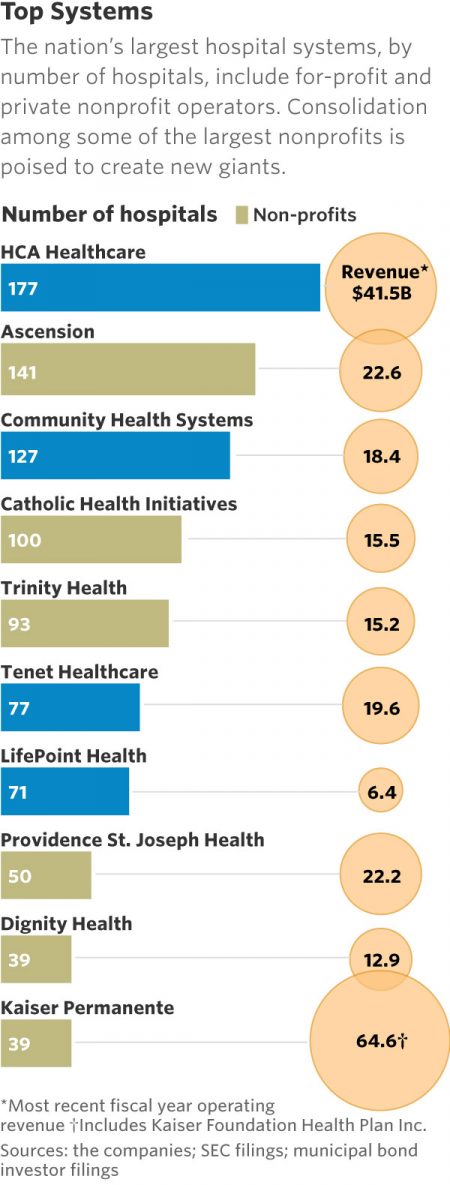
This month, two hospital mega-mergers were announced between Ascension and Providence, two of the nation’s largest hospital groups; and, between CHI and Dignity Health.

In terms of size, the CHI and Dignity combination would create a larger company than McDonald’s or Macy’s in terms of projected $28 bn of revenue. (Use the chart of America’s top systems to do the math).

For context, other hospital stories this week discuss layoffs at Virtua Health System in southern New Jersey. And this week, the New Jersey Hospital Association annual report called the hospital industry the “$23.4 billion economic bedrock” of the state.

Add a third important item to paint the state-of-the-U.S. hospital-industry picture: Moody’s negative ratings outlook for non-profit hospital finances for 2018.

So will getting bigger through merger and consolidation make the hospital business better?

In the wake of the CVS-Aetna plan to join together, the rationale to go big seems rational. Scale matters when it comes to contracting with health insurance plans at the front-end of pricing and financial planning for the CFO’s office, and to managing population health by controlling more of provider elements of care from several lenses: influencing physician care; crafting inpatient hospital care; doing smarter, cheaper supply purchasing; and leaning out overhead budgets for things like marketing and general management.

But the Wall Street Journal warned today the “serious condition” of U.S. hospitals, despite these big system mergers.

Health Populi’s Hot Points: In the past two years, I’ve had the amazing opportunity of speaking about new consumers and patients growing into healthcare payors with leadership from hospitals in over 20 states, some more rural, some more urban, and all in some level of financial crisis mode.

After describing the state of this consumer in health and healthcare, and how she/he got here, I have challenged hospital leadership to think more like marketers with a fierce lens on consumer experience and values. That equal proportions of U.S. consumers trust large retail and digital companies to help them manage their health is a jarring statistic to these hospital executives. The tie-up between CVS and Aetna marries the retail health/healthcare segments and responds to this consumer trust issue.

But then, I remind them that nurses, pharmacists, and doctors are the three most-trusted professions in America.

These three professional clinicians are the human capital that comprise the heart of a hospital in a community.

Hospitals should be mindful that trust is necessary for patient/health engagement. And the trust is with hospitals if the organization chooses to leverage that goodwill for a value-exchange. Hospitals are economic engines in their local communities — often, the largest employer in town. “Everyone” in most communities knows someone who works in a hospital.

And hospital employees spend money in communities, bolstering local employment and tax bases.

Partnering with patients means empathizing with them as both clinical subjects and consumers. For the latter, refer to the sage column from JAMA which recommends that Value-Based Healthcare Means Valuing What Matters to Patients. This means thinking about the value-chain of the patient journey, from keeping people well in their communities through to managing sticker-shock in the financial office. The financial toxicity of healthcare is one risk factor threatening the hospital-patient relationship with the patient-as-payor.

As Mufasa told Simba in The Lion King, “You are more than what you have become. Remember who you are.”


Fitch issues negative outlook for nonprofit hospitals: 4 things to know

https://www.beckershospitalreview.com/finance/fitch-issues-negative-outlook-for-nonprofit-hospitals-4-things-to-know.html

Image result for negative hospital outlook

Fitch Ratings’ outlook on the nonprofit healthcare sector is negative for 2018, as the sector faces regulatory, political and competitive challenges.

Here are four things to know about Fitch’s outlook on the sector.

1. Fitch expects nonprofit hospitals and health systems’ profitability to continue to weaken over the next year. “Growth in Medicare and Medicaid volumes are weakening provider payer mixes at a time when providers are moving from volume-based reimbursement in greater numbers,” said Fitch Senior Director Kevin Holloran.

2. Fitch said several factors could adversely affect lower-rated hospitals’ operating performance in 2018, including growing pressure on salaries and continued erosion in payer mix.

3. The proposed tax overhaul bill, which would hamper nonprofit hospitals’ ability to issue tax-exempt revenue, could further pressure the industry, according to Fitch.

4. Although the nonprofit healthcare sector outlook is negative, Fitch maintained its stable outlook for ratings of healthcare issuers. “Fitch anticipates our revised criteria for the acute care sector will be published early next year, which should lead to an above-average, but still balanced, degree of rating movement during the year,” the debt rating agency said.

How One U.S. Clinic Disrupted Primary Care, Made Patients Healthier And Still Failed

https://www.forbes.com/sites/robertpearl/2017/10/24/primary-care/#49ba8eee2c0f

Turntable Health launched in Las Vegas in 2013 and looked to turn the traditional primary care model on its head.

Zubin Damania has a face for television, a mind for medicine and the sort of fearless personality required to be one of the internet’s most famous MDs.

Damania’s celebrity began in earnest not long after someone posted a clip from his 1999 UCSF Medical School commencement address. In his opening, Damania jokes that he’s on a “time delay,” given his reputation as a “loose cannon.” The rest of the clip, which has been viewed over 130,000 times on YouTube, takes you briefly inside the mind of a versatile entertainer and healthcare visionary.

From UCSF, Damania completed his internal medicine residency at Stanford University. He spent the next 10 years as a practicing hospitalist by day and a healthcare satirist by night – writing, performing and filming musical parodies about the frustrations of being a doctor. He’s best known today by his online persona, ZDoggMD, and for his nightly Facebook show, covering the latest medical news with his trademark wit.

The rise and fall of Turntable Health

In 2013, Zappos.com CEO Tony Hsieh asked Damania to launch a next-generation medical clinic in Las Vegas as part of a $350 million downtown revitalization project. Founded as a primary care practice, Turntable Health looked to turn healthcare delivery on its head.

Inside a waiting room that resembled a sleek Silicon Valley startup, Turntable members passed the time by spinning records, playing Xbox and practicing yoga. As part of their membership, patients had access to an entire “wellness ecosystem,” complete with same-day visits, 24/7 doctor access (by email, phone or video), along with a dedicated health coach. Doctors at the clinic spent 45 minutes or more with their patients, quite unlike the 13 to 16-minute visits that have become standard in U.S. doctors’ offices.

Damania credits the vision for his clinic to a partnership he forged with Rushika Fernandopulle, CEO of another innovative primary-care organization called Iora Health. With Fernandopulle’s guidance, Damania focused on population health and disease prevention to improve patient wellness and, over time, lower costs. And rather than charging for each visit, test or procedure, Turntable patients who were not covered by traditional insurance paid a flat fee of $80 a month.

Unlike any other primary care clinic in Las Vegas, Turntable Health was a success, medically. By emphasizing prevention and doctor-patient relationships, Damania’s practice achieved superior quality outcomes, while providing rapid access to care and high patient satisfaction. But from an economic perspective, the clinic was a bust. Insurers shied away from member fees, insisting on more traditional reimbursements, which directly contradicted Damania’s long-term health strategy. Turntable Health was forced to close its doors in January 2017, just three years after opening.

In a public statement, Damania explained: “We flatly refused to compromise when pressured by payers to offer fee-for-service options, or to begin charging a co-pay. We firmly believe that healthcare is a relationship, not a transaction.”

Unfortunately for Damania, most health insurers are too impatient. Investing in primary care and chronic-disease management is proven to reduce and even avoid medical problems. But it can take five to 10 years for the improvements in the health of patients to offset the added upfront costs of providing the necessary care. Health plans worry patients will switch insurers before they can recoup such a long-term investment.

Primary care doctors can and do play a critical role in preventing disease, spurring lifestyle changes and warding off complications from chronic illness, when they have the time to do so. Today’s fee-for-service payment system doesn’t adequately reward these efforts.

Today’s insurers are systematically reducing primary care reimbursements, forcing doctors to see 20 to 30 patients a day while spending the bulk of their time in front of a computer, entering patient data for billing purposes. This backward approach to care delivery is wreaking havoc on the nation’s health and economy. As the incidence of chronic disease grows, the cost of American healthcare continues to rise more rapidly than the nation’s ability to pay.

The closure of Turntable Health was a major loss for Las Vegas, where residents joke that the best place to go for healthcare is the airport. Compared to people with access to integrated and coordinated medical care programs, Las Vegans are less likely to be insured, get the recommended cancer screenings and receive other necessary preventive care interventions.

Pushing primary care: Iora Health and One Medical

Damania’s partner in primary care, Iora Health, is experiencing relative success nationally, with 30+ clinics in 11 metropolitan areas. Using the same model of patient engagement and prevention that Turntable adopted, Iora has shown 35% to 40% drops in hospitalizations compared to their community peers, with 12% to 15% lower total healthcare costs. They’ve also established contracts with insurance companies who are willing to invest in primary care, thus solving one of ZDogg’s biggest challenges.

And they’re not alone. One of Iora’s leading competitors, One Medical, operates out of San Francisco under the leadership of Dr. Tom Lee. Labeled by some as a “concierge” medical practice, the company’s network includes 250+ doctors in 40 cities coast to coast. One Medical offers patients the ability to schedule same-day appointments, access their health records online, and fill prescriptions using the One Medical app – all for a relatively affordable yearly fee of about $149. With a promise that “your care is our highest priority,” the company makes the primary care experience more convenient and user friendly, a mission that’s been paying off since 2007. One Medical’s subscriber base continues to grow by tens of thousands of patients each year, particularly within the tech industry.

Although these extremely well-run primary care systems have improved outpatient quality and patient satisfaction, their impact on overall healthcare costs remains minimal. If Americans want to make healthcare affordable again, the scope and pace of change will need to accelerate at every point of care. This will require innovative approaches that rein in the rapidly escalating costs of specialty and hospital care, where most added national healthcare expenditures (NHE) exist.


5 payer trends to watch in 2018

https://www.healthcaredive.com/news/5-payer-trends-to-watch-in-2018/510136/

Image result for top 2018 healthcare industry trends

Expect insurers to accelerate programs and policies that cut costs and to push for value-based contracting as consumers demand more transparency in healthcare pricing.

Health Care Price Growth Plummets To Lowest Rate In Almost Two Years

https://altarum.org/about/news-and-events/health-care-price-growth-plummets-to-lowest-rate-in-almost-two-years

Image result for Health Care Price Growth Plummets To Lowest Rate In Almost Two Years

Fueled by health policy uncertainty and structural health sector changes, health care price growth in August rose by only 1.2% compared to a year earlier. This is the lowest health price growth rate recorded in almost 2 years, and just slightly above the all-time low, according to Altarum’s latest Health Sector Economic Indicators Briefs. Contributing to overall slow price growth is a historically low Medical Consumer Price Index growth rate, a possible signal of relief for health care consumers with substantial out-of-pocket expenditures.

Despite an upward revision to recent estimates, health spending growth in August 2017 was only a modest 4.3% higher than a year earlier. Per Charles Roehrig, founding director of Altarum’s Center for Sustainable Health Spending, this moderation in spending growth is in response to a leveling-off in insurance coverage.

Health care job growth also remained modest, with 22,500 new jobs added in September 2017, slightly less than the 2017 average of 25,000. “Slower growth in health care utilization is reflected in slower growth in health jobs, particularly in the hospital sector,” said Roehrig. “This relatively good news should be tempered by a serious look at whether even this moderate growth is sustainable in the longer term.”

Health Care Spending

In August, the health share of gross domestic project (GDP) fell to 18.0%, but spending at an annual rate was 4.3% higher than August 2016, exceeding $3.5 trillion. Spending growth in August 2017 increased in all major categories, led by home health care at 6.5%. Hospital spending continues to grow slowly, at a 2.3% rate.

Health Care Employment

Hospitals added 4,500 jobs and ambulatory care settings added an above-average 24,700 jobs in August, but these gains were offset by the loss of 6,700 jobs in nursing and residential care. Slow hospital job growth in 2017 is a primary force behind the health sector growing at about three-quarters the pace of 2015 and 2016.

Health Care Prices

The 12-month moving average of the Health Care Price Index (HCPI) fell to 1.8% growth after being at 1.9% for 6 straight months, dousing any expectations of a return to a 2.0% growth rate range in the near term. Year-over-year hospital price growth fell to from 1.5% to 1.3%, and physician and clinical services price growth fell one-tenth to 0.5%. Annual drug price growth fell to a 2.7% rate, its lowest reading since growing by 2.4% in December 2015.

Why Major Hospitals Are Losing Money By The Millions

https://www.forbes.com/sites/robertpearl/2017/11/07/hospitals-losing-millions/#67f501c67b50

Related image


A strange thing happened last year in some the nation’s most established hospitals and health systems. Hundreds of millions of dollars in income suddenly disappeared.

This article, part two of a series that began with a look at primary care disruption, examines the economic struggles of inpatient facilities, the even harsher realities in front of them, and why hospitals are likely to aggravate, not address, healthcare’s rising cost issues.

According to the Harvard Business Review, several big-name hospitals reported significant declines and, in some cases, net losses to their FY 2016 operating margins. Among them, Partners HealthCare, New England’s largest hospital network, lost $108 million; the Cleveland Clinic witnessed a 71% decline in operating income; and MD Anderson, the nation’s largest cancer center, dropped $266 million.

How did some of the biggest brands in care delivery lose this much money? The problem isn’t declining revenue. Since 2009, hospitals have accounted for half of the $240 billion spending increase among private U.S. insurers. It’s not that increased competition is driving price wars, either. On the contrary, 1,412 hospitals have merged since 1998, primarily to increase their clout with insurers and raise prices. Nor is it a consequence of people needing less medical care. The prevalence of chronic illness continues to escalate, accounting for 75% of U.S. healthcare costs, according to the CDC.

Part Of The Problem Is Rooted In The Past

From the late 19th century to the early 20th, hospitals were places the sick went to die. For practically everyone else, healthcare was delivered by house call. With the introduction of general anesthesia and the discovery of powerful antibiotics, medical care began moving from people’s homes to inpatient facilities. And by the 1950s, some 6,000 hospitals had sprouted throughout the country. For all that expansion, hospital costs remained relatively low. By the time Medicare rolled out in 1965, healthcare consumed just 5% of the Gross Domestic Product (GDP). Today, that number is 18%.

Hospitals have contributed to the cost hike in recent decades by: (1) purchasing redundant, expensive medical equipment and generating excess demand, (2) hiring highly paid specialists to perform ever-more complex procedures with diminishing value, rather than right-sizing their work forces, and (3) tolerating massive inefficiencies in care delivery (see “the weekend effect”).

How Hospital CEOs See It

Most hospital leaders acknowledge the need to course correct, but very few have been able to deliver care that’s significantly more efficient or cost-effective than before. Instead, hospitals in most communities have focused on reducing and eliminating competition. As a result, a recent study found that 90% of large U.S. cities were “highly concentrated for hospitals,” allowing those that remain to increase their market power and prices.

Historically, such consolidation (and price escalation) has enabled hospitals to offset higher expenses. As of late, however, this strategy is proving difficult. Here’s how some leaders explain their recent financial struggles:

“Our expenses continue to rise, while constraints by government and payers are keeping our revenues flat.”

Brigham Health president Dr. Betsy Nabel offered this explanation in a letter to employees this May, adding that the hospital will “need to work differently in order to sustain our mission for the future.”

A founding member of Partners HealthCare in Boston, Brigham & Women’s Hospital (BWH) is the second-largest research hospital in the nation, with over $640 million in funding. Its storied history dates back more than a century. But after a difficult FY 2016, BWH offered retirement buyouts to 1,600 employees, nearly 10% of its workforce.

Three factors contributed to the need for layoffs: (1) reduced reimbursements from payers, including the Massachusetts government, which limits annual growth in healthcare spending to 3.6%, a number that will drop to 3.1% next year, (2) high capital costs, both for new buildings and for the hospital’s electronic health record (EHR) system, and (3) high labor expenses among its largely unionized workforce.

“The patients are older, they’re sicker … and it’s more expensive to look after them.”

That, along with higher labor and drug costs, explained the Cleveland Clinic’s economic headwinds, according to outgoing CEO Dr. Toby Cosgrove. And though he did not specifically reference Medicare, years of flat reimbursement levels have resulted in the program paying only 90% of hospital costs for the “older,” “sicker” and “more expensive” patients.

Of note, these operating losses occurred despite the Clinic’s increase in year-over-year revenue. Operating income is on the upswing in 2017, but it remains to be seen whether the health system’s new CEO can continue to make the same assurances to employees as his predecessor that, “We have no plans for workforce reduction.”

“Salaries and wages and … and increased consulting expenses primarily related to the Epic EHR project.”

Leaders at MD Anderson, the largest of three comprehensive cancer centers in the United States, blamed these three factors for the institution’s operational losses. In a statement, executives attributed a 77% drop in adjusted income last August to “a decrease in patient revenues as a result of the implementation of the new Epic Electronic Health Record system.”

Following a reduction of nearly 1,000 jobs (5% of its workforce) in January 2017, and the resignation of MD Anderson’s president this March, a glimmer of hope emerged. The institution’s operating margins were in the black in the first quarter of 2017, according to the Houston Chronicle.

Making Sense Of Hospital Struggles

The challenges confronting these hospital giants mirror the difficulties nearly all community hospitals face. Relatively flat Medicare payments are constraining revenues. The payer mix is shifting to lower-priced patients, including those on Medicaid. Many once-profitable services are moving to outpatient venues, including physician-owned “surgicenters” and diagnostic facilities. And as one of the most unionized industries, hospitals continue to increase wages while drug companies continue raising prices – at three times the rate of healthcare inflation.

Though these factors should inspire hospital leaders to exercise caution when investing, many are spending millions in capital to expand their buildings and infrastructure with hopes of attracting more business from competitors. And despite a $44,000 federal nudge to install EHRs, hospitals are finding it difficult to justify the investment. Digital records are proven to improve patient outcomes, but they also slow down doctors and nurses. According to the annual Deloitte “Survey of US Physicians,” 7 out of 10 physicians report that EHRs reduce productivity, thereby raising costs.

Harsh Realities Ahead For Hospitals

Although nearly every hospital talks about becoming leaner and more efficient, few are fulfilling that vision. Given the opportunity to start over, our nation would build fewer hospitals, eliminate the redundancy of high-priced machines, and consolidate operating volume to achieve superior quality and lower costs.

Instead, hospitals are pursuing strategies of market concentration. As part of that approach, they’re purchasing physician practices at record rates, hoping to ensure continued referral volume, regardless of the cost.

Today, commercial payers bear the financial brunt of hospital inefficiencies and high costs but, at some point, large purchasers will say “no more.” These insurers may soon get help from the nation’s largest purchaser, the federal government. Last month, President Donald Trump issued an executive order with language suggesting the administration and federal agencies may seek to limit provider consolidation, lower barriers to entry and prevent “abuses of market power.”

With pressure mounting, hospital administrators find themselves wedged deeper between a rock and a hard place. They know doctors, nurses, and staff will fight the changes required to boost efficiency, especially those that involve increasing productivity or lowering headcount. But at the same time, their bargaining power is diminishing as health-plan consolidation continues. The four largest insurance companies now own 83% of the national market.

What’s more, the Centers for Medicare & Medicaid Services (CMS) announced last week a $1.6 billion cut to certain Medicare Part B drug payments along with reduced reimbursements for off-campus hospital outpatient departments in 2018. CMS said these moves will “provide a more level playing field for competition between hospitals and physician practices by promoting greater payment alignment.”

The American healthcare system is stuck with investments that made sense decades ago but that now result in hundreds of billions of dollars wasted each year. Hospitals are a prime example. That’s why we shouldn’t count on hospital administrators to solve America’s cost challenges.

Change will need to come from outside the traditional healthcare system. The final part of this series explores three potential solutions and highlights the innovative companies leading the effort.


The evolving CFO role, in quotes

https://www.beckershospitalreview.com/finance/the-evolving-cfo-role-in-quotes.html

Image result for evolving CFO role


As healthcare evolves, so too are the roles of hospital and health system CFOs.

The CFO role is becoming more strategic as organizations face additional financial pressures and navigate the shift to value-based care. CFOs today generally play a greater role in operations and are seen as business partners by CEOs.

Four panelists provided thoughts on this evolving role during a session at the Becker’s Hospital Review 6th Annual CEO + CFO Roundtable in Chicago. Here are quotes from the panelists.

Jim McNey, senior vice president and CFO of North Kansas City (Mo.) Hospital, addressed the development of Centrus Health, a physician-led clinically integrated network including City, Mo.-area physicians across NKCH, the University of Kansas Health System, Merriam, Mo.-based Shawnee Mission Health and Kansas City Metropolitan Physician Association. In these types of scenarios, he said the CFO almost acts like a “salesman.”

“You have to sell these ideas to people who may not be receptive. … You’ve got to go out. You’ve got to get educated. You’ve got to stay current on what’s going on. …You can’t ever quit learning.”

Britt Tabor, executive vice president and CFO/treasurer of Chattanooga, Tenn.-based Erlanger Health System, noted the move away from the traditional CFO role.

“What I’ve seen … is there’s [now] dramatic input of the CFO from a strategic and operation standpoint. I’m meeting with two or three physicians a week talking about the business model of the health system.

“As pressures have come, we’ve hired a lot of doctors. I do think physicians are getting the idea that we’ve got to balance the quality, the patient care and the business scene,” he added.

Angela Lalas, senior vice president of finance for Loma Linda (Calif.) University Health, talked about the skills necessary for today’s CFO.

“We’ve [previously] looked at finance professionals as number crunchers and more focused on historical. Now it’s more communication and interpersonal skills [are the] top needs for finance professionals to become impactful and effective.”

Brad Fetters, COO of Prism Healthcare Partners, a healthcare consulting firm, described the finance discipline as “becoming more sophisticated.”

“What I mean by that is the leadership used to be kind of the scorecard — they were in the room to make sure the numbers jived up — then somebody else was working with physicians and influencing. What you’re seeing now … in other industries … [is] when CEOs abruptly leave … they promote the CFO because they’ve gotten more strategic, there [are]softer skills around influencing and changing behaviors. That’s what you’ve got to do with this information so those successful CFOs are in the room kind of influencing everybody.”