


Thanksgiving Wishes

Concerns over how private equity is affecting health care access, quality, and costs in the United States have exploded in the past few years, reflecting the growing activity of private investors in health care markets.
Private equity investors spent more than $200 billion on health care acquisitions in 2021 alone, and $1 trillion in the past decade. Private equity firms have long been active in hospital, nursing home, and home care settings. But recently, acquisitions of physician practices have skyrocketed, especially in high-margin specialties like dermatology, urology, gastroenterology, and cardiology. A recent study showed that in 13 percent of metropolitan areas, a single private equity firm owns more than half of the physician market for certain specialties.
Given their potential impact on the cost, quality, and access to health care in the U.S., these developments have generated considerable interest among federal and state policymakers.
Strictly speaking, private equity in health care is a form of for-profit ownership reflecting investment in health care facilities by private parties. In general, for-profit health care organizations can take two forms: private or public.
As a form of ownership, private equity is not new to health care. A variety of private investors have invested in and owned health care facilities in the past. These have included individual physicians who invest in and own their for-profit private practices and pay taxes on their earnings. Physicians and other private investors have long owned health care facilities, such as specialty hospitals, dialysis units, ambulatory surgical centers, and imaging units.
There have been two key shifts in recent years. The first is in who’s doing the investing. Instead of physicians or small groups of investors using their own funds, investors now also include firms that manage funds for large groups of wealthy individuals or institutions. Fund managers and their investors may have little knowledge of health care, viewing it as just another market opportunity.
The second change relates to how they’re investing. Aggressively pursuing quick profits, some private equity firms are taking out loans, using their newly acquired health care facilities as collateral. The loans are used to pay back investors quickly and handsomely, while the health care organizations carry the debt. Another strategy is to sell the health care organization’s land, facilities, and other capital assets to other investors. The proceeds from the sales generate returns for fund managers and their investors. Health care organizations then rent those assets back from the new owners.
A third approach to getting a quick return is to flip the asset — selling the newly purchased health care organization to another buyer, such as a publicly traded company like CVS or Amazon, for a large multiple of the original price. To attract such a buyer, however, the private equity firm must boost the organization’s profits, which usually requires rapidly cutting costs, raising prices, or increasing the number of services provided.
All these strategies are legal, but until recently they hadn’t been deployed as widely or intensively in health care.
More research is needed on how private equity ownership affects health care costs, quality, access, and equity. So far, the results on cost are clearest. Given its short-term financial focus, private equity tends to increase health care prices and utilization — and thus costs — to both patients and the larger society. Some new private owners of health care facilities may adopt reforms that make care more efficient and reduce costs, thus improving value. And there are examples of promising innovations, such as CareMore, a privately funded organization that reengineered care for high-risk elderly individuals. But in general, it’s much easier, and more common, for private owners to raise prices and volumes and to focus on high-margin services.
Regarding quality, there is no evidence that private equity ownership leads to systematic improvements in care. In fact, a widely cited study of nursing homes acquired by private equity owners showed a 10 percent increase in mortality among Medicare patients. However, there haven’t been additional studies demonstrating such dramatic, harmful effects.
In terms of access to care and equity, the financial pressures on acquired facilities to pay rent or repay loans are raising alarms about possible bankruptcies and closures of hospitals, nursing homes, and other health care facilities. This is especially concerning for those serving poor and rural communities, since these entities tend to be less lucrative financially.
Several factors have driven private equity’s attraction to health care in recent years. One has been the low cost of capital resulting from low interest rates, which has spurred an influx of investors seeking to earn a piece of the $4 trillion health care economy.
A second factor has been the increasing commercialization of health care, which has made it more acceptable for private investors to treat health care — traditionally a nonprofit sector — like other markets. In fact, some nonprofit health care organizations have begun to look more and more like their for-profit brethren. Nonprofits have sought near-monopoly power in local markets through widespread mergers and acquisitions, which have enabled them to raise prices sharply. Compensation for nonprofit executives has also skyrocketed, as have their organizations’ capital reserves.
A third factor has been the ongoing failure of the U.S. health care system to deliver value and keep Americans healthy. With falling life expectancy, increasing maternal mortality, glaring inequities, soaring costs, and punishing medical debt, our health system is ripe for disruption. Private investors — with their energy, fresh perspective, and capital — offer hope for change.
As interest rates rise and investors pick the low-hanging fruit in health care, it seems unlikely that private equity will maintain its current rate of expansion into the sector, at least for the short term. Public scrutiny of private investment in the health sector is also increasing, as concerns grow about the effects on costs, quality, equity, and access.
Policymakers’ first step in addressing these concerns will likely include new transparency rules to make it clear who owns private, for-profit health care organizations. Congress is considering such requirements, and the Security and Exchange Commission has issued a new rule requiring increased transparency about the identity of investors in private equity arrangements. It seems doubtful, however, that greater transparency rules alone could slow private equity’s penetration of health care markets.
Other potential changes include reforming antitrust laws to open the sale of local physician practices to scrutiny. The Federal Trade Commission recently sued a private equity firm that has been trying to dominate the anesthesia market in areas of Texas.
Some scholars believe that private equity serves as a divining rod for failures in our current health care market. Investors, they believe, are simply exploiting the system’s weaknesses for profit. In this sense, the growth of private equity is a symptom, not the cause, of our health system’s failure to meet the needs of Americans.

Chicago-based CommonSpirit Health, one of the largest nonprofit healthcare systems in the country, reported an adjusted operating loss of $291 million on revenue of $8.9 billion for the first quarter of fiscal 2024, ending Sept. 30.
The adjusted figure reflects the effects of the California provider fee program. Without such an adjustment, the system reported an operating loss of $441 million versus a $23 million gain the previous year.
The adjusted figures compared with an operating loss of $227 million in the same period last year with revenue of $8.5 billion. Salaries and benefits increased $174 million over the prior year period, or 3.9%.
The overall net loss for the 142-hospital system totaled $738 million as CommonSpirit reported net investment losses of $289 million.
“Despite significant industry and economic headwinds, CommonSpirit was able to extend the momentum achieved in the previous quarter,” CFO Dan Morissette said in a statement. “While this is encouraging, we take nothing for granted. More efforts are underway to provide the strong financial foundation this health ministry needs to provide care to everyone in the communities we serve, including the most vulnerable.”
https://www.linkedin.com/pulse/how-america-skimps-healthcare-robert-pearl-m-d–p1qnc/

Not long ago, I opened a new box of cereal and found a lot fewer flakes than usual. The plastic bag inside was barely three-quarters full.
This wasn’t a manufacturing error. It was an example of shrinkflation.
Following years of escalating prices (to offset higher supply-chain and labor costs), packaged-goods producers began facing customer resistance. So, rather than keep raising prices, big brands started giving Americans fewer ounces of just about everything—from cereal to ice cream to flame-grilled hamburgers—hoping no one would notice.
This kind of covert skimping doesn’t just happen at the grocery store or the drive-thru lane. It’s been present in American healthcare for more than a decade.
With the passage of the Medicare and Medicaid Act in 1965, healthcare costs began consuming ever-higher percentages of the nation’s gross domestic product.
In 1970, medical spending took up just 6.9% of the U.S. GDP. That number jumped to 8.9% in 1980, 12.1% in 1990, 13.3% in 2000 and 17.2% in 2010.
This trajectory is normal for industrialized nations. Most countries follow a similar pattern: (1) productivity rises, (2) the total value of goods and services increases, (3) citizens demand better care, newer drugs, and more access to doctors and hospitals, (4) people pay more and more for healthcare.
But does more expensive care equate to better care and longer life expectancy? It did in the United States from 1970 to 2010. Longevity leapt nearly a decade as healthcare costs rose (as a percentage of GDP).
Beginning in 2010, something unexpected happened. Both of these upward trendlines—healthcare inflation and longevity—flattened.
Spending on medical care still consumes roughly 17% of the U.S. GPD—the same as 2010. Meanwhile, U.S. life expectancy in 2020 (using pre-pandemic data) was 77.3 years—about the same as in 2010 when the number was 78.7 years.
How did these plateaus occur?
With the passage of the Affordable Care Act of 2010, healthcare policy experts hoped expansions in health insurance coverage would lead to better clinical outcomes, resulting in fewer heart attacks, strokes and cancers. Their assumption was that fewer life-threatening medical problems would bring down medical costs.
That’s not what happened. Although the rate of healthcare inflation did, indeed, slow to match GDP growth, the cost decreases weren’t from higher-quality medical care, drug breakthroughs or a healthier citizenry. Instead, it was driven by skimping.
And as a result of skimping, the United States fell far behind its global peers in measures of life expectancy, maternal mortality, infant morality, and deaths from avoidable or treatable conditions.
To illustrate this, here are three ways that skimping reduces medical costs but worsens public health:
In the 20th century, traditional health insurance included two out-of-pocket expenses. Patients paid a modest upfront fee at the point of care (in a doctor’s office or hospital) and then a portion of the medical bill afterward, usually totaling a few hundred dollars.
Both those numbers began skyrocketing around 2010 when employers adopted high-deductible insurance plans to offset the rising cost of insurance premiums (the amount an insurance company charges for coverage). With this new model, workers pay a sizable sum from their own pockets—up to $7,050 for single coverage and $14,100 for families—before any health benefits kick in.
Insurers and businesses argue that high-deductible plans force employees to have more “skin in the game,” incentivizing them to make wiser healthcare choices.
But instead of promoting smarter decisions, these plans have made care so expensive that many patients avoid getting the medical assistance they need. Nearly half of Americans have taken on debt due to medical bills. And 15% of people with employer-sponsored health coverage (23 million people) have seen their health get worse because they’ve delayed or skipped needed care due to costs.
And when it comes to Medicaid, the government-run health program for individuals living in poverty, doctors and hospitals are paid dramatically lower rates than with private insurance.
As a result, even though the nation’s 90 million Medicaid enrollees have health insurance, they find it difficult to access care because an increasing number of physicians won’t accept them as patients.
Unlike with private insurers, the U.S. government unilaterally sets prices when paying for healthcare. And in doing so, it transfers the financial burden to employers and uninsured patients, which leads to skimping.
To understand how this happens, remember that hospitals pay the same amount for doctors, nurses and medicines, regardless of how much they are paid (by insurers) to care for a patient. If the dollars reimbursed for some patients don’t cover the costs, then other patients are charged more to make up the difference.
Two decades ago, Congress enacted legislation to curb federal spending on healthcare. This led Medicare to drastically reduce how much it pays for inpatient services. Consequently, private insurers and uninsured patients now pay double and sometimes triple Medicare rates for hospital services, according to a Kaiser Family Foundation report.
These higher prices generate heftier out-of-pocket expenses for privately insured individuals and massive bills for the uninsured, forcing millions of Americans to forgo necessary tests and treatments.
Insurers act as the bridge between those who pay for healthcare (businesses and the government) and those who provide it (doctors and hospitals). To sell coverage, they must design a plan that (a) payers can afford and (b) providers of care will accept.
When healthcare costs surge, insurers must either increase premiums proportionately, which payers find unacceptable, or find ways to lower medical costs. Increasingly, insurers are choosing the latter. And their most common approach to cost reduction is skimping through prior authorization.
Originally promoted as a tool to prevent misuse (or overuse) of medical services and drugs, prior authorization has become an obstacle to delivering excellent medical care. Insurers know that busy doctors will hesitate to recommend costly tests or treatments likely to be challenged. And even when they do, patients weary of the wait will abandon treatment nearly one-third of the time.
This dynamic creates a vicious cycle: costs go down one year, but medical problems worsen the next year, requiring even more skimping the third year.
Federal actuaries project that healthcare expenses will rise another $3 trillion over the next eight years, consuming nearly 20% of the U.S. GDP by 2031.
But given the challenges of ongoing inflation and rapidly rising national debt, it’s more plausible that healthcare’s share of the GDP will remain at around 17%.
This outcome won’t be due to medical advancements or innovative technologies, but rather the result of greater skimping.
For example, consider that Medicare decreased payments to doctors 2% this year with another 3.3% cut proposed for 2024. And this year, more than 10 million low-income Americans have lost Medicaid coverage as states continue rolling back eligibility following the pandemic. And insurers are increasingly using AI to automate denials for payment.
Currently, the competitive job market has business leaders leery of cutting employee health benefits. But as the economy shifts, employees should anticipate paying even more for their healthcare.
The truth is that our healthcare system is grossly inefficient and financially unsustainable. Until someone or something disrupts that system, replacing it with a more effective alternative, we will see more and more skimping as our nation struggles to restrain medical costs.
And that will be dangerous for America’s health.



https://mailchi.mp/f12ce6f07b28/the-weekly-gist-november-10-2023?e=d1e747d2d8
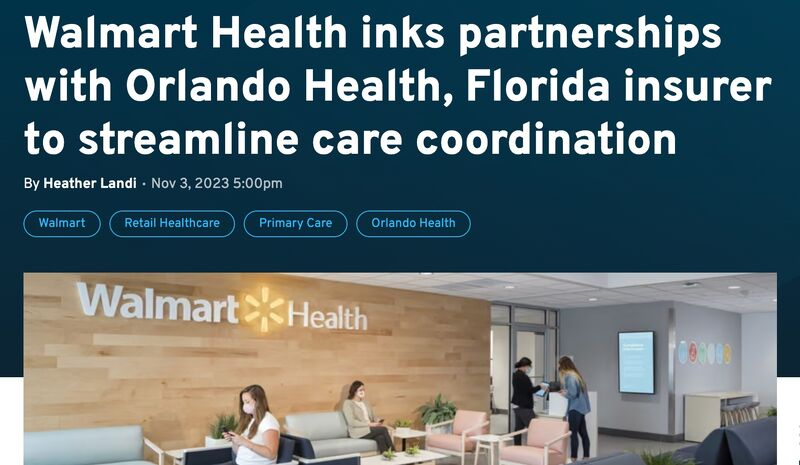
On Tuesday, Walmart Health announced deals with nine-hospital system Orlando Health and Ambetter from Sunshine Health, a Centene subsidiary offering Affordable Care Act exchange plans, to become a preferred provider in the Ambetter Value Plan.
Walmart Health’s 23 Florida-based centers will provide primary care services and care coordination in a narrow-network health plan that includes Orlando Health. The Ambetter Value Plan is available in seven counties, covering the Orlando, Tampa, and Jacksonville areas.
While this partnership is limited to Florida, Walmart Health operates 48 centers in five states, with plans to open dozens more locations and expand into three additional states next year.
The Gist: With a strong foothold and customer base in states that haven’t expanded Medicaid, Walmart Health centers are well positioned to be part of low-cost, narrow-network plans targeted at individuals who don’t qualify for Medicaid, or who were recently removed from the program.
While Walmart Health already works with major insurers, this first-ever network partnership with a health system is a notable step forward for Walmart, advancing its healthcare delivery business beyond meeting basic primary care needs into more complex care coordination.
While other large retail and pharmacy chains have opted to buy their way into the primary care space, Walmart is thus far building its own retail store-based clinic enterprise, with plenty of room to scale.
https://mailchi.mp/f12ce6f07b28/the-weekly-gist-november-10-2023?e=d1e747d2d8
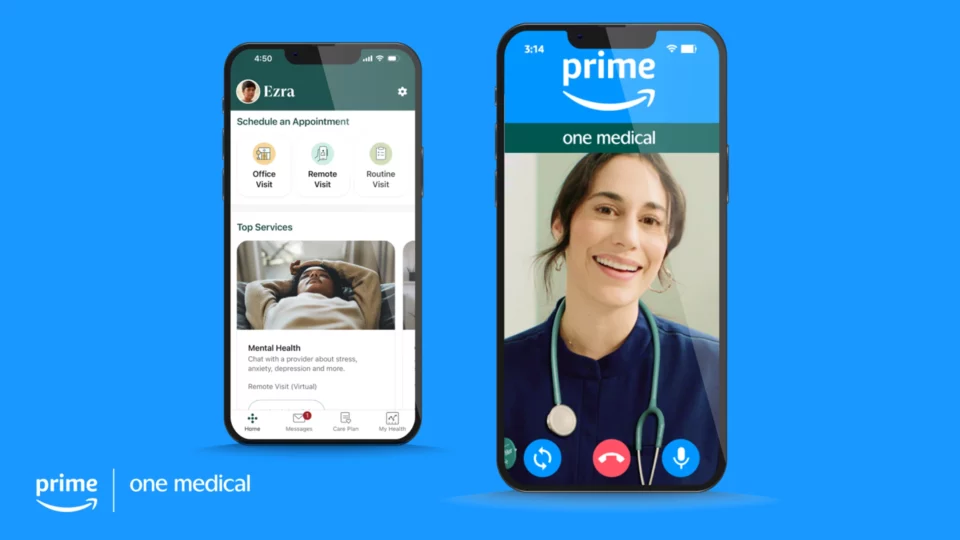
On Wednesday, e-commerce giant Amazon announced that its 167M US-based Prime members can now access One Medical primary care services for $9 per month, or $99 per year, which amounts to a 50 percent annual discount on One Medical membership. (Additional Prime family members can join for $6/month or $66/year.)
One Medical, which Amazon purchased for $3.9B last year, provides its 800K members with 24/7 virtual care as well as app-based provider communication and access to expedited in-person care, though clinic visits are either billed through insurance or incur additional charges. Amazon also recently started offering virtual care services through its Amazon Clinic platform, at cash prices ranging from $30 to $95 per visit.
The Gist: After teasing this type of bundle with a Prime Day sale earlier this year, Amazon has made the long-expected move to integrate One Medical into its suite of Prime add-ons, using a similar pricing model as its $5-per-month RxPass for generic prescription medications.
At such a low price, Amazon risks flooding One Medical’s patient population with demand it may struggle to meet. But if Amazon can scale One Medical, while maintaining its quality and convenience, it may be able to make the provider organization profitable.
Known for its willingness to take risks and absorb financial losses, Amazon is continuing to build a healthcare ecosystem focused on hybrid primary care and pharmacy services that delivers a strong consumer value proposition based on convenience and low cost.
 HENRY KOTULA