

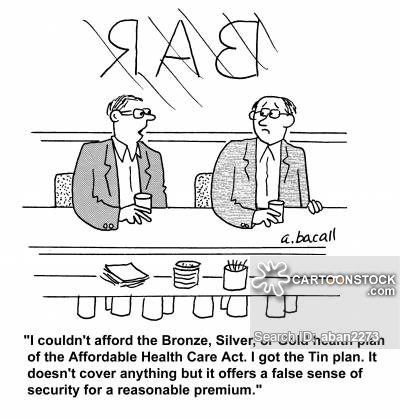
Cartoon – The Tin Plan (aka Short Term Health Insurance)


https://www.kaufmanhall.com/insights/blog/gist-weekly-april-12-2024
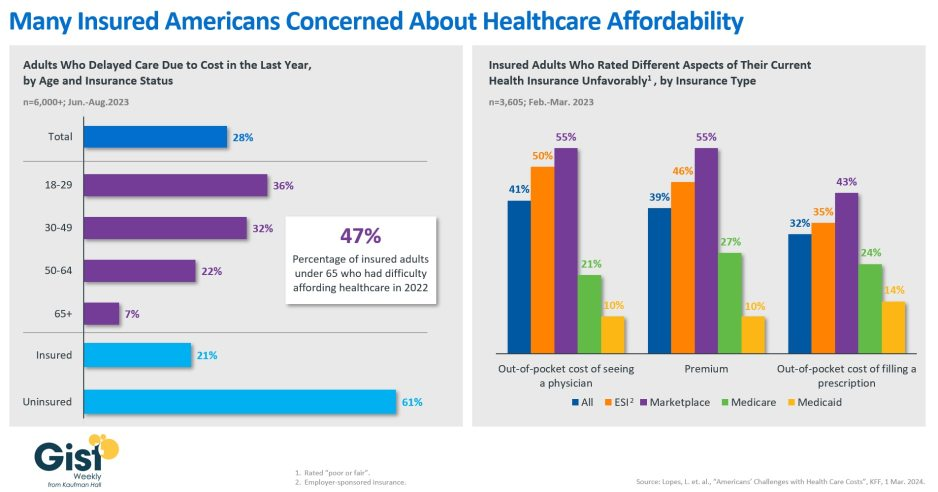
In this week’s graphic, we showcase recent KFF survey data on how healthcare costs impact the public, particularly those with health insurance.
Nearly half of US adults say it is difficult to afford healthcare, and in the last year, 28 percent have skipped or postponed care due to cost, with an even greater share of younger people delaying care due to cost concerns.
Although healthcare affordability has long been a problem for the uninsured, one in five adults with insurance skipped care in the past year because of cost. Insured Americans report low satisfaction with the affordability of their coverage.
In addition to high premiums, out-of-pocket costs to see a physician or fill a prescription are particular sources of concern. Adults with employer-sponsored or marketplace plans are far more likely to be dissatisfied with the affordability of their coverage, compared to those with government-sponsored plans.
With eight in ten American voters saying that it is “very important” for the 2024 presidential candidates to focus on the affordability of healthcare, we’ll no doubt see more attention focused on this issue as the presidential election race heats up.
https://mailchi.mp/ea16393ac3c3/gist-weekly-march-22-2024?e=d1e747d2d8
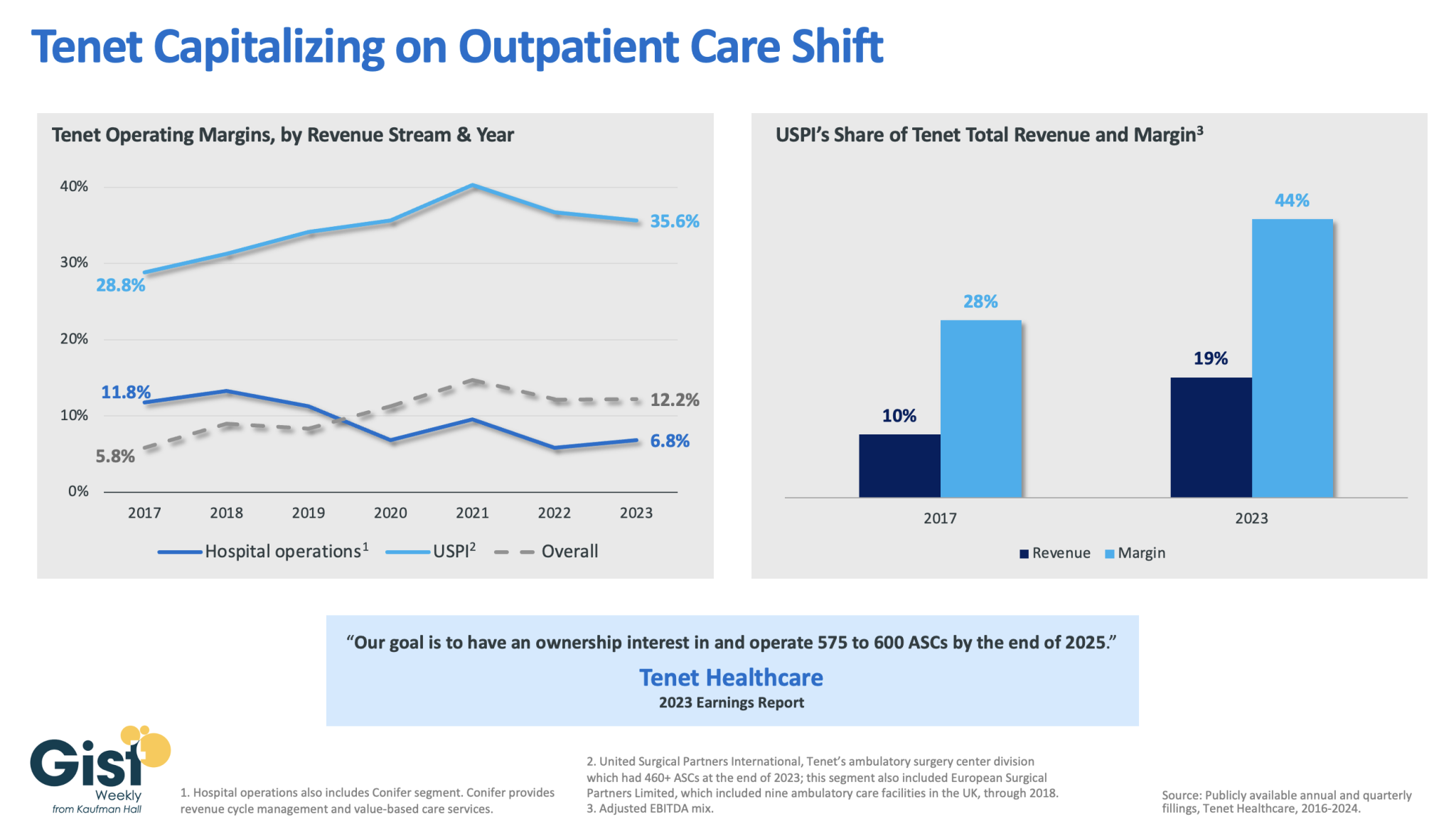
In this week’s graphic, we dive into recently released data on Tenet Healthcare’s 2023 financial performance. While the for-profit healthcare services company’s annual margin on hospital operations has declined since 2017, its overall profitability has more than doubled, thanks to strong performances from its ambulatory surgery center (ASC) chain,
United Surgical Partners International (USPI), which has consistently posted margins above 30 percent. Despite bringing in less than one fifth of Tenet’s total revenue, USPI is now responsible for almost half of Tenet’s overall margin.
Tenet has pursued this growth aggressively since buying USPI in 2015, swelling its ASC footprint from 249 locations in 2015 to more than 460 in 2023, with plans to increase that number to nearly 600 by the end of next year.
Tenet appears to be doubling down on its strategy of pursuing high-margin services over high-revenue services, especially as outpatient volumes are expected to far surpass growth in hospital-based care over the next decade.
https://mailchi.mp/ea16393ac3c3/gist-weekly-march-22-2024?e=d1e747d2d8

On Wednesday, CMS unveiled the ACO Primary Care Flex Model, which will offer participating accountable care organizations (ACOs)—whether new or renewing—in the Medicare Shared Savings Program (MSSP) a one-time, advanced payment along with monthly prospective payments, rather than shared savings at the end of a given performance year.
Set to begin in January 2025, the five-year, voluntary model is targeted at “low-revenue” ACOs (as defined by their share of Medicare Parts A and B spending for assigned beneficiaries). The National Association of ACOs (NAACOS), which supports the ACO Primary Care Flex Model, has asked that CMS reconsider its exclusion of high-revenue ACOs, saying that the exclusion prevents independent primary care practices that have already joined a health system ACO from being able to access the benefits of the new model.
The Gist: This new model is designed to better support smaller ACOs—which tend to be physician-only—by giving them access to a more stable cash flow.
The highest-performing ACOs in the MSSP have been smaller, physician-only ACOs with relatively more primary care physicians and fewer specialists.
With less than half of traditional Medicare beneficiaries in an ACO as of January 2024, CMS must entice more providers to join or form ACOs if it is to achieve its goal of getting every Medicare beneficiary into an accountable care arrangement by 2030.
https://mailchi.mp/ea16393ac3c3/gist-weekly-march-22-2024?e=d1e747d2d8

Published last week in the New York Times, this piece highlights a growing trend in health system community benefit provision: partnering with developers to build affordable housing.
These partnerships have focused on a range of housing needs, from transitional housing for people experiencing homelessness, to housing for people who need special care, to affordable housing for hospital employees. Many of these projects also include co-located medical clinics to make it easier for residents to access healthcare services, and some are even being planned on health system-owned property.
The Gist: Housing security has long been a significant social determinant of health, something that most providers recognize every day, given that a record number of Americans are currently experiencing homelessness.
Among families with complex medical needs, stable housing was demonstrated to reduce adverse health outcomes in children by 20 percent. In addition to health systems, managed care organizations are also investing in different kinds of housing solutions, and at least 19 states are directing Medicaid dollars toward housing assistance.
https://mailchi.mp/ea16393ac3c3/gist-weekly-march-22-2024?e=d1e747d2d8

On Monday, national supermarket giant Kroger announced that it had reached a definitive agreement to sell its specialty pharmacy business to insurer Elevance Health, which plans to fold the business into its CarelonRx pharmacy benefit manager (PBM) division. Kroger’s in-store retail pharmacies and walk-in clinics are not included in the deal, which could close in the second half of 2024. Kroger’s specialty pharmacy is the sixth largest by revenue, serving two percent of the US market. The planned sale comes as Kroger pursues a merger with rival supermarket chain Albertsons, which also operates a specialty pharmacy, although the Federal Trade Commission (FTC) recently announced that it’s challenging that merger.
The Gist: With total pharmacy spend up 25 percent since 2019, including a 34 percent growth for specialty drugs, Elevance is capitalizing on a booming market by pushing into pharmacy services, following last year’s acquisition of BioPlus, another specialty pharmacy.
Administering high-cost drugs to patients with rare or complex diseases, specialty pharmacies now account for more than half of all prescription drug spending despite making up only around two percent of total prescription volumes.
https://mailchi.mp/7bf72142fafb/gist-weekly-march-15-2024?e=d1e747d2d8

On Tuesday, the 8th US Circuit Court of Appeals ruled against the pharmaceutical industry after its PhRMA (The Pharmaceutical Research and Manufacturers of America) trade group sued to prevent Arkansas from requiring drug manufacturers to distribute discounted drugs to 340B contract pharmacies. The judge’s decision, seen as a win for hospitals, affirmed state authority to establish regulations on top of the federal 340B law, which does not actually reference contract pharmacies. A Louisiana law similar to Arkansas’ is currently being challenged.
The Gist: This ruling could encourage other states to pass laws protecting 340B contract pharmacy discounts. Contract pharmacy sales have swelled in recent years, prompting at least 20 major drug manufacturers to refuse to provide 340B discounts for drugs dispensed through contract pharmacies.
This issue is currently the subject of myriad lawsuits as courts have issued conflicting rulings.

 HENRY KOTULA