Cartoon – Totally Different Goals

https://mailchi.mp/f12ce6f07b28/the-weekly-gist-november-10-2023?e=d1e747d2d8

On Tuesday, Walmart Health announced deals with nine-hospital system Orlando Health and Ambetter from Sunshine Health, a Centene subsidiary offering Affordable Care Act exchange plans, to become a preferred provider in the Ambetter Value Plan.
Walmart Health’s 23 Florida-based centers will provide primary care services and care coordination in a narrow-network health plan that includes Orlando Health. The Ambetter Value Plan is available in seven counties, covering the Orlando, Tampa, and Jacksonville areas.
While this partnership is limited to Florida, Walmart Health operates 48 centers in five states, with plans to open dozens more locations and expand into three additional states next year.
The Gist: With a strong foothold and customer base in states that haven’t expanded Medicaid, Walmart Health centers are well positioned to be part of low-cost, narrow-network plans targeted at individuals who don’t qualify for Medicaid, or who were recently removed from the program.
While Walmart Health already works with major insurers, this first-ever network partnership with a health system is a notable step forward for Walmart, advancing its healthcare delivery business beyond meeting basic primary care needs into more complex care coordination.
While other large retail and pharmacy chains have opted to buy their way into the primary care space, Walmart is thus far building its own retail store-based clinic enterprise, with plenty of room to scale.
https://mailchi.mp/f12ce6f07b28/the-weekly-gist-november-10-2023?e=d1e747d2d8

On Wednesday, e-commerce giant Amazon announced that its 167M US-based Prime members can now access One Medical primary care services for $9 per month, or $99 per year, which amounts to a 50 percent annual discount on One Medical membership. (Additional Prime family members can join for $6/month or $66/year.)
One Medical, which Amazon purchased for $3.9B last year, provides its 800K members with 24/7 virtual care as well as app-based provider communication and access to expedited in-person care, though clinic visits are either billed through insurance or incur additional charges. Amazon also recently started offering virtual care services through its Amazon Clinic platform, at cash prices ranging from $30 to $95 per visit.
The Gist: After teasing this type of bundle with a Prime Day sale earlier this year, Amazon has made the long-expected move to integrate One Medical into its suite of Prime add-ons, using a similar pricing model as its $5-per-month RxPass for generic prescription medications.
At such a low price, Amazon risks flooding One Medical’s patient population with demand it may struggle to meet. But if Amazon can scale One Medical, while maintaining its quality and convenience, it may be able to make the provider organization profitable.
Known for its willingness to take risks and absorb financial losses, Amazon is continuing to build a healthcare ecosystem focused on hybrid primary care and pharmacy services that delivers a strong consumer value proposition based on convenience and low cost.
https://mailchi.mp/f12ce6f07b28/the-weekly-gist-november-10-2023?e=d1e747d2d8

One welcome side effect of the current economic challenges health systems face has been the return to prominence of the chief nursing officer (CNO) as a pivotal driver of system strategy.
So many of a hospital’s important operating and margin pressures intersect with the CNO’s domain: staffing shortages, nurse recruiting and retention, workplace violence, rising union activity, care model redesign, adoption of new care technologies (including AI), the shift of the clinical workforce into non-hospital settings, and on and on.
Never has the role of the CNO been more important to ensuring systems’ continued ability to deliver high-quality, cost-effective care in a sustainable way.
Even more heartening, we’ve been part of a number of system board retreats and strategy discussions over the past several months at which the CNO has been an important voice in the room.
We’d argue that, given how important these issues will be over the coming years, it may be time to give CNOs a permanent role in health system governance, just as boards often include physician members.
One additional agenda item that will be critical for systems to address, given the demographics of nursing executives:
what’s being done to cultivate the next generation of strong nursing leadership to fill the CNO role? A topic worth keeping an eye on.
https://mailchi.mp/f12ce6f07b28/the-weekly-gist-november-10-2023?e=d1e747d2d8
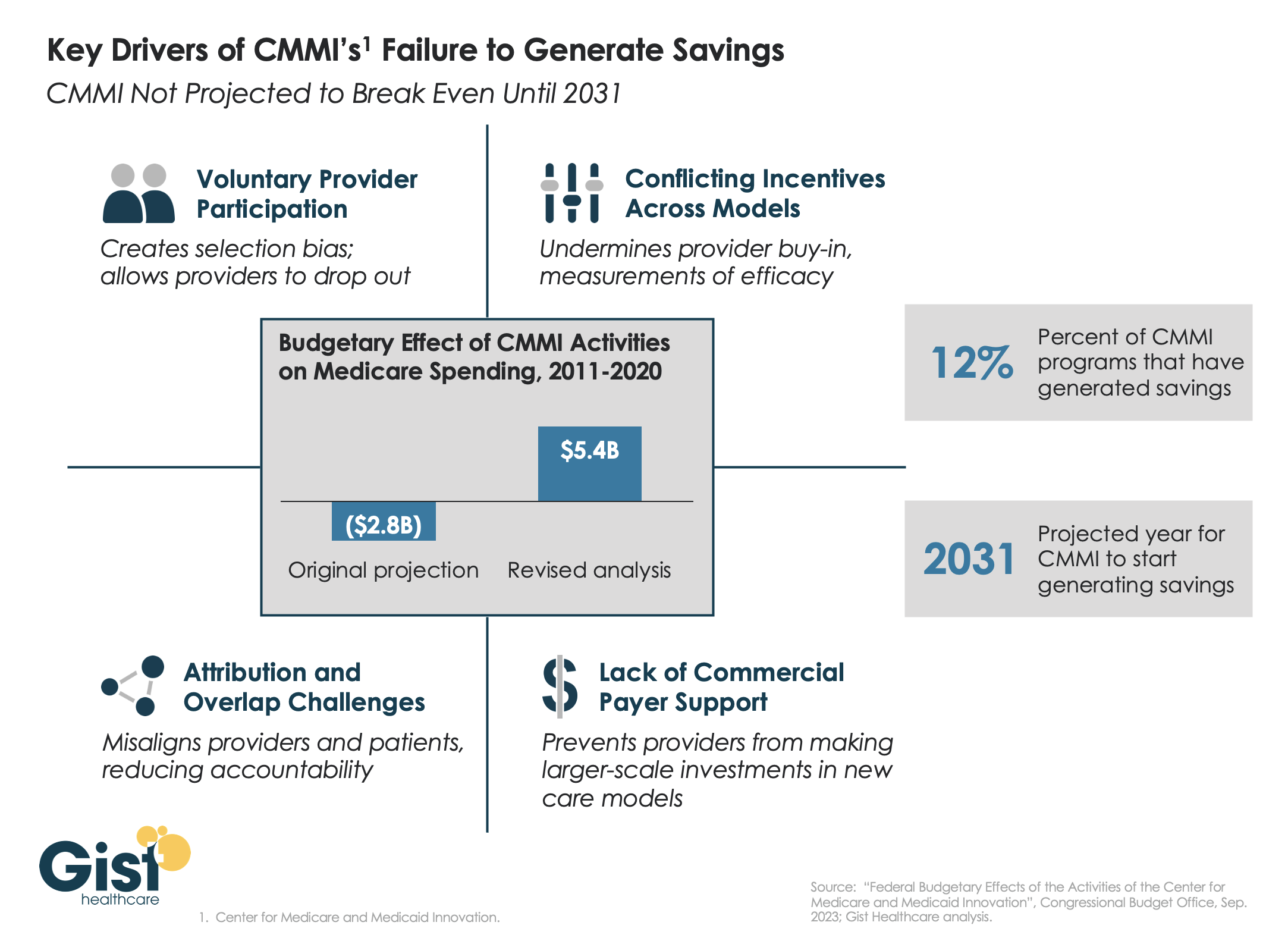
In this week’s graphic, we highlight the recent Congressional Budget Office (CBO) analysis of the budgetary impact of the Center for Medicare and Medicaid Innovation (CMMI), which has gotten off to a disappointing start.
CMMI was created by the Affordable Care Act in 2010 to test new payment models and other initiatives for reducing the federal government’s healthcare costs, but of the nearly 50 models it has run, only four have become permanent programs.
Originally projected to generate $2.8B in savings between 2011 and 2020, CMMI was responsible for a net spending increase of $5.4B, having achieved only one quarter of its projected Medicare savings.
Moreover, the CBO predicts that CMMI won’t produce net annual savings until 2031.
There are several factors to blame for CMMI’s initial shortcomings, including the lack of mandatory participation for providers, conflicting incentives across care models, patient attribution challenges between providers, and insufficient commercial payer support to scale new care models.
CMMI intends to simplify its approach, according to its 2021 “strategy refresh”, which should address some of these issues, though requiring commercial payers to participate in new models seems unlikely.
However, despite the discouraging results so far, CMMI’s mission is still laudable and important, and the transition to value remains a key priority for federal regulators.
https://mailchi.mp/f12ce6f07b28/the-weekly-gist-november-10-2023?e=d1e747d2d8

Last week, the Centers for Medicare and Medicaid Services (CMS) issued the final 2024 Physician Fee Schedule, which reduces overall payment rates for physicians by 1.25 percent, including a 3.4 percent decrease in the conversion factor for relative value units, compared to 2023.
The rule also implements a new add-on payment for complex evaluation and management visits, which is expected to boost pay for primary care physicians.
The American Medical Association (AMA) strongly opposes these cuts and immediately appealed to Congress for a reprieve. In response, the Senate Finance Committee unanimously advanced a bill to the Senate floor that would reduce the conversion-factor rate cut from 3.4 percent to 2.15 percent, while also delaying reductions in Medicaid disproportionate share funding for safety-net hospitals. Senate Majority Leader Chuck Schumer (D-NY) has indicated he intends to assemble a broad healthcare bill, including some or all of these provisions, by the end of this year.
The Gist: Physicians were hopeful that inflation’s toll on labor and supply costs would earn them a break from continued Medicare pay cuts, but CMS remains committed to reductions within its budget neutrality framework.
Earlier this year, the Medicare Payment Advisory Commission (MedPAC) recommended for the first time that physician payments be tied to an index of physician practice inflation, but that would require legislative intervention, which Congress has not taken up.
The AMA calculated that Medicare physician pay has lagged inflation by 26 percent since 2001, pointing to burnout and large numbers of physicians exiting the profession as a result.
Until calls for Medicare payment reform are heeded, physicians, like health systems, will have to adopt new, lower-cost models of care to cope with what they will continue to see as insufficient reimbursements.