Sentara sees net income climb 81% in first half of 2019

https://www.beckershospitalreview.com/finance/sentara-sees-net-income-climb-81-in-first-half-of-2019.html

Image result for sentara healthcare headquarters

Norfolk, Va.-based Sentara Healthcare improved its operating revenues and net income in the first half of fiscal year 2019, according to unaudited financial documents

Sentara recorded total operating revenues of $3.3 billion in the six-month period ended June 30, up 6.7 percent from $3.1 billion reported in the same period a year prior. The health system said the increase was primarily driven by growth in net patient service revenue. Sentara’s expenses also increased year over year by 9.3 percent to $3.1 billion for the most recent six-month period.

Sentara’s health plan saw a $34.8 million decrease in premium and capitation revenue in the most recent six-month period, driven by a 46,000-member reduction in health maintenance organization individual enrollment. However, the decline was mostly offset by an increase in Medicaid and other membership of 48,000, thanks to the state’s recent Medicaid expansion.

Overall, Sentara saw its net operating income decline 19 percent year over year to $230.5 million, down from $284.8 million reported in the same period of fiscal 2018. After including nonoperating gains, Sentara ended the first half of the fiscal year with net income of $569.4 million, up 81.2 percent from $314.1 million recorded in the same period of the previous year.


I’ve lived the difference between US and UK health care. Here’s what I learned

https://www.cnn.com/2019/08/07/opinions/single-payer-healthcare-beers/index.html?utm_source=Sailthru&utm_medium=email&utm_campaign=Newsletter%20Weekly%20Roundup:%20Healthcare%20Dive%2008-10-2019&utm_term=Healthcare%20Dive%20Weekender

Image result for conflict of interests

Earlier this year, I shattered my elbow in a freak fall, requiring surgery, plates and screws. While I am a US citizen, several years ago I married an Englishman and became a UK resident, entitled to coverage on the British National Health Service. My NHS surgeon was able to schedule me in for the three-hour surgery less than two weeks after my fall, and my physical therapist saw me weekly after the bone was healed to work on my flexion and extension. Both surgery and rehab were free at the point of use, and the only paperwork I completed was my pre-operative release forms.

Compare that to another freak accident I had while living in Boston in my 20s. I spilled a large cup of hot tea on myself, suffered second degree scald burns, and had to be taken to the hospital in an ambulance. In the pain and chaos of the ER admission, I accidentally put my primary insurance down as my secondary and vice versa. It took me the better part of six months to sort out the ensuing paperwork and billing confusion, and even with two policies, I still paid several hundred dollars in out-of-pocket expenses.
With debate raging in the US among Democrats about whether to push for a government health care system such as Medicare for All, there is no doubt in my mind that the NHS single-payer health care system is superior to the American system of private insurance.
As someone who suffers from chronic illness, is incredibly clumsy and accident-prone, and has two young children, I spend an inordinate amount of time in doctors’ offices and hospitals. When my family is in our home in York, England, our health care is paid for principally through direct taxation, and we have zero out of pocket costs.
In contrast, when we are in the US, we are on my employer-based insurance plan. After years with one provider, rising costs pushed the premiums alone to above 10% of my gross salary for the family plan, and I recently opted to switch to a new provider, whose premiums are a more modest but still eye-watering 7% of my salary. I have had to switch our family doctor and specialists, with the attendant hassle of applying to have our medical records released and transferred to our new providers. In addition to my premiums, both plans include significant co-pays, although my new provider does not have a deductible.

In Britain, I am not entitled to the annual well patient and women’s health check-ups that Americans can now receive without a co-pay or deductible thanks to the Affordable Care Act. As an asthma sufferer, I do, however, have regular annual reviews of my condition. When one of my children becomes ill, I am usually able to receive same-day treatment in both countries, although in both cases this involves showing up early for the urgent care clinic.
The comparative ease and security of the NHS is why the system retains such high levels of support from the British public, despite frustrations with wait times and other aspects of service provision. A recent poll found that 77% of respondents felt that “the NHS is crucial to British society and we must do everything we can to maintain it,” and nearly 90% agreed that that the NHS should be free at the point of delivery, provide a comprehensive service available to everyone, and be primarily funded through taxation. Britons’ affection for their NHS was dramatically enacted in Danny Boyle’s 2012 Olympic opening ceremony extravaganza.
Yet, while I share my adopted countrymen’s support for the NHS, I can see almost no chance of America adopting a single-payer health care system of the kind described by Sens. Sanders and Warren any time soon. Sanders, Warren and other single-payer advocates not only face a strong and entrenched adversary in the American insurance industry, they also lack the broad public support for reform which characterized post-WWII Britain.
That broad public support for reform was crucial. Britain’s NHS system was very nearly defeated by opposing interests when it was introduced in the 1940s. It was initially opposed by the municipal and voluntary authorities, who controlled the 3,000 hospitals which Health Secretary Aneurin Bevan sought to bring under national administration, by the various Royal Colleges of surgeons and specialists, and by British Medical Association (BMA), the professional body representing the vast majority of the nation’s general practitioners, who stood to lose control of their private practices and become state employees.
At a meeting of doctors following the publication of Bevan’s proposals in January 1946, one physician claimed that “This Bill is strongly suggestive of the Hitlerite regime now being destroyed in Germany,” and another described the proposed nationalization of the hospitals as “the greatest seizure of property since Henry VIII confiscated the monasteries.” The BMA hostility persisted through rounds of negotiations lasting two years. Less than six months before the bill was set to come into effect on July 5, 1948, the BMA’s membership voted by a margin of 8 to 1 against the NHS, sparking serious fears within the government that GPs would refuse to come on board, effectively scuppering the NHS.
Bevan insisted that he would not cave but he did have to make several costly concessions to bring the doctors on board. First, he cleaved off the specialists (who were closely tied to the hospitals), by promising them that, if they signed on, they could continue to treat private patients in NHS-run hospitals in addition to their NHS patients, whom they would be paid to treat on a fee-for-service basis. Then, he offered the general practitioners a generous buyout to give up their stake in their private practices (effectively purchasing their patient lists), if they came on board. And finally, he promised them that the government would not be able to compel them to become fully salaried employees of the state without the passage of new legislation.
At the same time that Bevan offered the carrot of economic concessions, he also wielded the stick of public opinion against the doctors. Speaking in the House of Commons in February 1948, Bevan positioned single-payer healthcare as an issue of middle class survival, in language whose substance, if not its style, would not sound out of place in a 2020 Democratic primary debate: “Consider that social class which is called the “middle class.” Their entrance into the scheme, and their having a free doctor and a free hospital service, is emancipation for many of them. There is nothing that destroys the family budget of the professional worker more than heavy hospital bills and doctors’ bills.”
Bevan spoke for a public exceptionally united in support of an expanded state welfare policy as a result of the socially unifying experience of World War II. Fear of public backlash combined with economic incentives ultimately brought the medical establishment to heel.
Many were shocked when Bevan succeeded, but the BMA was arguably a less formidable threat to reform then than the American insurance industry is now. Insurance companies stand to be the biggest losers from a switch to single-payer health care, which seeks to achieve economies in large part through cutting out the profit-making middle man. As Elizabeth Warren noted in last Tuesday’s debate, US insurance companies reported $23 billion in profits last year. And the insurance lobby is determined to protect its position. That is why insurance companies are major donors in both state and federal election campaigns. The insurance industry has put massive resources into ensuring continued public and political opposition to the introduction of a single-payer system.
It’s possible that, if Americans were presented with an arguably cheaper and less bureaucratic health care system, they might decide that they liked it and were committed to doing everything they could to maintain it. But given the constellation of political forces in 21st century America, that just isn’t going to happen any time soon.

New York Insurers get 6.8% bump, say high medical costs are driving up rates

https://www.crainsnewyork.com/health-pulse/insurers-get-68-bump-say-high-medical-costs-are-driving-rates?utm_source=health-pulse-monday&utm_medium=email&utm_campaign=20190809&utm_content=hero-readmore

Image result for high health insurance premiums

Rates in the individual insurance market will increase by 6.8% on average next year—the lowest amount since 2015—as the state Department of Financial Services continued to beat the drum of affordability and reduce health plans’ proposed increases.

Insurers in the individual market had asked for 9.2% on average, and DFS trimmed those requests by about one-quarter.

DFS granted Centene’s Fidelis Care, which has the largest market share on the state’s Affordable Care Act marketplace, a 3.9% increase; the insurer had asked for 6.8%.

UnitedHealthcare, which offers one of the highest-priced plans on the marketplace, sought a 27.1% price bump and was approved for 15%, the greatest average increase among all plans.

Oscar had the second-highest rate jump, 14%, which was lowered slightly from its initial 15.4% average request.

EmblemHealth, a nonprofit insurer that has lost millions in recent years, received its full 13.5% price increase.

In the small-group insurance market, insurers were granted an average 7.9% increase in premiums after requesting a 12.2% bump on average.

The percentage increase each New Yorker experiences depends on their insurer, where they live, which product they choose and whether they qualify for income-based subsidies.

The rising premiums reflect increases in the prices of medical care and prescription drugs, said Eric Linzer, president and CEO of the state Health Plan Association.

“Every New Yorker deserves affordable coverage choices that provide them with access to high-quality care,” Linzer said. “Making that a reality requires addressing the underlying factors driving health care costs, particularly the persistent price increases by drug companies and providers.”

The average request of 9.2%, which differs from the 8.4% DFS reported insurers asked for in May, accounts for the inclusion of risk adjustment, a spokeswoman for the department said.

Health Care for All New York, a coalition of patient advocacy groups, said in June that more predictable medical costs in the individual market and excessive increases in past years made insurers’ requests for 2020 unjustified.

The persistent price increases in the individual market, as well as growing out-of-pocket costs for patients, have fueled proponents of a single-payer health system. But the Cuomo administration noted that New Yorkers who don’t get insurance from their employer are still better off than they were before the Affordable Care Act.

The state said that premiums in the individual market are still 55% lower than they were before the implementation of the Affordable Care Act without accounting for income-based tax credits that can lower the cost of insurance.

“This year marks the ninth anniversary of the Affordable Care Act’s passage and the fifth year since implementation, and we continue our strong efforts to support the ACA and combat unjustified federal attacks on the nation’s health care system,” DFS Superintendent Linda Lacewell said in a statement. “By reducing insurers’ rate requests, DFS is ensuring access to affordable health care and helping to maintain a robust, competitive marketplace.”

Elisabeth Benjamin, vice president of health initiatives at the Community Service Society, said state lawmakers must take more aggressive action to make health insurance affordable for New Yorkers. Such action could include price controls, state premium assistance, the creation of a public option or the adoption of a single-payer health system through the New York Health Act, she said.

“I think Superintendent Lacewell and DFS did the best that they could through the administrative tools they have—that is New York’s transparent prior approval process,” Benjamin said. “But at the end of the day, New York needs to do more to address the health care affordability crisis.” —Jonathan LaMantia


Republicans ready to revive ACA repeal talks

https://www.beckershospitalreview.com/hospital-management-administration/republicans-ready-to-revive-aca-repeal-talks.html

Image result for aca repeal

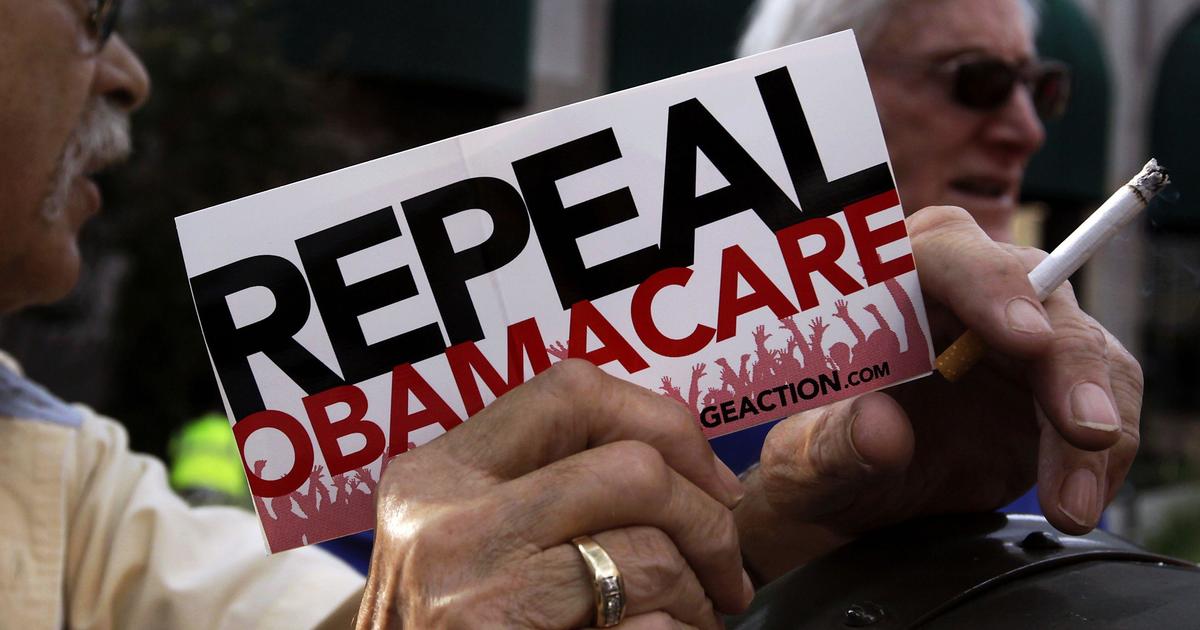
Sen. Lindsey Graham, R-S.C., promised to revive ACA repeal in Congress if Republicans can win back a majority in the House and reelect President Donald Trump in 2020, according to an interview on South Carolina radio show “The Morning Answer with Joey Hudson,” featured by The Hill

“This is what 2020 is about: If we can get the House back, and keep our majority in the Senate, and President Trump wins reelection, I can promise you, not only are we going to repeal Obamacare, we are going to do it in a smart way where South Carolina would be the biggest winner,” Mr. Graham said.

Mr. Graham, who failed to pass an ACA repeal plan in 2017, called “Medicare for All” and other Democratic presidential candidates’ healthcare plans “crazy.”  

“Medicare for All is $30 trillion, and it’s going to take private sector healthcare away from 180 million Americans,” he said. Instead, he proposed giving states the power to determine healthcare policy through block grants and other smaller reforms. This would allow states to test conservative healthcare policies against liberal ones, he said. 

“This election has got a common thing: Federalism versus socialism,” Mr. Graham said. “What I want to do is make sure the states get the chance to administer this money using conservative principles if you are in South Carolina, and if you want Medicare for All in California, knock yourself out.”

Charity Care Spending By Hospitals Plunges

Charity Care Spending By Hospitals Plunges

Image result for Charity Care Spending By Hospitals Plunges

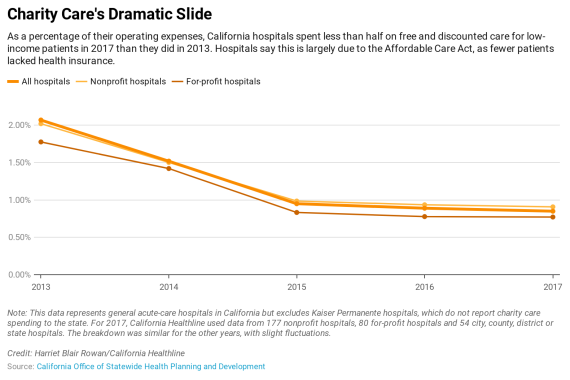
California hospitals are providing significantly less free and discounted care to low-income patients since the Affordable Care Act took effect.

As a proportion of their operating expenses, the state’s general acute-care hospitals spent less than half on these patients in 2017 than they did in 2013, according to data the hospitals reported to California’s Office of Statewide Health Planning and Development.

The biggest decline in charity care spending occurred from 2013 to 2015, when it dropped from just over 2% to just under 1%. The spending has continued to decline, though less dramatically, since then.

The decline was true of for-profit hospitals, so-called nonprofit hospitals and those designated as city, county, district or state hospitals.

Health experts attribute the drop in charity care spending largely to the implementation of the federal Affordable Care Act, popularly known as Obamacare. The law expanded insurance coverage to millions of Californians, starting in 2014, and hospitals are now treating far fewer uninsured patients who cannot pay for the care they receive.

With fewer uninsured patients, fewer patients seek financial assistance through the charity care programs, according to the California Hospital Association.

Cori Racela, deputy director at the Western Center on Law & Poverty, countered that many people still need financial assistance because — even with insurance — they struggle to pay their premiums, copays and deductibles.

“The need for charity care has changed,” she said, “but it still exists.”

The data on charity care comes from most of the state’s general acute-care hospitals but does not include Kaiser Permanente hospitals, which are not required by the state to report their charity care totals. (Kaiser Health News, which produces California Healthline, has no affiliation with Kaiser Permanente.)

For 2017, California Healthline used data from 177 nonprofit hospitals, 80 for-profit hospitals and 54 city, county, district or state hospitals. The breakdown was similar for the other years, with slight fluctuations.

Nonprofit hospitals, whose charity care spending dropped from 2.02% of operating expenses to 0.91% over the five-year period, are required by state and federal law to provide “community benefits” in exchange for their tax-exempt status.

They can meet that requirement beyond providing free and discounted care in a variety of ways: They can offer community public health programs, write off uncollected patient debt and claim the difference between what it costs to provide care and the amount that they are reimbursed by government insurance programs.

Nonprofit “hospitals get tax-exempt status, but they don’t get it for free,” said Ge Bai, associate professor of accounting and health policy at Johns Hopkins University. Charity care “is part of the implicit contract between hospital and taxpayers.”

Bai sees the reduced spending on charity care as part of a trend of nonprofit hospitals acting more like their for-profit counterparts.

Many nonprofit hospitals “no longer consider charity care their primary mission,” she said. “They are making more and more money but they are dropping their charity care.”

The state and federal governments set no minimum requirements for charity spending by hospitals, although the California Attorney General has created standards for a few nonprofit hospitals that have changed ownership in recent years.

Jan Emerson-Shea, a spokeswoman for the California Hospital Association, said hospitals are giving back to their communities in ways beyond charity care.

“You see charity care declining, but Medi-Cal losses are increasing,” Emerson-Shea said. She pointed to the growing shortfalls many hospitals report from caring for more patients covered by the public insurance program. “Every Medi-Cal patient we treat we lose money on.”

Medi-Cal, the state’s Medicaid program for low-income residents, increased its rolls by 5.6 million — or about 70% — from 2013 to 2017.

Racela, of the Western Center on Law & Poverty, would like to see changes in California’s charity care rules to address high out-of-pocket costs.

And she wants hospitals to abide by the state law that requires them to inform patients that they may be eligible for charity care based on their income.

“There is still a big unmet need for charity care across the state,” Racela said.


Seventy two percent of all rural hospital closures are in states that rejected the Medicaid expansion

https://www.gq.com/story/rural-hospitals-closing-in-red-states

Image result for rural hospital bankruptcies

States that refused Obamacare’s Medicaid expansion are hemorrhaging hospitals in rural areas.

Roughly 20 percent of Americans live in rural areas, including more than 13 million children, according to the last U.S. census. And, according to research and reporting by the Pittsburg Morning Sun and its parent company, GateHouse Media, those people have been steadily losing access to hospitals for years.

In Oklahoma, Georgia, South Carolina, and Mississippi, at least 52 percent of all rural hospitals spent more money than they made between 2011 to 2017. In Kansas, it’s 64 percent, and five hospitals there shut down completely in that time. Since 2010, 106 rural hospitals have closed across the country. (Another 700 are “on shaky ground,” and about 200 are “on the verge of collapse,” according to Gatehouse.) Of those 106 that closed, 77 were in deep red states where local politicians refused the Obama administration’s Medicaid expansion that came about as a result of the Affordable Care Act.

In short, the federal government provided funds to expand coverage for Medicaid, a program that helps pay for health care for low income patients. But the expansion was optional, and 14 Republican-controlled states rejected to take the money. The only state that bucked this trend was Utah, where rural hospitals were among the most profitable in the country thanks to a policy of shifting funds and resources from urban hospitals. Only 14 percent of rural hospitals operated at a loss and none shut down over the same time period.

The number of rural hospitals has been shriveling for some time now: more than 200 rural hospitals closed between 1990 and 2000, according to a report from the Office of Health and Human Services. Since rural areas have been losing hospitals for decades already, every additional closure is more devastating. And even the hospitals that remain open are struggling to stay fully staffed. According to the Health Resources and Services Administration, rural parts of the U.S. need an additional 4,022 doctors to completely close their coverage gaps.

Just refusing the Medicaid expansion alone doesn’t completely account for the hundreds of rural hospital closures across Republican-controlled states. For one thing, medical treatment and technology has gotten more advanced. Dr. Nancy Dickey, president of the Rural and Community Health Institute at Texas A&M, told Gatehouse, “Most of what we knew how to do in the 1970s and 1980s could be done reasonably well in small towns. But scientific developments and advances in neurosurgery, microscopic surgery and the like required a great deal more technology and a bigger population to support the array of technology specialists.” As a result, the number of services that rural hospitals offered started to shrink, while at the same time rural populations dwindled as both jobs and young people moved away. What’s left were older, poorer populations that needed more medical care and had less money to pay for it. In that situation, hospitals can’t generate enough revenue to stay open, let alone enough to pay the salaries of even new doctors, who carry an average of $200,000 in student debt.

Still, if the state legislatures and governors had accepted the money, billions of dollars could have gone to improving insurance coverage and propping up the hospitals’ bottom lines. In a health-care industry where the average CEO pay is $18 million a year, hospitals have to produce a lot of money to justify their existence to shareholders. The Medicaid expansion was one of the few lifelines available to rural Americans, and their politicians snubbed it.


Trump to Sign Medicare Order as Part of Attack on Democrats’ Health-Care Message

https://www.wsj.com/articles/trump-administration-proposal-would-allow-prescription-drug-imports-from-canada-11564580906?utm_source=Sailthru&utm_medium=email&utm_campaign=Newsletter%20Weekly%20Roundup:%20Healthcare%20Dive%2008-03-2019&utm_term=Healthcare%20Dive%20Weekender

Image result for band aid

Administration moves ahead to bolster Medicare Advantage plans and authorize lower-cost drug imports from Canada, as it takes on Medicare for All.

President Trump is preparing to sign an executive order next week on Medicare and moving ahead with allowing some drug imports from Canada, part of the administration’s effort to engineer a response to Democratic proposals that candidates say would expand health coverage to all Americans.

The executive order would aim to strengthen Medicare for 44 million Americans and portray the president as defending it against Democrats who want to expand it nationwide under their Medicare for All strategy, a White House official said Wednesday.

The administration on Wednesday also said it would allow the imports of some drugs from Canada, backing an idea most Democratic candidates have also said they support. More executive orders, including one on drug prices, are possible, according to a person familiar with the plans.

Mr. Trump is taking a two-pronged approach to his 2020 campaign message on health care, attacking Medicare for All as socialism and rolling out a blitz of health-care initiatives intended to position him as the person who can drive down costs and protect health care.

The president is expected to contrast the Democrats’ plans with his in a speech set for Aug. 6. “He’s going to indict and impugn the idea of Medicare for All,” a White House official said of the speech. Senior White House aides and agency officials are holding meetings several times a week on health care plans, the official said.

Democratic challengers say Mr. Trump has endangered coverage by backing cuts to Medicare and a lawsuit that could dismantle the Affordable Care Act.

“We are not about trying to take away health care from anyone,” Massachusetts Democratic Sen. Elizabeth Warren said during the candidates’ debate Tuesday. “That’s what the Republicans are trying to do.”

This week, the administration proposed a rule that would compel hospitals to disclose discounted rates with insurers. The president signed an executive order to overhaul kidney-disease care, and the White House relaxed restrictions on pretax health savings accounts so the money can be used on treatment to prevent disease.

Mr. Trump is expected to sign the Medicare executive order next week at The Villages, a Florida retirement community with 120,000 residents that is majority Republican.

Mr. Trump may call for agency action to bolster Medicare Advantage plans, which private insurers offer under contract with Medicare and cover about 22 million people, according to two people familiar with the executive order. The president is likely to focus on curbing waste and abuse in Medicare that can add to the program’s cost. In addition, the order may aim to let Medicare Advantage plans offer a wider array of supplemental benefits. The administration has already taken steps in this direction by letting home health-care providers become partners in the Medicare Advantage contracts.

Mr. Trump also is expected to push for changes that could lower the price of patient visits to hospital outpatient clinics, two of the people said. Those visits can cost more than visits to clinics operated by doctors. “This is part of the president’s broader vision to put American patients first,” one person familiar with the executive order said.

A White House spokesman declined to confirm the details or comment on the executive order.

House Republicans and Health and Human Services Secretary Alex Azar have criticized the plans from Democrats, saying they would end Medicare Advantage and imperil the Medicare program, which covers 44 million Americans.

“Our administration wants to strengthen the program, protect the program, make sure it’s sustainable over the long term,” Seema Verma, administrator at the Centers for Medicare and Medicaid Services, said Wednesday at a press event. “We need to work toward that instead of forcing so many more people onto the program.”


In Wednesday’s second Democratic debate, 7 of 10 candidates support Medicare for All

https://www.healthcarefinancenews.com/node/139034?mkt_tok=eyJpIjoiWW1OaFpUazJaV1l4TldFeiIsInQiOiJPSUpCQjRXc1E1MTZUUTJIaWFHTWtPWEFTVzRYa0RWTUJ6dFc4ZHNSWlN3aWlKSjlmN3NsajZ0b01PSGkzdHUrQWg1UzR2VUM5QWlSbXdLcG5qUFBIWlVPV1wvWnlKTHlUZ3lNU3JCWG9oM1JLY3hjc3hSRXl3RnBEanlPbUpSZnkifQ%3D%3D

Democratic candidates take the stage during first debate in June.

Expanding coverage, lowering healthcare costs, central to Democratic agenda.

Tonight, Joe Biden, Kamala Harris, Cory Booker, Andrew Yang, Julián Castro, Tulsi Gabbard, Michael Bennet, Jay Inslee, Kirsten Gillibrand, Bill de Blasio take the stage for round two of the Democratic presidential debates.

Seven support Medicare for All. The others – Biden, Bennett and Inslee have come out in favor of a public option. Here, in no particular order, is a look at where each candidate stands on healthcare coverage.

Joe Biden

As vice president to President Barack Obama, former Senator Joe Biden carries into this election the legacy of the Affordable Care Act. As president, Biden said he would protect the ACA and prevent further Republican attempts to dismantle it.

Unlike many of his Democratic rivals, Biden does not support full Medicare for All. Instead of getting rid of private insurance, Biden said he would build on the ACA through the Biden Plan to create a public health insurance option. As in Medicare, costs would be reduced through negotiating for lower prices from hospitals and other providers.

He also has a plan to increase the value of the ACA tax credits by eliminating the 400% income cap on tax credit eligibility and lowering the limit on the cost of coverage from 9.86% of income to 8.5%. This means that no one would spend more than 8.5% of their income on health insurance. Additionally,  Biden would base the size of tax credits on the cost of the higher-tiered gold plan, rather than silver plan.

Biden also supports premium-free access to the public option for individuals in the 14 states that have not expanded Medicaid under the ACA. States that have already expanded Medicaid would have the choice of moving the expansion population to the premium-free public option, as long as the states continue to pay their current share of the cost of covering those individuals.

Biden also promises to stop surprise billing, tackle market concentration, repeal the exception allowing drug companies to avoid negotiating with Medicare over drug prices and limiting the launch price for drugs that face no competition, among other actions.

In his words: “When we passed the Affordable Care Act, I told President Obama it was a big deal – or something to that effect.”

Kamala Harris

California Senator Kamala Harris often refers to her mother’s diagnosis of colon cancer and her Medicare coverage for treatment as an example of why all Americans should have Medicare for All.

Harris is looking to eliminate premiums and out-of-pocket costs through government insurance that guarantees comprehensive care including dental and vision and coverage. Harris gives no estimate of the cost of universal healthcare, but says taking profit out of America’s healthcare system would save money.

Her Medicare for All plan, which is similar to Senator Bernie Sanders – would cover all medically necessary services, including emergency room visits, doctor visits, vision, dental, hearing aids, mental health and substance use disorder treatment, telehealth and comprehensive reproductive care services. It would allow the Secretary of Health and Human Services to negotiate for lower prescription drug prices.

As former Attorney General of California who won a $320 million settlment from insurers, Harris said she wants to take on Big Pharma and private insurers to lower the cost of prescription drugs.

She also has strong views on prosecuting opioid makers and for preserving women’s right to healthcare and protecting Planned Parenthood from the financial cuts and policies of the Trump Administration.

She would institute an audit of prescription drug costs to ensure pharmaceutical companies are not charging more than other comparable countries, a comprehensive maternal child health program to reduce deaths among women and infants of color, and rural healthcare reforms, such as increasing residency slots for rural areas with workforce shortages and loan forgiveness for rural healthcare professionals.

In her words on the ACA: “As someone who fought tooth and nail as Attorney General and as Senator to prevent repeal, that’s exactly what I will continue to do.”

Cory Booker

Senator Cory Anthony Booker, first African-American Senator from New Jersey, and former mayor of Newark, is also a Medicare for All proponent.

He also wants to implement universal paid family and medical leave.

He supports lowering costs for prescription drugs by allowing Medicare to negotiate prices and by importing drugs from Canada and other countries, the latter a policy announced today by Health and Human Services Secretary Alex Azar.

He would also invest in ending the maternal mortality rate and work to reduce racial disparities in maternal mortality rates.

One of his big issues is expanding eligibility for long-term services and support for low and middle-income Americans needing care at home. He wants long-term care workers to be paid a minimum of $15 an hour.To limit the impact of the program on state budgets, the new costs associated with the expansion of Medicaid long-term care services and workforce standards would be financed entirely by the federal government in, effectively, a 100% match. The cost would be financed by making the tax code more progressive by reforming the capital gains, estate, and income taxes.

In his words: “Healthcare is a human right.”

Kirsten Gillebrand

Kirsten Gillebrand, U.S. Senator from New York, originally ran for a House seat in that state on a platform that supported the expansion of Medicare, a view she still holds, and in 2017 expressed support for Senator Bernie Sanders’ Medicare for All bill.

In May, Gillebrand reiterated her support, saying the best way to achieve a single-payer system is to let people buy-in over a transition period of about four to five years. She favors allowing a public option to create competition with insurance companies. Medicare needs to be fixed first so that reimbursement rates better reflect costs, she said.

In 2011 she helped pass the James Zadroga 9/11 Health and Compensation Act, which provides treatment to the first responders of the Sept. 11, 2001 terrorist attacks. The law provides health monitoring and services for 9/11-related health issues among those exposed to the debris and tainted air of the attack’s aftermath.

In her words: “Under the healthcare system we have now, too many insurance companies continue to value their profits more than they value the people they are supposed to be helping.”

Bill de Blasio

New York Mayor Bill de Blasio believes everyone, including undocumented immigrants, has a right to receive healthcare, and has repeatedly voiced his support for a national single-payer health plan.

He and rival Elizabeth Warren raised their hands during the first debate when asked if they supported Medicare for All.

One of his accomplishments as mayor was signing a bill into law that established a paid sick leave and safe leave plan for the city.

First unveiled in January, the program NYC Care, guarantees healthcare for the roughly 600,000 New Yorkers who aren’t currently insured, which de Blasio touted as the “most comprehensive health system in the nation.” He has indicated that NYC Care could become a model nationwide.

The plan encompasses primary and specialty care, pediatric and maternity care and mental health services. The idea is that NYC Care works on what de Blasio said was a “sliding scale,” in which people can essentially pay what they can for care. While the city already has a public option for healthcare, de Blasio said NYC Care will pay for direct comprehensive care for people who can’t afford insurance or who aren’t covered by Medicaid.

The program costs $100 million per year for the city — an investment the mayor expects will yield returns.

In his words: “If we don’t help people get their healthcare, we’re going to pay plenty on the back end when people get really sick,” he said recently on MSNBC’s “Morning Joe” broadcast.

Jay Inslee

Washington Governor Jay Inslee has planted a flag as “the climate change candidate” and in many ways he’s all in on that single issue, reasoning that things like healthcare policy “become relatively moot if the entire ecosystem collapses on which human life depends.”

That said, he has a strong case to make on healthcare by virtue of having just recently put his state’s money where his fellow candidates’ mouths are: in May he signed the country’s first public option into law in Washington.

Expect him to bring up that accomplishment — in which the state will contract with private insurers to create a public option that pays at Medicare plus 60 percent — in any conversation about healthcare, as he did in the first debate.

In his words: “We hope this will be a smashing success. We hope that it will give a shot of courage to other governors to move forward toward universal access. We were willing to take the leap and we’re gonna learn as we go along, I’m sure, and there will be some modifications. But we had to get started.”

Michael Bennet

Colorado Senator Michael Bennet supports a public option he calls Medicare-X. But where his plan stands apart from others is a strong focus on the rural-urban divide on access to care. He intends to create a healthcare policy that will ensure that all regions of the country are covered by available health plans, addressing what he calls a failure of the ACA exchanges.

His plan is unusually detailed and includes lowering prescription drug prices, closing existing gaps in care, and, yes, promoting telemedicine and other technology that can bolster rural healthcare. He also has provisions for combatting substance abuse, improving maternal and mental health, and bringing more support to senior caregivers.

In his words: “As president, I would build on the Affordable Care Act to cover everyone, rather than doing away with our current system. My Medicare-X plan gives every family the choice to buy an affordable public option or keep the plan they have today. It starts in rural areas, where there is very little competition and requires the federal government to negotiate drug prices. I have fought for this approach for almost a decade, because it is the most effective and fastest way to cover everyone and drive down costs.”

Julián Castro

The former U.S. Secretary of Housing and Urban Development and San Antonio Mayor favors a Medicare for All, single-payer system.

To pay for the system, Castro has said he would raise taxes on corporations and on the wealthiest Americans — the “0.05, 0.5 or 1%,” he said.

While he favors a single-payer system, Castro said he would allow private insurance, saying that anyone who wants their own private insurance plan should be able to have one.

In his words: Castro said at an event in Iowa that, “The U.S. should be the healthiest nation in the world.”

Andrew Yang

Entrepreneur Andrew Yang of New York is founder of Venture for America, a two-year fellowship program for recent grads who want to work at a startup and create jobs in American cities.

He supports Medicare for All and has called the Affordable Care Act a step in the right direction that didn’t go far enough because access to medicine isn’t guaranteed and the incentives for healthcare providers don’t align with providing quality, efficient care.

Doctors are incentivized to act as factory workers, he has said, churning through patients and prescribing redundant tests, rather than doing what they’d prefer–spending extra time with each patient to ensure overall health.

Medicare for All will increase access to preventive care, bringing overall healthcare costs down. Cost can also be controlled directly by setting prices provided for medical services.

He cites the Cleveland Clinic, where doctors are paid a flat salary instead of by a price-for-service model. Redundant tests are at a minimum, and physician turnover is much lower than at comparable hospitals, he said.

And the Southcentral Foundation which uses a holistic approach to treat native Alaskans with mental and physical problems by referring patients to psychologists during routine physicals.

Also, the current system of employer-sponsored insurance prevents employees from having economic mobility.

In his words: “New technologies – robots, software, artificial intelligence – have already destroyed more than 4 million U.S. jobs, and in the next 5-10 years, they will eliminate millions more.”

Tulsi Gabbard

Rep. Tulsi Gabbard of Hawaii is a military veteran who supports Medicare for All as a cosponsor of H.R.676, the Expanded & Improved Medicare for All Act.

But she is currently getting press for her lawsuit against Google claiming alleged election interference.

Following the first Democratic primary debate on June 26, many people searched her name, but “without any explanation, Google suspended Tulsi’s Google Ads account,” her office said in a statement, according to The Verge.

Tulsi claims the tech giant suspended her campaign’s Google Ads account just after that first debate.

Congress must act to prevent the tech giant from exerting too much influence, she claimed Monday on “Tucker Carlson Tonight.”
In her words: “This is really about the unchecked power these big tech monopolies have over our public discourse and how this is a real threat to our freedom of speech and to our fair elections.”


Democratic Debate Turns Ferocious Over Health Care

Candidates in the first night of this week’s Democratic presidential debates sparred over health care coverage.

It took only one question — the very first — in Tuesday night’s Democratic presidential primary debate to make it clear that the issue that united the party in last year’s congressional elections in many ways now divides it.

When Jake Tapper of CNN asked Senator Bernie Sanders whether his Medicare for All health care plan was “bad policy” and “political suicide,” it set off a half-hour brawl that drew in almost every one of the 10 candidates on the stage. Suddenly, members of the party that had been all about protecting and expanding health care coverage were leveling accusations before a national audience at some of their own — in particular, that they wanted to take it away.

“It used to be Republicans that wanted to repeal and replace,” Gov. Steve Bullock of Montana said in one of the more jolting statements on the subject. “Now many Democrats do as well.”

Those disagreements set a combative tone that continued for the next 90 minutes. The health care arguments underscored the powerful shift the Democratic Party is undergoing, and that was illustrated in a substantive debate that also included trade, race, reparations, border security and the war in Afghanistan.

In the end, it was a battle between aspiration and pragmatism, a crystallization of the struggle between the party’s left and moderate factions.

It is likely to repeat itself during Wednesday night’s debate, whose lineup includes former Vice President Joseph R. Biden Jr. and Senator Kamala Harris of California. He supports building on the Affordable Care Act by adding an option to buy into a public health plan. She released a proposal this week that would go further, eventually having everyone choose either Medicare or private plans that she said would be tightly regulated by the government.

Democrats know all too well that the issue of choice in health care is a potent one. When President Barack Obama’s promise that people who liked their health plans could keep them under the Affordable Care Act proved to be untrue, Republicans seized on the fallout so effectively that it then propelled them to majorities in both the House and Senate.

On Tuesday night, Representative Tim Ryan of Ohio evoked those Republican attacks of years ago on the Affordable Care Act, saying the Sanders plan “will tell the union members that give away wages in order to get good health care that they will lose their health care because Washington is going to come in and tell them they have a better plan.”

Republicans watching the debate may well have been smiling; the infighting about taking away people’s ability to choose their health care plan and spending too much on a pipe-dream plan played into some of President Trump’s favorite talking points. Mr. Trump is focusing on health proposals that do not involve coverage — lowering drug prices, for example — as his administration sides with the plaintiffs in a court case seeking to invalidate the entire Affordable Care Act, putting millions of people’s coverage at risk.

It was easy to imagine House Democrats who campaigned on health care, helping their party retake control of the chamber, being aghast at the fact that not a single candidate mentioned the case.

Mr. Sanders’s plan would eliminate private health care coverage and set up a universal government-run health system that would provide free coverage for everyone, financed by taxes, including on the middle class. John Delaney, the former congressman from Maryland, repeatedly took swings at the Sanders plan, suggesting that it was reckless and too radical for the majority of voters and could deliver a second term to Mr. Trump.

Mr. Sanders held firm, looking ready to boil over at time — “I wrote the damn bill,” he fumed after Mr. Ryan questioned whether benefits in his plan would prove as comprehensive as he was promising. Senator Elizabeth Warren of Massachusetts, the only other candidate in favor of a complete overhaul of the health insurance system that would include getting rid of private coverage, chimed in to back him up.

At one point she seemed to almost plead. “We are not about trying to take away health care from anyone,” she interjected. “That’s what the Republicans are trying to do.”

Mr. Delaney has been making a signature issue of his opposition to Medicare for all, instead holding up his own plan, which would automatically enroll every American under 65 in a new public health care plan or let them choose to receive a credit to buy private insurance instead. He repeatedly disparaged what he called “impossible promises.”

He was one of a number of candidates — including Beto O’Rourke, the former congressman from Texas; Senator Amy Klobuchar of Minnesota and Mayor Pete Buttigieg of South Bend, Ind. — who sought to stake out a middle ground by portraying themselves as defenders of free choice with plans that would allow, but not force, people to join Medicare or a new government health plan, or public option. (Some candidates would require people to pay into those plans, while others would not.)

The debate moderators also pressed Mr. Sanders and Ms. Warren on whether the middle class would have to help pay for a Sanders-style plan, which would provide a generous set of benefits — beyond what Medicare covers — to every American without charging them premiums or deductibles. One of the revenue options Mr. Sanders has suggested is a 4 percent tax on the income of families earning more than $29,000.

In defending his plan, Mr. Sanders repeatedly pointed out how many Americans are uninsured or underinsured, unable to pay high deductibles and other out-of-pocket costs and thus unable to seek care.

Analysts often point out that the focus on raising taxes to pay for universal health care leaves out the fact that in exchange, personal health care costs would drop or disappear.

“A health reform plan might involve tax increases, but it’s important to quantify the savings in out-of-pocket health costs as well,” Larry Levitt, executive vice president for health policy at the nonpartisan Kaiser Family Foundation, tweeted during the debate. “Political attacks don’t play by the same rules.”

A Kaiser poll released Tuesday found that two-thirds of the public supports a public option, though most Republicans oppose it. The poll also found about half the public supports a Medicare for all plan, down from 56 percent in April. The vast majority of respondents with employer coverage — which more than 150 million Americans have — rated it as excellent or good.

In truth, Mr. Delaney’s own universal health care plan could also face political obstacles, not least because it, too, would cost a lot. He has proposed paying for it by, among other steps, letting the government negotiate drug prices with pharmaceutical companies and requiring wealthy Americans to cover part of the cost of their health care.

Had Mr. Sanders not responded so forcefully to the attacks, it would have felt like piling on, though some who criticized his goals sounded more earnest than harsh.

“I think how we win an election is to bring everyone with us,” Ms. Klobuchar said, adding later in the debate that a public option would be “the easiest way to move forward quickly, and I want to get things done.”


White House races to come up with health-care wins for Trump’s campaign

https://www.washingtonpost.com/health/trump-to-unveil-drug-price-health-initiatives-in-walk-up-to-2020/2019/07/31/f4adc4de-af1a-11e9-8e77-03b30bc29f64_story.html?utm_term=.559659aa0911&wpisrc=nl_most&wpmm=1

Image result for healthcare initiatives


White House advisers, scrambling to create a health-care agenda for President Trump to promote on the campaign trail, are meeting at least daily with the aim of rolling out a measure every two to three weeks until the 2020 election.

One of the initiatives would allow states to import lower-priced drugs from Canada and other countries and another would bar Medicare from paying more than any other country for prescription drugs, according to two senior administration officials and lobbyists — controversial ideas in line with Democratic proposals. Yet it remains unclear the administration has the legal authority to execute some of these policies without Congress.

The White House is already facing fierce pushback on some proposals from Republicans on Capitol Hill and the pharmaceutical industry, which will likely go to court to challenge any measure it opposes.

The furious push reflects the administration’s sense of vulnerability on an issue that Democrats successfully used in 2018 to win control of the House of Representatives. White House officials are eager to inoculate the president against a repeat of that strategy in 2020 — and reduce the GOP disadvantage on an issue that pollsters say plays to Democratic strengths. Most of the Democratic presidential candidates have made health-care proposals, including Medicare-for-all plans, key to their campaigns. Health care is already playing a starring role in the debates and Democrats are sure to assail Trump for his attempts to eliminate coverage for millions of people by challenging the Affordable Care Act in court.

“President Trump has said we will protect people with preexisting conditions, lower drug prices, end surprise medical bills, and make sure Americans get the highest quality of care they deserve,” said White House spokesman Judd Deere. “While the radical left has sweeping proposals for a total government takeover of the health system that will hurt seniors and eliminate private insurance for 180 million Americans, the Trump administration is working on real solutions.”

Some, however, are doubtful a flurry of executive orders and new regulations would have an immediate effect on consumers’ pocketbooks. What is clear is that the approach, which includes White House support for a bipartisan Senate bill to cap Medicare drug price increases to the rate of inflation, is putting congressional Republicans in a tough spot: Embrace Trump’s agenda and abandon conservative precepts about interference in the marketplace, or buck the president on one of his top priorities.

While Republicans have largely fallen in line with Trump on free trade and immigration even when he has blown up GOP orthodoxy, many rely heavily on donations from the pharmaceutical industry and are reluctant to sour those relationships.

One lobbyist, who spoke on the condition of anonymity, described being stunned at a recent White House meeting when Domestic Policy Council Director Joe Grogan said the administration would not let Democrats run to the president’s left on lowering the prices of prescription medicines.

In another tense meeting, top pharmaceutical executives were told bluntly “it wasn’t in the industry’s best interests” to block the bipartisan Senate bill backed by Trump. If it failed, they were told, they’d see “the president of the United States negotiating with Nancy Pelosi [on allowing the government to negotiate drug prices in Medicare],” said a person familiar with the meeting.

On Wednesday, Health and Human Services Secretary Alex Azar announced the outlines of a plan to eventually allow Americans to import certain lower-cost drugs from Canada and other countries. White House officials are also weighing an Obamacare replacement that Congress would take up after the election, a Medicare plan to contrast with Democratic Medicare-for-all proposals, help for beleaguered rural hospitals and steps to reduce maternal death rates, according to two senior administration officials.

The health-care effort is being driven by the White House’s Domestic Policy Council Director Joe Grogan, Chief of Staff Mick Mulvaney and the White House Office of Management and Budget acting director Russ Vought. Other participants in the sometimes contentious daily meetings include Azar, the president’s son-in-law and senior adviser Jared Kushner, White House counselor Kellyanne Conway and representatives from the vice president’s office.

One senior administration official, who spoke on the condition of anonymity to discuss internal deliberations, said the White House believes it has “tremendous authority” to write executive orders under food, drug and cosmetic laws, as well as through the ACA, which gives the government broad power to test ways to improve health care and reduce costs in government programs.

“We think the [ACA] authority is pretty tremendous,” the official said. The administration is currently arguing in federal court to overturn the law, however, with a decision expected late summer or fall.

But many health policy and legal experts disagree and are also skeptical the steps the administration is talking about would have a tangible effect on consumers before the election.

“It’s unlikely the administration is going to be able to use an executive order that Americans are going to be able to notice before the election,” said Benedic Ippolito, a health economist at the American Enterprise Institute. “It’s an incredibly ambitious timeline.”

Others see court challenges as inevitable, noting the drug industry has already shown a willingness to sue the administration over policies it opposes; it recently won a lower court victory against an Health and Human Servies regulation that would have required drugmakers to include the list prices of their medications in television ads.

“I’m not sure they can get anything done and survive a court challenge before the election,” said Chris Meekins, a former HHS official who is now a health care policy research analyst at Raymond James, a financial services firm.

The White House is also attempting to build support for the Senate bill authored by Finance Committee Chairman Charles E. Grassley (R-Iowa) and ranking Democrat Sen. Ron Wyden (Ore.), that for the first time would require drugmakers to pay back the federal government if they raised the prices of medications in the Medicare program in excess of the rate of inflation. It would also limit out-of-pocket costs for beneficiaries.

The pharmaceutical industry opposes the bill, and some Republicans have already derided the legislation as tantamount to negotiating drug prices or imposing “price controls”a line in the sand for many who oppose what they see as government interference in the market. Senate Majority Leader Mitch McConnell (R-Ky.) has not said whether he will bring a drug-pricing legislative package up for a vote, but he is generally opposed to voting on health-care legislation ahead of the election.

Against the advice of many congressional Republicans, White House advisers are also working to craft an Obamacare replacement plan that Trump could campaign on, especially if the Fifth Circuit should declare the law unconstitutional this fall and catapult the issue to the forefront of the 2020 races.

Some GOP lawmakers and strategists worry about rolling out a plan that has no chance of passage in the current Congress and that Democrats could pick to pieces during a long campaign. Many also have little appetite to return to the debate over repealing Obamacare.

Nonetheless, the White House is considering a plan, put together by conservative think tanks, that would eliminate the ACA’s subsidies for low-income consumers and replace the open-ended federal commitment to Medicaid with a lump-sum payment for each state in the form of a block grant, according to a copy posted online. The proposal largely follows the outlines of a 2017 Republican bill, which the Senate never voted on because it did not garner enough support.

“We don’t have a lot of buy in on the Hill,” acknowledged the senior administration official, “but we’re figuring it out.”

Some of the other health-care proposals under review also appear largely aspirational, for instance, a draft executive order that instructs agencies to speed development of a universal flu vaccine, first reported by Politico, that proposes no new funding. Other efforts, such as the initiatives to reduce HIV infections, reduce end-stage kidney disease and double the number of transplants, contain new funding and have been widely heralded.

“Every chance we have to set or tweak a rule we are doing it.” said the senior official. “This administration has been more creative and accomplished more when it comes to health care and health than anybody has given us credit for.”