How generative AI will change the doctor-patient relationship

https://www.linkedin.com/pulse/how-generative-ai-change-doctor-patient-relationship-pearl-m-d-/?trackingId=sNn87WorSt%2BPg3F0SxKUIw%3D%3D

After decades of “doctor knows best,” the traditional physician-patient relationship is on the verge of a monumental shift. Generative AI tools like OpenAI’s ChatGPT, Google’s Bard and Microsoft’s Bing are poised to give people significantly more power and control—not just over their personal lives and professional tasks, but over their own medical health, as well.

As these tools become exponentially smarter, safer and more reliable (an estimated 32 times more powerful in the next five years), everyday Americans will gain access to unparalleled medical expertise—doled out in easily understandable terms, at any time, from any place.

Already, Google’s Med-PaLM 2 has scored an expert-level 86.5% on the U.S. medical license exam while other AI tools have matched the skill and accuracy of average doctors in diagnosing complex medical diseases.

Soon, AI tools will be able to give patients detailed information about their specific medical problems by integrating with health monitors and electronic medical records (such EHR projects are already underway at Oracle/Cerner and Epic). In time, people will be able to self-diagnose and manage their own diseases as accurately and competently as today’s clinicians.

This newfound expertise will shake the very foundation of clinical practice.

Although public health experts have long touted the concept of clinicians and patients working together through shared decision-making, this rarely happens in practice. Generative AI will alter that reality.

Building on part one of this article, which explained why generative AI constitutes a quantum leap ahead of all the tech that came before it, part two provides a blueprint for strengthening the doctor-patient alliance in the era of generative AI.

Patients Today: Sick And Confused

To understand how generative AI will impact the practice of medicine, it’s best to look closer at the current doctor-patient dynamic.

The relationship has undergone significant evolution. In the past century, patients and doctors held close, enduring relationships, built on trust and a deep understanding of the patient’s individual needs. These bonds were characterized by a strong sense of personal connection, as doctors had the time to listen to their patients’ concerns and provided not only medical treatment but also emotional support.

Today, the doctor-patient relationship remains vitally important, but it has undergone several meaningful changes. While medical advancements have greatly expanded the possibilities for diagnosis and treatment, the relationship itself has suffered from less trust and a more transactional focus. The average visit lasts just 15 minutes, barely enough time to address the patient’s current medical concerns. The doctor’s computer and electronic healthcare record systems sit, quite literally, between doctors and patients. The result is that patients feel rushed and find their medical care increasingly impersonal. Modern healthcare is characterized by time constraints, administrative burdens and a focus on efficiency. This can lead to a sense of impersonality and decreased communication between doctors and patients.

But throughout these changes, one thing has remained constant. The doctor-patient relationship, which dates back more than five millennia, has always existed on an uneven playing field, with patients forced to rely almost entirely on doctors to understand their diseases and what to do about them.

Though patients can and do access the internet for a list of possible diagnoses and treatment options, that’s not the same as possessing medical expertise. In fact, sorting through dozens of online sources—often with conflicting, inaccurate, outdated and self-serving information—proves more confusing than clarifying. Nowhere can web-surfers find personalized and credible advice based on their age, medical history, genetic makeup, current medications and laboratory results.

What’s needed now is modern doctor-patient relationship, one that is strong enough to meet the demands of medicine today and restore the vital, personal and emotional connections of the past.    

Patients Tomorrow: Self-Diagnosing And Confident

In the future, generative AI will alter the doctor-patient dynamic by leveling the playing field.

Already, consumer AI tools can equip users with not just knowledge, but expertise. They allow the average person to create artistic masterpieces, produce hit songs and write code with unimagined sophistication. Next generations will offer a similar ability for patients, even those without a background in science or medicine.

Like a digitized second opinion, generative AI will shrink the knowledge gap between doctors and patients in ways that search engines can’t. By accessing millions of medical texts, peer-reviewed journals and scientific articles, ChatGPT will deliver accurate and unbiased medical expertise in layman’s language. And unlike internet sources, generative AI tools don’t have built-in financial incentives or advertising models that might skew responses.

To help patients and doctors navigate the upcoming era of generative AI, here’s a model for the future of medical practice based on proven approaches in education:  

Introducing The ‘Flipped Healthcare’ Model

The “flipped classroom” can be traced back nearly four decades, but it became popularized in the United States in the early 2000s through the Khan Academy in Northern California.

Students begin the learning process by watching videos and engaging with interactive tools online rather than sitting through traditional lectures. This pre-class preparation (or “homework in advance”) allows people to learn at their own pace. Moreover, it enhances classroom discussions, letting teachers and students dive much deeper into topics than they ever could before. Indeed, students spend time in class applying knowledge and collaborating to solve problems—not merely listening and taking notes.  

The introduction of generative AI opens the door to a similar approach in healthcare. Here’s how that might work in practice:

  1. Pre-Consultation Learning: Before visiting a doctor, patients would use generative AI tools to understand their symptoms or medical conditions. This foundational knowledge would accelerate the diagnostic process and enhance patient understanding. Even in the absence of advanced diagnostic testing (X-rays or bloodwork), this pre-consultation phase allows the patient to understand the questions their clinicians will ask and the steps they will take.
  2. In-Depth Human Interactions: With the patient’s knowledge base already established, consultations will dive deep into proactive health strategies and/or long-term chronic-disease management solutions, rather than having to start at square one. This approach maximizes the time patients and clinicians spend together. It also addresses the reality that at least 50% of patients leave the doctor’s office unsure of what they’ve been told.
  3. Home Monitoring: For the 60% of American patients living with chronic diseases, generative AI combined with wearable monitors will provide real-time feedback, thereby optimizing clinical outcomes. These patients, instead of going in for periodic visits (every three to six months), will obtain daily medical analysis and insights. And in cases where generative AI spots trouble (e.g., health data deviates from the doctor’s expectations), the provider will be able to update medications immediately. And when the patient is doing well, physicians can cancel follow-up visits, eliminating wasted time for all.
  4. Hospital At Home: Inpatient (hospital) care accounts for 30% of all healthcare costs. By continuously monitoring patients with medical problems like mild pneumonia and controllable bacterial infections, generative AI (combined with home monitoring devices and telemedicine access) would allow individuals to be treated in the comfort of their home, safely and more affordably than today.
  5. Lifestyle Medicine: Generative AI would support preventive health measures and lifestyle changes, reducing the overall demand for in-person clinical care. Studies confirm that focusing on diet, exercise and recommended screenings can reduce the deadliest complications of chronic disease (heart attack, stroke, cancer) by 30% or more. Decreasing the need for intensive procedures is the best way to make healthcare affordable and address the projected shortage of doctors and nurses in the future.

The Future: Collaborative Care For Superior Outcomes

The U.S. healthcare model often leaves patients feeling frustrated and overwhelmed. Meanwhile, time constraints placed on doctors lead to rushed consultations and misdiagnoses, which cause an estimated 800,000 deaths and disabilities annually.

The “flipped” approach, inspired by the Khan Academy, leverages the patient expertise that generative AI will create. Following this model will free up clinician time to make the most of every visit. Implementing this blueprint will require improvements in AI technology and an evolution of medical culture, but it offers the opportunity to make the doctor-patient relationship more collaborative and create empowered patients who will improve their health.

Talk with educators at the Khan Academy, and they will tell you how their innovative model results in better-educated students. They’ll also tell you how much more satisfied teachers and students are compared to those working in the traditional educational system. The same can be true for American medicine.

The AI-empowered patient is coming. Are doctors ready?

https://www.linkedin.com/pulse/ai-empowered-patient-coming-doctors-ready-robert-pearl-m-d-/

Artificial intelligence (AI) has long been heralded as an emerging force in medicine. Since the early 2000s, promises of a technological transformation in healthcare have echoed through the halls of hospitals and at medical meetings.

But despite 20-plus years of hype, AI’s impact on medical practice and America’s health remains negligible (with minor exceptions in areas like radiological imaging and predictive analytics).

As such, it’s understandable that physicians and healthcare administrators are skeptical about the benefits that generative AI tools like ChatGPT will provide.

They shouldn’t be. This next generation of AI is unlike any technology that has come before. 

The launch of ChatGPT in late 2022 marked the dawn of a new era. This “large language model” developed by OpenAI first gained notoriety by helping users write better emails and term papers. Within months, a host of generative AI products sprang up from Google, Microsoft and Amazon and others. These tools are quickly becoming more than mere writing assistants.

In time, they will radically change healthcare, empower patients and redefine the doctor-patient relationship. To make sense of this bold vision for the future, this two-part article explores:

  1. The massive differences between generative AI and prior artificial intelligences
  2. How, for the first time in history, a technological innovation will democratize not just knowledge, but also clinical expertise, making medical prowess no longer the sole domain of healthcare professionals.

To understand why this time is different, it’s helpful to compare the limited power of the two earliest generations of AI against the near-limitless potential of the latest version.

Generation 1: Rules-Based Systems And The Dawn Of AI In Healthcare

The latter half of the 20th century ushered in the first generation of artificial intelligence, known as rule-based AI.

Programmed by computer engineers, this type of AI relies on a series of human-generated instructions (rules), enabling the technology to solve basic problems.

In many ways, the rule-based approach resembles a traditional medical-school pedagogy where medical students are taught hundreds of “algorithms” that help them translate a patient’s symptoms into a diagnosis.

These decision-making algorithms resemble a tree, beginning with a trunk (the patient’s chief complaint) and branching out from there. For example, if a patient complains of a severe cough, the doctor first assesses whether fever is present. If yes, the doctor moves to one set of questions and, if not, to a different set. Assuming the patient has been febrile (with fever), the next question is whether the patient’s sputum is normal or discolored. And once again, this leads to the next subdivision. Ultimately each end branch contains only a single diagnosis, which can range from bacterial, fungal or viral pneumonia to cancer, heart failure or a dozen other pulmonary diseases.

This first generation of AI could rapidly process data, sorting quickly through the entire branching tree. And in circumstances where the algorithm could accurately account for all possible outcomes, rule-based AI proved more efficient than doctors.

But patient problems are rarely so easy to analyze and categorize. Often, it’s difficult to separate one set of diseases from another at each branch point. As a result, this earliest form of AI wasn’t as accurate as doctors who combined medical science with their own intuition and experience. And because of its limitations, rule-based AI was rarely used in clinical practice.

Generation 2: Narrow AI And The Rise Of Specialized Systems

As the 21st century dawned, the second era of AI began. The introduction of neural networks, mimicking the human brain’s structure, paved the way for deep learning.

Narrow AI functioned very differently than its predecessors. Rather than researchers providing pre-defined rules, the second-gen system feasted on massive data sets, using them to discern patterns that the human mind, alone, could not.

In one example, researchers gave a narrow AI system thousands of mammograms, half showing malignant cancer and half benign. The model was able to quickly identify dozens of differences in the shape, density and shade of the radiological images, assigning impact factors to each that reflected the probability of malignancy. Importantly, this kind of AI wasn’t relying on heuristics (a few rules of thumb) the way humans do, but instead subtle variations between the malignant and normal exams that neither the radiologists nor software designers knew existed.

In contrast to rule-based AI, these narrow AI tools proved superior to the doctor’s intuition in terms of diagnostic accuracy. Still, narrow AI showed serious limitations. For one, each application is task specific. Meaning, a system trained to read mammograms can’t interpret brain scans or chest X-rays.

But the biggest limitation of narrow AI is that the system is only as good as the data it’s trained on. A glaring example of that weakness emerged when United Healthcare relied on narrow AI to identify its sickest patients and give them additional healthcare services.

In filtering through the data, researchers later discovered the AI had made a fatal assumption. Patients who received less medical care were categorized as healthier than patients who received more. In doing so, the AI failed to recognize that less treatment is not always the result of better health. This can also be the result of implicit human bias.

Indeed, when researchers went back and reviewed the outcomes, they found Black patients were being significantly undertreated and were, therefore, underrepresented in the group selected for additional medical services.

Media headlines proclaimed, “Healthcare algorithm has racial bias,” but it wasn’t the algorithm that had discriminated against Black patients. It was the result of physicians providing Black patients with insufficient and inequitable treatment. In other words, the problem was the humans, not narrow AI.

Generation 3: The Future Is Generative

Throughout history, humankind has produced a few innovations (printing press, internet, iPhone) that transformed society by democratizing knowledge—making information easier to access for everyone, not just the wealthy elite.

Now, generative AI is poised to go one step further, giving every individual access to not only knowledge but, more importantly, expertise as well.

Already, the latest AI tools allow users to create a stunning work of art in the style of Rembrandt without ever having taken a painting class. With large language models, people can record a hit song, even if they’ve never played a musical instrument. Individuals can write computer code, producing sophisticated websites and apps, despite never having enrolled in an IT course.

Future generations of generative AI will do the same in medicine, allowing people who never attended medical school to diagnose diseases and create a treatment plan as well as any clinician.

Already, one generative AI tool (Google’s Med-PaLM 2) passed the physician licensing exam with an expert level score. Another generative AI toolset responded to patient questions with advice that bested doctors in both accuracy and empathy. These tools can now write medical notes that are indistinguishable from the entries that physicians create and match residents’ ability to make complex diagnoses on difficult cases.

Granted, current versions require physician oversight and are nowhere close to replacing doctors. But at their present rate of exponential growth, these applications are expected to become at least 30 times more powerful in the next five years. As a result, they will soon empower patients in ways that were unimaginable even a year ago.

Unlike their predecessors, these models are pre-trained on datasets that encompass the near-totality of publicly available information—pulling from medical textbooks, journal articles, open-source platforms and the internet. In the not-distant future, these tools will be securely connected to electronic health records in hospitals, as well as to patient monitoring devices in the home. As generative AI feeds on this wealth of data, its clinical acumen will skyrocket.

Within the next five to 10 years, medical expertise will no longer be the sole domain of trained clinicians. Future generations of ChatGPT and its peers will put medical expertise in the hands of all Americans, radically altering the relationship between doctors and patients.

Whether physicians embrace this development or resist is uncertain. What is clear is the opportunity for improvement in American medicine. Today, an estimated 400,000 people die annually from misdiagnoses, 250,000 from medical errors, and 1.7 million from mostly preventable chronic diseases and their complications.

In the next article, I’ll offer a blueprint for Americans as they grapple to redefine the doctor-patient relationship in the context of generative AI. To reverse the healthcare failures of today, the future of medicine will have to belong to the empowered patient and the tech-savvy physician. The combination will prove vastly superior to either alone.

Epic expanding its lead on EHR competitors

https://mailchi.mp/b7baaa789e52/the-weekly-gist-september-29-2023?e=d1e747d2d8

Two large nonprofit health systems made headlines earlier this month announcing that they plan to transition, enterprise-wide, from Oracle Cerner to Epic for their electronic health record (EHR) system.

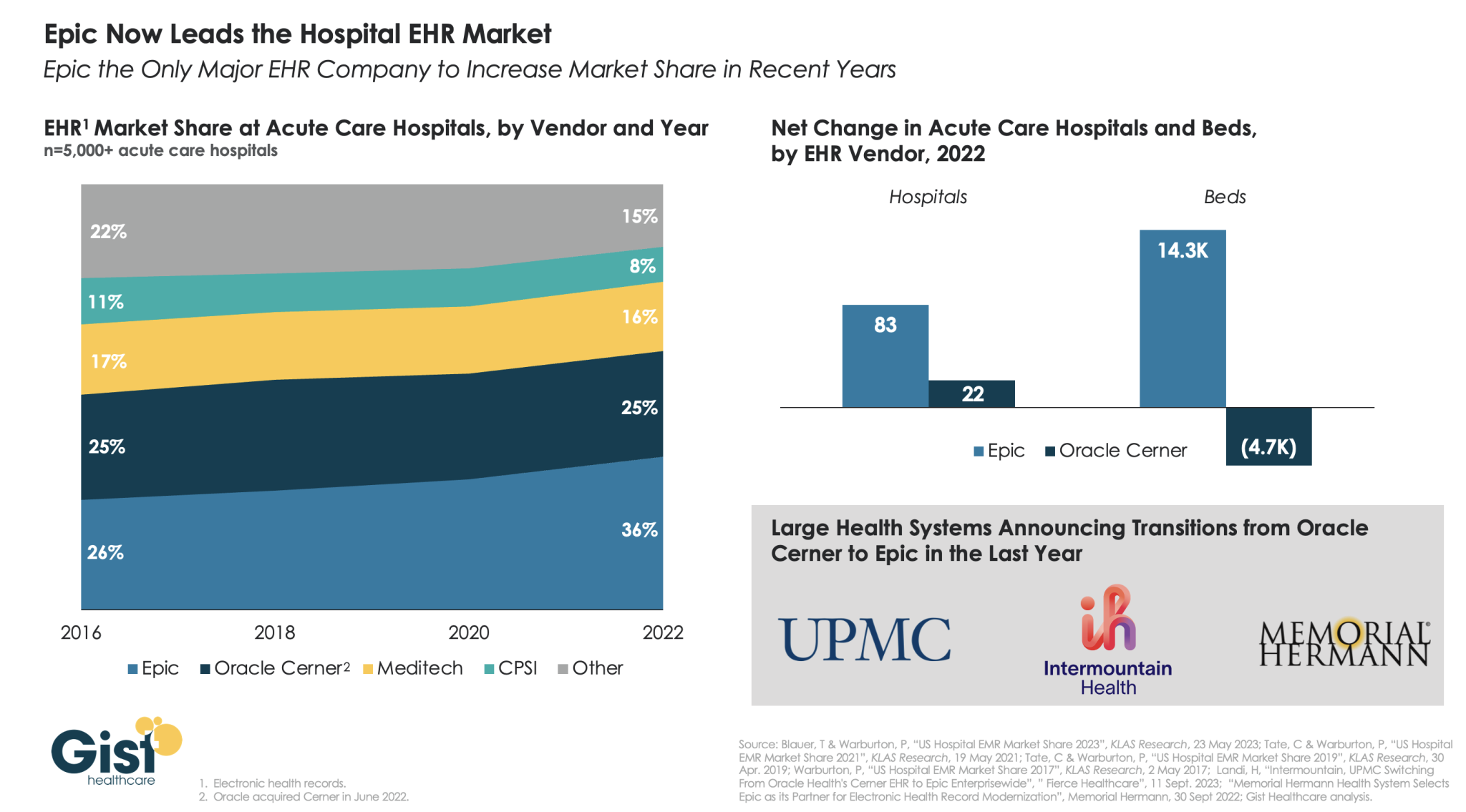
Using data from KLAS Research, the graphic below shows how Epic has emerged in recent years as the leader in the hospital EHR market. From 2016 to 2022, Epic increased its acute care hospital market share from 26 percent to 36 percent, while its main rival, Oracle Cerner, held flat at 25 percent.

Moreover, Epic is gaining popularity among larger health systems, while Oracle Cerner lost almost 5K beds in 2022, despite gaining 22 hospitals, as it trades large systems for smaller hospitals. 

Epic’s ability to consolidate multiple archives into a single, more functional platform has made it popular with physicians, whose feedback was cited by Intermountain as a key reason behind the system’s decision to switch. 

With three quarters of Americans having an Epic record, the company is leveraging its pole position in aggregating healthcare data as healthcare approaches the cusp of a generative AI boom, recently announcing an expanded partnership with Microsoft focused on integrating AI tools into its EHR system. 

A health system’s guide to reducing bureaucratic clinician busywork

https://mailchi.mp/b7baaa789e52/the-weekly-gist-september-29-2023?e=d1e747d2d8

Published this week in the Harvard Business Review, this intriguing case study tells the story of how Hawaii Pacific Health, a four-hospital system based in Honolulu, worked with its providers to reduce the deluge of needless or low-value administrative tasks required each day by the system’s electronic health record (EHR) platform.

The system’s “Get Rid of Stupid Stuff” (GROSS) initiative created a simple, accessible submission form that allowed providers to flag EHR prompts and workflows ranging from inefficient (printing and scanning discharge papers patients had already signed electronically) to nonsensical (affirming adolescent patients had received proper care for their non-existent umbilical cords). Around 10 percent of suggestions submitted were for prompts that could be immediately eliminated, 15 percent caught gaps in communication and workflow, and the remaining 75 percent identified more complex opportunities for redesign. The GROSS initiative not only freed thousands of labor hours, but also boosted morale by engaging clinicians in the system’s efforts to improve operations. 

The Gist: While Hawaii Pacific Health is far from the only system to have successfully engaged its providers in the mission of reducing administrative busywork, this case study provides an example of how sometimes the simplest approaches can be the most effective. 

As systems now look to generative AI as the next frontier of bureaucratic efficiency, they will need to optimize workflow processes before automating them in order to avoid ingraining today’s inefficiencies.

Thinking about AI’s impact on the healthcare workforce

https://mailchi.mp/e1b9f9c249d0/the-weekly-gist-september-15-2023?e=d1e747d2d8

We had an interesting exchange with a health system CEO this week, which started as a discussion about what to tell his board about the rapidly changing AI landscape, but drifted into a larger conversation about how human-dependent healthcare is. His system has invested heavily in virtual care and has begun to make strides in applying automation and artificial intelligence to both clinical care delivery and key operational processes. He’s glimpsed the potential for process automation—AI’s less sexy sibling, now that “generative AI” has burst onto the scene—to radically reduce staffing costs in areas like revenue cycle management.

And that’s making him wonder about the larger implications for workforce development—both inside his organization and in the economy as a whole. Like many health systems, his organization not only provides care to the community, but also employment opportunities and job growth. 

What happens when large swaths of healthcare delivery become more automated—how will the system look to retrain those workers for other roles? 

One clear area of workforce need over the coming decades will be hands-on caregiving for an older, sicker population that wants to age in place. Health aides, home health workers, community social workers and so forth—will those roles ultimately be filled by workers from other parts of healthcare (and the economy beyond) who find themselves displaced by AI and robotics? 

Will the Amazon warehouse worker of today become the home care worker of tomorrow? 

The conversation was fascinating and made us realize that we’ve paid too little attention to two key issues.

First, the tension between healthcare as a cost problem and healthcare as a source of job growth.

And second, the redistribution of workers into roles that will require hands-on, human presence (like caregiving) in the coming wave of AI and robotics. 

Healing Healthcare: Repairing The Last 5 Years Of Damage

Five years ago, I started the Fixing Healthcare podcast with the aim of spotlighting the boldest possible solutions—ones that could completely transform our nation’s broken medical system.

But since then, rather than improving, U.S. healthcare has fallen further behind its global peers, notching far more failures than wins.

In that time, the rate of chronic disease has climbed while life expectancy has fallen, dramatically. Nearly half of American adults now struggle to afford healthcare. In addition, a growing mental-health crisis grips our country. Maternal mortality is on the rise. And healthcare disparities are expanding along racial and socioeconomic lines.

Reflecting on why few if any of these recommendations have been implemented, I don’t believe the problem has been a lack of desire to change or the quality of ideas. Rather, the biggest obstacle has been the immense size and scope of the changes proposed.

To overcome the inertia, our nation will need to narrow its ambitions and begin with a few incremental steps that address key failures. Here are three actionable and inexpensive steps that elected officials and healthcare leaders can quickly take to improve our nation’s health: 

1. Shore Up Primary Care

Compared to the United States, the world’s most-effective and highest-performing healthcare systems deliver better quality of care at significantly lower costs.

One important difference between us and them: primary care.

In most high-income nations, primary care makes up roughly half of the physician workforce. In the United States, it accounts for less than 30% (with a projected shortage of 48,000 primary care physicians over the next decade).

Primary care—better than any other specialty—simultaneously increases life expectancy while lowering overall medical expenses by (a) screening for and preventing diseases and (b) helping patients with chronic illness avoid the deadliest and most-expensive complications (heart attack, stroke, cancer).

But considering that it takes at least three years after medical school to train a primary care physician, to make a dent in the shortage over the next five years the U.S. government must act immediately:

The first action is to expand resident education for primary care. Congress, which authorizes the funding, would allocate $200 million annually to create 1,000 additional primary-care residency positions each year. The cost would be less than 0.2% of federal spending on healthcare.

The second action requires no additional spending. Instead, the Centers for Medicare & Medicaid Services, which covers the cost of care for roughly half of all American adults, would shift dollars to narrow the $108,000 pay gap between primary care doctors and specialists. This will help attract the best medical students to the specialty.

Together, these actions will bolster primary care and improve the health of millions.

2. Use Technology To Expand Access, Lower Costs

A decade after the passage of the Affordable Care Act, 30 million Americans are without health insurance while tens of millions more are underinsured, limiting access to necessary medical care.

Furthermore, healthcare is expected to become even less affordable for most Americans. Without urgent action, national medical expenditures are projected to rise from $4.3 trillion to $7.2 trillion over the next eight years, and the Medicare trust fund will become insolvent.

With costs soaring, payers (businesses and government) will resist any proposal that expands coverage and, most likely, will look to restrict health benefits as premiums rise.

Almost every industry that has had to overcome similar financial headwinds did so with technology. Healthcare can take a page from this playbook by expanding the use of telemedicine and generative AI.

At the peak of the Covid-19 pandemic, telehealth visits accounted for 69% of all physician appointments as the government waived restrictions on usage. And, contrary to widespread fears at the time, patients and doctors rated the quality, convenience and safety of these virtual visits as excellent. However, with the end of Covid-19, many states are now restricting telemedicine, particularly when clinicians practice in a different state than the patient.

To expand telemedicine use—both for physical and mental health issues—state legislators and regulators will need to loosen restrictions on virtual care. This will increase access for patients and diminish the cost of medical care.

It doesn’t make sense that doctors can provide treatment to people who drive across state lines, but they can’t offer the same care virtually when the individual is at home.

Similarly, physicians who faced a shortage of hospital beds during the pandemic began to treat patients in their homes. As with telemedicine, the excellent quality and convenience of care drew praise from clinicians and patients alike.

Building on that success, doctors could combine wearable devices and generative AI tools like ChatGPT to monitor patients 24/7. Doing so would allow physicians to relocate care—safely and more affordably—from hospitals to people’s homes.

Translating this technology-driven opportunity into standard medical practice will require federal agencies like the FDA, NIH and CDC to encourage pilot projects and facilitate innovative, inexpensive applications of generative AI, rather than restricting their use.

3. Reduce Disparities In Medical Care

American healthcare is a system of haves and have-nots, where your income and race heavily determine the quality of care you receive.

Black patients, in particular, experience poorer outcomes from chronic disease and greater difficulty accessing state-of-the-art treatments. In childbirth, black mothers in the U.S. die at twice the rate of white women, even when data are corrected for insurance and financial status.

Generative AI applications like ChatGPT can help, provided that hospitals and clinicians embrace it for the purpose of providing more inclusive, equitable care.

Previous AI tools were narrow and designed by researchers to mirror how doctors practiced. As a result, when clinicians provided inferior care to Black patients, AI outputs proved equally biased. Now that we understand the problem of implicit human bias, future generations of ChatGPT can help overcome it.

The first step will be for hospitals leaders to connect electronic health record systems to generative AI apps. Then, they will need to prompt the technology to notify clinicians when they provide insufficient care to patients from different racial or socioeconomic backgrounds. Bringing implicit bias to consciousness would save the lives of more Black women and children during delivery and could go a long way toward reversing our nation’s embarrassing maternal mortality rate (along with improving the country’s health overall).

The Next Five Years

Two things are inevitable over the next five years. Both will challenge the practice of medicine like never before and each has the potential to transform American healthcare.

First, generative AI will provide patients with more options and greater control. Faced with the difficulty of finding an available doctor, patients will turn to chatbots for their physical and psychological problems.

Already, AI has been shown to be more accurate in diagnosing medical problems and even more empathetic than clinicians in responding to patient messages. The latest versions of generative AI are not ready to fulfill the most complex clinical roles, but they will be in five years when they are 30-times more powerful and capable.

Second, the retail giants (Amazon, CVS, Walmart) will play an ever-bigger role in care delivery. Each of these retailers has acquired primary care, pharmacy, IT and insurance capability and all appear focused on Medicare Advantage, the capitated option for people over the age of 65. Five years from now, they will be ready to provide the businesses that pay for the medical coverage of over 150 million Americans the same type of prepaid, value-based healthcare that currently isn’t available in nearly all parts of the country.

American healthcare can stop the current slide over the next five years if change begins now. I urge medical leaders and elected officials to lead the process by joining forces and implementing these highly effective, inexpensive approaches to rebuilding primary care, lowering medical costs, improving access and making healthcare more equitable.

There’s no time to waste. The clock is ticking.

Beyond Hype: Getting the Most Out of Generative AI in Healthcare Today

https://www.bain.com/insights/getting-the-most-out-of-generative-ai-in-healthcare/

Generative AI applications can already help health systems improve margins, yet only 6% have a strategy ready.

At a Glance
  • In the wake of their most challenging financial year since 2020, US hospitals are desperately searching for margin improvements.
  • Generative AI can increase productivity and cost efficiency, but only 6% of health systems currently have a strategy.
  • Leading providers and payers will start with highly focused, low-risk generative AI use cases, generating the funds and experience for more transformative future applications.

While Covid-19 may no longer be dominating the global news cycle, healthcare providers and payers are still feeling its reverberations. More than half of US hospitals ended 2022 with a negative margin, marking the most difficult financial year since the start of the pandemic.

CEOs and CFOs remember the challenges all too well: The Omicron surge halted nonurgent procedures in the first half of the year, government support tapered off, and labor expenses ballooned amid staffing shortages. There was also the record-high inflation that continues to intensify margin pressures today. According to a recent Bain survey of health system executives, 60% cite rising costs as their greatest concern.

Payers and providers are now on the hunt for margin improvements. In our experience, the most successful companies won’t merely reduce costs, but also ramp up productivity. When done right, modest technology investments can accomplish both.

Artificial intelligence (AI) may hold part of the answer. With the costs to train a system down 1,000-fold since 2017, AI provides an arsenal of new productivity-enhancing tools at a low investment.

Many executives recognize the growing opportunity, especially with the recent rise of generative AI, which uses sophisticated large language models (LLMs) to create original text, images, and other content. It’s inspiring an explosion of ideas around use cases, from reviewing medical records for accuracy to making diagnoses and treatment recommendations.

Our survey reveals that 75% of health system executives believe generative AI has reached a turning point in its ability to reshape the industry. However, only 6% have an established generative AI strategy.

It’s time to play offense—or be forced to play defense later. But choosing from the laundry list of generative AI applications is daunting. Companies are at high risk of overinvesting in the wrong opportunities and underinvesting in the right ones, undermining future profitability, growth, and value creation. A wait-and-see approach is a tempting prospect.

However, we believe the next generation of leading healthcare companies will start today, with highly focused, low-risk use cases that boost productivity and cost efficiency. Over the next three to nine months, these companies will improve margins and learn how to implement a generative AI strategy, building up the funds and experience needed to invest in a more transformative vision.

Endless potential—and high hurdles 

The excitement around generative AI may feel akin to the hype around other recent digital and technology developments that never quite rose to their promised potential. Well-intentioned, well-informed individuals are debating how much change will truly materialize in the next few years. While developments over the past six months have been a testament to the breakneck speed of change, nobody can accurately predict what the next six months, year, or decade will look like. Will new players emerge? Will we rely on different LLMs for different use cases, or will one dominate the landscape?

Despite the uncertainty, generative AI already has the power to alleviate some of providers’ biggest woes, which include rising costs and high inflation, clinician shortages, and physician burnout. Quick relief is critical, considering that the heightened risk of a recession will only compound margin pressures, and the US could be short 40,800 to 104,900 physicians by 2030, according to the Association of American Medical Colleges.

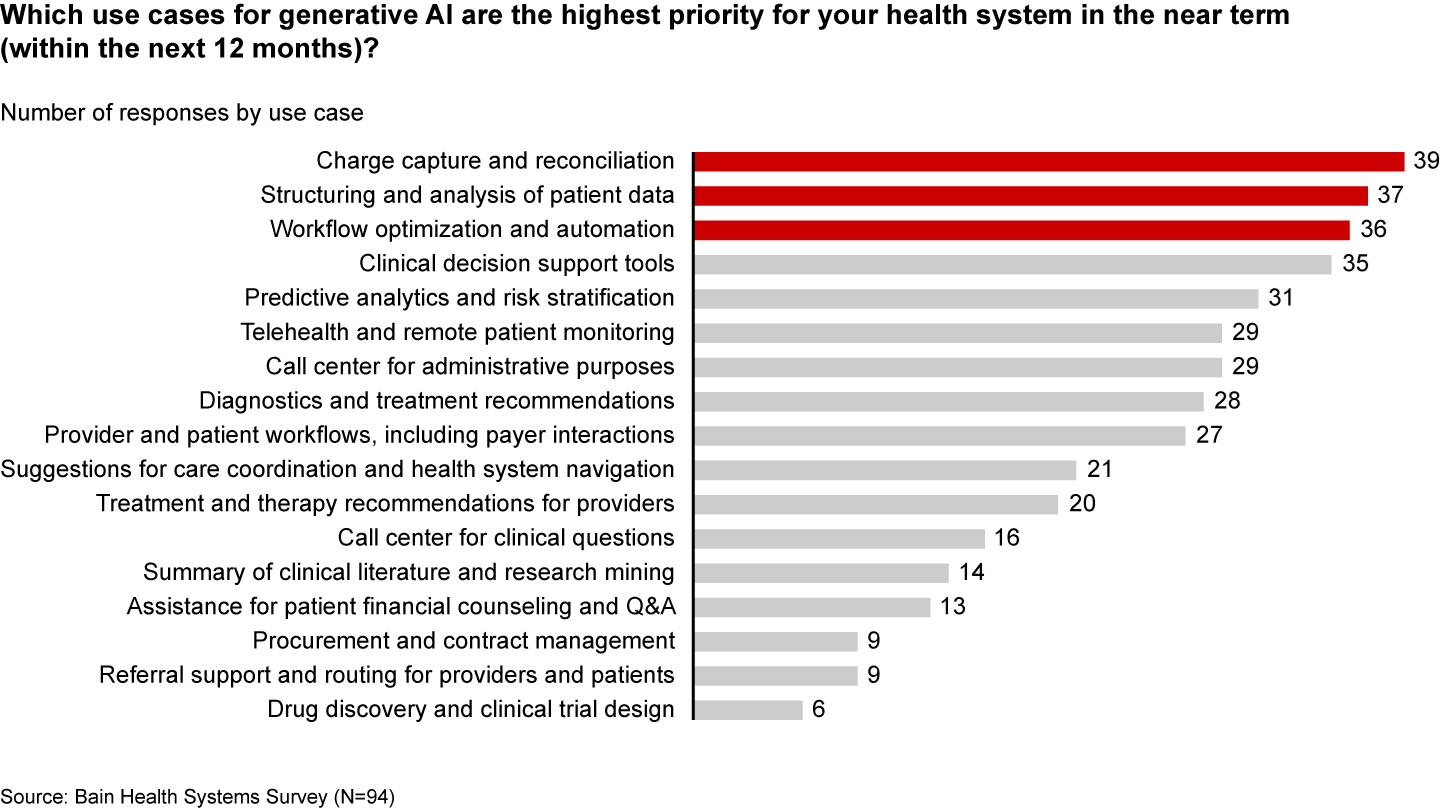
Many health systems are eyeing imminent opportunities to reduce administrative burdens and enhance operational efficiency. They rank improving clinical documentation, structuring and analyzing patient data, and optimizing workflows as their top three priorities (see Figure 1).

Figure 1

In the near term, generative AI can reduce administrative burdens and enhance efficiency

Some generative AI applications are already streamlining administrative tasks and allowing thinly stretched physicians to spend more time with patients. For instance, Doximity is rolling out a ChatGPT tool that can draft preauthorization and appeal letters. HCA Healthcare partnered with Parlance, a conversational AI-based switchboard, to improve its call center experience while reducing operators’ workload. And there are new announcements seemingly every week: Consider how healthcare software company Epic Systems is incorporating ChatGPT with electronic health records (EHRs) to draft response messages to patients, or how Google Cloud is launching an AI-enabled Claims Acceleration Suite for prior authorization processing. 

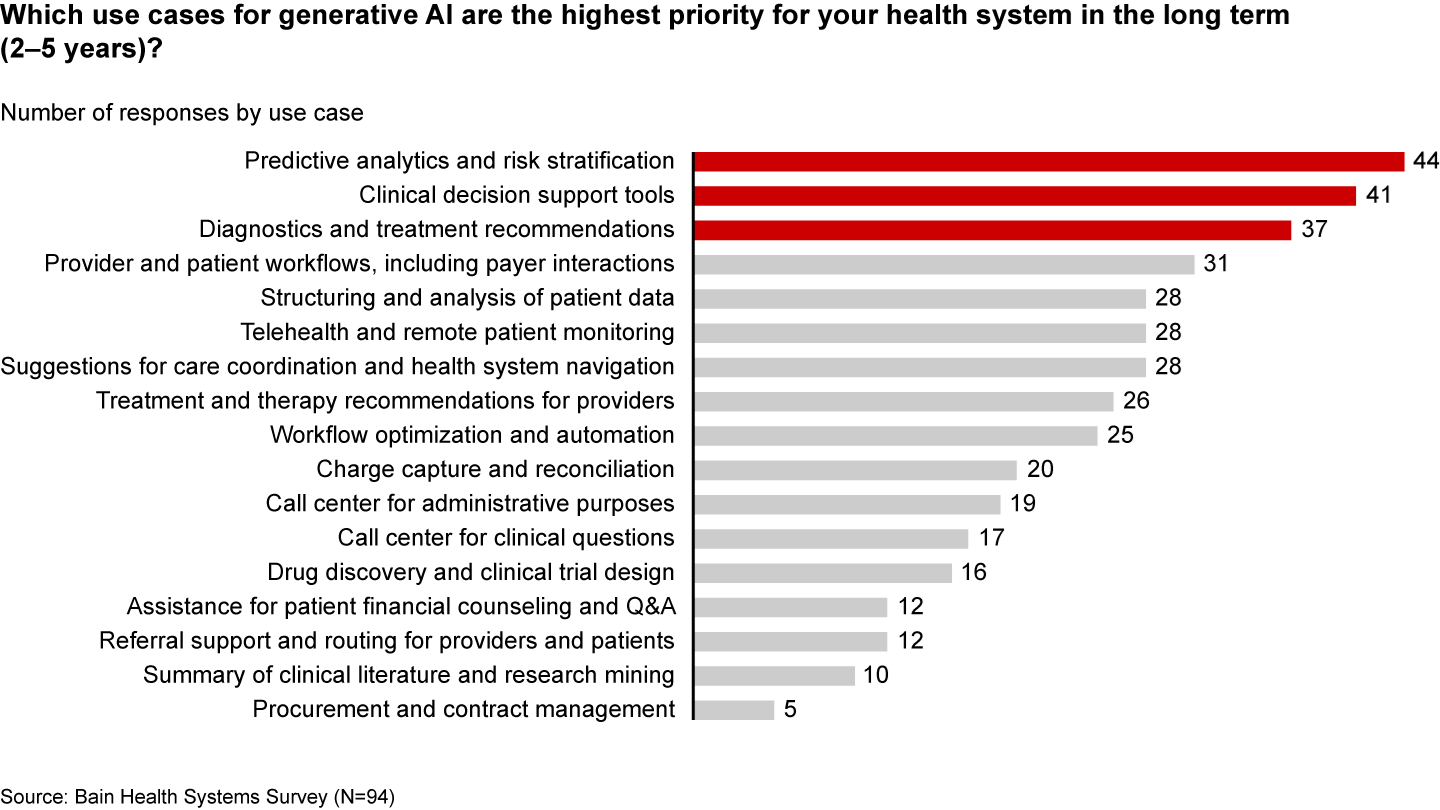
These applications only scratch the surface of potential. In the future, generative AI could profoundly transform care delivery and patient outcomes. Looking ahead two to five years, executives are most interested in predictive analytics, clinical decision support, and treatment recommendations (see Figure 2).

Figure 2

Predictive analytics, clinical decisions, and care recommendations are long-term generative AI priorities

It’s hard not to catch AI “fever.” But there are real challenges ahead. Some are already tackling the biggest questions: Organizations such as Duke Health, Stanford Medicine, Google, and Microsoft have formed the Coalition for Health AI to create guidelines for responsible AI systems. Even so, solutions to the greatest hurdles aren’t yet keeping up with the rapid technology development.

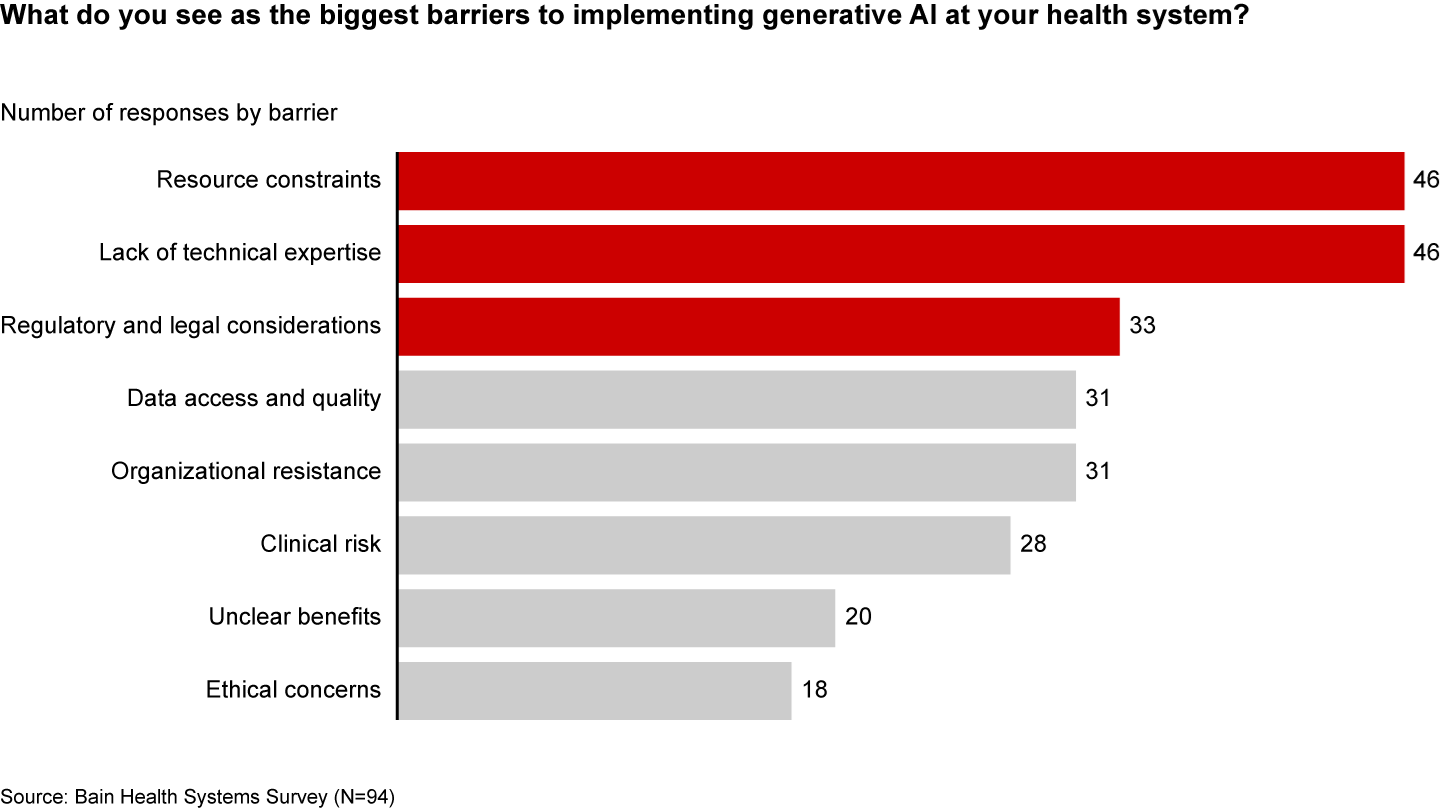
Resource and cost constraints, a lack of expertise, and regulatory and legal considerations are the largest barriers to implementing generative AI, according to executives (see Figure 3).

Figure 3

A lack of resources, expertise, and regulation are the biggest barriers to generative AI in healthcare

Even when organizations can overcome these hurdles, one major challenge remains: focus and prioritization. In many boardrooms, executives are debating overwhelming lists of potential generative AI investments, only to deem them incomplete or outdated given the dizzying pace of innovation. These protracted debates are a waste of precious organizational energy—and time. 

Starting small to win big 

Setting the bar too high is setting up for failure. It’s easy to get caught up, betting big on what seems like the greatest opportunity in the moment. But 12 months later, leaders often find themselves frustrated that they haven’t seen results or feeling as if they’ve made a misplaced bet. Momentum and investments slow, further hindering progress. 

Leading companies are forming a more pragmatic strategy that considers current capabilities, regulations, and barriers to adoption. Their CEOs and CFOs work together to enforce four guiding principles: 

  • Pilot low-risk applications with a narrow focus first. Tomorrow’s leaders are making no-regret moves to deliver savings and productivity enhancements in short order—at a time when they need it most. Gaining experience with currently available technology, they are testing and learning their way to minimum viable products in low-risk, repeatable use cases. These quick wins are typically in areas where they already have the right data, can create tight guardrails, and see a strong potential return on investment. Some, like call center and chatbot support, can improve the patient experience. However, given the current challenges around regulation and compliance, the most successful early initiatives are likely to be internally focused, such as billing or scheduling. Most importantly, executives prioritize initiatives by potential savings, value, and cost.
  • Decide to buy, partner, or build. CEOs will need to think about how to invest in different use cases based on availability of third-party technology and importance of the initiative.
  • Funnel cost savings and experience into bigger bets. As the technology matures and the value becomes clear, companies that generate savings, accumulate experience, and build organizational buy-in today will be best positioned for the next wave of more sophisticated, transformative use cases. These include higher-risk clinical activities with a greater need for accuracy due to ethical and regulatory considerations, such as clinical decision support, as well as administrative activities that require third-party integration, such as prior authorization.
  • Remember generative AI isn’t a strategy unto itself. To build a true competitive advantage, top CEOs and CFOs are selective and discerning, ensuring that every generative AI initiative reinforces and enables their overarching goals.

Some health systems are already seeing powerful results from relatively small, more practical investments. For instance, recognizing that clinicians were spending an extra 130 minutes per day outside of working hours on administrative tasks, the University of Kansas Health System partnered with Abridge, a generative AI platform, to reduce documentation burden. By summarizing the most important points from provider-patient conversations, Abridge is improving the quality and consistency of documentation, getting more patients in the door, and cutting down on pervasive physician burnout.

Although it will require some upfront investment, in the long run it will be more costly to underestimate the level and speed at which generative AI will transform healthcare. The next generation of leaders will start testing, learning, and saving today, putting them on a path to eventually revolutionize their businesses.

Opinion:  The AI revolution in health care is already here

Pay attention to the media coverage around artificial intelligence, and it’s easy to get the sense that technologies such as chatbots pose an “existential crisis” to everything from the economy to democracy.

These threats are real, and proactive regulation is crucial. But it’s also important to highlight AI’s many positive applications, especially in health care.

Consider the Mayo Clinic, the largest integrated, nonprofit medical practice in the world, which has created more than 160 AI algorithms in cardiology, neurology, radiology and other specialties. Forty of those have already been deployed in patient care.

To better understand how AI is used in medicine, I spoke with John Halamka, a physician trained in medical informatics who is president of Mayo Clinic Platform. As he explained to me, “AI is just the simulation of human intelligence via machines.”

Halamka distinguished between predictive and generative AI. The former involves mathematical models that use patterns from the past to predict the future; the latter uses text or images to generate a sort of human-like interaction.

It’s that first type that’s most valuable to medicine today. As Halamka described, predictive AI can look at the experiences of millions of patients and their illnesses to help answer a simple question: “What can we do to ensure that you have the best journey possible with the fewest potholes along the way?”

For instance, let’s say someone is diagnosed with Type 2 diabetes. Instead of giving generic recommendations for anyone with the condition, an algorithm can predict the best care plan for that patient using their age, geography, racial and ethnic background, existing medical conditions and nutritional habits.

This kind of patient-centered treatment isn’t new; physicians have long been individualizing recommendations. So in this sense, predictive AI is just one more tool to aid in clinical decision-making.

The quality of the algorithm depends on the quantity and diversity of data. I was astounded to learn that the Mayo Clinic team has signed data-partnering agreements with clinical systems across the United States and globally, including in Canada, Brazil and Israel. By the end of 2023, Halamka expects the network of organizations to encompass more than 100 million patients whose medical records, with identifying information removed, will be used to improve care for others.

Predictive AI can also augment diagnoses. For example, to detect colon cancer, standard practice is for gastroenterologists to perform a colonoscopy and manually identify and remove precancerous polyps. But some studies estimate that 1 in 4 cancerous lesions are missed during screening colonoscopies.

Predictive AI can dramatically improve detection. The software has been “trained” to identify polyps by looking at many pictures of them, and when it detects one during the colonoscopy, it alerts the physician to take a closer look. One randomized controlled trial at eight centers in the United States, Britain and Italy found that using such AI reduced the miss rate of potentially cancerous lesions by more than half, from 32.4 percent to 15.5 percent.

Halamka made a provocative statement that within the next five years, it could be considered malpractice not to use AI in colorectal cancer screening.

But he was also careful to point out that “it’s not AI replacing a doctor, but AI augmenting a doctor to provide additional insight.” There is so much unmet need that technology won’t reduce the need for health-care providers; instead, he argued, “we’ll be able to see more patients and across more geographies.”

Generative AI, on the other hand, is a “completely different kind of animal,” Halamka said. Some tools, such as ChatGPT, are trained on un-curated materials found on the internet. Because the inputs themselves contain inaccurate information, the models can produce inappropriate and misleading text. Moreover, whereas the quality of predictive AI can be measured, generative AI models produce different answers to the same question each time, making validation more challenging.

At the moment, there are too many concerns over quality and accuracy for generative AI to direct clinical care. Still, it holds tremendous potential as a method to reduce administrative burden. Some clinics are already using apps that automatically transcribe a patient’s visit. Instead of creating the medical record from scratch, physicians would edit the transcript, saving them valuable time.

Though Halamka is clearly a proponent of AI’s use in medicine, he urges federal oversight. Just as the Food and Drug Administration vets new medications, there should be a process to independently validate algorithms and share results publicly. Moreover, Halamka is championing efforts to prevent the perpetuation of existing biases in health care in AI applications.

This is a cautious and thoughtful approach. Just like any tool, AI must be studied rigorously and deployed carefully, while heeding the warning to “first, do no harm.”

Nevertheless, AI holds incredible promise to make health care safer, more accessible and more equitable.