New outbreaks used to be traced back to crowded factories and rowdy bars. But now, the virus is so widespread not even health officials are able to keep up.
When the coronavirus first erupted in Sioux Falls, S.D., in the spring, Mayor Paul TenHaken arrived at work each morning with a clear mission: Stop the outbreak at the pork plant. Hundreds of employees, chopping meat shoulder to shoulder, had gotten sick in what was then the largest virus cluster in the United States.
That outbreak was extinguished months ago, and these days, when he heads into City Hall, the situation is far more nebulous. The virus has spread all over town.
“You can swing a cat and hit someone who has got it,” said Mr. TenHaken, who had to reschedule his own meetings to Zoom this past week after his assistant tested positive for the virus.
Gone are the days when Americans could easily understand the virus by tracking rising case numbers back to discrete sources — the crowded factory, the troubled nursing home, the rowdy bar. Now, there are so many cases, in so many places, that many people are coming to a frightening conclusion: They have no idea where the virus is spreading.
“It’s just kind of everywhere,” said Crystal Watson, a senior scholar at the Center for Health Security at the Johns Hopkins Bloomberg School of Public Health, who estimated that tracing coronavirus cases becomes difficult once the virus spreads to more than 10 cases per 100,000 people.
The election. And its impact on you.
In some of the hardest-hit spots in the United States, the virus is spreading at 10 to 20 times that rate, and even health officials have all but given up trying to figure out who is giving the virus to whom.
There have been periods earlier in the pandemic when infections spread beyond large, well-understood clusters in prisons, business meetings and dinner parties, tearing through communities in ways that were nearly impossible to keep track of. But for the most part, that experience was isolated to hard-hit places like New York City in the spring and portions of the Sun Belt in the summer.
This time, the diffuse, chaotic spread is happening in many places at once. Infections are rising in 41 states, the country is recording an average of more than 79,000 new cases each day, and more Americans say they feel left to do their own lonely detective work.
“I was so careful,” said Denny Taylor, 45, who said he had taken exacting precautions — wearing a mask, getting groceries delivered — before he became the first in his family and among his co-workers to test positive for the virus. Lying in a hospital bed in Omaha this past week, he said he still had no idea where he caught it.
Uncovering the path of transmission from person to person, known as contact tracing, is seen as a key tool for containing the spread of the coronavirus. Within a day or two of testing positive, residents in many communities can expect to get a phone call from a trained contact tracer, who conducts a detailed interview before beginning the painstaking process of tracking down each new person who may have been exposed.
“We were pretty successful and we were very proud of how the case numbers went down,” said Dr. Sehyo Yune, who supervised a team of contact tracers in Massachusetts this spring. It was one of several strategies that helped tamp down earlier outbreaks in places like Massachusetts, New York and Washington, D.C.
But as cases skyrocket again in many states, many health officials have conceded that interviewing patients and dutifully calling each contact will not be enough to slow the outbreak. “Contact tracing is not going to save us,” said Dr. Ogechika Alozie, chief medical officer at Del Sol Medical Center in El Paso, where hospitalizations in the county have soared by more than 400 percent and officials issued a new order for residents to stay at home.
The problem, of course, is that failing to fully track the virus makes it much harder to get a sense of where the virus is flourishing, and how to get ahead of new outbreaks. But once an area spins out of control, trying to trace back each chain of transmission can feel like scooping cupfuls of water from a flood.
In some places, overwhelmed health officials have abandoned any pretense of keeping up.
In North Dakota, state officials announced they could no longer have one-on-one conversations with everyone who may have been exposed. Aside from situations involving schools and health care facilities, people who test positive were advised to notify their own contacts, leaving residents largely on their own to follow the trail of the outbreak.
In Philadelphia, where cases recently spiked to more than 300 per day, city officials acknowledged that they now must leave some cases untracked. Most people, they said, are catching the virus through family and friends.
“We weren’t supposed to get to this point,” said Dr. Arnold S. Monto, a professor of epidemiology at the University of Michigan, who said the process of tracking cases and notifying people who may have been exposed is a gold standard of disease prevention but impractical after a certain level of infection.
“If you have five clusters going on at the same time,” he said, “it’s hard to say where it came from.”
When a first major outbreak hit Grand Forks, N.D., in April, the problem was clear: More than 150 employees of a wind turbine blade factory were infected. The factory shut its doors for several weeks, and public health officials tested and contact traced each case.
For the rest of the summer, Grand Forks, a college town of 56,000 on the border with Minnesota, saw almost no new infections. An uptick in August was quickly tied to students at the University of North Dakota and largely contained.
Now, though, any sense of control has vanished. Active cases of Covid-19 have quadrupled since the beginning of October to 912 in Grand Forks County, and about half the people contacted by the health department say they are not sure how they became infected.
“People are realizing that you can get it anywhere,” said Kailee Leingang, a 21-year-old nursing student who also works as a state contact tracer in Grand Forks. Even Ms. Leingang has fallen ill, along with several of her colleagues. She traces her case to her parents, who first started showing symptoms. Beyond that, the trail goes cold.
“They have no idea,” she said of where her parents came in contact with the virus.
Ms. Leingang, isolating at her home with her cat, feels sicker by the day. Dishes have piled up in the sink — she is too weak to stand long enough to wash them. But she is still working, calling at least 50 people a day to notify them that their tests came back positive, though her job is no longer to track who else they may have infected. “With the high number of cases right now,” she said, “our team can’t afford to have somebody not work.”
In earlier, quieter periods of the pandemic, the virus spread with some degree of certainty. In all but the hardest-hit cities, people could ask a common question — “Where did you get it?” — and often find tangible answers.
A popular college bar in East Lansing, Mich., Harper’s Restaurant and Brewpub, became a hot spot this summerafter dozens of people piled into the bar, drinking, dancing and crowding close together. At least 192 people — 146 people at the bar and 46 people with ties to those at the bar — were infected. Afterward, Gov. Gretchen Whitmer shut down indoor dining in bars in parts of the state.
In Ingham County, which includes much of East Lansing, it is far harder to tell where the virus is spreading now. Of the county’s 4,700 reported cases over the course of the pandemic, more than 2,700 have come since the beginning of September.
Much of the new spread may be tied to students at Michigan State University, where students are living off campus and taking classes online. But every day, employers and residents call the Health Department to report random cases that defy easy explanation.
“It’s just a hodgepodge,” said Linda Vail, the Ingham County health officer.
Heidi Stevens is among the newly infected who considers her case a mystery. As a columnist at The Chicago Tribune, Ms. Stevens works from home. Her children attend school online. She wears a mask when she goes for a run, and she has not had a haircut since January.
So when she got a precautionary test a few weeks ago, with the hopes of inviting friends over to have cake for her daughter’s 15th birthday, Ms. Stevens was shocked to learn she was positive.
“I would drive myself crazy if I tried to really nail it down,” said Ms. Stevens, 46, who was hospitalized for three days and still wakes up with headaches. Did she pick up an infected apple at the grocery store and somehow touch her eye? Should she have been wearing a face shield, in addition to her mask? The possibilities feel endless.
Over the past week, as coronavirus cases have spiked and COVID hospitalizations have grown to alarming levels, we’ve been keeping a close pulse on the situation at our member health systems in markets across the country.
Here’s what we can report: admissions are rising on a curve that looks increasingly vertical.
The ICU is less of a problem than inpatient beds, and while no one wants to cancel non-emergent procedures again, having just worked through the backlog of cases that were postponed in late spring and early summer, discussions about reallocating capacityare starting again. Some are considering shifting more surgeries to ambulatory centers, others are planning to dedicate more space to COVID-positive cases in an attempt to segregate the “hot zone”, and still others are exploring home-based care for certain medical admissions. Fortunately, the supply of PPE feels sufficient for the time being, as does testing capacity.
The number one concern among everyone we’ve talked to: staffing. Because of the high level of community spread, many are now losing nurses and other key staff to COVID isolation, with one system reporting that 35 percent of its critical care nurses at a key hospital had tested positive or were in quarantine after exposure. Staff are burned out, exhausted from the past eight months, and turnover rates are spiking. Because the third wave is so widespread, it’s become harder to find nurses from other markets who can temporarily relocate to help with a surge of cases. And the rates being charged for “agency” nurses—stopgap staff hired on a temporary basis—are going through the roof.
The staffing issue may prove to be the biggest crisis of the third wave of COVID, given how difficult it is to solve; there’s no Defense Production Act or National Guard supply chain for nurses. At best, hospitals will find themselves cobbling together a solution by cross-training staff, paying extra for temporary workers, and asking their already-overtaxed workforce to weather yet another storm. We’re eager to hear any creative approaches to solving the staffing challenge as winter approaches, and we’ve dedicated a senior member of our team to tracking the workforce crisis. Let us know what you’re seeing.
The United States reported a record high of more than 90,000 new coronavirus infections on Friday, and today’s count is on pace to go even higher. The country has now exceeded 9 million cases since the outbreak began, with the last 1 million added in just the last two weeks.
As evidence, Trump Jr. cited a misleading graph on his Instagram page – apparently compiled from incomplete and already outdated federal data – which was used as evidence to suggest that the “death rate” has been falling dramatically in the last two weeks. In fact, daily deaths are slightly rising after a long plateau, and the situation is expected to worsen in November as the virus takes its toll on the newly infected. “I realize I am naive,” Ashish K. Jha, the dean of the Brown University School of Public Health, tweeted in response to the interview. “But I’m still shocked by the casualness by which our political and media leaders and their families dismiss the daily deaths of nearly a thousand Americans.”
Hundreds of thousands of Americans will have coronavirus infections on Election Day, and options are dwindling for those who intend to vote. “Some will be required to get doctor’s notes or enlist family members to help,” our Investigations desk reported. “Others, in isolation, will need to have a witness present while they vote. Planned accommodations — such as officials hand-delivering ballots — may prove inadequate or could be strained beyond limits.”
Nearly half a million people in the United States have contracted the novel coronavirus in the last seven days, according to a Reuters tally, as cases and hospitalizations set fresh records in hot spots in the Midwest.
More than 5,600 people died from the virus nationwide in the last week, with hospitalizations shooting up 13%, a Reuters analysis showed.
Illinois, which has emerged as a hot spot in recent weeks, reported over 31,000 new cases in the last seven days, more new infections than any other state except Texas.
To try and contain the surge, Illinois Governor J.B. Pritzker imposed fresh rounds of restrictions in six of 11 regions.
Indoor dining in bars and restaurants will be suspended by Wednesday and gatherings will be limited to 25 people under a state formula that triggers ‘mitigation’ when the positivity rate tops 8% for at least two days in a row. The affected areas include some Chicago suburbs.
Other states have walked back reopening plans to curb the spread of the virus as cooler weather sets in across most of the nation.
Idaho Governor Brad Little on Monday announced indoor gatherings of more than 50 people would be prohibited, and outdoor gatherings are to be capped at 25% capacity.
Health experts believe the virus is surging because of private social gatherings, colder temperatures driving people inside, and fatigue with COVID-19 precautions.
Beyond the Midwest, the Texas city of El Paso is also facing a surge in cases that is overwhelming local hospitals, with officials setting up an alternate care facility to help relieve medical centers.
“We are seeing all sorts of patients. The narrative historically has been the above-65, those with multiple co-morbidities. But we’re seeing 20-year-olds. We’re seeing 30-year-olds, 40-year-olds,” Dr. Ogechika Alozie, an infectious disease specialist in El Paso, told Reuters. “There’s that exhaustion, but again, we buckle up and we take care of the patients.”
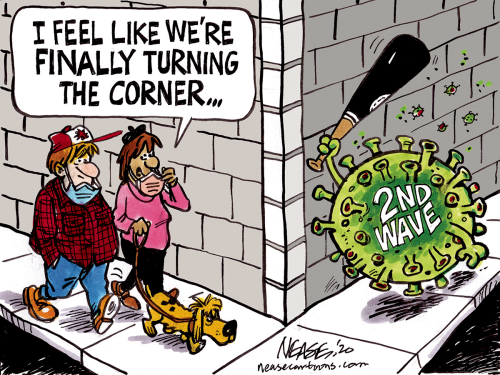
U.S. President Donald Trump, facing a tough re-election battle on Nov. 3, lashed out again at reports that the coronavirus is surging, and reiterated his false claim that the country is “rounding the turn” in its battle with the virus that has killed more than 225,800 people.
Pennsylvania, a hotly contested ‘battleground’ state in next week’s election, on Tuesday reported a fresh record in new coronavirus cases, according to the state’s health department.
The number of people hospitalized with the coronavirus has climbed significantly from a month ago, straining cities that have fewer resources to weather the surges.
The patient who died on Tuesday morning at Aurora St. Luke’s Medical Center was rolled out of her room under a white sheet. One nurse, fighting back tears, stood silently in the hall as the outline of the body passed by — one more death in an eight-month-old pandemic that has no end in sight.
“Those moments, they hit the soul,” said Jodie Gord, a nurse manager who oversees a team of about 120 people at the hospital in Milwaukee.
Aurora St. Luke’s is far from alone in coming under strain. Hospitals around the United States are reeling from the rampaging spread of the coronavirus, many of them in parts of the country that initially had been spared the worst.
Approaching the eve of the election, President Trump has downplayed the steep rise in cases, attributing much of it to increased testing. But the number of people hospitalized for the virus tells a different story, climbing an estimated 46 percent from a month ago and raising fears about the capacity of regional health care systems to respond to overwhelming demand.
The exploding case numbers point to a volatile new phase in the pandemic, coming after earlier waves hit large cities such as New York, then Sun Belt states like Florida and Arizona. While some of those places have begun to bring the virus under control, the surge of hospitalizations is crippling some cities with fewer resources.
In El Paso, where the number of people hospitalized with Covid-19 has more than tripled over the past three weeks, doctors at University Medical Center have started airlifting some patients to hospitals as far away as San Antonio while treating others in a field hospital in a nearby parking lot. Across the border in Mexico, the mayor of Ciudad Juárez, himself hospitalized after testing positive for the virus for the second time, is urging a temporary ban on U.S. citizens crossing into his city.
“We have never seen this in El Paso,” said Dr. Joel Hendryx, chief medical officer at University Medical Center, one of the largest hospitals along the border. Citing the need for field hospitals, Dr. Hendryx drew a sharp contrast to the city’s earlier surge in July, when mitigation measures drove case numbers down.
Dr. Hendryx’s hospital had 195 inpatient coronavirus cases as of Tuesday compared with about 30 a month ago. In addition to the parking lot tents, officials in El Paso are converting the downtown convention center into a 50-bed hospital. Hundreds of health workers from other parts of Texas are deploying to El Paso, including an ambulance strike team with paramedics from the Houston area.
The situation is also becoming critical in states such as Idaho, Missouri, New Mexico and Utah, with frontline workers exhausted and hospitals struggling to find replacements for those testing positive each day.
At St. Luke’s Magic Valley Medical Center in Twin Falls, Idaho, where more than one-third of patients have Covid-19, administrators are sending children to a hospital in Boise, two hours away. The influx of patients from rural areas with little health infrastructure is similarly straining hospitals in Wisconsin, where cases have increased 53 percent from two weeks ago.
Across the country, case numbers have risen to fearsome new levels in recent days, with the seven-day average for new cases exceeding 70,000 for the first time in the pandemic. Twenty-six states are at or near record numbers for new infections. More than 500,000 cases have been announced in the past week. And exactly zero states are seeing sustained declines in case numbers.
On a per capita basis, smaller cities and rural counties in the Upper Midwest and Mountain West are struggling most acutely. North Dakota, South Dakota, Wisconsin and Montana lead the country in new infections per capita. Of the 12 metro areas with the highest rates of new cases over the past two weeks, 10 are in North Dakota or Wisconsin.
But the dismal trend lines are not confined to those regions. North Carolina, New Mexico, Pennsylvania, Rhode Island and West Virginia have recently set seven-day records for new cases. And more big cities are starting to spiral, with alarming trends emerging in Chicago, Milwaukee and Newark.
And while the escalating case numbers had not been accompanied by a steep rise in deaths, that trend is starting to change. About 800 deaths are now being recorded across the country each day, far fewer than in the spring but up slightly from earlier this month.
Cities and towns nationwide are rushing to impose new restrictions. In Idaho, Gov. Brad Little backtracked on reopening but stopped short of a statewide mask mandate. Mr. Little limited indoor gatherings to 50 people, required masks at long-term care facilities and placed new restrictions on how bars and restaurants could serve their customers.
In Newark, all nonessential businesses will have to close at 8 p.m. beginning on Tuesday. Mayor Lori Lightfoot of Chicago imposed a curfew under which nonessential businesses must shut down from 10 p.m. to 6 a.m., and bars without a food license are no longer allowed to serve customers indoors.
In Fargo, N.D., Mayor Tim Mahoney used his emergency powers to pass the first mask mandate in the state. The mayors of Nixa and Ozark in Missouri imposed mask mandates after appeals by nearby hospitals overwhelmed by coronavirus hospitalizations.
On one of the I.C.U. floors at Aurora St. Luke’s in Milwaukee, the mood was somber on Tuesday morning as doctors and nurses made their rounds. Twenty of the 24 beds were filled, and many of the patients were on ventilators.
But the staff put on a brave face. They gave thumbs-up to patients from the hallways, walked into rooms to greet others and assisted one woman as she ate her breakfast.
Before noon, an older woman was transferred to the I.C.U. from the Covid-19 floor. Within 30 minutes of her arrival, loud beeping sent staff members running to her room, frantically grabbing personal protection gear.
The patient’s oxygen levels had plummeted to dangerously low levels, and she was going into cardiac arrest. A nurse practitioner called the patient’s family, making it clear there was a possibility she would not make it.
A staff member performed compressions on the woman in hopes of keeping her alive. After several minutes, her condition stabilized — for the moment.
She was the second patient who needed such care in just three hours. When the nurses and doctors stepped away for a breath, the woman lay on the bed, now intubated, eyes glazed over and her face pale. It was hard to see any clear signs of breathing.
Some staff members patted each other on the back. Others took deep breaths. A health care worker walked out of the patient’s room, holding a small plastic bag in her hand. Inside was jewelry to give to the family, said Ms. Gord, the nurse manager, in case the woman died.
Staff members still seemed in shock over the death of the other patient from that morning. She had become dear to the I.C.U. team, said Ms. Gord, who stood quietly and with obvious emotion as the stretcher slipped past. “Bless her soul,” she murmured. “Sweet little lady.”
Staff members said they were fighting constant exhaustion. “What’s going to happen when we cannot take care of these patients?” said Dr. Pedro Salinas, a critical care specialist, who worries about how much longer the staff can endure. “They are emotionally and mentally exhausted.”
The prospect of ending up in an overcrowded hospital ward is making some who are sick with the virus hesitant to check in. At the hospital in El Paso, staff members said some Covid-19 patients were arriving in the emergency room so debilitated that they required intubation almost immediately.
Sandra Garcia, 31, an El Paso resident who tested positive for the coronavirus last week, said she had been grappling with fatigue, shortness of breath and a loss of taste and smell, but had refrained from seeking care in the city’s crowded hospitals.
In the meantime, she is caring for a 13-year-old who also has Covid-19 and 5-year-old twins, who are all studying online from home. Ms. Garcia said she questioned why Dee Margo, El Paso’s mayor, had failed to order a shutdown of the city to curb the spike in cases.
“He’s just trying to get re-elected and it’s disgusting,” Ms. Garcia said.
Last week, Mr. Margo announced new restrictions such as closing parks to league and tournament play, but he said an order for a full city shutdown would need to come from the governor of Texas.
Dr. German Hernandez, a nephrologist who has been caring for patients at several hospitals in El Paso, said the situation was so acute that patients on oxygen were being kept in rooms in the trauma area of University Medical Center. He said that could be devastating in the event of a disaster such as the August 2019 mass shooting at a Walmart in the city that left 23 people dead.
“God forbid we have another Aug. 3 shooting because we can’t handle it right now,” Dr. Hernandez said. “We have no buffer.”
The fall Covid-19 surge keeps growing, with 29 states setting new records this month for the most new daily cases since the pandemic began, according to data from Johns Hopkins University.
And it’s not just due to more testing. The average number of daily new cases this past week is up 21% compared to the previous week, according to JHU. But testing has increased only 6.63% over the same time frame, according to the Covid Tracking Project. “We’re rising quickly. If we just go back about six, seven weeks ago to Labor Day, we were at about 35,000 cases a day,” said Dr. Ashish Jha, dean of Brown University School of Public Health.”
At least 73,240 new US cases and 985 deaths were reported Tuesday, according to JHU. “I would not be surprised if we end up getting to 100,000” new cases a day, Jha said. The surge is hitting all regions of the country. As of Wednesday, 40 states were trending in the wrong direction, with at least 10% more new cases this past week compared to the previous week, according to JHU. Missouri is the only state with at least 10% fewer cases, and the remaining nine states are relatively steady.
Without changes, ‘half a million people will be dead’
This month, 11 states reported their highest single day of new deaths since the pandemic began.
And because a vaccine probably won’t be available to most Americans until the middle of next year, personal responsibility will be key to saving American lives.“If we continue our current behavior, by the time we start to go down the other side of the curve, a half a million people will be dead,”said CNN medical analyst Dr. Jonathan Reiner, a professor of medicine at George Washington University.Under the current conditions, the daily US death toll is projected to reach 2,000 by January 1, according to the University of Washington’s Institute for Health Metrics and Evaluation.In the past nine months, more than 8.7million people in the US have been infected with coronavirus, and more than 226,000 have died.
Imminent threats to hospital capacity
Even after setting up a field hospital at the state fairgrounds, Wisconsin is facing a dire predicament with hospital capacity. “There is no way to sugarcoat it. We are facing an urgent crisis, and there is an imminent risk to you and your family,” Gov. Tony Evers said.
In Ohio, admissions to intensive care units have doubled since the beginning of this month, Gov. Mike DeWine said. Colorado is also worried about hospital capacity as the number of daily new cases skyrocketed this month. “If these trends continue, it would exceed May hospitalization numbers,” Gov. Jared Polis said. “And the modeling suggests that if we don’t change what we’re doing, it’ll exceed all of the existing hospital capacity by the end of the year. This thing moves quick, and we need to change the way we live.”The city and county of Denver has reduced the maximum allowed occupancy of restaurants, retailers and some other businesses from 50% to 25%, according to a statement Tuesday.”Why we’re doing this is to send a clarion call to everyone that we have a responsibility to once again put our hands on this boulder and begin to push it back up the hill,” Denver Mayor Michael Hancock said.
The president’s comments at a recent rally are false and contribute to the spread of misinformation, they say.
Hospital groups are pushing back against President Trump’s claims this week that doctors are over-reporting COVID-19 deaths for financial gain. Trump made the comments at a Wisconsin rally on Saturday.
“You know some countries they report differently,” Trump is quoted as saying in Newsweek. “If somebody’s sick with a heart problem, and they die of COVID they say they die of a heart problem. If somebody’s terminally ill with cancer and they have COVID, we report them. And you know doctors get more money and hospitals get more money. Think of this incentive. … We’re going to start looking at things.”
WHAT’S THE IMPACT
Hospitals and health systems are eligible to receive higher payments for complex coronavirus-related treatment under the Coronavirus Aid, Relief and Economic Security Act, under which they receive a Medicare add-on payment of 20%. However, American Hospital Association President and CEO Rick Pollack refuted Trump’s claims.
Asked to respond, the AHA referred to a viewpoint article written by Pollack in September, in which he sought to dispel what he called certain “myths.”
“Hospitals do not receive extra funds when patients die from COVID-19,” Pollack said. “They are not over-reporting COVID-19 cases. And they are not making money on treating COVID-19.
“The truth is,hospitals and health systems are in their worst financial shape in decades due to the coronavirus. In some cases, the situation is truly dire. An AHA report estimates total losses for our nation’s hospitals and health systems of least $323 billion in 2020. There is no windfall here.”
Pollack also noted that healthcare organizations adhere to strict coding guidelines and use the COVID-19 code for Medicare claims only for confirmed cases. Inappropriate coding can result in criminal penalties and exclusion from the Medicare program altogether.
In a more recent and direct response to the president’s latest comments, American Medical Association President Dr. Susan Bailey bemoaned that physicians are being pulled into a public battle over the legitimacy and motivation behind their work.
“The assault on public health and the undermining of efforts to defeat COVID-19 began with unfounded suspicions about the science and evidence of this novel coronavirus and how it spreads,” Bailey said on Tuesday. “It grew with speculation about harmful and unproven treatments for COVID-19, false claims that masks were a source of infections, and by misleading suggestions that increased testing alone explains why case counts are surging.
“It expanded again with inaccurate, dangerous statements about children being ‘almost immune’ from the most serious effects of COVID-19, a reckless plan of ‘focused protection’ and naturally acquired ‘herd immunity’ as a pathway out of this pandemic, and most recently with wild and highly offensive claims that physicians are inflating the number of COVID-19 cases and deaths to increase our incomes.”
Bailey said that many public health officials have been threatened and intimidated, prompting some to quit or retire, and decried the “campaign of misinformation” as a betrayal of public trust that threatens the work being done to treat and contain the virus.
“Our AMA will always stand on the side of patients and physicians, of science and evidence, and of free and honest conversations that build the trust that is so crucial to our work,” she said. “We will not hesitate to call out political intimidation and fear-driven rhetoric that undermines this trust or that interferes with our ability to deliver the very best care to patients.”
The American College of Emergency Physicians also issued a statement, calling Trump’s assertions “reckless” and “false.”
“To imply that emergency physicians would inflate the number of deaths from this pandemic to gain financially is offensive, especially as many are actually under unprecedented financial strain as they continue to bear the brunt of COVID-19,” ACEP wrote. “These baseless claims not only do a disservice to our health care heroes but promulgate the dangerous wave of misinformation which continues to hinder our nation’s efforts to get the pandemic under control and allow our nation to return to normalcy.”
THE LARGER TREND
The numbers of COVID-19 cases continue to bring grim news, especially in the U.S., which struggled early in the pandemic to secure testing capacity and necessary personal protective equipment for frontline healthcare workers.
As of Wednesday morning, the Johns Hopkins University coronavirus tracker showed more than 8.7 million confirmed cases of the virus in the U.S., with the death toll climbing to over 226,000. Both lead the world. Second on the list is India (7,990,322 cases, 120,010 deaths), while Brazil comes in third (5,439,641 cases, 157,946 deaths).






 HENRY KOTULA