Senator urges Pennsylvania AG to intervene in Crozer sale

Pennsylvania state Sen. Tim Kearney has raised concerns about the lack of transparency and details around the planned sale of Upland, Pa.-based Crozer Health and has called on the state attorney general to step in and conduct a thorough analysis of the deal, the Daily Times reported Aug. 22.

Earlier this month, Los Angeles-based Prospect Medical Holdings and CHA Partners signed a letter of intent for CHA to acquire Crozer. The proposed deal would involve transitioning Crozer’s four hospitals back to nonprofit status.

“Prospect’s proposed sale of Crozer to CHA Partners LLC exemplifies the need for state oversight of hospital sales, as both entities appear to have histories of burning public partners despite demanding hefty subsidies,” Mr. Kearney said in a statement shared with Becker’s.

Unlike many other states, Pennsylvania’s Attorney General lacks statutory authority to deeply evaluate these deals, according to Mr. Kearney. 

“While the AG’s legal settlement with Prospect gives them some oversight of this deal, the legislature needs to provide the AG with greater authority to protect hospitals and the communities that depend on them,” he said. “If the choice is CHA or closure, then we need some assurances that they will be a responsible organization and not just a profiteering speculator.”

Prospect, a for-profit company, plans to sell nine of its 16 hospitals in Pennsylvania, Rhode Island and Connecticut and is also being investigated by the Justice Department for alleged violations of the False Claims Act. A spokesperson for Prospect told Becker’s the system will continue to cooperate with the investigation, but feels that the allegations have no merit. 

CHA did not respond to Becker’s request for comment.

US Anesthesia Partners settles with Colorado regulators

https://mailchi.mp/fc76f0b48924/gist-weekly-march-1-2024?e=d1e747d2d8

Dallas, TX-based US Anesthesia Partners (USAP), one of the nation’s largest providers of anesthesia services, reached a settlement with the Colorado Attorney General’s Office, which had alleged that USAP engaged in anticompetitive behavior in the state.

Although it denies any wrongdoing, USAP agreed to relinquish exclusive contracts with five Colorado hospitals and revise its practice of adding noncompete agreements to its physician contracts.

This settlement is separate from the similar FTC suit against USAP and its creator-turned-minority owner, private-equity (PE) firm Welsh, Carson, Anderson, and Stowe. That suit, filed in federal district court in Texas in September 2023, alleges that USAP monopolized the Texas anesthesiology market in order to drive up prices unlawfully. 

The Gist: USAP isn’t the only large anesthesia group in the news this week for allegations of anticompetitive behavior—hospitals in New York and Florida are suing North American Partners in Anesthesia, claiming it stifles competition by forcing its physicians to sign noncompete agreements. 

Health systems and regulators are increasingly dissatisfied with the highly concentrated anesthesia provider market, which has become dominated by large, PE-backed groups. 

Because the Colorado case was settled out of court, no precedent has been established for antitrust enforcement, but the result of the ongoing FTC suit against USAP may have significant ramifications for other large, PE-backed physician organizations.

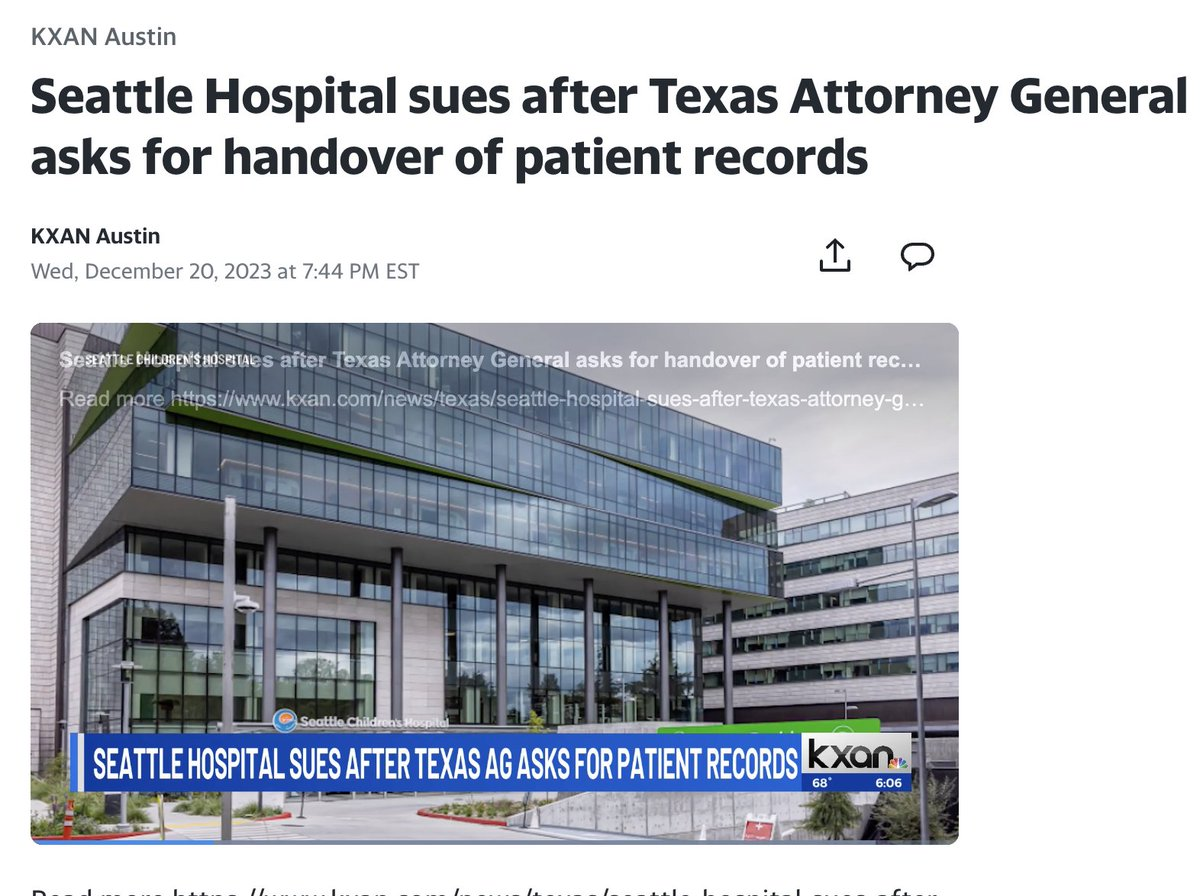
Seattle Children’s sues Texas attorney general

Seattle Children’s Hospital has filed a lawsuit against the Texas Office of the Attorney General after the agency requested documents related to gender transition policies and such care provided to Texas children, NBC affiliate KXAN reported Dec. 20.  

In a lawsuit filed Dec. 7, Seattle Children’s argues that the Texas attorney general does not have the jurisdiction to demand patient records from the hospital. It also states that Washington’s Shield Law, signed by Gov. Jay Inslee on April 27, protects it from requests made by states that “restrict or criminalize reproductive and gender-affirming care,” according to the report. 

The Shield Law creates a cause of action for interference with protected healthcare services, which protects against lawsuits filed in other states related to reproductive or gender-affirming care that is lawful in Washington. Those harmed by such out-of-state lawsuits can also file a countersuit in Washington for damages and recover their costs and attorneys’ fees.

The Texas attorney general said it is investigating misrepresentations involving gender transitioning and reassignment treatments and procedures that allegedly violated the Texas Deceptive Trade Practices-Consumer Protection Act. It has demanded that Seattle Children’s provide the following documents:

  • All medications prescribed by the hospital to Texas children
  • The number of Texas children treated by the hospital
  • Diagnosis for every medication provided by the hospital to Texas children
  • Texas labs that performed tests for the hospital before prescribing medications
  • Protocol/guidance for treating Texas children diagnosed with gender identity disorder, gender dysphoria or endocrine disorders
  • Protocol/guidance on how to “wean” a Texas child off gender transitioning care

Seattle Children’s maintains that it does not have property, accounts, nor employees who provide gender-affirming care or administrative services for that care in Texas, according to affidavits obtained by KXAN. Hospital leaders also said that Seattle Children’s has not marketed or advertised this type of care in Texas either. 

Attorneys for the hospitals argue that the demands are an “improper attempt” to enforce Texas’ SB 14 bill — signed June 2 by Gov. Greg Abbott — and investigate healthcare services that did not occur in Texas.

“Seattle Children’s took legal action to protect private patient information related to gender-affirming care services at our organization sought by the Texas attorney general,” a spokesperson for the hospital told Becker’s. “Seattle Children’s complies with the law for all healthcare services provided. Due to active litigation, we cannot comment further at this time.”

The Texas attorney general’s office did not respond to Becker’s request for comment.  

Senator has questions for Providence CEO on billing practices

U.S. Senator Patty Murray of Washington is seeking answers from Renton, Wash.-based Providence’s CEO following a Sept. 24 New York Times report detailing the system’s alleged debt collection practices. 

“According to recent reports, over the past several years, Providence has increasingly extracted payments from low-income patients, even when patients qualified for free or discounted care,” Ms. Murray said in a Sept. 28 letter to CEO Rod Hochman. “The reports allege several disturbing practices, including high-pressure billing conversations at hospital beds when patients are vulnerable, the use of extraordinary collection actions by debt collectors, and patients eligible for free or discounted care being billed for outstanding balances. As a result, patients have gone without food or heat, have seen their credit scores plummet, and have been afraid to seek out further medical care due to the cost—all as a result of practices that potentially violate both state and federal laws.”

Ms. Murray said in the letter she is seeking answers on how many patients Providence has served in recent years who qualified for free or discounted care and how many it referred to debt collection services. She is also seeking information about the system’s billing and debt collection policies, and how much it paid consulting firm McKinsey & Co. for a program designed to increase its revenue. She is seeking answers by Oct. 12. 

Washington state’s attorney general filed a lawsuit against Providence in February, alleging that 14 of its hospitals engaged in aggressive tactics to collect payment, failed to ensure discounts for eligible low-income patients, and steered poor patients to debt collectors. 

A Providence spokesperson expressed discontent and disagreement with the attorney general’s charges in a statement shared with Becker’s.

“The Providence family of organizations is extremely disappointed that the Office of the Washington State Attorney General has chosen to file inaccurate and unfair charges against us regarding our charity care and financial assistance practices,” the spokesperson said. “Serving every person who comes to us, regardless of ability to pay, is a central tenet of our mission as a not-for-profit organization. We take this responsibility seriously.”

Ohio AG Yost files suit against Centene, launching latest salvo in his war on PBMs

Ohio Attorney General Dave Yost has filed suit against Centene and several of its subsidiaries, alleging that they schemed to misrepresent pharmacy costs and gain overpayments from the state’s Medicaid program.

According to the lawsuit, Centene subsidiary Buckeye Health Plan used sister companies Envolve Health Solutions and Health Net Pharmacy Solutions to administer its pharmacy benefit. Yost’s office said it began to investigate their business practices as the arrangement “raised questions.”

In a statement, Yost’s office said the investigation, which was conducted by outside counsel, found that the companies filed reimbursement requests for amounts that had already been paid by third parties, and failed to accurately represent costs to the Ohio Department of Medicaid.

In addition, the scheme led to artificially inflated dispensing fees, the AG’s office said.

Corporate greed has led Centene and its wholly-owned subsidiaries to fleece taxpayers out of millions. This conspiracy to obtain Medicaid payments through deceptive means stops now,” Yost said in a statement. “My office has worked tirelessly to untangle this complex scheme, and we are confident that Centene and its affiliates have materially breached their obligations both to the Department of Medicaid and the state of Ohio.”

Yost has openly declared war on PBMs and has made investigating their business practices a critical initiative within his office. In March 2019, the AG filed suit against Optum, seeking to reclaim $16 million in what he says are drug overcharges.

The AG filed a similar suit against Express Scripts in July 2020.

In a statement, Centene called the claims in the lawsuit “unfounded” and said it will “aggressively defend” against the allegations.

“Envolve’s pharmacy contracts with the State are reviewed and pre-approved by state agencies before they ever go into effect. Furthermore, these services saved millions of tax-payer dollars for Ohioans from market-based pharmaceutical pricing,” Centene said.

“We look forward to answering any of the Attorney General’s questions. Our company is committed to the highest levels of quality and transparency,” the insurer said.

California investigates Providence after physicians’ complaint of religious limits on care at Hoag

Hoag Memorial Hospital Presbyterian | Visit Newport Beach

Renton, Wash.-based Providence is being investigated by California’s attorney general, Xavier Becerra, over allegations that it inappropriately applied religious care restrictions at Hoag Memorial Hospital in Newport Beach, Calif., the Los Angeles Times reported March 3. 

Several women’s health specialists from Hoag submitted a confidential complaint to the attorney general’s office in October, prompting the investigation. The physicians claim Heritage Healthcare, Providence’s physician management division, refused to pay for contraceptive services for HMO patients at Hoag and delayed miscarriage treatment authorizations, among other allegations, according to the complaint referenced by the news outlet. 

The physicians also reported Heritage specifically referenced the Ethical and Religious Directives for Catholic Health Care Services, which are put forth by the United States Conference of Catholic Bishops, in at least one instance when it declined to pay for a patient’s intrauterine device insertion.   

Applying the directives would be in violation of conditions set by now-Vice President Kamala Harris, who approved an affiliation between Hoag and Irvine, Calif.-based St. Joseph Health, a Catholic healthcare system, when she was California’s attorney general in 2014. In 2016, St. Joseph merged with Providence, which required Providence to maintain the pre-merger conditions related to women’s health services at Hoag. The only service for which Hoag was subjected to a ban was “direct abortions,” according to the Los Angeles Times report. 

In a letter sent to the involved institutions March 2, Mr. Becerra requested Providence provide documents related to the issues by March 23. 

“This office is monitoring whether the Catholic Ethical and Religious Directives are or have been applied to any aspect of a service, procedure, or other activity associated with a medical billing code, with the exception of direct abortions, performed by Hoag obstetrician/gynecologists,” the letter reads. 

In an emailed statement to the Los Angeles Times, Providence said it “welcomes the Attorney General’s request for further information, and is confident that the review will demonstrate that Providence has always complied with all requirements under the merger conditions.”

In May, Hoag filed a lawsuit seeking to end its affiliation with Providence. 

To read the full Los Angeles Times report, click here. 

New York physician charged with manslaughter in patient death

Legal and Illegal Drug Overdose: Guide to Signs, Symptoms, and Help

A New York physician has been charged with manslaughter in the second degree and is facing other felonies related to the overdose death of a patient, New York Attorney General Letitia James announced Feb. 19. 

Sudipt Deshmukh, MD, allegedly prescribed a lethal mix of opioids and other controlled substances that resulted in the overdose death of a patient. The physician allegedly knew the patient struggled with addiction.

An indictment, unsealed Feb. 18, alleges that between 2006 and 2016, Dr. Deshmukh ignored his professional responsibilities by prescribing combinations of opioid painkillers and other controlled substances, including hydrocodone, methadone and morphine, without regard to the risk of death associated with the combinations of those drugs.  

Dr. Deshmukh is facing several felony charges, including healthcare fraud, for allegedly causing Medicare to pay for medically unnecessary prescriptions. 

The indictment comes after the attorney general’s office filed a felony complaint against Dr. Deshmukh in August. In 2019, the New York State Office of Professional Medical Conduct found that he committed several counts of misconduct. 

Einstein’s flagship hospital at risk without merger, Jefferson and Einstein say

https://www.beckershospitalreview.com/hospital-transactions-and-valuation/einstein-s-flagship-hospital-at-risk-without-merger-jefferson-and-einstein-say.html?utm_medium=email

FTC says merger of Jefferson and Einstein would raise hospital prices 6.9%

The merger of Einstein Healthcare Network and Jefferson Health is a matter of survival for Einstein’s flagship hospital, the two Philadelphia systems argued in a federal court filing this week, according to The Philadelphia Inquirer.

The health systems are attempting to overcome opposition to their merger from the Pennsylvania attorney general and the Federal Trade Commission.

A Sept. 14 hearing is slated on the FTC’s preliminary injunction request. 

A court filing from the two health systems argued that Einstein, which has only had annual operating profits twice since 2012, is on a path to financial failure and needs $500 million to invest in key capital projects and deferred maintenance.

Without the infusion, Jefferson and Einstein said Einstein will continue to weaken “as it is forced to cut services or close facilities,” the Inquirer reported.

“Einstein was unable to identify any alternative buyer to Jefferson that possessed the financial strength and scale necessary to address Einstein’s financial problems,” the filing read, according to the Inquirer. “No other potential strategic partners were willing and able to commit to keep EMCP [Einstein Medical Center Philadelphia] open with its current set of services.”

The FTC announced in February its intent to sue to block the merger, arguing that combining the two systems would reduce competition in Philadelphia and Montgomery County.

“Jefferson and Einstein have a history of competing against each other to improve quality and service,” the FTC said in the February announcement. “The proposed merger would eliminate the robust competition between Jefferson and Einstein for inclusion in health insurance companies’ hospital networks to the detriment of patients.”

The FTC said that with a combination, the two parties would own at least 60 percent of the inpatient general acute care service market around Philadelphia and at least 45 percent of that same market in Montgomery County.


Sutter Health to pay $575M to settle antitrust case

https://www.beckershospitalreview.com/legal-regulatory-issues/sutter-health-to-pay-575m-to-settle-antitrust-case.html?origin=CFOE&utm_source=CFOE&utm_medium=email

Image result for Sutter Health to pay $575M to settle antitrust case

Sutter Health, a 24-hospital system based in Sacramento, Calif., has agreed to pay $575 million to settle an antitrust case brought by employers and California Attorney General Xavier Becerra.

The settlement resolves allegations that Sutter Health violated California’s antitrust laws by using its market power to overcharge patients and employer-funded health plans. The class members alleged Sutter Health’s inflated prices led to $756 million in overcharges, according to Bloomberg Law.

Under the terms of the settlement, Sutter will pay $575 million to employers, unions and others covered under the class action. The health system will also be required to make several other changes, including limiting what it charges patients for out-of-network services, halting measurers that deny patients access to lower-cost health plans, and improving access to pricing, quality and cost information, according to a Dec. 20 release from Mr. Becerra.

To ensure Sutter is complying with the terms of the settlement, the health system will be required to cooperate with a court-approved compliance monitor for at least 10 years.

Mr. Becerra said the settlement, which he called “a game changer for restoring competition,” is a warning to other organizations.

This first-in-the-nation comprehensive settlement should send a clear message to the markets: if you’re looking to consolidate for any reason other than efficiency that delivers better quality for a lower price, think again. The California Department of Justice is prepared to protect consumers and competition, especially when it comes to healthcare,” he said.

A Sutter spokesperson told The New York Times that the settlement did not acknowledge wrongdoing. “We were able to resolve this matter in a way that enables Sutter Health to maintain our integrated network and ability to provide patients with access to affordable, high-quality care,” said Flo Di Benedetto, Sutter’s senior vice president and general counsel, in a statement to The Times.

The settlement must be approved by the court. A hearing on the settlement is scheduled for Feb. 25, 2020.


New Hampshire AG rebuffs Partners acquisition

https://www.modernhealthcare.com/mergers-acquisitions/new-hampshire-ag-rebuffs-partners-acquisition?utm_source=modern-healthcare-daily-dose-tuesday&utm_medium=email&utm_campaign=20190924&utm_content=article6-readmore

New Hampshire officials opposed Partners HealthCare‘s continued expansion into the state, claiming that the health system’s proposed acquisition of Exeter Health Resources would diminish competition.

Partners’ Massachusetts General Hospital’s plans to acquire Exeter (N.H.) Health Resources, an independent system that includes a hospital, a physician group, home health and hospice agency, and a real estate management subsidiary. Exeter would merge with Dover, N.H.-based Wentworth-Douglass Hospital, which Mass General acquired in 2017, to create NewCo, a New Hampshire not-for-profit entity. NewCo was also the name used for the first iteration of what is now Beth Israel Lahey Health.

After a year-long review by the Consumer Protection and Antitrust Bureau, Attorney General Gordon MacDonald said the combination would violate state law requiring free and fair competition.

“New Hampshire patients already pay some of the highest prices for health care in the country,” he said in prepared remarks. “Based on our investigation, we have concluded that this transaction implicates our laws protecting free and fair competition and therefore threatens even higher health care costs to be borne by New Hampshire consumers.”

The AG’s Charitable Trusts Unit report followed a notice of intent to take civil enforcement action issued on Sept. 13 by the Consumer Protection and Antitrust Bureau.

Partners officials said they look to continue talks with the attorney general to allay antitrust concerns.

“We remain fully committed to seeing this transaction through and are confident that the Attorney General’s Office will ultimately determine that our affiliation will pass antitrust review based on the thorough review that the expert economists have completed on this proposal,” Dr. Peter Slavin, Massachusetts General Hospital president, said in prepared remarks.

In a public forum last year, Exeter officials said that the new regional health system would bolster their electronic health record capabilities and streamline care, offer scale to grow services, and enhance care quality.

Economists counter that hospital consolidation often inflates prices thanks to reduced competition and that so-called efficiencies don’t often reach expectations.

Under the deal, NewCo would be substituted as the sole member of Exeter Health Resources and Wentworth-Douglass Hospital. Mass General would become the sole member of NewCo, giving it significant control over the governance and operations, which is a matter of “considerable interest to this state,” the report said.

Exeter Hospital, a 100-bed hospital with outpatient programs in surgery, radiation, oncology and cardiac catheterization, and Wentworth-Douglass Hospital are within 18 miles of each other and provide similar inpatient and outpatient services, according to the report. Both Exeter and Wentworth-Douglass own a significant number of physician practices, such as Exeter’s 140-doctor group that offers primary care, pediatrics, orthopedics, gastroenterology and other specialties. Within the seacoast region, there are a limited number of healthcare entities of size and breadth similar to Exeter and Wentworth-Douglass that also own physician practices, the report said.

“Should EHR, WDH and MGH take further steps to consummate the transaction despite the objection set forth in this report, the Charitable Trusts Unit will bring judicial proceedings and seek injunctive relief,” New Hampshire authorities said in the report.

Partners has continued to try to expand into neighboring states, with varying success. The Boston-based integrated health system was targeting an entry point into the Rhode Island market through a deal with Care New England, adding Lifespan to the proposed talks early last year. It later dropped Lifespan and ultimately nixed the entire deal in June.

Establishing a presence in Rhode Island was an emphasis of Dr. David Torchiana, former president and CEO of Partners. Torchiana retired in April, making way for Dr. Anne Klibanski, who took on the interim CEO role in February and officially became the system’s first female chief executive in June.

Partners has been criticized for its high prices stemming from higher than average inpatient and academic medical center utilization. Beth Israel Deaconess Medical Center and Lahey Health said that a significant driver behind their merger late last year was to keep Partners in check.

Partners reported operating income of $309.9 million on operating revenue of $13.31 billion in 2018, up from $52.6 million in operating income on $13.37 billion of operating revenue in 2017, according to Modern Healthcare’s Health System Financials database.

Through three quarters of its fiscal 2019, Partners reported operating income of $450 million on total operating revenue of to $10.4 billion. That was up from $275 million of operating income on $10 billion of total operating revenue over the same period the year prior.