Medical ethics in pandemic times

https://www.axios.com/medical-ethics-clinical-trials-pandemic-eb77f819-76f1-45b0-af8a-cf181bc1607b.html

The Importance of Medical Ethics | Medical Ethics – theMSAG

The COVID-19 pandemic is rife with scientific and medical uncertainty, including debates about the ethics of using experimental treatments.

The big picture: As the global pandemic continues, the tension between providing the best available care for patients and performing trials to determine whether that care is effective risks complicating the medical response.

The big question: Is it unethical to withhold a possible treatment from someone who instead receives a placebo, or to continue to administer that treatment without having collected data on whether it works?

Driving the news: President Trump received an experimental monoclonal antibody cocktail via expanded access or “compassionate use,” which allows someone to access a treatment outside of a clinical trial before it is approved, provided their doctor, the drug company and the FDA agree.

  • Experts say his subsequent claims of the treatment being a cure risks reducing enrollment in clinical trials, flooding companies with requests for access to a limited number of doses and creating false hope for patients.
  • And the president’s treatment raised questions about fairness — would other COVID-19 patients have similar access?
  • “It’s important that we not say the president got access to a beneficial experimental intervention because we don’t know if it is beneficial or if there are adverse events associated with it, says Alex John London, director of the Center for Ethics and Policy at Carnegie Mellon University. 

He and other ethicists say the president’s treatment highlights a broader question about the ethical obligation doctors have to the science needed to determine if those treatments are effective.

Between the lines: Offering patients experimental COVID-19 drugs via emergency use authorizations, expanded access programs and compassionate use can slow needed clinical trials.

  • Researchers have struggled to enroll people in clinical trials in which they may receive a placebo if patients can access a drug directly.
  • One example: “There’s been some hiccups with the expanded access use for convalescent plasma, because it was something that precluded people from enrolling in a randomized control trial, so it took longer, and we still don’t quite know how well convalescent plasma works,” says Amesh Adalja, an infectious disease physician and senior scholar at the Johns Hopkins Center for Health Security.

More than 100,000 COVID-19 patients at almost 2,800 U.S. hospitals received convalescent plasma from people who survived the virus and developed antibodies to it.

  • “It’s easy for people to say you enrolled 100,000 people, there should have been a trial. But a small number of those 2,800 hospitals would have been capable of doing those trials,” says the Mayo Clinic’s Michael Joyner, who leads the program.
  • There are now smaller trials taking place to answer questions about the effectiveness of plasma in treating the disease in different stages.
  • But if this happens again, Joyner says programs at academic medical centers should be peeled off earlier to form clinical trials run in parallel.

The gold standard for determining whether a treatment works is through randomized controlled trials in which people are randomly assigned to receive a treatment or to be in a control group.

  • In the uncertainty and urgency of a pandemic, some physicians argue randomizing people to receive a placebo goes against physicians’ ethics and that it is better to do something to help patients than do nothing.
  • “That’s a false dichotomy because the question is, what should we do?” says London.

From a doctor’s perspectiveit’s important to weigh the collective value of theearly drug data and the individual needs of the patient, Adalja says.

  • “I do think you have to be extra careful when you’re thinking about drugs that you don’t have strong randomized control trial data for, or the data is incomplete or inconclusive,” he adds.
  • “What people have to ask themselves is what constitutes evidence or proof and where do you want to make the bets in a pandemic?” says Joyner.
  • “There is a moral, legal and public health obligation to do those trials before people use those products,” says Alison Bateman-House, a professor of medical ethics at NYU’s Grossman School of Medicine who co-chairs an international working group on pre-approval access to treatments.
  • She says she understands the emotional pull on doctors to help patients whose health is quickly deteriorating, “but it is not evidence-based medicine.”

“There is no ethical obligation to give anyone an unproven substance.”

Alison Bateman-House, NYU Grossman School of Medicine

In a forthcoming paper, London argues that when medical professionals don’t have the knowledge they need to treat patients, it is their responsibility “to band together and run studies to get evidence to discharge [their] very ancient medical obligation.”

  • Medical ethics should be updated to include a responsibility to learn in the face of uncertainty, says London, who was part of a committee that called for research to be incorporated into the response to the Ebola outbreak in West Africa in 2014.
  • The U.K.’s large randomized RECOVERY trial is based in part on the Ebola experience, says London. “Because of it, we know dexamethasone is effective and hydroxychloroquine is not.”

What to watch: How the FDA’s handling of treatments during the pandemic influences other drugs and diseases once the pandemic ends.

The bottom line: “Medicine doesn’t have a good handle on uncertainty, and that is a problem,” says London.

Cartoon – I’m DONE wearing a MASK

Editorial cartoon for June 19, 2020 | West Central Tribune

Cartoon – Constitutional Rights vs. Civility

Saturday cartoon

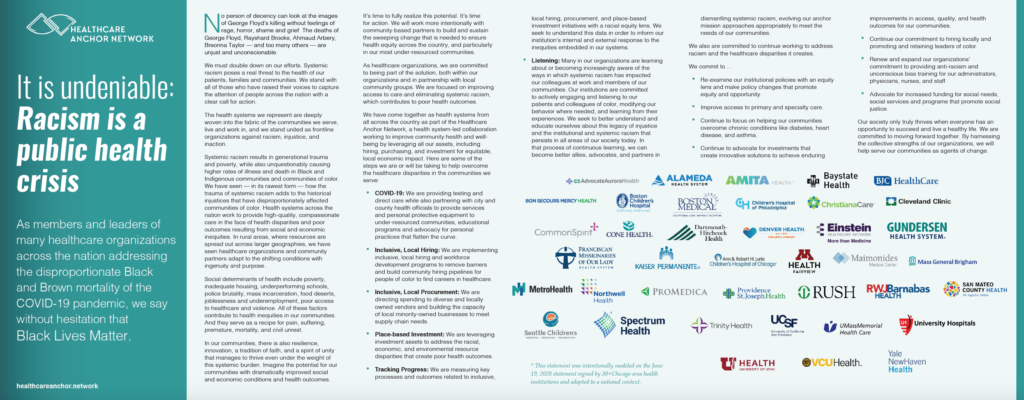
It is undeniable: Racism is a public health crisis

It is undeniable: Racism is a public health crisis

39 health systems in 45 states and Washington, DC have committed to addressing racism and the public health disparities caused by racism. Read the full statement below or download the PDF.

As members and leaders of many healthcare organizations across the nation addressing the disproportionate Black and Brown mortality of the COVID-19 pandemic, we say without hesitation that Black Lives Matter.

No person of decency can look at the images of George Floyd’s killing without feelings of rage, horror, shame, and grief. The deaths of George Floyd, Rayshard Brooks, Ahmaud Arbery, Breonna Taylor — and too many others — are unjust and unconscionable.

We must double down on our efforts. Systemic racism poses a real threat to the health of our patients, families, and communities. We stand with all of those who have raised their voices to capture the attention of people across the nation with a clear call for action.

The health systems we represent are deeply woven into the fabric of the communities we serve, live, and work in, and we stand united as frontline organizations against racism, injustice, and inaction. 

Systemic racism results in generational trauma and poverty, while also unquestionably causing higher rates of illness and death in Black and Indigenous communities and communities of color. We have seen — in its rawest form — how the trauma of systemic racism adds to the historical injustices that have disproportionately affected communities of color. Health systems across the nation work to provide high-quality, compassionate care in the face of health disparities and poor outcomes resulting from social and economic inequities. In rural areas, where resources are spread out across larger geographies, we have seen healthcare organizations and community partners adapt to the shifting conditions with ingenuity and purpose.

These social determinants of health include poverty, inadequate housing, underperforming schools, police brutality, mass incarceration, food deserts, joblessness and underemployment, poor access to healthcare, and violence. All of these factors contribute to health inequities in our communities. And they serve as a recipe for pain, suffering, premature mortality — and civil unrest.

In our communities, there is also resilience, innovation, a tradition of faith, and a spirit of unity that manages to thrive even under the weight of this systemic burden. Imagine the potential for our communities with dramatically improved social and economic conditions and health outcomes.

It’s time to fully realize this potential. It’s time for action. We will work more intentionally with community-based partners in building and sustaining the sweeping change that is needed to ensure health equity across the country, and particularly in our most under-resourced communities.

As healthcare organizations, we are committed to being part of the solution, both within our organizations and in partnership with local community groups. We are focused on improving access to care and eliminating systemic racism, which contributes to poor health outcomes.

We have come together as health systems from all across the country as part of the Healthcare Anchor Network, a health system-led collaboration working to improve community health and well-being by leveraging all our assets, including hiring, purchasing, and investment for equitable, local economic impact. Here are some of the steps we are or will be taking to help overcome the healthcare disparities in the communities we serve:

  • COVID-19: We are providing testing and direct care while also partnering with city and county health officials to provide educational programs, services and personal protective equipment to under-resourced communities, and advocacy for personal practices that flatten the curve.
  • Inclusive, Local Hiring: We are implementing inclusive, local hiring and workforce development programs to remove barriers and build community hiring pipelines for people of color to find careers in healthcare.
  • Inclusive, Local Procurement: We are directing spending to diverse and locally owned vendors and building the capacity of local minority-owned businesses to meet supply chain needs.
  • Place-based Investment: We are leveraging investment assets to address the racial, economic, and environmental resource disparities that create poor health outcomes.
  • Tracking Progress: We are measuring key processes and outcomes related to inclusive, local hiring, procurement, and place-based investment initiatives with a racial equity lens. We seek to understand this data in order to inform our institution’s internal and external response to the inequities embedded in our systems.
  • Listening: Many in our organizations are learning about or becoming increasingly aware of the ways in which systemic racism has impacted our colleagues at work and members of our communities. Our institutions are committed to actively engaging and listening to our patients and colleagues of color, modifying our behavior where needed, and learning from their experiences. We seek to better understand and educate ourselves about this legacy of injustice and the institutional and systemic racism that persists in all areas of our society today. In that process of continuous learning, we can become better allies, advocates, and partners in dismantling systemic racism, evolving our anchor mission approaches appropriately to meet the needs of our communities.

We also are committed to continue working to address racism and the healthcare disparities it creates. 

We commit to … 

  • Re-examine our institutional policies with an equity lens and make policy changes that promote equity and opportunity.
  • Improve access to primary and specialty care.
  • Continue to focus on helping our communities overcome chronic conditions like diabetes, heart disease, and asthma.
  • Continue to advocate for investments that create innovative solutions to achieve enduring improvements in access, quality, and health outcomes for our communities.
  • Continue our commitment to hiring locally and promoting and retaining leaders of color.
  • Renew and expand our organizations’ commitment to providing anti-racism and unconscious bias training for our administrators, physicians, nurses, and staff.
  • Advocate for increased funding for social needs, social services, and programs that promote social justice.

Our society only truly thrives when everyone has an opportunity to succeed and live a healthy life. We are committed to moving forward together. By harnessing the collective strengths of our organizations, we will help serve our communities as agents of change.

The healthcare systems that have signed onto this statement are: Advocate Aurora Health, Alameda Health System, AMITA Health, Baystate Health, BJC HealthCare, Bon Secours Mercy Health, Boston Children’s Hospital, Boston Medical Center, Children’s Hospital of Philadelphia, ChristianaCare, Cleveland Clinic, CommonSpirit Health, Cone Health, Dartmouth-Hitchcock Health, Denver Health, Einstein Healthcare Network, Franciscan Missionaries Of Our Lady Health System, Gundersen Health System, Kaiser Permanente, Lurie Children’s, M Health Fairview, Maimonides Medical Center, Mass General Brigham, Northwell Health, ProMedica, Providence St. Joseph Health, Rush University Medical Center, RWJBarnabas Health, San Mateo County Health, Seattle Children’s, Spectrum Health, The MetroHealth System, Trinity Health, UC San Francisco, UMass Memorial Health, University Hospitals, University of Utah Health, VCU Health, and Yale New Haven Health.


Cartoon – Problem with Agreements in Principle

Book review: How to be an ethical solicitor by Mena Ruparel and Richard  Burnham - ICLR

Cartoon – State of the Union on Integrity

Cartoon – Leadership Integrity on the Line | HENRY KOTULA

Visualizing the State of Democracy, by Country

Visualizing the State of Democracy, by Country

Visualizing The State Of Democracy, By Country | The Daily Reformer

https://www.visualcapitalist.com/wp-content/uploads/2020/09/state-of-democracy.html


Visualizing the State of Democracy, by Country

View the full-sized interactive version of this infographic by clicking here

From Norway to North Korea, governing systems differ around the world. But has the world become more or less free in the past decade?

This visualization from Preethi Lodha demonstrates how democracy levels of 167 countries have changed since 2006. The original data comes from the Democracy Index, which is compiled annually by the Economist Intelligence Unit.

Four Levels of Democracy

First, it’s important to understand the classifications made by the Democracy Index.

Based on answers to 60 questions across a nation’s electoral process, civil liberties, government functions, political participation and political culture, countries are assigned a range of scores in the Democracy Index.

Based on these scores, a nation automatically falls into one of the following four types of governance. Here’s which category fits the bill, depending on the range of scores:

Visualizing The State Of Democracy, By Country – Investing Matters

One thing that stands out is that many hybrid regimes and flawed democracies are also considered high potential emerging markets, but are held back by their political instability.

Notable Improvements

In recent times, public demonstrations have been a major cause behind increases in Democracy Index scores and changes in governance classifications.

Algeria moved from authoritarian to hybrid regime in 2019, the only country in the Arab region to do so in the index. This came after sustained protests against the previous president, Abdelaziz Bouteflika—who had served for 20 years.

Chile experienced similar turmoil, for the better. After a spike in the scale of middle class unrest over inequality and unfair policies in late 2019, the political participation moved it up from a flawed to full democracy.

Sliding Countries

The U.S. has one of the oldest democracies in the world. However, it was downgraded from a full to a flawed democracy as of the 2016 index, a status that had been “teetering” since before then, according to the report that year.

Venezuela dropped into an authoritarian regime in 2017, and it doesn’t seem to be improving anytime soon. The state was found to use the COVID-19 pandemic as an excuse to crack down on any dissent against the government.

Global Change in Democracy Levels

All in all, the average global democracy score worldwide emerged at 5.48 in 2019, although it’s clear that certain countries pull this value towards the opposite extremes.

North Korea, an authoritarian regime with a 1.08 score, has remained consistently one of the lowest ranked countries in the index. Meanwhile, its alphabetical successor Norway steadily keeps up its high score streak, with 9.87 being the best example of a full democracy in 2019.

Here’s how many countries made up each system of governance over the years, and the global Democracy Index score for that year.

Visualizing The State Of Democracy, By Country | NewsLinks.Net |  Conservative News

Authoritarian regimes peaked in 2010 with 57 countries, whereas the full democracy category peaked in 2008 with 28 countries.

Since 2006, the average global score has slid from 5.52 to 5.48, and the total of countries categorized under full democracy decreased from 26 to 22.

Does this signal an increasingly divided world? And will the global pandemic—which is already delaying elections—have a further pronounced effect on backsliding these democracy scores?