The United States’ top infectious-disease expert, Anthony S. Fauci, cautioned against despair as the country endures a surge in covid-19 cases unlike anything it has previously seen. A record high of 145,835 new cases were reported Wednesday, just one week after the U.S. hit 100,000 cases for the first time. At least 65,000 Americans are hospitalized with covid-19, according to The Post’s latest data.
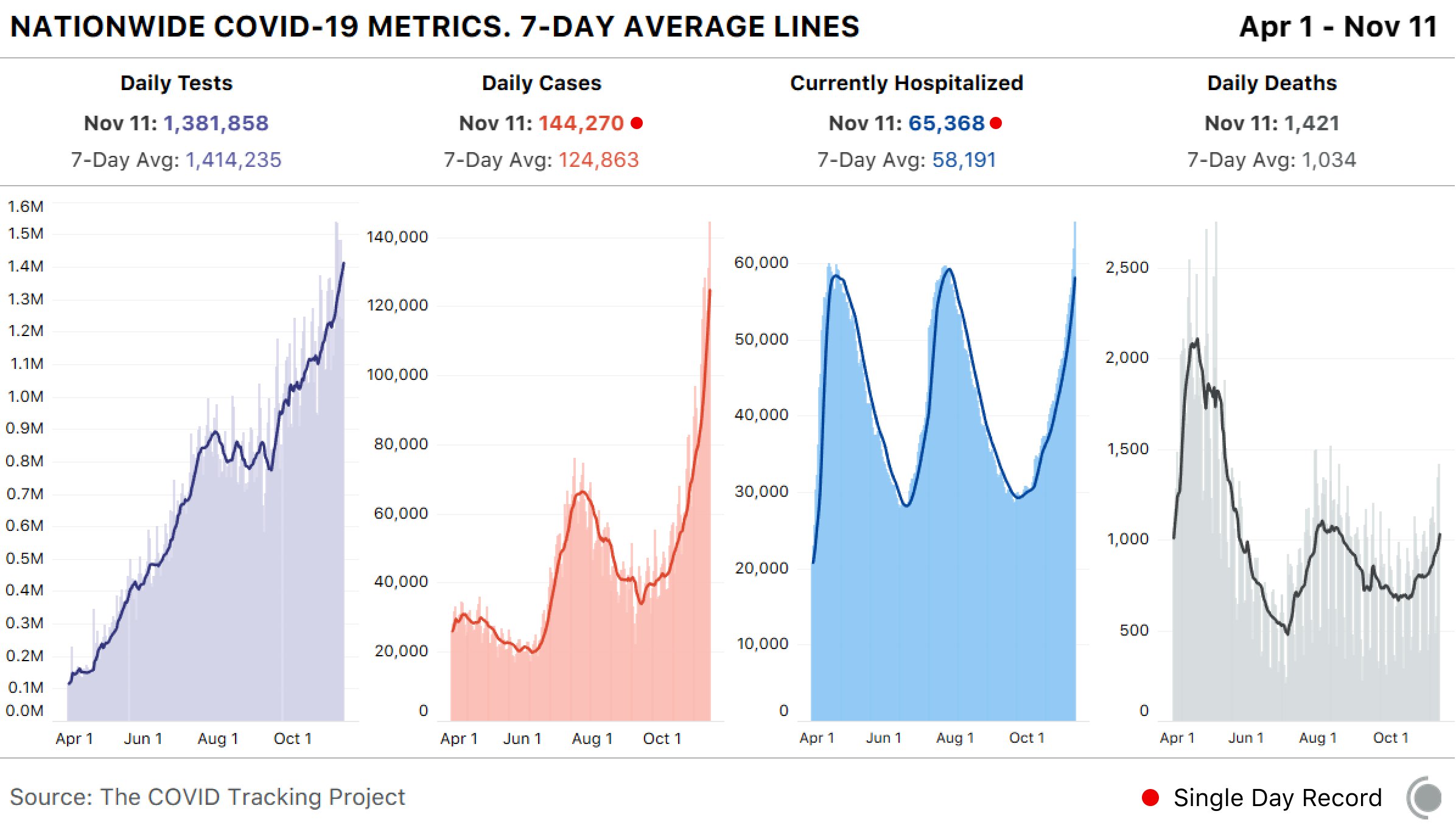
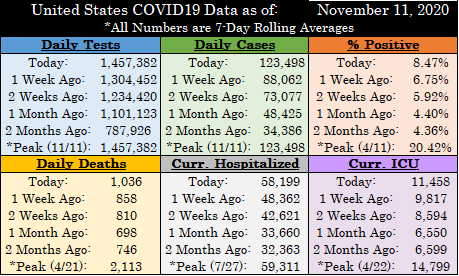
Our daily update is published. States reported 1.4M new tests and 144k cases, another all-time high. 65.4k people are hospitalized, 15k more than on election day. The death toll was 1,421, pushing the 7-day average over 1,000.
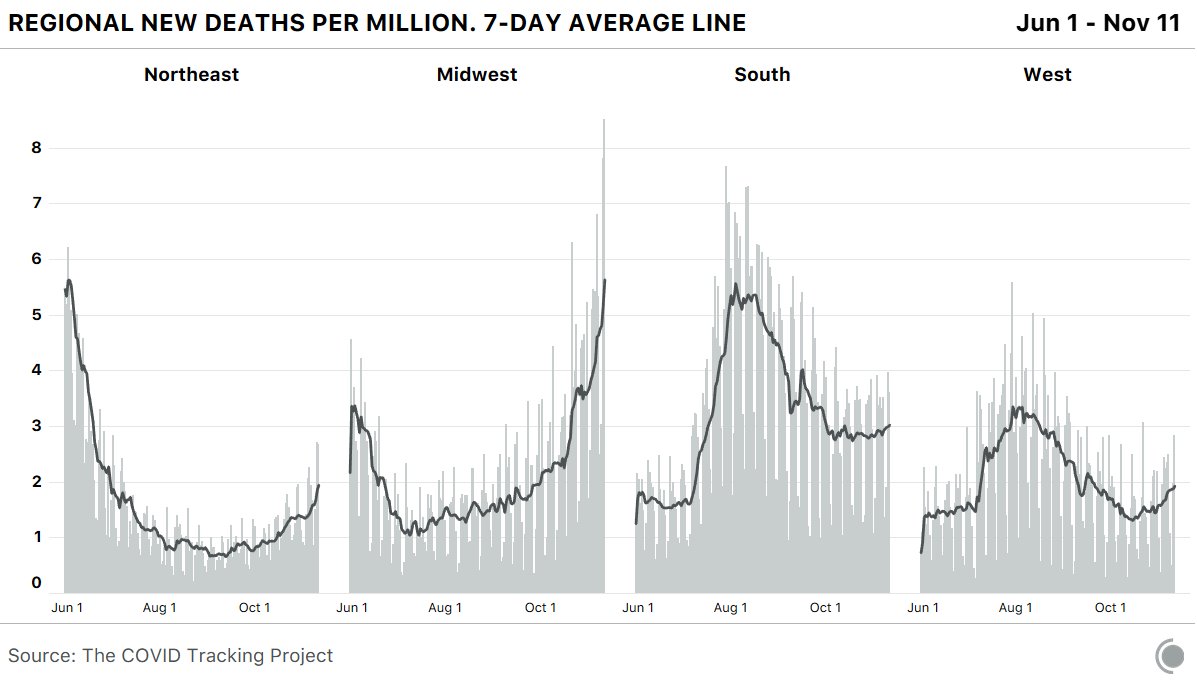
On a per capita basis, more people are now dying across the Midwest than even at the peak of the summer surge in the South.
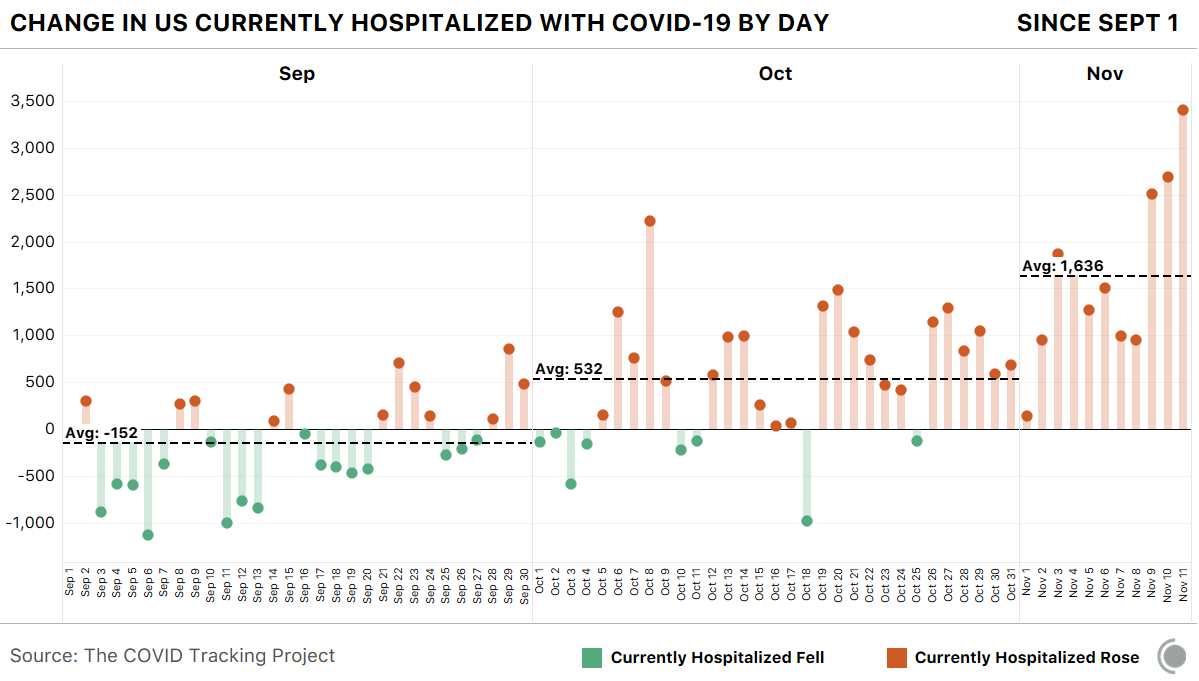
Hospitalizations are now rising very quickly. The last three days standout, but across all of November, we’re averaging 1,636 more current hospitalizations each day.
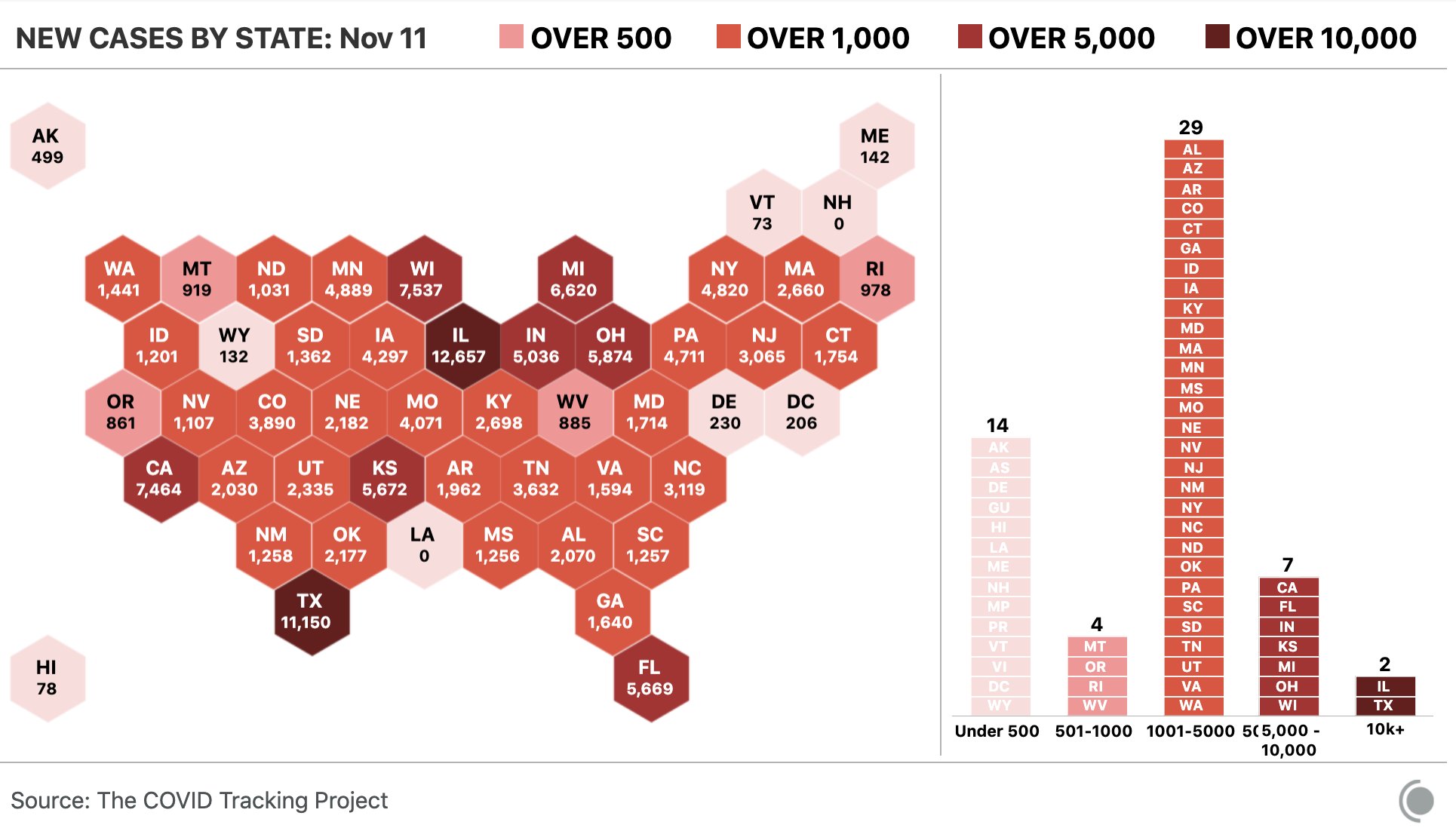
38 states reported over 1,000 cases today.
*Today’s #Covid19 Update Thread* (tests, cases, deaths, hospitalizations, ICU, and % testing positive as of Today, 1 week, 2 weeks, 1 month, and 2 months ago—data from @COVID19Tracking)
In the days and weeks leading up to Election Day, President Donald Trump claimed that the “fake news media” chose to focus on Covid-19 to damage his campaign, predicting that once November 4th arrived, Americans would not hear about the virus anymore, however, in the seven days since that date, infections and hospitalizations have spiked to unseen levels, shattering previous records.
KEY FACTS
The United States reported a record-setting high of 139,855 new positive cases on Tuesday and 1,448 coronavirus deaths, according to a New York Times database.
In the seven days since Nov. 4, there has been an average of 123,315 new cases per day (a total of 863,205), which is the highest daily average ever recorded in any nation, and an increase of 69% from the average just two weeks earlier.
According to the Covid Tracking Project, a record high of 61,964 people are currently hospitalized in the United States.
A total of 7,021 Americans have been killed by the virus since November 4th, as the daily average death count has risen above 1,000 for the first time since August.
CRITICAL QUOTE:
“That’s all I hear about now. That’s all I hear. Turn on television—’Covid, Covid, Covid, Covid, Covid, Covid.’ A plane goes down. 500 people dead, they don’t talk about it,” Trump told his supporters at a campaign rally in Lumberton, North Carolina, on October 24th. “Covid, Covid, Covid, Covid.’ By the way, on November 4, you won’t hear about it anymore,”
KEY BACKGROUND:
On October 27th, Trump tweeted: “ALL THE FAKE NEWS MEDIA WANTS TO TALK ABOUT IS COVID, COVID, COVID. ON NOVEMBER 4th, YOU WON’T BE HEARING SO MUCH ABOUT IT ANYMORE. WE ARE ROUNDING THE TURN!!!“ In August, speaking at Republican National Convention, Trump asserted that Democrats were imposing restrictions to damage the economy. He prognosticated that these left-leaning states would reopen after the election. “On November 4th, it will all open up,” said the president, adding, “They want to make our numbers look as bad as possible for the election.” Back in May, Eric Trump, during an appearance on Fox News, said the Democrats “will milk it every single day between now and November 3rd, and guess what, after November 3rd, coronavirus will magically all of a sudden go away and disappear.” In late October, Trump alleged, “Until November 4th., Fake News Media is going full-on Covid, Covid, Covid.” Although the coronavirus is raging out of control, the president has yet to address the pandemic since the election. Trump has tweeted 149 times since Nov. 3 but has not once mentioned Covid, Covid-19, or the coronavirus. Nor has he offered an update to U.S. citizens on how the federal government plans to counteract this most recent nationwide outbreak.
TANGENT:
Vice President Mike Pence is the head of the White House Coronavirus Task Force. According to the Federal Aviation Administration, Pence was scheduled to vacation in Sanibel, Florida, Tuesday through Saturday this week. However, the Washington Post reported Tuesday that Pence is no longer planning to leave Washington.
BIG NUMBER:
240,000. Since the start of the pandemic, more than 10,331,900 Americans have been infected with the coronavirus, and at least 240,200 have died.
For the first time in the coronavirus pandemic, more than 60,000 Americans are hospitalized for Covid-19, according to The COVID Tracking Project, which also reported yet another record for new cases Tuesday—130,989, as the pandemic continues to worsen.
KEY FACTS
61,964 Covid-19 hospitalizations were reported in the U.S. Tuesday, breaking a record that had stood since April 15, when 59,940 were in the hospital.
The record for new cases was also broken, topping 130,000 for the first time, but the old record had stood for just three days.
1,347 deaths were reported, which is the most since Aug. 19, according to The COVID Tracking Project, which collects its data from local reporting agencies.
WHAT TO WATCH FOR
The grim impacts of the third U.S. coronavirus surge are starting to be felt. Hard-hit El Paso, Texas is running out of morgue space, while Tulsa ran out of ICU beds Monday night. In North Dakota, hospitals are at capacity and the state is now taking the extreme step of allowing Covid-positive nurses to keep working in some cases amid a serious staffing shortage.
KEY BACKGROUND
New cases have been rising exponentially since mid-September, with no signs of slowing up. Hospitalizations starting rising around a week later—a rate that has been on the increase. Deaths, which lag behind rises in other metrics, remained relatively steady until around Oct. 18. The death toll has been on a steady rise ever since, with the 7-day rolling average now just shy of 1,000 per day.
TANGENT
President-elect Joe Biden says that fighting coronavirus is a top priority of his incoming administration. He announced a 12-member Covid task force on Monday, with the goal of coming up with a plan to combat the pandemic. That’s in contrast to President Donald Trump, whose administration has not come up with a national plan while the president has continued to make false statements that the U.S. is “rounding the turn” on coronavirus.
On Monday, Pfizer announced preliminary results from the phase 3 trial of the vaccine that it has developed with German company BioNTech, suggesting that it may be up to 90% effective at preventing Covid-19 with no serious safety concerns.The vaccine, which represents a new way to make a vaccine, might be ready for an Emergency Use Authorization from the FDA by the end of the year.
BioNTech’s vaccine is an mRNA (as in “messenger RNA,” which might ring a faint bell from high school biology class) vaccine, similar to one being developed by Boston-based Moderna as well as Translate Bio, which is partnered with pharmaceutical giant Sanofi. This type of vaccine has been in the works for other diseases, including the flu, but none have been approved for use by any regulatory body yet. Success with this platform has the potential to accelerate the development of vaccines for new diseases, a process which can typically take close to a decade.
Here’s what you need to know.
Pfizer’s vaccine is based on a new kind of technology
Traditional vaccines are made from dead or weakened versions of an infectious virus. This new type of vaccine is different. To develop it, the genes of the SARS-CoV-2 virus, which causes Covid-19, were first analyzed to locate the part that codes its “spike” protein, which is what enables the virus to infect people. The codes for that protein are then isolated and copied as mRNA fragments, which is what cells use as instructions for making proteins. Those fragments are packaged up into special molecules, then injected into the patient’s cells.
Within the cells, the mRNA comes into the body’s protein factories, called ribosomes. The ribosomes “read” the mRNA, and follow its instructions to make copies of the spike protein. Those copies of the spike protein can’t, by themselves, cause harm. But they’ll trigger the body to make antibodies against the virus. Those antibodies, in turn, will protect patients from a Covid-19 infection. At least, that’s the idea.
The vaccine still needs to be approved by the Food and Drug Administration
Before the vaccine can be distributed, it has to first be approved by appropriate regulatory bodies. In the United States, that’s the FDA. Pfizer has said that it intends to seek an Emergency Use Authorization from the FDA to enable distribution and administration of the vaccine in late November, at which point the company will have an average of two months’ worth of safety data for each patient. That’s because most bad reactions to vaccines happen shortly after infection. Additionally, Pfizer will continue to monitor the patients in its study for two years after the vaccine administration.
Distributing this vaccine is more complicated than for a typical vaccine
Although one advantage of mRNA vaccines is that they’re potentially faster to develop than traditional vaccines, their administration and distribution is scads more complicated. For example, the Pfizer vaccine is currently being tested on a two-dose schedule, 21 days apart, unlike the single dose of a typical vaccine for diseases like the flu. The 21-day separation has raised some concerns about the patient compliance needed for vaccines to work.
For long-term storage, the vaccine has to be kept at very cold temperatures—around –70° Celsius (–94° Fahrenheit), which requires a specialized freezer. (Flu vaccines, by contrast, can usually be stored in a refrigerator.) The company has developed a specialty thermal shipping container, which can be kept cold with dry ice and be used to store the vaccine doses for up to 15 days. If long-term storage isn’t required, Pfizer’s vaccine can be stored in a refrigerator, but only for up to five days.
Pfizer footed the bill for its own part of vaccine development
Several companies, such as Moderna, have received federal funding and support for the development of their vaccines and treatments through the research and development process. Pfizer opted out of that, choosing instead to spend $1 billion of its own money to move the vaccine forward. “A billion dollars is not going to break us,” CEO Albert Bourla told Forbes earlier this year.
That said, BioNTech did receive a $442 million grant from the German government to help develop the vaccine. And in July, the two companies signed an agreement to sell at least 100 million doses to the U.S. Department of Health and Human Services (HHS) for $1.95 billion. The country of Spain has initially secured 20 million doses of the vaccine as well.
Detroit Medical Center is laying off employees, and its parent company, Dallas-based Tenet Healthcare, is planning to sell or close four urgent care centers in the Detroit area, according toCrain’s Detroit Business.
Detroit Medical Center officials told Crain’s layoffs have occurred, but they declined to disclose the number of employees affected. Sources told Crain’s several hundred DMC employees have been laid off with more expected this year. Clinical staff, administrative assistants and employees at the management level were reportedly affected by the layoffs.
“Like many health systems locally and nationally, we continually evaluate and review our staffing needs, which have decreased due to reduced patient demand during the pandemic,” DMC said in a statement to Becker’s Hospital Review. “Our goal is to ensure we are strongly positioned to provide the highest quality and safest care to our patients while making the best use of our resources.”
Tenet is also planning to sell or close its four remaining MedPost urgent care centers in the Detroit area. Tenet has reached agreements to sell three of the urgent care centers in Bloomfield, Livonia and Southfield, Mich., to First Choice Urgent Care, a company spokesperson told Becker’s Hospital Review.
“We expect all employees in good standing to be offered positions to remain at the facilities upon completion of the sale, which we anticipate occurring in December,” the spokesperson told Becker’s.
The MedPost urgent care center in Rochester Hills, Mich., will close in December, the spokesperson said. Tenet may convert it to a physician office or other type of healthcare facility.
“We are committed to providing our full support and assistance to employees through the close, and facilitating opportunities for open roles at local Tenet facilities,” the spokesperson told Becker’s.
Tenet, a 65-hospital system, operated nine MedPost urgent care centers in the Detroit area at the beginning of the year. It closed five of the centers in April due to challenges linked to the COVID-19 pandemic. The MedPost urgent care centers are not part of DMC.
President-elect Joe Biden and Vice President-elect Kamala Harris have released a seven-point plan regarding the COVID-19 pandemic.
The Biden administration’s seven pandemic plans:
1. Ensure all Americans have access to regular, reliable and free testing by doubling the number of drive-thru testing sites, investing in next-generation testing, developing a pandemic testing board to produce and distribute tests, and establishing a U.S. Public Health Jobs Corps.
2. Provide all states, cities, tribes and territories with critical supplies. Efforts will include full use of the Defense Production Act, building American-sourced and manufactured capabilities.
3. Provide clear, consistent and evidence-based guidance for how communities should navigate the pandemic. Planned resources will be tailored to the needs of schools, small businesses and families.
4. Plan for effective and equitable distribution of treatments and vaccines. The administration intends to invest in a $25 billion manufacturing and distribution plan to guarantee every American can receive the vaccine for free. The administration also said it will work to ensure that politics won’t play a role in determining the safety and efficacy of vaccines.
5. Protect older Americans and other high-risk groups. Efforts will include establishing a COVID-19 racial and ethnic disparities task force and a nationwide pandemic dashboard that can be checked in real-time to gauge local transmission.
6. Rebuild and expand defenses to prevent and mitigate pandemic threats, including the restoration of the White House National Security Council Directorate for Global Health Security and Biodefense and the nation’s membership with the World Health Organization.
Kennett Square, Pa.-based Genesis Healthcare, one of the largest post-acute care providers in the U.S., warned that bankruptcy is possible if its financial losses continue.
“The virus continues to have a significant adverse impact on the company’s revenues and expenses, particularly in hard-hit Mid Atlantic and Northeastern markets,” Genesis CEO George V. Hager Jr., said in a Nov. 9 earnings release.
Mr. Hager said government stimulus funds the company received in the third quarter of this year fell nearly $60 million short of the company’s COVID-19 costs and lost revenue.
Genesis said it has taken several steps to help offset the financial damage linked to the pandemic, including delaying payment of a portion of payroll taxes incurred through December.
But the company warned that bankruptcy is possible if its financial losses continue.
“Even if the company receives additional funding support from government sources and/or is able to execute successfully all of its these plans and initiatives, given the unpredictable nature of, and the operating challenges presented by, the COVID-19 virus, the company’s operating plans and resulting cash flows, along with its cash and cash equivalents and other sources of liquidity. may not be sufficient to fund operations for the 12-month period following the date the financial statements are issued,” Genesis said. “Such events or circumstances could force the company to seek reorganization under the U.S. Bankruptcy Code.”
Genesis ended the third quarter of this year with a net loss of $62.8 million, compared to net income of $46.1 million in the same period a year earlier.
President-elect Joe Biden on Monday announced the members of his coronavirus task force, a group made up entirely of doctors and health experts,signaling his intent to seek a science-based approach to bring the raging pandemic under control.
Biden’s task force will have three co-chairs: Vivek H. Murthy, surgeon general during the Obama administration; David Kessler, Food and Drug Administration commissioner under Presidents George H.W. Bush and Bill Clinton; and Marcella Nunez-Smith, associate dean for health equity research at the Yale School of Medicine. Murthy and Kessler have briefed Biden for months on the pandemic.
Biden will inherit the worst crisis since the Great Depression, made more difficult by President Trump’s refusal to concede the election and commit to a peaceful transition of power. The Trump administration has not put forward national plans for testing, contact tracing and resolving shortages in personal protective equipment that hospitals and health-care facilities are experiencing again as the nation enters its third surge of the virus.
“Dealing with the coronavirus pandemic is one of the most important battles our administration will face, and I will be informed by science and by experts,” Biden said in a statement. “The advisory board will help shape my approach to managing the surge in reported infections; ensuring vaccines are safe, effective, and distributed efficiently, equitably, and free; and protecting at-risk populations.”
The United States is recording more than 100,000 new coronavirus cases a day and, on many days, more than 1,000 deaths, a toll expected to worsen during the crucial 10-week stretch of the transition. It remains unclear whether Trump or his top aides will oversee and lead a robust response to the pandemic during the transition, which could further exacerbate the crisis Biden and Vice President-elect Kamala D. Harris inherit.
The 13-member task force also includes former Trump administration officials, including Rick Bright, former head of the Biomedical Advanced Research and Development Authority, who, after being demoted, spoke out against the administration’s approach to the pandemic. Luciana Borio, director for medical and biodefense preparedness on Trump’s National Security Council until 2019, is also on the panel.
The group includes several other prominent doctors:
· Ezekiel Emanuel, chair of the Department of Medical Ethics and Health Policy at the University of Pennsylvania.
· Atul Gawande, a surgeon at Brigham and Women’s Hospital and a professor at Harvard Medical School who is a prolific author.
· Michael T. Osterholm, director of the Center for Infectious Disease Research and Policy at the University of Minnesota.
· Eric Goosby, global AIDS coordinator under President Barack Obama and professor of medicine at the University of California at San Francisco School of Medicine.
· Celine R. Gounder, clinical assistant professor of medicine and infectious diseases at New York University’s Grossman School of Medicine.
· Julie Morita, executive vice president of the Robert Wood Johnson Foundation, a philanthropy focused on health issues.
· Loyce Pace, president and executive director of the Global Health Council, a U.S.-based nonprofit organization dedicated to global health issues.
· Robert Rodriguez, professor of emergency medicine at the UCSF School of Medicine.
Rebecca Katz, director of the Center for Global Health Science and Security at Georgetown University Medical Center, and Beth Cameron, director for global health security and biodefense on the White House National Security Council during the Obama administration, are serving as advisers to the transition task force.
Task force members will work with state and local officials to craft public health and economic policies to address the virus and racial and ethnic disparities, while also working to reopen schools and businesses, the transition team said in a news release.
While the makeup of the task force garnered widespread praise, Peter Hotez, dean of the National School of Tropical Medicine at the Baylor College of Medicine, said the group needs more geographic diversity.
“They are all from the Acela corridor or the [San Francisco] Bay Area,” he said. “Who is going to be the field marshal or the supreme allied commander who goes into middle of the country and get this done? The coasts are doing okay but the red states are being hammered and the deaths are going to be extraordinary. There needs to be a frank reckoning between leaders of the two parties, to say we cannot let this happen.”
Public health experts said Biden should use the transition to provide leadership as the pandemic continues through a deadly stretch and begin communicating a strong national message.
“Clearly from the election outcomes, half the country doesn’t believe we’re in a crisis,” said Kavita Patel, a fellow at the Brookings Institution who worked on health policy in the Obama administration. Biden and Harris “have an incredible platform that can be used for communication. The country needs clear daily briefings that we thought we’d get from the White House coronavirus task force. They have an incredible platform, if not an official platform.”
Biden plans to call Republican and Democratic governors to ask for their help in developing a consistent message from federal and state leaders, according to three Biden advisers who spoke on the condition of anonymity because they were not authorized to speak publicly about these matters. He will urge governors to adopt statewide mask mandates and to provide clear public health guidance to their constituents, including about social distancing and limiting large gatherings.
The task force will have subgroups that focus on issues related to the response, including testing, vaccine distribution and personal protective equipment, according to two people familiar with the plans who spoke on the condition of anonymity to reveal plans that were not yet public.
In his victory speech Saturday, Biden addressed challenges in bringing the pandemic under control.
“We cannot repair the economy, restore our vitality or relish life’s most precious moments — hugging a grandchild, birthdays, weddings, graduations, all the moments that matter most to us — until we get this virus under control,” Biden said. “That plan will be built on a bedrock of science. It will be constructed out of compassion, empathy and concern. I will spare no effort — or commitment — to turn this pandemic around.”
Yet the plans Biden laid out on the campaign trail are set to collide with political realities. That includes a deeply divided nation in which more than 71 million people voted for Trump and the possibility of having to navigate a Republican-controlled Senate disinclined to support a greater federal role in testing and contact tracing, among other responsibilities now left mostly to the states.
Biden’s most ambitious plans will require significant congressional funding. Senate Majority Leader Mitch McConnell (R-Ky.) has said he would like to pass new coronavirus relief measures during Congress’s lame-duck session, and Congress faces a Dec. 11 government funding deadline. Biden and his team are poised to begin engaging with congressional Democrats on their priorities.
Biden’s plans include dramatically expanding testing and building a U.S. public health jobs corps to have 100,000 Americans conduct contact tracing. They also include ramping up production of personal protective equipment and implementing a vaccine distribution plan.
Murthy, who served as the 19th U.S. surgeon general, is a physician whose nomination was stalled in the Senate for more than a year because of his view that gun violence is a public health issue. Three months into the Trump administration, he was replaced as “the nation’s doctor” with more than two years left on his four-year term.
In 2016, he wrote a landmark report on drug and alcohol addiction, which put that condition alongside smoking, AIDS and other public health crises that previous surgeons general addressed. The report called the addiction epidemic “a moral test for America.” Murthy’s office sent millions of letters to doctors asking for their help to combat the opioid crisis.
The son of immigrants from India, he earned medical and MBA degrees at Yale before joining the faculty at Harvard Medical School, where his research focused on vaccine development and the participation of women and minorities in clinical trials.
After leaving his post as surgeon general, he wrote a book on loneliness and social isolation, including their implications for health, that grew out of his conversations with people in clinical practice and as surgeon general.
Several public health officials celebrated Nunez-Smith’s leadership role on the task force. Her research focuses on promoting health and health-care equity in marginalized populations, according to her Yale biography. She has also studied discrimination that patients endure in the health-care system — expertise that many said was welcome in an epidemic that is disproportionately affecting people of color.
Kessler was FDA commissioner from 1990 to 1997, during the George H.W Bush and Clinton administrations. He is well-known for his attempts to regulate cigarettes — an effort that resulted in a loss in the Supreme Court, which ruled that the agency did not have the authority. That prompted Congress to pass a law, enacted in 2009, that explicitly gave the agency that power.
Kessler, a pediatrician and lawyer, worked at the FDA to accelerate AIDS treatments and on food and nutrition issues. He oversaw the FDA’s development of standardized nutrition labels and notably ordered the seizure of orange juice labeled “fresh” because it was made from concentrate. He has written several books on diet, mental illness and other topics, and has served as dean of the medical schools at Yale and UCSF.





 HENRY KOTULA