Are Employers Ready to Move from the Back Bench in U.S. Healthcare?

This year, 316 million Americans (92.3% of the population) have health insurance: 61 million are covered by Medicare, 79 million by Medicaid/CHIP and 164 million through employment-based coverage. By 2032, the Congressional Budget Office predicts Medicare coverage will increase 18%, Medicaid and CHIP by 0% and employer-based coverage will increase 3.0% to 169 million. For some in the industry, that justifies seating Medicare on the front row for attention. And, for many, it justifies leaving employers on the back bench since the working age population use hospitals, physicians and prescription meds less than seniors.  

Last week, the Business Group on Health released its 2025 forecast for employer health costs based on responses from 125 primarily large employers surveyed in June: Highlights:

  • “Since 2022, the projected increase in health care trend, before plan design changes, rose from 6% in 2022, 7.2% in 2024 to almost 8% for 2025. Even after plan design changes, actual health care costs continued to grow at a rate exceeding pre-pandemic increases. These increases point toward a more than 50% increase in health care cost since 2017. Moreover, this health care inflation is expected to persist and, in light of the already high burden of medical costs on the plan and employees, employers are preparing to absorb much of the increase as they have done in recent years.”.
  • Per BGH, the estimated total cost of care per employee in 2024 is $18,639, up $1,438 from 2023. The estimated out-of-pocket cost for employees in 2024 is $1,825 (9.8%), compared to $1,831 (10.6%) in 2023.

The prior week, global benefits firm Aon released its 2025 assessment based on data from 950 employers:

  • “The average cost of employer-sponsored health care coverage in the U.S. is expected to increase 9.0% surpassing $16,000 per employee in 2025–higher than the 6.4% increase to health care budgets that employers experienced from 2023 to 2024 after cost savings strategies. “
  • On average, the total health-plan cost for employers increased 5.8% to $14,823 per employee from 2023 to 2024: employer costs increased 6.4% to 80.7% of total while employee premiums increased 3.4% increase–both higher than averages from the prior five years, when employer budgets grew an average of 4.4% per year and employees averaged 1.2% per year.
  • Employee contributions in 2024 were $4,858 for health care coverage, of which $2,867 is paid in the form of premiums from pay checks and $1,991 is paid through plan design features such as deductibles, co-pays and co-insurance.
  • The rate of health care cost increases varies by industry: technology and communications industry have the highest average employer cost increase at 7.4%, while the public sector has the highest average employee cost increase at 6.7%. The health care industry has the lowest average change in employee contributions, with no material change from 2023: +5.8%

And in July, PWC’s Health Research Institute released its forecast based on interviews with 20 health plan actuaries. Highlights:

  • “PwC’s Health Research Institute (HRI) is projecting an 8% year-on-year medical cost trend in 2025 for the Group market and 7.5% for the Individual market. This near-record trend is driven by inflationary pressure, prescription drug spending and behavioral health utilization. The same inflationary pressure the healthcare industry has felt since 2022 is expected to persist into 2025, as providers look for margin growth and work to recoup rising operating expenses through health plan contracts. The costs of GLP-1 drugs are on a rising trajectory that impacts overall medical costs. Innovation in prescription drugs for chronic conditions and increasing use of behavioral health services are reaching a tipping point that will likely drive further cost inflation.”

Despite different methodologies, all three analyses conclude that employer health costs next year will increase 8-9%– well-above the Congressional Budget Office’ 2025 projected inflation rate (2.2%), GDP growth (2.4% and wage growth (2.0%).  And it’s the largest one-year increase since 2017 coming at a delicate time for employers worried already about interest rates, workforce availability and the political landscape.

For employers, the playbook has been relatively straightforward: control health costs through benefits designs that drive smarter purchases and eliminate unnecessary services. Narrow networks, price transparency, on-site/near-site primary care, restrictive formularies, value-based design, risk-sharing contracts with insurers and more have become staples for employers. 

But this playbook is not working for employers: the intrinsic economics of supply-driven demand and its regulated protections mitigate otherwise effective ways to lower their costs while improving care for their employees and families.

My take:

Last week, I reviewed the healthcare advocacy platforms for the leading trade groups that represent employers in DC and statehouses to see what they’re saying about their take on the healthcare industry and how they’re leaning on employee health benefits. My review included the U.S. Chamber of Commerce, National Federal of Independent Businesses, Business Roundtable, National Alliance of Purchaser Coalitions, Purchaser Business Group on Health, American Benefits Council, Self-Insurance Institute of America and the National Association of Manufacturers.

What I found was amazing unanimity around 6 themes:

  • Providing health benefits to employees is important to employers. Protecting their tax exemptions, opposing government mandates, and advocating against disruptive regulations that constrain employer-employee relationships are key.
  • Healthcare affordability is an issue to employers and to their employees, All see increasing insurance premiums, benefits design changes, surprise bills, opaque pricing, and employee out-of-pocket cost obligations as problems.
  • All believe their members unwillingly subsidize the system paying 1.6-2.5 times more than what Medicare pays for the same services. They think the majority of profits made by drug companies, hospitals, physicians, device makers and insurers are the direct result of their overpayments and price gauging.
  • All think the system is wasteful, inefficient and self-serving. Profits in healthcare are protected by regulatory protections that disable competition and consumer choices.
  • All think fee-for-service incentives should be replaced by value-based purchasing.
  • And all are worried about the obesity epidemic (123 million Americans) and its costs-especially the high-priced drugs used in its treatment. It’s the near and present danger on every employer’s list of concerns.

This consensus among employers and their advocates is a force to be reckoned. It is not the same voice as health insurers: their complicity in the system’s issues of affordability and accountability is recognized by employers. Nor is it a voice of revolution: transformational changes employers seek are fixes to a private system involving incentives, price transparency, competition, consumerism and more.

Employers have been seated on healthcare’s back bench since the birth of the Medicare and Medicaid programs in 1965. Congress argues about Medicare and Medicaid funding and its use. Hospitals complain about Medicare underpayments while marking up what’s charged employers to make up the difference. Drug companies use a complicated scheme of patents, approvals and distribution schemes to price their products at will presuming employers will go along. Employers watched but from the back row.

As a new administration is seated in the White House next year regardless of the winner, what’s certain is healthcare will get more attention, and alongside the role played by employers. Inequities based on income, age and location in the current employer-sponsored system will be exposed. The epidemic of obesity and un-attended demand for mental health will be addressed early on. Concepts of competition, consumer choice, value and price transparency will be re-defined and refreshed. And employers will be on the front row to make sure they are.

For employers, it’s crunch time: managing through the pandemic presented unusual challenges but the biggest is ahead. Of the 18 benefits accounted as part of total compensation, employee health insurance coverage is one of the 3 most expensive (along with paid leave and Social Security) and is the fastest growing cost for employers.  Little wonder, employers are moving from the back bench to the front row.

Keeping employers in the health benefits business   

https://mailchi.mp/09f9563acfcf/gist-weekly-february-2-2024?e=d1e747d2d8

“What if 10 percent, or even five percent, of the employers in our market decide to stop providing health benefits?” a Chief Strategy Officer (CSO) at a midsized health system in the Southeast recently asked.

“Their health insurance costs have been growing like crazy for 20 years. Some of these companies could easily decide to just give their employees some amount of tax-advantaged dollars and let them do their own thing.” An emerging option for employers is the relatively new individual coverage Health Reimbursement Arrangement (ICHRA), which allows employers to give tax-deductible contributions to employees to use for healthcare, including purchasing health insurance on an exchange. 

According to the CSO, “What happens is this: We’ll go from getting 250 percent of Medicare for beneficiaries in a commercial group plan to getting 125 percent for beneficiaries in a market plan. I don’t know any provider with the margins to withstand that kind of shift without significant pain—certainly not us.” 


The conversation shifted to a discussion about treating employers like true customers that pay generously for healthcare services, which involves increasing engagement with them and better understanding their specific problems with their employees’ healthcare. What complaints are they hearing about their employee’s difficulties with things like making timely appointments or finding after-hours care?

Provider organizations can help keep employers in the health insurance market by regularly checking in with them about their healthcare challenges, meaningfully focusing on mitigating their pain points, and exploring new kinds of mutually beneficial partnerships. 

They should also carefully monitor the employer market in their region and create financial assessments of the potential impact of employers shifting employees to health insurance stipend arrangements. 

Jobless claims plunge to 199K, lowest level since 1969

Jobless claims plunge to 199K, lowest level since 1969

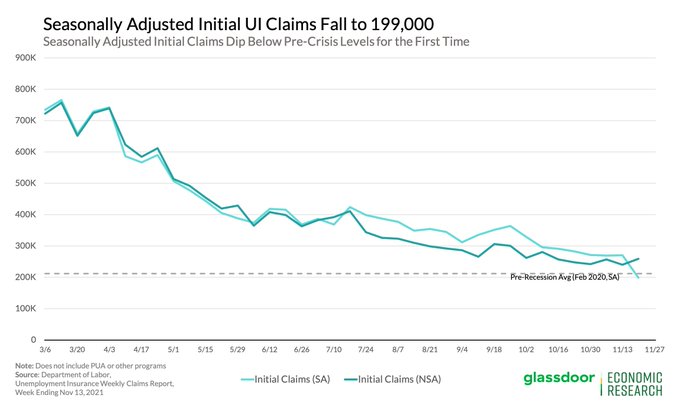
For the 1st time during the pandemic, initial UI claims have dipped below pre-crisis levels, falling to 199,000 (vs the Feb 2020 avg: 211,700). Layoffs are hitting new lows amid ongoing labor shortages as employers look to hold onto hard-to-find workers.

New weekly claims for jobless aid plunged to the lowest level in more than 50 years last week, according to data released Wednesday by the Labor Department.

In the week ending Nov. 20, there were 199,000 initial applications for unemployment insurance, according to the seasonally adjusted figures, a decline of 71,000 from the previous week. Claims fell to the lowest level since November 1969 and are now well below the pre-pandemic trough of 225,000 applications received the week of March 14, 2020.

The steep drop in unemployment applications comes after several strong months of job growth and rising consumer spending heading into the holiday shopping season. While high inflation has stressed many household budgets, U.S. job growth, economic production, stock values and corporate profits have all steamed ahead.

“Getting new claims below the 200,000 level for the first time since the pandemic began is truly significant, portraying further improvement,” said Mark Hamrick, chief economic analyst at Bankrate.com.

“The strains associated with higher prices, shortages of supplies and available job candidates are weighed against low levels of layoffs, wage gains and a falling unemployment rate,” he continued. “Growth will likely be above par for the foreseeable future, but within the context of historically high inflation which should relax its grip on the economy to some degree in the year ahead.”

The U.S. added 531,000 jobs in October and job growth in the previous months was revised substantially higher after a string of what first appeared to be meager gains. While businesses have struggled to hire enough workers to meet surging consumer demand, the decline in jobless claims appears to be a sign of an improving labor market.

“Layoffs are hitting new lows amid ongoing labor shortages as employers look to hold onto hard-to-find workers,” said Daniel Zhao, senior economist at Glassdoor, in a Wednesday thread on Twitter.

Even so, Zhao said the sharp decline below pre-pandemic levels may have been due to a lower than expected seasonal impact on hiring.

“As you can see from the above chart, this is in part due to the seasonal adjustment expecting a much larger jump in non-seasonally adjusted claims, so this dip below pre-crisis levels may be short-lived,” he explained.

Trading high deductibles for narrow networks

https://mailchi.mp/f3434dd2ba5d/the-weekly-gist-december-20-2019?e=d1e747d2d8

Related image

For many employers, narrowing provider networks has been a bridge too far, despite unrelenting healthcare cost growth.

A recent Los Angeles Times profile of a Boston union that was able not only to lower costs but also nearly eliminate employee cost-sharing may make doubters reconsider. Unite Here Local 26, which represents 9,000 hotel workers and their families, implemented a narrow network health plan in 2013, when two-thirds of its members agreed to forego care at certain marquee academic hospitals, which charged two to three times more than others in the Boston area.

Today the union actually pays less in medical costs per member than it did six years ago, and premiums are ten percent lower than the national average, despite Boston being one of the highest-cost healthcare markets in the country. Employees pay no deductibles, and generic medications cost them only $1. Savings have translated into raises for many employees, with some low-income workers seeing a pay jump of up to 39 percent across six years.

As we’ve discussed in the past, employers are reaching a limit on how high they can push deductibles, especially in a tight labor market. Some are beginning to experiment with various network options that lower health care costs—but many have been reticent to change benefit design in any way that could be perceived as narrowing choice.

Local 26’s experience shows that well-designed narrow networks, implemented with employee education and buy-in, can provide cost relief for both businesses and individuals that can be sustained over time.


Denver Provider Market at ‘Tipping Point,’ Study Finds

https://www.healthleadersmedia.com/finance/denver-provider-market-tipping-point-study-finds?spMailingID=16259324&spUserID=MTg2ODM1MDE3NTU1S0&spJobID=1720747610&spReportId=MTcyMDc0NzYxMAS2

The report expects employers and health plans to exert more influence in demanding market power going forward.

Health systems and physician groups have dominated the Denver healthcare market in recent years, but a new study indicates that employer-purchasers and health plans are poised to disrupt that dynamic. 

Supported by existing legislation, activism from local businesses, and the efforts of Gov. Jared Polis, the Denver market is at a ‘tipping point,’ according to a Catalyst for Payment Reform (CPR) and the Colorado Business Group on Health (CBGH) report released Thursday morning.

The study specifically referenced the RAND report from May which found that payers were paying rates to providers well above Medicare levels, noting that employers have an opportunity to pressure insurers to engage providers in contract arrangements that better align with care rendered.

Researchers believe that payment reform is achievable in Denver, suggesting six policy recommendations to business groups, lawmakers, and insurers, including the expansion of price transparency measures and promotion of benchmarking prices relative to Medicare.

Corralling healthcare prices has been a primary issue in Colorado this year, with the state most recently pursuing a reinsurance program that Polis expects to lower premiums by 18%.

The study found that four major health systems, HCA Holdings, Centura Health, UC Health, and SCL Health, accounted for 85% of patient admissions in 2017. On the Herfindahl-Hirschman Index, this level is considered “moderately concentrated” but the report highlights that it also means the market is “concentrated enough to stifle price competition.”

While providers have concentrated in the market through continuous merger activity, the study found that insurers are governed by strict regulations. The result has been Coloradans facing 13% higher prices compared to the national average and 5% high utilization rates.

Two of the recommendations offered by the study were to align two-sided risk arrangements with Medicaid and the Polis-Primavera “Roadmap to Affordability,” the governor’s strategic initiative to make care more affordable, as well as to implement benefit designs to “encourage consumers seek higher value care.” The study also urges that employer-purchases to pursue value-oriented programs that hold providers accountable to the listed targets.

However, in an interview with HealthLeaders earlier this year, Centura Health CEO Peter Banko said the system was going to “pause on the mad rush” to value-based care models, citing the direction the market was taking on the issue.

As highlighted in the RAND report, CPR and CBGH believe that building on purchaser momentum through a statewide purchase cooperative can be an effective method at changing the market dynamics in Denver.

Similar to the Employers’ Forum of Indiana, an employer-led healthcare coalition which collaborated on the RAND report, the Peak Health Alliance, a Summit County-based purchaser cooperative, has sought to combat rising healthcare prices in the Denver area. The report states that Peak Health, which represents 6,000 covered lives, has already negotiated a “very aggressive” reduction in rates with Centura.

Bob Smith, MBA, executive director of CBGH, said that the report gives employer-purchasers “the tools to make changes” to the Denver healthcare market and stem the tide of rising prices.

“Healthcare costs, primarily driven by high prices and seemingly unwarranted increases, are edging out salary growth and economic development,” Smith said in a statement. “These trends are taking a toll on every employer from school districts to manufacturers and are simply not sustainable.”

Smith urged lawmakers to act on the report’s suggested reforms but also said that employers now have “the responsibility to act.”