The White House said it was following health experts’ advice. Then we learned it isn’t approving a key CDC document.

https://www.washingtonpost.com/politics/2020/05/07/white-house-said-it-was-following-health-experts-advice-then-we-learned-it-isnt-approving-key-cdc-document/?fbclid=IwAR1TRmiDX4IF5WgkAEVT0BeV0qnYxHCZhF1YwfWrmM79FmS6UOivaFbNBA4&utm_campaign=wp_main&utm_medium=social&utm_source=facebook

Diseases & Conditions | CDC

White House press secretary Kayleigh McEnany made a point at the start of Wednesday’s news briefing to emphasize that President Trump is following health experts’ advice as we enter what Trump has labeled the “next stage” of the coronavirus response — reopening the economy.

“As you are well aware, President Trump has consistently sided with the experts and always prioritized the health and safety of the American people,” McEnany said.

Several hours later, we got another example of the White House resisting what those health experts are advising.

The Associated Press reported around midnight that the White House had shelved planned guidelines from the Centers for Disease Control and Prevention. The document, which was due nearly a week ago, was aimed at providing local authorities with step-by-step guidance on how to reopen:

The 17-page report by a Centers for Disease Control and Prevention team, titled “Guidance for Implementing the Opening Up America Again Framework,” was researched and written to help faith leaders, business owners, educators and state and local officials as they begin to reopen.
It was supposed to be published last Friday, but agency scientists were told the guidance “would never see the light of day,” according to a CDC official. The official was not authorized to talk to reporters and spoke to The Associated Press on the condition of anonymity.

A coronavirus task force official told The Washington Post that the document has not been completely shelved but was in the process of being revised because it was “overly specific.” The official also indicated that it was felt the document was too broad, as “guidance in rural Tennessee shouldn’t be the same guidance for urban New York City.”

The denial, though, reinforces that the White House is reluctant to submit to the CDC’s more detailed prescriptions for reopening the economy. And it’s difficult to divorce the delay in this document’s publication from Trump’s anxiety to reopen the economy — and the tension that has created with past guidelines.

The administration in mid-April issued phased advice on when areas should start to reopen places such as restaurants and other nonessential businesses. But many states have moved forward with certain elements of reopening without actually satisfying those guidelines. Most notably, they have begun to reopen without meeting the Phase One guideline that they should see a decrease in confirmed coronavirus cases over a 14-day period.

As The Post’s Philip Bump reported, some states that have pushed forward with reopening have also seen an increase in cases — which would prevent them from satisfying the requirement for moving into Phase Two. That requirement is that the decline should continue for another 14 days after Phase One begins.

Issuing a detailed document would seemingly complicate further reopenings, because it would again restrict what states and local authorities are supposed to do.

The Washington Post’s Lena H. Sun and Josh Dawsey previewed what the document was set to look like last week. And they also obtained a draft of the document. The new guidelines were to go beyond the initial ones in prescribing specific actions that could be taken in each phase of the reopening. Advocates for reopening have worried that strict guidance could make it difficult for businesses, churches, child-care centers and other facilities to actually function.

Trump, who has long signaled a desire to begin reopening that economy sooner rather than later, has doubled down on that rhetoric in recent days. Despite a steady national death rate that approached previous highs on Tuesday and Wednesday, and even though cases continue to increase outside the major U.S. hotbed of New York City, Trump on Tuesday signaled that we are entering the “next stage” of reopening the economy.

“Thanks to the profound commitment of our citizens, we’ve flattened the curve, and countless American lives have been saved,” Trump said. “Our country is now in the next stage of the battle: a very safe phased and gradual reopening. So, reopening of our country — who would have ever thought we were going to be saying that? A reopening. Reopening.”

Trump has been resistant to the advice of the health officials around him, from the early days of the outbreak when he continuously downplayed the severity of the situation. On several occasions, this tension has boiled over.

We’re also hearing from those officials less and less. The CDC long ago ceased holding briefings on the coronavirus outbreak, and the White House coronavirus task force briefings, which often featured health experts Anthony S. Fauci and Deborah Birx, have now been halted in favor of less-frequent and less-coronavirus-focused briefings from McEnany. Fauci has also been prevented from testifying to the Democratic-controlled House, although he is still slated to testify in the GOP-controlled Senate and has continued doing some interviews. The cumulative effect is that these health experts aren’t on the record as much as the effort to reopen the economy begins in earnest.

In the place of those public comments, the CDC guidelines were to provide firm and detailed advice from those officials for the new stage. But for reasons that seem pretty conspicuous, we still don’t have them.


COVID-19 and the End of Individualism

https://www.project-syndicate.org/commentary/covid19-economic-interdependence-waning-individualism-by-diane-coyle-2020-05?utm_source=Project+Syndicate+Newsletter&utm_campaign=1cfd702284-covid_newsletter_07_05_2020&utm_medium=email&utm_term=0_73bad5b7d8-1cfd702284-105592221&mc_cid=1cfd702284&mc_eid=5f214075f8

Daniel Innerarity - Project Syndicate

The pandemic has shown that it is not existential dangers, but rather everyday economic activities, that reveal the collective, connected character of modern life. Just as a spider’s web crumples when a few strands are broken, so the coronavirus has highlighted the risks arising from our economic interdependence.

CAMBRIDGE – Aristotle was right. Humans have never been atomized individuals, but rather social beings whose every decision affects other people. And now the COVID-19 pandemic is driving home this fundamental point: each of us is morally responsible for the infection risks we pose to others through our own behavior.

In fact, this pandemic is just one of many collective-action problems facing humankind, including climate change, catastrophic biodiversity loss, antimicrobial resistance, nuclear tensions fueled by escalating geopolitical uncertainty, and even potential threats such as a collision with an asteroid.

As the pandemic has demonstrated, however, it is not these existential dangers, but rather everyday economic activities, that reveal the collective, connected character of modern life beneath the individualist façade of rights and contracts.

Those of us in white-collar jobs who are able to work from home and swap sourdough tips are more dependent than we perhaps realized on previously invisible essential workers, such as hospital cleaners and medics, supermarket staff, parcel couriers, and telecoms technicians who maintain our connectivity.

Similarly, manufacturers of new essentials such as face masks and chemical reagents depend on imports from the other side of the world. And many people who are ill, self-isolating, or suddenly unemployed depend on the kindness of neighbors, friends, and strangers to get by.

The sudden stop to economic activity underscores a truth about the modern, interconnected economy: what affects some parts substantially affects the whole. This web of linkages is therefore a vulnerability when disrupted. But it is also a strength, because it shows once again how the division of labor makes everyone better off, exactly as Adam Smith pointed out over two centuries ago.

Today’s transformative digital technologies are dramatically increasing such social spillovers, and not only because they underpin sophisticated logistics networks and just-in-time supply chains. The very nature of the digital economy means that each of our individual choices will affect many other people.

Consider the question of data, which has become even more salient today because of the policy debate about whether digital contact-tracing apps can help the economy to emerge from lockdown faster.

This approach will be effective only if a high enough proportion of the population uses the same app and shares the data it gathers. And, as the Ada Lovelace Institute points out in a thoughtful report, that will depend on whether people regard the app as trustworthy and are sure that using it will help them. No app will be effective if people are unwilling to provide “their” data to governments rolling out the system. If I decide to withhold information about my movements and contacts, this would adversely affect everyone.

Yet, while much information certainly should remain private, data about individuals is only rarely “personal,” in the sense that it is only about them. Indeed, very little data with useful information content concerns a single individual; it is the context – whether population data, location, or the activities of others – that gives it value.

Most commentators recognize that privacy and trust must be balanced with the need to fill the huge gaps in our knowledge about COVID-19. But the balance is tipping toward the latter. In the current circumstances, the collective goal outweighs individual preferences.

But the current emergency is only an acute symptom of increasing interdependence. Underlying it is the steady shift from an economy in which the classical assumptions of diminishing or constant returns to scale hold true to one in which there are increasing returns to scale almost everywhere.

In the conventional framework, adding a unit of input (capital and labor) produces a smaller or (at best) the same increment to output. For an economy based on agriculture and manufacturing, this was a reasonable assumption.

But much of today’s economy is characterized by increasing returns, with bigger firms doing ever better. The network effects that drive the growth of digital platforms are one example of this. And because most sectors of the economy have high upfront costs, bigger producers face lower unit costs.

One important source of increasing returns is the extensive experience-based know-how needed in high-value activities such as software design, architecture, and advanced manufacturing. Such returns not only favor incumbents, but also mean that choices by individual producers and consumers have spillover effects on others.

The pervasiveness of increasing returns to scale, and spillovers more generally, has been surprisingly slow to influence policy choices, even though economists have been focusing on the phenomenon for many years now. The COVID-19 pandemic may make it harder to ignore.

Just as a spider’s web crumples when a few strands are broken, so the pandemic has highlighted the risks arising from our economic interdependence. And now California and Georgia, Germany and Italy, and China and the United States need each other to recover and rebuild. No one should waste time yearning for an unsustainable fantasy.


Home of the Brave

Image may contain: 8 peopleImage may contain: 8 people

Cartoon – The Wisdom of Pandemic Protests

Kevin it's Necessary everyone stay home on Twitter: "Looks like ...

Healthcare Front Line Workers Counter-protest in Denver

https://www.trendsmap.com/twitter/tweet/1251984156998975492

Image may contain: 1 person, outdoor

🇯🇲Black🇭🇹Aziz🇳🇬aNANsi🇹🇹's tweet - "Health care workers ...

Scott Loy on Twitter: "Nurses blocking cars in Downtown Denver to ...

keyvan (کیوان) 🌹's tweet - "More below. Photos by Alyson McClaran ...


This says it all from a Nurse in Michigan

Image may contain: 1 person

“I am posting, for once, about something other than my dog.

I have seen 4 patients die, 5 get intubated, 2 re-intubated, witnessed family consent to make 2 more patients DNRs, sweat my butt off during CPR, titrated so many drips to no avail, watched vent settings increase to no avail. We are exhausted and at a total loss.

All of this in two shifts in a row.

Some of you people have never done EVERYTHING you could to save someone, and watched them die anyway, and it shows.

I would have no problem if you fools worried about your “freedom” all went out and got COVID. If only you could sign a form stating that you revoke your right to have medical treatment based on your cavalier antics and refusal to abide by CDC and medical professionals’ advice. If you were the only people who got infected during your escapades to protest tyranny, great. But that’s sadly not how this works.

You wanna complain because the garden aisle is closed? If you knew a thing about gardening, you’d know it’s too early to plant in Michigan. Your garden doesn’t matter. If killing your plants would bring back my patients, I would pillage the shit out of your “essential” garden beds.

Upset because you can’t go boating…in Michigan…in April…in the cold-ass water? You wanna tell my patient’s daughter (who was sobbing as she said goodbye to her father over the phone) about your first-world problems?

Upset because you can’t go to your cottage up north? Your cottage…your second property…used for leisure. My coworkers can’t even stay in their regular homes. Most have been staying in hotels and dorms, not able to see their spouses or babies.

All of these posts, petitions online to evade “tyranny”, it’s all such bullshit. I’m sorry you’re bored and have nothing to do but bitch and moan. You wanna pick up a couple hours for me? Yeah, didn’t think so. I wouldn’t trust most of you with patient care, anyway. Not just because of the selfish lack of humanity your posts exude, but because most of those posts and petitions are so riddled with misspellings and grammatical errors, that it makes me question your cognitive capacity.

Shoutout to my coworkers, the real MVPs.”


The Grim Truth About the “Swedish Model”

https://www.project-syndicate.org/commentary/swedish-coronavirus-no-lockdown-model-proves-lethal-by-hans-bergstrom-2020-04?utm_source=Project+Syndicate+Newsletter&utm_campaign=5b31132e51-sunday_newsletter_19_04_2020&utm_medium=email&utm_term=0_73bad5b7d8-5b31132e51-105592221&mc_cid=5b31132e51&mc_eid=5f214075f8

QOSHE - The Grim Truth About the “Swedish Model” - Hans Bergstrom

As the coronavirus pandemic has swept the planet, Sweden has stood out among Western democracies by pursuing a “low-scale” lockdown. Whether this approach speaks to a unique strength of Swedish society, as opposed to bad judgment, can be determined by comparing Sweden’s COVID-19 rate with its neighbors’.

STOCKHOLM – Does Sweden’s decision to spurn a national lockdown offer a distinct way to fight COVID-19 while maintaining an open society? The country’s unorthodox response to the coronavirus is popular at home and has won praise in some quarters abroad. But it also has contributed to one of the world’s highest COVID-19 death rates, exceeding that of the United States.

In Stockholm, bars and restaurants are filled with people enjoying the spring sun after a long, dark winter. Schools and gyms are open. Swedish officials have offered public-health advice but have imposed few sanctions. No official guidelines recommend that people wear masks.

During the pandemic’s early stages, the government and most commentators proudly embraced this “Swedish model,” claiming that it was built on Swedes’ uniquely high levels of “trust” in institutions and in one another. Prime Minister Stefan Löfven made a point of appealing to Swedes’ self-discipline, expecting them to act responsibly without requiring orders from authorities.

According to the World Values Survey, Swedes do tend to display a unique combination of trust in public institutions and extreme individualism. As sociologist Lars Trägårdh has put it, every Swede carries his own policeman on his shoulder.

But let’s not turn causality on its head. The government did not consciously design a Swedish model for confronting the pandemic based on trust in the population’s ingrained sense of civic responsibility. Rather, actions were shaped by bureaucrats and then defended after the fact as a testament to Swedish virtue.

In practice, the core task of managing the outbreak fell to a single man: state epidemiologist Anders Tegnell at the National Institute of Public Health. Tegnell approached the crisis with his own set of strong convictions about the virus, believing that it would not spread from China, and later, that it would be enough to trace individual cases coming from abroad. Hence, the thousands of Swedish families returning from late-February skiing in the Italian Alps were strongly advised to return to work and school if not visibly sick, even if family members were infected. Tegnell argued that there were no signs of community transmission in Sweden, and therefore no need for more general mitigation measures. Despite Italy’s experience, Swedish ski resorts remained open for vacationing and partying Stockholmers.

Between the lines, Tegnell indicated that eschewing draconian policies to stop the spread of the virus would enable Sweden gradually to achieve herd immunity. This strategy, he stressed, would be more sustainable for society.

Through it all, Sweden’s government remained passive. That partly reflects a unique feature of the country’s political system: a strong separation of powers between central government ministries and independent agencies. And, in “the fog of war,” it was also convenient for Löfven to let Tegnell’s agency take charge. Its seeming confidence in what it was doing enabled the government to offload responsibility during weeks of uncertainty. Moreover, Löfven likely wanted to demonstrate his trust in “science and facts,” by not – like US President Donald Trump – challenging his experts.

It should be noted, though, that the state epidemiologist’s policy choice has been strongly criticized by independent experts in Sweden. Some 22 of the country’s most prominent professors in infectious diseases and epidemiology published a commentary in Dagens Nyheter calling on Tegnell to resign and appealing to the government to take a different course of action.

By mid-March, and with wide community spread, Löfven was forced to take a more active role. Since then, the government has been playing catch-up. From March 29, it prohibited public gatherings of more than 50 people, down from 500, and added sanctions for noncompliance. Then, from April 1, it barred visits to nursing homes, after it had become clear that the virus had hit around half of Stockholm’s facilities for the elderly.

Sweden’s approach turned out to be misguided for at least three reasons. However virtuous Swedes may be, there will always be free riders in any society, and when it comes to a highly contagious disease, it doesn’t take many to cause major harm. Moreover, Swedish authorities only gradually became aware of the possibility of asymptomatic transmission, and that infected individuals are most contagious before they start showing symptoms. And, third, the composition of the Swedish population has changed.

After years of extremely high immigration from Africa and the Middle East, 25% of Sweden’s population – 2.6 million of a total population of 10.2 million – is of recent non-Swedish descent. The share is even higher in the Stockholm region. Immigrants from Somalia, Iraq, Syria, and Afghanistan are highly overrepresented among COVID-19 deaths. This has been attributed partly to a lack of information in immigrants’ languages. But a more important factor seems to be the housing density in some immigrant-heavy suburbs, enhanced by closer physical proximity between generations.

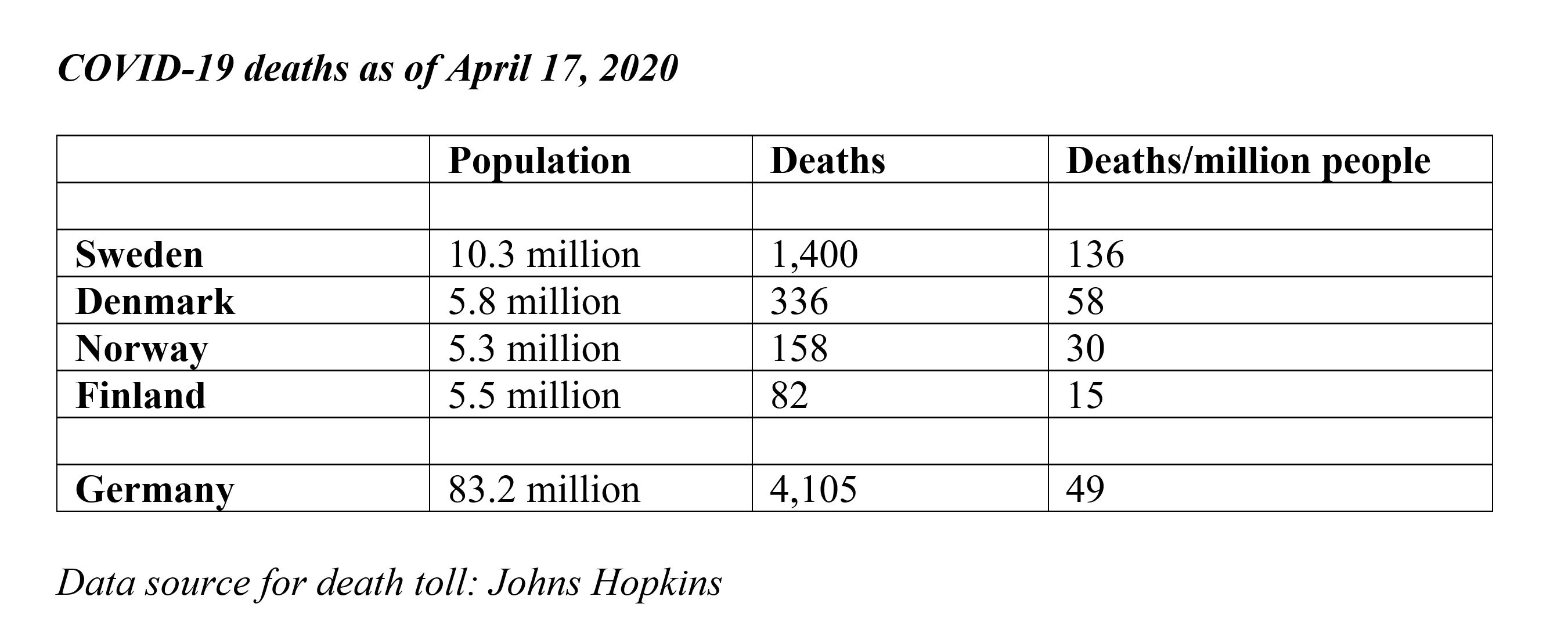
It is too soon for a full reckoning of the effects of the “Swedish model.” The COVID-19 death rate is nine times higher than in Finland, nearly five times higher than in Norway, and more than twice as high as in Denmark. To some degree, the numbers might reflect Sweden’s much larger immigrant population, but the stark disparities with its Nordic neighbors are nonetheless striking. Denmark, Norway, and Finland all imposed rigid lockdown policies early on, with strong, active political leadership.

Now that COVID-19 is running rampant through nursing homes and other communities, the Swedish government has had to backpedal. Others who may be tempted by the “Swedish model” should understand that a defining feature of it is a higher death toll.


Scattered protests push back on U.S. coronavirus stay-at-home orders

https://www.reuters.com/article/us-health-coronavirus-usa-protests/scattered-protests-push-back-on-us-coronavirus-stay-at-home-orders-idUSKBN21Y34A

Scattered protests push back on U.S. coronavirus stay-at-home ...

As sweeping stay-at-home orders in 42 U.S. states to combat the new coronavirus have shuttered businesses, disrupted lives and decimated the economy, some protesters have begun taking to the streets to urge governors to rethink the restrictions.

A few dozen protesters, many with young children, gathered in Virginia’s state capital of Richmond on Thursday in defiance of Democratic Governor Ralph Northam’s mandate, the latest in a series of demonstrations this week around the country.

The protests have taken on a partisan tone, often featuring supporters of President Donald Trump, and critiquing governors whose shelter-at-home directives are intended to slow the spread of a pandemic that has killed more than 31,000 across the United States.

On Wednesday, thousands of Michigan residents blocked traffic in Lansing, the state capital, while protesters in Kentucky disrupted Democratic Governor Andy Beshear’s afternoon news briefing on the pandemic, chanting “We want to work!”

States including Utah, North Carolina and Ohio also saw demonstrations this week, and more are planned for the coming days, including in Oregon, Idaho and Texas.

The United States has seen the highest death toll of any country in the pandemic, and public health officials have warned that a premature easing of social distancing orders could exacerbate it.

Trump has repeatedly said he wants to “reopen” the economy as soon as possible and has clashed with governors over whether he can overrule their stay-at-home orders.

In Michigan, where Democratic Governor Gretchen Whitmer has imposed some of the country’s toughest limits on travel and business, some protesters at “Operation Gridlock” wore campaign hats and waved signs supporting Trump.

Whitmer is considered a top contender to be the running mate of Democratic presidential nominee Joe Biden when he takes on Trump in November’s general election.

One of the organizers of the demonstration in Lansing, Meshawn Maddock, said she was frustrated that much of the media focused on a handful of protesters who gathered on the steps of the capitol, including militia group members and a man holding a Confederate flag who she said were not part of the rally.

She faulted Whitmer for dismissing the event as a partisan rally instead of engaging with the thousands of residents who Maddock said have legitimate questions about the governor’s stay-at-home order.

“When I’m fighting to (help) a guy who cleans pools or mows lawns, or a women who wants to sell her onion sets or geraniums, I don’t care whether they vote Republican, Democrat, or never vote at all,” Maddock said.

Maddock, 52, is among seven board members of the Republican-aligned Michigan Conservative Coalition who organized the protest. She is also a board member of the pro-Trump political action committee Women for Trump, but said the Trump campaign had no involvement in organizing the protest.

“The Trump campaign has given me no messaging,” she said. “All I know is that I care about Michigan. I’ve lived here my whole life and I want to help workers get back to work.”

She said she had received calls from people in Wisconsin, Pennsylvania, Virginia and other states asking for advice on planning similar protests.

The political wrangling over the COVID-19 crisis has begun to take on familiar partisan battle lines. Democratic strongholds in dense urban centers such as Seattle and Detroit have been hard hit by the virus, while more Republican-leaning rural communities are struggling with the shuttered economy but have seen fewer cases.

Kenny Clevenger, 30, a realtor in western Michigan’s Allegan County, where only 25 coronavirus cases have been identified, said the shutdown had put him out of business.

“Yes, this needs to be taken seriously, but it’s being taken advantage of,” Clevenger said. “People believe Democrats are attempting to use this to undermine the economy, once again just attacking the president.”

Increasingly, Republican state lawmakers, including some in Texas, Oklahoma and Wisconsin, have begun putting pressure on governors to reopen businesses. Pennsylvania’s Republican-led legislature passed a bill that would loosen restrictions, which Democratic Governor Tom Wolf was expected to veto.

Both Democratic and Republican governors have resisted calls to abandon distancing too quickly. On Thursday, five Democratic governors and two Republican governors in the Midwest, including Whitmer in Michigan, said they would coordinate efforts.

Stephen LaSpina, one of the organizers of a “Stand Up to End the Shutdown” protest set for April 20 at Pennsylvania’s capitol in Harrisburg said that its sole goal was to get the economy running again by May 1.

“We are really welcoming groups of all different backgrounds and demographics,” said LaSpina, who lives near Scranton, and like many others who work in retail, said he had personally been affected by the shutdown. “Anyone who has been impacted by this shutdown in a negative way is welcome and we want them to be heard regardless of their party affiliation.”


Social distancing won’t just save lives. It might be better for the economy in the long run.

https://www.vox.com/future-perfect/2020/3/31/21199874/coronavirus-spanish-flu-social-distancing

Spanish flu: How social distancing helped the economy in 1918 - Vox

A study of the 1918 Spanish flu pandemic finds that cities with stricter social distancing reaped economic benefits.

For much of the past month, some commentators have defended the effort to promote social distancing, including the near-shutdown of huge swaths of America’s economy, as the lesser of two evils: Yes, asking or forcing people to remain in their homes for as much of the day as possible will slow economic activity, the argument goes. But it’s worth it for the public health benefits of slowing the coronavirus’s spread.

This argument has, naturally, led to a backlash, explained here by my colleague Ezra Klein. Critics — including the president — have argued that the cure is worse than the disease, and mass death from coronavirus is a price we need to be willing to pay to keep the American economy from cratering.

Both these viewpoints obscure an important possibility: The social distancing regime may well be optimal not just from a public health point of view, but from an economic perspective as well.

Economists Sergio Correia, Stephan Luck, and Emil Verner released a working paper (not yet peer-reviewed) last week that makes this argument extremely persuasively. The three analyzed the 1918-1919 flu pandemic in the United States, as the closest (though still not identical) analogue to the current crisis. They compare cities in 1918-’19 that adopted quarantining and social isolation policies earlier to ones that adopted them later.

Their conclusion? “We find that cities that intervened earlier and more aggressively do not perform worse and, if anything, grow faster after the pandemic is over.”

The researchers refer to such social distancing policies as NPIs, or “non-pharmaceutical interventions,” essentially public health interventions not achieved through medication, like quarantines and school and business closures. The key to the paper is their observation that, in theory, NPIs can both decrease economic activity directly, by keeping people in certain jobs from going to work, and increase it indirectly, because it prevents large-scale deaths that would also have a negative impact on the economy.

“While NPIs lower economic activity, they can solve coordination problems associated with fighting disease transmission and mitigate the pandemic-related economic disruption,” they write. In other words, social distancing measures that save lives can also, in the end, soften the economic disruption of a pandemic.

The data here comes from a 2007 paper in the Journal of the American Medical Association, where a group of researchers chronicled what specific policies were put in place between September 8, 1918, and February 22, 1919, by 43 different cities. The most common NPI the JAMA researchers identified was a combination of school closures and bans on public gatherings; 34 of the 43 cities adopted this rule, for an average of four weeks.

Other cities eschewed these policies in favor of mandatory isolation and quarantine procedures: “Typically, individuals diagnosed with influenza were isolated in hospitals or makeshift facilities, while those suspected to have contact with an ill person (but who were not yet ill themselves) were quarantined in their homes with an official placard declaring that location to be under quarantine,” the JAMA authors write, detailing New York City’s approach.

Another 15 cities did both isolation/quarantines and school closures/public gathering bans.

The 2007 paper found a strong association between the number and duration of NPIs and pandemic deaths, with more and longer-lasting NPIs associated with a smaller death toll. Correia, Luck, and Verner, in their new paper, replicate this finding.

But they take it a step further. They study the impact of changes in mortality due to the 1918 pandemic on economic outcomes.

“The increase in mortality from the 1918 pandemic relative to 1917 mortality levels (416 per 100,000) implies a 23 percent fall in manufacturing employment, 1.5 percentage point reduction in manufacturing employment to population, and an 18 percent fall in output,” they conclude. In other words, a big outbreak spelled economic disaster for affected cities.

Then they combined this analysis with an analysis of the effects of NPI policies. They find that the introduction of social distancing policies is associated with more positive outcomes in terms of manufacturing employment and output. Cities with faster introductions of these policies (one standard deviation faster, to be technical) had 4 percent higher employment after the pandemic had passed; ones with longer durations had 6 percent higher employment after the disaster.

The takeaway is clear: These policies not only led to better health outcomes, they in turn led to better economic outcomes. Pandemics are very bad for the economy, and stopping them is good for the economy.

A few notes of caution

It’s important to always approach this kind of study with a degree of skepticism. The 1918 pandemic was not a planned experiment, so researchers’ ability to determine the degree to which the pandemic, or the policies adopted in response to it, affected economic outcomes is always going to be somewhat limited.

The researchers acknowledge that their biggest limitation is the non-randomness of policy adoption by cities. Presumably cities with strict responses to the pandemic were different from cities with laxer responses in ways that went beyond this one incident. Maybe the stricter cities had better public health infrastructure to begin with, for instance, which could exaggerate the estimated effect of social distancing interventions.

The authors argue that because the second and most fatal wave of the 1918 pandemic spread mostly from east to west, geographically, these kinds of dynamics weren’t at play. “Given the timing of the influenza wave, cities that were affected later appeared to have implemented NPIs sooner as they were able to learn from cities that were affected in the early stages of the pandemic,” they note.

The best explanation of differences in policies, then, is how far a city is from the East Coast of the US. They control for a big factor that might affect Western states more (the boom and bust of the agricultural industry as World War I drew to a close) and find few other observable differences between Western cities with strong policies and Eastern policies with weak ones. But the notion that these cities are comparable is a key part of the paper’s research design, and one worth digging into as the paper goes through peer review and revisions.

The economy isn’t everything

The message that there isn’t a trade-off between saving lives and saving the economy is reassuring. If there were such a trade-off, the debate over coronavirus response would be in the realm of pure values: How much money should we be willing to forsake to save a human life? That’s a thorny choice, and finding that we don’t actually have to make it — as this paper suggests — is comforting.

It’s worth emphasizing, though, that if we did have to make that choice, it would still be an easy decision. The lives saved would be worth more.

In another recent white paper, UChicago’s Michael Greenstone and Vishan Nigam estimate the social value of social distancing policies, relative to a baseline where we endure an untrammeled pandemic. To simulate the two scenarios, they rely on the influential Imperial College London model of the coronavirus pandemic — a paper that found that an uncontrolled spread of coronavirus would kill 2.2 million Americans.

Then they throw in an oft-used tool of cost-benefit economic analysis: the value of a statistical life (VSL). Popularized by Vanderbilt economist Kip Viscusi, VSL involves putting a dollar value on a human life by estimating the implicit value that people in a given society place on continuing to live based on their willingness to pay for services that reduce their risk of dying.

Usually, this involves a “revealed preferences” approach. A 2018 paper by Viscusi, for example, used, among other data sources, Bureau of Labor Statistics Census of Fatal Occupational Injuries to measure how much more, in practice, US workers demand to be paid to take jobs that carry a higher risk of death.

Greenstone and Nigam allow VSL to vary with age — understandably, older people are less willing to pay to reduce their odds of death than younger people — but set the average VSL for an American age 18 and over to $11.5 million.

Based on the Imperial College projection that social distancing would save about 1.76 million lives over the next six months, Greenstone and Nigam estimate that the economic value of the policy is $7.9 trillion, larger than the entire US federal budget and greater than a third of GDP. The value is about $60,000 per US household. Even if the Imperial College model is off by 60 percent and the no-social-distancing scenario is less deadly than anticipated, the aggregate benefits are still $3.6 trillion. And this is likely an underestimate that ignores other costs of a large-scale outbreak to society; it focuses solely on mortality benefits.

VSL is sometimes attacked from the left as craven, a reductio ad absurdum of economistic reasoning trampling over everything, including the value of human life itself. But coronavirus helps illustrate how VSL can work in the opposite direction. Human life is so valuable in these terms that social distancing would have to force a 33 percent drop in US GDP before you could start to plausibly argue that the cure is worse than the disease.

That social distancing likely won’t cause a reduction in GDP relative to a scenario where there’s a multimillion-person death toll, as indicated by the 1918 flu paper, makes the case for distancing policies that much stronger.


TED Danielle Allen: Here’s how we might save both lives and the economy

Harvard professors take a lively look at love and politics ...

As the coronavirus pandemic sweeps the globe, it’s hard to know where to turn or what to think. TED Connects is a free, live, daily conversation series featuring experts whose ideas can help us reflect and work through this uncertain time with a sense of responsibility, compassion and wisdom.

Danielle Allen serves as Director of the Edmond J. Safra Center for Ethics at Harvard University. The Center seeks to advance teaching and research on ethical issues in public life. Widespread ethical lapses of leaders in government, business, and other professions prompt demands for more and better moral education. More fundamentally, the increasing complexity of public life – the scale and range of problems and the variety of knowledge required to deal with them – make ethical issues more difficult, even for men and women of good moral character. Not only are the ethical issues we face more complex, but the people we face them with are more diverse, increasing the frequency and intensity of our ethical disagreements.

Given these changes in the United States and in societies around the globe, the Center seeks to help meet the growing need for teachers, scholars, and leaders who address questions of moral choice across many of the professions and in public life more generally, and promotes a perspective on ethics informed by both theory and practice. We explore the connection between the problems that professionals confront and the social and political structures in which they act. More generally, we address the ethical issues that all citizens face as they make the choices that profoundly affect the present and future of their societies in our increasingly interdependent world.

https://scholar.harvard.edu/danielleallen/edmond-j-safra-center-ethics