Coronavirus Dashboard

https://www.axios.com/coronavirus-latest-news-quick-highlights-57a186a3-7547-45bf-852a-83019849d8d5.html

Coronavirus dashboard: Catch up fast - Axios


  1. Global: Total confirmed cases as of 9 a.m. ET: 9,635,935 — Total deaths: 489,922 — Total recoveries — 4,861,715 — Map.
  2. U.S.: Total confirmed cases as of 9 a.m ET: 2,422,312 — Total deaths: 124,415 — Total recoveries: 663,562 — Total tested: 29,207,820 — Map.
  3. Public health: America’s workers still aren’t protected from the coronavirus — Gilead says coronavirus drug should likely cost no more than $2,800.
  4. White House: Trump administration asks Supreme Court to overturn ACA during pandemic.
  5. Sports: Universities cut sports teams, as they struggle with coronavirus fallout.


The U.S. divide on coronavirus masks

https://www.axios.com/political-divide-coronavirus-masks-1053d5bd-deb3-4cf4-9570-0ba492134f3e.html

Politics, not public health, drive Americans' attitudes toward ...

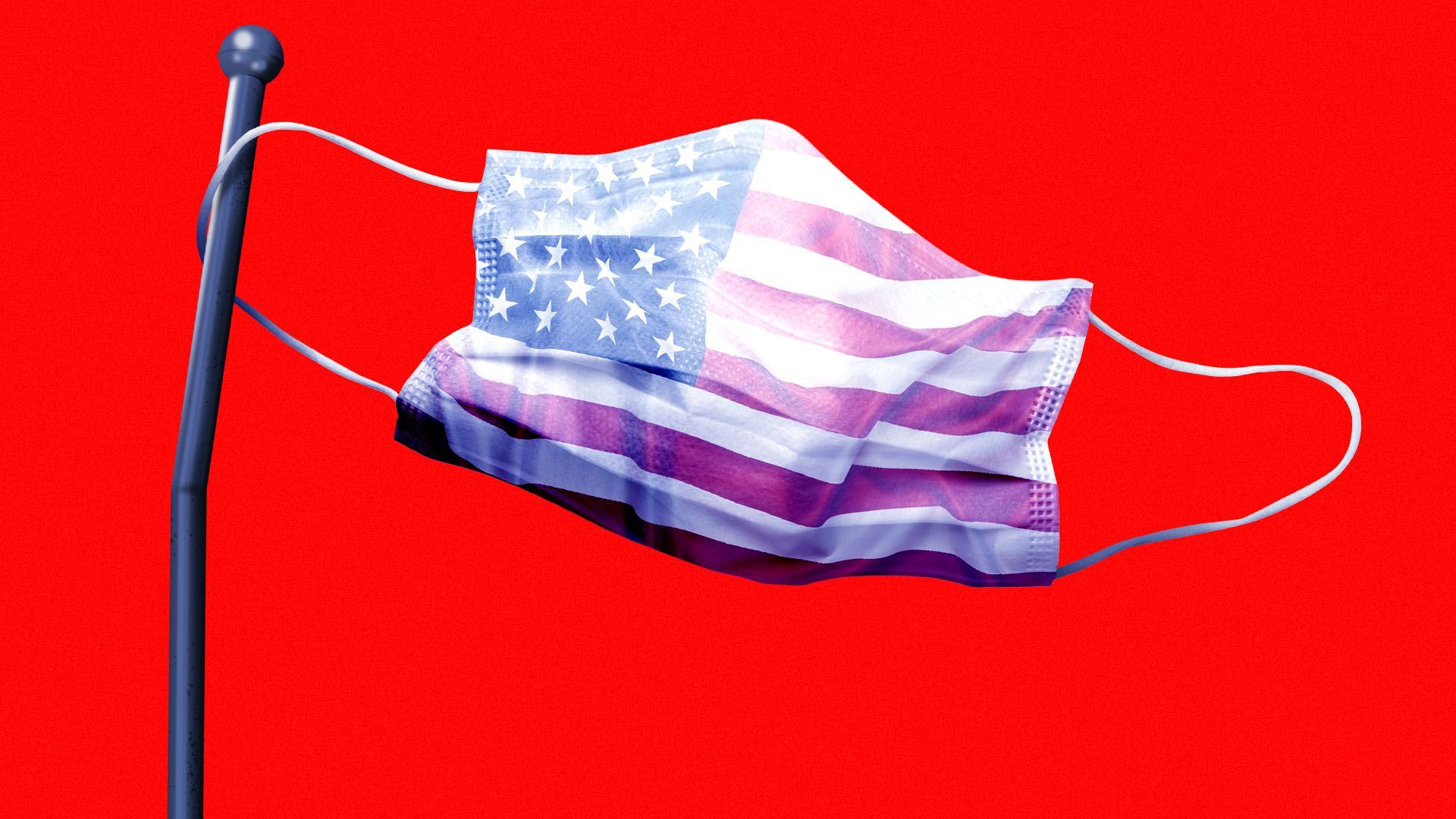
Mask-wearing has become the latest partisan division in an increasingly politically divided pandemic.

Why it matters: It’s becoming increasingly clear that wearing even a basic cloth mask is one of the most effective ways to prevent the spread of COVID-19. But whether or not people are willing to wear one has less to do with the risk of the pandemic than their political affiliation.

By the numbers: Results from months of the Axios-Ipsos coronavirus polls show a clear and growing political divide between Democrats and Republicans on mask-wearing habits.

  • Nationally, the percentage of Democrats who reported wearing a mask all the time when leaving home rose from 49% between April 10 and May 4 to 65% between May 8 and June 22.
  • During the same time period, the percentage of Republicans who reported constant mask-wearing rose from 29% to just 35%.

Context: The political divide Americans are reporting on mask use echoes one seen within nearly all levels of the government.

  • President Trump has not been seen to wear a mask, and he told Axios last week that attendees at his Tulsa campaign event on June 20 should “do what they want” on masks, which were not required at the rally.
  • Governors in many red states like Nebraska have refused to mandate facial masks in public, even as cases have begun to rise in recent weeks. At the same time, leaders in blue states — especially those that grappled with large outbreaks of COVID-19 — have urged residents to wear masks, with California Gov. Gavin Newsom mandating their use last week as cases in the state passed 4,000 a day.
  • The situation is even more divided at the local level, with leaders of red towns in blue states pushing back against mask mandates, and vice versa.

Flashback: Some of the blame for the divide can be traced back to muddled public health messaging on mask use in the early stages of the pandemic, when Americans were urged not to go out and buy masks in bulk because of concerns that there wasn’t enough personal protective equipment for front-line health care workers.

  • Those fears were real, as government virus expert Anthony Fauci pointed out in congressional testimony on Tuesday. And public health officials worried that pushing masks would inadvertently encourage Americans to continue going out in public at a moment when lockdowns demanded they stay inside.
  • Like the divide among experts on whether mass protests would increase coronavirus cases, just the perception that health advice might be based on politics rather than science gives cover to those who would forego masks, especially since the outbreak itself initially seemed like a blue state problem.

Health experts now know that cloth masks are most effective not so much at protecting individuals from infection as protecting the community from infected individuals. But that makes masks as much about social signaling as they are about public health.

  • Conservatives who prize individual autonomy over social responsibility experience “a massive pushback of psychological resistance” when presented with mask mandates, says Steven Taylor, the author of “The Psychology of Pandemics.”
  • That reaction is reinforced “if leaders like Trump downplay the significance of COVID-19 or if they won’t wear masks,” says Taylor. As a result, wearing a mask in conservative communities means visibly going against public opinion, while the opposite is true in communities where mask use is common.
  • The Axios-Ipsos data reflects this reality, showing that while Republicans in blue states use masks less than Democrats, they wear them at higher rates than Republicans in red states, just as Democrats in red states use masks at lower rates than Democrats in blue states.

What to watch: The one factor that seems capable of breaking the political deadlock is the outbreak itself. As cases have skyrocketed in red states like Arizona recently, there’s been a significant increase in Google searches for masks.


Cartoon – Flattening the I.Q. Curve

Editorial cartoons

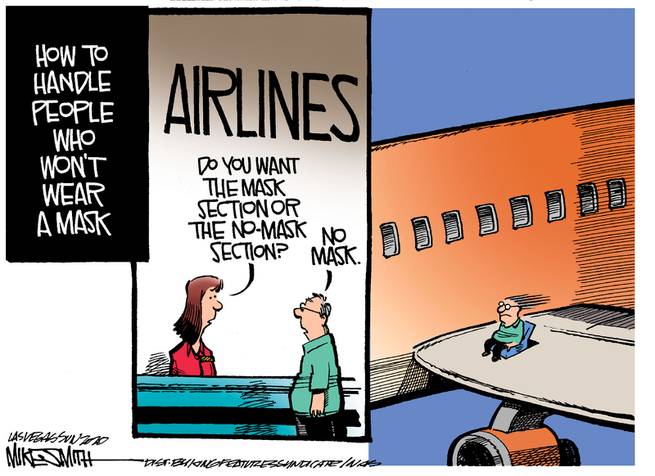
Cartoon – How to handle people who won’t wear a mask

Mike Smith Cartoon: 051420 smith cartoon masks -

Mask-wearing becomes political even as some governors ease resistance

Mask-wearing becomes political even as some governors ease resistance

More US states mandate wearing masks | The Canberra Times ...

Some state and local leaders are softening their resistance to issuing public masking requirements as emerging research shows face coverings can slow the spread of COVID-19, even as others are doubling down on their opposition.

The debate over whether to require face coverings in public has become increasingly politicized in recent weeks, even as COVID-19 cases have increased in the Sun Belt and some other parts of the country as lockdowns across the country have greatly eased.

Governors in southern, conservative states have been reluctant to issue statewide mandates on public mask-wearing, and in some cases have prevented local governments from taking stronger actions. 

“We want to make sure that individual liberty is not infringed upon by government and hence government cannot require individuals to wear a mask,” Texas Gov. Greg Abbott (R) said Wednesday in an interview with Waco television station KWTX.

Abbott, who frequently recommends mask-wearing, has resisted calls from local leaders to require it, and has also prohibited them from enforcing local orders with civil or criminal penalties on individuals.

However, two Texas counties on Wednesday announced businesses must impose a mask rule on staff and customers or face fines of up to $1,000, which Abbott said would be allowed under his executive order.

“Businesses … they’ve always had the opportunity and the ability, just like they can require people to wear shoes and shirts, these businesses can require people to wear face masks if they come into their businesses. Now local officials are just now realizing that that was authorized,” he said.

Texas has experienced a rapid increase in COVID-19 cases that experts say is likely related to the state’s decision to lift lockdown measures ahead of Memorial Day. The state reported 3,129 new COVID-19 cases Wednesday, its largest single-day increase. Nearly 2,800 people were hospitalized with COVID-19 as of Wednesday, a new high for the state.

In Arizona, which has also seen a surge in cases, Gov. Doug Ducey (R) on Wednesday again resisted calls to issue a statewide masking requirement, but in a reversal, said he would allow local governments to take their own actions. Larger cities including Phoenix and Tucson plan to do so.

“Every Arizonan should wear a face mask,” he said at a Wednesday press conference. “This is an issue of personal responsibility, and we’re asking Arizonans to make responsible decisions to protect the most vulnerable in our communities.” 

While a number of coastal states and cities led by Democrats have strict mask requirements when in public settings such as grocery stores, where staying six feet away from others may not be possible, some Republicans appear to see it as a restriction on freedom and have emphasized individual responsibility.

Trump has almost exclusively declined to wear a mask, and has criticized his political rival Joe Biden, the Democratic candidate for president, for wearing one. 

“I see Biden. It’s like his whole face is covered,” Trump said in an interview published Thursday in The Wall Street Journal. “It’s like he put a knapsack over his face. He probably likes it that way. He feels good that way because he does. He seems to feel good in a mask, you know, feels better than he does without the mask, which is a strange situation.”

The debate of whether to wear masks has sparked division on Capitol Hill, where two Republicans this week refused to follow a new directive from House Speaker Nancy Pelosi (D-Calif.) 

“I consider masks much more effective at spreading panic and much less effective at stopping a virus,” said Rep. Tom McClintock (R-Calif.), during a hearing yesterday. He later put on a mask. 

Polls have shown Democrats are more likely to wear masks in public than Republicans; a Gallup poll conducted in April found 75 percent of Democrats have worn a mask in public, compared to half of Republicans.

However, emerging evidence shows face coverings can slow the transmission of COVID-19. A study published in Health Affairs this week found that mandated use of face masks in public was associated with a reduction in the daily COVID-19 growth rate in 15 states and Washington, D.C., compared to states that did not have such requirements.

Governors of other states experiencing outbreaks, including Henry McMaster (R) of South Carolina, have recommended but don’t require people to wear face masks in public. City council members in Columbia, S.C., however, are reportedly considering a requirement for the state’s largest city.

Alabama Gov. Kay Ivey (R) hasn’t issued a statewide mask requirement for the public, but employees of certain businesses are required to wear them while working.

In Montgomery, Ala., which has the largest COVID-19 outbreak in the state, Mayor Steven Reed (D) issued an executive order Wednesday requiring face coverings be worn in public after a similar ordinance failed to pass the city’s council.

Florida Gov. Ron DeSantis (R) has also resisted a statewide mask requirement, though localities can require their use in public. On Tuesday, he encouraged people to wear masks when social distancing isn’t possible but said it would not be a requirement.

“In terms of forcing that under penalty of criminal law, we’re not going to be doing that. I think it would be applied unevenly and I just don’t think it would end up working,” DeSantis said at a press conference.

The state is also seeing an increase in cases, which DeSantis ties to increased testing. However, public health experts note that the percentage of tests coming back positive is also increasing, a sign of ongoing community transmission. 

In Nebraska, where the rate of COVID-19 transmission has been declining, Gov. Pete Ricketts (R) encourages the use of masks in public but has threatened to withhold federal relief funding from localities that require their use in government buildings.

“The governor encourages people to wear a mask but does not believe that failure to wear a mask should be the basis for denying taxpayers’ services,” spokesman Taylor Gage told the Omaha World-Herald.

Not all Republican governors have resisted masking mandates. Maryland Gov. Larry Hogan and Massachusetts Gov. Charlie Baker were early to issue wide-ranging mask requirements in their states.

Meanwhile, Democratic governors are mandating mask requirements or say they are seriously considering it. 

As cases continue to climb in North Carolina, Gov. Roy Cooper (D) said this state leaders are considering making mask-wearing in public settings mandatory but has not done so yet.

Oregon Gov. Kate Brown (D) announced Wednesday that people living in seven of the state’s counties will have to wear masks in public beginning June 24 as the state sees an increase in cases.

Democratic governors of states hit hard early in the pandemic including New York, Washington and New Jersey have required the use of face coverings in public for several weeks.

California Gov. Gavin Newsom (D) issued a statewide mask order Thursday amid an increase in COVID-19 cases in his state.

“Science shows that face coverings and masks work,” Newsom said Thursday. “They are critical to keeping those who are around you safe, keeping businesses open and restarting our economy.” 


Cartoon – What your Face Mask says about you

Andrew Cuomo Allows Businesses to Deny Entry to Customers Not ...


Cartoon – Sheep at a Crossroads

Florida needs an executive order requiring wearing of face masks

Scientists caught between pandemic and protests

https://www.axios.com/black-lives-matter-protests-coronavirus-science-15acc619-633d-47c2-9c76-df91f826a73c.html

Scientists accused of double standards on coronavirus and Black ...

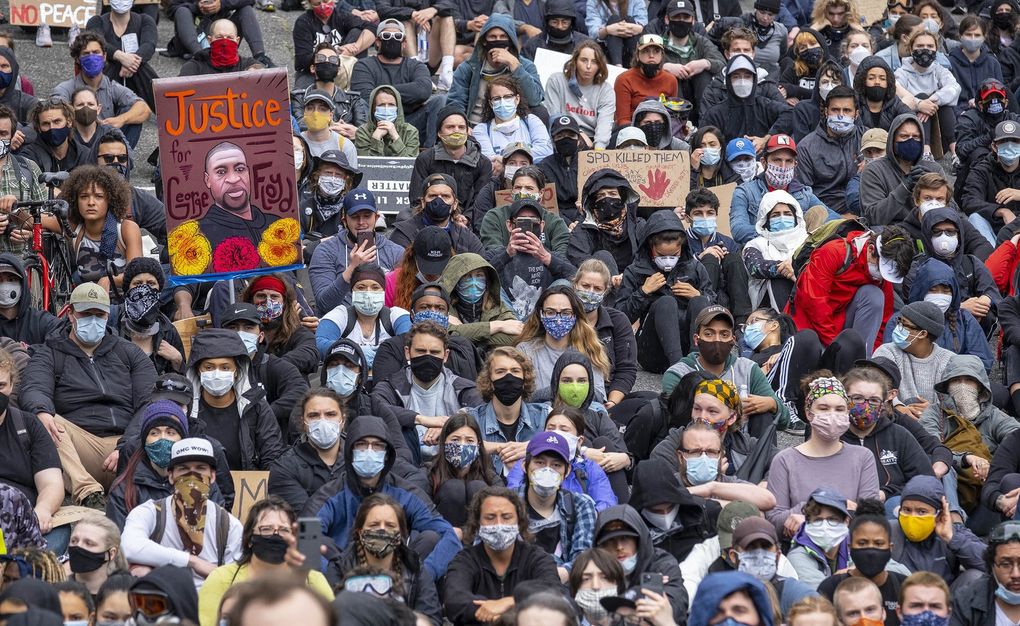
When protests broke out against the coronavirus lockdown, many public health experts were quick to warn about spreading the virus. When protests broke out after George Floyd’s death, some of the same experts embraced the protests. That’s led to charges of double standards among scientists.

Why it matters: Scientists who are seen as changing recommendations based on political and social priorities, however important, risk losing public trust. That could cause people to disregard their advice should the pandemic require stricter lockdown policies.

What’s happening: Many public health experts came out against public gatherings of almost any sort this spring — including protests over lockdown policies and large religious gatherings.

  • But some of the same experts are supporting the Black Lives Matter protests, arguing that addressing racial inequality is key to tackling the coronavirus epidemic.
  • The systemic racism that protesters are decrying contributes to massive health disparities that can be seen in this pandemic — black Americans comprise 13% of the U.S. population, but make up around a quarter of deaths from COVID-19. Floyd himself survived COVID-19 before he was killed by a now former police officer in Minneapolis.
  • “While everyone is concerned about the risk of COVID, there are risks with just being black in this country that almost outweigh that sometimes,” Abby Hussein, an infectious disease fellow at the University of Washington, told CNN last week.

Yes, but: Spending time in a large group, even outdoors and wearing masks — as many of the protesters are — does raise the risk of coronavirus transmission, says Michael Osterholm, director of the Center for Infectious Disease Research and Policy at the University of Minnesota.

  • In a Twitter thread over the weekend, coronavirus expert Trevor Bedford estimated that each day of protests would result in some 3,000 additional infections, which over time could lead to hundreds of additional deaths each day.
  • Public health experts who work in the government have struck a cautionary note. Mass, in-person protests are a “perfect setup” for transmission of the virus, Anthony Fauci told radio station WTOP last week. “It’s a delicate balance because the reasons for demonstrating are valid, but the demonstration puts one at additional risk.”

The difference in tone between how some public health experts are viewing the current protests and earlier ones focused on the lockdowns themselves was seized upon by a number of critics, as well as the Trump campaign.

  • “It will deepen the idea that the intellectual classes are picking winners and losers among political causes,” says Tom Nichols, author of the “The Death of Expertise.”
  • Politico reported that the Trump campaign plans to restart campaign rallies in the next two weeks, with advisers arguing that “recent massive protests in metropolitan areas will make it harder for liberals to criticize him” despite the ongoing pandemic.

The current debate underscores a larger question: What role should scientists play in policymaking?

  • “We should never try to harness the credibility of public health on behalf of our judgments as citizens,” writes Peter Sandman, a retired professor of environmental journalism. He tells Axios some scientists who supported one protest versus others “clearly damaged the credibility of public health as a scientific enterprise that struggles to be politically neutral.
  • But some are pushing back against the very idea of scientific neutrality. “Science is part of how we got to our racist system in the first place,” Susan Matthews wrote in Slate.
  • Medical science has often betrayed the trust of black Americans, who receive less, and often worse, care than white Americans. That means — as Uché Blackstock, a physician and CEO of Advancing Health Equity, told NPR — that the pandemic presents “a crisis within a crisis.”

The big picture: The debate risks exacerbating a partisan divide among Americans in their reported trust in scientists.

  • 53% of Democrats polled in late April — about a month before Floyd’s death — reported a “great deal of confidence in medical scientists to act in the public interests” versus 31% of Republicans.
  • If science-driven policymaking continues to be seen as biased, it will have repercussions for public trust in issues beyond the pandemic, including climate change, AI and genetic engineering.

What to watch: If there is a rise in new cases in the coming weeks, there will be pressure to trace them — to protests, rallies and the reopening of states. How experts weigh in could affect how their recommendations will be viewed in the future — and whether the public, whatever their political leanings, will follow them again.


Cartoon – Importance of Transparency

Corrupt Politician Cartoons and Comics - funny pictures from ...

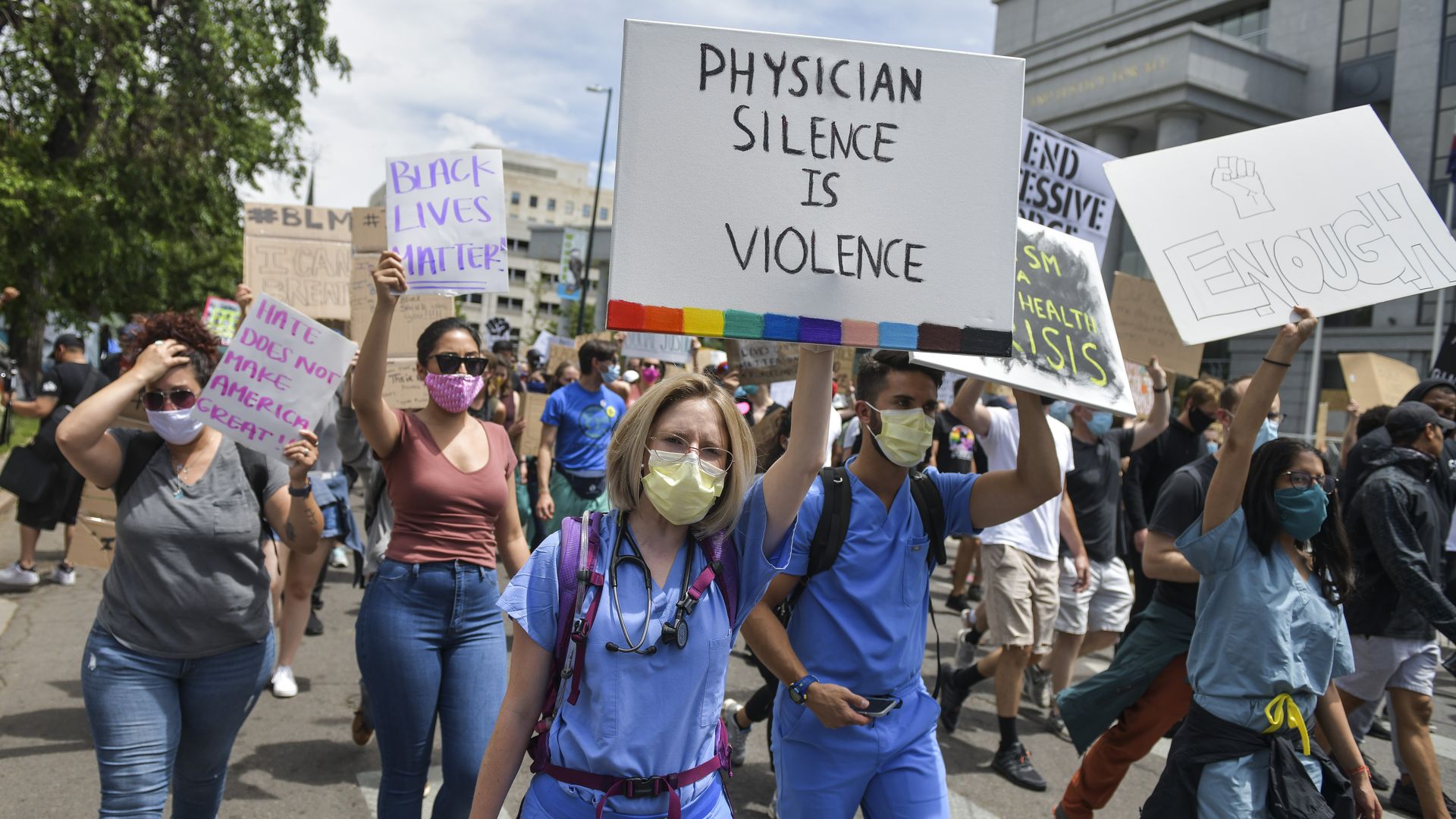
Protests essential despite risk of coronavirus spread, healthcare workers say

https://www.beckershospitalreview.com/public-health/protests-essential-despite-risk-of-coronavirus-spread-healthcare-workers-say.html?utm_medium=email

After months of pleading for social distancing, health officials ...

Though the protests that erupted after a black man died in police custody might result in spikes of COVID-19, some healthcare workers say that they are important, as racial disparities in healthcare is also a public health issue, according to The Wall Street Journal.

Public health experts and healthcare workers across the country are joining in the protests that began after George Floyd died at the hand of police in Minneapolis in late May. He is the most recent example of police brutality against black people and joins a long list of deaths of African Americans in police custody.

Healthcare experts and workers are saying though the protests may result in a new wave of coronavirus cases, the issue at hand is more important and the potential benefits outweigh the risks, especially since the risk of transmission is lower outside than inside when precautions are taken.

Darrell Gray, MD, a black gastroenterologist at the Ohio State University Wexner Medical Center in Columbus, has been attending protests, telling the Journal, “I prioritize being at protests and peaceful demonstrations because I strongly believe that they can be leveraged to produce change.” He said that he is taking precautions, wearing a face mask and distancing himself as much as possible.

Dr. Gray also said that the pandemic has disproportionately affected black communities, as the underlying conditions that are linked to more severe COVID-19 illness, such as diabetes and high blood pressure, are more rampant in those communities.

Jennifer Nuzzo, DrPH, an epidemiologist and senior scholar at the Johns Hopkins Center for Health Security in Baltimore, also supports the protests, though she has not been able to attend one in person as yet due to time constraints.

She told the Journal although she is worried about virus transmission, “there are some categories of risk that are, for me, completely worth it.” These protests are in those categories, she said.

Dr. Nuzzo and other health experts have also said protesters can reduce the risk of transmission by wearing masks, trying to maintain 6 feet of social distance when possible and making sure they are washing their hands often or using hand sanitizer.

More than 1,000 public health and infectious disease experts and community stakeholders signed an open letter last week saying that demonstrations were important for combating race-based health inequities, largely a result of racism, the Journal reports.