Public Charge Rule Could Erode Enrollment in Insurance Coverage

Public Charge Rule Could Erode Enrollment in Insurance Coverage

Mother and baby at clinic with doctor. Baby is looking directly into the camera.

In a 5-4 vote reflecting the ideological split among the justices, the US Supreme Court on January 27 decided to allow the Trump administration to commence enforcement (PDF) of its “public charge” rule nationwide. Only Illinois, where a statewide injunction is currently in effect, will not begin enforcing the rule. The regulation was slated to take effect last October, but federal judges in California, Illinois, Maryland, New York, and Washington blocked its implementation after states and immigrant rights groups challenged its legality. Federal appeals courts later lifted all but New York’s nationwide injunction and Illinois’ statewide injunction. The Supreme Court has now “stayed,” or put on hold, New York’s injunction, allowing the rule to take effect while the litigation continues.Essential Coverage

The US Citizenship and Immigration Services agency said the new rule will become effective February 24.

The public charge rule sparked controversy because it “would expand the government’s ability to refuse green cards or visas for legal immigrants determined to be a ‘public charge,’ or dependent on public assistance,” Susannah Luthi explained in Politico. “Those using or likely to use Medicaid, food stamps, and other safety-net programs would face greater scrutiny from immigration officials.”

Experts have warned of a “chilling effect” among immigrant communities, meaning that even those who are not subject to the public charge rule could disenroll or avoid public benefits out of fear. The Institute for Community Health estimated that 195,000 to 455,000 California children in need of medical attention could leave Medi-Cal if the rule takes effect. Including adults, this estimate grows to between 317,000 and 741,000 Californians disenrolling from Medi-Cal, according to researchers from UCLA and UC Berkeley (PDF).

The chilling effect has been documented on a national scale. According to the Urban Institute, in 2018, the year when the Trump administration proposed expanding the public charge rule, about 14% of adults in immigrant families reported that fear prompted them or a family member not to apply for a public benefit program or to disenroll from one. Of the adults who experienced chilling effects, 42% said they or their family members did not participate in Medicaid or the Children’s Health Insurance Program.

Soon after the rule was finalized last year, Eisner Health, a community clinic in Los Angeles, started getting phone calls from patients enrolled in Medi-Cal and CalFresh who wanted to end their families’ coverage, Claudia Boyd-Barrett reported in California Health Report. Many of those patients were not yet permanent residents or were members of mixed immigration status families who feared being penalized for using public benefits.

New Rule Doesn’t Apply to Many Immigrants

It is important to note that many immigrants are not subject to the new public charge rule. “It is urgent that all of us working with immigrant communities — via government, legal aid, health care, and more — have accurate and accessible information for families,” Sandra R. Hernández, president and CEO of CHCF, wrote on Twitter.

Mark Ghaly, California Health and Human Services Agency secretary, released a statement emphasizing that immigrant families should learn their rights. “You can find a list of nonprofit organizations providing free legal immigration services on the California Department of Social Services (CDSS) website, here,” Ghaly said.

CDSS offers a list of legal services providers across California who can assist with public charge questions. Protecting Immigrant Families (a partnership of the National Immigration Law Center and The Center for Law and Social Policy) also has resources on the public charge rule.

Following the Supreme Court’s order to stay the nationwide injunction, California Attorney General Xavier Becerra reiterated his commitment to fighting the rule. “We are a nation of immigrants, so we will lean forward in the face of heartless attacks on working families,” Becerra said in a statement. “Together, we’ll continue our fight to stand up for the right of each and every person who calls the United States their home.”

The legal challenges to the public charge rule will continue to move forward in courts around the nation — including in California — the New York Times’s Adam Liptak reported.

Medicaid Block Grants Could Reduce Access for Many

The Trump administration has announced its plan to let states volunteer to convert a portion of their Medicaid funding into block grants. The program, which has been branded a “Healthy Adult Opportunity,” represents a radical change in financing for Medicaid. Medicaid programs, which are operated by states with significant federal funding and oversight, constitute the nation’s health insurance program for Americans with low incomes. Covering over 75 million people, or one in five Americans, Medicaid programs provide services to 83% of children from low-income families, 48% of children with special health care needs, and 45% of nonelderly adults with disabilities.

On January 30, the administrator of the US Centers for Medicare & Medicaid Services, Seema Verma, sent to state Medicaid directors a letter (PDF) about the new block grant program. Verma gave states “the possibility of trading away an entitlement program that expands and contracts depending on how many poor people need the government health coverage,” Amy Goldstein wrote in the Washington Post. “In exchange, for able-bodied adults in the program, states could apply to receive a fixed federal payment and freedom from many of the program’s rules.”

Additionally, participating states would be allowed to limit the health benefits and drugs offered by their Medicaid programs, Rachel Roubein and Dan Diamond reported for Politico. According to one official, patients with behavioral health needs or HIV would be protected under the new plan.

Criticism from Medicaid advocates was swift. Twenty-seven patient and consumer groups, including the American Lung Association, American Cancer Society, and National Alliance on Mental Illness, issued a statement expressing strong opposition to the new guidance. “Block grants and per capita caps will reduce access to quality and affordable health care for patients with serious and chronic health conditions and are therefore unacceptable to our organizations,” they wrote.

“Worst Medicaid Idea Ever”

Frederick Isasi, executive director of Families USA, said in a statement, “Having spent many years working with governors and Medicaid programs, block grants are possibly the worst Medicaid idea ever presented to states by a federal administration. They would allow the federal government to off-load shared Medicaid responsibility at the expense of deep cuts to state budgets, vital programs supported by states, and the people who rely on those programs.”

Joan Alker, executive director and a cofounder of Georgetown University’s Center for Children and Families, warned in a statement that “if states accept a fixed cap on federal funding to meet their health care needs, they may be able to get by in the short term, but they put the health of their citizens and future state budgets at serious risk down the road.”

The block grant program is unlikely to affect California, which has invested heavily in expanding Medi-Cal access and is not expected to apply to participate.

Nonetheless, the block grant proposal shows that the Trump administration continues to prioritize changes that weaken the foundation of the nation’s health care safety net and could dramatically reduce health coverage for millions of Americans with low incomes.


We’re going to our primary care doctors less

https://www.axios.com/newsletters/axios-vitals-ded63eb6-2431-48d0-a186-2f3b52417f2f.html?utm_source=newsletter&utm_medium=email&utm_campaign=newsletter_axiosvitals&stream=top

Image result for primary care physician"

Adults in the U.S. are visiting primary care doctors less often, according to a new study in the Annals of Internal Medicine, which could foreshadow worse health outcomes and higher costs.

By the numbers: The study focused on adults enrolled with a large commercial insurer.

  • Between 2008 and 2016, visits to primary care physicians declined by 24.2%, and nearly half of adults didn’t visit one in any given year by the end of the time frame.
  • Groups with the largest declines were young adults, adults without chronic conditions, and those living in the lowest-income areas.

Meanwhile, visits to alternative facilities like urgent care clinics increased by 46.9%.

The big picture: Primary care doctors are there to keep people healthy. The less often we go to them, the more likely we are to get or remain sick, which ultimately costs the health care system more money.


Supreme Court denies blue states’ effort to expedite ObamaCare challenge

Supreme Court denies blue states’ effort to expedite ObamaCare challenge

Supreme Court denies blue states' effort to expedite ObamaCare challenge

The Supreme Court on Tuesday rejected an effort by Democrats to expedite a challenge to a lower court’s ruling striking down a key tenet of ObamaCare, narrowing the possibility that the court takes up the contentious case this year.

The House of Representatives and a group of blue states had asked the court to fast-track their appeal after the 5th Circuit Court of Appeals ruled that the Affordable Care Act’s individual mandate is unconstitutional.

“Under the current state of affairs, there is considerable doubt over whether millions of individuals will continue to be able to afford vitally important care,” the House wrote in a court filing earlier this month.

“Millions of individuals will live with the insecurity of not knowing that they have access to affordable health care, and will be forced to make important life decisions without knowing how those decisions will affect their continued access to such care.”

“If the Court does not hear the case this Term, that uncertainty will likely persist through next year’s open enrollment period,” the House wrote.

Tuesday’s order makes it unlikely that the high court will rule on the health care law before the November presidential election, where health insurance policy is sure to play a prominent role.

The 5th Circuit’s ruling delivered a victory for the coalition of conservative state attorneys general challenging the Obama administration’s signature achievement.

The Trump administration has declined to defend the Affordable Care Act in court, and the president has cheered on legal efforts to dismantle it.

“This decision will not alter the current healthcare system,” President Trump said in a statement last month. “My Administration continues to work to provide access to high-quality healthcare at a price you can afford, while strongly protecting those with pre-existing conditions. The radical healthcare changes being proposed by the far left would strip Americans of their current coverage. I will not let this happen.”

It’s still unclear whether the Supreme Court will decide to hear the challenge to the 5th Circuit ruling. Now that the justices have chosen to adhere to a normal briefing schedule, that decision will likely not come until March at the earliest.


Remembering King’s fight for health-care equity

https://www.limaohio.com/news/393041/remembering-kings-fight-for-health-care-equity

Image result for martin luther king on healthcare

America celebrates a distortion of Martin Luther King Jr., void of his prophetic call to justice by any nonviolent means necessary. Particularly around the annual remembrance of his life Monday, watch for his words to be repackaged in tasty sound bites and stripped of the so-called extremism that prompted FBI Director J. Edgar Hoover to label him “the most dangerous man in America.”

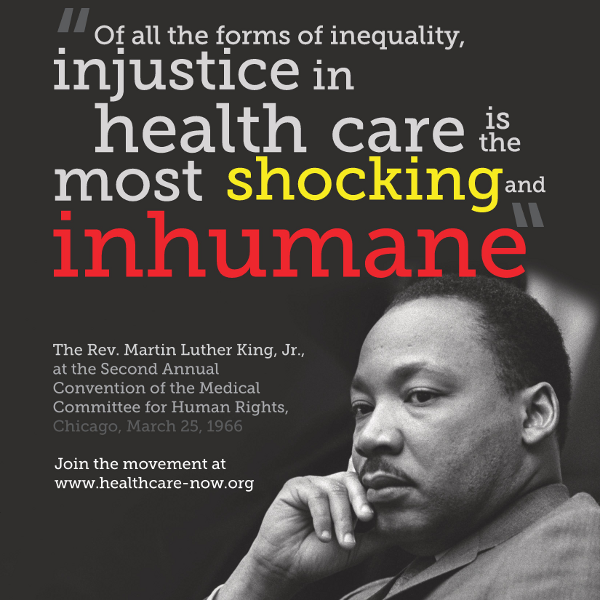
Chicago was a seminal backdrop for King’s work toward justice and the place where he sounded his call for health care justice. Before a medical conference in 1966 he proclaimed, “Of all the forms of inequality, injustice in health is the most shocking and the most inhuman because it often results in physical death.” National criticism ensued because this activist, two years after he won the Nobel Peace Prize, dared to articulate a prophetic truism still relevant in 2020.

Researchers at New York University found that Chicago has the largest gap in life expectancy of any city in the United States (followed by Washington, D.C., and New York). Although the national trend in the gap between blacks and non-Hispanic whites continues to improve, ZIP codes can still determine life expectancy with alarming racial disparities. Like real estate, health inequality is about location, location, location.

Dallas is another city with a dubious distinction. The Urban Institute ranked it last out of 274 U.S. cities in racial equity and racial segregation. A study by Parkland Health and Hospital System and the Dallas County Health Department found that geography is deeply linked to health inequity, where a difference of 2 miles has a life expectancy gap of 26 years. Although separated by 1,000 miles, Dallas and Chicago share similar systemic inequities that perpetuate racial disparities in health.

These glaring divides are an enduring legacy of decades of isolating black Americans seeking homeownership by marking mortgage lending maps with red lines. Today, more than 50 years since the passage of the Fair Housing Act, 91% of the communities identified as “best” on the redlined maps remain middle to upper class, with 85% of these communities having majority white populations. Accordingly, 3 out of 4 redlined neighborhoods remain impoverished, and 67% of redlined neighborhoods remain populated by racial minorities. Many were intentionally located in proximity to industrial areas, municipal landfills and toxic waste sites — and the subsequent negative health impacts persist across generations.

This lengthy history of systemic inequality will take time to remedy, as will the legacy of distrust of the medical establishment from the history of experimentation without consent on black Americans. A doctor known as the “Father of Modern Gynecology” performed barbaric vaginal operations on enslaved women. They were denied anesthesia, physically restrained, repeatedly mutilated. The U.S. Public Health Service denied 600 men therapeutic penicillin from 1932 to 1972 to allow the study of the natural progression of latent syphilis in the Tuskegee syphilis experiment. Their health was compromised, as were their partners and children who were predictably exposed to the disease. Black women, many of them teenagers, were the prime target for controlled breeding through forced sterilization. This practice of eugenics did not end until the 1980s. And there was the Pentagon-funded study of nontherapeutic, whole-body irradiation from 1960 to 1971, in which 25% of the subjects died within one month of exposure. All were poor, most were black, and the Radiological Society of North America awarded the lead physician its highest honor.

Nearing his death, King was deemed “unfavorable” by two-thirds of Americans in a 1966 Gallup poll. Decades later in a 1999 Gallup poll, more than 90% of Americans had a favorable opinion and ranked him as the second most admired person of the 20th century (behind Mother Teresa). As we celebrate his legacy, we should embrace his prescient view on health care inequity and further his goal of creating a just society for all.

Perhaps King’s greatest threat was to recognize that, from Chicago to Dallas and to other cities and towns across the land, we are more alike than different. He dared to criticize health inequities embedded in communities from urban ghettos to the mountains of West Virginia. And although his life was ended while he was building bridges across racial and ethnic divides, his dream of proper health care for all should not. Because if raising his voice against persistent health inequality made King a dangerous man, add us to that list.

Health inequality remains among the greatest injustices of our time, and, as King penned in “Letter From Birmingham Jail,” “injustice anywhere is a threat to justice everywhere.” Like King, let us commit ourselves anew to eradicating these death-dealing realities “until justice rolls down like waters, and righteousness like a mighty stream” (Amos 5:24).


MARTIN LUTHER KING JR.’S HEALTHCARE JUSTICE ADVOCACY MAKES AMERICA’S HOSPITALS BETTER TODAY

Martin Luther King Jr.’s Healthcare Justice Advocacy Makes America’s Hospitals Better Today

Image result for MARTIN LUTHER KING JR.’S HEALTHCARE JUSTICE ADVOCACY MAKES AMERICA’S HOSPITALS BETTER TODAY

Every January, the United States celebrates the lasting legacy of Dr. Martin Luther King Jr. Not widely known is how his civil rights advocacy made a lasting impact on modern-day hospitals, including children’s hospitals.

Today in 170 Children’s Miracle Network Hospitals, every young patient is treated regardless of their race or background. CMN Hospitals are deeply committed to offering world-renowned treatment to all kids in need and that’s why donations to your local hospital can make such a difference for families facing health crises.

Unfortunately, certain hospitals in America were still segregated in the not too recent past. When Brown vs. Board of Education passed in 1954, schools began to desegregate, and this paved the way for institutions like hospitals to follow suite. King’s healthcare justice advocacy advanced health care access in particular for the African American community.

A History of Unequal Healthcare

When patients enter a hospital, they expect to receive a standard of care that will improve their lives regardless of who they might be. That expectation, unfortunately, has not always been backed up by medical institutions across the United States. African Americans, in particular, experienced a history of receiving substandard care and outright abuse within the framework of medical science.

Notable examples of this include:

While the details of those specific examples weren’t publicly known in the 1960s, African Americans were certainly aware that they received care that was inferior to white patients. Doctors and hospitals continued perpetuating this double standard even after the passage of the Civil Rights Act in 1964. The disparity in treatment quality was so egregious that Dr. Martin Luther King Jr. spoke out against it, calling for an awakening in the conscience of the United States.

Desegregating Hospitals

King uttered his famous words on healthcare while addressing the press before attending the annual meeting of the Medical Committee for Human Rights, an organization formed because the American Medical Association was segregated at the time. “Of all the forms of inequality, injustice in health is the most shocking and the most inhuman because it often results in physical death,” said King.

The Civil Rights Act of 1964 isn’t typically associated with healthcare. However, at that point in history, it was well known that some hospitals and medical institutions were resisting the push for desegregation, a practice which hospitals used to provide less than adequate care to African American patients. Hospitals would continue to hold onto such discriminatory practices unless something was done.

Legal Gains for Equality in Hospitals

The reason King spoke out so vehemently in 1966 was due to the passage of Medicare and Medicaid in 1965, something that was only possible due to the efforts of the Medical Committee for Human Rights and its head, W. Montague Cobb. The organization made use of the non-violent protest strategies of King and the Civil Rights Movement. The passage of the Social Security Act, which created Medicare and Medicaid brought federal funding into every hospital and medical institution in the United States, forever binding each facility to the Civil Rights Act, a stipulation of which was that any organization receiving federal funding could not discriminate on the basis of race.

From that point onward, hospitals that clung to the old ways of discrimination were subject to lawsuits from mistreated African Americans and pressure from activists like King and the Medical Committee for Human Rights. This gave King the legal ground to stand on when calling on hospitals to abandon the evil practice of systemic discrimination in 1966 with those now famous words from that 1966 conference.

While we know there’s more work to be done to promote equal healthcare access to every child in need across North America, we’re proud that our non-profit children’s hospitals can be a part of the solution.

Thank you, King.


Private insurance is health care’s pot of gold

https://www.axios.com/jp-morgan-2020-private-health-insurance-prices-costs-1e92f969-bffc-4584-a3c9-e8c4072b5144.html

Image result for Private insurance is health care's pot of gold

Private health insurance is a conduit for exploding health care spending, and there’s no end in sight.

The big picture: Most politicians defend this status quo, even though prices are soaring. And as the industry’s top executives and lobbyists gathered this week in San Francisco, some nodded to concerns over affordability — but then went on to tell investors how they plan to keep the money flowing.


Where it stands: More than 160 million Americans get private insurance through an employer or on their own, and per-person spending in that market rose by almost 7% in 2018, the highest annual growth rate in 14 years.

  • “Prices are definitely going up,” Owen Tripp, CEO of health tech startup Grand Rounds, told me this week during the annual J.P. Morgan Healthcare Conference.
  • His company’s vast amount of commercial health data shows big increases in what companies are spending on hospitals, doctors, specialty drugs, devices and out-of-network services.


What they’re saying: Many in the industry admit price inflation has been hammering the commercial markets for years.

  • “Cost per unit is the primary driver,” Cigna CEO David Cordani said. He did not mention the exploding costs of administering health insurance.
  • One hospital system at the conference acknowledged that “the number one cause of personal bankruptcy is our industry” — before going on to tell investors about the hospital’s strong margins.


Multiple hospital executives claimed they charge commercial plans higher prices to make up for the lower rates they get from Medicare and Medicaid.

  • “Every health system I know of loses money on every Medicaid and every Medicare patient,” Amy Compton-Phillips, a top clinical executive at Providence St. Joseph Health, told me.
  • But the evidence overwhelmingly shows that hospitals’ explanation doesn’t hold water.


Drug spending has risen at a slower rate than hospital and physician spending.

  • But in the commercial market, drug companies also have tripled their spending on programs that cover all or part of patients’ out-of-pocket costs, then bill insurers for the full freight.
  • “It’s an intriguing theory,” said Stephen Ubl, CEO of PhRMA, the pharmaceutical industry’s main lobbying group. “But I would be shocked if we were a significant contributor” to the increased private spending.


The bottom line: The private market is the main pot of money that everyone is chasing at the J.P. Morgan conference, and most in the industry don’t see the ballooning spending within that market as a problem.


How the Health Insurance Industry (and I) Invented the ‘Choice’ Talking Point

It was always misleading. Now Democrats are repeating it.

There’s a dangerous talking point being repeated in the Democratic primary for president that could affect the survival of millions of people, and the finances of even more. This is partly my fault.

When the candidates discuss health care, you’re bound to hear some of them talk about consumer “choice.” If the nation adopts systemic health reform, this idea goes, it would restrict the ability of Americans to choose their plans or doctors, or have a say in their care.

It’s a good little talking point, in that it makes the idea of changing the current system sound scary and limiting. The problem? It’s a P.R. concoction. And right now, somewhere in their plush corporate offices, some health care industry executives are probably beside themselves with glee, drinking a toast to their public relations triumph.

I should know: I was one of them.

To my everlasting regret, I played a hand in devising this deceptive talking point about choice when I worked in various communications roles for a leading health insurer between 1993 and 2008, ultimately serving as vice president for corporate communications. Now I want to come clean by explaining its origin story, and why it’s both factually inaccurate and a political ploy.

Those of us in the insurance industry constantly hustled to prevent significant reforms because changes threatened to eat into our companies’ enormous profits. We were told by our opinion research firms and messaging consultants that when we promoted the purported benefits of the status quo that we should talk about the concept of “choice”: It polled well in focus groups of average Americans (and was encouraged by the work of Frank Luntz, the P.R. guru who literally wrote the book on how the Republican Party should communicate with Americans). As instructed, I used the word “choice” frequently when drafting talking points.

But those of us who held senior positions for the big insurers knew that one of the huge vulnerabilities of the system is its lack of choice. In the current system, Americans cannot, in fact, pick their own doctors, specialists or hospitals — at least, not without incurring huge “out of network” bills.

Not only does the current health care system deny you choice within the details of your plans, it also fails to provide many options for the plan itself. Most working Americans must select from a limited list made by their company’s chosen insurance provider (usually a high-deductible plan or a higher-deductible plan). What’s more, once that choice is made, there are many restrictions around keeping it. You can lose coverage if your company changes its plan, or if you change jobs, or if you turn 26 and leave your parents’ plan, among other scenarios.

This presented a real problem for us in the industry. Well aware that we were losing the “choice” argument, my industry colleagues spent millions on lobbying, advertising and spin doctors — all intended to muddy the issue so Americans might believe that reform would somehow provide “less choice.” Recently, the industry launched a campaign called “My Care, My Choice” aimed in part at convincing Americans that they have choice now — and that government reform would restrict their freedom. That group has been spending large sums on advertising in Iowa during this presidential race.

This isn’t the first time the industry has made “choice” a big talking point as it fights health reform. Soon after the Affordable Care Act was passed a decade ago, insurers formed the Choice and Competition Coalition and pushed states not to create insurance exchanges with better plans.

What’s different now is that it’s the Democrats parroting the misleading “choice” talking point — and even using it as a weapon against one another. Back in my days working in insurance P.R., this would have stunned me. It’s why I believe my former colleagues are celebrating today.

The truth, of course, is that Americans now have little “choice” when it comes to managing their health care. Most can’t choose their own plan or how long they retain it, or even use it to select the doctor or hospital they prefer. But some reforms being discussed this election, such as “Medicare for all,” would provide these basic freedoms to users. In other words, the proposed reforms offer more choice than the status quo, not less.

My advice to voters is that if politicians tell you they oppose reforming the health care system because they want to preserve your “choice” as a consumer, they don’t know what they’re talking about or they’re willfully ignoring the truth. Either way, the insurance industry is delighted.

I would know.