Health System Chief Strategy Officer Roundtable Assessment: ‘The Near-Term is Tough, the Long-Term is Uncertain and the Deck is Stacked against Hospitals’

On November 2-3 in Austin, I moderated the 4th Annual CSO Roundtable* in which Chief Strategy/Growth Officers from 12 mid-size and large multi-hospital systems participated. The discussion centered on the future: the issues and challenges they facing their organizations TODAY and their plans for their NEAR TERM (3-5 years) and LONG-TERM (8-10 years) future. Augmenting the discussion, participants rated the likelihood and level of disruptive impact for 50 future state scenarios using the Future State Diagnostic Survey. *

Five themes emerged from this discussion:

1-Major change in the structure and financing of U.S. health system is unlikely.

  • CSOs do not believe Medicare for All will replace the current system. They anticipate the existing public-private delivery system will continue with expanded government influence likely.
  • Public funding for the system remains problematic: private capital will play a larger role.
  • CSOs think it is unlikely the public health system will be fully integrated into the traditional delivery system (aka health + social services). Most hospital systems are expanding their outreach to public health programs in local markets as an element of their community benefits strategy.
  • CSOs recognize that states will play a bigger role in regulating the system vis a vis executive orders and referenda on popular issues. Price controls for hospitals and prescription drugs, restraints on hospital consolidation are strong possibilities.
  • Consensus: conditions for hospitals will not improve in the immediate and near-term. Strategies for growth must include all options.

2-Health costs, affordability and equitable access are major issues facing the health industry overall and hospitals particularly.

  • CSOs see equitable access as a compliance issue applicable to their workforce procurement and performance efforts and to their service delivery strategy i.e., locations, patient experiences, care planning.
  • CSOs see reputation risk in both areas if not appropriately addressed in their organizations.
  • CSOs do not share a consensus view of how affordability should be defined or measured.
  • There is consensus among CSOs that hospitals have suffered reputation damage as a result of inadequate price transparency and activist disinformation campaigns. Executive compensation, non-operating income, discrepancies in charity care and community benefits calculations and patient “sticker shock” are popular targets of criticism.
  • CSO think increased operating costs due to medical inflation, supply chain costs including prescription drugs, and labor have offset their efforts in cost reduction and utilization gains.
  • CSO’s are focusing more of their resources and time in support of acute clinical programs where streamlining clinical processes and utilization increases are achievable near-term.
  • Consensus: the current financing of the system, particularly hospitals, is a zero-sum game. A fundamental re-set is necessary.

3-The regulatory environment for all hospitals will be more challenging, especially for not-for-profit health systems.

  • Most CSOs think the federal regulatory environment is hostile toward hospitals. They expect 340B funding to be cut, a site neutral payment policy in some form implemented, price controls for hospital services in certain states, increased federal and state constraints on horizontal consolidation vis a vis the FTC and State Attorneys General, and unreasonable reimbursement from Medicare and other government program payers.
  • CSOs believe the challenges for large not-for-profit hospital systems are unique: most CSOs think not-for-profit hospitals will face tighter restrictions on their qualification for tax-exempt status and tighter accountability of their community benefits attestation. Most expect Congress and state officials to increase investigations about for-profit activities, partnerships with private equity, executive compensation and other issues brought to public attention.
  • CSOs think rural hospital closures will increase without significant federal action.
  • Consensus: the environment for all hospitals is problematic, especially large, not-for-profit multi-hospitals systems and independent rural facilities.

4-By contrast, the environment for large, national health insurers, major (publicly traded) private equity sponsors and national retailers is significantly more positive.

  • CSOs recognize that current monetary policy by the Fed coupled with tightening regulatory restraints for hospitals is advantageous for national disruptors. Scale and access to capital are strategic advantages enjoyed disproportionately by large for-profit operators in healthcare, especially health insurers and retail health.
  • CSOs believe publicly traded private equity sponsors will play a bigger role in healthcare delivery since they enjoy comparably fewer regulatory constraints/limitations, relative secrecy in their day-to-day operations and significant cash on hand from LPs.
  • CSOs think national health insurer vertical consolidation strategies will increase noting that all operate integrated medical groups, pharmacy benefits management companies, closed networks of non-traditional service providers (i.e. supplemental services like dentistry, home care, et al) and robust data management capabilities.
  • CSOs think national retailers will expand their primary care capabilities beyond traditional “office-based services” to capture market share and widen demand for health-related products and services
  • Consensus: national insurers, PE and national retailers will leverage their scale and the friendly regulatory environment they enjoy to advantage their shareholders and compete directly against hospital and medical groups.

5-The system-wide shift from volume to value will accelerate as employers and insurers drive lower reimbursement and increased risk sharing with hospitals and medical groups.

  • CSOs think the pursuit of value by payers is here to stay. However, they acknowledge the concept of value is unclear but they expect HHS to advance standards for defining and measuring value more consistently across provider and payer sectors.
  • CSOs think risk-sharing with payers is likely to increase as employers and commercial insurers align payment models with CMS’ alternative payment models: the use of bundled payments, accountable care organizations and capitation is expected to increase.
  • CSOs expect network performance and data management to be essential capabilities necessary to an organization’s navigation of the volume to value transition. CSOs want to rationalize their current acute capabilities by expanding their addressable market vis a vis referral management, diversification, centralization of core services, primary and preventive health expansion and aggressive cost management.
  • Consensus: successful participation in payer-sponsored value-based care initiatives will play a bigger role in health system strategy.

My take:

The role of Chief Strategy Officer in a multi-hospital system setting is multi-functional and unique to each organization. Some have responsibilities for M&A activity; some don’t. Some manage marketing, public relations and advocacy activity; others don’t. All depend heavily on market data for market surveillance and opportunity assessments. And all have frequent interaction with the CEO and Board, and all depend on data management capabilities to advance their recommendations about risk, growth and the future. That’s the job.

CSOs know that hospitals are at a crossroad, particularly not-for-profit system operators accountable to the communities they serve. In the 4Q Keckley Poll, 55% agreed that “the tax exemption given not-for-profit hospitals is justified by the community benefits they provide”  but 45% thought otherwise. They concede their competitive landscape is more complicated as core demand shifts to non-hospital settings and alternative treatments and self-care become obviate traditional claims-based forecasting. They see the bigger players getting bigger: last week’s announcements of the Cigna-Humana deal and expansion of the Ascension-LifePoint relationship cases in point. And they recognize that their reputations are under assault: the rift between Modern Healthcare and the AHA over the Merritt Research ’s charity care study (see Hospital section below) is the latest stimulant for not-for-profit detractors.

In 1937, prominent literary figures Laura Riding and Robert Graves penned a famous statement in an Epilogue Essay that’s especially applicable to hospitals today: “the future is not what it used to be.”

For CSO’s, figuring that out is both worrisome and energizing.

The Broader Policy Implications of the Medicaid Unwinding Crisis

November 2023 marks seven months since the federal government began unwinding Medicaid’s pandemic-related continuous enrollment guarantee. Because Medicaid coverage is associated with improved access and better health outcomes, stabilizing enrollment throughout the public health emergency was a vital public health measure. Now states must grapple with the challenge of returning to normal operations, which means reviewing eligibility for more than 90 million beneficiaries. 

By early November, at least 10,135,000 people had been disenrolled. Overall, two-thirds of people had their coverage renewed while about one-third lost eligibility.

The rate of disenrollment during renewal varies greatly, depending on a state’s underlying Medicaid eligibility rules, capacity to process renewals, and strategies for simplifying the process and reducing risks of error. Illinois showed a disenrollment rate of less than 10 percent, while Florida’s rate was one-third. Disenrollment of children appears to be happening at a high rate, even though they should be protected because of the relatively generous eligibility standards governing children’s coverage under Medicaid and the Children’s Health Insurance Program (CHIP).

As of November, children’s enrollment was down by 2.2 million. 

Among those disenrolled, more than 70 percent lost coverage for procedural reasons, like failure to return forms or an inaccurate mailing address. High procedural disenrollments also likely reflect agency error (e.g., miscalculating earnings information), but available data do not track the proportion of procedural disenrollments that result from such mistakes.

The high procedural disenrollment problem is exacerbated by the speed at which some states are acting — far faster than required under the federal 12-month unwinding timeline allowed by Congress. 

Compounding matters, anecdotal evidence suggests that people terminated for procedural reasons are also being turned away from the health insurance marketplace because states close cases without determining if beneficiaries are truly ineligible for Medicaid. This is happening even though marketplaces and Medicaid agencies are supposed to coordinate activities to ensure that people losing Medicaid can obtain marketplace coverage if eligible. 

The numbers are staggering. Texas has disenrolled more than 1.2 million people; Florida’s disenrollments have exceeded 730,000.

Disenrollment rates are the result of a complex process, excessive speed, and overtasked workers, along with states’ underlying eligibility rules for low-income children and adults. If these rules are more restrictive, they increase the disenrollment rate. In states that have not adopted the Affordable Care Act (ACA) expansion, the potential for major coverage loss is far higher. In nonexpansion states, the rules for poor adults (who had coverage throughout the pandemic, including postpartum women or teenage children who have now reached young adulthood) require an extremely low income level — 16 percent of the federal poverty level in Texas or about $4,000 annually for a family of three in 2023. As stated previously, the disenrollment of children has been far higher than expected, affecting even newborns during the first year of life when enrollment is guaranteed. 

The ACA streamlined and simplified Medicaid’s historically complex enrollment and renewal process by eliminating in-person interviews, automating data collection functions, and instituting an ex parte process, in which the state performs reviews without placing unnecessary renewal burdens on beneficiaries. In addition, a historic 1970 Supreme Court decision governing due process protections for people receiving means-tested public assistance benefits requires states to fully and comprehensibly explain in writing why coverage is ending and gives beneficiaries the opportunity to contest a termination decision before it takes effect. These constitutional safeguards are especially crucial to Medicaid because termination implicates not only coverage, but access to health care itself. 

In 2022, long after the ACA simplification reforms were instituted, the U.S. Department of Health and Human Services (HHS) concluded that of the 15 million people estimated to lose Medicaid during the unwinding process, nearly 45 percent would lose coverage because of procedural issues associated with navigating the renewal process. HHS also foresaw that children and younger adults (including very poor parents) would be disproportionately affected. The evidence appears to be bearing both predictions out. 

The federal government and advocates have begun to take action to mitigate erroneous coverage loss. The 2022 unwinding legislation empowers the HHS Secretary to impose corrective action plans in states showing excessive procedural disenrollments. In states that fail to comply with such plans, HHS would “require the State to suspend . . . terminations of eligibility for medical assistance . . . that are for procedural reasons until the State takes appropriate corrective action.” Under this special power, HHS has urged states to guard against improper disenrollments without an individualized ex parte review and also ordered reinstatement of a half-million children and adults disenrolled simply because other family members were no longer eligible. The agency has ordered states to halt disenrollment until corrective action is taken. 

In a first-of-its-kind case, beneficiaries in Florida who have lost coverage without required constitutional protections have sued for reinstatement and to halt further disenrollment. Plaintiffs include children (some with serious disabilities) and adults. The complaint describes state notices that are incomprehensible by people with average education and that fail to convey which family members are losing coverage, why coverage is being lost, and the right to a pre-termination hearing. Beneficiaries in other states may follow suit. 

The current unwinding situation presents a unique challenge for states, health care providers, and above all, millions of beneficiaries who depend on Medicaid. It is important to remember that continuous enrollment enacted during the pandemic was a response to three structural limitations that are part of everyday Medicaid: first, highly restrictive eligibility limits, particularly in states that do not cover low-income working-age adults; second, the lack of annual guaranteed enrollment for all beneficiaries, regardless of age or basis of eligibility; and third, a redetermination process that, despite improvements, continues to face enormous operational challenges. 

Health Care Sharing Ministries Leave Consumers with Unpaid Medical Claims

https://www.commonwealthfund.org/blog/2023/health-care-sharing-ministries-leave-consumers-unpaid-medical-claims

Health care sharing ministries (HCSMs) claim to offer health coverage: members follow a common set of religious or ethical beliefs and make monthly payments to help pay the qualifying medical expenses of other members.

These products often appear comparable to insurance, but they lack the consumer protections and benefit standards that apply to comprehensive coverage. HCSMs are under no obligation to pay members’ claims and often require members to negotiate discounts or seek charity care from health care providers.

Because of how HCSMs are marketed, consumers may have difficulty identifying the significant limitations of these arrangements and risk getting stuck with unpaid bills. Until recently, states did not have access to data on HCSMs’ enrollment, operations, and finances.

Massachusetts and Colorado have begun to fill these gaps, and the data they have obtained are revealing. The Massachusetts marketplace began requiring HCSMs to report key data in 2020; and last year, Colorado became the first state to require comprehensive data from all HCSMs enrolling Colorado residents. The state’s first report provides a detailed look at HCSMs selling memberships in Colorado.

What’s in Colorado’s First Report?

The data show HCSMs have grown to include far more members than previously understood and shed light on risks for consumers who pay monthly fees with an expectation that their membership will cover health care claims.

Greater than expected enrollment. National enrollment for the HCSMs included in the Colorado report is larger than previously recognized: 1.7 million people. In Colorado alone, HCSM enrollment (at least 68,000) is equivalent to 30 percent of marketplace enrollment. Because HCSMs often exclude essential health services and are therefore more attractive to people who are relatively healthy, enrollment of this size, relative to marketplace enrollment, may increase premiums for marketplace plans.

It also means a significant number of people have forgone comprehensive coverage and federal subsidies to buy this alternative arrangement that does not guarantee health care costs will be paid.

One HCSM recently surveyed its members and found 42 percent had incomes under 200 percent of the federal poverty level (about $50,000 annually for a family of three). Individuals and families at this income level would likely be eligible for low- or no-cost coverage in the marketplace or Medicaid.

Broker-driven marketing. Seven HCSMs reported using brokers to market their plans; some said they rely heavily or exclusively on brokers to grow membership. About one-third of all enrollment in these seven HCSMs was attributed to brokers.

Because HCSMs pay substantially higher commissions (15% to 20%) than marketplace insurers (2.6%) typically do, brokers have an incentive to place consumers in these arrangements.

Unpaid claims. Though their members submitted about $362 million in claims during the reporting period, the HCSMs asserted that only one-third of this amount — about $132 million — was eligible for payment. During the same time period, HCSMs brought in about $97 million, resulting in an apparent shortfall of $35 million. The low share of eligible claims is attributable in part to the HCSMs’ strict rules that disallow reimbursement for various types of care.

In addition, HCSMs have broad flexibility to refuse sharing of a claim even if it otherwise meets the rules. For example, HCSMs often require their members to negotiate their own discounts or seek charity care from health care providers before their claims will be eligible for sharing.

Essential care ineligible for sharing. HCSMs reported they exclude from sharing any expenses for certain essential health care, including costs related to preventive care, mental health care, and substance use disorders, and exclude coverage for many preexisting conditions, including asthma, autism, cancer, diabetes, and hypertension. Alternatively, comprehensive insurance must cover essential health benefits and all preexisting conditions.

Getting Uniform Data Is Challenging but Essential

The first-year report shows the challenges of obtaining data from HCSMs that are not subject to any of the standards or oversight that apply to comprehensive health insurance. Regulators determined that several HCSMs marketing memberships in Colorado had failed to report data and getting complete and accurate data from those that did was difficult. A second report, recently released, indicates those challenges continue, making it impossible to draw comparisons between the two years. Still, by requiring HCSMs to use templates and state-defined terms to submit data in a uniform way, Colorado regulators seem to be on the path to a clearer understanding of how HCSMs are working, their financial solvency, and their effect on state residents and the health insurance market. Indeed, data in the second report show the risks to consumers described above persist.

Looking Ahead

Colorado’s annual requirement to share data will help regulators better understand HCSM operations and finances and, with improved compliance to data submission requirements, should allow for comparisons across HCSMs and from year to year. Data can help point regulators to HCSMs that warrant closer scrutiny and identify for policymakers ways to better protect consumers who may lack a clear understanding of the financial risks of HCSM membership.

Cigna’s Express Scripts adopts cost-plus pricing model

https://mailchi.mp/169732fa4667/the-weekly-gist-november-17-2023?e=d1e747d2d8

This week, Express Scripts, the nation’s second-largest pharmacy benefit manager (PBM), which is owned by health insurer Cigna, announced a new pricing model.

It is giving employers and health plans the option to pay pharmacies up to 15 percent over acquisition costs, plus a dispensing fee, for covered drugs. This payment structure was popularized by the Mark Cuban Cost Plus Drugs Company, founded by the billionaire businessman in reaction to the opaque pricing and complicated discounts and rebates common among PBMs.

While Cigna is not promising that this new pricing model will result in lower prices, it says it will improve transparency and should benefit retail pharmacies, who will split the markup with Express Scripts.

Cigna projects that only some employers will lower their healthcare spending through the cost-plus model, and that patient cost-sharing should be similar under both approaches. 

The Gist: Between disruptive competitors like Cuban’s venture and increasing scrutiny from Congress, PBMs are facing new pressures to improve transparency and account for their role in rising drug costs. 

This move by Cigna is an attempt to address at least one of those concerns, possibly intended to preempt regulatory and legislative action. 

After years of complaints surrounding their business practices, it appears that the Congressional tide may be turning toward PBM industry reform. However, patients—who by and large are unaware of what PBMs are or do—won’t be satisfied till they see their out-of-pocket prescription drug costs go down. 

Next up on this front: seeing which provisions targeting PBMs, many which have bipartisan support, make it into the Senate’s broad healthcare legislation planned for the end of this year, and in what form that bill ultimately passes. 

CMMI increased Medicare spending in its first decade

https://mailchi.mp/f12ce6f07b28/the-weekly-gist-november-10-2023?e=d1e747d2d8

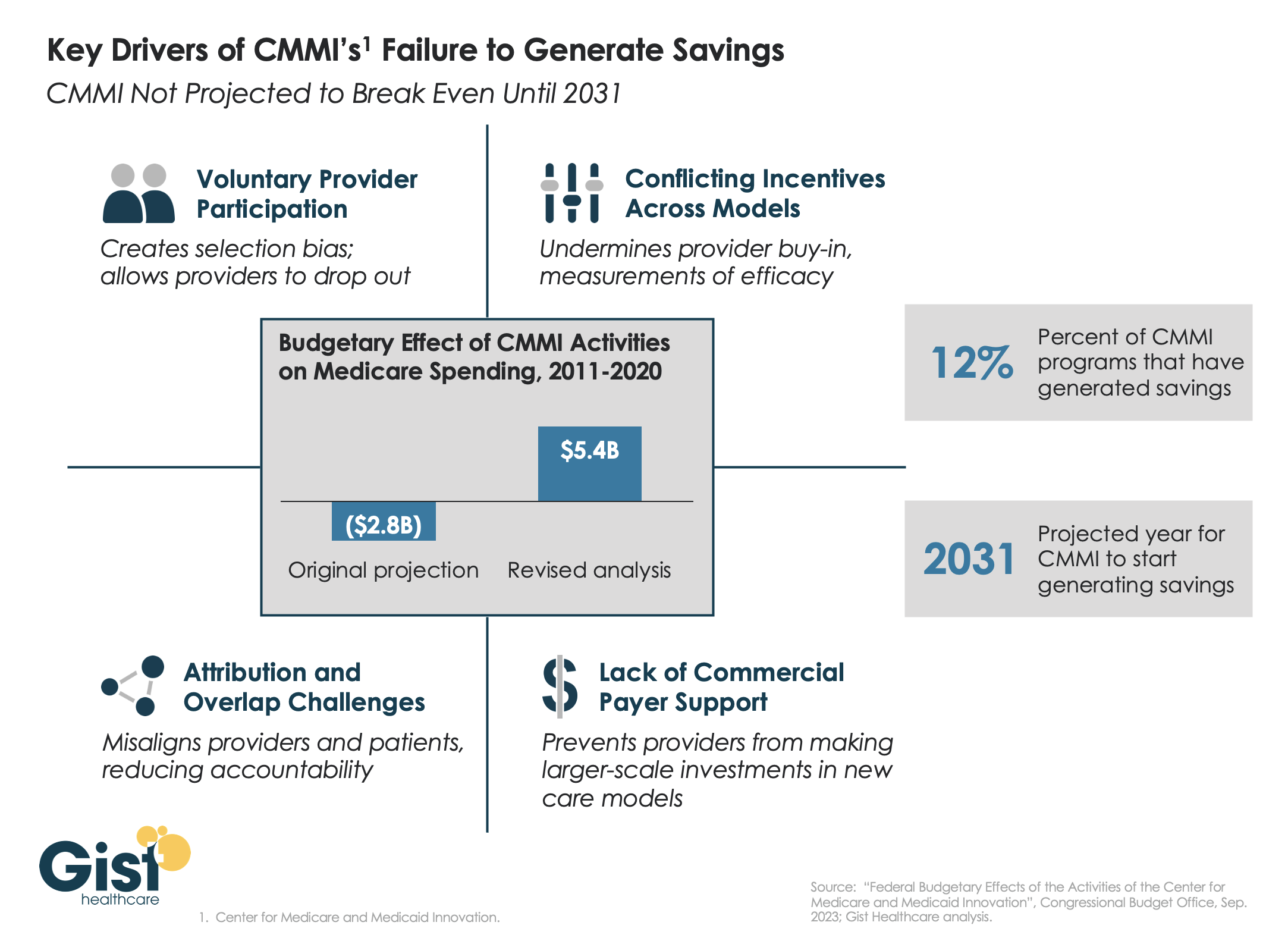
In this week’s graphic, we highlight the recent Congressional Budget Office (CBO) analysis of the budgetary impact of the Center for Medicare and Medicaid Innovation (CMMI), which has gotten off to a disappointing start. 

CMMI was created by the Affordable Care Act in 2010 to test new payment models and other initiatives for reducing the federal government’s healthcare costs, but of the nearly 50 models it has run, only four have become permanent programs. 

Originally projected to generate $2.8B in savings between 2011 and 2020, CMMI was responsible for a net spending increase of $5.4B, having achieved only one quarter of its projected Medicare savings. 

Moreover, the CBO predicts that CMMI won’t produce net annual savings until 2031. 

There are several factors to blame for CMMI’s initial shortcomings, including the lack of mandatory participation for providers, conflicting incentives across care models, patient attribution challenges between providers, and insufficient commercial payer support to scale new care models. 

CMMI intends to simplify its approach, according to its 2021 “strategy refresh”, which should address some of these issues, though requiring commercial payers to participate in new models seems unlikely.

However, despite the discouraging results so far, CMMI’s mission is still laudable and important, and the transition to value remains a key priority for federal regulators.

California takes a step toward establishing universal health coverage for residents

https://mailchi.mp/de5aeb581214/the-weekly-gist-october-13-2023?e=d1e747d2d8

California Governor Gavin Newsom signed a bill directing the state’s Health and Human Services Agency to work with the federal government to create a waiver allowing Medicare and Medicaid funding to be reallocated toward a universal health insurance system for its residents. 

The established timeline sets California on track to submit its final waiver for federal approval in 2026. The law does not specify whether universal coverage would be via a single-payer system, which is what Newsom favored in 2018. The California Nurses Association opposed the bill on the grounds that it does not commit to a single-payer outcome, while the California Association of Health Plans protested against its threat to end private coverage in the state.

The Gist: This is California’s 10th attempt at universal care, with all previous attempts having ended in failure because, despite both popular and political support in the state, there has not been consensus on how to pay for it. 

This most recent bill only passed because it was separated from a funding bill, since shelved, addressing the over $300B in tax revenue needed to pay for it. This process-first approach may be seen as a calculated appeasement of the Democratic Party’s left wing, as Governor Newsom clearly holds aspirations for higher office—but so far, 

healthcare has not ranked among the top issues for the current roster of candidates targeting the White House in 2024.

The ACA’s Promise of Free Preventive Health Care Faces Ongoing Legal Challenges

An ongoing legal challenge is threatening the guarantee of free preventive care in the Affordable Care Act (ACA).

Six individuals and the owners of two small businesses sued the federal government, arguing that the ACA provision “makes it impossible” for them to purchase health insurance for themselves or their employees that excludes free preventive care. The plaintiffs argue that they do not want or need such care. They specifically name the medication PrEP (used to prevent the spread of HIV), contraception, the HPV vaccine, and screening and behavioral counseling for sexually transmitted diseases and substance use; however, they seek to invalidate the entire ACA preventive benefit package.

A federal trial court judge agreed with some of their claims and invalidated free coverage of more than 50 services, including lung, breast, and colon cancer screenings and statins to prevent heart disease.

This ruling, which is currently being appealed, strips free preventive services coverage from more than 150 million privately insured people and approximately 20 million Medicaid beneficiaries who are covered under the ACA’s Medicaid expansion.

This suit was first filed in 2020. The plaintiffs in the case, Braidwood Management v. Becerra, continue to oppose the entire preventive benefit package, which consists of four service bundles: services rated “A” or “B” by the United States Preventive Services Task Force (USPSTF); routine immunizations recommended by the Advisory Committee on Immunization Practices (ACIP); evidence-informed services for children recommended by the Health Resources and Services Administration (HRSA); and evidence-informed women’s health care recommended by HRSA. The trial judge invalidated all benefits recommended by the USPSTF after March 23, 2010, the date the ACA became law. (The court also exempted the plaintiffs on religious grounds from their obligation to cover PrEP.) The Fifth Circuit put the trial court’s decision on temporary hold while the case is on appeal.

The Fifth Circuit, one of the nation’s most conservative appeals courts, will hear the Biden administration’s appeal of the trial court’s USPSTF ruling and the entirety of the plaintiffs’ original challenge, thereby putting all four coverage guarantees in play. The court also will hear whether the ruling should apply only to the plaintiffs or to all Americans.

The trial court held that the USPSTF lacks the legal status necessary under the Constitution to make binding coverage decisions, and that the Secretary of the U.S. Department of Health and Human Services (HHS) — who can make such binding decisions — lacks the power to rectify matters by formally adopting USPSTF recommendations. The judge concluded that federal law fails to require that members be presidential nominees confirmed by the Senate under the Appointments Clause; in the judge’s view, this means that members are not politically accountable for their decisions, which is constitutionally problematic. The judge also ruled that federal law makes the USPSTF the final coverage arbiter, which means that the HHS Secretary, who is nominated and confirmed under the Appointments Clause and thus politically accountable, cannot cure the constitutional problem by ratifying USPSTF recommendations.

On appeal, the Biden administration argues that the USPSTF passes constitutional muster because the HHS Secretary, who oversees the Task Force, is a nominated and confirmed constitutional officer. Alternatively, the administration argues the appeals court should interpret the statute as allowing the HHS Secretary to ratify USPSTF recommendations, since the law specifies that USPSTF members are independent of political pressure only “to the extent practicable.” The administration makes similar arguments on behalf of ACIP and HRSA.

The plaintiffs argue that secretarial ratification cannot cure the constitutional problems with all three advisory bodies. According to the plaintiffs, none of the advisory bodies has the status of constitutional officers demanded by the Appointments Clause, and so their recommendations must remain recommendations only, unenforceable by HHS on insurers, health plans, and state Medicaid programs.

The second issue is the scope of the remedy if the law is found unconstitutional. The trial court did not limit its holding to the four individual plaintiffs and two companies who sued, but instead applied its order nationwide. The Biden administration argues that, if the coverage guarantee is unconstitutional, the court only should prohibit HHS from enforcing the preventive services provision against the plaintiffs who brought the lawsuit and should allow the coverage guarantee to remain in force for the rest of the country. Citing an amicus brief filed by the American Public Health Association and public health deans and scholars, the administration argues that barring HHS from enforcing the preventive services requirement nationwide “pose[s] a grave threat to the public health” by decreasing Americans’ access to lifesaving preventive services. The plaintiffs argue that a nationwide prohibition is necessary, the broader public interest in free preventive coverage is irrelevant, and insurers will voluntarily continue to offer free preventive coverage if people want it.

The administration’s arguments on appeal have attracted amicus briefs by bipartisan economic scholars, organizations concerned with health equity and preventive health, health care organizations, and 23 states.

Crucially, the economists point out that, prior to the ACA, comprehensive free preventive coverage was extremely limited because it is not in insurers’ interest to make a long-term economic investment in members’ health. Indeed, prior to the ACA, insurers did not even uniformly cover the basic screenings for newborns to detect treatable illnesses and conditions.

Amicus briefs supporting the plaintiffs have been filed by Texas and an organization dedicated to “protecting individual liberties . . . against government overreach.” All briefing will be complete by November 3, 2023, with oral argument thereafter. A decision is likely in early to mid-2024. Whatever the outcome, expect a Supreme Court appeal given the size of the stakes in the case.

As HLTH 2023 Convenes, Three Themes speak Volumes about Where U.S, Healthcare is Headed

In Las Vegas this week, 10,000 healthcare entrepreneurs, investors, purchasers and industry onlookers are gathered to celebrate the business of U.S. healthcare. It follows the inaugural Nashville Healthcare Sessions last month that drew a crowd to Music City touting “the premier healthcare conference set in the most relevant, exciting, and welcoming city in the south.“

Besides their locations and exceptional marketing, three notable themes are prominent that speak volumes about where this industry is:

1- The focus is systemness—integrated, connected, data-driven and scalable. Traditional divides that separate health and social services, hospitals and insurers, biotherapeutics and companion diagnostics are obsolete and access to private capital and swift execution vitals. And embedded in systemness is an expanded role of human resources that create workforces that are right-sized, diverse, AI-enabled and productive.
2-Technologies focused on end user value are gaining traction. Solutions that enable better, quicker, more accurate and affordable transactions with consumers are prominent. While traditional providers—hospitals, physicians, long-term care providers and public health programs– see HIT and AI investments as ways to make their work more efficient and satisfying, disruptors are focused on the untapped consumer market that’s dissatisfied with the status quo.
3-Access to smart capital is key. The venture capital and private equity markets in healthcare services are weathering corrections that have deflated returns and forced many to pullback or exit. The possibility of regulatory reforms involving greater transparency, carried interest restrictions and minimum hold periods means stronger funds with experienced operating partners and stable LP funding will be advantaged. In Vegas, they’ll be working the hallways to find tuck-ins for their platform bets and courting not-for-profit hospitals needing non-operating income to fund their growth and diversification efforts.

Those attending recognize the U.S. health industry faces unprecedented challenges:

  • Growing employer activism against lack of price transparency and inexplicably high unit costs for hospital care, prescription drugs, insurer overhead and mal-effect of consolidation in each sector.
  • Medical inflation that’s persistent but disproportionately absorbed by fewer and fewer employers and individuals who lack bargaining power.
  • Value-based purchasing activities that have failed to achieve desired cost containment goals.
  • Public dissatisfaction with the “system” and growing receptivity to alternatives.
  • Growing hostility in media coverage about hospitals, especially large not-for-profit hospitals, deemed to be profitable and wasteful.
  • Increased tension between providers (hospitals, medical groups) and insurers.
  • Increased regulation in states and court rulings that change (or have the potential to alter) how care is defined, provided, funded and legally authorized.

HLTH and Session attendees recognize the uncertainties of the political, economic and global markets in which healthcare operates. Israel will be front of mind to all as the fast-paced HLTH proceedings continue this week. 

The root causes of the system’s poor performance are understood and considered: they’re daunting. But that does not impede the willingness of private investors to make bets presuming the future of the U.S. healthcare is not a repeat of its past.

Contrary to pop culture, what happens in Vegas this week will not stay in Vegas: that’s the point. The health system is not working well. While some HLTH and Sessions attendees are no doubt focused on incremental innovations to improve the performance of their legacy organizations, others are looking beyond. And, if industries akin to healthcare like financial services and higher education are instructive, the latter are better prepared to respond than the former.

PS: Nearly 50 years to the day after the Yom Kippur War in 1973, Israel was again taken by surprise by a sudden attack. Unlike the series of clashes with Palestinian forces in Gaza over the past few years, this appears to be a full-scale conflict mounted by Hamas and its allies including Iran. 

Thousands are dead, more are injured and the health systems in both will be overwhelmed by the need. Health systems matter!

How US is failing to keep its citizens alive into old age

https://mailchi.mp/9fd97f114e7a/the-weekly-gist-october-6-2023?e=d1e747d2d8

Published this week in the Washington Post, this unsparing article packages a year of investigative reporting into a thorough accounting of why US life expectancy is undergoing a rapid decline

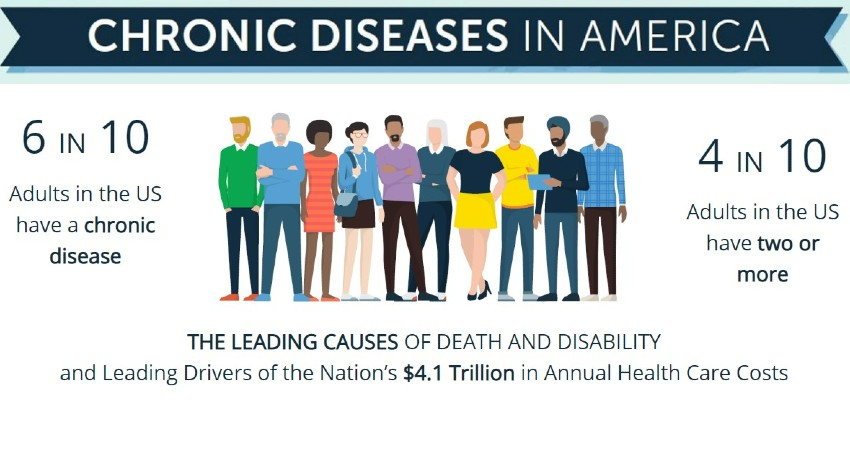
After peaking in 2014, US life expectancy has declined each subsequent year, trending far worse than peer countries. In a quarter of US counties, working-age Americans are dying at the highest rates in 40 years, reversing decades of progress. While deaths from firearms and opioids play a role, chronic diseases remain our nation’s greatest killer, erasing more than double the years of life as all overdoses, homicides, suicides, and car accidents combined.

The drivers of this trend are too numerous to list, but experts suggest targeting “the causes of the causes”, namely social factors, as the death rate gap between the rich and poor has grown almost 15x faster than the income gap since 1980. 

The Gist: This reporting is a sobering reminder of the responsibilities—and failures—borne by our nation’s healthcare system. 

The massive death toll of chronic disease in this country is not an indictment of the care Americans receive, but of the care and other resources they cannot access or afford. 

While it’s not the mandate of health systems to reduce systemic issues like poverty, there is no solution to the problem without health systems playing a key role in increasing access to care, while convening community resources in service of these larger goals.

CBO Report finds CMMI hasn’t saved Medicare any money

https://mailchi.mp/9fd97f114e7a/the-weekly-gist-october-6-2023?e=d1e747d2d8

Late last week, the Congressional Budget Office (CBO) released its analysis of the Center for Medicare and Medicaid Innovation (CMMI)’s spending outlays, revealing that in its first decade of operations it produced a $5.4B net increase in federal spending instead of a projected $2.8B reduction. 

Moreover, CBO revised its CMMI projection for 2021-2030 from a $77.5B net spending reduction to a $1.3B increase, predicting CMMI may only begin to generate annual savings in 2031. CBO says its updated projections largely reflect revised expectations on CMMI’s ability to identify and scale models that actually reduce Medicare spending.

CMMI was created by the Affordable Care Act (ACA) in 2010 to test new payment models and other initiatives for reducing the federal government’s healthcare costs, but of the nearly 50 models it has run, only four have become permanent programs.

The Gist: This critical report confirms what many in the healthcare world already believed: the ACA’s value-based care initiatives have largely struggled to reduce Medicare spending. 

There are plenty of policy factors to blame, including the lack of mandatory participation for providers and conflicting incentives across care models, but one factor left out of the CBO report is CMMI’s disproportionate emphasis on accountable care organizations (ACOs) to produce meaningful cost savings, even as years of data proved otherwise. 

ACOs are designed to reduce spending primarily through utilization management, but research has shown that prices, not utilization, are responsible for the US’s high medical spend relative to other countries.

While CMMI’s mission is still laudable and important, the center must make good on its 2021 “strategic refresh” if it hopes to continue receiving Congressional support.