The fight over the future of our most expensive drugs

https://www.axios.com/the-fight-over-the-future-of-our-most-expensive-drugs-034b6e4d-b596-4f48-9b53-6e2c267e01e3.html

An illustration of a hammer and a concrete pill.

The market designed to create competition for biologics — typically our most expensive drugs — has been slow to take off, but some experts say that even its best-case scenario doesn’t do enough to lower drug prices.

Why it matters: While wonks debate the future of biosimilars in policy journals and on editorial pages, the argument is reflected in the political divide over whether enhanced drug competition or price regulation is the best way to address drug prices.

The big picture: Congress created the pathway for biosimilars to come to market knowing that they’d look different than small-molecule generics, and even their most ardent supporters say biosimilars will never achieve the steep discounts that generics do.

  • That’s because biosimilars are much harder to make than normal generics, meaning that drug companies have to charge enough to make their endeavor worthwhile.
  • Nevertheless, the Biosimilars Council says on its website that biosimilars could lead to more than $54 billion in savings over the next decade. A recent analysis by the Pacific Research Institute found that biosimilars could save $7.2 billion a year under the most optimistic modeled scenario.

Yes, but: Some experts are arguing that that’s not enough, and that biosimilars aren’t the best way to control biologic prices.

  • Last week, Memorial Sloan Kettering Cancer Center’s Peter Bach and MIT’s Mark Trusheim published an editorial in the Wall Street Journal arguing that biosimilars don’t produce enough savings and that the resources spent developing them would be better used to bring new, innovative drugs to market.
  • Bach and Trusheim proposed that the government instead regulate the price of older biologics after they’ve been on the market for a certain period of time, which they wrote could save around $50 billion a year.

The other side: Former FDA Commissioner Scott Gottlieb wrote an editorial in the WSJ yesterday in response, arguing that Congress should speed up the use and development of biosimilars instead of regulating prices.

  • “Among other dangers, [price regulation] could trigger shortages of the drugs. It would also discourage investment in manufacturing, as few drugmakers would want to produce complex drugs in perpetuity for little profit,” Gottlieb writes.

The bottom line: This argument isn’t just for the academics. The leading Democratic presidential candidates are also arguing for drug price regulation, a major shift left for the party.

  • “Price regulation may be a tough sell in some quarters, but it’s the best way to keep the promise of America’s extraordinary pharmaceutical industry alive,” Bach and Trusheim write.


The provider lobby takes on Congress

https://www.axios.com/the-provider-lobby-takes-on-congress-57d2acc6-b26b-4b57-aa64-a75606e612b8.html

Illustration of a giant health plus on top of a pile of cash, the ground underneath is cracking.

Ending surprise medical bills inspires bipartisan kumbaya in a way nearly unheard of these days, and yet a brutal lobbying and public relations blitz by doctor and hospital groups is threatening to kill the entire effort.

Driving the news: Provider-backed groups are spending millions of dollars to sway lawmakers and the public opinion against Congress’s efforts to ban surprise billing, according to a handful of recent reports.

Details:

  • A dark money group called Doctor Patient Unity has spent more than $13 million on advertising in states where senators are up for re-election, Bloomberg Government reported on Monday — the most expensive campaign on any congressional health care topic this year.
  • Modern Healthcare’s Susannah Luthi reported yesterday that some congressional staffers worry that the provider onslaught will cause the entire surprise billing effort to collapse. The staffers say that may be what the groups want; providers insist this isn’t the case.
  • My colleague Bob Herman reported last week that physician outsourcing companies — which are often the source of surprise medical bills — and private equity firms have flooded Congress with lobbyists.

The other side: Other congressional aides are less worried about the surprise billing effort being killed.

  • “If anything, [providers’] tactics are backfiring. Compassion is winning. Members are more concerned for patients than a profit fight between industries,” a GOP aide familiar with the effort told me.
  • Instead, “members are beginning to question private equity’s interest in this. What is it they’re willing to invest $13 million to save and why are they hiding behind dark money?”


Medicare Advantage is booming but not producing savings, report finds

https://www.healthcaredive.com/news/medicare-advantage-is-booming-but-not-producing-savings-report-finds/561187/

Image result for Medicare Advantage is booming but not producing savings, report finds

Dive Brief:

  • Medicare Advantage is not producing any savings but spends between 2% and 5.5% more than traditional Medicare, a report in Health Affairs finds.
  • On the other hand, the report found Medicare’s accountable care organizations are reducing costs as compared to traditional Medicare. The Medicare Shared Savings Program, which includes accountable care organizations, saved about 1% to 2% in 2016. 
  • The authors suggest a number of changes for policymakers to consider if they want to improve competition and address flaws among the two programs.

Dive Insight:

As the popularity of programs such as Medicare Advantage grows, it’s important to understand the spending ramifications and whether the program is yielding any savings for taxpayers.

More and more seniors are choosing coverage options outside of traditional Medicare. Together, Medicare Advantage and the Medicare Shared Savings Program cover about half of all Medicare beneficiaries. In a six-year period, Medicare Advantage alone grew by 57% and as of 2018 covered nearly 20 million seniors.

Medicare Advantage allows private insurers to contract with the federal government to care for eligible Medicare beneficiaries. Private plans receive a fixed payment — typically a per member, per month allotment — to coordinate care for beneficiaries who choose MA plans. 

It’s these “predictable” payments that allow MA plans to invest in unconventional coverage options such as meal delivery and transportation to appointments, the authors said.

But despite the program’s popularity, it’s not yielding the savings that was originally expected.

“When a beneficiary joins MA, Medicare spends more, on average, than it would have if the patient had remained in traditional Medicare. We find the opposite in the MSSP: When a patient joins the Medicare ACO program, Medicare costs fall,” according to Health Affairs.

There are also differences between the two programs that should be fixed, the authors said. 

The MSSP is only punitive, which is not true for the star-rating program for MA. One way to achieve a more equitable ratings system is to “radically” reduce the number of quality measures, which have become a burden for physicians, the authors said.

“We propose limiting quality measurement to five measures that are outcome oriented: hospital and ER use, patient satisfaction, and diabetes A1c and blood pressure control.”

It’s also important to find a risk adjustment model that can be used for both MA and MSSP populations, the authors said.

CMS has committed itself to reducing the amount of burden on payers and providers, and paring down quality ratings overhead is a key part of that. The agency’s removed a number of measures across its reporting programs in 2018 as part of its “Meaningful Measures” initiative, and is currently looking at others in MSSP, MA and the Merit-based Incentive Payment System.


The Facts on Medicare Spending and Financing

https://www.kff.org/medicare/issue-brief/the-facts-on-medicare-spending-and-financing/

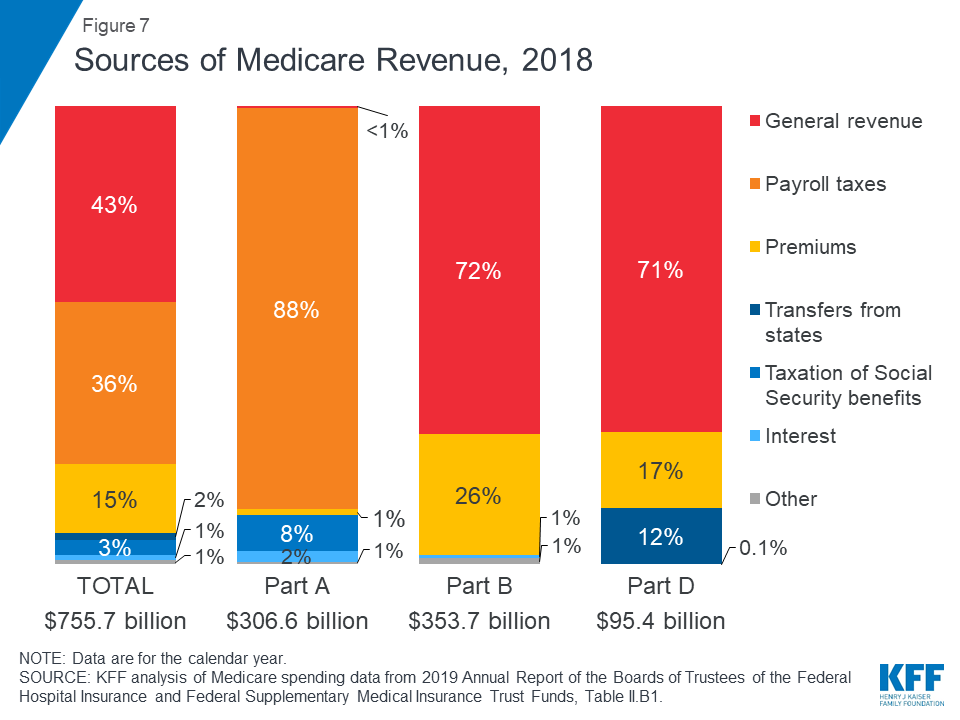
Figure 7: Sources of Medicare Revenue, 2018

Medicare, the federal health insurance program for more than 60 million people ages 65 and over and younger people with long-term disabilities, helps to pay for hospital and physician visits, prescription drugs, and other acute and post-acute care services. This issue brief includes the most recent historical and projected Medicare spending data published in the 2019 annual report of the Boards of Medicare Trustees from the Centers for Medicare & Medicaid Services (CMS) Office of the Actuary (OACT) and the 2019 Medicare baseline and projections from the Congressional Budget Office (CBO).

Key Facts
  • Medicare spending was 15 percent of total federal spending in 2018, and is projected to rise to 18 percent by 2029.
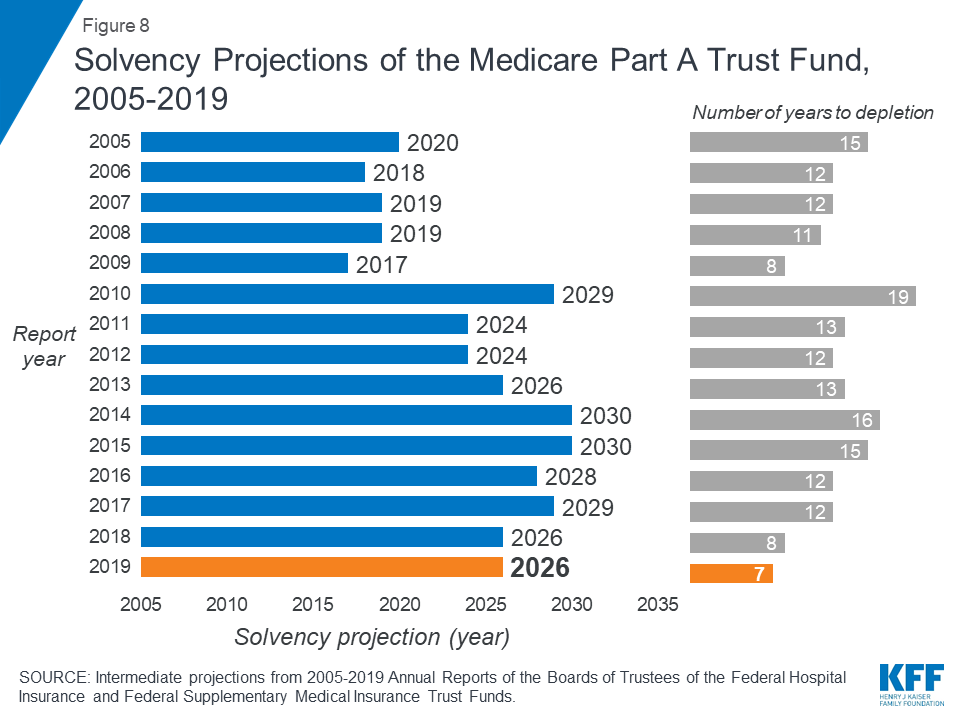
  • Based on the latest projections in the 2019 Medicare Trustees report, the Medicare Hospital Insurance (Part A) trust fund is projected to be depleted in 2026, the same as the 2018 projection.
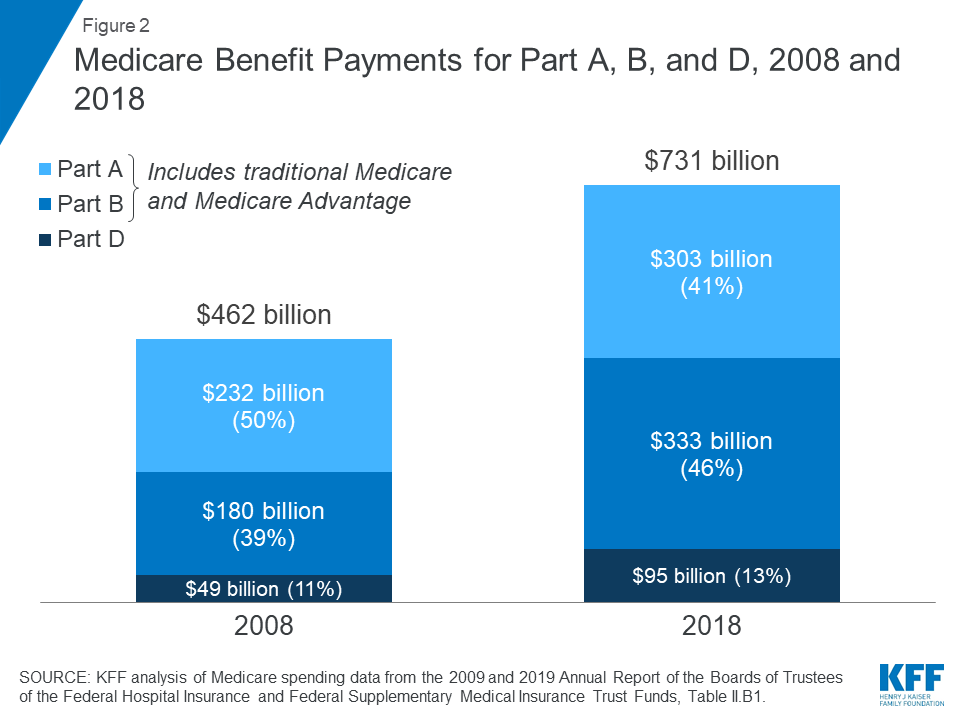
  • In 2018, Medicare benefit payments totaled $731 billion, up from $462 billion in 2008.
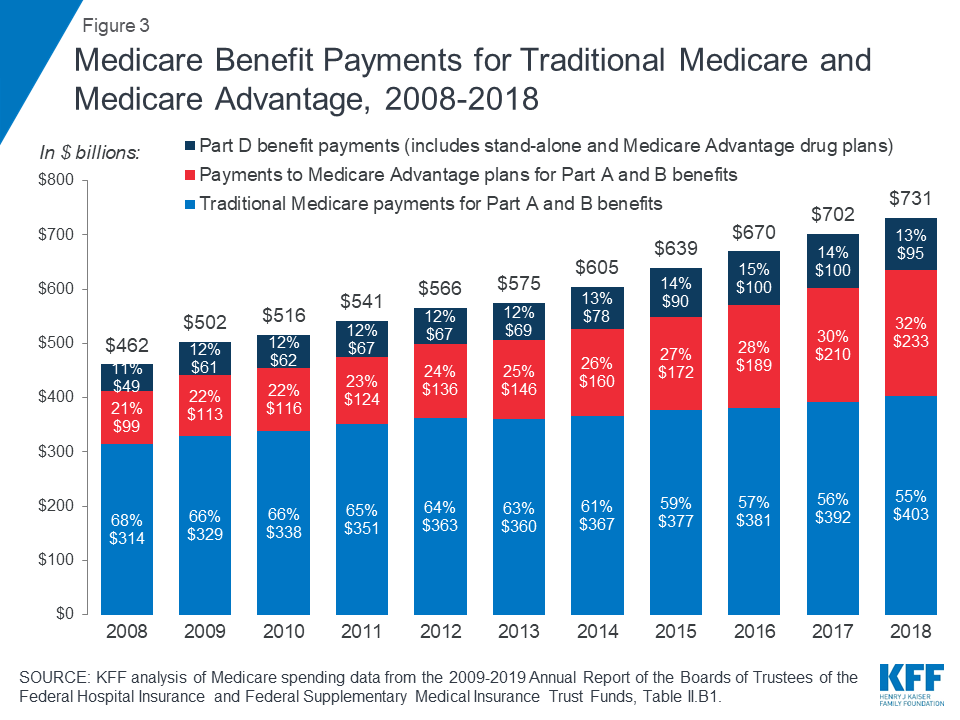
  • As a share of total Medicare benefit spending, payments to Medicare Advantage plans for Part A and Part B benefits increased by nearly 50 percent between 2008 and 2018, from 21 percent ($99 billion) to 32 percent ($232 billion) of total spending, as enrollment in Medicare Advantage plans increased over these years.
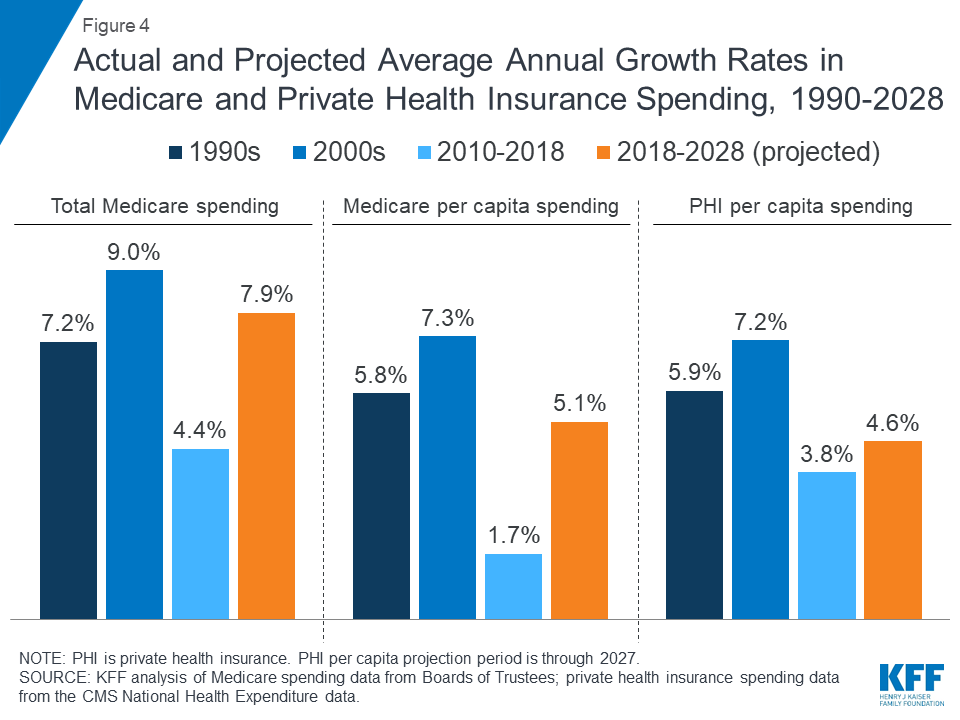
  • Average annual growth in Medicare per capita spending was 1.7 percent between 2010 and 2018, down from 7.3 percent between 2000 and 2010, due in part to the Affordable Care Act’s reductions in payments to providers and plans, and to an influx of younger beneficiaries from the baby boom generation aging on to Medicare, who have lower per capita health care costs.
  • Medicare per capita spending is projected to grow at an average annual rate of 5.1 percent over the next 10 years (2018 to 2028), due to growing Medicare enrollment, increased use of services and intensity of care, and rising health care prices.

Overview of Medicare Spending

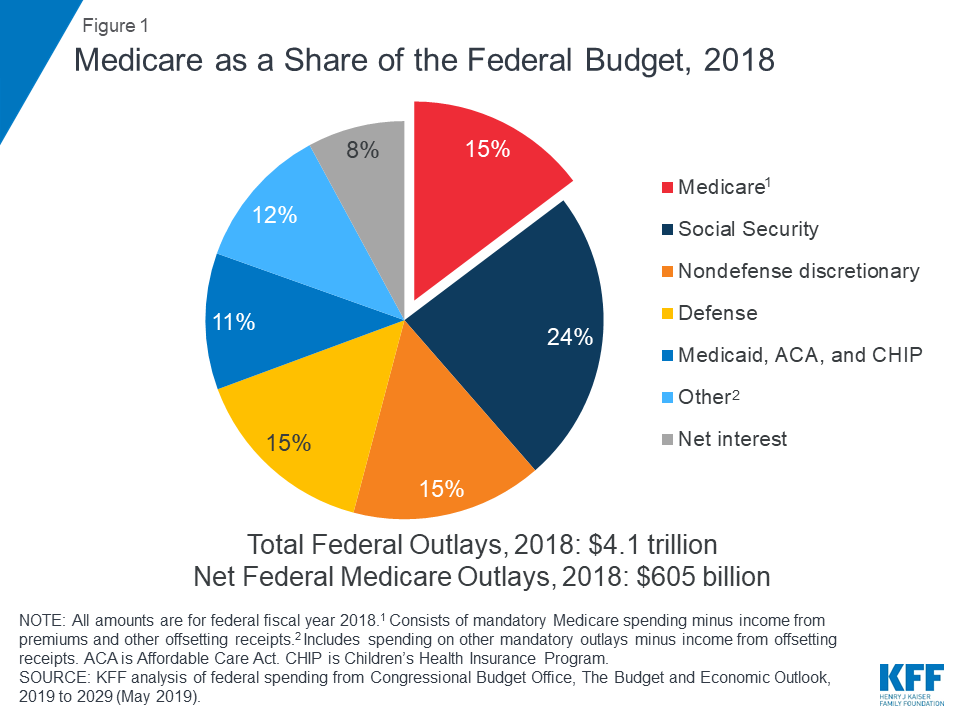
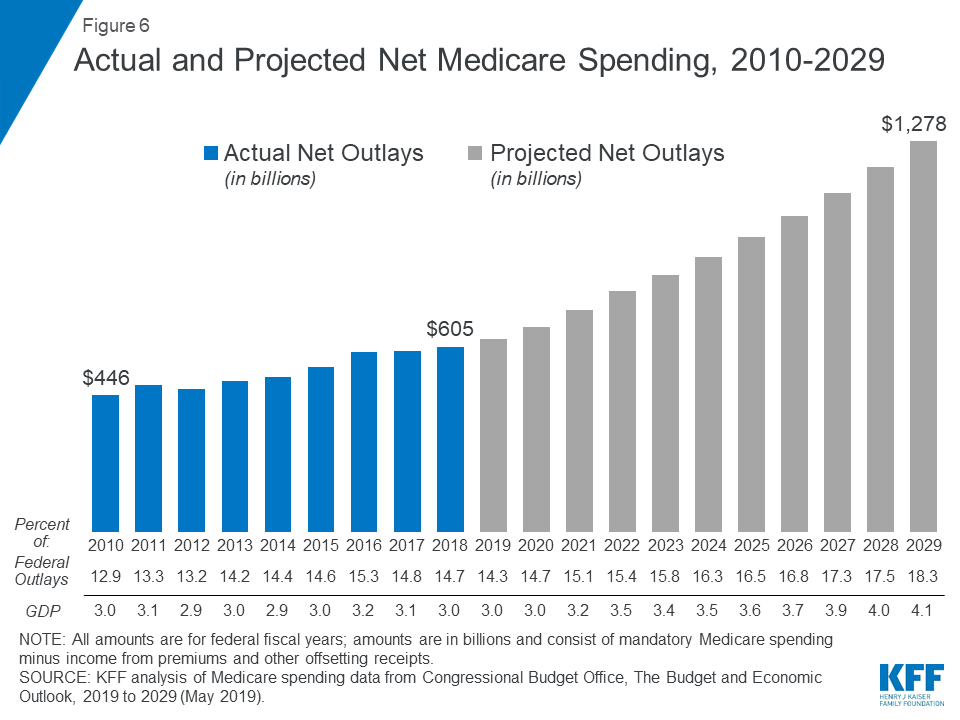
Medicare plays a major role in the health care system, accounting for 20 percent of total national health spending in 2017, 30 percent of spending on retail sales of prescription drugs, 25 percent of spending on hospital care, and 23 percent of spending on physician services. In 2018, Medicare spending (net of income from premiums and other offsetting receipts) totaled $605 billion, accounting for 15 percent of the federal budget (Figure 1).

Figure 1: Medicare as a Share of the Federal Budget, 2018

Historical Trends in Medicare Spending

Trends in Medicare Benefit Payments

In 2018, Medicare benefit payments totaled $731 billion, up from $462 billion in 2008 (Figure 2) (these amounts do not net out premiums and other offsetting receipts). While benefit payments for each part of Medicare (A, B, and D) increased in dollar terms over these years, the share of total benefit payments represented by each part changed. Spending on Part A benefits (mainly hospital inpatient services) decreased from 50 percent to 41 percent, spending on Part B benefits (mainly physician services and hospital outpatient services) increased from 39 percent to 46 percent, and spending on Part D prescription drug benefits increased from 11 percent to 13 percent.

Figure 2: Medicare Benefit Payments for Part A, B, and D, 2008 and 2018

Another notable change in Medicare spending in the past 10 years is the increase in payments to Medicare Advantage plans, which are private health plans that cover all Part A and Part B benefits, and typically also Part D benefits. As a percent of total Medicare benefit spending, payments for Part A and Part B benefits covered by Medicare Advantage plans increased by nearly 50 percent between 2008 and 2018, from 21 percent ($99 billion) to 32 percent ($232 billion), as private plan enrollment grew steadily over these years (Figure 3). In 2018, 34 percent of Medicare beneficiaries were enrolled in Medicare Advantage plans, up from 22 percent in 2008.

Figure 3: Medicare Benefit Payments for Traditional Medicare and Medicare Advantage, 2008-2018

The overall cost of administering benefits for traditional Medicare is relatively low. In 2018, administrative expenses for traditional Medicare (plus CMS administration and oversight of Part D) were 1.3 percent of total program spending; this includes expenses for the contractors that process claims submitted by beneficiaries in traditional Medicare and their providers. This estimate does not include insurers’ costs of administering private Medicare Advantage and Part D drug plans, which are considerably higher. Medicare’s actuaries estimate that insurers’ administrative expenses and profits for Part D plans were 10.7 percent of total plan benefit payments in 2018. The actuaries have not provided a comparable estimate for Medicare Advantage plans; however, according to a recent analysis, simple loss ratios (medical expenses as a share of total premiums collected) averaged 86 percent for Medicare Advantage plans in 2018, which means that administrative expenses, including profits, were 14 percent for Medicare Advantage plans.

Trends in Total and Per Capita Medicare Spending

There has been a notable reduction in the growth of Medicare spending in recent years, compared to prior decades, both overall and per beneficiary.

  • Average annual growth in total Medicare spending was 4.4 percent between 2010 and 2018, down from 9.0 percent between 2000 and 2010, despite faster growth in enrollment since 2011 when the baby boom generation started becoming eligible for Medicare (Figure 4).
  • Average annual growth in Medicare spending per beneficiary was just 1.7 percent between 2010 and 2018, down from 7.3 percent between 2000 and 2010.
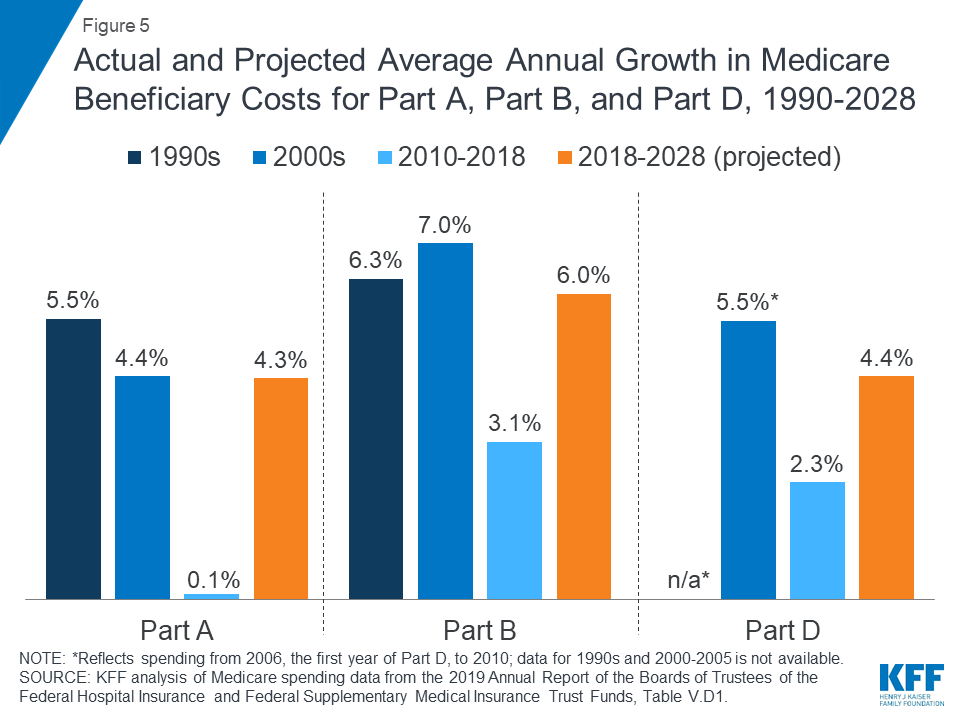
  • Spending on each of the three parts of Medicare (A, B, and D) has grown more slowly in recent years than in previous decades (Figure 5). For example, the average annual growth rate between 2010 and 2018 was 0.1 percent for Part A, compared to 4.4 percent in the 2000s, and 3.1 percent for Part B, compared to 7.0 percent in the 2000s.

Figure 4: Actual and Projected Average Annual Growth Rates in Medicare and Private Health Insurance Spending, 1990-2028

Figure 5: Actual and Projected Average Annual Growth in Medicare Beneficiary Costs for Part A, Part B, and Part D, 1990-2028

Slower growth in Medicare spending in recent years can be attributed in part to policy changes adopted as part of the Affordable Care Act (ACA) and the Budget Control Act of 2011 (BCA). The ACA included reductions in Medicare payments to plans and providers, increased revenues, and introduced delivery system reforms that aimed to improve efficiency and quality of patient care and reduce costs, including accountable care organizations (ACOs), medical homes, bundled payments, and value-based purchasing initiatives. The BCA lowered Medicare spending through sequestration that reduced payments to providers and plans by 2 percent beginning in 2013.

In addition, although Medicare enrollment has been growing between 2 percent and 3 percent annually for several years with the aging of the baby boom generation, the influx of younger, healthier beneficiaries has contributed to lower per capita spending and a slower rate of growth in overall program spending.

Spending Trends for Medicare Compared to Private Health Insurance

Prior to 2010, per enrollee spending growth rates were comparable for Medicare and private health insurance. With the recent slowdown in the growth of Medicare spending and the recent expansion of private health insurance through the ACA, however, the difference in growth rates between Medicare and private health insurance spending per enrollee has widened.

  • In the 1990s and 2000s, Medicare spending per enrollee grew at an average annual rate of 5.8 percent and 7.3 percent, respectively, compared to 5.9 percent and 7.2 percent for private insurance spending per enrollee (Figure 4).
  • Between 2010 and 2018, Medicare per capita spending grew considerably more slowly than private insurance spending, increasing at an average annual rate of just 1.7 percent over this time period, while average annual private health insurance spending per capita grew at 3.8 percent.

Medicare Spending Projections

Short-Term Spending Projections for the Next 10 Years

While Medicare spending is expected to continue to grow more slowly in the future compared to long-term historical trends, Medicare’s actuaries project that future spending growth will increase at a faster rate than in recent years, in part due to growing enrollment in Medicare related to the aging of the population, increased use of services and intensity of care, and rising health care prices.

Looking ahead, CBO projects Medicare spending will double over the next 10 years, measured both in total and net of income from premiums and other offsetting receipts. CBO projects net Medicare spending to increase from $630 billion in 2019 to $1.3 trillion in 2029 (Figure 6). Between 2019 and 2029, net Medicare spending is also projected to grow as a share of the federal budget—from 14.3 percent to 18.3 percent—and the nation’s economy—from 3.0 percent to 4.1 percent of gross domestic product (GDP).

Figure 6: Actual and Projected Net Medicare Spending, 2010-2029

Spending Growth Rate Projections for the Next 10 Years

  • Average annual growth in total Medicare spending is projected to be higher between 2018 and 2028 than between 2010 and 2018 (7.9 percent versus 4.4 percent) (Figure 4).
  • On a per capita basis, Medicare spending is also projected to grow at a faster rate between 2018 and 2028 (5.1 percent) than between 2010 and 2018 (1.7 percent), and slightly faster than the average annual growth in per capita private health insurance spending over the next 10 years (4.6 percent).
  • Medicare’s actuaries project a higher per capita growth rate in the coming decade for each part of Medicare, compared to their 2010-2018 growth rates: 6.0 percent for Part B, 4.4 percent for Part D, and 4.3 percent for Part A (Figure 5).
  • Among the reasons cited for projected growth in Part B spending are legislative changes in the Bipartisan Budget Act (BBA) of 2018, including repeal of the Independent Payment Advisory Board (which also affects Part A and Part D spending projections) and repealing annual limits on therapy services covered under Part B, and higher Medicare Advantage spending. Projected increases in Part B per capita spending will lead to increases in the Part B premium and deductible.
  • The projected increase in Part D per capita spending growth is driven by a slowdown in the generic dispensing rate and increased specialty drug use, offset by higher manufacturer rebates negotiated by private plans and a decline in spending for hepatitis C drugs, which was a significant driver of higher total Part D spending in 2014 and 2015.

Long-term Spending Projections

Over the longer term (that is, beyond the next 10 years), both CBO and OACT expect Medicare spending to rise more rapidly than GDP due to a number of factors, including the aging of the population and faster growth in health care costs than growth in the economy on a per capita basis. According to CBO’s most recent long-term projections, net Medicare spending will grow from 3.0 percent of GDP in 2019 to 6.0 percent in 2049.

Over the next 30 years, CBO projects that “excess” health care cost growth—defined as the extent to which the growth of health care costs per beneficiary, adjusted for demographic changes, exceeds the per person growth of potential GDP (the maximum sustainable output of the economy)—will account for half of the increase in spending on the nation’s major health care programs (Medicare, Medicaid, and subsidies for ACA Marketplace coverage), and the aging of the population will account for the other half.

How is Medicare Financed?

Medicare is funded primarily from general revenues (43 percent), payroll taxes (36 percent), and beneficiary premiums (15 percent) (Figure 7).

Figure 7: Sources of Medicare Revenue, 2018

  • Part A is financed primarily through a 2.9 percent tax on earnings paid by employers and employees (1.45 percent each) (accounting for 88 percent of Part A revenue). Higher-income taxpayers (more than $200,000/individual and $250,000/couple) pay a higher payroll tax on earnings (2.35 percent).
  • Part B is financed through general revenues (72 percent), beneficiary premiums (26 percent), and interest and other sources (2 percent). Beneficiaries with annual incomes over $85,000/individual or $170,000/couple pay a higher, income-related Part B premium reflecting a larger share of total Part B spending, ranging from 35 percent to 85 percent.
  • Part D is financed by general revenues (71 percent), beneficiary premiums (17 percent), and state payments for beneficiaries dually eligible for Medicare and Medicaid (12 percent). Higher-income enrollees pay a larger share of the cost of Part D coverage, as they do for Part B.
  • The Medicare Advantage program (Part C) is not separately financed. Medicare Advantage plans, such as HMOs and PPOs, cover Part A, Part B, and (typically) Part D benefits. Beneficiaries enrolled in Medicare Advantage plans pay the Part B premium, and may pay an additional premium if required by their plan; about half of Medicare Advantage enrollees pay no additional premium.

Assessing Medicare’s Financial Condition

Medicare’s financial condition can be assessed in different ways, including comparing various measures of Medicare spending—overall or per capita—to other spending measures, such as Medicare spending as a share of the federal budget or as a share of GDP, as discussed above, and estimating the solvency of the Medicare Hospital Insurance (Part A) trust fund.

Solvency of the Medicare Hospital Insurance Trust Fund

The solvency of the Medicare Hospital Insurance trust fund, out of which Part A benefits are paid, is one way of measuring Medicare’s financial status, though because it only focuses on the status of Part A, it does not present a complete picture of total program spending. The solvency of Medicare in this context is measured by the level of assets in the Part A trust fund. In years when annual income to the trust fund exceeds benefits spending, the asset level increases, and when annual spending exceeds income, the asset level decreases. When spending exceeds income and the assets are fully depleted, Medicare will not have sufficient funds to pay all Part A benefits.

Each year, Medicare’s actuaries provide an estimate of the year when the asset level is projected to be fully depleted. In the 2019 Medicare Trustees report, the actuaries projected that the Part A trust fund will be depleted in 2026, the same year as their 2018 projection and three years earlier than their 2017 projection (Figure 8). The actuaries estimate that Medicare will be able to cover 89 percent of Part A costs from payroll tax revenue in 2026.

Figure 8: Figure 8: Solvency Projections of the Medicare Part A Trust Fund, 2005-2019

In the 2018 and 2019 Medicare Trustees reports, the actuaries attributed the earlier depletion date to several factors, including legislative changes enacted since the 2017 report that will reduce revenues to the Part A trust fund and increase Part A spending:

  • lower-than-expected revenues from payroll taxes in 2017 and 2018 due to lowered wages and lower levels of projected GDP;
  • lower revenue projections from taxation of Social Security benefits (which provided 8 percent of Part A revenues in 2018) as a result of the tax cut legislation enacted in December 2017;
  • higher-than-expected spending for Part A benefits and higher projected provider payment updates;
  • higher spending projections due repeal of the ACA’s individual mandate, which is expected to increase the number of people without health insurance, which will result in an increase in Medicare’s disproportionate share hospital (DSH) payments for uninsured patients; and
  • higher spending projections due to repeal of the Independent Payment Advisory Board, which would have helped to control Medicare spending if the growth rate exceeded certain target levels.

In general, Part A trust fund solvency is also affected by the level of growth in the economy, which affects Medicare’s revenue from payroll tax contributions, by overall health care spending trends, and by demographic trends—of note, an increasing number of beneficiaries, especially between 2010 and 2030 when the baby boom generation reaches Medicare eligibility age, and a declining ratio of workers per beneficiary making payroll tax contributions.

Part B and Part D do not have financing challenges similar to Part A, because both are funded by beneficiary premiums and general revenues that are set annually to match expected outlays. Expected future increases in spending under Part B and Part D, however, will require increases in general revenue funding and higher premiums paid by beneficiaries.

The Future Outlook

Although Medicare spending is on a slower upward trajectory now than in past decades, total and per capita annual growth rates are trending higher than their historically low levels of the past few years. The aging of the population, growth in Medicare enrollment due to the baby boom generation reaching the age of eligibility, and increases in per capita health care costs are leading to growth in overall Medicare spending. At the same time, recent legislative changes, including repeal of the ACA’s individual mandate and repealing IPAB, have worsened the short-term outlook for the Medicare Part A trust fund and have led to projections of higher Medicare spending in the future.

A number of changes to Medicare have been proposed in the past to address the fiscal challenges posed by the aging of the population and rising health care costs. Lately, policymakers have been focused more narrowly on policy options to control Medicare prescription drug spending, rather than on broader proposals to reduce the growth in Medicare spending. And there has been little discussion of revenue options that could be considered to help finance care for Medicare’s growing and aging population, including raising the Medicare payroll tax or increasing other existing taxes. Meanwhile, Medicare has featured prominently in the 2020 presidential campaign, with proposals from some Democratic candidates to expand on it as part of a Medicare-for-all plan, and ideas from others to allow people to buy into it.

The prospects for proposals that would affect Medicare’s financial outlook are unknown, but they will require careful deliberation over the effects on not only the program’s finances but also its growing number of beneficiaries.


Trump considers payroll tax cut — what it could mean for healthcare

https://www.beckershospitalreview.com/finance/trump-considers-payroll-tax-cut-what-it-could-mean-for-healthcare.html?origin=cfoe&utm_source=cfoe

The White House is considering a payroll tax cut, President Donald Trump confirmed Aug. 20, according to The Washington Post.

The president’s confirmation comes after the White House disputed that it was considering a payroll tax cut, the Post reported Aug. 19. The tax would help jump-start a slowing economy by giving low- and middle-income Americans more spending power.

However, payroll taxes do help fund Medicare. A cut could significantly handicap that program, which is just seven years away from running dry, depending on how the tax is designed. A payroll tax cut of two percentage points in 2011-12 reduced taxes by more than $100 billion each year, according to The Washington Post. During those years, the Obama administration redirected revenue to Social Security programs and the federal deficit took the hit, according to the report.

Read more here.


Where the AHA is focusing its lobbying efforts in September

https://www.aha.org/news/perspective/2019-08-16-perspective-gearing-busy-september-capitol-hill

Image result for american hospital association headquarters

Two weeks ago, I wrote about the important role AHA member hospitals and health system leaders play in advocating for the field. This week, I’ll tell you exactly what we’re advocating for when Congress returns in September … and how you can help.
 
Here’s where things stand: There will be three issues before Congress next month that could greatly affect our field: surprise medical billing, the planned Medicaid disproportionate share hospital cuts and prescription drug pricing.
 
The AHA and its members strongly support protecting patients from surprise medical bills. However, we have concerns about the proposals in the House Energy & Commerce Committee and the Senate Health, Education, Labor & Pensions Committee, which both contain a rate-setting approach for settling out-of-network claims.
 
We believe providers and insurers should continue to be permitted to negotiate payment rates for services provided … and we strongly oppose approaches that would impose arbitrary rates on providers. Hospitals and health systems work hard to align physician networks, but we cannot compromise independent physicians’ abilities to negotiate fair contract terms with payers. These approaches would add unnecessary complexity and burden to the system.
 
On Medicaid DSH, legislators need to act before Oct. 1 or $4 billion in automatic cuts to hospitals and health systems will go into effect. This will be followed by another $8 billion the following year. If these cuts proceed, they will threaten our ability to care for the most vulnerable members of society. The good news is that there’s strong support in the House for preventing these cuts from kicking in: The House Energy and Commerce Committee passed legislation last month that would eliminate the Medicaid DSH cuts for the next two fiscal years and reduce the cuts by half in the following year. So let’s make sure the Senate acts on this.
 
In addition, on drug pricing, legislators recognize that skyrocketing drug prices — as well as shortages for many critical medicines — are hurting patients and the hospitals and health systems that care for them each day. The Senate Finance Committee has taken an important step forward by advancing a drug pricing package to the full Senate. More work needs to be done, though … especially in the House.
 
Here’s where you come in: Your legislators need to hear from you. Urge them to protect patients while rejecting proposals such as rate-setting or setting a “reference” or “benchmark” price. Keep encouraging them to prevent the Medicaid DSH cuts from kicking in so we can make sure the most vulnerable can access care. And tell them how important it is to rein in the skyrocketing costs of prescription drugs.
 
You can read our latest Action Alert here, which includes key resources for talking with your legislators over the congressional recess.
 
On Sept. 10, we’re holding an advocacy day on Capitol Hill … so please make plans to join us if you can and add your voice to those of your colleagues.
 
At the same time, as we all know, the recent tragic events in El Paso, Dayton and Gilroy have increased the focus on addressing gun violence. Be certain: We will continue to give voice to the fact that violence is a serious health problem, as hospitals and health systems are on the front lines of taking care of the victims and serving their communities. Beyond supporting research and education and highlighting the innovative actions taken by our members to address all forms of community violence, we’ll also continue to closely monitor evolving efforts to develop bipartisan, consensus legislation in regard to more specific approaches to address this serious problem. 
 
You are leaders in your communities. You are the experts on health care. And when you speak up, your senators and representatives listen. Together, it’s time to engage with them so we can ensure every hospital and health system has the tools they need to always be there, ready to care.


Trade Secrets Challenge Could Trip Up Trump Hospital Prices Plan

https://news.bloomberglaw.com/health-law-and-business/trade-secrets-challenge-could-trip-up-trump-hospital-prices-plan

Image result for Trade Secrets Challenge Could Trip Up Trump Hospital Prices Plan

A legal fight is looming over a Trump administration proposal that would require hospitals to list their standard prices for medical services and their negotiated rates with insurance companies—prices some believe are proprietary.

Hospital and insurance groups are likely to sue if the administration moves forward with a final rule, and the litigation could raise thorny legal questions about a company’s right to be competitive and a patient’s right to make informed health-care choices.

One way hospitals and insurance groups may try to fight the rule is by claiming their negotiated prices are trade secrets, health attorneys say.

“We’ve been looking in our research group at whether health-care prices can be trade secrets, and the law is very unsettled on this issue,” said Jaime King, associate dean and professor of law at the University of California Hastings College of Law in San Francisco.

The Centers for Medicare & Medicaid Services issued the proposed rule July 29 as part of a Trump administration push to make health-care costs more transparent.

It would require hospitals to list their standard prices and what individual insurers have agreed to pay for 70 “shoppable” medical services—like psychotherapy, blood tests, MRIs and ultrasounds—that can be scheduled in advance.

The government’s goal is to give consumers the information they need to compare what hospitals charge for similar services and to help them understand their potential financial liability for services they obtain at the hospital. Hospitals that fail to comply would be fined.

Listing the negotiated price an insurance company will pay on a patient’s behalf will show consumers how effective different health insurers are at negotiating lower out-of-pocket costs, attorneys say.

“We believe that this, in turn, will enable health-care consumers to make more informed decisions, increase market competition, and ultimately drive down the cost of health-care services, making them more affordable for all patients,” the CMS said in its proposal.

Legal Authority Questioned

The American Hospital Association was quick to object, contending in a prepared statement that the plan “exceeds the administration’s legal authority.” If the proposal is finalized, the trade group said it would look at its legal options.

“I think it’s reasonable for hospital groups to be looking at potential challenges if the rule is finalized as proposed,” said Philo Hall, senior counsel in Epstein, Becker and Green LLP’s health-care and life sciences practice.

The Affordable Care Act amended the Public Health Service Act by requiring hospitals to make public their “standard prices” for items and services. Attorneys say the CMS is now interpreting standard prices to also include the privately negotiated rates for each individual insurer.

But neither Congress, the Department of Health and Human Services, nor hospital groups have ever considered the standard prices provision in the ACA to include commercial and financial information that is treated as confidential in a highly competitive industry, said Hall. Hall served as counsel to the George W. Bush administration’s HHS Secretary Michael Leavitt and worked closely in that role with Alex Azar, the current HHS chief.

“The concern that the government is overstepping is not frivolous,” said Michael Adelberg, a former senior CMS official who now leads the health-care strategy practice of the Faegre, Baker, Daniels Consulting.

“I don’t know if you can say to two entities ‘You can engage in a contract in a competitive market, but the most important terms of that contract are public,’” he said. “I don’t know if you can do that.”

In a statement, America’s Health Insurance Plans said the CMS proposal would make it harder for insurance companies to bargain for lower rates. The group said even the Federal Trade Commission agrees that making hospitals disclose their privately negotiated rates would create a floor—not a ceiling—for what hospitals would be willing to accept.

When the HHS Office of the National Coordinator for Health Information Technology indicated in a proposal that it was considering adding network discounts and pricing data to the definition of electronic health information, UnitedHealth Group told the agency the details of the negotiated rates and the overall cost of its networks is a trade secret.

“Although federal courts have upheld regulations compelling the disclosure of Medicare cost report information, there is a significant difference between government payment information held by the government and the internal, proprietary information that the proposed regulation would compel UHC to disclose,” the insurance company said in comments in June.

CMS Could Prevail

The CMS proposal is similar to an HHS rule that would have required pharmaceutical companies to disclose the list price of their drugs in TV advertisements. A federal district court judge in July said the rule exceeded the administration’s regulatory authority and blocked it from taking effect.

In the drug pricing rule, the agency pointed to two provisions in the Social Security Act that tell the HHS secretary to make rules necessary for the “efficient administration of the Medicare and Medicaid program” as the source of authority.

But the U.S. District Court for the District of Columbia said there’s nothing in the law’s text, structure, or context to indicate Congress intended to give the HHS the power to issue a rule that forces drugmakers to disclose their list prices.

Attorneys say the agency’s authority to issue the hospital pricing rule is more explicit in the ACA.

“In this case, we have a different statutory provision that delegates the agency with a more specific task,” a former HHS attorney, who asked not to be identified, said in a conversation with Bloomberg Law.

“We’re not talking about a general statute concerning the efficient administration of the Medicare program to drug companies,” the former HHS attorney said. “We’re talking about an explicit statutory provision that directs the agency to require federally funded hospitals to disclose their ‘standard charges.’”

On that, the former HHS attorney said, the CMS could prevail. But it depends on how the agency defines “standard charges.” The agency could ultimately decide not to include negotiated rates after it considers the public comments.

In a statement, the CMS said its proposal is consistent with the ACA and responsive to patients and their advocates who say knowledge of negotiated rates is necessary for individuals to be able to determine their out-of-pocket costs for hospital services.

“All Americans have the right to know the price of their health care up front,” an agency spokesperson said. “Health-care prices shouldn’t be a mystery and consumers will be able to shop for health care just like they do for everything else they buy.”


Federal appeals court limits hospitals’ disproportionate-share funding

https://www.modernhealthcare.com/payment/federal-appeals-court-limits-hospitals-disproportionate-share-funding?utm_source=modern-healthcare-daily-finance-wednesday&utm_medium=email&utm_campaign=20190814&utm_content=article1-headline

Hospitals that care for a large share of Medicaid, low-income and uninsured patients stand to receive less funding from the federal government after the D.C. Circuit reconsidered how Medicaid disproportionate-share hospital reimbursement is calculated.

A three-judge panel of the U.S. Court of Appeals for the District of Columbia Circuit reversed a lower court and reinstated a 2017 rule establishing that payments by Medicare and private insurers are to be included in calculating a hospital’s DSH limit, ultimately lowering its maximum reimbursement.

In Tuesday’s ruling, U.S. Circuit Judge Karen LeCraft Henderson opined that the rule aligns with the intent of the Medicaid Act.

“By requiring the inclusion of payments by Medicare and private insurers, the 2017 rule ensures that DSH payments will go to hospitals that have been compensated least and are thus most in need,” Henderson wrote.

The case, brought by four children’s hospitals in Minnesota, Virginia and Washington and an association representing eight children’s hospitals in Texas, concerns the calculation of the uncompensated costs of treating Medicaid beneficiaries known as the “Medicaid shortfall.

For instance, if a hospital spends $1 million on treating Medicaid patients who have no other healthcare coverage and Medicaid pays $600,000, then the Medicaid shortfall is $400,000. In some instances, Medicaid patients have additional third-party coverage such as Medicare or private insurance.

Hospitals cannot receive more money in Medicaid DSH payments than they spent to treat Medicaid beneficiaries or the uninsured. Part of the motivation behind that stipulation was to prevent hospitals from double dipping by collecting DSH payments to cover costs that had already been reimbursed. Previous cases also revealed that some states have made DSH payments to state psychiatric or university hospitals that exceed the net costs, or even total costs, of operating the facilities.

Providers successfully fought the 2017 rule that limited hospitals’ reimbursement. A federal judge sided with the hospitals that claimed the CMS overstepped its authority and essentially ignored payments by commercial insurers and Medicare. That was overturned Tuesday.

The Children’s Hospital Association of Texas said in a statement that it is exploring its options.

“We are disappointed with the result because it will reduce critical Medicaid funding to safety net providers like children’s hospitals,” the association said. “These hospitals are heavily reliant on Medicaid payments because between 50% and 80% of their inpatient days are covered by Medicaid. Children’s hospitals care for all children, and are, in fact, often the only place that children with complex conditions can get life-saving care.”