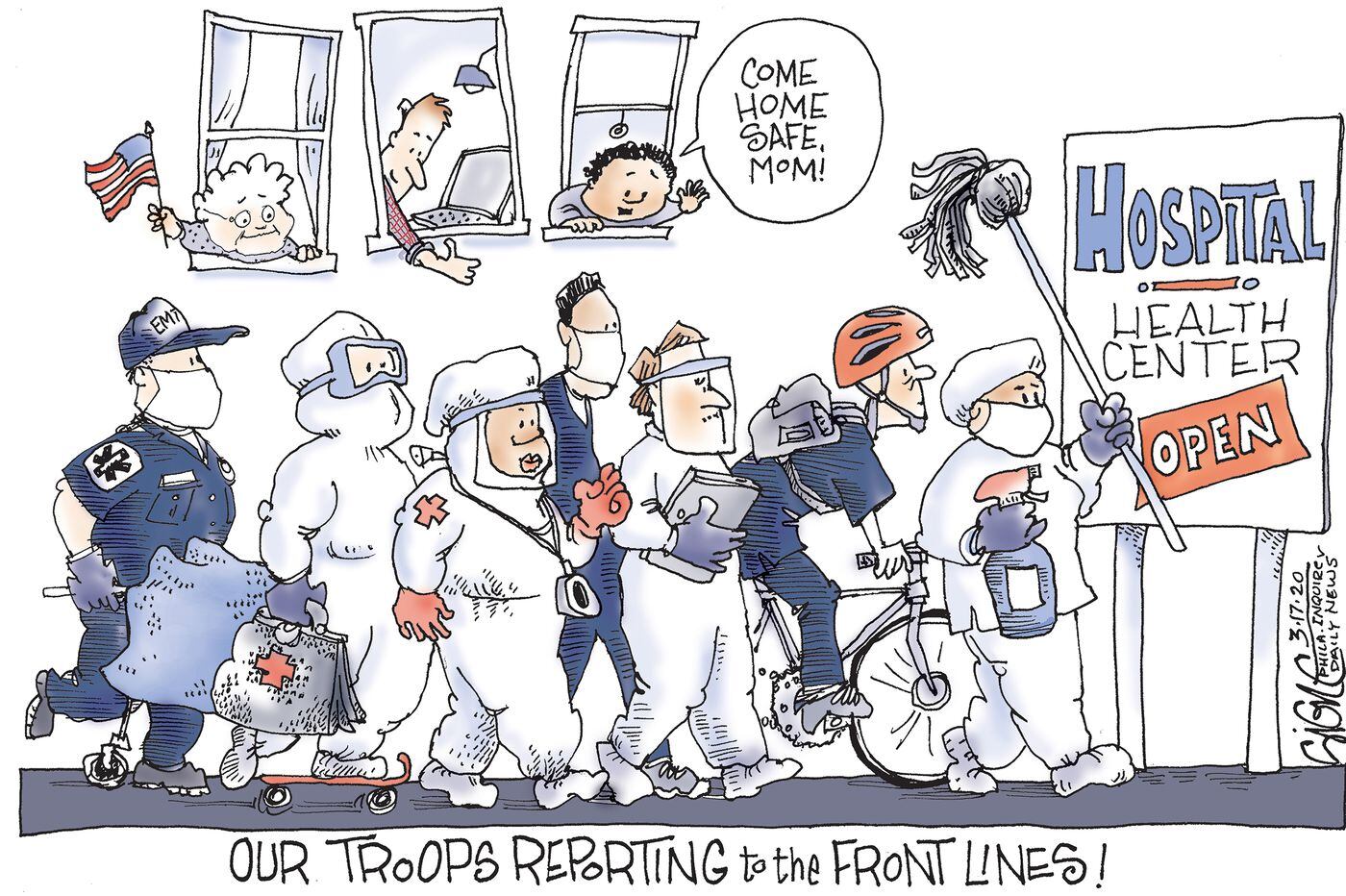
Nurses Die, Doctors Fall Sick and Panic Rises on Virus Front Lines

Nurses Die, Doctors Fall Sick and Panic Rises on Virus Front Lines ...

The pandemic has begun to sweep through New York City’s medical ranks, and anxiety is growing among normally dispassionate medical professionals.

A supervisor urged surgeons at Columbia University Irving Medical Center in Manhattan to volunteer for the front lines because half the intensive-care staff had already been sickened by coronavirus.

“ICU is EXPLODING,” she wrote in an email.

A doctor at Weill Cornell Medical Center in Manhattan described the unnerving experience of walking daily past an intubated, critically ill colleague in her 30s, wondering who would be next.

Another doctor at a major New York City hospital described it as “a petri dish,” where more than 200 workers had fallen sick.

Two nurses in city hospitals have died.

The coronavirus pandemic, which has infected more than 30,000 people in New York City, is beginning to take a toll on those who are most needed to combat it: the doctors, nurses and other workers at hospitals and clinics. In emergency rooms and intensive care units, typically dispassionate medical professionals are feeling panicked as increasing numbers of colleagues get sick.

“I feel like we’re all just being sent to slaughter,” said Thomas Riley, a nurse at Jacobi Medical Center in the Bronx, who has contracted the virus, along with his husband.

Medical workers are still showing up day after day to face overflowing emergency rooms, earning them praise as heroes. Thousands of volunteers have signed up to join their colleagues.

But doctors and nurses said they can look overseas for a dark glimpse of the risk they are facing, especially when protective gear has been in short supply.

In China, more than 3,000 doctors were infected, nearly half of them in Wuhan, where the pandemic began, according to Chinese government statistics. Li Wenliang, the Chinese doctor who first tried to raise the alarm about Covid-19, eventually died of it.

In Italy, the number of infected heath care workers is now twice the Chinese total, and the National Federation of Orders of Surgeons and Dentists has compiled a list of 50 who have died. Nearly 14 percent of Spain’s confirmed coronavirus cases are medical professionals.

New York City’s health care system is sprawling and disjointed, making precise infection rates among medical workers difficult to calculate. A spokesman for the Health and Hospitals Corporation, which runs New York City’s public hospitals, said the agency would not share data about sick medical workers “at this time.”

William P. Jaquis, president of the American College of Emergency Physicians, said the situation across the country was too fluid to begin tracking such data, but he said he expected the danger to intensify.

“Doctors are getting sick everywhere,” he said.

Last week, two nurses in New York, including Kious Kelly, a 48-year-old assistant nurse manager at Mount Sinai West, died from the disease; they are believed to be the first known victims among the city’s medical workers. Health care workers across the city said they feared many more would follow.

Mr. Riley, the nurse at Jacobi, said when he looked at the emergency room recently, he realized he and his colleagues would never avoid being infected. Patients struggling to breathe with lungs that sounded like sandpaper had crowded the hospital. Masks and protective gowns were in short supply.

“I’m swimming in this,” he said he thought. “I’m pretty sure I’m getting this.”

His symptoms began with a cough, then a fever, then nausea and diarrhea. Days later, his husband became ill. Mr. Riley said both he and his husband appear to be getting better, but are still experiencing symptoms.

Like generals steadying their troops before battle, hospital supervisors in New York have had to rally, cajole and sometimes threaten workers.

“Our health care systems are at war with a pandemic virus,” Craig R. Smith, the surgeon-in-chief at NewYork-Presbyterian Hospital, wrote in an email to staff on March 16, the day after New York City shut down its school system to contain the virus. “You are expected to keep fighting with whatever weapons you’re capable of working.”

“Sick is relative,” he wrote, adding that workers would not even be tested for the virus unless they were “unequivocally exposed and symptomatic to the point of needing admission to the hospital.”

“That means you come to work,” he wrote. “Period.”

Arriving to work each day, doctors and nurses are met with confusion and chaos.

At a branch of the Montefiore hospital system in the Bronx, nurses wear their winter coats in an unheated tent set up to triage patients with symptoms, while at Elmhurst Hospital Center in Queens, patients are sometimes dying before they can be moved into beds.

The inviolable rules that once gave a sense of rhythm and harmony to even the busiest emergency rooms have in some cases been cast aside. Few things have caused more anxiety than shifting protocols meant to preserve a dwindling supply of protective gear.

When the pandemic first hit New York, medical workers changed gowns and masks each time they visited an infected patient. Then, they were told to keep their protective gear on until the end of their shift. As supplies became even more scarce, one doctor working on an intensive care unit said he was asked to turn in his mask and face shield at the end of his shift to be sterilized for future use. Others are being told to store their masks in a paper bag between shifts.

“It puts us in danger, it puts our patients in danger. I can’t believe in the United States that’s what’s happening,” said Kelley Cabrera, an emergency room nurse at Jacobi Medical Center.

An emergency room doctor at Long Island Jewish Medical Center put it more bluntly: “It’s literally, wash your hands a lot, cross your fingers, pray.”

Doctors and nurses fear they could be transmitting the virus to their patients, compounding the crisis by transforming hospitals into incubators for the virus. That has happened in Italy, in part because infected doctors struggle through their shifts, according to an article published by physicians at a hospital in Bergamo, a city in one of the hardest-hit regions.

Frontline hospital workers in New York are now required to take their temperature every 12 hours, though many doctors and nurses fear they could contract the disease and spread it to patients before they become symptomatic.

They also say it is a challenge to know when to come back to work after being sick. All medical workers who show symptoms, even if they are not tested, must quarantine for at least seven days and must be asymptomatic for three days before coming back to work.

But some employers have been more demanding than others, workers said.

Lillian Udell, a nurse at Lincoln Medical Center, another public hospital in the Bronx, said she was still weak and experiencing symptoms when she was pressured to return to work. She powered through a long shift that was so chaotic she could not remember how many patients she attended. By the time she returned home, the chills and the cough had returned.

“I knew it was still in me,” she said. “I knew I wasn’t myself.”

Christopher Miller, a spokesman for the Health and Hospitals Corporation, said the agency could not comment on Ms. Udell’s claim, but said its hospitals had “never asked health care workers who are sick and have symptoms of Covid-19 to continue to work or to come back to work.”

There is also the fear of bringing the disease home to spouses and children. Some medical workers said they were sleeping in different rooms from their partners and even wearing surgical masks at home. Others have chosen to isolate themselves from their families completely, sending spouses and children to live outside the city, or moving into hotels.

“I come home, I strip naked, put clothes in a bag and put them in the washer and take a shower,” one New York City doctor at a large public hospital said.

Because the pathogen has spread so widely, even medical workers not assigned directly to work with infected patients risk contracting the disease.

A gynecologist who works for the Mount Sinai hospital system said she had begun seeing women in labor who were positive for the coronavirus. Because she is not considered a front-line worker, she said, restrictions on protective gear are even more stringent than on Covid-19 units. She said she was not aware of any patients who had tested positive after contact with doctors or nurses, but felt it was only a matter of time.

“We’re definitely contaminating pregnant mothers that we’re assessing and possibly discharging home,” said the doctor, who spoke on condition on anonymity because her hospital had not authorized her to speak.

Mount Sinai said in a statement that it had faced equipment shortages like other hospitals, but added the issues had been solved in part by a large shipment of masks that arrived from China over the weekend. The hospital “moved mountains” to get the shipment, the statement said.

This week, the Health and Hospitals Corporation recommended transferring doctors and nurses at higher risk of infection — such as those who are older or with underlying medical conditions — from jobs interacting with patients to more administrative positions.

But Kimberly Marsh, a nurse at Westchester Medical Center outside New York City, said she has no intention of leaving the fight, even though she is a 53-year-old smoker with multiple sclerosis and on a medication that warns against getting near people with infections.

“It almost feels selfish,” she said, though she acknowledged that with two years before retirement she could not afford leave if she wanted to.

Even so, she said, the fear is palpable each time she steps into the emergency room. A nurse on her unit has already contracted the virus and one doctor is so scared he affixes an N95 mask to his face with tape at the beginning of each shift. Ms. Marsh said she sweats profusely in her protective gear because she is going through menopause and suffers from hot flashes.

“We all think we’re screwed,” she said. “I know without any doubt that I’m going to lose colleagues. There’s just no way around it.”


First Sign of Civilization in a Culture

Image may contain: 1 person, closeup

Years ago, anthropologist Margaret Mead was asked by a student what she considered to be the first sign of civilization in a culture. The student expected Mead to talk about fishhooks or clay pots or grinding stones.

But no. Mead said that the first sign of civilization in an ancient culture was a femur (thighbone) that had been broken and then healed. Mead explained that in the animal kingdom, if you break your leg, you die. You cannot run from danger, get to the river for a drink or hunt for food. You are meat for prowling beasts. No animal survives a broken leg long enough for the bone to heal.

A broken femur that has healed is evidence that someone has taken time to stay with the one who fell, has bound up the wound, has carried the person to safety and has tended the person through recovery. Helping someone else through difficulty is where civilization starts, Mead said.”

We are at our best when we serve others. Be civilized.

– Ira Byock.

Hospitals consider universal do-not-resuscitate orders for coronavirus patients

https://www.washingtonpost.com/health/2020/03/25/coronavirus-patients-do-not-resucitate/?utm_campaign=wp_post_most&utm_medium=email&utm_source=newsletter&wpisrc=nl_most

Image result for Hospitals consider universal do-not-resuscitate orders for coronavirus patients

Worry that ‘all hands’ responses may expose doctors and nurses to infection prompts debate about prioritizing the survival of the many over the one.

Hospitals on the front lines of the pandemic are engaged in a heated private debate over a calculation few have encountered in their lifetimes — how to weigh the “save at all costs” approach to resuscitating a dying patient against the real danger of exposing doctors and nurses to the contagion of coronavirus.

The conversations are driven by the realization that the risk to staff amid dwindling stores of protective equipment — such as masks, gowns and gloves — may be too great to justify the conventional response when a patient “codes,” and their heart or breathing stops.

Northwestern Memorial Hospital in Chicago has been discussing a do-not-resuscitate policy for infected patients, regardless of the wishes of the patient or their family members — a wrenching decision to prioritize the lives of the many over the one.

Richard Wunderink, one of Northwestern’s intensive-care medical directors, said hospital administrators would have to ask Illinois Gov. J.B. Pritzker for help in clarifying state law and whether it permits the policy shift.

“It’s a major concern for everyone,” he said. “This is something about which we have had lots of communication with families, and I think they are very aware of the grave circumstances.”

Officials at George Washington University Hospital in the District say they have had similar conversations, but for now will continue to resuscitate covid-19 patients using modified procedures, such as putting plastic sheeting over the patient to create a barrier. The University of Washington Medical Center in Seattle, one of the country’s major hot spots for infections, is dealing with the problem by severely limiting the number of responders to a contagious patient in cardiac or respiratory arrest.

Several large hospital systems — Atrium Health in the Carolinas, Geisinger in Pennsylvania and regional Kaiser Permanente networks — are looking at guidelines that would allow doctors to override the wishes of the coronavirus patient or family members on a case-by-case basis due to the risk to doctors and nurses, or a shortage of protective equipment, say ethicists and doctors involved in those conversations. But they would stop short of imposing a do-not-resuscitate order on every coronavirus patient. The companies declined to comment.

Lewis Kaplan, president of the Society of Critical Care Medicine and a University of Pennsylvania surgeon, described how colleagues at different institutions are sharing draft policies to address their changed reality.

“We are now on crisis footing,” he said. “What you take as first-come, first-served, no-holds-barred, everything-that-is-available-should-be-applied medicine is not where we are. We are now facing some difficult choices in how we apply medical resources — including staff.”

The new protocols are part of a larger rationing of lifesaving procedures and equipment — including ventilators — that is quickly becoming a reality here as in other parts of the world battling the virus. The concerns are not just about health-care workers getting sick but also about them potentially carrying the virus to other patients in the hospital.

R. Alta Charo, a University of Wisconsin-Madison bioethicist, said that while the idea of withholding treatments may be unsettling, especially in a country as wealthy as ours, it is pragmatic. “It doesn’t help anybody if our doctors and nurses are felled by this virus and not able to care for us,” she said. “The code process is one that puts them at an enhanced risk.”

Wunderink said all of the most critically ill patients in the 12 days since they had their first coronavirus case have experienced steady declines rather than a sudden crash. That allowed medical staff to talk with families about the risk to workers and how having to put on protective gear delays a response and decreases the chance of saving someone’s life.

A consequence of those conversations, he said, is that many family members are making the difficult choice to sign do-not-resuscitate orders.

Code blue

Health-care providers are bound by oath — and in some states, by law — to do everything they can within the bounds of modern technology to save a patient’s life, absent an order, such as a DNR, to do otherwise. But as cases mount amid a national shortage of personal protective equipment, or PPE, hospitals are beginning to implement emergency measures that will either minimize, modify or completely stop the use of certain procedures on patients with covid-19.

Some of the most anxiety-provoking minutes in a health-care worker’s day involve participating in procedures that send virus-laced droplets from a patient’s airways all over the room.

These include endoscopies, bronchoscopies and other procedures in which tubes or cameras are sent down the throat and are routine in ICUs to look for bleeds or examine the inside of the lungs.

Changing or eliminating those protocols is likely to decrease some patients’ chances for survival. But hospital administrators and doctors say the measures are necessary to save the most lives.

The most extreme of these situations is when a patient, in hospital lingo, “codes.”

When a code blue alarm is activated, it signals that a patient has gone into cardiopulmonary arrest and typically all available personnel — usually somewhere around eight but sometimes as many as 30 people — rush into the room to begin live-saving procedures without which the person would almost certainly perish.

“It’s extremely dangerous in terms of infection risk because it involves multiple bodily fluids,” explained one ICU physician in the Midwest, who did not want her name used because she was not authorized to speak by her hospital.

Fred Wyese, an ICU nurse in Muskegon, Mich., describes it like a storm:

A team of nurses and doctors, trading off every two minutes, begin the chest compressions that are part of cardiopulmonary resuscitation or CPR. Someone punctures the neck and arms to access blood vessels to put in new intravenous lines. Someone else grabs a “crash cart” stocked with a variety of lifesaving medications and equipment ranging from epinephrine injectors to a defibrillator to restart the heart.

As soon as possible, a breathing tube will be placed down the throat and the person will be hooked up to a mechanical ventilator. Even in the best of times, a patient who is coding presents an ethical maze; there’s often no clear cut answer for when there’s still hope and when it’s too late.

In the process, heaps of protective equipment is used — often many dozens of gloves, gowns, masks, and more.

Bruno Petinaux, chief medical officer at George Washington University Hospital, said the hospital has had a lot of discussion about how — and whether — to resuscitate covid-19 patients who are coding.

“From a safety perspective you can make the argument that the safest thing is to do nothing,” he said. “I don’t believe that is necessarily the right approach. So we have decided not to go in that direction. What we are doing is what can be done safely.”

However, he said, the decision comes down to a hospital’s resources and “every hospital has to assess and evaluate for themselves.” It’s still early in the outbreak in the Washington area, and GW still has sufficient equipment and manpower. Petinaux said he cannot rule out a change in protocol if things get worse.

GW’s procedure for responding to coronavirus patients who are coding includes using a machine called a Lucas device, which looks like a bumper, to deliver chest compressions. But the hospital has only two. If the Lucas devices are not readily accessible, doctors and nurses have been told to drape plastic sheeting — the 7-mil kind available at Home Depot or Lowe’s — over the patient’s body to minimize the spread of droplets and then proceed with chest compressions. Because the patient would presumably be on a ventilator, there is no risk of suffocation.

In Washington state which had the nation’s first covid-19 cases, UW Medicine’s chief medical officer, Tim Dellit, said the decision to send in fewer doctors and nurses to help a coding patient is about “minimizing use of PPE as we go into the surge.” He said the hospital is monitoring health-care workers’ health closely. So far, the percentage of infections among those tested is less than in the general population, which, he hopes, means their precautions are working.

‘It is a nightmare’

Bioethicist Scott Halpern at the University of Pennsylvania is the author of one widely circulated model guideline being considered by many hospitals. In an interview, he said a blanket stop to resuscitations for infected patients is too “draconian” and may end up sacrificing a young person who is otherwise in good health. However, health-care workers and limited protective equipment cannot be ignored.

“If we risk their well-being in service of one patient, we detract from the care of future patients, which is unfair,” he said.

Halpern’s document calls for two physicians, the one directly taking care of a patient and one who is not, to sign off on do-not-resuscitate orders. They must document the reason for the decision, and the family must be informed but does not have to agree.

Wyese, the Michigan ICU nurse, said his own hospital has been thinking about these issues for years but still is unprepared.

“They made us do all kinds of mandatory education and fittings and made it sound like they are prepared,” he said. “But when it hits the fan, they don’t have the supplies so the plans they had in place aren’t working.”

Over the weekend, Wyese said, a suspected covid-19 patient was rushed in and put into a negative pressure room to prevent the virus spread. In normal times, a nurse in full hazmat-type gear would sit with the patient to care for him, but there was little equipment to spare. So Wyese had to monitor him from the outside. Before he walked inside, he said, he would have to put on a face shield, N95 mask, and other equipment and slather antibacterial foam on his bald head as the hospital did not have any more head coverings. Only one powered air-purifying respirator or PAPR was available for the room and others nearby that could be used when performing an invasive procedure — but it was 150 feet away.

While he said his hospital’s policy still called for a full response to patients whose heart or breathing stopped, he worried any efforts would be challenging, if not futile.

“By the time you get all gowned up and double-gloved the patient is going to be dead,” he said. “We are going to be coding dead people. It is a nightmare.”


Hertz thanks our healthcare workers

https://pub.emails.hertz.com/HealthcareHonor?utm_medium=email&utm_campaign=H_US_GPR_AD_HLTH_PNT_20200326&utm_source=hertz_master_list&utm_content=health_cta&sfmc_j=156129&sfmc_s=37058107&sfmc_l=146&sfmc_jb=5023&sfmc_mid=7269153&sfmc_u=6209368&utm_krxconf=s6iu815js

Image result for Hertz thanks our healthcare workers.

We see you go the extra mile every day – and you inspire us. Thank you.


“We’re looking at a tsunami”

https://mailchi.mp/a3d9db7a57c3/the-weekly-gist-march-20-2020?e=d1e747d2d8

Yesterday we spoke with a senior healthcare executive leading the COVID-19 response for a regional health system on the West Coast. Their area is now experiencing exponential growth of new cases, with the number of local diagnoses doubling every couple of days. In all likelihood, they’re less than two weeks from having the number of cases seen in harder-hit areas like San Francisco, Seattle and New York City. She said the “anticipation of what is about to happen” is the scariest part of the around-the-clock work they are doing to prepare.

But that two-week lead time has given them precious time to organize, and she generously shared key elements of their action plan. Their preparation work—surely similar to what hundreds of health systems around the country are doing—impressed us not only with its breadth, depth and comprehensiveness, but also the level of energy and confidence conveyed by the hundreds of actions and decisions, large and small, the system is making every day. Here are some of their important learnings so far:

  1. Even though the surge of patients has yet to begin, staff are “worried and scared”. They are concerned about PPE shortages and personal safety and stressed at home with schools and daycare closed. Detailed and regular communication is more critical than ever—and they’re trying to answer every inbound concern or question from associates directly. They are funding and expanding childcare options for staff, through partnerships with community organizations and daily stipends for home-based care.
  2. As the system works through worst-case scenario planning, they anticipate the need for critical care nurses, respiratory therapists, and emergency physicians will be the worst bottlenecks, and they are working to cross-train adjacent clinicians and build new staffing models to increase capacity. While most providers are deeply dedicated to providing care for COVID-19 patients, a small number have already “called off” and refused to report—creating unanticipated questions around how to manage these difficult situations.
  1. As they prepare to implement new surge staffing models, the system is now navigating through a period of downtime. With elective procedures cancelled and some ambulatory sites closed, they currently need fewer nurses and clinical staff than a month ago, and are creating policies, like allowing staff to go negative into PTO, to maintain income while they wait for the surge. Staff who must work in-person are working variable shifts to reduce crowding. They are also working to credential nurses and staff furloughed from local ambulatory surgery centers, so they have them ready to deploy when needed.
  1. IT staff are working nonstop to quickly make it possible for all eligible employees to work remotely, and to enable staff to safely gain access to the system’s intranet while guarding against new cybersecurity threats. The system is training and enabling hundreds of doctors to deliver care virtually, including affiliated independents.
  1. Guidelines for coronavirus patient management and recommended PPE practices change daily; it’s a full-time job for clinical leaders to keep up. Doctors are eager to try novel and creative treatments for very sick patients. (For instance, one doctor is developing a 3-D printed device that will allow one ventilator to be used for four patients simultaneously.) This eagerness to “do something” is understandable but creates a bit of chaos as leaders work to create policies around how to best manage patients.
  1. While leaders communicate with other health systems and local and state authorities daily, the vast majority of decisions are made internally, on the fly. For instance, the system is connecting with now-empty local hotels and universities to provide options for low-acuity patient capacity, but leaders hope that parallel efforts at other organizations can be brought together into a more unified regional response. For now, however, coordination would likely create unacceptable delays.
  1. Long-term health and stamina of staff is top among the system’s concerns. “If I borrow worry from the future”, this leader said, “I am worried that we are facing years-long trauma, both emotional and financial, and I’m not sure how we will sort it out”. For now, efforts to support staff and provide moments of relief and joy, are critical, and very appreciated by front-line team members.

We left this conversation emotionally overwhelmed ourselves, and with a huge sense of gratitude for clinicians and health system leaders. Americans can take comfort in the amount of work that is taking place even before critical patients begin to appear—and that doctors, nurses and hospitals are truly dedicated to providing us the best possible care under circumstances they have never faced before. If you know about creative approaches or new ideas organizations are putting in place to contend with the current situation, please let us know. We’re eager to share great ideas!


We may need retired doctors and nurses

https://www.axios.com/newsletters/axios-vitals-57b7c8cf-bfca-4900-845a-7a841790f39d.html?utm_source=newsletter&utm_medium=email&utm_campaign=newsletter_axiosvitals&stream=top

Image result for axios We may need retired doctors and nurses

Hospitals are asking retired doctors and nurses to come back and help with operations as they prepare for a rush of severe coronavirus cases, Axios’ Bob Herman reports.

The bottom line: Retired clinicians likely won’t be placed in intensive care units or coronavirus testing stations, because older adults are at higher risk of falling ill and dying from the virus. But they could help stabilize hospitals that will need as many hands on deck as possible over the coming months.

Where it stands: The Association of American Medical Colleges floated this idea last week with hospitals and federal agencies.

  • “The question is: How can we bring people up to speed and bring them in?” said Janis Orlowski, a physician and executive at the AAMC. “They will … [likely] backfill in areas where it’s not direct patient care.”

What they’re saying: Some retired clinicians are willing to take on other necessary care, while residents and other doctors funnel into coronavirus cases.

By the numbers: 41% of doctors are 55 or older, according to American Medical Association data provided to Axios, and 38% of nurses are 55 or older.


COVID-19 threatens to overwhelm hospitals. They’re weighing how best to ration care.

https://www.healthcaredive.com/news/covid-19-threatens-to-overwhelm-hospitals-theyre-weighing-how-best-to-rat/574489/

The coronavirus outbreak is forcing the U.S., a nation largely unaccustomed to scarcity, to have tough conversations about how to allocate limited medical resources as hospitals warn its only a matter of time before they’re inundated with COVID-19 patients.

Across the country, hospital officials are discussing ethical dilemmas and attempting to draft policies about rationing care when patients needing ventilators and other resources dwarf the supply, several hospital ethicists told Healthcare Dive. In addition to issues of mortality, questions also are being raised about whether medical workers can opt out of treating patients with COVID-19, particularly if they don’t have the right personal protective equipment.

“They are having these conversations at the policy level,” Kelly Dineen, director of the health law program at Creighton University and a member of COVID-19 Ethics Advisory Committee at the University of Nebraska Medical Center​, told Healthcare Dive.

Ethical dilemmas are usually tackled by a hospital’s ethics committee, which, in an ideal scenario, encompasses a variety of workers from across the hospital, including clinicians, ethicists and social workers. 

No federal mandate exists requiring hospitals to have such committees. However, many do to meet accreditation standards that require facilities to have some sort of mechanism for ethics conflicts and decision making. Many choose to meet that standard by having an ethics committee, though not all do, according to one expert.

Hospitals are at risk of not having the capacity to care for a surge of COVID-19 patients if an outbreak similar to Wuhan or Italy occurs here. New York Gov. Andrew Cuomo has pleaded with the federal government to allow the Army Corps of Engineers to build back-up facilities as the COVID-19 rapidly spreads through areas of the hard-hit state. Similarly, California Gov. Gavin Newsom has requested a Navy hospital ship and two mobile hospitals to address a surge in patients.

Federal officials are urging Americans to do their part by retreating to their homes to socially distance themselves from others in an effort to hamper the disease’s reach. CMS also last week urged hospitals to put off non-essential elective surgeries to prepare for an onslaught of cases. Years of culling hospital beds in a shift to outpatient care has the nation’s facilities short of meeting expected demand under some prediction models.

The concern about scarce resources is not unfounded. Italy’s healthcare system has been pushed to the brink and many see parallels in terms of the trajectory of the spread. Overwhelmed with sick patients, Italy’s society of anesthesiology and intensive care published recommendations on how to prioritize patients and not just serve the first in the door.

China, the first country to report cases of the disease, feverishly began building hospitals to meet demand.

And the U.S. has far fewer hospital beds per 1,000 residents than China or Italy.

It’s important facilities across the country start having conversations about allocating resources now before clinicians are pushed to their limits, ethicists said.

“Any time you have that kind of pressure and load … it’s going to be hard to also be thinking about all of the ethical implications and what that means in a way that might otherwise not be so hard,” Dineen said.

The struggle will be effectively communicating those policies throughout a system or hospital, Erica Salter, associate professor and program director of the doctorate program for healthcare ethics at St. Louis University, told Healthcare Dive.

“It’s wise to anticipate failures of communication and protect against those,” Salter said.

Ultimately, those policies will vary by institution, though ethicists said it’s important to be proactive rather than reactive. And hospitals should also be prepared to be held to account for decisions that are made, Dineen said.

Patients and their loved ones will want to know there was a process and that it was fair, not arbitrary. 

“There’s no reason we can’t be prepared with a process, even if we don’t necessarily have a better answer,” she said.

Still, despite the most well-intentioned plans it will always be the doctor’s call, Arthur Caplan, head of the division of medical ethics at NYU School of Medicine, told Healthcare Dive.  

“You’re going to see variation in what is decided floor to floor, doctor to doctor, hospital to hospital,” Caplan said.

Still, some hospitals are hesitant to issue overly broad guidance because of the liabilities that might come later. However, depending on the state, emergency orders issued during a pandemic may help shield providers or systems from liability as standard of care decisions were made during a unique situation.

And, though Americans may struggle to talk about the end of life and mortality, the medical profession is used to tough conversations about scarce resources.

For example, when dialysis machines were first developed, the technology was not widely available for everyone with end-stage kidney failure. A decision had to be made about which patients were granted access to the lifesaving treatment and which ones were not. It’s a conversation that continues today for those needing transplants.

“The principles guiding these decisions are not new,” Salter said. “We’ve been dealing with issues of scarce resources for many decades.”