State-by-state breakdown of 354 rural hospitals at high risk of closing

https://www.beckershospitalreview.com/finance/state-by-state-breakdown-of-354-rural-hospitals-at-high-risk-of-closing.html?utm_medium=email

What Rural Hospital Closures Mean for EMS Professionals

Twenty-five percent of the 1,430 rural hospitals in the U.S. are at high risk of closing unless their finances improve, according to an annual analysis from Guidehouse, a consulting firm. 

The 354 rural hospitals at high risk of closing are spread across 40 states and represent more than 222,000 annual discharges. According to the analysis, 287 of these hospitals — 81 percent — are considered highly essential to the health and economic wellbeing of their communities.

Several factors are putting rural hospitals at risk of closing, according to the analysis, which looked at operating margin, days cash on hand, debt-to-capitalization ratio, current ratio and inpatient census to determine the financial viability of rural hospitals. Declining inpatient volume, clinician shortages, payer mix degradation and revenue cycle management challenges are among the factors driving the rural hospital crisis.

The Guidehouse study analyzed the financial viability of rural hospitals prior to the COVID-19 pandemic, and the authors noted that the rural hospital crisis could significantly worsen due to the pandemic or any downturn in the economy. 

Here are the number and percentage of rural hospitals at high risk of closing in each state based on the analysis:

Tennessee
Rural hospitals at high risk of closing: 19 (68 percent)

Alabama
Rural hospitals at high risk of closing: 18 (60 percent)

Oklahoma
Rural hospitals at high risk of closing: 28 (60 percent)

Arkansas
Rural hospitals at high risk of closing: 18 (53 percent)

Mississippi
Rural hospitals at high risk of closing: 25 (50 percent)

West Virginia
Rural hospitals at high risk of closing: 9 (50 percent)

South Carolina
Rural hospitals at high risk of closing: 4 (44 percent)

Georgia
Rural hospitals at high risk of closing: 14 (41 percent)

Kentucky
Rural hospitals at high risk of closing: 18 (40 percent)

Louisiana
Rural hospitals at high risk of closing: 11 (37 percent)

Maine
Rural hospitals at high risk of closing: 7 (33 percent)

Indiana
Rural hospitals at high risk of closing: 8 (31 percent)

Kansas
Rural hospitals at high risk of closing: 26 (31 percent)

New Mexico
Rural hospitals at high risk of closing: 3 (30 percent)

Michigan
Rural hospitals at high risk of closing: 13 (29 percent)

Missouri
Rural hospitals at high risk of closing: 10 (26 percent)

Virginia
Rural hospitals at high risk of closing: 5 (25 percent)

Oregon
Rural hospitals at high risk of closing: 4 (24 percent)

California
Rural hospitals at high risk of closing: 6 (23 percent)

North Carolina
Rural hospitals at high risk of closing: 6 (23 percent)

Florida
Rural hospitals at high risk of closing: 2 (22 percent)

North Dakota
Rural hospitals at high risk of closing: 7 (21 percent)

Ohio
Rural hospitals at high risk of closing: 6 (20 percent)

Vermont
Rural hospitals at high risk of closing: 2 (20 percent)

Idaho
Rural hospitals at high risk of closing: 4 (19 percent)

Pennsylvania
Rural hospitals at high risk of closing: 4 (19 percent)

Washington
Rural hospitals at high risk of closing: 5 (18 percent)

Wyoming
Rural hospitals at high risk of closing: 3 (18 percent)

Texas
Rural hospitals at high risk of closing: 14 (16 percent)

Colorado
Rural hospitals at high risk of closing: 4 (14 percent)

Illinois
Rural hospitals at high risk of closing: 7 (14 percent)

Montana
Rural hospitals at high risk of closing: 7 (14 percent)

Nebraska
Rural hospitals at high risk of closing: 8 (13 percent)

New York
Rural hospitals at high risk of closing: 4 (13 percent)

Iowa
Rural hospitals at high risk of closing: 9 (12 percent)

Minnesota
Rural hospitals at high risk of closing: 8 (11 percent)

Alaska
Rural hospitals at high risk of closing: 1 (10 percent)

Arizona
Rural hospitals at high risk of closing: 1 (10 percent)

New Hampshire
Rural hospitals at high risk of closing: 1 (9 percent)

Wisconsin
Rural hospitals at high risk of closing: 5 (9 percent)


Philadelphia hospital won’t reopen to treat COVID-19 patients

https://www.beckershospitalreview.com/patient-flow/philadelphia-hospital-won-t-reopen-to-treat-covid-19-patients.html?utm_medium=email

Closed Philadelphia Hospital Won't Be Used To Treat COVID-19 Patients

Hahnemann University Hospital, which closed last year, will not be reopened to treat COVID-19 patients, Philadelphia Mayor Jim Kenney announced March 26.

Philadelphia leaders identified Hahnemann as a possible site to quarantine patients who have tested positive for or been exposed to COVID-19. However, the mayor said the city is ending its effort to rent the shuttered hospital after negotiations with the hospital’s owner, Joel Freedman, failed to progress.

“We need to focus on the crisis at hand — including the need to develop facilities that will serve as field hospitals, as quarantine space, and as isolation space — facilities that will help save lives,” Mr. Kenney said. “We will focus our energies on working with other property owners in order to find temporary solutions to these absolutely vital needs. And I fully expect that we will find owners who are ready and willing to step up, to work with us, to do what is best for all Philadelphians.”

Talks collapsed a few days after Philadelphia Managing Director Brian Abernathy said negotiations with Mr. Freedman were not going well.

“I think he is looking at how to turn an asset that is earning no revenue into an asset that earns some revenue, and isn’t actually particularly thinking through what the impacts are on public health,” Mr. Abernathy said of Mr. Freedman at a March 24 press briefing, according to WHYY. “I think he’s looking at this as a business transaction rather than providing an imminent and important aid to the city and our residents.”

Regarding the city’s decision to end negotiations, Mr. Freedman’s Broad Street Healthcare Properties provided the following statement to Becker’s:

“We appreciate and applaud the city’s efforts to address the health crisis quickly. We understand that the city doesn’t feel that the Hahnemann building currently fits their urgent needs as a quarantine site. Should the situation change we stand ready to reengage in discussions on how the city or the state can best use the facility.”


Hospital leaders plead for financial help, warn of closures, missing payroll

https://www.healthcaredive.com/news/hospital-leaders-plead-for-financial-help-warn-of-closures-missing-payrol/574625/

Hospital executives from across the country sounded the alarm Saturday about the dire need for federal financial aid as their cash on hand continues to erode amid the coronavirus pandemic.

“We’ll exhaust all avenues to make payroll in the next few weeks,” Scott Graham, CEO of Three Rivers and North Valley Hospitals in rural Washington said of Three Rivers during a call with reporters Saturday morning.

The American Hospital Association is urging lawmakers on Capitol Hill to consider deploying at least $100 billion to aid hospitals fight against the outbreak of the novel coronavirus. The relief package would fund medical personnel, supplies and infrastructure, and expenses related to COVID-19, Rick Pollack, CEO of AHA, told reporters.

Without a relief package, Pollack warned it “could mean that many hospitals won’t survive.” The pleas came as Congress debates a stimulus package this weekend.

American life has ground to halt as experts urge the public to distance themselves from others in an attempt to slow the spread of the virus. Many states closed bars and restaurants with virtually all group events canceled. Likewise, hospitals have been asked — or required in some locales — to halt all elective procedures to free up resources for an expected surge of patients.

But hospitals rely on those typically lucrative procedures to drive revenue. Some hospitals are starting to wonder how they’ll keep the lights on after facing the reality of canceled procedures and the need to increase staff and supplies to combat the pathogen.

On top of that, hospitals are unable to get much needed supplies as some vendors are requiring payment on delivery, funds they do not have.

There is no time to waste, hospital leaders warned, citing less than two weeks cash on hand.

“We need to get this done now,” Pollack said of an emergency funding package from the federal government.

Despite the dire financial strain, hospitals are still preparing to increase capacity to meet a surge in demand. It’s unclear whether they will be reimbursed for all expenses related to increasing the amount of beds, capacity and supplies.

Some areas were already facing a shortage of nurses and physicians before the outbreak and anticipate that to become worse.

“In spite of our existing financial challenges, we are planning to increase capacity because that is what we must do,” LaRay Brown, CEO of One Brooklyn Health System in New York, said Saturday. One Brooklyn​ operates three hospitals, nursing homes and community health centers in New York, serving about 2 million.

Brown said all hospitals in New York were asked Friday by state health officials to submit plans for the upping of capacity by 50% of existing bed count.

Brown anticipates receiving some support from the state of New York but seemed wary of the state’s future financial footing as it battles the pathogen as well, and with a weakened tax base as businesses have shuttered.

“This is why I’m on this call,” Brown said. “We need immediate cash relief from the federal government.”


California hospital secures $20M to stave off closure

https://www.beckershospitalreview.com/finance/california-hospital-secures-20m-to-stave-off-closure.html?utm_medium=email

Image result for seton medical center daly city

The San Mateo County (Calif.) Board of Supervisors voted March 10 to allocate $5 million annually over the next four years to keep Seton Medical Center in Daly City, Calif., open, according to Bay City News.

The county supervisors voted 4-1 to give $20 million in funding to the company that buys the hospital from El Segundo, Calif.-based Verity Health. The funding package will come with conditions, including that the purchaser must keep the hospital open and fully functional.

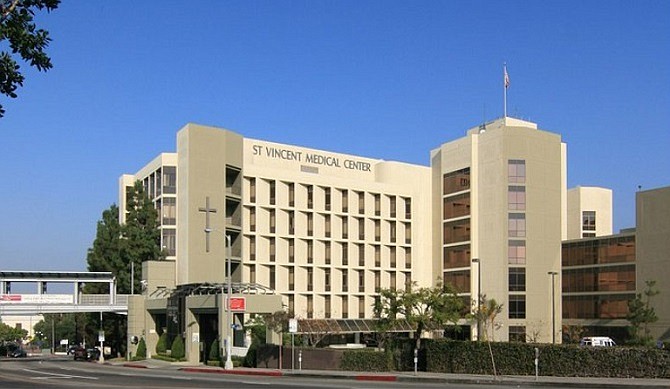
Verity entered Chapter 11 bankruptcy in August 2018. In January, the health system closed St. Vincent Medical Center, a 366-bed hospital in Los Angeles, after a deal to sell four of its hospitals fell through. The system had been planning to close Seton Medical Center as soon as this week, according to the report.

There are currently two companies bidding to purchase the hospital in Daly City and Seton Coastside in Moss Beach, Calif. The funding will help ensure Seton Medical Center, which sees roughly 27,000 patients per year, keeps its doors open.


Verity to close Los Angeles hospital

https://www.beckershospitalreview.com/finance/verity-to-close-los-angeles-hospital.html?utm_medium=email

Image result for Verity to close Los Angeles hospital

Verity Health System announced Jan. 6 that it plans to close St. Vincent Medical Center, a 366-bed hospital in Los Angeles.

El Segundo, Calif.-based Verity entered Chapter 11 bankruptcy in August 2018 and is seeking bankruptcy court approval to close St. Vincent Medical Center. The nonprofit health system is shutting down St. Vincent after a deal to sell four of its hospitals fell through.

Corona, Calif.-based KPC Group bid $610 million in January 2019 to acquire four hospitals from Verity, and the bankruptcy court approved the asset purchase agreement three months later. In early December, KPC’s Strategic Global Management missed the court-appointed deadline to purchase the hospitals.

In December, SGM appealed the court’s order setting the closing deadline. About one month later, Verity filed a lawsuit against KPC Group and its affiliates, alleging “intentional and misleading conduct” and breach of the asset purchase agreement, according to the Los Angeles Times.

The bankruptcy court will consider Verity’s request to close St. Vincent later this week. The health system said arrangements have already been made to transfer patients and specialty services to nearby facilities.

“We are deeply saddened to announce the planned closure of St. Vincent Medical Center,” Verity Health CEO Rich Adcock said in a news release. “This decision has not been taken lightly and comes only after exhausting every option to keep this hospital open.”

The closure of St. Vincent will not affect Verity’s other three hospitals in California: St. Francis Medical Center in Lynwood, Seton Medical Center in Daly City, and Seton Coastside in Moss Beach.


2019 WAS A ROUGH YEAR FOR RURAL HOSPITALS

https://www.healthleadersmedia.com/clinical-care/2019-was-rough-year-rural-hospitals?spMailingID=16767558&spUserID=MTg2ODM1MDE3NTU1S0&spJobID=1781791709&spReportId=MTc4MTc5MTcwOQS2

Since 2005, 162 rural hospitals have shuttered, with 60% of the closures occurring in southern states that did not expand Medicaid enrollment.


KEY TAKEAWAYS

19 rural hospitals closed in 2019, up from 15 closures in 2018, and continuing a steady double-digit trend in closures since 2013.

Most hospitals closed because of financial problem, and 38% of rural hospitals are unprofitable.

Patients in communities affected by closure travel 12.5 miles on average for care. However, 43% of the closed hospitals are more than 15 miles to the nearest hospital, and 15% are more than 20 miles.

Despite a booming national economy, 2019 was the worst year for hospital closings since at least 2005.

The North Carolina Rural Health Research Program says that 19 rural hospitals closed this year, up from 15 closures in 2018, and continuing a steady double-digit trend in closures since 2013.

Since 2005, the North Carolina researchers tracked 162 hospital closings, with 60% of the closures occurring in southern states that did not expand Medicaid enrollment.

Texas led the way, with 23 hospital closures since 2005, followed by Tennessee with 13, and North Carolina with 11.

The closures have been blamed on a number of factors, including: the older, sicker, poorer, and less-concentrated rural demographic; bypassing by local residents seeking care at regional hospitals; hospital consolidation; value-based care; referral patterns of larger hospitals; the transition to outpatient services; and mismanagement.

Among the findings highlighted by the North Carolina Rural Health Research Program:

  • More than half of the rural hospitals that close cease to provide any type of health care, which were define as abandoned.
  • Most closures and “abandoned” rural hospitals are in South (60%), where poverty rates are higher, people are generally less healthy and less likely to have public or private health insurance.
  • Most hospitals closed because of financial problems. 38% of rural hospitals are unprofitable.
  • In 2016, 1,375 acute care hospitals out of 4,471 urban and rural acute care hospitals (31%) were unprofitable, including 847 rural hospitals (versus 528 unprofitable urban hospitals).
  • Patients in communities affected by closure travel 12.5 miles on average for care. However, 43% of the closed hospitals are more than 15 miles to the nearest hospital, and 15% are more than 20 miles.
  • The typical rural hospital employs about 300 people, serves a community of about 60,000. When the only hospital in a county closes, there is a decrease of about $1,400 in per capita income in the county.
  • University of Minnesota research shows that between 2004 and 2014, 179 rural counties lost all hospital-based OB services.
  • Over the last 15 years, the difference in mortality between rural and urban areas has tripled – from a 6% difference to an 18% difference in 2015.


EIGHT MORE HOSPITALS JOIN PA’S RURAL HEALTH MODEL

https://www.healthleadersmedia.com/innovation/eight-more-hospitals-join-pas-rural-health-model

Image result for PA'S RURAL HEALTH MODEL

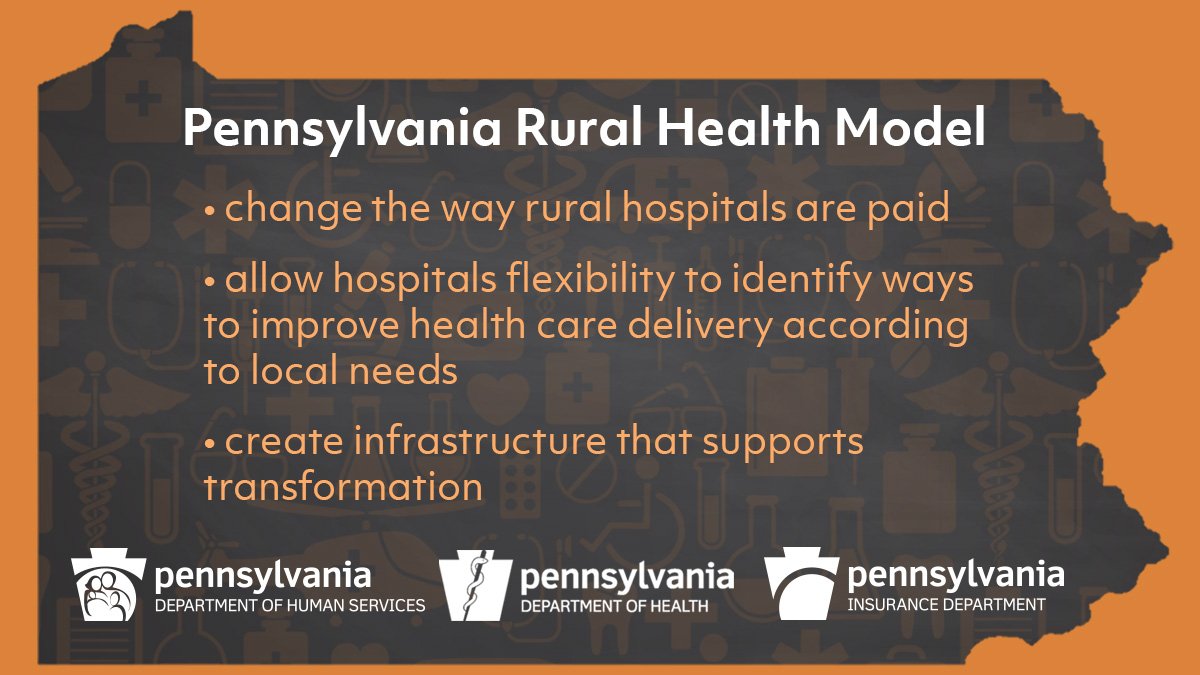
The Rural Health Model, the first of its kind, creates an alternative payment model that transitions hospitals from fee-for-service to global budget payments.


KEY TAKEAWAYS

The Rural Health Model creates an alternative payment model that transitions hospitals from fee-for-service to global budget payments.

Instead of getting paid for admissions, hospitals in the model will get a preset amount of money to provide services in the community.

State officials say the new payment model allows hospitals time to transform care to better meet the health needs of the community.

Eight more hospitals and one payer have joined a Pennsylvania initiative to shore up the financial footing of the state’s rural hospitals.

“I am especially pleased to see more hospitals joining this important initiative to improve their financial viability so that every Pennsylvanian has access to quality health care within a reasonable distance from home,” Gov. Tom Wolf said in a media release.

State officials the program is needed because nearly half of all rural hospitals in Pennsylvania are operating with negative margins and are at risk of closure. Four rural hospitals in Pennsylvania have shuttered since 2006, according to the North Carolina Rural Health Research Program.

So far this year, 19 rural hospitals across the nation have closed, making 2019 the worst year for rural hospital closures since at least 2005.

The Rural Health Model, the first of its kind, creates an alternative payment model that transitions hospitals from fee-for-service to global budget payments. Those global payments come from several payers, including private and public insurers.

Instead of getting paid for admissions, hospitals in the model will get a preset amount of money to provide services in the community.

State officials say the new payment model allows hospitals time to transform care to better meet the health needs of the community. This includes providing nontraditional roles, such as providing transportation and broadband internet access.

The eight hospitals are:

• Armstrong County Memorial Hospital in Kittanning.

• Chan Soon-Shiong Medical Center at Windber in Somerset County.

• Fulton County Medical Center in McConnellsburg.

• Greene Hospital in Waynesburg, Greene County.

• Monongahela Valley Hospital in Monongahela, Washington County.

• Punxsutawney Area Hospital in Punxsutawney, Jefferson County.

• Tyrone Hospital in Tyrone, Blair County.

• Washington Hospital in Washington, Washington County

A total of 67 hospitals are eligible for model based and nearly 20% of them will participate in in 2020, state officials said.

In addition, Aetna will join five other private payers  – Gateway, Geisinger, Highmark, Medicare and UPMC – which combine make up nearly half of the individual and small group market insurance population in the state.

The program is funded and administered by the newly created Rural Health Redesign Center Authority and the Pennsylvania Rural Health Redesign Center Fund.

In addition to providing access to care for rural communities, state officials say the model will ensure that, by remaining open, rural hospitals continue to be a vital economic driver for their communities.

“The Rural Health Model is a transformative step that changes the financial model for hospitals in rural areas,” said Pennsylvania Secretary of Health Rachel Levine, MD. “This is a step that will help achieve financial stability for these facilities and aims to improve the overall health of the community.”

“THIS IS A STEP THAT WILL HELP ACHIEVE FINANCIAL STABILITY FOR THESE FACILITIES AND AIMS TO IMPROVE THE OVERALL HEALTH OF THE COMMUNITY.”


Buyer of 4 California hospitals misses closing deadline

https://www.beckershospitalreview.com/hospital-transactions-and-valuation/buyer-of-4-california-hospitals-misses-closing-deadline.html?origin=cfoe&utm_source=cfoe

Image result for Buyer of 4 California hospitals misses closing deadline

Corona Calif.-based KPC Group missed the court-appointed deadline to purchase four hospitals from El Segundo, Calif.-based Verity Health, which entered Chapter 11 bankruptcy in August 2018.

KPC Group bid $610 million in January to purchase the four hospitals from Verity. Three months later, U.S. Bankruptcy Judge Ernest M. Robles approved the asset purchase agreement for KPC’s Strategic Global Management to acquire the hospitals. In late November, the judge ordered SGM to close the deal by Dec. 5.

After SGM failed to complete the purchase by the court-appointed deadline, Verity asked the court to issue an order requiring SGM’s principals to testify as to why the deal did not close and whether SGM has the financial ability to close the sale. Verity also asked the court to issue an order finding SGM in breach of the asset purchase agreement and allowing it to keep SGM’s $30 million deposit and proceed with other plans to sell the hospitals.

On Dec. 9, the court denied Verity’s request to force SGM’s executives to appear and testify in court.

“By failing to close, SGM risks the loss of its $30 million good-faith deposit as well as the possibility of damages for breach of contract in an amount of up to $60 million,” Judge Robles wrote in a Dec. 9 court filing. “Being compelled to offer testimony will not motivate SGM to close where the threat of the loss of up to $90 million has failed to accomplish that end.”

The judge assured Verity that it would have the chance to litigate the issues of whether SGM breached the asset purchase agreement and whether it’s entitled to keep the good-faith deposit.

Though neither party has terminated the sale process, the judge said Verity can “explore options for the alternative disposition of the hospitals” without violating the asset purchase agreement.

The next bankruptcy court hearing is slated for Dec. 30.


10 latest hospital closures

https://www.beckershospitalreview.com/finance/10-latest-hospital-closures-120219.html

Related image

From reimbursement landscape challenges to dwindling patient volumes, many factors lead hospitals to close.

Here are 10 hospitals that have closed in the past four months, beginning with the most recent:

1. Dallas-based Steward Health Care closed St. Luke’s Medical Center in Phoenix on Nov. 24. Officials said the hospital closed due to dwindling patient volumes. St. Luke’s Medical Center’s occupancy rate remained below 40 percent over the past two years, President James Flinn wrote in a letter to the local community in October.

2. Nix Medical Center, a 208-bed hospital in San Antonio, closed in November. A few months earlier, Los Angeles-based Prospect Medical Holdings said it was closing the hospital because community demand for acute care at Nix Medical Center has declined over the past year.

3. Southcross Hospital in San Antonio closed Oct. 11. The hospital and its operator, San Antonio-based Arete Healthcare, entered Chapter 11 bankruptcy in November.

4. Haskell County Community Hospital in Stigler, Okla., closed Oct. 2, according to the Cecil G. Sheps Center for Health Services Research. Haskell County Community Hospital is one of several hospitals previously owned by Kansas City, Mo.-based EmpowerHMS that filed for bankruptcy protection earlier this year.

5. Brentwood, Tenn.-based Quorum Health closed MetroSouth Medical Center in Blue Island, Ill., on Sept. 30. Quorum announced in June that it filed an application with the Illinois Health Facilities and Services Review Board to close the 314-bed hospital.

6. East Ohio Regional Hospital in Martins Ferry closed Sept. 27. The hospital’s president and CEO cited mounting financial losses as one of the factors that forced the hospital to shut down.

7. Ohio Valley Medical Center in Wheeling, W.Va., closed in September. Hospital officials said the “unwanted, yet unavoidable,” decision was made due to an unsuccessful search for a strategic partner, lack of interest from potential buyers and a more than $37 million operating loss over the last two years.

8. Hahnemann University Hospital in Philadelphia closed in early September. Hahnemann announced in June that it would close Sept. 6. The hospital pushed back the closure date after a bankruptcy judge approved the sale of its residency programs on Sept. 5.

9. Westlake Hospital in Melrose Park, Ill., closed in August, according to the Chicago Sun-Times. Los Angeles-based Pipeline Health revealed plans to close Westlake Hospital in February, a few weeks after acquiring the 230-bed hospital from Dallas-based Tenet Healthcare.

10. North Metro Medical Center in Jacksonville, Ark., closed Aug. 20, leaving local residents without an emergency room. No notice was given before the hospital shut down.


Healthcare delivery is moving “up and out”

https://mailchi.mp/699634d842fa/the-weekly-gist-november-1-2019?e=d1e747d2d8


Our graphic this week captures a phenomenon that we’ve observed in our strategy work with regional, “super-regional” and national health systems. We call it the “up and out” phenomenon—healthcare delivery is increasingly being pulled up and out from local, siloed hospitals. The traditional hospital enterprise, operating in what we refer to below as the “fee-for-service zone”, has typically pursued a service approach that delivers all things to all people. Commonly, the combination of reimbursement incentives and health system governance structures has encouraged hospital executives to prioritize facility profitability over system performance.

One important source of value creation for regional systems is service line rationalization—essentially, consolidating key services in one facility rather than performing duplicative services in every hospital. Centralizing open heart surgery, for example, in one “center of excellence” in a region often results in both lower cost and higher quality, thanks to clinical and operational scale economies. But the economies of scale don’t necessarily run out at the regional level—for some high-end specialty services (transplants, for example) it makes sense to consolidate at a super-regional or national level. For a better outcome and lower price, consumers will be increasingly willing to travel to receive the best value care.

Meanwhile, many services currently performed in the hospital can be more efficiently performed in non-hospital settings and should be distributed across the market in ways that are more convenient and accessible for patients. Traditional hospital economics make the “inpatient-to-outpatient shift” problematic, but as price and access become important consumer engagement levers, there’s little use fighting that shift. Indeed, the logical setting for much care delivery is in the patient’s home itself. This puts systems in the position of pushing care delivery to the hyper-local level, a strategy that can be powered by digital medicine delivered at a national level. All of this raises an important question for the regional health system: as hands-on care is increasingly pulled “up” to the national level (centers of excellence) and pushed “out” to the community setting (home-based care), and as national providers of digital health services can deliver services to anywhere, from anywhere, what is the value of the regional system? We’re working with a number of members to better understand and prepare for this new operating model.