

https://www.healthleadersmedia.com/finance/top-5-differences-between-nfps-and-profit-hospitals
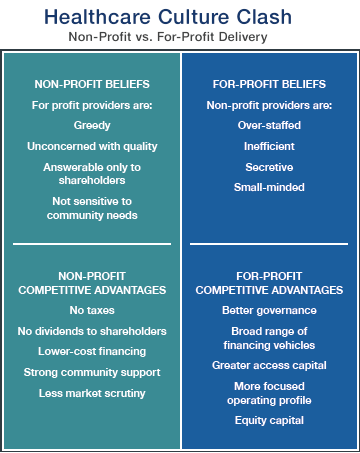
All hospitals serve patients, employ physicians and nurses, and operate in tightly regulated frameworks for clinical services. For-profit hospitals add a unique element to the mix: generating return for investors.
This additional ingredient gives the organizational culture at for-profits a subtly but significantly different flavor than the atmosphere at their nonprofit counterparts, says Yvette Doran, chief operating officer at Saint Thomas Medical Partners in Nashville, TN.
“When I think of the differences, culture is at the top of my list. The culture at for-profits is business-driven. The culture at nonprofits is service-driven,” she says.
Doran says the differences between for-profits and nonprofits reflect cultural nuances rather than cultural divides. “Good hospitals need both. Without the business aspects on one hand, and the service aspects on the other, you can’t function well.”
There are five primary differences between for-profit and nonprofit hospitals.
The most obvious difference between nonprofit and for-profit hospitals is tax status, and it has a major impact financially on hospitals and the communities they serve.
Hospital payment of local and state taxes is a significant benefit for municipal and state governments, says Gary D. Willis, CPA, a former for-profit health system CFO who currently serves as CFO at Amedisys Inc., a home health, hospice, and personal care company in Baton Rouge, LA. The taxes that for-profit hospitals pay support “local schools, development of roads, recruitment of business and industry, and other needed services,” he says.
The financial burden of paying taxes influences corporate culture—emphasizing cost consciousness and operational discipline, says Andrew Slusser, senior vice president at Brentwood, TN-based RCCH Healthcare Partners.
“For-profit hospitals generally have to be more cost-efficient because of the financial hurdles they have to clear: sales taxes, property taxes, all the taxes nonprofits don’t have to worry about,” he says.
“One of the initiatives we’ve had success with—in both new and existing hospitals—is to conduct an Operations Assessment Team survey. It’s in essence a deep dive into all operational costs to see where efficiencies may have been missed before. We often discover we’re able to eliminate duplicative costs, stop doing work that’s no longer adding value, or in some cases actually do more with less,” Slusser says.
With positive financial performance among the primary goals of shareholders and the top executive leadership, operational discipline is one of the distinguishing characteristics of for-profit hospitals, says Neville Zar, senior vice president of revenue operations at Boston-based Steward Health Care System, a for-profit that includes 3,500 physicians and 18 hospital campuses in four states.
“At Steward, we believe we’ve done a good job establishing operational discipline. It means accountability. It means predictability. It means responsibility. It’s like hygiene. You wake up, brush your teeth, and this is part of what you do every day.”
A revenue-cycle dashboard report is circulated at Steward every Monday morning at 7 a.m., including point-of-service cash collections, patient coverage eligibility for government programs such as Medicaid, and productivity metrics, he says. “There’s predictability with that.”
A high level of accountability fuels operational discipline at Steward and other for-profits, Zar says.
There is no ignoring the financial numbers at Steward, which installed wide-screen TVs in most business offices four years ago to post financial performance information in real-time. “There are updates every 15 minutes. You can’t hide in your cube,” he says. “There was a 15% to 20% improvement in efficiency after those TVs went up.”
Accountability for financial performance flows from the top of for-profit health systems and hospitals, says Dick Escue, senior vice president and chief information officer at the Hawaii Medical Service Association in Honolulu.
Escue worked for many years at a rehabilitation services organization that for-profit Kindred Healthcare of Louisville, Kentucky, acquired in 2011. “We were a publicly traded company. At a high level, quarterly, our CEO and CFO were going to New York to report to analysts. You never want to go there and disappoint. … You’re not going to keep your job as the CEO or CFO of a publicly traded company if you produce results that disappoint.”
Finance team members at for-profits must be willing to push themselves to meet performance goals, Zar says.
“Steward is a very driven organization. It’s not 9-to-5 hours. Everybody in healthcare works hard, but we work really hard. We’re driven by each quarter, by each month. People will work the weekend at the end of the month or the end of the quarter to put in the extra hours to make sure we meet our targets. There’s a lot of focus on the financial results, from the senior executives to the worker bees. We’re not ashamed of it.”
“Cash blitzes” are one method Steward’s revenue cycle team uses to boost revenue when financial performance slips, he says. Based on information gathered during team meetings at the hospital level, the revenue cycle staff focuses a cash blitz on efforts that have a high likelihood of generating cash collections, including tackling high-balance accounts and addressing payment delays linked to claims processing such as clinical documentation queries from payers.
For-profit hospitals routinely utilize monetary incentives in the compensation packages of the C-Suite leadership, says Brian B. Sanderson, managing principal of healthcare services at Oak Brook, IL–based Crowe Horwath LLP.
“The compensation structures in the for-profits tend to be much more incentive-based than compensation at not-for-profits,” he says. “Senior executive compensation is tied to similar elements as found in other for-profit environments, including stock price and margin on operations.”
In contrast to offering generous incentives that reward robust financial performance, for-profits do not hesitate to cut costs in lean times, Escue says.
“The rigor around spending, whether it’s capital spending, operating spending, or payroll, is more intense at for-profits. The things that got cut when I worked in the back office of a for-profit were overhead. There was constant pressure to reduce overhead,” he says. “Contractors and consultants are let go, at least temporarily. Hiring is frozen, with budgeted openings going unfilled. Any other budgeted, but not committed, spending is frozen.”
The for-profit hospital sector is highly concentrated.
There are 4,862 community hospitals in the country, according to the American Hospital Association. Nongovernmental not-for-profit hospitals account for the largest number of facilities at 2,845. There are 1,034 for-profit hospitals, and 983 state and local government hospitals.
In 2016, the country’s for-profit hospital trade association, the Washington, DC–based Federation of American Hospitals, represented a dozen health systems that owned about 635 hospitals. Four of the FAH health systems accounted for about 520 hospitals: Franklin, TN-based Community Hospital Systems (CHS); Nashville-based Hospital Corporation of America; Brentwood, TN–based LifePoint Health; and Dallas-based Tenet Healthcare Corporation.
Scale generates several operational benefits at for-profit hospitals.
“Scale is critically important,” says Julie Soekoro, CFO at Grandview Medical Center, a CHS-owned, 372-bed hospital in Birmingham, Alabama. “What we benefit from at Grandview is access to resources and expertise. I really don’t use consultants at Grandview because we have corporate expertise for challenges like ICD-10 coding. That is a tremendous benefit.”
Grandview also benefits from the best practices that have been shared and standardized across the 146 CHS hospitals. “Best practices can have a direct impact on value,” Soekoro says. “The infrastructure is there. For-profits are well-positioned for the consolidated healthcare market of the future… You can add a lot of individual hospitals without having to add expertise at the corporate office.”
The High Reliability and Safety program at CHS is an example of how standardizing best practices across the health system’s hospitals has generated significant performance gains, she says.
“A few years ago, CHS embarked on a journey to institute a culture of high reliability at the hospitals. The hospitals and affiliated organizations have worked to establish safety as a ‘core value.’ At Grandview, we have hard-wired a number of initiatives, including daily safety huddles and multiple evidence-based, best-practice error prevention methods.”
Scale also plays a crucial role in one of the most significant advantages of for-profit hospitals relative to their nonprofit counterparts: access to capital.
Ready access to capital gives for-profits the ability to move faster than their nonprofit counterparts, Sanderson says. “They’re finding that their access to capital is a linchpin for them. … When a for-profit has better access to capital, it can make decisions rapidly and make investments rapidly. Many not-for-profits don’t have that luxury.”
There are valuable lessons for nonprofits to draw from the for-profit business model as the healthcare industry shifts from volume to value.
When healthcare providers negotiate managed care contracts, for-profits have a bargaining advantage over nonprofits, Doran says. “In managed care contracts, for profits look for leverage and nonprofits look for partnership opportunities. The appetite for aggressive negotiations is much more palatable among for-profits.”
:format(webp)/cdn.vox-cdn.com/uploads/chorus_image/image/65358995/843175548.jpg.0.jpg)
Is the rapidly rising cost of employer-sponsored health insurance sustainable?
Half of all Americans get their health insurance through work. Trouble is, doing so is becoming less and less affordable — especially for already low-wage workers.
In 2019, the Kaiser Family Foundation Employer Health Benefits Survey — an annual account of roughly 2,000 small and large businesses’ employer-sponsored insurance — found the average annual premium to cover a family through work was a whopping $20,576, and $7,188 for an individual. Employers cover most of that, but families still contributed an average of $6,015 in premiums, and single Americans covered about $1,242 of the annual cost.
The kicker? Over the past 10 years, the cost of the portion of employer-sponsored health insurance premiums that falls on American families has increased by 71 percent. Overall, premiums have gone up 54 percent since 2009. That’s faster than the rate of inflation and faster than the average wage growth.
Nearly half of all Americans get their health insurance through work, a system that covers roughly 153 million people. And for lower-wage workers it’s a system that is increasingly unaffordable.
Workers at companies with a significant number of low-wage employees (which the Kaiser Family survey quantifies as a company in which at least 35 percent of employees are making an annual salary of $25,000 or less) have lower premiums than those who work at companies with fewer low-wage workers, probably because their plans cover less. But at the same time, workers at firms with a significant number of low-wage employees are faced with high-deductible plans, and also pay a larger share of the premium cost than workers at companies with fewer lower-wage employees.
According to the survey, workers at lower-wage companies pay an average of $7,000 a year family plan — $1,000 more than employees at companies with higher salaried workers.
“When workers making $25,000 a year have to shell out $7,000 a year just for their share of family premiums,” Drew Altman, the president of Kaiser Family Foundation, said in a statement, that’s where cost becomes prohibitive. Such employees are putting almost 30 percent of their salaries toward premiums.
The takeaway is clear. Health care is getting more and more expensive, and families and employers are having to bear more of the cost, which research has shown not only has an effect on how much workers are actually getting paid, but how many workers are hired.
As Sarah Kliff reported for Vox, there are a lot of studies spanning decades that show how a rapid rise in health insurance premiums has unfavorable outcomes for workers. This is in large part because employers think of compensation in totality; they lump together an employee’s salary, as well as their benefits as one total cost. So if covering a worker’s health insurance gets more and more expensive, employers see less room to give the worker a raise.
For example, a 2006 study from Katherine Baicker and Amitabh Chandra, both with the National Bureau of Economic Research, found that an overall 10 percent increase in health insurance premiums reduced wages by 2.3 percent and actually reduced the probability of becoming employed by 1.2 percent.
Results such as these, and the high premiums low-wage workers must pay, led the Kaiser survey’s authors to explicitly question the tenability of employer-sponsored insurance: “the national debate about expanding Medicare or creating public program options provides an opportunity to step back and evaluate how well employer-based coverage is doing in achieving national goals relating to costs and affordability,” the report reads.
The United States is unique in its reliance on employers to provide health insurance. And, as Democratic candidates for president continue to go in circles debating health care, employer-sponsored insurance is often the biggest sticking point.
Several candidates, like Sen. Bernie Sanders, who popularized a plan for Medicare-for-all, a single government-run program, and Sen. Elizabeth Warren, who supports Sanders’s plan, have called for getting rid of the employer-based system, and private insurance, all together.
But their critics always bring up the same talking point: that the people who like their health insurance plans through work, should be able to keep it. The Kaiser survey raises questions as to how affordable those plans really are, and, as Democrats debate ideas like Medicare-for-all, how sustainable the current trajectory is.

The health-care sector just closed out a third straight month in the red, its longest losing streak in three years.
A fourth monthly decline would be its worst stretch since 2011, and one trader says there could be more pain ahead.
“I view the whole sector as a wounded target right now,” said Boris Schlossberg of BK Asset Management on CNBC’s “Trading Nation” on Monday. “Health care, in my opinion, is the most bloated, the most bureaucratic, the most inefficient sector of the economy. At 20% of the GDP and at $20,000 premium per capita at this point, they pretty much have squeezed all the rentier profits out of the system that they can at this point.”
The sector also has a target on its back as the 2020 presidential election draws closer. The XLV health care ETF has fallen more than 3% in the past three months as Democratic presidential candidates such as Elizabeth Warren have pushed for a “Medicare For All” solution.
“Even if the Democrats do not win, there’s going to be tremendous amount of pressure to cut costs, control drug prices,” said Schlossberg. “Any way you slice it, basically the sector is a ‘sell the rally’ trade at this point. Any time you have a pop in the sector, it’s going to be a sell for quite a long time.”
Health-care stocks faced similar pressure in 2015 and 2016 as Democratic presidential candidate Hillary Clinton pledged health-care reform. At its worst, the XLV ETF plummeted 11% in the third quarter of 2015.
However, Miller Tabak equity strategist Matt Maley does not see that degree of decline this time.
“I don’t think it’ll be anywhere near as bad as it was four years ago because the setup is much, much different. In the 12 months leading into the summer before the election year the last time around, the XLV had outperformed the S&P by two times,” said Maley on “Trading Nation” on Monday. “This group had become very overbought, and very over-owned.”
This time around, Maley says the XLV ETF had performed in line with the S&P 500 before beginning its breakdown in April.
“I don’t think you’ll have that forced selling or at least that reweighting that you had going forward. So even though I think it’s a problem, it’s not as big a problem,” said Maley.

The underlying forces that fueled worry a few weeks ago haven’t gone anywhere.
For one brief, terrifying moment this summer, the word “recession” was on everyone’s lips — the stuff of television segments, front-page articles and Google searches.
Then, just as abruptly, everything started to look pretty much fine.
The trade war with China went into another of its periodic phases of de-escalation, as the Trump administration seemed rattled about the possibility of a faltering economy. The Federal Reserve cut interest rates twice, something of an insurance policy against a recession. Much of the data on the economy, particularly on the job market and the service sector, remained quite solid.
And the proximate cause of many of those August recession warnings, a sharp drop in longer-term interest rates and a yield curve inversion, was partly reversed.
Crisis averted! That, anyway, has been the mood in financial markets in the last few weeks, as stocks have remained near record highs and the fearful tenor of economic commentary has subsided.
But it would be premature to declare a clean bill of health. Public attention may be focused on an impeachment battle in Washington, but the underlying forces that drove recession fears in the summer are still very much here — with some new ones potentially in play.
The latest, starkest reminder was a new manufacturing number published Tuesday. It showed the sector was contracting in September at its fastest rate since 2009. That might have been dragged down in part by a strike at General Motors, but the softness in the factory sector is evident in other data that predates the strike.
For example, in the last six months, the manufacturing industry in the United States has added an average of only 3,000 jobs a month, down from 25,000 a month as recently as the spring of 2018. (The Labor Department will release the latest employment numbers Friday.)
A less noticed piece of data on Friday showed that manufacturing wasn’t the only pocket of weakness.
Spending on nonresidential construction fell 0.4 percent in August, the latest indication that businesses are not investing in new warehouses, factories and office buildings at the rate they were a few months ago.
There is a tendency to think of the economic angst caused by the trade wars as resembling a light switch — something that President Trump can turn on and off. Some even think of it as a “Trump Put,” referring to a financial contract that insures against big losses. That is, there’s an assumption that the administration will ease trade tensions if they start to affect the stock market or the economy too negatively.
As the last few weeks have shown, there’s some truth to that. The spike in recession fears in August seemed to bring a more conciliatory tone from the Trump administration, even if concrete progress in trade negotiations isn’t really in evidence.
But the $20 trillion United States economy is a slow-moving beast, and just as the trade rift between the world’s two largest economies didn’t cause a major disruption overnight, neither do a few conciliatory comments make everything O.K.
We are only starting to see the delayed economic impact of a series of trade escalations over the summer and of a slowdown in the global economy. It’s starting to show up in hiring and capital-spending plans, as the latest numbers demonstrate.
For some time, close watchers of federal policy have been urging businesses to think of the trade disruptions not as one-off headlines, but as the continuing cost of doing business globally.
“This kind of goes to the advice we’re giving clients, and we’ve been trying to do this for a while, ‘no head-in-sand behavior here,’” said Scott McCandless, trade policy leader at the accounting firm PwC. “Be cleareyed about this. This will probably be around a while.”
There is reason to view the seemingly more optimistic signs being flashed by financial markets with skepticism.
The yield on 10-year Treasury bonds fell to 1.45 percent in early September from 2.07 percent in late July, an uncommonly sharp drop, before rebounding to 1.64 percent Tuesday. The big swings can be chalked up to global capital flows that aren’t necessarily reflective of the economic outlook in the United States.
But that doesn’t mean there is no signal in the noise. Lower long-term rates imply lower growth and inflation in the United States in the years ahead. While the bond markets are becoming more stable, yields are settling at levels consistent with an American economy that is growing more sluggishly than it has the last few years — albeit not at recession level.
Even after sharp drops Tuesday and Wednesday, the S&P 500 has remained not far from its record highs. But the market is often slow to reflect a shifting economic landscape. When the first rumblings of what would become the global financial crisis took place in August 2007, for example, the stock market actually peaked in October; the economy fell into recession that December.
“The lights haven’t gone out on the economic outlook yet, but they are certainly growing very dim,” said Chris Rupkey, chief financial economist of MUFG Union Bank, in a research note.
A recession is certainly not a foregone conclusion, and a period of slow growth still looks more likely than an outright contraction. But just because the recession talk is out of the headlines doesn’t mean all is well.


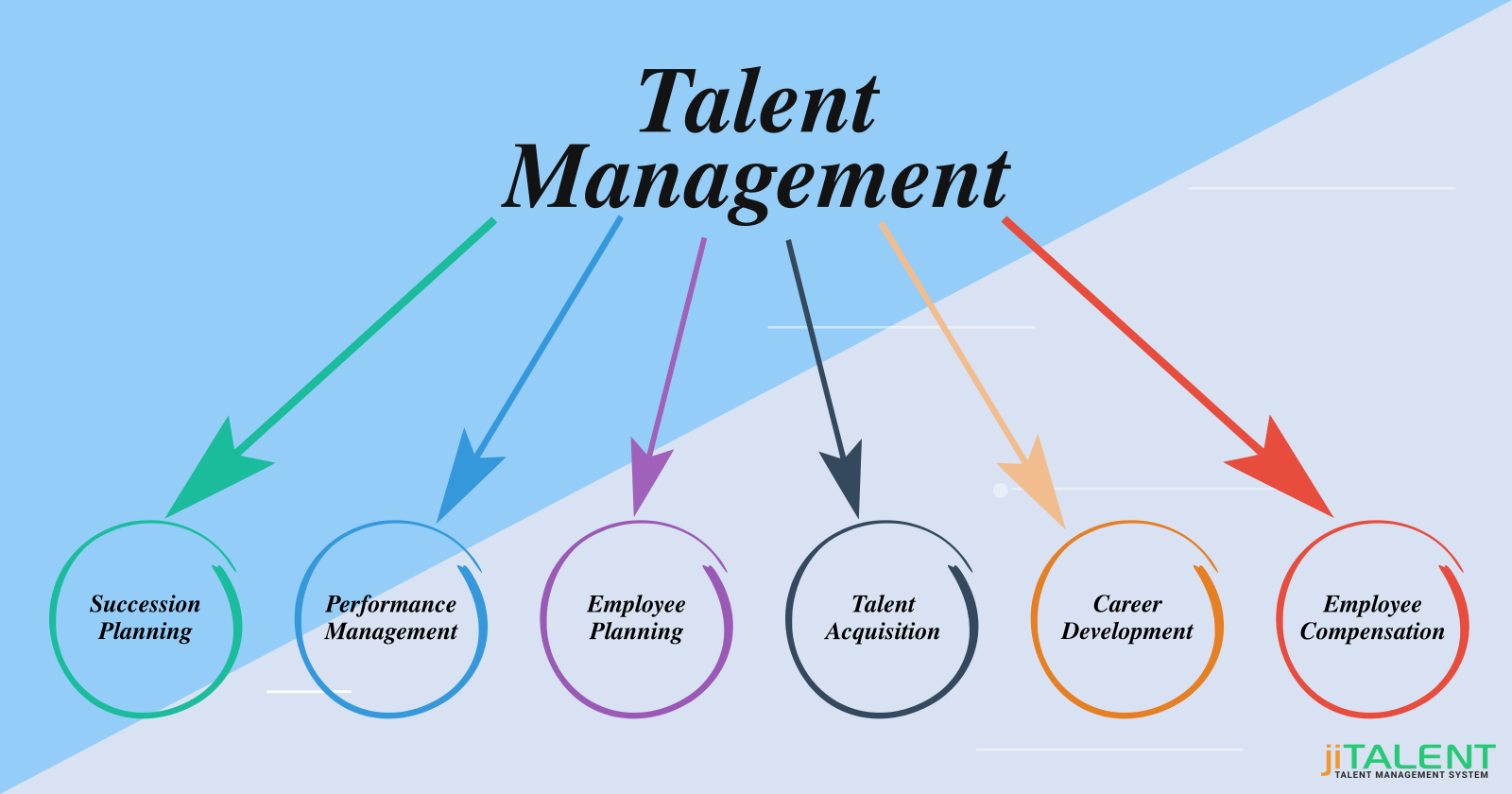
“Talent management deserves as much focus as financial capital management in corporations.”
~ Jack Welch
One of the best ways to strengthen your company as a whole is to devote attention to developing your employee talent. If your staff isn’t given the proper encouragement or assistance needed to help them move forward within your company, it can be more challenging for the company itself to continue growing in its capabilities. There are several ways that you, as a leader, can help to develop the talent at your company. Talent identification and management begin with The Four P’s.
For instance, if one of their goals is to expand their understanding of the daily responsibilities of your company’s executive team, create an opportunity for them to shadow you or another company leader so they can gain insight into whether an executive career path could be a good fit for them. The more your employees are able to broaden their comprehension of your company’s functionality beyond their own duties, the greater the likelihood that they’ll be able to develop into well-informed and well-rounded contributors.

 HENRY KOTULA