How the GOP could dial back Obamacare

The massive Republican budget bill working its way through Congress has mostly drawn attention for its tax cuts and Medicaid changes.

  • But it would also take steps to significantly roll back coverage under the Affordable Care Act, with echoes of the 2017 repeal-replace debate.

Why it matters: 

The bill that passed the House before Memorial Day includes an overhaul of ACA marketplaces that would result in coverage losses for millions of Americans and savings to help cover the cost of extending President Trump’s tax cuts, Peter Sullivan wrote first on Pro.

  • It comes after a growth spurt that saw ACA marketplace enrollment reach new highs, with more than 24 million people enrolling for 2025, according to KFF. The House’s changes would likely reverse that trend, unless the Senate goes in a different direction when it picks up the bill next week.

Driving the news: 

The changes are not as sweeping as the 2017 effort at repealing the law, but many of them erect barriers to enrollment that supporters say are aimed at fighting fraud.

  • Brian Blase, president of Paragon Health Institute and a health official in Trump’s first administration, said Republicans are focusing on rolling back Biden-era expansions “that have led to massive fraud and inefficiency.”
  • The Congressional Budget Office estimates the ACA marketplace-related provisions would lead to about 3 million more people becoming uninsured.
  • Cynthia Cox, a vice president at KFF, said while the changes “sound very technical” in nature, taken together “the implications are that it will be much harder for people to sign up for ACA marketplace plans.”

What’s inside: 

The bill would end automatic reenrollment in ACA plans for people getting subsidies, instead requiring them to proactively reenroll and resubmit information about their incomes for verification.

  • It would also prevent enrollees from provisionally receiving ACA subsidies in instances where extra eligibility checks are needed, which can take months.
  • If people wound up making more income than they had estimated for a given year, the bill removes the cap on the amount of ACA subsidies they would have to repay to the government.
  • Some legal immigrants would also be cut off from ACA subsidies, including people granted asylum and those in their five-year waiting period to be eligible for Medicaid.

What they’re saying: 

In a letter to Congress, patient groups pointed to the various barriers as “unprecedented and onerous requirements to access health coverage” that would have “a devastating impact on people’s ability to access and afford private insurance coverage.”

  • The letter was signed by groups including the American Cancer Society Cancer Action Network, American Diabetes Association and American Lung Association.

Between the lines: 

A last-minute addition to the bill would also make a technical but important change that increases government payments to insurers in ACA marketplaces.

  • That would have the effect of reducing the subsidies that help people afford premiums and save the government money, by reducing the benchmark silver premiums that are used to set the subsidy amounts.
  • Democrats are concerned that if Congress also allows enhanced ACA subsidies to expire at the end of this year, the combined effect would be even higher premium increases for enrollees next year.

Insurers that already are planning their premium rates for next year say the Republican funding changes are throwing uncertainty into the mix.

  • “Disruption in the individual market could also result in much higher premiums,” the trade group AHIP warned in a statement on the bill.

The big picture: 

Blase said changes like ending automatic reenrollment are needed to increase checks that ensure people are not claiming higher subsidies than they’re entitled to.

  • Cox said another way to address fraud would be to target shady insurance brokers, rather than enrollees themselves. She estimated that marketplace enrollment could fall by roughly one-third from all the changes together.
  • “The justification for many of these provisions is to address fraud,” she said. “The question is, how many people who are legitimately signed up are going to get lost in that process?”
They Cut Medicaid, Not the Waste: Congress Protects Big Insurance While Slashing Care

The House of Representatives’ reconciliation bill, passed by the powerful Energy and Commerce Committee today, cuts just about everything when it comes to health care – except the actual waste, fraud and abuse. Now the bill heads to the floor for a vote of the full House of Representatives before it must also be passed by the Senate to become law. 

I know what you’re thinking: not another story about Medicaid. With the flood of articles detailing the devastating Medicaid cuts proposed by House Republicans —cuts that could strip 8.7 million people of their health coverage — there’s an important fact being overlooked: Members of Congress chose to sidestep policies aimed at reining in Big Insurance abuses and, instead, opted to cut Medicaid.

And the real irony of it all is they could have saved a ton of money if they would just address the elephant in the room. 

Abuses by Big Insurance companies have been going on for decades but have only recently come under scrutiny. Insurance companies figured out how to take advantage of the structure of the Medicare Advantage program to receive higher payments from the government.

They do this in two ways:

  1. They make their enrollees seem sicker than they are through a strategy called “upcoding” and;
  2. They use care obstacles such as prior authorization and inadequate provider networks that eventually drive sicker people to drop their plans and leave them with healthier enrollees, referred to as “favorable selection.” 

According to the Medicare Payment Advisory Commission (MedPAC) these tactics lead the government to overpay insurance corporations running MA plans by $84 billion a year. This number is expected to grow, and estimates show that overpayments will cost the government more than a $1 trillion from 2025-2034. That is $1 trillion dollars in potential savings Republicans could have included in their bill instead of cutting Medicaid spending that provides care for vulnerable communities. 

These overpayments do not lead to better care in MA plans; in fact, research has shown that care quality and outcomes are often worse in MA compared to traditional Medicare. Even worse, these overpayments are tax dollars meant for health care that end up in the pockets of shareholders of big insurance corporations, which spend billions of taxpayer dollars on things like stock buybacks and executive bonuses. 

One of the most frustrating parts of the lawmaker’s choice to target Medicaid rather than Big Insurance abuses is that there are multiple policies supported by both Republicans and Democrats to stop these abuses. Sen. Bill Cassidy (R-Louisiana), along with Sen. Jeff Merkley (D-Oregon), have introduced the NO UPCODE Act, which would cut down on the practice of upcoding explained above. President Trump’s Administrator of the Centers for Medicare and Medicaid Services, Dr. Mehmet Oz, said during his confirmation hearing that he supports efforts to crack down on practices used by insurers to upcode. And Rep. Mark Green (R-Tennessee) introduced a bipartisan bill to decrease improper prior authorization denials in MA. 

In a somewhat cruel twist, the only mention of Medicare fraud in the Republican reconciliation bill proposals is a section claiming to crack down on improper payments in Medicare Parts A and B (which make up traditional Medicare) by using artificial intelligence.

The total improper payments in TM represent just over one-third of the overpayments going to MA plans each year, and many of the payments flagged as improper in TM are flagged due to missing documentation rather than questionable tactics that MA insurers use. 

In reflecting on why Republicans in Congress ignored potential savings from Big Insurance reforms and instead pursued cuts to care for people depending on Medicaid, which do not save as much, my biggest question was, why?

Why would lawmakers swerve around a populist policy right in front of them to stop Big Insurance from profiting off of the federal government to instead propose a regressive policy that targets millions of working Americans and leaves health insurance corporations that make billions in profits each year untouched?

Unfortunately, the answer likely lies in money. Although people enrolled in Medicaid and the Children’s Health Insurance Program (CHIP) make up roughly one-third of the U.S. population, they account for just 0.5% of all political campaign contributions — about $60 million annually. This disparity is likely driven by financial constraints: Many of these individuals are rightly focused on covering basic needs such as housing, food, and childcare, especially as wages have not kept pace with the rising cost of living.

In contrast, the health care sector — which includes major players like big insurance, pharmaceutical and hospital companiescontributed $357 million during the 2020 election cycle, including $97 million to outside groups such as Super PACs. These outside spending groups are largely funded by corporations and wealthy individuals, who represent less than 1% of the population but wield significant political influence.

Super PACs spent more than $2 billion during the 2020 election cycle, amplifying the voices of industry-aligned donors. This stark imbalance in political spending may help explain why congressional proposals targeted Medicaid recipients while leaving the powerful health insurance industry largely untouched.

It is not only Republicans who have failed to stop Big Insurance from taking advantage of federal health programs, Democrats declined to take action when negotiating their health care legislation during President Biden’s term. Rather, it seems to be a failure of policymakers of both parties to pass legislation that makes it clear to Big Insurance that our health care is not an investment opportunity for Wall Street, and the dollars we pay in taxes to support Medicare are not pocket change for executives to use for stock buybacks.

The failure to include MA reform represents a missed opportunity to prioritize patient care over corporate profits. However, the growing strength and voices of patients across the nation will ultimately make it impossible for lawmakers to ignore this issue much longer. With continued momentum, the fight to put patients over Big Insurance profits will succeed.

Medicaid provider taxes throw off sparks

Congress and the Trump administration are trying to limit how much states can tax hospitals, nursing homes and other providers to help cover the cost of their Medicaid programs.

  • That could tie governors’ and legislatures’ hands at a critical moment.

Why it matters: 

The taxes have been a friction point for decades, but they’re deeply ingrained in the safety net program. Every state except Alaska levies at least one type of provider tax to help cover the non-federal part of Medicaid spending.

How it works: 

States typically cover about 30% of Medicaid costs annually and use general funds along with taxes on hospitals, nursing homes and even managed care organizations. The more they collect, the more they receive in federal matching funds.

  • That’s key in the current debate over federal Medicaid spending, with projections showing that limiting provider taxes could reduce federal outlays by hundreds of billions over a decade.

The stakes are particularly high for red states. Mississippi, South Carolina, Utah and Alabama would all lose more than one-third of their federal Medicaid funding without the ability to levy provider taxes.

State of play: 

The House Energy and Commerce Committee on Wednesday advanced a sweeping overhaul of Medicaid that would prevent states from establishing new provider taxes and freeze those taxes already on the books at their current rates.

  • Democrats unsuccessfully fought the move during a marathon 26-hour markup. But the committee ultimately advanced the restrictions and the rest of the legislation along party lines.
  • The Congressional Budget Office estimated the restrictions would save about $87 billion through 2034.

Meanwhile, the Trump administration this week proposed additional restrictions on how states can structure their provider taxes. Seven states currently have waivers for provider taxes that would have to be restructured under the new policy, mostly for taxes on insurers.

  • That proposal alone, which mirrors another provision in the House reconciliation bill, would reduce federal Medicaid spending by $33 billion over five years, CMS estimates.
  • “Every state is going to have a really different situation in front of them,” said Morgan Craven, a director in ATI Advisory’s state program and policy practice.
  • Because it’s been such a part of the fabric of how so many states finance and deliver care, undoing that is going to be really complex, and states will need time and will need a really strategic lens for how they can sustainably undo these policies,” she added.

Zoom out: 

Hospitals and patient advocates are concerned about the effects of such a foundational change in Medicaid financing.

  • “By freezing the taxes, the proposal ignores circumstances that drive increased health care costs including inflation, increased labor and drug costs, increased utilization and increased population demand for service,” the American Hospital Association wrote in a statement to the Energy and Commerce Committee this week.

Yes, but: Hospital stocks actually gained, on the premise that the House’s Medicaid changes could have been more onerous, per the Wall Street Journal.

  • And the CMS proposal suggested that the Trump administration won’t further try to dock provider taxes outside of congressional efforts — good news for hospital investors, Capstone senior vice president Wylie Butler wrote in an analyst note.

What to watch: 

There are some signs that Senate Republicans aren’t as interested in cracking down on provider taxes as their counterparts in the House.

  • “It’s not that I think that provider taxes are good; it’s that the Medicaid reimbursements have been insufficient,” Sen. Susan Collins (R-Maine) told reporters this week.
  • “Our rural hospitals in my state and across the country are really teetering.”

Millions could lose coverage under potential GOP Medicaid policies: CBO

https://www.healthcaredive.com/news/medicaid-coverage-losses-gop-policies-cbo/747615/

Dive Brief:

  • Millions of people could lose coverage under potential policy changes to Medicaid under consideration by Republicans in Congress, according to a letter sent to lawmakers this week from the Congressional Budget Office. 
  • One option, reducing the federal government’s share of costs for enrollees covered under Medicaid expansion, would reduce the federal deficit by $710 billion over the next decade. But in 2034, 5.5 million people would be removed from the safety-net program, with 2.4 million of these enrollees becoming uninsured, according to the CBO.
  • Another potential policy, placing a per-enrollee cap on federal spending, would remove 5.8 million people from Medicaid. Nearly 3 million of those people would lose coverage entirely. The policy would reduce the deficit by $682 billion, the analysis found.

Dive Insight: 

Debates surrounding potential cuts to Medicaid — and their implications for patients and providers — have been heating up in Congress for weeks. 

Last month, lawmakers approved a budget resolution that called for the House Energy and Commerce Committee, which oversees Medicare and Medicaid, to find $880 billion in savings. That budget goal is likely impossible to hit without targeting major healthcare programs under the committee’s purview, according to an earlier analysis published in March by the CBO.

The committee is expected to meet next week to mark up its portion of the reconciliation package and hash out legislation.

However, cutting Medicaid is a politically contentious move for Republican lawmakers. Some legislators have pushed back on potential cuts, and others have argued they’ll preserve Medicaid for the most vulnerable by targeting fraud, waste and abuse in the safety-net insurance program. 

But Rep. Frank Pallone Jr., D-N.J., and Sen. Ron Wyden, D-Ore., who requested the latest CBO analysis, said the policies will ultimately limit benefits and result in coverage losses.

“This analysis from the non-partisan, independent CBO is straightforward: the Republican plan for health care means benefit cuts and terminated health insurance for millions of Americans who count on Medicaid,” Wyden said in a statement. “Republicans continue to use smoke and mirrors to try to trick Americans into thinking they aren’t going to hurt anybody when they proceed with this reckless plan, but fighting reality is an uphill battle.”

The letter from the CBO analyzes five potential policy options for Medicaid: setting the federal matching rate for the expansion population at the same rate as other enrollees; limiting state taxes on providers; setting federal caps on spending for the entire Medicaid population or just the expansion group; and repealing two regulations linked to eligibility and enrollment. 

Most of the options reduce the funds available to states, according to the CBO. The agency expects states will replace about half of the reduced support with their own resources, and then reduce spending by cutting provider payment rates, reducing optional benefits and cutting enrollment. 

For example, if Congress decides to limit provider taxes, where states levy taxes that finance a portion of their Medicaid spending, that would result in 8.6 million fewer people enrolled in Medicaid in 2034, including nearly 4 million becoming uninsured. The move would ultimately lessen the federal deficit by $668 billion, as the government would offer reimbursement for lower state spending, the analysis found.

Another option, placing a cap on federal spending for the expansion population, would save $225 billion — but 3.3 million people would lose Medicaid coverage. Repealing regulations that aim to reduce barriers to enrollment and simplify the renewal process would reduce the federal deficit by $162 billion over the next decade, but 2.3 million fewer people would be enrolled in Medicaid, the CBO found.

Democrats urge Republicans to focus on Medicare Advantage upcoding instead of Medicaid cuts

https://www.healthcaredive.com/news/democrats-urge-republicans-focus-medicare-advantage-upcoding/747627/

Dive Brief:

  • Democrat lawmakers are urging Republicans debating cuts to Medicaid to focus instead on fraud, waste and abuse in another federal healthcare program: Medicare Advantage.
  • Curbing upcoding in the privatized Medicare plans, wherein insurers exaggerate the health needs of their members to inflate government reimbursement, is a better avenue for saving federal dollars than restricting benefits or cutting eligibility in Medicaid, the 36 Democrats wrote in a letter to GOP leadership on Wednesday.
  • The letter was addressed to Senate Majority Leader John Thune, R-S.D, and House Speaker Mike Johnson, R-La., and comes as Republicans debate different policies to reach savings targets.

Dive Insight:

Republicans in Congress are aiming to extend tax cuts from President Donald Trump’s first term. Their budget directs the House Energy and Commerce Committee to cut $880 billion in spending — a goal that’s impossible to reach without touching Medicaid, which (along with its sister program for children) provides safety-net insurance to some 80 million Americans.

Now, Democrats in both chambers are urging Republicans to redirect their attention from Medicaid to MA, privatized plans for Medicare seniors that can provide additional benefits but also restrict care in a way traditional Medicare is not allowed to do. Still, the plans have steadily grown in popularity and now cover more than half of the 68 million Americans in Medicare.

“Your directive to cut federal health care spending should come from reducing waste, fraud, and abuse like upcoding by for-profit insurance companies, not by cutting health care benefits for American families who rely on Medicaid to make ends meet,” the Democrats’ letter reads.

The letter cites a Wall Street Journal investigation into upcoding published last year that found MA insurers frequently added diagnoses for their members for which their members never received treatment or that went against doctors’ observations. The practice drove a total of $50 billion in additional payments to the private insurers over three years, according to the investigation.

Similarly, influential congressional advisory group MedPAC found CMS paid MA insurers $84 billion more in 2024 than the government would have if those members had been in traditional Medicare. Upcoding was responsible for almost half of those overpayments.

Traditionally, Republicans broadly support MA, which was created on the premise that private insurers could help the government manage Medicare more economically. However, there’s been rising bipartisan support for reforming the program in light of growing evidence of practices like upcoding that inflate government reimbursement to plans without helping enrollees.

In his confirmation hearing, Dr. Mehmet Oz, the surgeon and television personality tapped by Trump as the administrator of the CMS, agreed that tackling fraud, waste and abuse in MA was a “rational” way of lowering federal healthcare spending.

“We’re actually apparently paying more for Medicare Advantage than we’re paying for regular Medicare. So it’s upside down,” Oz said in front of the Senate Finance Committee in March.

Republicans in the House are currently trying to figure out how to achieve desired savings without slashing Medicaid, given the program’s political popularity, including among Republican voters.

GOP leadership recently appeared to rule out two Medicaid policies that would cause significant upheaval for enrollees in the program: lowering the portion of Medicaid costs borne by the federal government for the Medicaid expansion population, and per-capita caps on benefits for beneficiaries in expansion states.

More moderate policies Republicans are considering include requirements tying eligibility to work, education or volunteering hours or curbing financing arrangements that allow states to draw more funds from the federal government. Policies on the table would still result in millions of Americans losing Medicaid coverage.

“Moving forward with this dangerous plan to rip health care away from low- and middle-income Americans would be a man-made disaster for the health of the nation and the economy,” the Democrats’ letter reads. “We urge you instead to listen to Administrator Oz and tackle real fraud, waste, and abuse by private, for-profit health insurers in MA.”

House E&C is expected to hold its reconciliation markup next week.

New HHS Rule Wipes Out Some Public Comment on Rulemaking

A 3-page ruleopens in a new tab or window published in the Federal Register today and signed by HHS Secretary Robert F. Kennedy Jr. ends the ability of stakeholders to comment on many of the agency’s policies regarding benefits, contracts, and grants within the agency.

“The intent of this policy is very clearly to enable the administration to adopt major policy changes very quickly, without first letting the public know what those changes are going to be,” said Samuel Bagenstos, JD, who served as general counsel to the Office of Management Budget and subsequently HHS during the 4 years of the Biden administration.

Under this new policy, which says it “is rescinding the policy on public participation in rule making,” rules issued by any of the divisions within HHS that fall under the Administrative Procedure Act (APA) would be affected — except for Medicare, which falls under a separate provision of the Medicare Act, Bagenstos told MedPage Today during a phone call Friday.

Medicaid, the Substance Abuse and Mental Health Services Administration, the Administration for Children and Families, the National Institutes of Health, and many other agencies fall under this new rule, he said, for all policies having to do with grants or benefits or both.

The policy ends a practice that has been an important part of U.S. healthcare for more than 50 years.

“For example, if they wanted to allow work requirements under Medicaid, they could do that now … without going through rule changing policies,” said Bagenstos, who now is a professor of law at the University of Michigan in Ann Arbor.

Bagenstos said he doubts the new rule “is going to hold up in court. There are very substantial grounds to challenge this as being arbitrary and capricious.”

Typically, HHS issues a notice of proposed policies and then allows a period, typically 60 days, for interested and affected parties to give feedback on how the rule would impact them and/or the public. Often hundreds and sometimes thousands of comments in support or opposition are typically posted on regulations.govopens in a new tab or window for each proposed rule. After the comment period, the agency reviews each comment and often provides a written response in the final rule explaining why the provision was or wasn’t finalized.

This new rule contends that the APA exempts the agency from having to adhere to the commenting process in rulemaking when the matter relates to “agency management or personnel or to public property, loans, grants, benefits or contracts.”

In 1971, HHS adopted a policy that waived the APA’s statutory exemption from procedural rulemaking requirements, the so-called “Richardson Waiver.” The waiver required HHS to use notice and comment rulemaking procedures.

But under the new rule, that waiver is “contrary to the clear text of the APA and imposes on the Department obligations beyond the maximum procedural requirements specified in the APA.”

It concludes, “Effective immediately, the Richardson Waiver is rescinded and is no longer the policy of the Department.”

The new rule relieves these agencies of a tremendous amount of work. It states: “The extra-statutory obligations of the Richardson Waiver impose costs on the Department and the public, are contrary to the efficient operation of the Department, and impede the Department’s flexibility to adapt quickly to legal and policy mandates.”

Steven Balla, PhD, co-director of the George Washington Regulatory Studies Center in Washington, D.C., said that while it’s unclear how the new policy will be enforced, “It hit me out of the blue.”

“There’s historically been a bipartisan consensus that there are these two practices that you should follow when writing rules, and one is to seek public input, and the other is to do regular regulatory impact analysis. You have studies of the costs and benefits, the likely impacts of what you’re going to do,” he said.

He thinks that going forward, policies that must be published in the Federal Register “that have the full force of law as a regulation would all still have to go through notice and comment, unless the agency [invokes] a good cause exemption from the Administrative Procedure Act.”

The announcement also seems inconsistent with the Trump administration’s stated goal to improve transparency in public policy, a key element of which is public involvement that would be taken away, he said. “It’s a big deal, for sure.”

In the hours following the unpublished rule’s posting on Friday, several organizations expressed opposition mixed with confusion.

Stella Dantas, MD, president of the American College of Obstetricians and Gynecologists (ACOG), said in a statement that such a policy could weaken the healthcare system and harm patients and clinicians.

“The practice, delivery, and regulation of medicine is incredibly complex. The experiences of patients, clinicians, administrators, and other stakeholders across medicine must be taken into account in order to avoid unintended outcomes,” she said. Expert input from medical societies, researchers, and patient advocates is necessary “to inform regulatory bodies and ensure the soundness of final rules and other actions.”

Kate Smith Sloan, president and CEO of LeadingAge, an association of 5,400 non-profit organizations including nursing homes that provide a variety of services for seniors, echoed many of ACOG’s views. In a statement, she said the policy “has the potential to significantly harm older adults and the nonprofit providers who serve them.”

“The possibility that HHS under the Trump White House will eliminate or significantly scale back public comment on policies impacting payment, regulations, safety, operations, and other critical areas is truly troubling — a move we can only hope will not have the negative impact that we fear it might,” she said.

Ted Okon, MBA, executive director of the Community Oncology Alliance, a non-profit organization of oncology practices, told MedPage Today in an email that the administration needs to provide more clarification on the rule. But he said the ability to comment on any policy impacting cancer care “is critical … to provide agencies with real-world data and insight that is not available to them in D.C.”

Alice Bers, JD, litigation director for the Center for Medicare Advocacy, said that the “likely attempt to avoid public comment on actions and policies the agency expects will be unpopular” and “will have broad impact across HHS and its subagencies.”

Like Bagenstos, Bers doesn’t think the changes would impact Medicare policy, which has its own notice and comment requirements under the Medicare Act separate from the APA.

It was not immediately clear whether the HHS under Kennedy plans to pursue additional policy changes on annual Medicare rulemaking, a complex process that affects payment amounts, reporting, qualification and quality requirements affecting hospitals, physician practices, nursing homes, hospices, and many other healthcare settings.

Said Bagenstos: “They’d need to get Congress to repeal it [which] I can’t really see happening.”

Several large healthcare advocacy organizations appeared caught off guard by the new rule.

Representatives of the American Medical Association, the American Hospital Association, and the California Hospital Association said on Friday they were reviewing the new policy.

The Perfect Storm facing the Healthcare Workforce: Eight Current Issues frame the Challenge

Tonight at midnight, thousands of federal workers face the possibility their jobs will be eliminated as part of the Department of Government Efficiency (DOGE) federal cost reduction initiative under Elon Musk’ leadership. Already, thousands who serve in federal healthcare roles at the NIH, CDC and USAID have been terminated and personnel in agencies including CMS, HHS and the FDA are likely to follow.

The federal healthcare workforce is large exceeding more than 2.5 million who serve agencies and programs as providers, clerks, administrators, scientists, analysts, counselors and more. More than half work on an hourly basis, and 95% work outside DC in field offices and clinics. For the vast majority, their work goes unnoticed except when “government waste” efforts like DOGE spring up. In those times, they’re relegated to “expendables” status and their numbers are cut.

The same can be said for the larger private U.S. healthcare workforce. Per the U.S. Bureau of Labor Statistics, industry employment was 21.4 million, or 12.8% of total U.S. employment in 2023 and is expected to reach 24 million by 2030. It’s the largest private employer in the U.S. economy and includes many roles considered “expendable” in their organizations.

Facts about the U.S. healthcare workforce:

  • More than 70% of the healthcare workforce work in provider settings including 7.4 million who work in hospitals.
  • More than half work in non-clinical roles.
  • Home health aides is the highest growth cohort and hospitals employ the biggest number (7.4 million).
  • 29% of physicians and 15% of nurses are foreign born, almost three-fourths of the workforce are women, two-thirds are non-Hispanic whites, and the majority are older than 50.
  • Its licensed professions enjoy public trust ranking among Gallup’s highest rated though all have declined:
 % 2023‘19-‘23’23 Rank % 2023‘19-‘23’23 Rank
Nurses78-71Pharmacists55-96
Dentists59-2 Psychiatrists36-79
Medical doctors56-95Chiropractors33-810

The Perfect storm

The healthcare workforce is unsteady: while stress and burnout are associated with doctors and nurses primarily, they cut across every workgroup and setting.

Eight fairly recent issues complicate efforts to achieve healthcare workforce stability:

Increased costs of living: 

Consumers are worried about their costs of living: it hits home hardest among young, low-income households including dual eligible seniors for whom gas, food and transportation are increasing faster than their incomes, and rents exceed 50% of their income. The healthcare workforce takes a direct hit: one in five we employ cannot pay their own medical bills.

Slowdown in consolidation: 

The Federal Trade Commission’s new pre-merger notification mandate that went in effect today essentially requires greater pre-merger/acquisition disclosures and a likely slowdown in deals.  Organizations anticipating deals might default to layoffs to strengthen margins while the regulatory consolidation dust settles. Expendables will take a hit.

Uncertainty about Medicaid cuts: 

In the House’ budget reconciliation plan, Medicaid cuts of up to $880 billion/10 years are contemplated. A cut of that magnitude will accelerate closure of more than 400 rural hospitals already at risk and throw the entire Medicaid program into chaos for the 79 million it serves—among them 3 million low-hourly wage earners in the healthcare workforce and at least 2 million in-home unpaid caregivers who can’t afford paid assistance. The impact of Medicaid cuts on the healthcare workforce is potentially catastrophic for their jobs and their health.

Heightened attention to tax exemptions for not-for-profit hospitals: 

Large employers sent this recommendation to Congressional leaders last week as spending cuts were being considered: “Nonprofit hospitals, despite their tax-exempt status, frequently prioritize profits over patient care. Many have deeply questionable arrangements with for-profit entities such as management companies or collections agencies, while others have “joint ventures” with Wall Street hedge funds or other for-profit provider or staffing companies. Nonprofit hospitals often shift the burden of their costs onto taxpayers and the communities they serve by overcharging for health care services, or abusing programs intended to provide access to low-cost care and prescription drugs for low-income patients. By eliminating nonprofit hospital status, resources could be more evenly distributed across the healthcare system, ensuring that hospitals are held accountable for their charitable care both to their communities and the tax laws that govern them.” Pressures on NFP hospitals to lower costs and operate more transparently are gaining momentum in state legislatures and non-healthcare corporate boardrooms. Belt tightening is likely. Layoffs are underway.

Heightened attention to executive compensation in healthcare organizations: 

Executive compensation, especially packages for CEO’s, is a growing focus of shareholder dissent, Congressional investigation, media coverage and employee disgruntlement. Compensation committee deliberations and fair market comparison data will be more publicly accessible to communities, rank and file employees, media, regulators and payers intensifying disparities between “labor” and “management”.

Increased tension between providers and insurers:

Health insurers are now recovering from 2 years of higher utilization and lower profits; hospitals did the same in 2022 and 2023. Neither is out of the woods and both are migrating to tribal warfare based on ownership (not-for-profit vs. investor owned vs. government owned), scale and ambition. Bigger, better-capitalized organizations in their ranks are faring better while many struggle. The workforce is caught in the crossfire.

Increased pressure on private equity-backed employers to exit: 

The private equity market for healthcare services has experienced a slow recovery after 2 disappointing years peppered by follow-on offerings in down rounds. Exit strategies are front and center to PE sponsors; workforce stability and retention is a means to an end to consummate the deal—that’s it.

The AI Yellow Brick Road: 

Last and potentially the most disruptive is the role artificial intelligence will play in redefining healthcare tasks and reorganizing the system’s processes based on large-language models and massive investments in technology. Job insecurity across the entire healthcare workforce is more dependent on geeks and less on licensed pro’s going forward.

These eight combine to make life miserable most days in health human resource management. DOGE will complicate matters more. It’s a concern in every sector of healthcare, and particularly serious in hospitals, medical practices, long-term and home care settings.

‘Modernizing the healthcare workforce’ sounds appealing, but for now, navigating these issues requires full attention. They require Board understanding and creative problem-solving by managers. And they merit a dignified and respectful approach to interactions with workers displaced by these circumstances: they’re not expendables, they’re individuals like you and me.

What Trump and the GOP have planned for healthcare

Health systems are rightly concerned about Republican plans to cut Medicaid spending, end ACA subsidies and enact site neutral payments, says consultant Michael Abrams, managing partner of Numerof, a consulting firm.

“Health systems have reason to worry,” Abrams said shortly after President Donald Trump was inaugurated on Monday. 

While Trump mentioned little about healthcare in his inauguration speech, the GOP trifecta means spending cuts outlined in a one-page document released by Politico and another 50-pager could get a majority vote for passage.

Of the insurers, pharmaceutical manufacturers and health systems that Abrams consults with, healthcare systems are the ones that are most concerned, Abrams said.

At the top of the Republican list targeting $4 trillion in healthcare spending is eliminating an estimated $2.5 billion from Medicaid. 

“There’s no question Republicans will find savings in Medicaid,” Abrams said.

Medicaid has doubled its enrollment in the last couple of years due to extended benefits made possible by the Affordable Care Act, despite disenrolling 25 million people during the redetermination process at the end of the public health emergency, according to Abrams.

Upward of 44 million people, or 16.4% of the non-elderly U.S. population are covered by an Affordable Care Act initiative, including a record high of 24 million people in ACA health plans and another 21.3 million in Medicaid expansion enrollment, according to a KFF report. Medicaid expansion enrollment is 41% higher than in 2020.

The enhanced subsidies that expanded eligibility for Medicaid and doubled the number of enrollees are set to expire at the end of 2025 and Republicans are likely to let that happen, Abrams said. Eliminating enhanced federal payments to states that expanded Medicaid under the ACA are estimated to cut the program by $561 billion.

If enhanced subsidies end, the Congressional Budget Office has estimated that the number of people who will become uninsured will increase by 3.8 million each year between 2026 and 2034. 

The enhanced tax subsidies for the ACA are set to expire at the end of 2025. This could result in another 2.2 million people losing coverage in 2026, and 3.7 million in 2027, according to the CBO.

WHY THIS MATTERS

For hospitals, loss of health insurance coverage means an increase in sicker, uninsured patients visiting the emergency department and more uncompensated care.

“Health systems are nervous about people coming to them who are uninsured,” Abrams said. “There will be people disenrolled.”

The federal government allowed more people to be added to the Medicaid rolls during the public health emergency to help those who lost their jobs during the COVID-19 pandemic, Numerof said. Medicaid became an open-ended liability which the government wants to end now that the unemployment rate is around 4.2% and jobs are available.

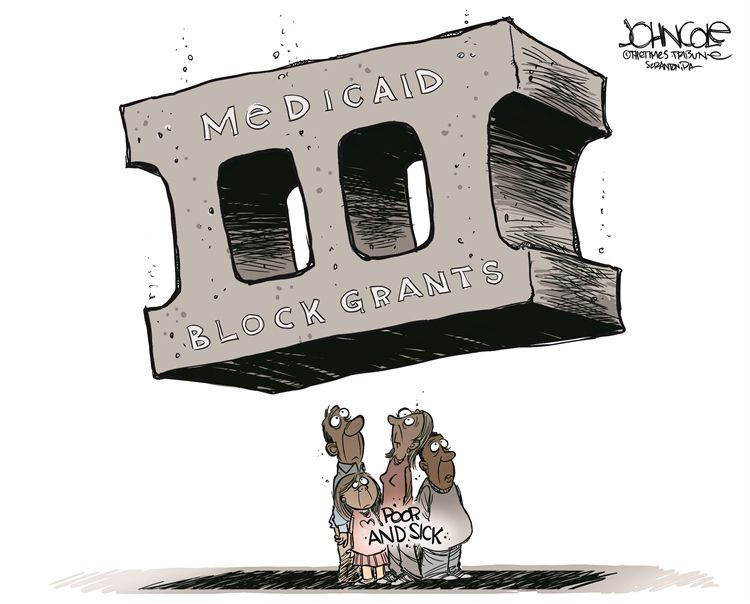
An idea floating around Congress is the idea of converting Medicaid to a per capita cap and providing these funds to the states as a block grant, Abrams said. The cost of those programs would be borne 70% by the federal government and 30% by states.

This fixed amount based on a per person amount would save money over the current system of letting states report what they spent.

Another potential change under the new administration includes site neutral Medicare payments to hospitals for outpatient services.

The HFMA reported the site neutral policy as a concern in a list it published Monday of preliminary federal program cuts totaling more than $5 trillion over 10 years. The 50-page federal list is essentially a menu of options, the HFMA said, not an indication that programs will actually be targeted leading up to the March 14 deadline to pass legislation before federal funding expires.

Other financial concerns for hospitals based on that list include: the elimination of the tax exemption for nonprofit hospitals, bringing in up to $260 billion in estimated 10-year savings; and phasing out Medicare payments for bad debt, resulting in savings of up to $42 billion over a decade.

Healthcare systems are the ones most concerned over GOP spending cuts, according to Abrams. Pharmacy benefit managers and pharmaceutical manufacturers also remain on edge as to what might be coming at them next.

THE LARGER TREND

President Donald Trump mentioned little about healthcare during his inauguration speech on Monday.

Trump said the public health system does not deliver in times of disaster, referring to the hurricanes in North Carolina and other areas and to the fires in Los Angeles.

Trump also mentioned giving back pay to service members who objected to getting the COVID-19 vaccine.

He also talked about ending the chronic disease epidemic, without giving specifics.

“He didn’t really talk about healthcare even in the campaign,” Abrams said.

However, in his consulting work, Abrams said, “The common thread is the environment is changing quickly,” and that healthcare organizations need to do the same “in order to survive.”

Advocates roll out efforts to shield Medicaid

https://nxslink.thehill.com/view/6230d94bc22ca34bdd8447c8msmrk.ngi/32c5cdf6

Liberal advocacy groups are ramping up efforts to protect the Medicaid program from potential cuts by Republican lawmakers and the new Trump administration. 

The Democratic group Protect Our Care launched Tuesday an eight-figure “Hands off Medicaid” ad campaign targeting key Republicans in the House and Senate, warning of health care being “ripped away” from vulnerable Americans. 

The lawmakers include GOP Sens. Bill Cassidy (La.), Chuck Grassley (Iowa), Lisa Murkowski (Alaska) and Susan Collins (Maine), as well as Reps. David Schweikert (Ariz.), Mike Lawler (N.Y.) and David Valadao (Calif.). 

The campaign will also include digital advertising across platforms targeting the Medicaid population in areas around nursing homes and rural hospitals, ads on streaming platforms as well as billboards and bus stop wraps. 

Medicaid covers 1 in 5 Americans, and the group wants to highlight that includes “kids, moms, seniors, people of color, rural Americans, and people with disabilities.” 

“The American people didn’t vote in November to have their grandparents kicked out of nursing homes or health care ripped away from kids with disabilities or expectant moms in order to give Elon Musk another tax cut,” Protect Our Care chair Leslie Dach said in a statement.  

House Republicans have expressed openness to making some drastic changes in the Medicaid program to pay for extending President Trump’s signature tax cuts, including instituting work requirements and capping how much federal money is spent per person. The ideas have been conservative mainstays since they were included as part of the 2017 Obamacare repeal effort.  

Separately, advocacy group Families USA led a letter with more than 425 national, state and local organizations calling on Trump to protect Medicaid.  

The groups noted that if the Trump administration wants to trim health costs, “there are many well-vetted, commonsense and bipartisan proposals” that don’t involve slashing Medicaid. 

“In 2017, millions upon millions of Americans rose up against proposed cuts and caps and made clear how much they valued Medicaid as a critical health and economic lifeline for themselves, their families, and their communities. The American people are watching once again, and we urge you to take this opportunity to choose a different path,” they wrote.