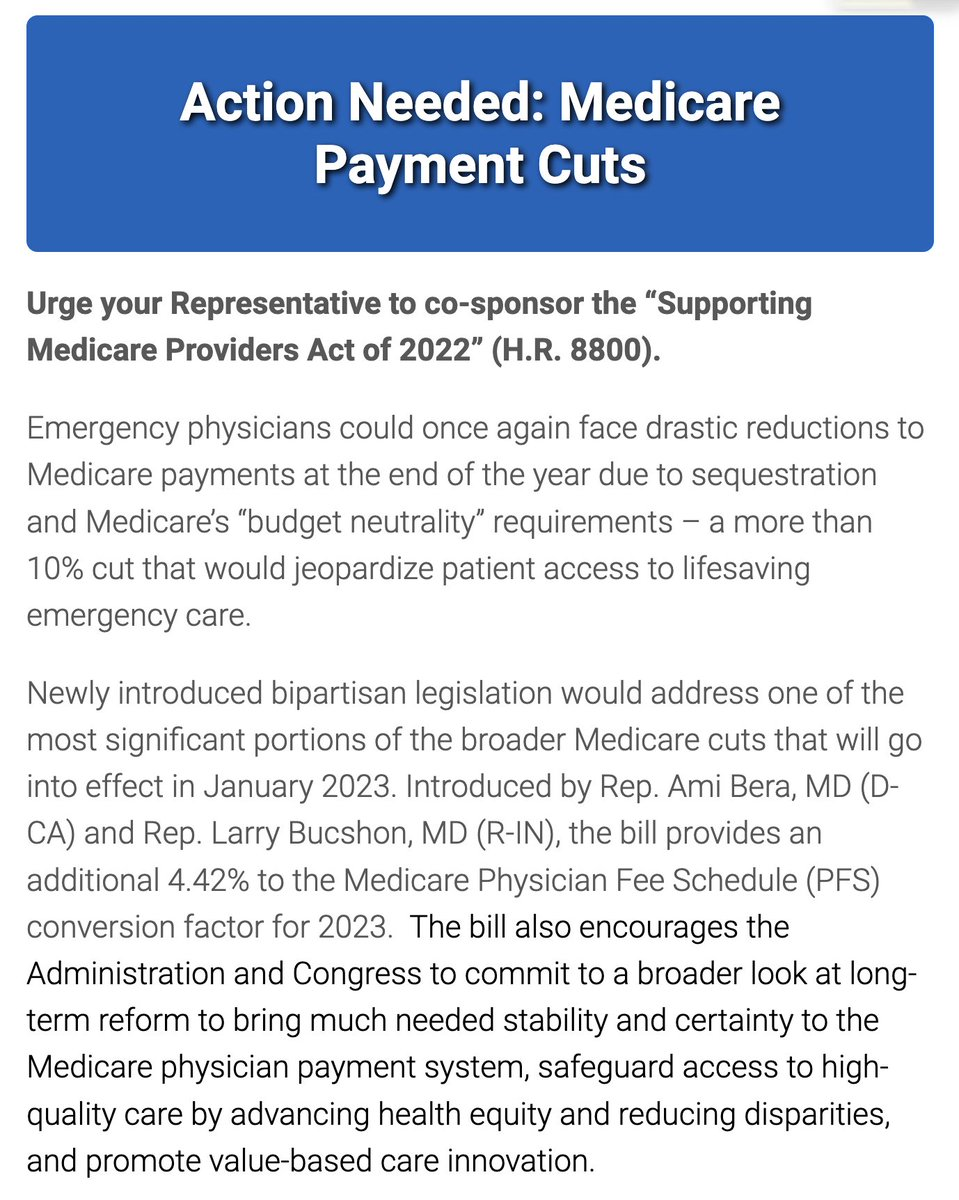
This critical, bipartisan legislation would stabilize Medicare for physicians and patients because it:
Stops the 4.42% of the Medicare cuts related to the budget neutrality adjustment in the Medicare Physician Fee Schedule (MPFS), helping to buoy physician practices that are still recovering from the pandemic;
Protects patients access to care, particularly in underserved communities; and
Provides a commitment to long-term Medicare payment reform.
Stillwater Medical Center in Oklahoma has ended all in-network contracts with Medicare Advantage plans amid financial challenges at the 117-bed hospital, the Stillwater News Press reported Oct. 14.
Humana and BCBS of Oklahoma were notified that their members will no longer receive in-network coverage after Jan. 1, 2023.
“BCBSOK is willing to work with Stillwater Medical Center in finding solutions that will allow Payne County residents continued local access to Medicare Advantage providers,” a BCBS spokesperson told the newspaper.
The hospital said it made the decision after facing rising operating costs and a high prior authorization burden for the MA plans.
“This was a very tough financial decision for the Stillwater Medical leadership team. Our cost to operate has increased 26 percent over the past 2 years,” Tamie Young, vice president of revenue cycle at SMC, told the News Press. “Financial challenges are increased by a 22 percent denial of service rate from Medicare Advantage plans. This is in comparison to a less than 1 percent denial rate from traditional Medicare.”
Before 2011, Medicare Advantage health plans absorbed a greater share of Medicare enrollment because traditional Medicare enrollees were transitioning to Medicare Advantage plans. From 2011 to 2019, Medicare Advantage enrollment continued to increase but the source changed.
The researchers used the Master Beneficiary Summary File from 2011 to 2019 to inform their study of the source of Medicare Advantage enrollment during that timeframe. These files provided over 524.4 million person-years.
Medicare Advantage still drew enrollees from traditional Medicare from 2012 to 2019, with the share of those who came from Medicare Advantage growing from 65.9 percent to 71.1 percent.
The number of enrollees that were new to Medicare who chose Medicare Advantage coverage also grew. A little over 18 percent of enrollees who did not have Medicare coverage previously transitioned into Medicare Advantage in 2012. But by 2019, that share had swelled to 24.7 percent.
Beneficiaries who switched to Medicare Advantage from traditional Medicare tended to be older. Fewer of them identified as Hispanic individuals but more of them identified as Black individuals. Additionally, they were more likely to be dually eligible and more likely to have a disability. Finally, they were more likely to die within two years of enrolling in Medicare Advantage.
“Our study is limited in that it was not designed to examine these mechanisms,” the researchers acknowledged. “As MA continues to grow, understanding the reasons for switching from TM to MA will become more important.”
Although the study did not explicitly explore the causes behind these enrollment shifts, the researchers cited three factors that might contribute to the growth and diversity of the Medicare Advantage population.
First, they noted that Medicare Advantage plans offer supplemental benefits and dental and vision coverage, which traditional Medicare does not cover.
In 2022, more Medicare Advantage plans offered more supplemental benefits, including special supplemental benefits for the chronically ill (SSBCI), expanded supplemental benefits, and traditional supplemental benefits, according to a Better Medicare Alliance brief.
Second, Medicare Advantage plans offer lower out-of-pocket healthcare spending compared to traditional Medicare.
Finally, Medicare Advantage might be more attractive due to the lower premiums.
In 2022, costs were particularly low since Medicare Advantage premiums dropped to the lowest level in 15 years, 10 percent lower than in 2021, the Better Medicare Alliance report shared.
The results corroborate separate studies that show that the Medicare Advantage population is growing and becoming more diverse.
In more than 100 congressional districts, Medicare Advantage coverage represents half or more of enrollment, according to Better Medicare Alliance research. Medicare Advantage coverage is particularly strong in Alabama, Michigan, and Florida.
Medicare Advantage plans grew 60 percent from 2013 to 2020. By 2020, Medicare Advantage plans served 25 million seniors, of which six out of ten were women. Also, more than half of all Hispanic American seniors (52 percent), 49 percent of African American seniors, and 35 percent of Asian Americans selected Medicare Advantage plans for their coverage.
From the spring of 2021 through June of this year, the U.S. has been in a period of high and rising economywide price inflation. Pressures such as labor scarcities, global energy interruptions, and supply chain disruptions have made everything from consumer goods to business services more expensive. Yet, in our ongoing series of Health Sector Economic Indicators (HSEI) briefs, we have been detailing data that find, quite surprisingly, overall inflation for the health care sector—as measured by the aggregate Health Care Price Index (HCPI)—has remained in a very tight and modest range, rarely exceeding three percent year-over-year growth or falling beneath two percent growth. In our monthly briefs, we have explored how factors such as the time it takes for new contracts and reimbursement rates to take effect and recent policy changes restraining public health care costs have kept overall health care inflation well below economywide rates. As these factors continue to play out, the recently-released July price data are revealing what may be a key inflection point in Medicare and private insurance prices for health care services.
In July, the prices paid for many types of health care from these two major payer types diverged substantially. Medicare prices fell by nearly a full percentage point, putting overall Medicare services prices below the levels seen back in January 2021 (Exhibit 1). These declining Medicare prices are due to two major factors: very low or no increases in the statutory reimbursement rates for hospital care and physician services in the calendar year 2022 and the re-institution of the mandated sequestration cuts for Medicare provider payments in April and July of this year. These sequestration cuts, which had been postponed for many years since they were updated in 2011, are having a meaningful impact as seen in the chart below (click on link above). The impact of the two sequestration cuts can be seen clearly in the data, pulling down Medicare prices between March and April and then between June and July across all three major settings of care as first a 1% and then a 2% cut were put in place. Due to the fact that physician services received relatively smaller baseline increases in new Medicare rates for 2022, the sequestration cuts have pulled those price levels the lowest, down by 2.2% since January 2021. Medicare price changes for nursing homes care fall in between hospitals and physician services, down by 1.0% since January 2021.
At the same time Medicare prices are falling, the prices for similar types of care paid by private insurance increased substantially in July, up a full percentage point from the previous month and 5.4% higher than the price levels in January 2021 (Exhibit 2). We believe many of these increases are occurring as new contracts or updated rates are slowly taking effect, and further expect there may be a noticeable discrete jump in private prices beginning in 2023, as recent comments from providers and insurers are stating 2023 negotiations are generally favoring providers. We can see in the data that it appears hospitals are experiencing much higher private price growth than other components (up 7.2% since January 2021) and faster recent growth, with price levels increasing by nearly a full percentage point in each of the past three months. Physician services are the next fastest growing component, while nursing home private prices have barely moved since the beginning of 2021. Faster increases in hospital prices may indicate stronger negotiating positions for those providers, particularly given ongoing consolidation in the industry over the past ten years.
When looking at the HCPI in aggregate, these two diverging trends have been cancelling out, leading to overall moderate growth in health care prices. Yet, these detailed, by-payer data indicate that significant trends in health care prices are occurring underneath, with the long-expected increases in private prices beginning to follow overall economywide inflation trends. All else equal, these price increases in care paid by private insurance will further exacerbate an already wide gap between public and private prices. This is especially true for hospital care, where the disparity between Medicare and private prices diverged by a whopping 7.2 percentage points in the last eighteen months. The most important factors driving the trends going forward for private prices will be the extent to which overall economywide inflation slows and who has the balance of power in insurer/provider contract negotiations. For public prices, government policy decisions will continue to be most important influencer of their growth. We expect to follow all these factors and the overall impact of the diverging data on overall health sector inflation in our ongoing series of HSEI briefs through the rest of the year and into 2023.
The Inflation Reduction Act is law. But that doesn’t mean major health care interests are done testing their lobbying clout. Many are already lining up for year-end relief from Medicare payment cuts, regulatory changes and inflation woes.
The big picture: Year-end spending bills often contain health care “extenders” that delay cuts to hospitals that treat the poorest patients or keep money flowing to community health centers. But lawmakers may be hard-pressed to justify the price tag this time, and are seeing an unusual assortment of appeals for help.
Background: 2% Medicare sequester cuts that had been paused by the pandemic took effect last month. Another 4% cut could come at year’s end, if lawmakers don’t delay it.
These automatic reductions in spending come amid health labor force shortages, supply chain problems and other pressures that are making providers jockey for relief.
It will fall to Congress to pick winners and losers among hospitals, physicians, home health care groups, nursing homes and ambulance services. And each says the consequences of not helping are dire.
“The core question is how do they come up with the money and how do they decide to prioritize who give it to?” said Raymond James analyst Chris Meekins.
Go deeper: Hospitals arepressing hard for relief from the year-end sequester, and want Congress to extend or make permanent programs that support rural facilities and are slated to expire on Sept. 30, absent legislative action.
The American Hospital Association has estimated its members will lose at least $3 billion by year’s end.
Hospitals in the government’s discount drug program also have to be made whole after the Supreme Court unanimously overturned a huge pay cut stemming from a 2018 rule. And the industry also is seeking to reverse a planned cuts to supplementary payments for uncompensated care.
Doctors and nursing homes are among the other players lining up for relief from sequester cuts, specific Medicare payment changes that affect their businesses or new regulations.
The American Medical Association says Medicare cuts could threaten physician practices that have been racked by pandemic-induced retirements and burnout. “This is really about allowing patients and Medicare beneficiaries to continue care,” AMA President Jack Resneck told Axios.
National Association for Home Care and Hospice President Bill Dombi said over half of the home health agencies will run deficits if lawmakers don’t act. “When you have that many providers in the red, you can foresee there will be negative consequences. They’re already rejecting 20 to 30% of referrals for admissions to care, so it will be affecting patients,” said Dombi.
Ambulance services are also struggling. “Ambulance providers around the country are at a very near breaking point as we kind of walk along the ledge leading to this cliff at the end of the calendar year,” Shawn Baird, president of the American Ambulance Association and chief operating officer of Metro West Ambulance in Oregon, told Axios.
The other side: Despite Congress’ willingness to delay payment cuts, there’s not enough money to make everyone happy. And concerns about Medicare program’s solvency that emerged during the lengthy debate over the Democrats’ tax, climate and health package could dampen lawmakers’ enthusiasm for costly fixes that favor one provider group.
The continuation of the COVID-19 public health emergency and its myriad temporary payment allowances could also lessen a sense of urgency around provider relief.
The bottom line: For all the dire warnings, it’s unlikely Congress will do much until December, when it will likely pass a continuing resolution or an omnibus spending bill and could then move to delay the 4% cut.
With a closely divided Congress, President Biden has leaned heavily on regulatory actions to advance his healthcare priorities. With the midterm elections fast approaching, the graphic above assesses the impact of those actions, and outlines which legislative components Democrats may still try to pass before November.
From the start, the administration has signaled the importance of promoting competition in healthcare markets, and has devoted more scrutiny to hospital mergers—while leaving most attempts at vertical integration unchallenged. Through Medicaid waivers, it has worked to expand insurance coverage, rolling back Trump-era work requirements, expanding postpartum coverage, and encouraging states to experiment with public option plans on the Affordable Care Act (ACA) exchanges.
The Centers for Medicare and Medicaid Services (CMS) has continued the steady march toward value programs, revising the Direct Contracting model to factor in health equity. Despite these incremental moves, Medicare Advantage (MA) remains the focus of long-term efforts to control Medicare spending, and MA programs have seen payments boosts year-over-year.
Meanwhile, the fate of President Biden’s signature healthcare campaign promises remains in the hands of an intransigent Congress. Senate Democrats are currently trying to negotiate a deal on a bill allowing Medicare drug negotiations and extending ACA subsidies, an important provision to protect millions from receiving premium hike notices just weeks before Election Day.
Editor’s Note: This story has been updated with the DOJ’s statement regarding its civil fraud complaint. This story was originally filed June 3.
Updated: July 13, 3:30 p.m.
The federal government filed a civil complaint Tuesday in federal court in Brooklyn against the country’s largest dialysis provider alleging that the company performed unnecessary procedures on dialysis patients.
The Department of Justice has formally intervened and joined the False Claims Act whistleblower lawsuit filed against dialysis giant Fresenius Medical Care, according to court documents filed in U.S. District Court in Brooklyn.
The DOJ’s False Claims Act complaint alleges Fresenius Vascular Care, a business unit of Fresenius Medical Care performed these unnecessary procedures at nine centers across New York City, Long Island and Westchester, and billed the procedures to Medicare, Medicaid, the Federal Health Benefits Program and TRICARE. The complaint seeks damages and penalties under the False Claims Act.
The whistleblower complaint alleges that from about January 1, 2012 through June 30, 2018, Fresenius routinely performed certain procedures on patients with end stage renal disease (ESRD) who were receiving dialysis, without sufficient clinical indication that the patients needed the procedures. Fresenius knowingly subjected ESRD patients—who included elderly, disadvantaged minority, and low-income individuals—to these procedures to increase its revenues, the DOJ complaint states.
A Fresenius spokesperson said the company disputes the allegations contained in both the relators’ complaint and the U.S. government’s complaint and “intends to vigorously defend the litigation.”
“Our network of vascular centers is leading efforts to reduce total healthcare costs and improve patient outcomes by expanding access to innovative and less-invasive procedures. Our policies are intended to result in a high standard of care and compliance with government regulations,” the Fresenius spokesperson said in a statement.
Breon Peace, United States Attorney for the Eastern District of New York, called the company’s alleged conduct “egregious,” claiming that Fresenius “not only defrauded federal healthcare programs but also subjected particularly vulnerable people to medically unnecessary procedures.”
“This Office will hold medical providers accountable for practices that needlessly expose patients to harm for financial gain at taxpayer expense,” Peace said in a statement.
Two doctors allege in a lawsuit that the country’s largest dialysis provider performed potentially thousands of unnecessary, invasive vascular procedures on late-stage kidney disease patients and fraudulently charged Medicare and Medicaid for these procedures.
The lawsuit, originally filed in 2014 in New York, claims Fresenius Medical Care and its business unit, Azura Vascular Care, violated the federal False Claims Act. The case remained under seal until the court lifted the seal May 9. The federal government has 60 days to file its complaint.
Nineteen states also are included in the lawsuit and potentially could join the case.
The U.S. attorney in the Eastern District of New York will be taking over with respect to federal False Claims Act fraud claims against Fresenius, according to law firm Cohen Milstein Sellers & Toll, which is representing the plaintiffs in the case.
The U.S. attorney’s office declined to comment at the time.
The plaintiffs, two practicing nephrologists, charge in the complaint that Fresenius performed thousands of end-stage renal disease-related treatments that were “not medically reasonable and necessary” and that “exposed patients to undue and unnecessary risks.”
In a statement provided by a spokesperson, Fresenius declined to comment on the lawsuit.
Fresenius Medical Care North America is the largest dialysis provider in the U.S., operating over 2,600 dialysis units nationwide and treating over 205,000 patients annually. Its business unit, Azura Vascular Care, operates more than 90 vascular care facilities across the country.
On July 7, 2022, the Centers for Medicare & Medicaid Services (CMS) released the 2023 Medicare Physician Fee Schedule (MPFS) proposed rule, which includes payment provisions and policy changes to the Quality Payment Program (QPP) and Alternative Payment Model (APM) participation options and requirements for 2023.
MPFS Key Proposals and Additional Potential Medicare Reductions:
For 2023, CMS proposes a Conversion Factor (CF) of $33.0775 which is a decrease of $1.53 or -4.42% from the 2022 conversion factor of 34.6062.
This significant reduction in the CF accounts for the expiration of the 3.00% increase in PFS payments for CY 2022 as required by the Protecting Medicare and American Farmers from Sequester Cuts Act, in addition to the statutorily required budget neutrality adjustment to account for changes in Relative Value Units.
The separately calculated Anesthesia CF is proposed at 20.7191, a -3.91% decrease from the 2022 conversion factor of $21.5623.
Key Takeaways: CMS estimates an impact to allowed charges from policy changes in the rule as outlined below. These impacts are due in part due changes in the RVUs and the second year of the transition to clinical labor pricing updates.
(Please note: These estimates do not include the impact on payments from the expiration of the congressionally mandated 3.00% boost to the 2022 CF.)
Anesthesiology: -1%
Diagnostic Radiology: -3%
Interventional Radiology: -4%
Emergency Medicine: +1%
Critical Care: +1%
Nuclear Medicine: -3%
Pathology: -1%
Radiation Oncology/Therapy Centers: -1%
Internal Medicine: +3%
Independent Laboratory -1%
Additional Potential Medicare Reductions:
In addition to the proposed cut to the CF, the second of two sequestration cuts was implemented on July 1, 2022, at -1%, bringing the total sequestration cut to -2% which will continue without Congressional intervention.
Also, the lack of full funding of the American Rescue Plan meant that the Medicare program would contribute 4% under the “PAYGO” (Pay as You Go) rules and that cut will come back into the Medicare fee schedule in 2023. In total, hospital-based physicians face in the approximate range of -10% in 2023 without Congressional intervention.
Appropriate Use Criteria (AUC): CMS did not address the appropriate use criteria (AUC)/clinical decision support (CDS) mandate for advanced diagnostic imaging services in this rule. CMS posted an update on its website indicating that the current educational and operations testing period will continue beyond January 1, 2023, even if the COVID-19 public health emergency (PHE) ends in 2022. The notice states that the agency is unable to forecast when the payment penalty phase of the program will begin. Read more at CMS.gov.
Additional highlights of the MPFS Proposed Rule include: Evaluations and Management (E/M) Services: As part of the ongoing updates to E/M visits and the related coding guidelines that are intended to reduce administrative burden, the AMA CPT Editorial Panel approved revised coding and updated guidelines for Other E/M visits, effective January 1, 2023.
Like the approach CMS finalized in the CY 2021 MPFS final rule for office/outpatient E/M visit coding and documentation, CMS is proposing to adopt most changes in coding and documentation for Other E/M visits including: hospital inpatient, hospital observation, emergency department, nursing facility, home or residence services, and cognitive impairment assessment, effective January 1, 2023. This revised coding and documentation framework would include CPT code definition changes (revisions to the Other E/M code descriptors), and for the first time would mean that AMA CPT and CMS would follow the same coding guidelines, including:
• New descriptor times (where relevant). • Revised interpretive guidelines for levels of medical decision making. • Choice of medical decision making or time to select code level (except for services such as emergency department visits (time has never been a component of ED E/M services except critical care) and cognitive impairment assessment, which are not timed services). • Eliminated use of history and exam to determine code level (instead there would be a requirement for a medically appropriate history and exam).
Split (or Shared) Visits (Where services are performed by advance practice clinicians.) CMS had previously finalized in the 2022 MPFS final rule a new January 1, 2023 billing policy for instances in which a physician delivers an E/M service along with an advanced practice clinician (APC). Recall that E/M services billed under an APC reimburse at 85% of the MPFS unless there is a documented shared service by the supervising physician.
• The key determinant for deciding if there was a shared service is if the physician provided key elements of the history, exam, or medical decision making ─ OR half of the total time spent treating the patient. • There were significant concerns that in hospital-based settings, the rule (set for implementation on January 1, 2023) would have required only time as the determinative element, and that the majority of APC services would then be reimbursed at 85% of the fee schedule. After significant advocacy by multiple stakeholders, CMS has delayed the policy that would have based the determination of the billing practitioner solely on time. This policy is proposed for delay until January 1, 2024 while CMS collects additional input.
Expand Telehealth Coverage: • CMS is proposing making several services that are temporarily available as telehealth services for the PHE available through CY 2023 on a Category III basis, which will allow more time for collection of data that could support their eventual inclusion as permanent additions to the Medicare telehealth services list. • CMS is also proposing to extend the duration of time that services are temporarily included on the telehealth services list during the PHE, but are not included on a Category I, II, or III basis for a period of 151 days following the end of the PHE, in alignment with the Consolidated Appropriations Act, 2022 (CAA, 2022).
Highlights of the Quality Payment Program (QPP): CMS stated they are limiting proposals for traditional MIPS and focusing on further refining implementation of MIPS Value Pathways (MVPs). 2023 Proposed Performance Threshold and Performance Category Weights: The performance threshold for the 2023 performance year is proposed to be 75 points, same as 2022. • Beginning with 2023, CMS will no longer offer an exceptional performance adjustment. • The category weights for the 2023 performance year are proposed to remain the same as the 2022 weights: o Quality – 30%, o Cost – 30% o Promoting interoperability – 25% o Improvement Activities – 15%
Data Completeness Requirements: • For 2023, CMS is proposing quality measure submissions should continue to account for at least 70% of total exam volume – same as 2022.
• CMS proposed to increase this threshold to 75% beginning with the 2024 and 2025 performance years.
Quality Category – Measure Scoring System • Beginning with 2023 CMS will change the scoring range for benchmarked measures to 1 to 10 points, doing away with the 3-point floor. • Score existing non-benchmarked measures at 0 points even if data completeness is met • New measures will continue to be scored at a minimum of 7 points for their first year and a minimum of 5 points in their second year. • CMS is maintaining the small practice bonus of 6 points that is included in the Quality • performance category score. • CMS also continues to award small practices 3 points for submitted quality measures that do not meet case minimum requirements or do not have a benchmark.
MIPS Value Pathways (MVPs) CMS is proposing 5 new MVPs and revising the 7 previously established MVPs that would be available beginning with the 2023 performance year. • Advancing Cancer Care • Optimal Care for Kidney Health • Optimal Care for Patients with Episodic Neurological Conditions • Supportive Care for Neurodegenerative Conditions • Promoting Wellness
Advanced Alternative Payment Models For payment years 2019 through 2024, Qualifying APM Participants (QPs) receive a 5 percent APM Incentive Payment. After performance year 2022, which correlates with payment year 2024, there is no further statutory authority for a 5 percent APM Incentive Payment for eligible clinicians who become QPs for a year.
CMS is concerned that the statutory incentive structure under the QPP beginning in the 2023 performance year. corresponding 2025 payment year, could lead to a drop in Advanced APM participation, and a corresponding increase in MIPS participation. As a result, CMS concluded that it would forego action for the 2023 performance period and 2025 payment year. They instead are seeking public input in identifying potential options for the 2024 performance period and 2026 payment year of the QPP.
As part of the 2023 Physician Fee Schedule proposed rule, the Centers for Medicare & Medicaid Services (CMS) outlined major changes to the Medicare Shared Savings Program (MSSP), with the goals of increasing participation in the program and improving health equity.
The agency hopes their revisions to the benchmarking methodology, which will advantage smaller accountable care organizations (ACOs) and those enrolling large numbers of underserved beneficiaries, will change the trajectory of the program.
With participation among providers stagnating in recent years, the new rules represent a recognition from CMS that MSSP, in its current form, is likely to increase spending rather than generate significant savings. The rule also includes a 3.9 percent decrease in the “conversion factor” for physician payment, which has already drawn outrage from the American Medical Association and other physician groups.
The Gist:There is little reason to expect that these modifications—as significant as they are—will be meaningful to beneficiaries or to the Medicare program’s overall sustainability. Although it is heartening to see CMS admit that ACOs are on course to violate the statutory requirement that the program not increase spending, the proposed changes would net only $14.8B in savings over a twelve-year period—a rounding error for a program that spent $830B in 2020 alone. Meanwhile the 11M beneficiaries attributed to MSSP ACOs are dwarfed by the 28M enrolled in MA.
For many health systems and physician groups—particularly those who are most progressive in managing risk—MSSP is now a sideshow to their Medicare Advantage (MA) strategies. The federal government has made two “bets” on how to lower health spending for seniors, and the dollars spent on enticing insurers to grow their MA businesses (in the form of subsidies) far outweigh the effort to encourage provider participation in ACOs—a clear sign of Medicare’s priorities.
But with MA currently not generating savings compared to fee-for-service Medicare, cuts in per-beneficiary spending in MA will be necessary to achieve savings in the long term.
Political will seems to be growing to reshape the increasingly popular Medicare Advantage program.
At a House Energy and Commerce committee hearing on Tuesday, lawmakers on both sides of the aisle called for more oversight of MA following watchdog reports that found impediments to receiving covered care, including improper denials of prior authorization requests, and plans gaming the system in exchange for more funding from Medicare.
“Medicare Advantage is an important tool for helping seniors and we want it to succeed. We’re going to continue to conduct the oversight necessary,” said Oversight and Investigations Subcommittee Chair Diana DeGette, D-Colo.
Witnesses at the hearing — officials from the Government Accountability Office, HHS Office of Inspector General and congressional advisory board MedPAC — also pointed to higher rates of beneficiary disenrollment in their last year of life and opaque plan data, which can complicate oversight efforts.
Surveys have shown MA remains extremely popular with beneficiaries, attracted by lower co-pays and supplemental benefits like vision coverage and telehealth. In the program, Medicare pays private plans a capitated monthly rate to provide care for their beneficiaries based on the severity of their beneficiaries’ needs.
The hearing comes amid inflamed industry debate over the future of MA.
For-profit hospital lobby Federation of American Hospitals submitted a letter for the record sharing concerns over some MA plans denying patient care and having inadequate care networks.
Meanwhile, MA trade group Better Medicare Alliance sent a letter to the CMS on Monday urging the agency to safeguard the program as Congress mulls changes to Medicare.
But as Medicare’s hospital benefit — part of which funds MA — limps towards insolvency, lawmakers appear poised to target the growing MA program in a bid to crack down on improper payments and care denials.
“This is something that I think is very much bipartisan,” said Rep. Gary Palmer, R-Ala.
Coverage delays and denials
It’s not the first time lawmakers have zeroed in on MA oversight as a strategy to save Medicare money: In a Senate hearing on Medicare insolvency in February, Sen. Elizabeth Warren, D-Mass., said “the Medicare system is hemorrhaging money on scams and frauds” due to insurers taking advantage of the program’s rules to increase profits.
Even amid rising congressional criticism of MA, lawmakers on Tuesday reiterated their support for the program overall, which covered roughly 27 million Americans in 2021.
That’s more than a third of all Medicare beneficiaries, though MA is expected to swell to cover half of all Medicare members by 2030.
But lawmakers said they are increasingly concerned about disparities in the quality of coverage offered by Medicare Advantage plans compared to traditional Medicare plans, along with unscrupulous practices in the program resulting in higher reimbursement for MA organizations.
A GAO report found MA beneficiaries in their last year of life disenroll from MA in favor of traditional Medicare at a rate two times higher than other MA members, suggesting the plans may not support high-cost and specialized care, testified Leslie Gordon, GAO’s acting director for healthcare.
Gordon called it a “red flag” for the program that requires more scrutiny from CMS.
In addition, an HHS OIG report published April found MA organizationswrongly denied members care, with plans turning down 18% of payment requests that should have been approved.
Erin Bliss, OIG assistant inspector general in the Office of Evaluation and Inspection, testified plans sometimes use internal critical criteria that are not required by Medicare. In one example, an MA plan denied a medically necessary CT scan to diagnose a serious disease, citing that the patient hadn’t yet received an x-ray, Bliss said.
When appealed, plan denials were reversed 75% of time, a rate DeGette called “alarmingly high.”
“We are concerned that patients are receiving the timely care they need in those situations,” Bliss said.
OIG also found plans denied 13% of prior authorization requests that would have been approved under traditional Medicare.
Rep. Michael Burgess, R-Texas, suggested policymakers consider requiring insurers to forego prior authorization for doctors with a consistent track record of submitting accurate data. That strategy, called “gold carding,” is already used in some states, including Texas and West Virginia, to pare back on prior authorization delays.
MA payment reform
Along with coverage restrictions, lawmakers at Tuesday’s hearing asked witnesses about the scope and severity of improper MA payments in a bid to zero in on specific solutions Congress and the CMS can enact.
Though MA has potential to save the Medicare program money, “the current incentives for MA plans are not adequately aligned with the Medicare program,” said James Mathews, MedPAC executive director.
“Substantial reforms are urgently needed,” especially in light of Medicare’s “profound” financial problems, Mathews said.
In 2022, the average MA plan bid was 85% of fee-for-service spending, Mathews said. However, Medicare pays plans 104% of fee-for-service costs.
That imbalance is partially due to plans making patients appear sicker than they are to get extra payments from the government, witnesses said. The practice, called “coding intensity,”resulted in an estimated $12 billion in excess Medicare spending in 2020, according to MedPAC data.
Methods include chart reviews, where plans identify and add patient diagnoses that aren’t included in the service record, and health risk assessments, where plans contract with vendors to visit beneficiaries homes and conduct assessments, finding new diagnoses that often aren’t backed up by other records, according to Bliss.
GAO estimates that roughly a tenth of Medicare payments to MA plans in 2021 were improper, Gordon said.
To try to tamp down on coding intensity, the CMS should conduct targeted oversight of MA plans that routinely use these tools, and reassess whether chart reviews and in-home assessments are allowed to be sole sources of diagnoses for payment purposes, witnesses said. In addition, MA should improve care coordination for enrollees who receive health risk assessments.
The CMS should also consider replacing the quality bonus program and change its approach to calculating MA benchmarks, Mathews said.
In addition, the agency should require and validate data for completeness and accuracy before risk-adjusting payments through methods like medical record reviews, Gordon said.
Gordon also suggested the agency conduct more timely audits, as the CMS is currently missing out on recouping hundreds of millions of dollars in improper payments.
Policymakers appeared open witnesses’ suggestions to ensure MA is running as smoothly as possible, with Rep. Frank Pallone, D-N.J., calling for an additional hearing on the matter.
“This is bipartisan … You can be assured that we’re going to be following up,” DeGette said.










 HENRY KOTULA