Modeling the ominous impact of testing delays

https://mailchi.mp/da2dd0911f99/the-weekly-gist-july-17-2020?e=d1e747d2d8

Sponsors Delay Trials and Shift Toward Using Remote Procedures ...

With delays in getting test results growing in many areas of the country, a new analysis in the Lancet shows just how destructive increased turnaround times for COVID tests can be.

Researchers modeled the impact of the timeliness and completeness of contact tracing, finding that minimizing testing delay—shortening the time between symptom onset and a positive test result—had the greatest impact on reducing future spread of the disease.

Digging into the details, if infected individuals who develop symptoms are isolated within one day of symptom onset, the R0 (“R-naught”) can be reduced to 1—each existing infection seeds one new case—stabilizing the level of infection in a population. With contact tracing, the R0 can be reduced to 0.8, meaning the disease will decline.

And researchers found with a testing delay of three days or more, even the most efficient isolation and contact tracing is essentially futile, powerless to bend the curve of transmission rates.

Ominous findings for many states, where average test turnaround times are again approaching one week, showing just how far we are from being able to implement the basic public health strategy of “test, trace and isolate”, which has proven effective for so many countries around the world.


The surge in coronavirus hospitalizations is severe

https://www.axios.com/newsletters/axios-vitals-b0ebd340-d76f-49c3-8f02-cb2896ae2e8d.html?utm_source=newsletter&utm_medium=email&utm_campaign=newsletter_axiosvitals&stream=top

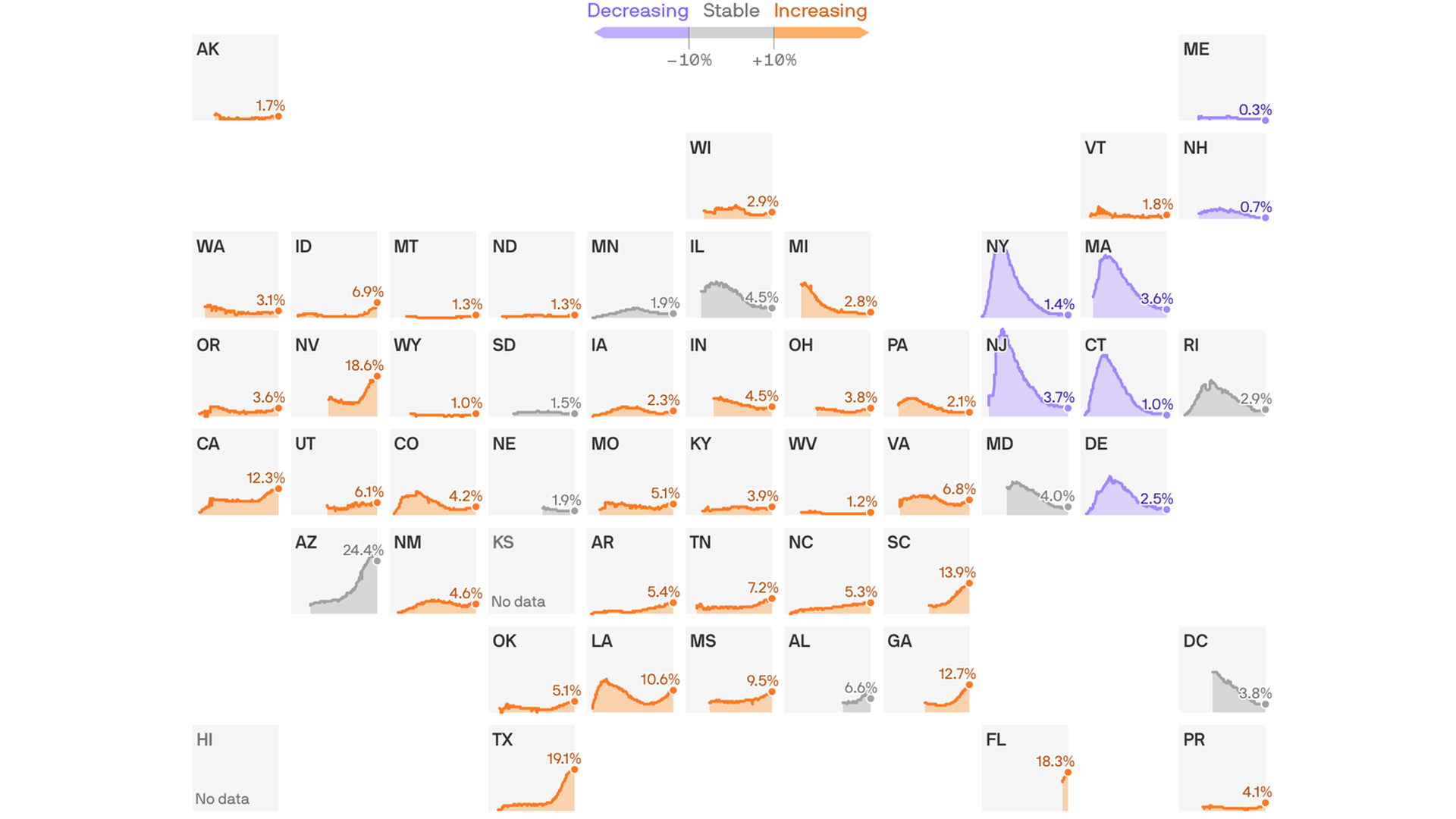
Share of hospital beds occupied
by COVID-19 hospitalizations

States shown from first date of reported data, from March 17 to July 19, 2020

  • In the last two weeks hospitalizations are:

The coronavirus surge is real, and it's everywhere - Axios


Coronavirus hospitalizations are skyrocketing, even beyond the high-profile hotspots of Arizona, Florida and Texas, Axios’ Bob Herman and Andrew Witherspoon report.

Why it matters: The U.S. made it through the spring without realizing one of experts’ worst fears — overwhelming hospitals’ capacity to treat infected people. But that fear is re-emerging as the virus spreads rapidly throughout almost every region of the country.

Where things stand: Arizona remains in the worst shape; 27.1% of all hospital beds in the state are occupied by COVID-19 patients as of July 15, according to an analysis combining data from the COVID Tracking Project and the Harvard Global Health Institute. Texas is second at 18.8%.

  • Nevada is the next worst, with COVID-19 patients taking up 18.7% of all hospital beds. That’s up significantly from 11.2% at the start of July.
  • Florida just started tallying current hospitalization data, showing more than 16% of all hospital beds occupied.

It gets worse: Many other states are showing significant upticks in coronavirus hospitalizations during the first half of July, including Alabama, California, Louisiana, Mississippi, South Carolina and Tennessee.

  • Many of these states, which reopened a lot of their economies in May, do not have mask mandates.

Between the lines: Intensive-care unit beds, reserved for the sickest patients, are completely full in parts of ArizonaFloridaMississippi and Texas.

  • Hospitals can convert other areas into ICUs, but that’s not all that useful if hospitals don’t have enough staff and supplies.

The bottom line: Cases have soared over the past 45 days, and hospitalizations naturally follow many of those cases.

  • Rising hospitalizations mean the outbreaks in many areas are not close to being controlled, and some percentage of those hospitalizations will end as deaths.


Covid-19 data is a public good. The US government must start treating it like one.

https://www.technologyreview.com/2020/07/17/1005391/covid-coronavirus-hospitalizations-data-access-cdc/

Data for the public good - O'Reilly Radar

The US has failed to prioritize a highly effective and economical intervention—providing quick and easy access to coronavirus data.

Earlier this week as a pandemic raged across the United States, residents were cut off from the only publicly available source of aggregated data on the nation’s intensive care and hospital bed capacity. When the Trump administration stripped the Centers for Disease Control and Prevention (CDC) of control over coronavirus data, it also took that information away from the public.


I run a nonpartisan project called covidexitstrategy.org, which tracks how well states are fighting this virus. Our team is made up of public health and crisis experts with previous experience in the Trump and Obama administrations. We grade states on such critical measures as disease spread, hospital load, and the robustness of their testing. 


Why does this work matter? In a crisis, data informs good decision-making. Along with businesses, federal, state, and local public health officials and other agencies rely on us to help them decide which interventions to deploy and when workplaces and public spaces can safely reopen. Almost a million people have used our dashboards, with thousands coming back more than 200 times each.

To create our dashboards, we rely on multiple sources. One is the National Healthcare Safety Network (NHSN), run by the CDC. Prior to July 14, hospitals reported the utilization and availability of intensive care and inpatient beds to the NHSN. This information, updated three times a week, was the only publicly available source of aggregated state-level hospital capacity data in the US.

With 31 states currently reporting increases in the number of hospitalized covid-19 patients, these utilization rates show how well their health systems will handle the surge of cases.


Having this information in real time is essential; the administration said the CDC’s system was insufficiently responsive and data collection needed to be streamlined. The US Department of Health and Human Services (HHS) directed hospitals (pdf) to report their data to a new system called HHS Protect.

Unfortunately, by redirecting hospitals to a new system, it left everyone else in the dark. On July 14, the CDC removed the most recent data from its website. As we made our nightly update, we found it was missing. After significant public pressure, the existing maps and data are back—but the agency has added a disclaimer that the data will not be updated going forward.


This is unacceptable. This critical indicator was being shared multiple times a week, and now updates have been halted. US residents need a federal commitment that this data will continue to be refreshed and shared.

The public is being told that a lot of effort is going into the new system. An HHS spokesman told CNBC that the new database will deliver “more powerful insights” on the coronavirus. But the switch has rightly been criticized because this new data source is not yet available to the public. Our concerns are amplified by the fact that responsibility for the data has shifted from a known entity in the CDC to a new, as-yet-unnamed team within HHS.

I was part of the team that helped fix Healthcare.gov after the failed launch in 2013. One thing I learned was that the people who make their careers in the federal government—and especially those working at the center of a crisis—are almost universally well intentioned. They seek to do the right thing for the public they serve.


In the same spirit, and to build trust with the American people, this is an opportunity for HHS to make the same data it’s sharing with federal and state agencies available to the public. The system that HHS is using helps inform the vital work of the White House Coronavirus Task Force. From leaked documents, we know that reports for the task force are painstakingly detailed. They include county-level maps, indicators on testing robustness, and specific recommendations. All of this information belongs in the public domain.

This is also an opportunity for HHS to make this data machine readable and thereby more accessible to data scientists and data journalists. The Open Government Data Act, signed into law by President Trump, treats data as a strategic asset and makes it open by default. This act builds upon the Open Data Executive Order, which recognized that the data sets collected by the government are paid for by taxpayers and must be made available to them. 

As a country, the United States has lagged behind in so many dimensions of response to this crisis, from the availability of PPE to testing to statewide mask orders. Its treatment of data has lagged as well. On March 7, as this crisis was unfolding, there was no national testing data. Alexis Madrigal, Jeff Hammerbacher, and a group of volunteers started the COVID Tracking Project to aggregate coronavirus information from all 50 state websites into a single Google spreadsheet. For two months, until the CDC began to share data through its own dashboard, this volunteer project was the sole national public source of information on cases and testing.

With more than 150 volunteers contributing to the effort, the COVID Tracking Project sets the bar for how to treat data as an asset. I serve on the advisory board and am awed by what this group has accomplished. With daily updates, an API, and multiple download formats, they’ve made their data extraordinarily useful. Where the CDC’s data is cited 30 times in Google Scholar and approximately 10,000 times in Google search results, the COVID Tracking Project data is cited 299 times in Google Scholar and roughly 2 million times in Google search results.


Sharing reliable data is one of the most economical and effective interventions the United States has to confront this pandemic. With the Coronavirus Task Force daily briefings a thing of the past, it’s more necessary than ever for all covid-related data to be shared with the public. The effort required to defeat the pandemic is not just a federal response. It is a federal, state, local, and community response. Everyone needs to work from the same trusted source of facts about the situation on the ground.

Data is not a partisan affair or a bureaucratic preserve. It is a public trust—and a public resource.


Administration’s war on the public health experts

https://www.axios.com/trump-public-health-experts-cdc-fauci-e1509d14-0cf1-4b1c-b107-7753bf95395d.html

Trump's war on the public health experts - Axios

A pandemic would normally be a time when public health expertise and data are in urgent demand — yet President Trump and his administration have been going all out to undermine them.

Why it matters: There’s a new example almost every day of this administration trying to marginalize the experts and data that most administrations lean on and defer to in the middle of a global crisis.

Here’s how it has been happening just in the past few weeks:

  • The administration has repeatedly undermined the Centers for Disease Control and Prevention. Most recently, Trump has criticized the CDC’s school reopening guidelines, Education Secretary Betsy DeVos declared that “kids need to be in school,” and the administration has reportedly ordered hospitals to bypass the CDC in reporting coronavirus patient information.
  • It has repeatedly undermined Anthony Fauci. Trump distanced himself on Wednesday from an op-ed attack by White House trade adviser Peter Navarro, but longtime Trump aide Dan Scavino also called the infectious diseases specialist “Dr. Faucet” in a Facebook post accusing him of leaking his disagreements. And the White House gave a opposition research-style list of the times Fauci “has been wrong” to the Washington Post and other media outlets.
  • Trump himself undermined public health experts generally with his retweet of former game show host Chuck Woolery’s “everyone is lying” tweet — which blamed “The CDC, Media, Democrats, our Doctors, not all but most, that we are told to trust.”
  • Trump has made numerous statements suggesting, over and over again, that we wouldn’t have as many COVID cases if we just tested less. (From his Tuesday press conference at the White House: “If we did half the testing we would have half the cases.”)

The impact: The result is that the CDC — which is supposed to be the go-to agency in a public health crisis — is distracted by constant public critiques from the highest levels. And Fauci, “America’s Doctor,” is the subject of yet another round of stories about whether Trump is freezing him out.

  • “The way to make Americans safer is to build on, not bypass, our public health system,” Tom Frieden, a former CDC director under Barack Obama, said in a statement to Axios about the efforts to sideline the agency.
  • “Unfortunately, as with mask-up recommendations and schools reopening guidance, the administration has chosen to sideline and undermine our nation’s premier disease fighting agency in the middle of the worst pandemic in 100 years,” Frieden said.
  • And Fauci, in an interview with The Atlantic, said of the efforts to discredit him: “Ultimately, it hurts the president to do that … It doesn’t do anything but reflect poorly on them.”

The other side: The White House insists there’s no problem. “President Trump has always acted on the science and valued the input of public health experts throughout this crisis,” said White House deputy press secretary Sarah Matthews.

  • Trump campaign communications director Tim Murtaugh closed ranks with the experts as well. “President Trump has said repeatedly that he has a strong relationship with Dr. Fauci, and Dr. Fauci has always said that the President listens to his advice,” he said.
  • And Department of Health and Human Services spokesman Michael Caputo declared that “the scientists and doctors speak openly, they are listened to closely, and their advice and counsel helps guide the response.”
  • “Frankly, when it comes to this tempest in a teapot over Dr. Fauci, I blame the media and their unending search for a ‘Resistance’ hero, for turning half a century of a brilliant scientist’s hard work into a clickbait headline that helps reporters undermine the president’s coronavirus response,” Caputo said.

Between the lines: Murtaugh deflected several times when asked whether there was a deliberate strategy to marginalize the CDC and the experts: “The President and the White House have consistently advised Americans to follow CDC guidelines. The President also believes we can open schools safely on time and that we must do so.”

  • However, one administration official said there were parts of the CDC school reopening guidelines that were impractical, and noted that kids can also suffer long-term harm by staying out of school too long.

Our thought bubble, by Axios White House reporter Alayna Treene: The responses make it clear that the White House and the Trump campaign don’t want to advance the narrative that they’re deliberately battling with America’s health experts, or that there’s any kind of strategy behind it.

The bottom line: When the history of this pandemic is written, it will show that the public health experts who were trying to fight it also had to deal with political fights that made their jobs harder.


Cartoon – False Narratives Today

Cartoon – Unethical vs. Ethical Advertising | HENRY KOTULA