
Market Consolidation on Trial

Market Consolidation on Trial

Image result for Market Consolidation on Trial

California Attorney General Xavier Becerra alleges that Sutter Health used its pre-eminent market power to artificially inflate prices. Photo: Rich Pedroncelli/Associated Press

As a jury trial draws near in a major class-action lawsuit alleging anticompetitive practices by Northern California’s largest health system (PDF), a new CHCF study shows the correlation between the prices consumers pay and the extensive consolidation in the state’s health care markets. Importantly, the researchers estimated the independent effect of several types of industry consolidation in California — such as health insurers buying other insurers and hospitals buying physician practices. The report, prepared by UC Berkeley researchers, also examines potential policy responses.

While other states have initiated antitrust complaints against large hospital systems and medical groups in the past, the case against Sutter Health is unique in both the expansive nature of the alleged conduct and in the scale of the potential monetary damages. The complaint goes beyond claims of explicit anticompetitive contract terms and argues that by virtue of its very size and structure, the Northern California system imposed implicit or “de facto” terms that led to artificially inflated prices. Sutter Health vigorously denies the allegations.

The formation of large health systems like Sutter is neither new (PDF) nor unique to California (PDF). Several factors seem to be encouraging their growth, including payment models that place health care providers at financial risk for the cost of care, increased expectations from policymakers and payers around the continuum of patient needs that must be managed, and economies of scale for investments in information technology and administrative services. Some market participants also point to consolidation in other parts of the health care system, such as health plans and physician groups, as encouragement for their own mergers.

Economic Consolidation in California

In general, economists study two major categories of market consolidation:

  • Horizontal consolidation: Entities of the same type merge, such as the merger of two hospitals or insurance companies, or the merger of providers into a physician network.
  • Vertical consolidation: Entities of different types merge, such as when a hospital purchases a physician practice or when a pharmacy buys an insurance company.

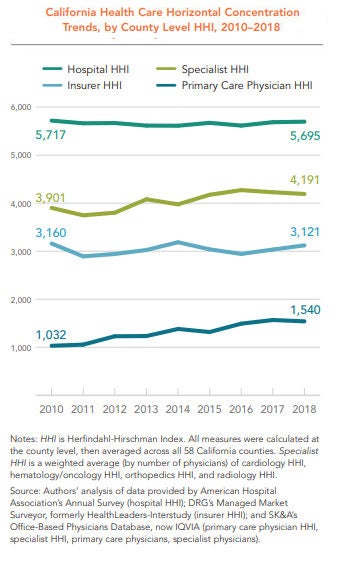
To measure market consolidation, the CHCF study relied on the Herfindahl-Hirschman Index (HHI), a metric used by the US Department of Justice and the Federal Trade Commission. An HHI of between 1,500 and 2,500 is considered moderately concentrated, and 2,500 or above is considered highly concentrated. According to this measure, horizontal concentration is high in California among hospitals, insurance companies, and specialist providers (and moderately high among primary care physicians), even though the level of concentration in all but primary care has remained relatively flat from 2010 to 2018.
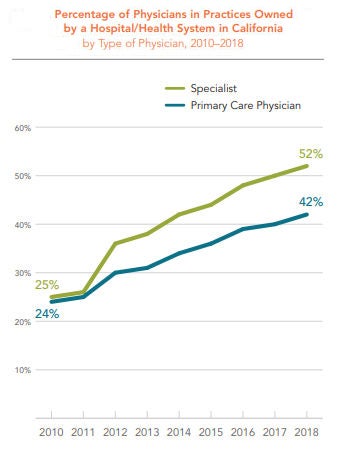
The percentage of physicians in practices owned by a hospital or health system increased dramatically in California between 2010 and 2018 — from 24% in 2010 to 42% in 2018. The percentage of specialists in practices owned by a hospital or health system rose even faster, from 25% in 2010 to 52% in 2018.
Consolidation Is Not Clinical Integration

While this study defined and quantified the extent of consolidation across several industry segments in California, it is important to note that it did not define, quantify, or evaluate clinical integration within the state. Clinical integration has been defined by others in many ways, but generally involves arrangements for coordinating and delivering a wide range of medical services across multiple settings.

As the CHCF study authors point out, other analysis has shown that various types of clinical integration can lead to broader adoption of health information technology and evidence-based care management processes. Data from the Integrated Healthcare Association suggests that certain patient benefit designs and provider risk-sharing arrangements associated with clinical integration can lead to higher quality and lower costs.

Crucially, an emerging body of law (PDF) suggests that clinical integration does not require formal ownership and joint bargaining with payers.

Relationship Between Consolidation and Health Insurance Premiums

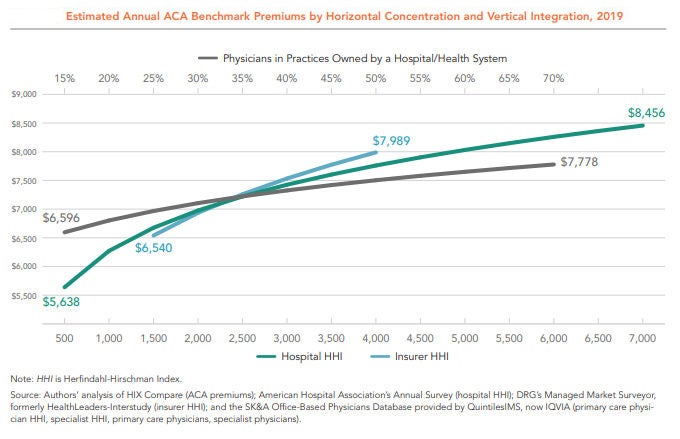
Among the six variables analyzed in the CHCF study, three showed a positive and statistically significant association with higher premiums: insurance company mergers, hospital mergers, and the percentage of primary care physicians in practices owned by hospitals and health systems. The remaining three variables studied — specialist provider mergers, primary care provider mergers, and the percentage of specialists in practices owned by a hospital and health system — were statistically insignificant.

The figure below shows the independent relationship between market concentration and premiums for these three variables. As the lines move left to right, concentration increases — that is, fewer individual insurers, hospitals, or providers occupy the market. The vertical axis shows the average premiums associated with each level of market concentration. In short, regardless of the industry structure represented by the other variables, insurer consolidation, hospital consolidation, and hospital-physician mergers each lead to higher premiums.
Unexplained Price Variation and Growth

Health insurance premiums rise when the underlying cost of medical care increases. California ranks as the 16th most expensive state on average in terms of the seven common services the researchers studied, after adjusting for wage differences across states. Among all states, California has the eighth-highest prices for normal childbirth, defined as vaginal delivery without complications. Childbirth is the most common type of hospital admission, and the relatively standardized procedure is comparable across states.

Even within California, prices vary widely and are growing rapidly. For example, the 2016 average wage-adjusted price for a vaginal delivery was twice as high in Rating Area 9 (which has Monterey as its largest county) as it was in Rating Area 19 (San Diego) — $22,751 versus $11,387. (See next figure.) Prices for the service are increasing rapidly across counties — rising anywhere from 29% in San Francisco from 2012 to 2016 to 40% in Orange County over the same period.

The authors of the CHCF report investigated the impact of various types of consolidation on the prices of individual medical services in California. For cesarean births without complications, a 10% rise in hospital HHI is associated with a 1.3% increase in price.

Potential Policy Responses to Consolidation

While the study shows significant associations between various types of market concentration and the prices consumers pay, policymakers should carefully consider implementing steps that restrain the inflationary impact of consolidation while allowing the benefits of clinical integration to proliferate. To that end, the authors of the CHCF report offered a series of recommendations, which include:

Enforce antitrust laws. Federal and state governments should scrutinize proposed mergers and acquisitions to evaluate whether the net result is procompetitive or anticompetitive.

Restrict anticompetitive behaviors. Anticompetitive behaviors, such as all-or-nothing and anti-incentive contract terms, should be addressed through legislation or the courts in markets where providers are highly concentrated.

Revise anticompetitive reimbursement incentives. Reimbursement policies that reduce competition, such as Medicare rules that implicitly reward hospital-owned physician groups, should be adjusted.

Reduce barriers to market entry. Policies that restrict who can participate in the health care market, such as laws prohibiting nurse practitioners from practicing independently from a physician, should be changed when markets are concentrated.

Regulate provider and insurer rates. If antitrust enforcement is not successful and significant barriers to market entry exist — including those in small markets unable to support a competitive number of hospitals and specialists — regulating provider and insurer rates should be considered.

Encouraging meaningful competition in health care markets is an exceedingly difficult task for policymakers. It is no easier to promote the benefits of clinical integration while restraining the inflationary aspects of economic consolidation through public policy. Despite these challenges, the rapid rise in health care premiums and prices in the state require a fresh look at the consequences of widespread horizontal and vertical consolidation in California.


Sutter Antitrust Class Action Could Upend Industry Consolidation

https://news.bloomberglaw.com/health-law-and-business/sutter-antitrust-class-action-could-upend-industry-consolidation

Health-care consolidation and antitrust allegations are the focus of litigation that alleges Sutter Health Systems uses its Northern California dominance to force higher fees out of employer-funded health plans and consumers.

Jury selection begins Sept. 23 in San Francisco in a case that could translate into more than a billion-dollar liability for California’s third-largest hospital system. Sutter denies the allegations.

Employers, payors, and the health-care industry are closely watching the case. Success in California could spill into other states and undermine consolidation efforts by other health-care providers, observers said.

“If I’m a system somewhere else and these guys lose, these class-action lawyers I assume are going to start putting pins in the map around the country and say, ‘OK let’s go look at Utah, Florida, other parts of California’” that have dominant players, said Glenn Melnick, a health-care economist at the University of Southern California. “They have a template now.”

Total Revenue Hit $13 Billion in 2018

Sutter Health is a California behemoth, consisting of 24 acute care hospital facilities, 36 ambulatory surgery centers, nine cancer centers, six specialty care centers, nine major physician organizations, with 12,000 physicians and 53,000 employees located in 19 counties in Northern California. The system reported $13 billion in revenue in 2018.

“There is no evidence that Sutter has hurt competition, as demonstrated by the fact that new hospitals continue to open and existing facilities continue to expand in markets that Sutter Health serves, including in the San Francisco Bay Area and the greater Sacramento region,” Sutter said in a statement.

Northern California has experienced more rapid consolidation of hospital, physician, and insurance markets from 2010 to 2016 than Southern California, University of California Berkeley researchers found. And inpatient prices were 70% higher, outpatient prices 17%-55% higher depending on physician specialty, and Affordable Care Act premiums 35% higher in the northern part of the state.

Sutter inflated prices by an average 15.5% between 2003 and 2016, a United Food & Commercial Workers & Employers Benefit Trust expert analysis said. The UFCW trust sued Sutter first, followed by the state. For trial purposes, the court joined California’s lawsuit with the UFCW class action.

The inflated prices translated into $756 million in overcharges, the state and class members allege. More than 90% of class members for which measurements were available paid higher average prices at Sutter than class members paid for services at other California hospitals, they said.

Patients Protected, Sutter Says

The hospital system says its offerings shield patients from unforeseen expenses.

“Our broad provider network gives patients greater choice and predictability and protects patients from surprise billing. It also prevents patients from paying more in co-pays and deductibles for out-of-network doctor and hospital visits,” Sutter’s statement said.

Treble damages and attorneys’ fees are available if the UFCW and state win under the Cartwright Act, California’s antitrust law. The union trust fund, representing a class of large California employers who self insure their health-care costs, seeks damages from the jury while the California Attorney General wants to stop the practices alleged.

Jury selection is set for Sept. 23-24 with a two-week break while the parties argue over issues including sealing contracts negotiated with third parties including Anthem Inc., Blue Shield of California Inc., United Healthcare Services Inc., Teamsters Benefit Trust, Apple Inc., and HealthNet of California Inc. The trial is expected to last 60-90 days.

Consolidation Concerns

Health-care costs are one of the most important concerns in the U.S., said Jaime King, associate dean of the University of California Hastings School of Law and director of the Concentration on Law and Health Sciences.

“I know that attorneys general in other states are paying very close attention to what’s happening because concentration is not something that is just happening in California—it’s happening all over the country. If successful we will start to see a rollout of lots of similar cases across country,” King said.

“I think we will see ripple effects that go well into the future,” she said.

The case has implications especially in Northern California and could have legs elsewhere, Attorney General Xavier Becerra (D) said.

“Does this have an impact outside California? I would say that most everything that California does has an impact on this country and dare say the world. We hope that in our effort to pursue lower costs and higher quality of care in health care that the beneficiaries are not just Californians but people throughout the country,” Becerra said.


Hospital Giant Sutter Health Faces Legal Reckoning Over Medical Pricing

https://khn.org/news/sutter-health-antitrust-lawsuit-hospital-consolidation-medical-pricing/?fbclid=IwAR25Fe5xyq6Ne2lq_tuTo-r5ft4mUaLBLN7TLaMIo_cl5gJ59lMBNXwB33A

Economists and researchers long have blamed the high cost of health care in Northern California on the giant medical systems that have gobbled up hospitals and physician practices — most notably Sutter Health, a nonprofit chain with 24 hospitals, 34 surgery centers and 5,000 physicians across the region.

Now, those arguments will have their day in court: A long-awaited class-action lawsuit against Sutter is set to open Sept. 23 in San Francisco Superior Court.

The hospital giant, with $13 billion in operating revenue in 2018, stands accused of violating California’s antitrust laws by leveraging its market power to drive out competition and overcharge patients. Health care costs in Northern California, where Sutter is dominant, are 20% to 30% higher than in Southern California, even after adjusting for cost of living, according to a 2018 study from the Nicholas C. Petris Center at the University of California-Berkeley cited in the complaint.

The case was initiated in 2014 by self-funded employers and union trusts that pay for worker health care. It since has been joined with a similar case brought last year by California Attorney General Xavier Becerra. The plaintiffs seek up to $900 million in damages for overpayments that they attribute to Sutter; under California’s antitrust law, the award can be tripled, leaving Sutter liable for up to $2.7 billion.

The case is being followed closely by industry leaders and academics alike.

“This case could be huge. It could be existential,” said Glenn Melnick, a health care economist at the University of Southern California. If the case is successful, he predicted, health care prices could drop significantly in Northern California. It also could have a “chilling effect” nationally for large health systems that have adopted similar negotiating tactics, he said.

The case already has proved controversial: In November 2017, San Francisco County Superior Court Judge Curtis E.A. Karnow sanctioned Sutter after finding it had intentionally destroyed 192 boxes of documents sought by plaintiffs, “knowing that the evidence was relevant to antitrust issues.” He wrote: “There is no good explanation for the specific and unusual destruction here.”

Antitrust enforcement is more commonly within the purview of the Federal Trade Commission and U.S. Department of Justice. “One of the reasons we have such a big problem [with consolidation] is that they’ve done very little. Enforcement has been very weak,” said Richard Scheffler, director of the Nicholas C. Petris Center. From 2010 to 2017, there were more than 800 hospital mergers, and the federal government has challenged just a handful.

“We feel very confident,” said Richard Grossman, lead counsel for the plaintiffs. “Sutter has been able to elevate their prices above market to the tune of many hundreds of millions of dollars.”

Or, as Attorney General Becerra put it at a news conference unveiling his 2018 lawsuit: “This is a big ‘F’ deal.”

Sutter vigorously denies the allegations, saying its large, integrated health system offers tangible benefits for patients, including more consistent high-quality care. Sutter also disputes that its prices are higher than other major health care providers in California, saying its internal analyses tell a different story.

“This lawsuit irresponsibly targets Sutter’s integrated system of hospitals, clinics, urgent care centers and affiliated doctors serving millions of patients throughout Northern California,” spokeswoman Amy Thoma Tan wrote in an emailed statement. “While insurance companies want to sell narrow networks to employers, integrated networks like Sutter’s benefit patient care and experience, which leads to greater patient choice and reduces surprise out-of-network bills to our patients.”

There’s no dispute that for years Sutter has worked aggressively to buy up hospitals and doctor practices in communities throughout Northern California. At issue in the case is how it has used that market dominance.

According to the lawsuit, Sutter has exploited its market power by using an “all-or-none” approach to contracting with insurance companies. The tactic — known as the “Sutter Model” — involves sitting down at the negotiating table with a demand: If an insurer wants to include any one of the Sutter hospitals or clinics in its network, it must include all of them. In Sutter’s case, several of its 24 hospitals are “must-haves,” meaning it would be almost impossible for an insurer to sell an insurance plan in a given community without including those facilities in the network.

“All-or-none” contracting allows hospital systems to demand higher prices from an insurer with little choice but to acquiesce, even if it might be cheaper to exclude some of the system’s hospitals that are more expensive than a competitor’s. Those higher prices trickle down to consumers in the form of higher premiums.

The California Hospital Association contends such negotiations are crucial for hospitals struggling financially. “It can be a great benefit to small hospitals and rural hospitals that don’t have a lot of bargaining power to have a larger group that can negotiate on their behalf,” said Jackie Garman, the CHA’s legal counsel.

Sutter also is accused of preventing insurers and employers from tiering benefits, a technique used to steer patients to more cost-effective options. For example, an insurer might charge $100 out-of-pocket for a procedure at a preferred surgery center, but $200 at a more expensive facility. In addition, the lawsuit alleges that for years Sutter restricted insurers from sharing information about its prices with employers and workers, making it nearly impossible to compare prices when selecting a provider.

Altogether, the plaintiffs allege, such tactics are anti-competitive and have allowed Sutter to drive up the cost of care in Northern California.

Hospitals in California and other regions across the country have watched the success of such tactics and taken note. “All the other hospitals want to emulate [Sutter] to get those rates,” said Anthony Wright, executive director of the advocacy group Health Access.

A verdict that finds such tactics illegal would “send a signal to the market that the way to compete is not to be the next Sutter,” said Wright. “You want them to compete instead by providing better quality service at a lower price, not just by who can get bigger and thus leverage a higher price.”

Along with damages, Becerra’s complaint calls for dismantling the Sutter Model. It asks that Sutter be required to negotiate prices separately for each of its hospitals — and prohibit officials at different hospitals from sharing details of their negotiations. While leaving Sutter intact, the approach would give insurers more negotiating room, particularly in communities with competing providers.

Consolidation in the health care industry is likely here to stay: Two-thirds of hospitals across the nation are part of larger medical systems. “It’s very hard to unscramble the egg,” said Melnick.

California legislators have attempted to limit the “all or nothing” contracting terms several times, but the legislation has stalled amid opposition from the hospital industry.

Now the courts will weigh in.


Trial approaching in Sutter Health antitrust case

https://www.modernhealthcare.com/legal/trial-approaching-sutter-health-antitrust-case?utm_source=modern-healthcare-daily-finance&utm_medium=email&utm_campaign=20190923&utm_content=article1-readmore

Spurred in part by the Affordable Care Act, hospitals across the country have merged to form massive medical systems in the belief it would simplify the process for patients.

But a simpler bill doesn’t always guarantee a cheaper bill.

That’s a key issue in an antitrust lawsuit against one of California’s largest hospital systems set to begin Monday.

About 1,500 self-funded health plans have sued Sutter Health, a system that includes 24 hospitals across Northern California. The case has dragged on since 2014, but it picked up steam last year when Attorney General Xavier Becerra filed a similar lawsuit. The cases have been combined and jury selection begins Monday. Opening arguments are scheduled for October.

The lawsuit alleges Sutter Health gobbled up competing medical providers in the region and used its market dominance to set higher prices for insurance plans, which means more expensive insurance premiums for consumers.

Becerra points to a 2018 study that found unadjusted inpatient procedure prices are 70% higher in Northern California than Southern California. The lawsuit notes Sutter Health’s assets were $15.6 billion at the end of 2016, up from $6.4 billion in 2005.

“We never meant for folks to use integration to boost their profits at the expense of consumers,” Becerra said.

It’s rare for antitrust lawsuits of this size to go to trial because the law allows for triple damages — a prospect that often spooks companies into settling outside of court to avoid an unpredictable jury. Health plans in this case are asking for $900 million in damages, meaning Sutter Health could take a nearly $3 billion hit.

Atrium Health, a North Carolina-based hospital system, settled a similar anti-trust lawsuit with the federal government last year. And CHI Franciscan, a health system based in Washington state, also settled similar claims in March that had been brought by the state.

But Sutter Health is fighting the case. The company says the lawsuit is not about its prices, but about insurance companies who want to maximize their own profits. Sutter Health officials insist the company faces fierce competition, vowing to detail in court the expansion of other health systems in the San Francisco Bay Area and the Sacramento Valley.

Four Sutter Health hospitals had operating losses in 2018, totaling $49 million.

“The bottom line is that this lawsuit is designed to skew the healthcare system to the advantage of large insurance companies so they can market inadequate insurance plans to Californians,” said Sutter Health Director of Public Affairs Amy Thoma Tan.

At issue are several of Sutter Health’s contracting policies that Becerra says have allowed the company to “thoroughly immunize itself from price competition.”

One way insurance companies keep costs down is to steer patients to cheaper health care providers through a variety of incentives. Becerra says Sutter Health bans insurance companies from using these incentives, making it harder for patients to use their lower-priced competitors.

Becerra also says Sutter has an “all or nothing” approach to negotiating with insurance companies, requiring them to include all of the company’s hospitals in their provider networks even if it doesn’t make financial sense to do so.

The case was originally filed by a trust of Northern California’s largest unionized grocery companies in 2014. A representative for the trust said it was “unknowingly forced to pay Sutter’s artificially high prices.”

But the company says these contracting practices are designed to protect patients. People often are unable to pick which hospital they go to in a medical emergency, which can lead to surprise bills when they learn a hospital or doctor was not in their network.

Jackie Garman, lawyer for the California Hospital Association, said these contracting practices are standard at a lot of hospitals. If the lawsuit is successful, she said it could “disrupt contracting practices at a lot of other systems.”

But the consequences of not bringing the lawsuit could be greater, Becerra said.

“We are paying every time we allow an anti-competitive behavior to drive the market,” he said.


Sutter Health faces class-action lawsuit over pricing: 4 things to know

https://www.beckershospitalreview.com/finance/sutter-health-faces-class-action-lawsuit-over-pricing-4-things-to-know.html?oly_enc_id=2893H2397267F7G

Image result for sutter health headquarters

A class-action lawsuit alleging Sutter Health violated California’s antitrust laws by using its market power to overcharge patients is slated to open Sept. 23, according to the Los Angeles Times.

Four things to know:

1. The lawsuit dates back to 2014. Self-funded employers and union trusts initially filed the case, which was later joined with a lawsuit brought in 2018 by California’s attorney general.

2. In March, California Attorney General Xavier Becerra said a six-year investigation revealed Sutter restricted health insurers from providing consumers with more low-cost health plan options, and the health system set excessively high out-of-network prices. Sutter also allegedly restricted publication of provider cost information, which impeded transparency.

3. Sutter could be liable for as much as $2.7 billion. The plaintiffs are seeking up to $900 million in damages, and that amount can be tripled under California’s antitrust law, according to the Los Angeles Times.

4. Sutter denies the allegations. Regarding the lawsuit, a health system spokesperson released the following statement to the Los Angeles Times:

“This lawsuit irresponsibly targets Sutter’s integrated system of hospitals, clinics, urgent care centers and affiliated doctors serving millions of patients throughout Northern California. While insurance companies want to sell narrow networks to employers, integrated networks like Sutter’s benefit patient care and experience, which leads to greater patient choice and reduces surprise out-of-network bills to our patients.”

Access the full Los Angeles Times article here.


Another round of debate over hospital consolidation

Image result for Another round of debate over hospital consolidation
 
Are hospital mergers a good thing or a bad thing?

Much of the answer to that question depends on what happens after the merger—does the combined organization provide better, more efficient care, or does it use its increased leverage to raise prices? Yet another round of back and forth on this issue took place this week, as the American Hospital Association (AHA) released the results of a study it commissioned from economic analysis firm Charles River Associates (CRA), while a group of academic antitrust specialists countered with their own briefing in response.

The AHA study, based on interviews with select health system leaders and econometric analysis by CRA, shows (surprise, surprise) that consolidation decreases hospital expenses by 2.3 percent, reduces mortality and readmissions, and reduces revenue per admission by 3.5 percent—indicating that the “savings” from consolidation are being passed along to purchasers. The economists, including Martin Gaynor at Carnegie Mellon, Zack Cooper at Yale, and Leemore Dafny at Harvard, countered in their briefing (surprise, surprise) that CRA’s research was biased in favor of hospitals, and cited numerous academic studies that indicate that hospital consolidation drives overall healthcare costs higher.

Beyond the predictable debate, our view is that consolidation can and should lead to better quality and lower prices—but that it largely hasn’t delivered on that promise. The prospect of “integrated care” that’s often touted by consolidation advocates hasn’t materialized in most places, both because hospital executives haven’t pushed hard enough on strategies to produce it, and because the market lacks sufficient incentives to encourage it.

AHA says hospital mergers are good — economists say otherwise

https://www.beckershospitalreview.com/hospital-transactions-and-valuation/aha-says-hospital-mergers-are-good-economists-say-otherwise.html

Image result for hospital market power

The American Hospital Association released a report stating that hospital acquisitions allow providers to provide better care at a lower cost to patients.

The report, which revisited an analysis concluding similar results three years ago, found acquisitions decrease cost due to the increased size of a combined system as well as clinical standardization.

Specifically, the AHA said hospital acquisitions lead to a 2.3 percent reduction in annual operating expenses at acquired hospitals. The study also said readmission and mortality rates decline at merging hospitals, and acquired hospitals see revenues per admission decline 3.5 percent, suggesting “savings that accrue to merging hospitals are passed on to patients and their health plans.”

However, the AHA’s findings — which were largely based on interviews with leaders of 10 health systems who weren’t randomly surveyed — contradict a wealth of economic data published that argues the opposite.

Last year, researchers found hospitals in monopoly markets, compared to hospitals in markets with four or more competitors, have prices that are 12 percent higher. In markets with four or more competitors, hospitals have lower prices and take on more financial risk, researchers said. Another independent analysis found hospital prices rise after hospitals combine. Researchers have also questioned whether consolidation really leads to better quality.


Conservatives buck Trump over worries of ‘socialist’ drug pricing

Conservatives buck Trump over worries of ‘socialist’ drug pricing

Image result for socialist drug pricing

Conservatives are growing increasingly uneasy with the Trump administration’s new drug pricing policy.

President Trump is desperately seeking an elusive political win in his efforts to lower prescription drug costs, but he faces a hard sell to conservative groups and GOP lawmakers as he touts ideas traditionally favored by Democrats and presidential candidate Sen. Bernie Sanders (I-Vt.).

In a rare break with Trump, conservatives are now pushing back against key administration policies and accusing the president of supporting what they call Sanders-style socialism.

The president has embraced importing drugs from Canada, as well as an international pricing policy that would bar Medicare from paying more than other countries for prescription drugs.

The moves are designed to co-opt Democratic talking points and position Trump as a populist champion of the free market.

Trump has made lowering drug prices a top priority of his presidency, but he has suffered some high-profile setbacks in recent weeks.

Drug importation and the international pricing caps proposal are the only remaining policies remaining that the White House can use to make a splash heading into 2020.

Trump has frequently railed against “global freeloading” and said he doesn’t think it’s fair that the U.S. subsidizes research and development in other countries.

Last year he went to the Department of Health and Human Services (HHS) and announced the plan to cap U.S. payments for expensive drugs, over the objections of some White House advisers.

Those objections later spread to include conservative groups.

Facebook ads this year from FreedomWorks, a conservative advocacy group, urged people to tell HHS Secretary Alex Azar to oppose “socialist-style price controls.”

Another ad warned the administration against “importing socialist European drug prices in America.”

Separately, a website sponsored by the American Conservative Union rails against the administration’s pricing index, calling it an experiment “directly out of the Bernie Sanders and Hillary Clinton government health care takeover playbook.”

In the GOP-controlled Senate, a bill backed by the administration is facing Republican opposition over a provision that would impose a limit on drug price increases in Medicare’s Part D prescription drug program.

The legislation would force drug companies to pay money back to the government if their prices rise faster than inflation.

The Senate Finance Committee approved the measure late last month in a 19-9 vote — all Democrats voted for it, and all nine “no” votes came from Republicans. Some GOP senators said they were concerned because they think the Medicare Part D provision violates traditional free-market principles.

The bill faces long odds of making it to the Senate floor without substantial changes.

“I’m not comfortable with putting price controls on drugs,” Sen. Pat Toomey (R-Pa.), a member of the Finance Committee, told The Hill.

Toomey offered an amendment to strip out the provision, which failed on a tie vote of 14-14. All but two Republicans voted for his amendment.

Aside from capping drug payments, Trump has also softened his stance on importing drugs from Canada. The administration last week announced a proposal that would set the groundwork for states or wholesalers to launch pilot programs to safely import drugs.

Shipping in drugs from abroad has long been a goal of progressives like Sanders, but has also won the support of libertarian-leaning conservatives like GOP Sens. Rand Paul (Ky.), Ted Cruz (Texas) and Mike Lee (Utah).

But with Trump looking for a win on drug pricing, political analysts and health experts argue he doesn’t necessarily care about gaining the support of conservatives.

“This is the administration throwing down a wild card,” said health care consultant Alex Shekhdar, founder of Sycamore Creek Healthcare Advisors. “In order to win in 2020, they need to take into consideration independents and anyone else who thinks drug prices are an issue.”

Joe Antos, a health care expert at the conservative American Enterprise Institute, said it doesn’t matter if the policies Trump is embracing are traditionally Democratic ones.

“Just because Democrats endorsed it in the past, doesn’t mean Trump can’t take ownership and call it his idea. He might not call them Republican ideas, but he’ll call them Donald Trump ideas,” Antos said.

But some GOP senators cautioned against letting Democrats play too much of a role.

After the Finance Committee advanced the drug-pricing bill, Chairman Chuck Grassley (R-Iowa) told reporters that Republicans don’t want Trump negotiating with Speaker Nancy Pelosi (D-Calif.).

A competing bill from House Democrats is far more sweeping than the Senate’s, and includes direct Medicare negotiation on drug prices.

“It seems to me that the Grassley-Wyden approach is a very moderate approach to what could come out,” Grassley said, referring to the bill backed by him and Sen. Ron Wyden (Ore.), the ranking Democrat on the Finance Committee.

But a stalled bill could still work to Trump’s advantage, according to Antos, who said the president doesn’t necessarily need to lower drug prices, he just needs to convince the public he is trying. 

In that sense, Antos argued, Republicans haven’t offered anything better, and they will eventually support whatever the administration does.

“Republicans don’t have any alternative ideas,” Antos said. “Trump has full control of Republicans in Congress, so there’s just not going to be any response other than going along with what comes along.”


When a hospital wields monopoly power

https://www.axios.com/newsletters/axios-vitals-1b40c794-c913-4681-b2ac-7a6e9746718f.html?utm_source=newsletter&utm_medium=email&utm_campaign=newsletter_axiosvitals&stream=top

Illustration of a giant health plus on top of a pile of cash, the ground underneath is cracking.

NorthBay Healthcare, a not-for-profit hospital system in California, recently gave a candid look into how it operates, telling investors it has used its negotiating clout to extract “very lucrative contracts” from health insurance companies.

Why it matters: This is a living example of the economic theories and research that suggest hospitals will charge whatever they want if they have little or no competition, Axios’ Bob Herman reports.

Details: NorthBay owns two hospitals and several clinics in California’s Solano County. Kaiser Permanente owns the only other full-service hospital in the county, and Sutter Health operates some medical offices. (A NorthBay spokesperson argued the system is “more akin to the David among two Goliaths.“)

Three health insurers have terminated their contracts with NorthBay over the past couple years. During a June 19 call with bondholders, executives explained why this has happened.

“We’ve been able to maintain very lucrative contracts without the competition. And what the payers are saying is, they would like us to be like 90% of the rest of the United States in terms of contract structure.”

Jim Strong, interim CFO, NorthBay Healthcare

Between the lines: NorthBay’s revenue has increased by 50% over the past few years, from $400 million in 2013 to $600 million in 2018, due in large part to its natural monopoly and oligopoly over hospital services.

  • This is exactly what we should expect to happen when sellers have the upper hand over buyers, economists say.

NorthBay also serves as a cautionary tale for price transparency, the policy fix du jour.

  • If the health care system is consolidated, consumers don’t have anywhere else to go,” said Sunita Desai, a health economist at NYU. “Even if they see the prices of a given hospital, they’re limited in terms of how much they can ‘shop’ across providers.”


Medical monopoly: An unusual hospital merger in rural Appalachia leaves residents with few options

https://www.tennessean.com/story/news/health/2019/06/23/ballad-health-merger-rural-hospital-closures/1342608001/

Protest organizer Dani Cook of Kingsport, Tennessee, conducts a Facebook Live outside Holston Valley Medical Center in Kingsport on May 7. The merger of Mountain State Health Alliance and Wellmont has led to the downgrading of the area's NICU and trauma center.

KINGSPORT, Tenn. – Molly Worley is an angry grandma.

For weeks she has stubbornly occupied a folding lawn chair on a grassy median outside Holston Valley Medical Center, sheltered from sweltering Appalachian summer sun by a thin tarp and flanked by a rotating crew staging a round-the-clock protest since May 1.

Behind them is the state-of-the-art neonatal intensive care unit where Worley’s newborn grandson spent his first weeks of life treated for opioid exposure.

In the same building is a Level I trauma center to respond to the most critical emergencies.

Both facilities will downgraded in the coming months, diverting the sickest babies and adults elsewhere.

The cuts are the latest fallout from an unusual and controversial merger between two former rival hospital systems headquartered in northeast Tennessee.

The newly formed company, Ballad Health, is now the sole hospital provider for a region the size of New Jersey. For nearly 1.2 million people people living in a largely rural stretch of 29 counties in northeast Tennessee and nearby parts of Virginia, North Carolina and Kentucky, Ballad hospitals are the only inpatient option.

Mergers involving hospitals that compete for same patients face opposition from the Federal Trade Commission, which can block mergers on the grounds the combined company can limit patient choices, cut services, raise prices and diminish quality.

Ballad officials found a way to bypass FTC rules. They turned to Tennessee state Sen. Rusty Crowe, R-Johnson City, who successfully carried legislation making the merger possible. Crowe is a longtime paid consultant with Ballad hospitals. 

Only a handful of other states have exempted similar hospital mergers from FTC anti-monopoly rules. Ballad’s is the largest.

CEO Alan Levine said the merger lets the hospital system save money and keep rural hospitals afloat in a state that is already No. 2 in the nation for closures.

Eliminating overlapping staff and services, including the trauma center and NICU, will free funds to invest in other public health initiatives. Ballad pledged to keep open all of its rural hospitals for five years and to invest $308 million in public health, medical education and other initiatives.

“Every decision we make starts and ends with how can we best serve the community and what does the evidence show will lead to the best possible outcome,” Levine said.

“You don’t want a trauma center on every corner and you don’t want a NICU on every corner because it dilutes volume and hurts quality,” he said.

No rural hospitals owned by Ballad have been closed. 

Some residents, doctors, nurses, EMS workers and public officials say the changes by Ballad expose the dangers of a single system imposing decisions on health care services on a captive audience that has no other options. More than 23,000 people have signed a petition opposing Ballad’s proposed changes.

“Never ever have I been this outspoken about anything,” said Worley, 60. “This NICU saved my grandson’s life. With Ballad we have no other choice. They have a monopoly at every level of health care.”

As hospital systems across the country struggle to stay afloat, particularly in rural areas, Ballad’s plan is being closely watched by other states weighing whether to allow other hospitals to take a similar approach.