Stanford and Lucile Packard Children’s hospitals in Palo Alto, Calif., and the Committee for Recognition of Nursing Achievement reached a tentative agreement on a three-year contract for about 5,000 nurses represented by the union, according to hospital and union statements.
The sides reached the agreement April 29, the fifth day of a strike, and union members approved it May 1.
“After extensive discussions, we were able to reach consensus on a contract that reflects our shared priorities and enhances existing benefits supporting our nurses’ health, well-being and ongoing professional development,” Stanford said in its latest negotiations update.
With the new agreement, striking nurses will return to work May 3.
Meanwhile, in a news release shared with Becker’s, the union highlighted parts of the agreement, including improvements it said “ensure high patient acuity is reflected in staffing.”
The agreement also includes a combined 7 percent base wage increase in 2022 (a 5 percent increase followed by a 2 percent increase) for nurses, 5 percent in 2023 and 5 percent in 2024, as well as funds specifically for mental healthcare of workers, according to the union.
As part of the labor deal, the hospitals also agreed to continue medical benefits for striking nurses without disruption, the union said.
“From day one of our contract negotiations, CRONA nurses have been unified in our goals of improving staffing and making our profession more sustainable,” Colleen Borges, president of CRONA and pediatric oncology nurse at Packard hospital, said in the release. “We stood strong behind our demands for fair contracts that give us the resources and support we need to take care of ourselves, our families and our patients. We are proud to provide world-class patient care — and are glad the hospitals have finally listened to us.”
Dale Beatty, DNP, RN, chief nurse executive and vice president of patient care services for Stanford Health Care, and Jesus Cepero, PhD, RN, senior vice president of patient care and chief nursing officer for Stanford Children’s Health, acknowledged on the Stanford negotiations page that reaching an agreement has been challenging.
Now “we can all take pride in this agreement. And we are proud of our team for maintaining continuity of care for our patients,” they said.
More information on negotiations is available here and here.
Hospitals and health systems have lost billions over the last two years, leaving more than 33 percent of them with negative margins, according to an April 25 report by the American Hospital Association.
Six findings:
1. Employment is down by 100,000 jobs compared to pre-pandemic levels, the U.S. Bureau of Labor Statistics found. But at a time when hospitals are desperately trying to fill positions, labor expenses per patient were 19.1 percent higher in 2021 than in 2019. Labor expenses are more than 50 percent of hospitals’ total expenses, meaning a small increase in labor costs can have a major effect on hospital’s total expenses and operating margins.
2. The report attributed the increase in labor expenses to hospitals’ dependence on contract staff, specifically nurses. In 2019, travel nurses accounted for a median of 4.7 percent of hospitals’ total nurse labor expenses, compared to a median of 38.6 percent in January.
3. Hourly billing rates for contract employees rose 213 percent compared to pre-pandemic levels. This created a 62 percent profit margin for staff agencies.
4. Drug expenses soared by 36.9 percent per patient compared to pre-pandemic levels.
5. Medical supply expenses also rose through 2021, by 20.6 percent, compared to pre-pandemic levels. For intensive care units and respiratory care departments — which were most involved in COVID-19 care — medical supply expenses grew 31.5 percent and 22.3 percent, respectively.
6. Economywide, the consumer price index saw major increases, the Bureau of Labor Statistics found. Meanwhile, hospital prices rose modestly, by an average of 2.1 percent per year in the last decade, about half the average annual increase in health insurance premiums.
The number of registered nurses plunged by 100,000 in 2021, representing the steepest drop in the RN workforce in 4 decades, according to a new analysis.
From 2019 to 2021, the total workforce size declined by 1.8%, including a 4% drop in the number of RNs under the age of 35, a 0.5% drop in the number of those ages 35 to 49, and a 1.0% drop in the number of those over 50, reported David Auerbach, PhD, of the Center for Interdisciplinary Health Workforce Studies at Montana State University College of Nursing, and colleagues in Health Affairs Forefront.
“The numbers really are unprecedented,” Auerbach told MedPage Today.
“But … given all that we’ve been hearing about burnout, retirement, job switching, and shifting,” and all of the ways the pandemic disrupted the labor market, including healthcare, “I am not super surprised either,” he added.
While Auerbach said he and his co-authors can’t definitively say what caused this shift, he does not think it’s merely a problem of “entry and education” — in other words, fewer people choosing nursing as a career.
There have been no “major changes” in the enrollment and graduation rates reported by the American Association of Colleges of Nursing (AACN), and the number of RNs completing the National Council Licensure Examination actually increased in 2020 versus 2019, according to the National Council of State Boards of Nursing, Auerbach said.
This suggests that the decline in younger RNs is more likely due to nurses “either pausing or leaving nursing. What we really don’t know is whether this is a temporary or more permanent phenomenon,” he added.
The overall decline was not spread evenly across sites, but instead was “entirely due” to a 3.9% reduction in hospital employment, offset by a 1.6% increase in nursing employment in other settings, the authors said.
For decades, the RN workforce grew steadily, from 1 million nurses in 1982 to 3.2 million in 2020. Though the profession saw a rocky period in the late 1990s, during which growth looked less certain, millennials reversed this temporary downward trend in the early 2000s, Auerbach and team explained.
In a prior Health Affairs analysis, Auerbach and colleagues found that the labor market for nurses had “plateaued” during the first 15 months of the pandemic.
Auerbach’s team had previously projected that the supply of nurses would grow 4.4% from 2019 to 2021.
The data may reflect a mix of RNs leaving “outright” and those shifting to non-hospital jobs. The authors were unable to follow the same people from pre-pandemic to now, Auerbach noted. “Based on taking a snapshot of the world in 2019 and then taking another snapshot of the world in 2021, we’re inferring from what we see what we think might have happened.”
Auerbach said that he and his colleagues are close to ruling out childcare problems as a core reason for younger nurses departing. “We didn’t see some huge reduction in nurses with kids at home,” he explained.
However, if that had been the case, then the decline might be seen as something temporary that could be “ironed out,” compared to more deeply rooted structural problems, like poor working conditions, he said.
Auerbach and colleagues stressed that more needs to be done to help early-career nurses who have endured a “trial by fire” during the pandemic, and that “more effective strategies” must be leveraged to reward nurses who have stayed on the front lines and to bring back those who have left.
On a hopeful note, Auerbach pointed to recent AACN data, which showed a “big jump” in the number of applications to nursing schools. Additionally, prior research found that “times of natural disaster or health crisis could increase interest in RN careers,” the authors noted.
“That doesn’t sound like people are just going to abandon nursing altogether,” Auerbach said.
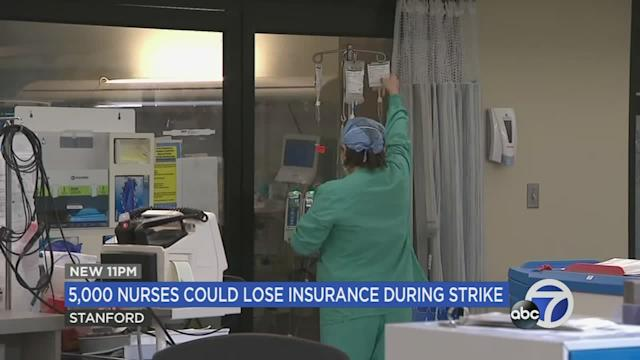
Stanford Health Care and Lucile Packard Children’s Hospital administrators have notified union leaders that its nurse members who strike later in April risk losing pay and health benefits, according to Palo Alto Weekly.
The Committee for Recognition of Nursing Achievement, a union at Stanford Health Care and Stanford Children’s Health that represents about 5,000 nurses, has scheduled a strike to begin April 25. The nurses’ contract expired March 31.
If the strike moves forward, Stanford Health Care and the Lucile Packard Children’s Hospital, both based in Palo Alto, Calif., are prepared to continue to provide safe, quality healthcare, according to a statement from Dale Beatty, DNP, RN, chief nurse executive and vice president of patient care services for Stanford Health Care, and Jesus Cepero, PhD, RN, senior vice president of patient care and chief nursing officer for Stanford Children’s Health.
But the statement, which was shared with Becker’s, said nurses who choose to strike will not be paid for shifts they miss.
“In addition, employer-paid health benefits will cease on May 1 for nurses who go out on strike and remain out through the end of the month in which the strike begins,” Drs. Beatty and Cepero said.
The leaders quoted from Committee for Recognition of Nursing Achievement’s “contingency manual” that the union provided to nurses: “If a strike lasts beyond the end of the month in which it begins and the hospitals discontinue medical coverage, you will have the option to pay for continued coverage.”
Drs. Beatty and Cepero said nurses who strike may pay to continue their health coverage through the Consolidated Omnibus Budget Reconciliation Act.
In a separate statement shared with Becker’s, Committee for Recognition of Nursing Achievement President Colleen Borges called Stanford and Packard management’s move regarding nurses’ health benefits “cruel” and “immoral.”
“Health benefits should not be used against workers, especially against the very healthcare professionals who have made Stanford a world-class health system,” said Ms. Borges, who is also a pediatric oncology nurse at Lucile Packard Children’s Hospital. “We have spent our careers caring for others and putting others first — now more than ever we need solutions that will ensure sustainability, safe staffing and strong benefits to retain nurses. But instead of taking our proposals seriously, hospitals are spending their time and energy weaponizing our medical benefits. We refuse to be intimidated from standing up for the fair contracts that we need in order to continue delivering world-class patient care.”
The union has organized a petition to tell Stanford not to cut off medical benefits for nurses and their families during the strike. As of April 19, the petition had more than 25,150 signatures.
Businesses who suffered from the Great Resignation, in which large numbers of workers voluntarily resigned during the pandemic looking for more fulfilling work or higher wages, are now hoping the “Great Regret” might bring workers back. According to recent surveys, over 70 percent of workers who switched employment during the pandemic found that their new jobs didn’t live up to their expectations, and nearly half wish they had their old job back.
After scores of nurses left hospital positions for travel roles, health system leaders are seeing some nurses return. One physician told us about a favorite nurse on his oncology unit who returned from over a year as a traveler, ready to settle down and be closer to family.
A chief nursing officer relayed that her system was seeing nurses who took agency positions to work toward personal financial goals, like earning a down payment for a house, wanting to come back now that they’ve reached it: “Travel roles are intense, and most nurses can’t do them forever”.
But other nursing leaders caution that they’re preparing for agency nurses to become a permanent fixture in the workforce: “More nurses will see travel as an option for different points in their career, when they have personal flexibility or need the extra money”.
The “Great Regret” might help some hospitals lessen their reliance on agency nursing in the short-term. But building a stable clinical workforce will require addressing underlying structural challenges, through changes in education, rethinking job roles and care models, and finding ways to build individualized job flexibility and customization.
Hospitals’ reliance on travel workers is nothing new. The pandemic intensified it and highlighted the gap between full-time workers’ pay and lucrative temporary contracts.
While the average salary for a travel nurse can vary based on location, regional demand, hospital type and specialty, the compensation for a travel nurse has increased significantly compared to pre-pandemic, Bill Morgan, president of the Orlando, Fla.-based travel nurse staffing firm Jackson Nurse Professionals, toldBecker’s in September.
Meanwhile, hospitals and health systems have offered bonuses, increased wages and made other investments in employee retention for their staff workers. Still, the compensation gap between hospital employed nurses and travel or agency nurses remains stark.
The gap poses the seemingly simple question: Why aren’t hospitals paying full-time staff more instead of paying higher prices for travel workers?
Travel nursing’s start
Taking a look back at the history of why hospitals started using travel nurses in the first place helps answer that question, said Kathy Sanford, DBA, RN, chief nursing officer at Chicago-based CommonSpirit Health.
Dr. Sanford recalls first using local agencies and travel nurses in the 1980s as a cost-effective staffing strategy for periods when the patient census fluctuates, such as during flu epidemics.
“When you have those fluctuations, you need to have a staffing strategy of what you want to do when the census goes up higher than we are staffed for, but it’s only going to last maybe a month, or a little longer,” she told Becker’s. “Because of the fluctuations, our nursing strategy for staffing was to use these non-employed nurses to fill in when there were gaps.”
The COVID-19 pandemic, however, has created a situation where volumes are consistently higher than normal. And while rates for a travel or agency nurse have traditionally been higher than those of a hospital staff nurse, the current demand has pushed travel rates to record highs.
Rising rates
Pittsburgh-based UPMC, for example, paid an estimated $85 an hour for a traveling nurse or a nurse from an agency before the pandemic. The health system is now experiencing rates between $225 and $250 an hour. Such rates have made nurses who may not have considered traveling before take the leap.
“And the nurses are making more, and we don’t fault the nurses for taking advantage of that opportunity. But … now not only are nurses making more, but the agencies have taken the opportunity to triple their profits … and it shouldn’t be permitted during a pandemic, just like we don’t permit building companies to triple the price of lumber after a hurricane. It just shouldn’t be allowed,” said John Galley, chief human resource officer at UPMC.
“Hospitals are all trying to fill the positions that need to be filled to help us get through this crisis with travel nurses, but because there aren’t enough, it becomes a cycle of bidding of who will pay me the most to travel,” Dr. Sanford said. Because of that, many nurses who may have never considered traveling before are now choosing to do so and leaving hospitals in areas of the country with a lower wage index, she said.
Pay for travel nurses has always been higher for the same reasons hospitals pay float pool nurses more, Dr. Sanford explained.
“Nurses are specialists and they work on a particular type of unit, and sometimes one unit’s census will be down and another unit’s census will be up,” she said. Float pool nurses are willing to shift to different units that need help “and it’s not a favorite thing for nurses to do,” Dr. Sanford said. “You have to pay them a little extra to be willing to learn different types of nursing and be willing to float.”
The same line of thinking applies to agency or travel nurses. Travelers don’t have the perks that come with a full-time job, like job security and benefits. That coupled with the burden of travel itself and short-term assignments was the initial justification for why travel nurses had higher rates.
Simply put, hospitals can’t afford to pay full-time staff wages that were meant for temporary assignments.
“The bottom line is it would not be sustainable for hospitals to pay the kind of dollars that they’re paying right now for travel nurses in the long run. Because nurses are our backbone … they’re our heart, but they’re also our backbone. They’re the majority of our staff.” Dr. Sanford said.
Mr. Galley of UPMC echoed that sentiment, noting that salaries and benefits make up about 50 percent of a health system’s entire expenses. “If you were to double a good portion of that — the nursing salaries — you’d completely wipe out any operating margin. Then you wouldn’t be able to invest in anything to keep the hospitals going,” he said.
And healthcare has a lot of costly demands that would go unaddressed if such rates became the expectation for staff nurses.
“There are a lot of needs that healthcare has in technology, and making sure that we have the equipment to take care of patients, and that we can do programs for the poor and vulnerable that we wouldn’t be able to afford if we pay these non-sustainable prices forever,” Dr. Sanford of CommonSpirit said.
The value of in-house agencies
To combat skyrocketing travel nursing costs, some health systems have introduced their own travel agencies, including CommonSpirit and UPMC, where travel nurses work within the system.
Mr. Galley said UPMC started the agency for its 40-hospital system not only to combat the nursing shortage — and attract back nurses the health system has lost to outside travel agencies — but also to address increased rates from outside travel agencies.
Nurses and surgical techs who qualify for UPMC’s in-house agency will earn $85 an hour and $63 an hour, respectively, in addition to a $2,880 stipend at the beginning of each six-week assignment.
Compensation for travel nurses at UPMC is still higher than full-time employees because the job comes with its own set of challenges. While full-time nurses get to know their facilities and have a more regular schedule, travel nurses are constantly on the move.
“They’re going to have assignments for a few weeks at a time at a particular location, then we’re going to pick them up and move them somewhere else, so they’re going to be constantly traveling, living out of a suitcase, and that’s what external travelers do, so we want to be just like the market, create roles like that and pay like that,” Mr. Galley said. “I think our employees understand the difference between that kind of a lifestyle that goes along with the higher salary.”
CommonSpirit’s internal agency plans to start traveling in the early spring and is in the process of hiring a national director for the program. The system’s goal is to have 500 nurses.
Dr. Sanford said the program will be beneficial because it will bring down competition, and people who want to travel can still be employees within the health system.
“It gives nurses who are our employees a choice if they want to be travelers or if they want to do it part time and then come back to a job within one of our hospitals or in one of our clinics. … They won’t lose their benefits, they won’t lose their seniority. They’ll be our employees,” Dr. Sanford said.
Other systems are exploring similar programs, such as Charlotte, N.C.-based Atrium Health, which recently ran a pilot in-house traveler program. The health system has also used outside agencies, which cost about triple compared to pre-pandemic.
“This program was very successful, less expensive than using an external travel agency and worked really well across our large health system that covers multiple states,” said Patricia Mook, MSN, RN, vice president of nursing operations at Atrium Health.
But internal travel programs may not be easy for other health systems to mimic, especially smaller ones. Hospitals have to be of a certain size for an internal travel program to work, meaning an individual hospital wouldn’t be able to have one, Mr. Galley said.
More than that, it’s a complex undertaking, he said.
“It’s not without its challenges,” Mr. Galley said. “I just think it’s something that takes the resources and thought leadership to be able to do. But you’re not going to find independent hospitals being able to mirror this.”
Dr. Sanford also recommends having a few different strategies in place to combat nurse shortages.
“Don’t make it your only strategy because there are so many issues that we could do better with our nursing staff. … You need to be looking at all of the different things that give nurses voice in your organization,” Dr. Sanford said.
UPDATE: April 14, 2022: Nurses will begin striking April 25 if they are unable to reach a deal with the system by then, according to a Wednesday statement from the union. The two sides have met with a federal mediator three times, and the strike would be open-ended.
Dive Brief:
Unionized nurses at Stanford hospitals in California voted in favor of authorizing a strike Thursday, meaning more than 4,500 nurses could walk off the job in a bid for better staffing, wages and mental health measures in new contracts.
Some 93% of nurses represented by the Committee for Recognition of Nursing Achievement voted in favor of the work stoppage, though the union did not set a date, according to a union release. It must give the hospitals 10 days notice before going on strike.
Nurses’ contracts expired March 31 and the union and hospital have engaged in more than 30 bargaining sessions over the past three months, including with a federal mediator, according to the union.
Dive Insight:
As the COVID-19 pandemic has worsened working conditions for nurses, some unions have made negotiating contracts a priority. Better staffing is key, along with higher wages and other benefits to help attract and retain employees amid ongoing shortages.
The California nurses’ demands in new contracts focus heavily on recruitment and retention of nursing staff “amid an industry-wide shortage and nurses being exhausted after working through the pandemic, many in short-staffed units,” the union said in the release.
They’re also asking for improved access to time off and more mental health support.
Nurses say their working conditions are becoming untenable and relying on travel staff and overtime shifts is not sustainable, according to the release.
The hospitals are taking precautionary steps to prepare for a potential strike and will resume negotiations with the union and a federal mediator Tuesday, according to a statement from Stanford.
But according to CRONA, nurses have filed significantly more assignment despite objections documents from 2020 to 2021 — forms that notify hospital supervisors of assignments nurses take despite personal objections around lacking resources, training or staff.
And a survey of CRONA nurses conducted in November 2021 founds that as many as 45% were considering quitting their jobs, according to the union.
That’s in line with other national surveys, including one from staffing firm Incredible Health released in March that found more than a third of nurses said they plan to leave their current jobs by the end of this year.
The CRONA nurses “readiness to strike demonstrates the urgency of the great professional and personal crisis they are facing and the solutions they are demanding from hospital executives,” the union said in the release.
No major strikes among healthcare workers have occurred so far this year, though several happened in 2021 and in 2020, the first year of the pandemic.
Even as COVID admissions continue to wane, hospitals report that workforce shortages persist. The impact on hospital finances is stark: as shown in the graphic above, there has beenan eight percent increase in clinical labor costs per patient day since the start of the pandemic, amounting to an additional $17M annually for an average 500-bed hospital.
Two of the primary factors driving this increase—higher turnover among clinical staff and a continued reliance on travel nurses—are mutually reinforcing.
Quarterly turnover rates for some nursing positions doubled from Q4 2019 to Q2 2021, as hospitals turned to expensive agency labor to fill resulting vacancies. Spiking demand for travel nurses, still running nearly three times higher than the pre-pandemic baseline, fueled more turnover, as more nurses left for these lucrative roles.
It’s unclear how long increased labor costs will persist.
Some HR tactics, like signing and retention bonuses, are one-time expenditures. But total hospital employment is still down two percent from pre-pandemic levels, pointing to a diminished healthcare labor supply.
Permanent wage increases may end up being unavoidable, especially for lower-wage jobs, where a new compensation baseline for talent is being set by the market, both inside and outside the healthcare industry.
The US healthcare sector added 64K jobs in February, an increase from recent months, but the gains were concentrated in provider offices and home health companies. Hospitals and nursing facilities, which have both struggled with widespread staffing shortages, saw more anemic job growth. In particular, nursing homes have lost 15 percent of their workforce, remaining significantly understaffed even though resident occupancy rates still lag pre-pandemic levels. This week, nursing home groups pushed back against President Biden’s call for minimum staffing levels, calling them unrealistic without federal funding.
The Gist: Hospital and nursing facility workers have taken on some of the most taxing and dangerous jobs during the pandemic, caring for the sickest patients while personally risking COVID infection.
Healthcare workers are increasingly opting for safer, less intense jobs in outpatient care settings like physician offices, or are exiting direct patient care entirely. Even as the pandemic subsides, recruitment and retention of nurses and other caregivers will be of paramount importance, given rising vacancy rates and unabating staff shortages.
The Great Nursing Resignation, and hospitals’ growing reliance on expensive agency labor (a.k.a. “travelers”) has grabbed headlines, for good reason. But lately we’ve heard a couple of anecdotes from health system leaders about the second-order impacts of the phenomenon that are worth considering as well.
First, as the ranks of agency nurses at hospitals have swelled, full-time employed nurses’ morale has plummeted—tenured nurses are having to orient their new temporary co-workers, then watch them earn up to three times as much money for the same work.
At the same time, willingness to work overtime among employed nurses has dropped. That’s not just because of burnout—it turns out that the nurses who were most likely to take overtime shifts are also more likely to have chosen to leave full-time employment to become travelers, where they are even more richly rewarded for working extra shifts. So, the “productivity” of the remaining corps of staff nurses has dropped, even as caseloads have increased.
One other implication we’ve heard about recently: the economic impact of “observation” cases, where patients are held in a staffed bed but not admitted—already a bad bargain for hospitals—has gotten worse. That’s because the cost of deploying staff to care for those patients has gone up, due to wage inflation and use of travelers. It’s hard to overstate the level of staffing crisis at most hospitals today, and the rapid growth in reliance on temporary staff will have consequences lasting well beyond the current surge.






 HENRY KOTULA