A covid surge in Western Europe has U.S. bracing for another wave

https://www.washingtonpost.com/health/2022/03/16/covid-ba2-omicron-surge/?utm_campaign=wp_post_most&utm_medium=email&utm_source=newsletter&wpisrc=nl_most&carta-url=https%3A%2F%2Fs2.washingtonpost.com%2Fcar-ln-tr%2F36559b9%2F62320b1e9d2fda34e7d4e992%2F5b63a342ade4e2779550ca1b%2F9%2F73%2F62320b1e9d2fda34e7d4e992

A surge in coronavirus infections in Western Europe has experts and health authorities on alert for another wave of the pandemic in the United States, even as most of the country has done away with restrictions after a sharp decline in cases.

Infectious-disease experts are closely watching the subvariant of omicron known as BA.2, which appears to be more transmissible than the original strain, BA.1, and is fueling the outbreak overseas.

Germany, a nation of 83 million people, saw more than 250,000 new cases and 249 deaths Friday, when Health Minister Karl Lauterbach called the nation’s situation “critical.” The country is allowing most coronavirus restrictions to end Sunday, despite the increase. The United Kingdom had a seven-day average of 65,894 cases and 79 deaths as of Sunday, according to the Johns Hopkins University Coronavirus Research Center. The Netherlands, home to fewer than 18 million people, was averaging more than 60,000 cases the same day.

In all, about a dozen nations are seeing spikes in coronavirus infections caused by BA.2, a cousin of the BA.1 form of the virus that tore through the United States over the past three months.

In the past two years, a widespread outbreak like the one now being seen in Europe has been followed by a similar surge in the United States some weeks later. Many, but not all, experts interviewed for this story predicted that is likely to happen. China and Hong Kong, on the other hand, are experiencing rapid and severe outbreaks, but the strict “zero covid” policies they have enforced make them less similar to the United States than Western Europe.

A number of variables — including relaxed precautions against viral transmission, vaccination rates, the availability of antiviral medications and natural immunity acquired by previous infection — may affect the course of any surge in the United States, experts said.

Most importantly, it is unclear at this point how many people will become severely ill, stressing hospitals and the health-care system as BA.1 did.

Another surge also may test the public’s appetite for returning to widespread mask-wearing, mandates and other measures that many have eagerly abandoned as the latest surge fades and spring approaches, experts said.

“It’s picking up steam. It’s across at least 12 countries … from Finland to Greece,” said Eric Topol, director of the Scripps Research Translational Institute in San Diego, who recently posted charts of the outbreak on Twitter. “There’s no question there’s a significant wave there.”

Topol noted that hospitalizations for covid-19, the disease caused by the virus, are rising in some places as well, despite the superior vaccination rates of many Western European countries.

At a briefing Monday, White House press secretary Jen Psaki said about 35,000 cases of BA.2 have been reported in the United States to date. But she offered confidence that “the tools we have — including mRNA vaccines, therapeutics and tests — are all effective tools against the virus. And we know because it’s been in the country.”

Kristen Nordlund, a spokeswoman for the Centers for Disease Control and Prevention, said in an email Tuesday that “although the BA.2 variant has increased in the United States over the past several weeks, it is not the dominant variant, and we are not seeing an increase in the severity of disease.”

The seven-day average of cases in the United States fell 17.9 percent in the past week, according to data tracked by The Washington Post, while the number of deaths dropped 17.2 percent and hospitalizations declined 23.2 percent.

Predicting the future course of the virus has proved difficult throughout the pandemic, and the current circumstances in Europe elicited a range of opinions from people who have closely tracked the pathogen and the disease it causes.

In the United States, just 65.3 percent of the population, 216.8 million people, are fully vaccinated, and only 96.1 million have received a booster shot, according to data tracked by The Post. In Germany, nearly 76 percent are fully vaccinated, according to the Johns Hopkins data, and the United Kingdom has fully vaccinated 73.6 percent.

That lower vaccination rate is very likely to matter as BA.2 spreads further in the United States, especially in regions where it is significantly lower than the national rate, several experts said. And even for people who are fully vaccinated and have received a booster shot, research data is showing that immunity to the virus fades over time. Vaccine-makers Pfizer and BioNTech asked the Food and Drug Administration on Tuesday for emergency authorization to offer a fourth shot to people 65 and older.

Any place you have relatively lower vaccination rates, especially among the elderly, is where you’re going to see a bump in hospitalizations and deaths from this,” said Céline Gounder, an infectious-diseases physician and editor at large for public health at Kaiser Health News.

Similarly, as the public sheds masks — every state has dropped its mask mandate or announced plans to do so — another layer of protection is disappearing, several people tracking the situation said.

“Why wouldn’t it come here? Are we vaccinated enough? I don’t know,” said Kimberly Prather, a professor of atmospheric chemistry and an expert on aerosol transmission at the University of California at San Diego.

“So I’m wearing my mask still. … I am the only person indoors, and people look at me funny, and I don’t care.”

Yet BA.2 appears to be spreading more slowly in the United States than it has overseas, for reasons that aren’t entirely clear, Debbie Dowell, chief medical officer for the CDC’s covid-19 response, said in a briefing Saturday for clinicians sponsored by the Infectious Diseases Society of America.

“The speculation I’ve seen is that it may extend the curve going down, case rates from omicron, but is unlikely to cause another surge that we saw initially with omicron,” Dowell said.

One reason for that may be the immunity that millions of people acquired recently when they were infected with the BA.1 variant, which generally caused less-severe illness than previous variants. Yet no one really knows whether infection with BA.1 offers protection from BA.2.

“That’s the question,” said Jeffrey Shaman, an epidemiologist at the Columbia University Mailman School of Public Health. “Better yet, how long does it provide protection?

Topol said the United States needs to improve its vaccination and booster rates immediately to protect more of the population against any coming surge.

“We have got to get the United States protected better. We have an abundance of these shots. We have to get them into people,” he said.

Biden administration officials said that whatever the further spread of BA.2 brings to the United States, the next critical step is to provide the $15.6 billion in emergency funding that Congress stripped from a deal to fund the government last week. That money was slated to pay for coronavirus tests, more vaccines and antiviral medications.

“That means that some programs, if we don’t get funding, could abruptly end or need to be pared back, Psaki said at Monday’s briefing. “And that could impact how we are able to respond to any variant.”


US House Passes a Massive Spending Bill—but Leaves out Billions in Covid Aid

https://link.wired.com/view/5db707423f92a422eaeaf234g2an9.rsw/db0c8990

The House passed a sweeping spending bill last night that omitted billions in Covid-19 aid. Biden administration officials had said the funds were urgently needed to maintain supplies of essential treatments and support further vaccine development, but Republicans disagreed. Some public health experts have expressed dismay that the pandemic relief money was cut, given the likelihood that new variants will continue to emerge. After all, viruses keep evolving until they run out of hosts to infect, and there are billions of people around the world—and millions in the US—who haven’t been vaccinated against Covid-19.

Cases continue to decline in the US, and a number of top voices in public health recently put out a report mapping when and how the country can transition out of the pandemic. Their recommendations include vaccinating at least 85 percent of the US population by 2023, improving indoor air quality in public buildings, and allocating additional funding for Covid-19 response and to prepare for future pandemics.

How the pandemic may fundamentally change the health-care system

https://www.washingtonpost.com/politics/2022/03/11/how-pandemic-may-fundamentally-change-health-care-system/

Welcome to Friday’s Health 202, where today we have a special spotlight on the pandemic two years in.

🚨 The federal government is about to be funded. The Senate sent the long-term spending bill to President Biden’s desk last night after months of intense negotiations. 

Two years since the WHO declared a pandemic, what health-care system changes are here to stay?

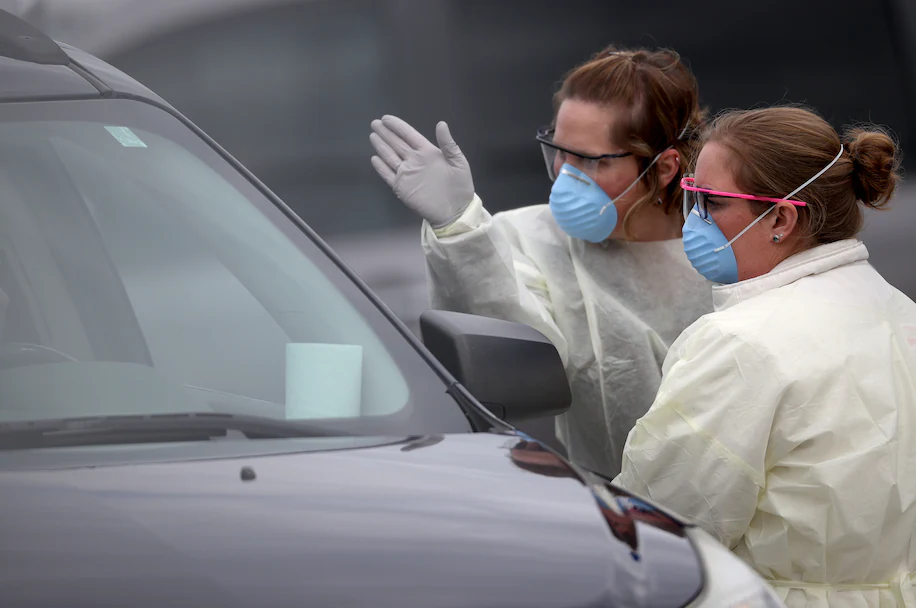
Nurses screened patients at a drive-through testing site in March 2020. (Win McNamee/Getty Images)

Exactly two years ago, the World Health Organization declared the coronavirus a pandemic and much of American life began grinding to a halt. 

That’s when the health-care system, which has never been known for its quickness, sped up. The industry was forced to adapt, delivering virtual care and services outside of hospitals on the fly. Yet, the years-long pandemic has exposed decades-old cracks in the system, and galvanized efforts to fix them.

Today, as coronavirus cases plummet and President Biden says Americans can begin resuming their normal lives, we explore how the pandemic could fundamentally alter the health-care system for good. What changes are here to stay — and what barriers are standing in the way?

A telehealth boom

What happened: Telehealth services skyrocketed as doctors’ offices limited in-person visits amid the pandemic. The official declaration of a public health emergency eased long-standing restrictions on these virtual services, vastly expanding Medicare coverage. 

But will it stick? Some of these changes go away whenever the Biden administration decides not to renew the public health emergency (PHE). The government funding bill passed yesterday extends key services roughly five months after the PHE ends, such as letting those on Medicare access telehealth services even if they live outside a rural area.

But some lobbyists and lawmakers are pushing hard to make such changes permanent. Though the issue is bipartisan and popular, it could be challenging to pass unless the measures are attached to a must-pass piece of legislation. 

  • “Even just talking to colleagues, I used to have to spend three or four minutes while they were trying desperately not to stare at their phone and explain to them what telehealth was … remote patient monitoring, originating sites, and all this wonky stuff,”said Sen. Brian Schatz (D-Hawaii), a longtime proponent of telehealth.
  • “Now I can go up to them and say, ‘So telehealth is great, right?’ And they say, ‘yes, it is.’ ”
A new spotlight on in-home care

What happened: The infectious virus tore through nursing homes, where often fragile residents share rooms and depend on caregivers for daily tasks. Ultimately, nearly 152,000 residents died from covid-19.

The devastation has sparked a rethinking of where older adults live and how they get the services they need — particularly inside their own homes. 

  • “That is clearly what people prefer,” said Gail Wilensky, an economist at Project HOPE who directed the Medicare and Medicaid programs under President George H.W. Bush. “The challenge is whether or not it’s economically feasible to have that happen.”

More money, please: Finding in-home care — and paying for it — is still a struggle for many Americans. Meanwhile, many states have lengthy waitlists for such services under Medicaid.

Experts say an infusion of federal funds is needed to give seniors and those with disabilities more options for care outside of nursing homes and assisted-living facilities. 

For instance, Biden’s massive social spending bill included tens of billions of dollars for such services. But the effort has languished on Capitol Hill, making it unclear when and whether additional investments will come. 

A reckoning on racial disparities

What happened: Hispanic, Black, and American Indian and Alaska Native people are about twice as likely to die from covid-19 than White people. That’s according to age-adjusted data from a recent Kaiser Family Foundation report

In short, the coronavirus exposed the glaring inequities in the health-care system. 

  • “The first thing to deal with any problem is awareness,” said Georges Benjamin, the executive director of the American Public Health Association. “Nobody can say that they’re not aware of it anymore, that it doesn’t exist.”

But will change come? Health experts say they hope the country has reached a tipping point in the last two years. And yet, any real systemic change will likely take time. But, Benjamin said, it can start with increasing the number of practitioners from diverse communities, making office practices more welcoming and understanding biases. 

We need to, as a matter of course, ask ourselves who’s advantaged and who’s disadvantaged” when crafting new initiatives, like drive-through testing sites, Benjamin said. “And then how do we create systems so that the people that are disadvantaged have the same opportunity.”

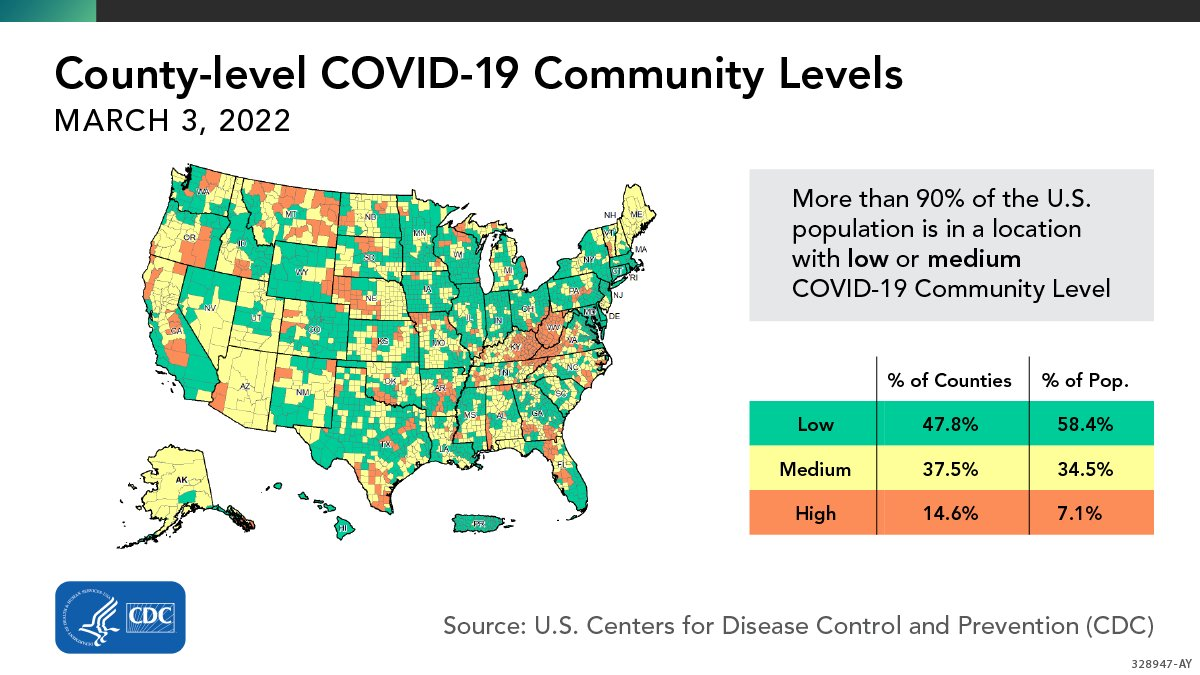
More than 90% of the U.S. population lives in an area with a “low” or “medium” risk of COVID-19

More than 90% of the U.S. population lives in an area with a “low” or “medium” risk of COVID-19, the U.S. Centers for Disease Control and Prevention (CDC) announced yesterday. Last week, the CDC changed the way it assesses county-level COVID-19 risk, using data on hospitalizations and health care capacity in addition to case counts. The CDC now recommends universal indoor masking only for counties that are at “high” risk under this system—which means that the vast majority of Americans are not currently advised to wear masks inside.

US approaches end of ‘full-blown’ pandemic, Fauci says

Fauci: US exiting 'full-blown' pandemic phase of coronavirus crisis

The U.S. may see an end to all pandemic restrictions, including mandatory mask-wearing, in the coming months, Anthony Fauci, MD, director of the National Institute of Allergy and Infectious Diseases, told the Financial Times Feb. 8. 

He said he hopes that the end to these restrictions will come soon and explained that the response to the pandemic going forward will be concentrated at a local level. 

“As we get out of the full-blown pandemic phase of COVID-19, which we are certainly heading out of, these decisions will increasingly be made on a local level rather than centrally decided or mandated. There will also be more people making their own decisions on how they want to deal with the virus,” he told the FT

The National Institute for Allergy and Infectious Diseases is preparing for the next pandemic by monitoring viruses that are known to cause severe illness.

COVID-19 deaths pass peak from delta surge

https://click1.email.thehill.com/ViewMessage.do;jsessionid=69623F0C51A9AD108D92583CE78B74C7

Welcome to Wednesday’s Overnight Health Care, where we’re following the latest moves on policy and news affecting your health. Subscribe here: thehill.com/newsletter-signup

Masks come to the Super Bowl: Fans attending the big game next month will be given KN95 masks.  

Despite omicron being less severe on average, the sheer number of cases has driven deaths past the peak from last year’s delta surge.  

The average number of U.S. COVID-19 deaths this week surpassed the height of the delta surge earlier this fall and is at its highest point since last winter, when the nation was coming out of the peak winter surge. 

The seven-day average of deaths hit 2,166 on Monday, according to the latest data from the Centers for Disease Control and Prevention (CDC). Average daily deaths in mid-September before the omicron variant was discovered peaked at around 1,900. 

While increasing evidence shows omicron may be less likely to cause death or serious illness than delta, the sheer infectiousness and the speed at which it spreads has overwhelmed hospitals, primarily with people who have not been vaccinated. 

The U.S. saw the highest numbers of deaths in the pandemic just over a year ago, before vaccines were widely available, when the daily average reached 3,400. The last time the U.S. topped 2,000 deaths was last February, as the country was slowly coming down from the January peak. 

Caution urged: Infections are falling in states that were hardest hit earlier, as well as broadly across the nation. Hospitalizations are also falling, but deaths are a lagging indicator and are still increasing. CDC Director Rochelle Walsenky said deaths have increased about 21 percent over the past week. 

The fact that the omicron variant tends to cause less severe disease on average also helped avoid an even greater crisis that would have occurred if it was as severe as the delta variant.  

Biden moves to shore up testing and mask supply as Omicron wave appears to ease

https://mailchi.mp/d57e5f7ea9f1/the-weekly-gist-january-21-2022?e=d1e747d2d8

Covid omicron variant expected to hit New York in 'coming days,' NY health  commissioner says

 This week the Biden Administration unveiled actions to make at-home COVID tests and N95 masks available, free of charge, to hundreds of millions of Americans. However, even as US COVID hospitalizations have now surpassed last winter’s previous peak, two newly-approved COVID antiviral drugs remain scarce. Just as fast as Omicron has surged across the country, it may be starting to recede, with cases beginning to drop in several states in the Northeast. Modelers now project the incredibly contagious variant will infect 40 percent of Americans and more than half the human race by the end of March.

The Gist: Absent another significant variant, experts are cautiously optimistic that enough of the US population will soon have either infection-acquired or vaccine-induced immunity that we may be nearing the end of the pandemic, and the beginning of “endemic COVID.” 

The US must now shift from COVID “war footing” to learning how to live with the virus long term. That will mean tackling difficult and politically-charged decisions, such as what level of testing and masking are sustainable, and how many COVID deaths we are willing to tolerate.

Good morning. Omicron is in retreat. What’s next?

Fewer fevers
The latest Omicron developments continue to be encouraging. New Covid-19 cases are plummeting in a growing list of places. The percentage of cases causing severe illness is much lower than it was with the Delta variant. And vaccines — particularly after a booster shot — remain extremely effective in preventing hospitalization and death.
I also think it’s time to begin considering what life after the Omicron wave might look like.
1. Plunging cases
Since early last week, new cases in Connecticut, Maryland, New Jersey and New York have fallen by more than 30 percent. They’re down by more than 10 percent in Colorado, Florida, Georgia, Massachusetts and Pennsylvania. In California, cases may have peaked.
“Let’s be clear on this — we are winning,” Mayor Eric Adams of New York said yesterday. Kathy Hochul, the governor of New York State, said during a budget speech, “We hope to close the books on this winter surge soon.”
If anything, the official Covid numbers probably understate the actual declines, because test results are often a few days behind reality.
The following data comes from Kinsa, a San Francisco company that tracks 2.5 million internet-connected thermometers across the country. It uses that data to estimate the percentage of Americans who have a fever every day. The declines over the past week have been sharp, which is a sign of Omicron’s retreat:

Many hospitals are still coping with a crushing number of patients, because Covid hospitalization trends often trail case trends by about a week. But even the hospital data shows glimmers of good news: The number of people hospitalized with Covid has begun declining over the past few days in places where Omicron arrived first:

The U.S. seems to be following a similar Omicron pattern as South Africa, Britain and several other countries: A rapid, enormous surge for about a month, followed by a rapid decline — first in cases, then hospitalizations and finally deaths.
(Look up official numbers for your state and county.)
2. Low risks
Some of the clearest research on Covid’s risks comes from a team of British researchers led by Dr. Julia Hippisley-Cox of the University of Oxford. The team has created an online calculator that allows you to enter a person’s age, vaccination status, height and weight, as well as major Covid risk factors. (It’s based on an analysis of British patients, but its conclusions are relevant elsewhere.)
A typical 65-year-old American woman — to take one example — is five foot three inches tall and weighs 166 pounds. If she had been vaccinated and did not have a major Covid risk factor, like an organ transplant, her chance of dying after contracting Covid would be 1 in 872, according to the calculator. For a typical 65-year-old man, the risk would be 1 in 434.
Among 75-year-olds, the risk would be 1 in 264 for a typical woman and 1 in 133 for a typical man.
Those are meaningful risks. But they are not larger than many other risks older people face. In the 2019-20 flu season, about 1 out of every 138 Americans 65 and older who had flu symptoms died from them, according to the C.D.C.
And Omicron probably presents less risk than the British calculator suggests, because it uses data through the first half of 2021, when the dominant version of Covid was more severe than Omicron appears to be. One sign of Omicron’s relative mildness: Among vaccinated people in Utah (a state that publishes detailed data), the percentage of cases leading to hospitalization has been only about half as high in recent weeks as it was last summer.
For now, the available evidence suggests that Omicron is less threatening to a vaccinated person than a normal flu. Obviously, the Omicron wave has still been damaging, because the variant is so contagious that it has infected tens of millions of Americans in a matter of weeks. Small individual risks have added up to large societal damage.
3. Effective boosters
The final major piece of encouraging news involves booster shots: They are highly effective at preventing severe illness from Omicron. The protection is “remarkably high,” as Dr. Eric Topol of Scripps Research wrote.
Switzerland has begun reporting Covid deaths among three different groups of people: the unvaccinated; the vaccinated who have not received a booster shot; and the vaccinated who have been boosted (typically with a third shot). The first two shots still provide a lot of protection, but the booster makes a meaningful difference, as Edouard Mathieu and Max Roser of Our World in Data have noted:
The next stage
The Covid situation in the U.S. remains fairly grim, with overwhelmed hospitals and nearly 2,000 deaths a day. It’s likely to remain grim into early February. Caseloads are still high in many communities, and death trends typically lag case trends by three weeks.
But the full picture is less grim than the current moment.
Omicron appears to be in retreat, even if the official national data doesn’t yet reflect that reality. Omicron also appears to be mild in a vast majority of cases, especially for the vaccinated. This combination means that the U.S. may be only a few weeks away from the most encouraging Covid situation since early last summer, before the Delta variant emerged.
If that happens — and there is no guarantee it will, as Katherine Wu of The Atlantic explains — it will be time to ask how society can move back toward normalcy and reduce the harsh toll that pandemic isolation has inflicted, particularly on children and disproportionately on low-income children.
When should schools resume all activities? When should offices reopen? When should masks come off? When should asymptomatic people stop interrupting their lives because of a Covid exposure? Above all, when does Covid prevention do more harm — to physical and mental health — than good?
These are tricky questions, and they could often sound inappropriate during the Omicron surge. Now, though, the surge is receding.

What “mild” really means when it comes to Omicron

https://www.axios.com/what-mild-really-means-when-it-comes-to-omicron-f808e5ba-5655-4ac5-b057-4afe3b0aa860.html?fbclid=IwAR27eTD0HrjsF_XiS_USEVn9MxermNoLWJNhU10AeIFQV_y59C7Fl3ok9RM

Illustration of a coronavirus cell in curly quotes.

The Omicron variant doesn’t cause as much severe illness as other variants have, but its “mild” symptoms can still be pretty unpleasant.

The big picture: The way health care professionals and doctors differentiate between “mild” and “severe” illness may not align with a layperson’s understanding of those terms.

“To a health care professional, ‘mild’ means you’re not getting hospitalized,” said Megan Ranney, academic dean at the Brown University School of Public Health.

  • But, she said: “Omicron symptoms can range from absolutely no symptoms to a really mild cold to something where you are in bed with shakes and chills, and have a horrible cough and are fatigued and headachy for weeks. Those are all ‘mild.'”
  • A “severe,” illness means you’d likely have symptoms such as very low oxygen levels, kidney damage and heart impairment, she said.

What we’re watching: Omicron is causing a lot less severe illness than previous variants, but a “mild” case can still require about a week away from work, especially in front-line jobs.

  • And because so many people have gotten infected in such a short time, it’s leaving schools, airlines, and other businesses — including, critically, hospitals — with large numbers of workers out sick simultaneously, The Atlantic reported.
  • Then there’s the matter of long COVID. A study published Thursday in Nature Immunology found ongoing, sustained inflammatory responses following even mild-to-moderate COVID-19 cases.

What they’re saying: “It’s going to be a messy few weeks. I don’t think there’s any way around it,” said Joseph Allen, a professor of public health at Harvard, per The Atlantic.

Did you know that as of January 1st, Omicron represents 95.4% of US cases?

May be an image of text that says '100% As of January 1, Omicron represents 95.4% of US cases Other 75% lota Gamma 50% Omicron Omicron Alpha 25% Delta 0% Mar 13 May 22 Jun 26 Jul31 Jul Sep 11 Oct 23 Source: Centers for Disease Control Apr17 17 Estimated proportions of COVID-19 infection in the US (March 13, 2021 to Jan 1, 2022) USAFACTS Nov 27 revention'

In the second year of the COVID-19 pandemic, a lot changed in how the US responded to the virus and adapted to new variants.

Did you know that as of January 1st, Omicron represents 95.4% of US cases?

Find out more: https://usafacts.org/vis…/coronavirus-covid-19-spread-map/