South Korea Warns Covid-19 Back In ‘Full Swing’ After Week-Long Case Spike

https://www.forbes.com/sites/alisondurkee/2020/08/20/south-korea-warns-covid-19-back-in-full-swing-after-week-long-case-spike

South Korea Warns Covid-19 Back In 'Full Swing' After Week-Long ...

TOPLINE

South Korea officials warned Thursday that the country is in a “grave situation” after Covid-19 cases rose by triple digits for a week straight, as one of the countries most hailed for its success in containing the coronavirus sees a new resurgence of the virus linked to a far-right church and anti-government protest.


KEY FACTS

South Korea added 288 Covid-19 cases Thursday—slightly down from 297 cases Wednesday, the highest number observed in the country since March 8.

“Consider the COVID-19 pandemic now to be in full-swing,” Korea Centers for Disease Control and Prevention deputy director Kwon Jun-wook said, warning that the country could experience similar sustained outbreaks to the U.S. and Europe without aggressive contact tracing.

The new case spikes are largely tied to Sarang Jeil Church, which has been linked to 676 recent cases, and a large anti-government rally held in Seoul Saturday in which many church members participated.

The outbreak is the second time a church has been linked to a large outbreak in the country—5,200 cases in February and March were linked to the Shincheonji Church of Jesus—but officials warn this one has the potential to be worse, and the New York Times notes anti-government sentiment among the church’s members may make efforts to contain the virus more difficult.

South Korean President Moon Jae-in has shut down churches in the country in response to the new outbreak, sparking a broader controversy as conservatives accuse the government of infringing on religious freedoms.

South Korea has been hailed for its effective response to the coronavirus, and was previously able to curb the Shincheonji church outbreak through widespread testing, self-isolation orders and contact tracing.


CRUCIAL QUOTE

“We are standing on the cusp of the nationwide outbreak,” Kwon said at a briefing Thursday. “The wider capital region should brace for a massive wave of the outbreak.”


BIG NUMBER

16,346: The total number of Covid-19 cases in South Korea since the start of the pandemic, as reported by Johns Hopkins University.


KEY BACKGROUND

South Korea is one of many countries to see a worrying resurgence of Covid-19 in recent weeks, as Europe and countries that had successfully contained the virus see new spikes.

Spain and Italy posted new Covid-19 case number highs Wednesday, while France reported Wednesday that it had recorded new Covid-19 cases at the highest rate since May.

Germany reported its highest case count since April on Thursday, with 1,707 new cases.

Outside of Europe, India experienced its highest daily total yet of new Covid-19 cases Thursday—69,672 cases, also the fourth highest daily total reported globally—while Japan reported that more than a third of its 59,213 cases have been recorded since the start of August alone.

New Zealand, one of the countries that had most successfully contained the virus, went back into lockdown last week after seeing Covid-19 spread through community transmission for the first time in 102 days; the outbreak has so far resulted in 80 new cases.


School reopenings with COVID-19 offer preview of chaotic fall

https://thehill.com/policy/healthcare/public-global-health/512824-school-reopenings-with-covid-19-offer-preview-of

When Texas schools reopen, officials planning few required safety ...

Thousands of students and teachers across the country are quarantining just days into the new school year, highlighting the challenges of resuming in-person instruction during a pandemic.

While many schools aren’t scheduled to reopen until later this month or September, those that have are offering a preview of the chaos that awaits districts this fall, particularly in hot spots in the South and Midwest where the virus is spreading uncontrollably.

In Georgia’s Cherokee County School District, where students are not required to wear masks, nearly 2,200 students — mostly high schoolers — are quarantining after coming into contact with one of 116 students or 25 teachers and staff members with COVID-19. Another 53 teachers and staff members are also quarantining.

Those numbers are expected to increase with more test results. In the meantime, three of the district’s six high schools have moved classes online, at least until September.

Experts have warned for weeks that it will be extremely difficult to safely reopen schools in hot spots, but some districts are still charging ahead — some willingly, others after some prodding from state and national leaders.

The results, health officials say, are not surprising, though they are preventable.

“You go in, people get infected — boom, you close them down. So it’s better to ease in, perhaps with virtual, until you see what’s going on when you’re in a really hot zone,” Anthony Fauci said during a livestreamed event Tuesday, referring to schools that have already closed after reopening this year.

“When you’re in a red zone … you really better think twice before you do that because what might happen, is what you’ve seen,” Fauci added.

Schools in states like IndianaLouisianaOklahoma and Tennessee have shut down, at least temporarily, after finding COVID-19 in their hallways and classrooms.

The question of when and how to open schools has moved from a public health debate to a political one, with President Trump and his administration strongly advocating for full-time, in-person instruction, hoping in part that parents can then return to work and revamp an economy that’s been ravaged by the coronavirus recession.

Health experts and administration officials note that the consequences of missing in-person learning can be severe, especially for younger students. Finding a solution that minimizes harm to students while protecting public health has proven difficult.

Annette Anderson, a professor in the school of education at Johns Hopkins University, said there is no proven or agreed-upon approach to holding classes during a pandemic, no set protocols around when to return to in-person instruction or how to conduct testing and contact tracing.

“There’s a wild, wild west approach with all the different types of plans in reopening and because of that, a gold standard would just mean clarity around what schools should do. But we don’t have a tacit agreement about what that actually means,” she said.

Most states are deferring school opening decisions to local school districts. For example, while the Cherokee County School District is offering in-person learning five days a week, Atlanta Public Schools, just one county over, is beginning the year online.

Many school districts are opting for online instruction or pursuing hybrid models in which students alternate which days they are in class to limit the number of people in school buildings at one time.

Others, like some districts in Georgia, Arkansas, Florida and Texas, are moving full speed ahead with in-person learning, despite the challenges posed by cramped buildings and classrooms. Some of those districts also offer online options.

While in-person instruction might work for some states where transmission is relatively low, like New York, which gave districts the green light to fully reopen this year, it will be much harder in hot spots.

Fauci classified hot spots as areas with test positivity rates that exceed 10 percent.

While he didn’t specify any states, several across the country have positivity rates over 10 percent, according to figures compiled by Johns Hopkins University, and have districts pursuing in-person instruction. The list includes Florida, Georgia, Idaho, Iowa, Kansas, Mississippi and Texas.

“There’s one opportunity to do this well, because once you open you want the schools to stay open as much as possible, given how disruptive isolating schools and teachers can be,” said Thomas Tsai, assistant professor in the Department of Health Policy and Management at Harvard T.H. Chan School of Public Health.

He recommended schools consider shutting down if the virus appears to be widespread. If cases appear to be isolated to one cluster in a classroom, the rest of the school can probably remain open, while exposed students isolate at home.

That’s why it’s especially important for students to wear masks and keep their desks at least 6 feet apart, and avoid gatherings outside of classrooms, he said, otherwise the number of contacts per case can quickly grow, resulting in more students and teachers needing to be quarantined.

If there are clusters in multiple classrooms and hundreds of students and teachers need to quarantine, schools might need to consider shutting down, Tsai added.

The Centers for Disease Control and Prevention says in “most instances” a single case of COVID-19 should not warrant a school closure.

But if the spread of COVID-19 at a school is higher than within the community, or if the school is becoming the source of an outbreak, administrators should work with local health officials to determine whether temporary closures are needed.

Mississippi State Health Officer Thomas Dobbs said Monday that 245 teachers and 199 students have tested positive for the coronavirus in 71 of the state’s 82 counties. Almost 600 teachers and more than 2,000 students are now in quarantine, but none of the schools have closed.

Dobbs said many of the teachers and students likely contracted the virus outside of school but unknowingly “brought it with them” to class.

Classes are canceled indefinitely at a school district in Pinal County, Ariz., after more than 100 teachers and staff members refused to come to work, citing a concern with the spread of COVID-19 in the community.

The school district planned to resume in-person learning Monday, despite the county not meeting metrics recommended by the state’s health department for safely reopening, including a drop in the number of new cases, new COVID-19 hospitalizations and the percentage of people testing positive.

In Florida, 13 counties have reopened schools in the past week for in-person instruction; at least three districts have reported COVID-19 cases. In Martin County, more than 300 students and teachers are quarantining after coming into contact with infected classmates.

County officials said some parents are not keeping their kids at home while awaiting the results of COVID-19 tests. Instead, they’re waiting until the test is positive before notifying the school.

And in Florida’s Dade County, about 70 students and staff are quarantining after 11 people in the district tested positive. County officials have said that cases are to be expected and superintendents should call them before making any decisions about closures.

The confusion at all levels of government has frustrated both parents and school officials. In the lead-up to the new school year, Trump has offered mixed messages.

Last month, he said schools in hot spots might need to delay their reopening plans, but in August he renewed his push for a return to in-person instruction by tweeting: “OPEN THE SCHOOLS!!!”


Notre Dame cancels in-person classes after surge of COVID-19 cases

https://www.axios.com/notre-dame-cancels-classes-coronavirus-a7bd3249-f757-44a9-baf8-fb4de0bbefa3.html?stream=health-care&utm_source=alert&utm_medium=email&utm_campaign=alerts_healthcare

The University of Notre Dame announced Tuesday that it is canceling in-person classes for at least two weeks following a spike in coronavirus cases.

Why it matters: Notre Dame is the second prominent university to announce this week that it would revert back to remote learning, following the the University of North Carolina at Chapel Hill on Tuesday. The reversals underscore the challenges facing colleges and universities as more students are set return to campus.

Between the lines: As was the case with UNC, most of the COVID-19 infections at Notre Dame have been linked to off-campus parties.

  • The nearly 12,000 students that returned to Notre Dame were all tested before arriving on campus on Aug. 10, and just 33 tested positive, according to the Journal.
  • Through Monday, 147 of the 927 students who had shown symptoms tested positive for the virus — a sharp uptick in the positivity rate.

What they’re saying: Our contact-tracing analysis indicates that most infections are coming from off-campus gatherings,” said University of Notre Dame President Rev. John Jenkins. “Students infected at those gathering passed it on to others, who in turn have passed the virus on to others, resulting in the positive cases we have seen.”

  • “For your sake and the sake of our community and for continuing our semester on campus, please observe health protocols and avoid behavior that puts yourself or others at risk,” Jenkins added.


U.S. records deadliest coronavirus day of the summer

https://www.axios.com/1485-us-coronavirus-death-record-5ee493cc-df91-4549-8c9d-43a5fee0bd87.html

U.S. records deadliest coronavirus day of the summer - Axios

The U.S. reported 1,485 deaths due to the coronavirus on Wednesday, COVID Tracking Project data shows.

Why it matters: It’s the highest single-day COVID-19 death toll since May 15, when the country reported 1,507 deaths. The U.S. has seen a total of 157,758 deaths from the virus.

The big picture: Georgia reported 109 deaths on Wednesday — its second triple-digit day in a row.

Go deeper: 5 states set single-day coronavirus case records last week


The two sides of America’s coronavirus response

https://www.axios.com/us-coronavirus-vaccine-testing-science-b656e905-67d1-4836-863e-c91f739cfd1e.html

The two sides of America's coronavirus response - Axios

America’s bungled political and social response to the coronavirus exists side-by-side with a record-breaking push to create a vaccine with U.S. companies and scientists at the center.

Why it matters: America’s two-sided response serves as an X-ray of the country itself — still capable of world-beating feats at the high end, but increasingly struggling with what should be the simple business of governing itself.

What’s happening: An index published last week by FP Analytics, an independent research division of Foreign Policy, ranked the U.S. 31st out of 36 countries in its assessment of government responses to COVID-19.

  • That puts it below developed countries like New Zealand and Denmark, and also lower than nations with fewer resources like Ghana, Kenya and South Africa.
  • The index cited America’s limited emergency health care spending, insufficient testing and hospital beds and limited debt relief.

By the numbers: As my Axios colleague Jonathan Swan pointed out in an interview with President Trump, the U.S. has one of the worst per-capita death rates from COVID-19, at 50.29 per 100,000 population.

Yes, but: Work on a COVID-19 vaccine is progressing astonishingly fast, with the Cambridge-based biotech company Moderna and the National Institutes of Health announcing at the end of July that they had begun Phase 3 of the clinical trial.

  • Their efforts are part of a global rush to a vaccine, and while companies in the U.K. and China are jockeying for the lead, U.S. companies and the NIH’s resources and expertise have been key to the effort.
  • Anthony Fauci has said he expects “tens of millions” of doses to be available by early 2021, a little over a year after the novel coronavirus was discovered.
  • If that turns out to be the case, “the Covid-19 vaccine could take a place alongside the Apollo missions as one of history’s greatest scientific achievements,” epidemiologist Michael Kinch recently wrote in STAT.

So which is the real American response to COVID-19? The bungled testing policies, the politically driven rush to reopen, the tragic racial divide seen in the sick and the dead? Or the warp-speed work to develop a vaccine in a year when most past efforts took decades?

Be smart: It’s both.

The bottom line: It can often feel as if there are two Americas, and not even a virus that has spread around the world seems capable of bridging that gap.


U.S. doing a lot less coronavirus testing

https://www.axios.com/newsletters/axios-vitals-32689a40-e409-4547-8468-b03dc589c082.html

The two sides of America's coronavirus response - Axios

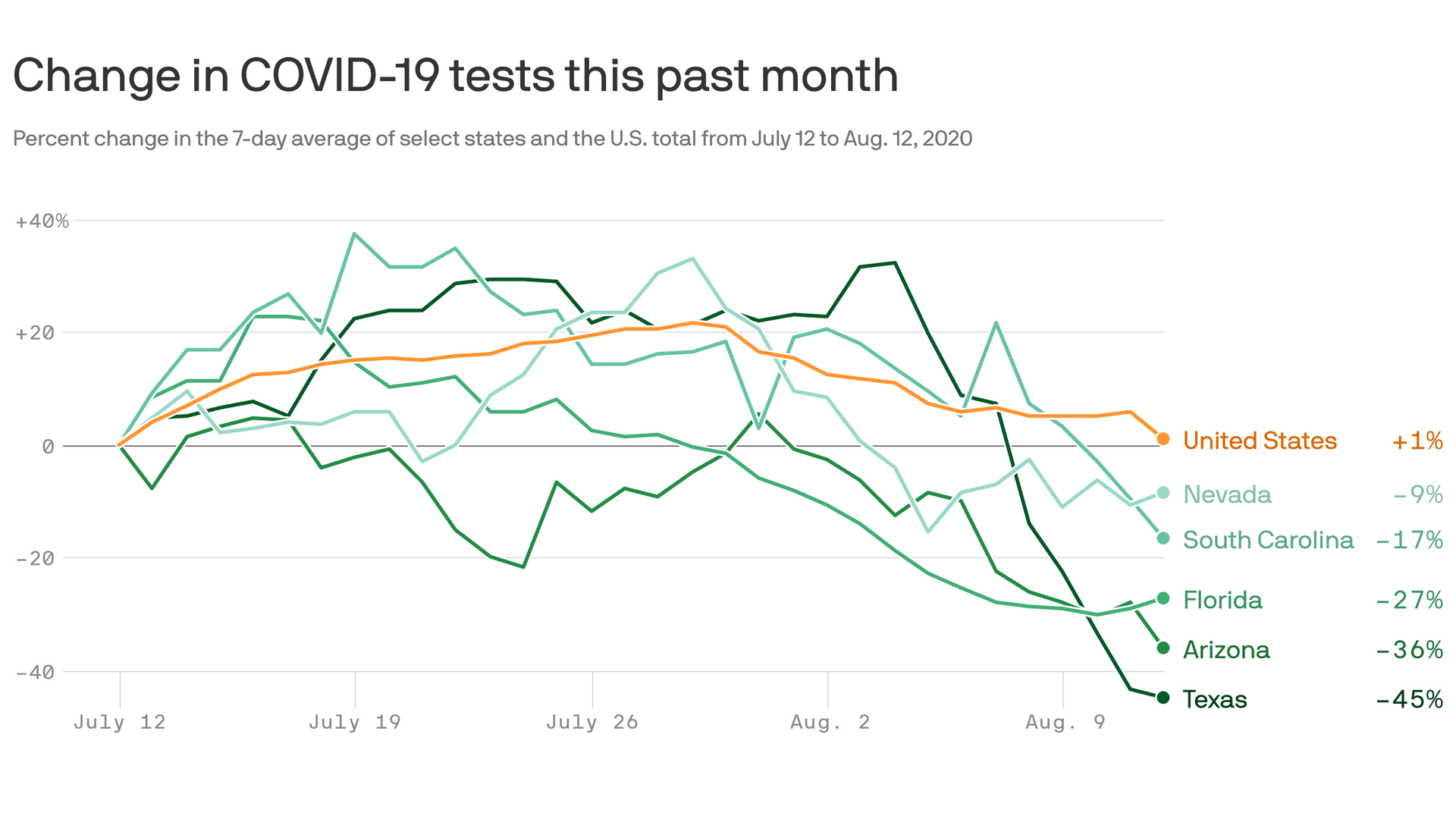
The U.S. is cutting back on coronavirus testing. Nationally, the number of tests performed each day is about 17% lower than it was at the end of July, and testing is also declining in hard-hit states.

Why it matters: This big reduction in testing has helped clear away delays that undermined the response to the pandemic. But doing fewer tests can also undermine the response to the pandemic.

By the numbers: At the end of July, America was doing more than 800,000 tests a day. This week, it’s hovered around 715,000.

  • Even as states with particularly bad outbreaks pull back on their testing, the proportion of tests coming back positive is still high — which would normally be an indication that they need to be doing more tests.
  • In Texas, 19% of tests are coming back positive, according to Nephron Research. In Florida, the rate of positive tests is 18%, and in Nevada, 17%.

Yes, but: Experts have said reducing the demand for testing may be the best way to alleviate long delays, which made tests all but useless. And that appears to be working.

Driving the news: The Department of Health and Human Services estimated this week that nearly 90% of all tests are being completed within three days — a big improvement from turnaround times that had been stretching well over a week.

  • Quest Diagnostics says its expected turnaround time is now 2–3 days, and less for priority patients. LabCorp announced a similar turnaround time last week.

The bottom line: The U.S. is averaging 50,000 new cases a day, and that high caseload is ultimately why the demand for testing is more than the system can handle.

  • We can’t get our caseload under control without fast, widespread testing, but we can’t achieve fast, widespread testing with such a high caseload.


Coronavirus: Some college students returning to campus are being met with liability waivers

https://finance.yahoo.com/news/colleges-students-liability-waivers-112753572.html

Schools that are choosing to reopen amid the coronavirus pandemic are attempting to protect themselves against possible legal blowback with legal liability waivers.

From universities to K-12 districts, some schools are sending forms with titles such as “Assumption of Risk” and “Waiver of Liability” to fend off any lawsuits should students contract coronavirus on campus or in the classroom.

“Institutions are basically trying to have it both ways,” Kevin McClure, associate professor of higher education at the University of North Carolina Wilmington, told Yahoo Finance. “They’re trying to say: ‘We are opening in the midst of significant risk, and at the same time we want you — as students or faculty or staff — to assume that risk and to not hold us responsible for the decisions that we’ve made.’”

‘Students’ ability to take responsibility both for themselves and each other’

Generally, the waiver forms note two things: That there is a risk of contracting the coronavirus if a student appears on campus and that the decision to come back cannot be held against the school.

“I know the challenge these circumstances present, but I also know our students’ ability to take responsibility both for themselves and each other,” Damon Sims, vice president for Student Affairs at Penn State, said in a press release. “If ever there was a time for them to do so, now is that time. We will do all we can to encourage that outcome, and we expect them to do all they can to make it so. We are in this together.”

Students returning to Penn State’s University Park campus, which usually houses more that 45,000 undergraduate students, are required to fill out the following “coronavirus compact” prior to their arrival on Penn State’s campus

This is the reality of the current situation’

Saint Anselm College in New Hampshire is another college asking its students to sign a waiver.

The liberal arts school is planning to conduct its fall semester primarily in-person, an option 30% of schools have chosen. Classes start for 2,000 students on August 19, university spokesperson Paul Pronovost told Yahoo Finance.

Aside from the usual safety measures — from reducing density in housing, classroom, and common spaces, restricting visitors, implementing distancing — the school is also going to administer two coronavirus tests on students upon their arrival: A rapid test and a fuller test. Saint Anselm is also planning to do surveillance testing throughout the semester.

Beyond social distancing, testing, and contact tracing, the university wants students and parents to “accept” the unique schooling situation.

There’s “simply no way for the College – or any College or institution, for that matter – to guarantee that our campus will not see cases of COVID-19,” Pronovost said in an email. “We believe it is important for students and families to understand and accept that this is the reality of the current situation.”

The liability waiver notes that students “forever release and waive my right to bring suit against Saint Anselm College, its Board of Trustees, officers, directors, managers, officials, agents, employees, or other representatives in connection with exposure, infection, and/or spread of COVID-19 related to taking classes, living or participating in activities on the Saint Anselm College Campus.”

Colleges fear an avalanche of lawsuits 

The possibility of lawsuits worried colleges enough to lobby Congress for protections from liability.

Nearly 80 education groups sent a letter to congressional leaders back in May, stating that reopening schools involves not just “enormous uncertainty about COVID-19-related standards of care” but also the “corresponding fears of huge transactional costs associated with defending against COVID-19 spread lawsuits.”

Rutgers Law Professor Adam Scales argued that we may see an uptick in litigation, at least “until Congress or the courts firmly signal that COVID is not going to be ‘the new asbestos,’” adding that courts will not likely impose severe liability on public entities like schools.

“Just because a student can get into court does not mean the student can win,” Michael Duff, a law professor at the University of Wyoming, told Yahoo Finance. “So even if the waiver does not ‘work,’ and the student can get into court, there is no guarantee that a lawyer would take the case because the case may be weak.”

There is also the issue of proof.

“The idea that liability — whether caused by negligence or gross negligence — is easy to prove is a myth,” Duff said. “The student would first have to prove that the college did not act ‘reasonably’ in the COVID-19 context.”

Given that the definition of acting “reasonably” would not necessarily involve a college being perfect with its coronavirus mitigation, Duff added, gross negligence would be “a very hard thing to prove.”

At the same time, Scales added, a liability waiver could not serve as a “get-out-of-jail-free card” a school taken to court in a coronavirus-related case brought by a student.

‘A stark dilemma’

At the end of the day, McClure noted, colleges need students to return to campus and pay tuition to survive as institutions of higher education.

“I do genuinely believe that many institutions and the people running them want to do what’s right and keep people healthy,” McClure said. “On the other hand, there are the financial realities of attempting to keep an organization up and running, and an organization whose revenue is often very much tied to people coming to campus.”

Schools are thus faced with “a stark dilemma,” McClure added, of either bringing students and faculty back to campus or “make significant cuts because we are not able to pay our bills.”

That said, given that students are paying a lot more today than previous generations in terms of tuition and fees, there is a sentiment that “institutions actually have a greater duty of care to their students.”

That idea is being put to the test amid the coronavirus pandemic, McClure said, and the liability waivers — which essentially abandon the “duty of care” that these institutions should take — fly in the face of this “consumerist moment” in higher education.

“Anytime that you’ve got people that are forking over large amounts of money and making a significant investment,” McClure said, “you can expect that they’re going to want a certain level of service and are going to be unhappy when a company or an organization isn’t delivering their end of the deal.”


60% of Sturgis residents were against a motorcycle rally that brings in thousands but the city approved it. Here’s why

https://www.cnn.com/2020/08/10/us/sturgis-motorcycle-rally-residents-decision

Steven J. Frisch on Twitter: "I'm fearful of what is to come, as ...

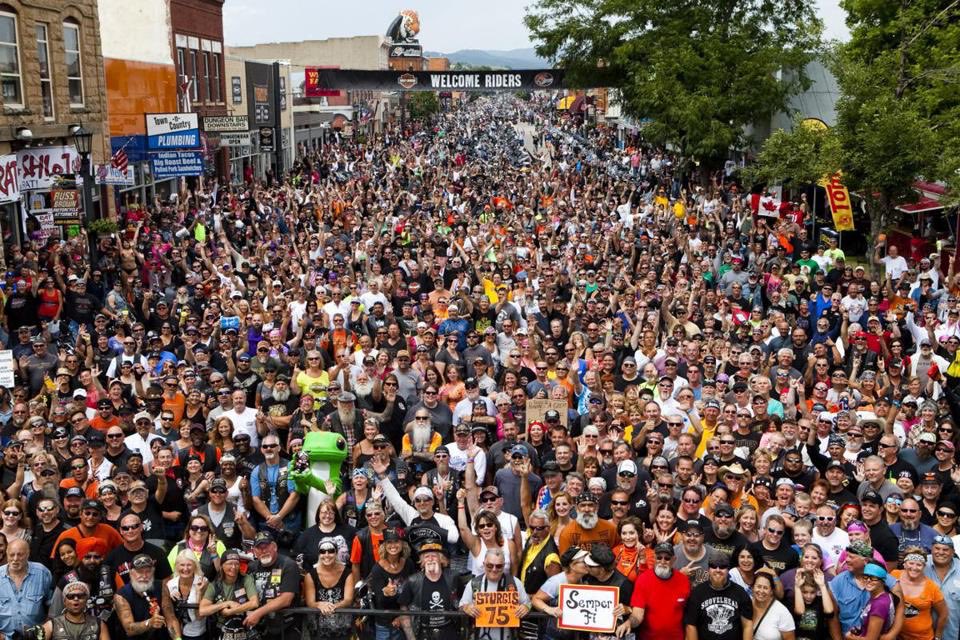
Before deciding on whether to hold the 80th annual motorcycle rally in Sturgis, South Dakota, the local city council turned to its residents to get their take.

“There was a significant amount of discussion that the council had with residents, businesses and state health officials as well as local health officials,” Daniel Ainslie, the city manager, told CNN Sunday.
The city, home to fewer than 7,000, sent a survey to all households asking if they wanted the rally to proceed on its scheduled date. The massive event usually brings in crowds of about 500,000 over 10 days of drag races, contests and concerts. On its 75th anniversary, nearly three quarters of a million people showed.
A little more than 60% of people in the city voted against holding the event this week. But the city council approved it anyway.

https://www.washingtonpost.com/arts-entertainment/2020/08/10/smash-mouth-coronavirus-concert/?utm_campaign=wp_main&utm_medium=social&utm_source=facebook&fbclid=IwAR0EIjLLrhpAEXabcLb11uuVlYYSuluULzd13BPitPSQCW7m-KHfsL7ZNgE


The Health 202: Coronavirus keeps spreading. But at least we’ve learned more about it.

https://www.washingtonpost.com/politics/2020/08/11/health-202-coronavirus-keeps-spreading-least-we-learned-more-about-it/?utm_campaign=wp_the_health_202&utm_medium=email&utm_source=newsletter&wpisrc=nl_health202

Coronavirus: FI Strategy to Stop the Spread

Coronavirus infections are swelling in the United States, which hit 5 million cases over the weekend.

But so is the body of research on how the novel coronavirus spreads and affects people.

Dozens of studies have now been published in top medical journals, providing critical information to public health officials and medical professionals attempting to get a handle on the virus. More understanding of the virus is critical, as its aggressive spread around the country confounds President Trump’s efforts toward an economic rebound and threatens to keep schools and workplaces shuttered through the fall.

There’s a lot left to learn. But some of the blanks are starting to be filled in, now that researchers around the world have had six months to study it (check out The Post’s database of questions and answers about the pandemic).

Here are some things we learned about the virus over the summer — and some questions that persist:


Can asymptomatic people spread the virus?

Researchers are still trying to discover whether people without visible symptoms spread the virus at similar rates as those with symptoms. There’s been a considerable amount of confusion around this question, particularly after the World Health Organization appeared to suggest the virus isn’t spread asymptomatically — and then walked back its pronouncement the next day.

It seems clear that asymptomatic transmission does occur. People with no symptoms carry the same level of virus in their nose, throat and lungs as those with symptoms, according to a South Korean study of 303 people published last week in JAMA Internal Medicine.

The study was the first to distinguish between patients who didn’t develop symptoms initially and those who did develop symptoms later on — which can cause some confusion when looking at asymptomatic spread. Based on their observations, the researchers estimated that 30 percent of infected people never develop symptoms.

Anthony Fauci, director of the National Institute of Allergy and Infectious Diseases, said last week he thinks the figure is closer to 40 percent.

“The good news about covid-19 is that about 40 percent of the population have no symptoms when they get infected,” Fauci said, but he added that asymptomatic people “are propagating the outbreak, which means that you’re going to infect someone, who will infect someone, who then will have a serious consequence.”

Are some people immune to the virus without ever getting it?

There is some very early, tentative evidence suggesting a segment of the world’s population may have partial protection thanks to the immune system’s “memory” T cells, which are trained to recognize specific invaders.

People may derive this protection from standard childhood vaccinations or from previous infections by other coronaviruses, such as those that cause the common cold, my colleague Ariana Eunjung Cha reported.

“This might potentially explain why some people seem to fend off the virus and may be less susceptible to becoming severely ill,” National Institutes of Health Director Francis Collins remarked in a blog post last week.

“On a population level, such findings, if validated, could be far-reaching,” Ariana wrote. “ … In communities in Boston, Barcelona, Wuhan and other major cities, the proportion of people estimated to have antibodies and therefore presumably be immune has mostly been in the single digits. But if others had partial protection from T cells, that would raise a community’s immunity level much higher.”


How many untested Americans have already had the virus?

The head of the Centers for Disease Control and Prevention estimated in June that there were roughly 10 times more coronavirus infections in the United States than had been confirmed through testing.

There were just 2.4 million confirmed cases when CDC Director Robert Redfield made that estimate — which, if accurate, would have translated to 24 million cases at the time. Confirmed cases have since doubled, to more than 5 million — meaning the virus may have swept through tens of millions of people.

Redfield based his estimate on the results of antibody tests, which examine a person’s blood for indicators that the body fought off an infection, Lena H. Sun and Joel Achenbach wrote.


How does the virus travel?

Scientists initially thought the virus easily spread on surfaces, similar to how other viruses operate. That’s why much of the initial public health advice centered around hand-washing and disinfecting surfaces.

Now public health experts think SARS-CoV-2 is primarily spread through person-to-person contact.

In May, the CDC updated guidance on its “How COVID-19 Spreads” website to say that “the virus spreads easily between people.” The agency also acknowledged the virus may spread other ways, such as through touching contaminated objects or surfaces, but clarified “this is not thought to be the main way the virus spreads.”

“The virus travels through the droplets a person produces when talking or coughing,” Ben Guarino and Joel wrote. “An individual does not need to feel sick or show symptoms to spread the submicroscopic virus. Close contact means within about six feet, the distance at which a sneeze flings heavy droplets. Example after example have shown the microbe’s affinity for density. The virus has spread easily in nursing homes, prisons, cruise ships and meatpacking plants — places where many people are living or working in proximity.”


Do children spread it?

Children only rarely get seriously ill or die of covid-19, the disease the virus causes; data on hospitalizations and deaths make that clear. But whether — and to what extent — they can spread the virus to others asymptomatically is still murky.

Studies are also conflicting on whether the age of children affects their likelihood of spreading the virus. One study conducted at a Chicago hospital found children younger than 5 with mild to moderate cases of covid-19 had much higher levels of virus in their noses than older children and adults — suggesting they could be more infectious, Ariana, Haisten Willis and Chelsea Janes reported.

But a study out of South Korea examining household transmission seemed to reach an opposite conclusion. It found children under age 10 did not appear to pass on the virus readily, while those between 10 and 19 appeared to transmit the virus almost as much as adults did, my colleagues wrote.


Which organs does Covid-19 attack?

The lungs appear most susceptible to the virus. Researchers have also found the pathogen in parts of the brain, kidneys, liver, gastrointestinal tract, spleen and in the endothelial cells that line blood vessels, along with widespread clotting in many organsAriana and Lenny Bernstein reported.

But researchers have been surprised to discover little inflammation on the brain, despite previous reports about neurological symptoms related to the coronavirus. The same goes for the heart. While physicians warned for months about a cardiac complication they suspected was myocarditis, autopsy investigators found no evidence of the condition.


THE BIG DEAL—Five takeaways from the July jobs report

https://thehill.com/policy/finance/510987-july-jobs-report-unemployment-economy-coronavirus

July U.S. Job Gains Top Expectations

The Friday release of the July jobs report gave a clearer view into a labor market clouded by mixed signals from real-time data and concerns about rising coronavirus cases across the country. The U.S. recovered another 1.8 million jobs last month—a bit above economists’ expectations, but well below the gains of May and June — and pushed the unemployment rate down to 10.2 percent.

While the U.S. economy is continuing to recover from the shock of pandemic, the report is a bit more complicated than the headline numbers indicate. Here are five key points to make sense of the July jobs report.


The recovery is still going, but slowing: The story of the coronavirus recession is a story of declines of record-breaking size and speed. Between March and April, the U.S. lost roughly 10 years of job gains and followed it up with a 32-percent annualized decline in economic growth in the second quarter.

The U.S. made solid progress recovering part of the more than 20 million jobs lost to the pandemic with gains of 2.7 million in May and 4.8 million in June. But the 1.8 million jobs gained in July marks a notable slowdown in the pace of recovery.

Economists have warned since coronavirus cases began spiking in mid-June that the resurgence would hinder the pace of growth, even if states don’t reimpose business closures. Those warnings bore out in the July jobs report, reinforcing the need to control the virus before the economy can fully recover.


The report gives both sides ammo in stimulus talks: The state of the economy rarely fits into a neat political narrative and the July jobs report is no exception.

Democrats can point to the slowing pace of job growth and the long road to recovery to support their calls for another $3 trillion in stimulus.

“The latest jobs report shows that the economic recovery spurred by the investments Congress has passed is losing steam and more investments are still urgently needed to protect the lives and livelihoods of the American people,” said House Speaker Nancy Pelosi (D-Calif.) and Senate Minority Leader Charles Schumer (D-N.Y.) in a Friday statement.

But the White House and Republican lawmakers are seizing on the expectations-beating job gain and lack of increase in permanent layoffs to make the case behind a pared down bill focused on reopening the economy.

“The most responsible thing we can do is to take proactive measures to allow people to return to work safely, instead of continuing to lock down the economy,” said Rep. Kevin Brady (R-Texas), ranking member of the House Ways and Means Committee.


The job market is still a long way from recovery: Despite three months of seven-figure job gains, the U.S. economy is still in a deeply damaged state. The July unemployment rate of 10.2 percent is roughly even with the peak of joblessness during the Great Recession of 10 percent in October 2009. And the true level of U.S. unemployment may be higher given how the pandemic has made it harder to define and track who is truly in the labor force.

It took a decade of steady economic recovery— the longest in modern U.S. history — for unemployment to drop to a 50-year low of 3.5 percent in February, so the nation remains a long way from where it was before the pandemic.

“At the current pace, it would take well into 2021 to recoup the 12.9 million jobs lost since February,” wrote Diane Swonk, chief economist at Grant Thornton, in a Friday analysis of the jobs report.


The increase in government jobs is likely misleading: Employment in government — which includes public schools — rose by 301,000 in July.

At first glance, that’s a welcome sign of resilience as state and local governments face severe budget crunches driven by falling tax revenues and staggering unemployment claims. But economists warn that the rise is likely the result of a seasonal adjustment designed to account for the large numbers of teachers and school employees that roll off of payrolls during the summer before coming back to work in the fall.

Elise Gould, senior economist at the left-leaning Economic Policy Institute, noted that public sector employment is still 1 million jobs below its February level after loads of layoffs during the beginning of the pandemic.

“We’ve seen large reductions in state and local public sector employment — a sector which disproportionately employs women and Black workers — over the last few months,” Gould wrote.

“I’d warn data watchers to consider those gains with a grain of salt, and to look at the overall changes from February (pre-COVID-19) to July.”

Aid to state and local governments is one of the biggest obstacles to gathering GOP support behind another stimulus bill, so this rise could factor into the rhetoric around the negotiations.


The report poses hard questions for negotiators: Every monthly jobs report has about two weeks of lag between the time the data was compiled — around the 12th of that month — and the report’s release.

While economic conditions don’t typically change drastically in that time, July was an exception. The $600 weekly boost to jobless benefits and the federal eviction and foreclosure ban enacted in March both lapsed in between the jobs report survey period and release, and much of the money lent through the Paycheck Protection Program had been spent by the end of the month. That means lawmakers are looking at a glimpse of the economy with much more fiscal support than it currently has, posing tough choices about how much more is needed to keep the economy afloat.

Even so, economists are urging  lawmakers not to rest on their laurels as the U.S. faces a difficult road ahead.

“Any notion that the improvement in the top line provides a convenient excuse for policymakers to avoid hard decisions around a fifth round of fiscal aid aimed at the unemployed should be summarily dismissed,” wrote Joe Brusuelas, chief economist at tax and audit firm RSM, in a Friday analysis.

Talks on a new coronavirus relief package were going poorly before the report and collapsed hours after it was released. 


LEADING THE DAY

Trump embraces jobs report signaling slowdown: The White House is trying to capitalize on the latest jobs numbers, arguing they point to a strong economic recovery under President Trump even as millions remain out of work and states grapple with increases in coronavirus infections.

But the data nevertheless point to an economic slowdown, challenging the White House’s bullish predictions for a speedy V-shaped recovery. The figures also come amid collapsed talks between the Trump administration and Democratic leaders on a coronavirus relief package, which economists say is desperately needed to prevent a deeper recession.

“This is not a rocket ship,” said Martha Gimbel, senior manager of economic research at Schmidt Futures. “It’s really unclear if the economy is going to achieve escape velocity before the lack of government spending crashes down or before … we have to shut down again, which is a total possibility.”

The Hill’s Morgan Chalfant and I explain why here.

The White House view: White House economic adviser Larry Kudlow, who did the rounds on cable news Friday morning, declared that the numbers evidenced a “self-sustaining recovery” and predicted that the United States would see unemployment head into the single digits in the fall months.

“The worries that some partial shutdowns or some pausing shutdowns would wreck the jobs numbers did not pan out. I think that shows signs of strength,” Kudlow said on Fox Business.

The economists’ take: Economic analysts say that despite the jobs report, there remains a need for additional fiscal stimulus. Many point to an extension of the expanded unemployment benefits and additional aid to states as necessary steps to shepherd the economy through recovery until there is a vaccine for the coronavirus.

“This jobs number doesn’t change the undeniable need for additional federal support,” said Isaac Boltansky, director of policy research at investment bank Compass Point Research & Trading.