Reopening is a risk for Republican governors

https://www.axios.com/coronavirus-reopening-republican-governors-cases-deaths-c0233fd4-8f92-448e-a11c-ec5bded1def1.html

Coronavirus reopening is a risk for Republican governors - Axios

Republican governors run a big risk — both to public health and their own political fortunes — if they open up their economies too soon, without adequate safeguards.

The big picture: The hardest-hit areas so far have mostly been in states with Democratic governors. But the number of coronavirus cases is now increasing more quickly in states with Republican governors.

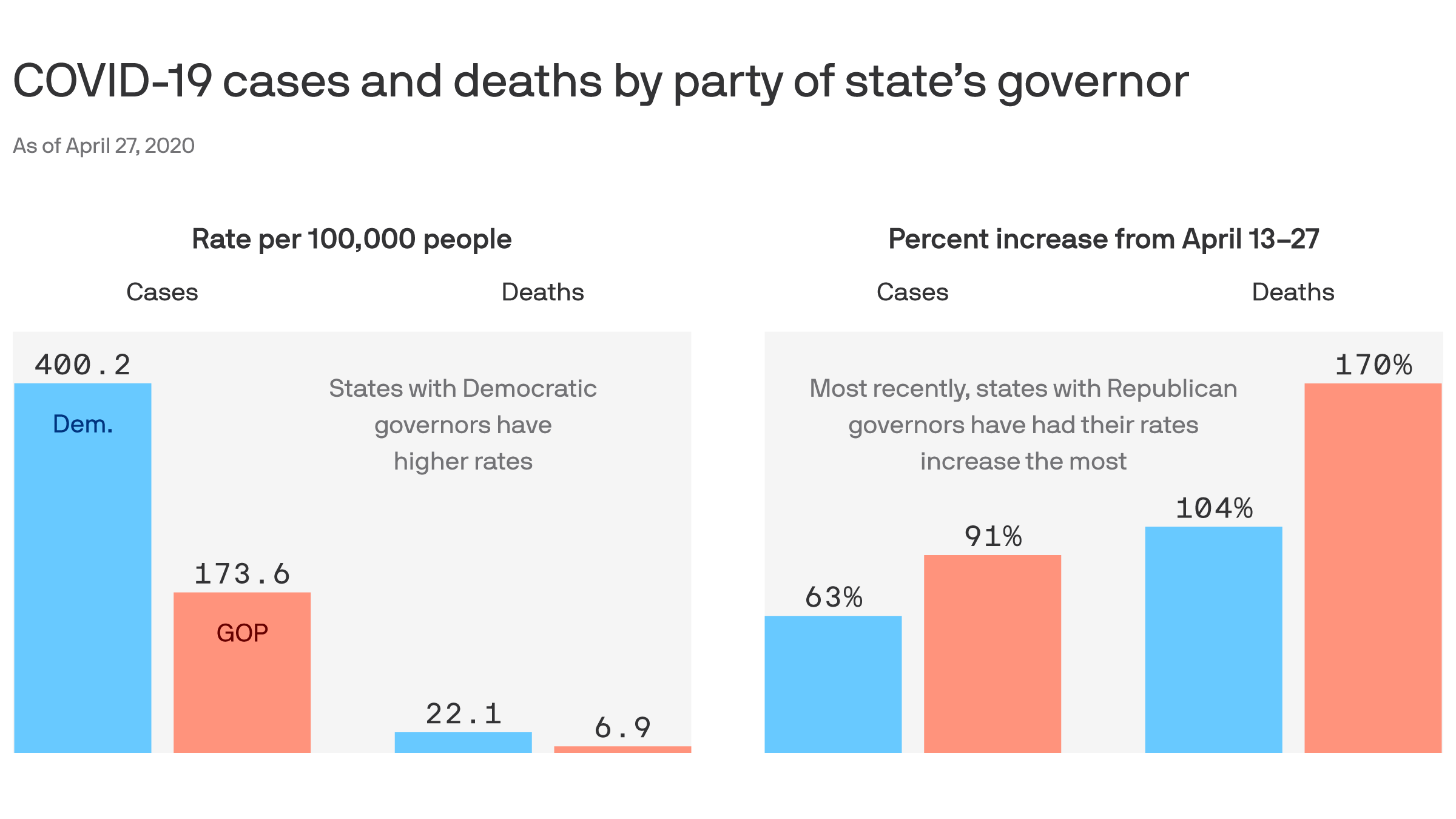
By the numbers: Coronavirus cases and deaths are both higher in Democratic states than in Republican ones, even after adjusting for population.

  • However, over the last two weeks, reported infections have increased 91% in red states versus 63% in blue states.
  • We see the same pattern for COVID-19 deaths: 170% growth in red states vs. 104% in blue states.

Driving the news: Texas has begun easing its lockdown measures, and other red states are also moving quickly. Florida has reopened some beaches, and some southern states in particular never locked down as tightly as the Northeast and West coast.

  • Yes. but: Every governor wants to open up when they can to get the economy going, and there are some Democratic governors who are also taking steps to ease distancing measures.

Between the lines: The core of the Republican base in white, rural areas is at risk.

  • 20% of people living in non-metro areas are older than 65, compared with 15% in metro areas.
  • And rural residents under 65 are more likely to have pre-existing health conditions (26%), compared to their urban counterparts (20%).

The bottom line: Polls show that Republicans are far more likely than Democrats to think that the worst is behind us when it comes to COVID-19.

  • That may be partly because they, and the Republican governors, think this is largely someone else’s problem. It isn’t.


U.S. coronavirus caseload has held steady

https://www.axios.com/newsletters/axios-vitals-5da91be0-bb6c-44a4-8571-d723352e6ef9.html?utm_source=newsletter&utm_medium=email&utm_campaign=newsletter_axiosvitals&stream=top

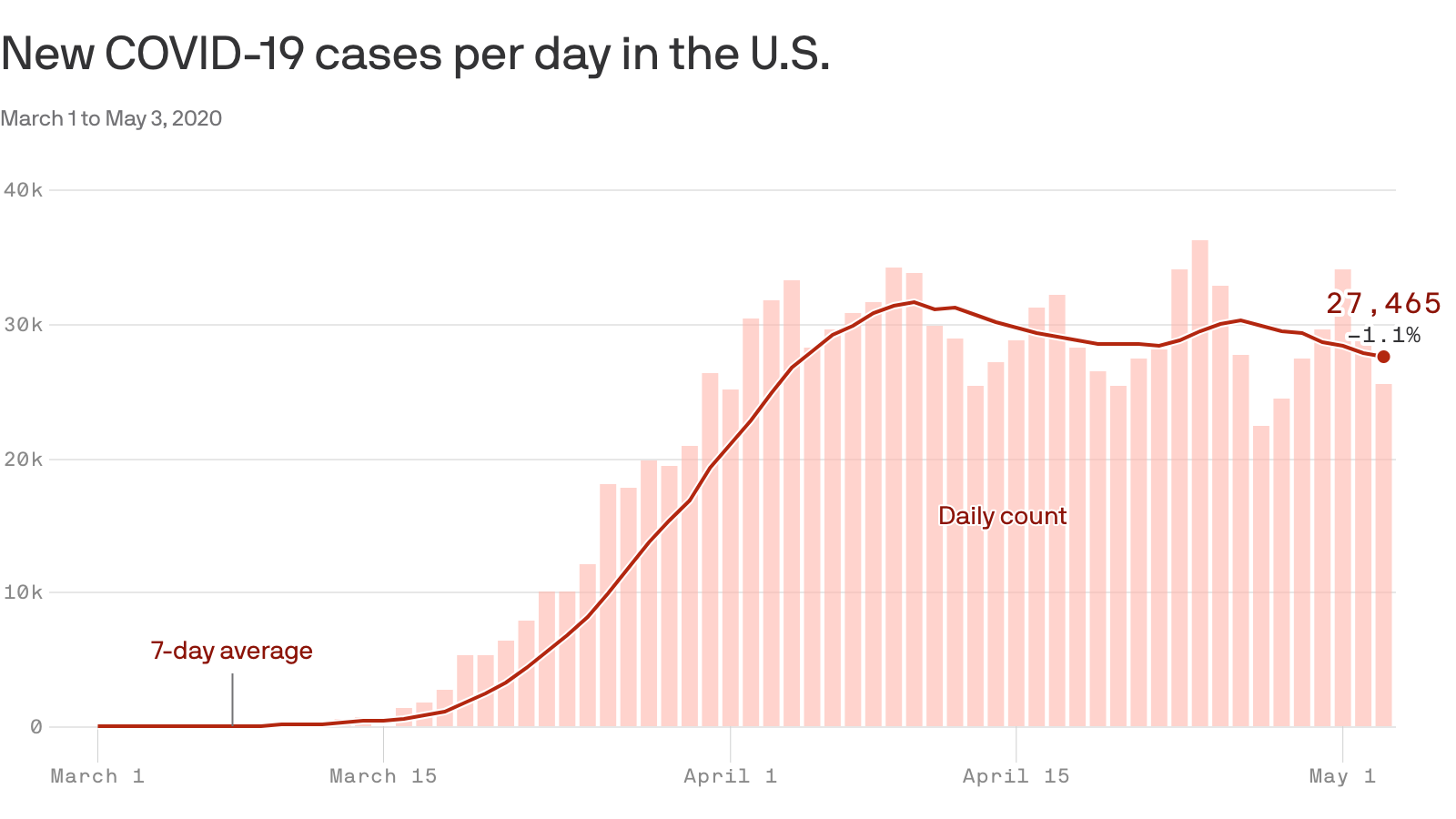
The number of new coronavirus cases in the U.S. has held steady ...

The number of new coronavirus cases nationally hovered around 30,000 a day during the entire month of April, meaning that the virus has managed to spread in spite of stringent social distancing measures.

Why it matters: Many states have already started to lift these measures, which will enable the virus to spread even faster.

Between the lines: Many Americans — like health care workers, grocery workers and emergency personnel — haven’t been able to stay home, as their jobs are considered essential. That’s enabled the virus to spread among these populations.

  • It has also been able to spread among people who live close together, like nursing home residents.

The big picture: The fewer people who have the virus once society reopens, the easier it will be to control. That’s part of why we shut down — the caseload had already outgrown our public health infrastructure’s ability to respond to it.

  • We’ve built up our testing capacity over the last several weeks and are starting to do the same with contact tracing, but these tools can only do so much against exponential spread — even when fully developed, which they’re not yet.
  • Even if we’re able to keep the caseload at current levels, that’s still an enormously challenging reality to live with.

What they’re saying: “Continuing spread at something near current levels may become the cruel ‘new normal.’ Hospitals and public-health systems will have to contend with persistent disease and death,” former FDA commissioner Scott Gottlieb wrote in a Wall Street Journal op-ed yesterday.

The bottom line: April was tough, but as states begin to reopen, we don’t yet know what lies ahead of us.

  • Things could get worse, or today’s status quo could be in place for a long time.
  • What happens will look different from one community to another.


How Long Will a Vaccine Really Take?

Health - Digg

A vaccine would be the ultimate weapon against the coronavirus and the best route back to normal life. Officials like Dr. Anthony S. Fauci, the top infectious disease expert on the Trump administration’s coronavirus task force, estimate a vaccine could arrive in at least 12 to 18 months.

The grim truth behind this rosy forecast is that a vaccine probably won’t arrive any time soon. Clinical trials almost never succeed. We’ve never released a coronavirus vaccine for humans before. Our record for developing an entirely new vaccine is at least four years — more time than the public or the economy can tolerate social-distancing orders.

But if there was any time to fast-track a vaccine, it is now. So Times Opinion asked vaccine experts how we could condense the timeline and get a vaccine in the next few months instead of years.

Here’s how we might achieve the impossible.

Normally, researchers need years to secure funding, get approvals and study results piece by piece. But these are not normal times.

There are already at least 254 therapies and 95 vaccines related to Covid-19 being explored.

“If you want to make that 18-month timeframe, one way to do that is put as many horses in the race as you can,” said Dr. Peter Hotez, dean of the National School of Tropical Medicine at Baylor College of Medicine.

Despite the unprecedented push for a vaccine, researchers caution that less than 10 percent of drugs that enter clinical trials are ever approved by the Food and Drug Administration.

The rest fail in one way or another: They are not effective, don’t perform better than existing drugs or have too many side effects.

Fortunately, we already have a head start on the first phase of vaccine development: research. The outbreaks of SARS and MERS, which are also caused by coronaviruses, spurred lots of research. SARS and SARS-CoV-2, the virus that causes Covid-19, are roughly 80 percent identical, and both use so-called spike proteins to grab onto a specific receptor found on cells in human lungs. This helps explain how scientists developed a test for Covid-19 so quickly.

There’s a cost to moving so quickly, however. The potential Covid-19 vaccines now in the pipeline might be more likely to fail because of the swift march through the research phase, said Robert van Exan, a cell biologist who has worked in the vaccine industry for decades. He predicts we won’t see a vaccine approved until at least 2021 or 2022, and even then, “this is very optimistic and of relatively low probability.”

And yet, he said, this kind of fast-tracking is “worth the try — maybe we will get lucky.”

The next step in the process is pre-clinical and preparation work, where a pilot factory is readied to produce enough vaccine for trials. Researchers relying on groundwork from the SARS and MERS outbreaks could theoretically move through planning steps swiftly.

Sanofi, a French biopharmaceutical company, expects to begin clinical trials late this year for a Covid-19 vaccine that it repurposed from work on a SARS vaccine. If successful, the vaccine could be ready by late 2021.

As a rule, researchers don’t begin jabbing people with experimental vaccines until after rigorous safety checks.

They test the vaccine first on small batches of people — a few dozen during Phase 1, then a few hundred in Phase 2, then thousands in Phase 3. Months normally pass between phases so that researchers can review the findings and get approvals for subsequent phases.

But “if we do it the conventional way, there’s no way we’re going to be reaching that timeline of 18 months,” said Akiko Iwasaki, a professor of immunobiology at Yale University School of Medicine and an investigator at the Howard Hughes Medical Institute.

There are ways to slash time off this process by combining several phases and testing vaccines on more people without as much waiting.

Last week the National Academy of Sciences showed an overlapping timeline, describing it as moving at “pandemic speed.”

It’s here that talk of fast-tracking the timeline meets the messiness of real life: What if a promising vaccine actually makes it easier to catch the virus, or makes the disease worse after someone’s infected?

That’s been the case for a few H.I.V. drugs and vaccines for dengue fever, because of a process called vaccine-induced enhancement, in which the body reacts unexpectedly and makes the disease more dangerous.

Researchers can’t easily infect vaccinated participants with the coronavirus to see how the body behaves. They normally wait until some volunteers contract the virus naturally. That means dosing people in regions hit hardest by the virus, like New York, or vaccinating family members of an infected person to see if they get the virus next. If the pandemic subsides, this step could be slowed.

“That’s why vaccines take such a long time,” said Dr. Iwasaki. “But we’re making everything very short. Hopefully we can evaluate these risks as they occur, as soon as possible.”

This is where the vaccine timelines start to diverge depending on who you are, and where some people might get left behind.

If a vaccine proves successful in early trials, regulators could issue an emergency-use provision so that doctors, nurses and other essential workers could get vaccinated right away — even before the end of the year. Researchers at Oxford announced this week that their coronavirus vaccine could be ready for emergency use by September if trials prove successful.

So researchers might produce a viable vaccine in just 12 to 18 months, but that doesn’t mean you’re going to get it. Millions of people could be in line before you. And that’s only if the United States finds a vaccine first. If another country, like China, beats us to it, we could wait even longer while it doses its citizens first.

You might be glad of that, though, if it turned out that the fast-tracked vaccine caused unexpected problems. Only after hundreds or thousands are vaccinated would researchers be able to see if a fast-tracked vaccine led to problems like vaccine-induced enhancement.

“It’s true that any new technology comes with a learning curve,” said Dr. Paul Offit, the director of the Vaccine Education Center at the Children’s Hospital of Philadelphia. “And sometimes that learning curve has a human price.”

Once we have a working vaccine in hand, companies will need to start producing millions — perhaps billions — of doses, in addition to the millions of vaccine doses that are already made each year for mumps, measles and other illnesses. It’s an undertaking almost unimaginable in scope.

Companies normally build new facilities perfectly tailored to any given vaccine because each vaccine requires different equipment. Some flu vaccines are produced using chicken eggs, using large facilities where a version of the virus is incubated and harvested. Other vaccines require vats in which a virus is cultured in a broth of animal cells and later inactivated and purified.

Those factories follow strict guidelines governing biological facilities and usually take around five years to build, costing at least three times more than conventional pharmaceutical factories. Manufacturers may be able to speed this up by creating or repurposing existing facilities in the middle of clinical trials, long before the vaccine in question receives F.D.A. approval.

“They just can’t wait,” said Dr. Iwasaki. “If it turns out to be a terrible vaccine, they won’t distribute it. But at least they’ll have the capability” to do so if the vaccine is successful.

The Bill and Melinda Gates Foundation says it will build factories for seven different vaccines. “Even though we’ll end up picking at most two of them, we’re going to fund factories for all seven, just so that we don’t waste time,” Bill Gates said during an appearance on “The Daily Show.”

In the end, the United States will have the capacity to mass-produce only two or three vaccines, said Vijay Samant, the former head of vaccine manufacturing at Merck.

“The manufacturing task is insurmountable,” Mr. Samant said. “I get sleepless nights thinking about it.”

Consider just one seemingly simple step: putting the vaccine into vials. Manufacturers need to procure billions of vials, and billions of stoppers to seal them. Sophisticated machines are needed to fill them precisely, and each vial is inspected on a high-speed line. Then vials are stored, shipped and released to the public using a chain of temperature-controlled facilities and trucks. At each of these stages, producers are already stretched to meet existing demands, Mr. Samant said.

It’s a bottleneck similar to the one that caused a dearth of ventilators, masks and other personal protective equipment just as Covid-19 surged across America.

If you talk about vaccines long enough, a new type of vaccine, called Messenger RNA (or mRNA for short), inevitably comes up. There are hopes it could be manufactured at a record clip. Mr. Gates even included it on his Time magazine list of six innovations that could change the world. Is it the miracle we’re waiting for?

Rather than injecting subjects with disease-specific antigens to stimulate antibody production, mRNA vaccines give the body instructions to create those antigens itself. Because mRNA vaccines don’t need to be cultured in large quantities and then purified, they are much faster to produce. They could change the course of the fight against Covid-19.

“On the other hand,” said Dr. van Exan, “no one has ever made an RNA vaccine for humans.”

Researchers conducting dozens of trials hope to change that, including one by the pharmaceutical company Moderna. Backed by investor capital and spurred by federal funding of up to $483 million to tackle Covid-19, Moderna has already fast-tracked an mRNA vaccine. It’s entering Phase 1 trials this year and the company says it could have a vaccine ready for front-line workers later this year.

“Could it work? Yeah, it could work,” said Dr. Fred Ledley, a professor of natural biology and applied sciences at Bentley University. “But in terms of the probability of success, what our data says is that there’s a lower chance of approval and the trials take longer.”

The technology is decades old, yet mRNA is not very stable and can break down inside the body.

“At this point, I’m hoping for anything to work,” said Dr. Iwasaki. “If it does work, wonderful, that’s great. We just don’t know.”

The fixation on mRNA shows the allure of new and untested treatments during a medical crisis. Faced with the unsatisfying reality that our standard arsenal takes years to progress, the mRNA vaccine offers an enticing story mixed with hope and a hint of mystery. But it’s riskier than other established approaches.

Imagine that the fateful day arrives. Scientists have created a successful vaccine. They’ve manufactured huge quantities of it. People are dying. The economy is crumbling. It’s time to start injecting people.

But first, the federal government wants to take a peek.

That might seem like a bureaucratic nightmare, a rubber stamp that could cost lives. There’s even a common gripe among researchers: For every scientist employed by the F.D.A., there are three lawyers. And all they care about is liability.

Yet F.D.A. approvals are no mere formality. Approvals typically take a full year, during which time scientists and advisory committees review the studies to make sure that the vaccine is as safe and effective as drug makers say it is.

While some steps in the vaccine timeline can be fast-tracked or skipped entirely, approvals aren’t one of them. There are horror stories from the past where vaccines were not properly tested. In the 1950s, for example, a poorly produced batch of a polio vaccine was approved in a few hours. It contained a version of the virus that wasn’t quite dead, so patients who got it actually contracted polio. Several children died.

The same scenario playing out today could be devastating for Covid-19, with the anti-vaccination movement and online conspiracy theorists eager to disrupt the public health response. So while the F.D.A. might do this as fast as possible, expect months to pass before any vaccine gets a green light for mass public use.

At this point you might be asking: Why are all these research teams announcing such optimistic forecasts when so many experts are skeptical about even an 18-month timeline? Perhaps because it’s not just the public listening — it’s investors, too.

“These biotechs are putting out all these press announcements,” said Dr. Hotez. “You just need to recognize they’re writing this for their shareholders, not for the purposes of public health.”

What if It Takes Even Longer Than the Pessimists Predict?

Covid-19 lives in the shadow of the most vexing virus we’ve ever faced: H.I.V. After nearly 40 years of work, here is what we have to show for our vaccine efforts: a few Phase 3 clinical trials, one of which actually made the disease worse, and another with a success rate of just 30 percent.

Researchers say they don’t expect a successful H.I.V. vaccine until 2030 or later, putting the timeline at around 50 years.

That’s unlikely to be the case for Covid-19, because, as opposed to H.I.V., it doesn’t appear to mutate significantly and exists within a family of familiar respiratory viruses. Even still, any delay will be difficult to bear.

But the history of H.I.V. offers a glimmer of hope for how life could continue even without a vaccine. Researchers developed a litany of antiviral drugs that lowered the death rate and improved health outcomes for people living with AIDS. Today’s drugs can lower the viral load in an H.I.V.-positive person so the virus can’t be transmitted through sex.

Therapeutic drugs, rather than vaccines, might likewise change the fight against Covid-19. The World Health Organization began a global search for drugs to treat Covid-19 patients in March. If successful, those drugs could lower the number of hospital admissions and help people recover faster from home while narrowing the infection window so fewer people catch the virus.

Combine that with rigorous testing and contact tracing — where infected patients are identified and their recent contacts notified and quarantined — and the future starts looking a little brighter. So far, the United States is conducting fewer than half the number of tests required and we need to recruit more than 300,000 contact-tracers. But other countries have started reopening following exactly these steps.

If all those things come together, life might return to normal long before a vaccine is ready to shoot into your arm.


The audacity of those comparing ‘open up’ protesters to Rosa Parks

https://www.washingtonpost.com/politics/2020/05/01/problems-with-holding-up-open-up-protesters-legacy-rosa-parks/?fbclid=IwAR0Ve3Ezq3qEmOAYJ9WDH1NETrIv13pgmObPlNxmfKpaQXaZX36fjUE8vw0&utm_campaign=wp_main&utm_medium=social&utm_source=facebook

Civil Rights Movement Timeline From 1951 to 1959

President Trump has a couple of times now encouraged or praised the Americans protesting government-issued stay-at-home orders and other recommendations from medical experts in a tone that is quite different from how he talks about protesters who aren’t aligned with him politically.

The response to the movement by some conservatives suggests that they are willing to wield the legacies of civil rights icons when it benefits them politically while blasting Americans whose activism actually aligns more closely with the work of those historical figures.

After demonstrators filled the streets near the several state capitols last month demanding that their political leaders reopen the states, Trump was asked his view on the protesters, many of whom were photographed carrying Make America Great Again signs. He appeared to embrace them: “They seem to be protesters that like me.”

“These are people expressing their views,” he also told reporters on April 17. “I see where they are, and I see the way they’re working. They seem to be very responsible people to me, but they’ve been treated a little bit rough.”

Shortly after, he took to Twitter and seemed to affirm their protests by calling for these states’ liberation.

Other Trump allies have compared protesters to civil rights activists protesting racism — despite some of them carrying Confederate flags and flags with swastikas.

Stephen Moore, a member of the White House council to reopen the country, praised those taking to the streets.

“I call these people the modern-day Rosa Parks — they are protesting against injustice and a loss of liberties,” he told The Washington Post earlier this month.

Trump was asked about Moore’s words the following day at a White House news briefing. “Yeah, I can see where he’s coming from. Strong statement. Strong statement,” Trump said.

And GOP-endorsed Houston City Council member Michael Kubosh invoked Parks as he violated a stay-at-home order this past weekend in a restaurant.

“Sometimes civil disobedience is required to move things forward, and so that’s why we remember Rosa Parks,” he told Houston’s NBC affiliate.

Conservative radio host Dennis Prager, who has questioned the constitutionality of the government advising Americans to stay at home, also invoked Parks while discussing his plans to rebut some recommendations from the Centers for Disease Control and Prevention to slow the spread of the coronavirus.

“Civil disobedience in the United States has a very, very, very noble history,” he said Thursday. “Rosa Parks wouldn’t sit in the back of the bus because the disgusting law of blacks had to sit in the back of the bus in some Southern cities in the United States. Should she have obeyed the law?”

Parks protested discrimination by refusing to give up her seat on a bus in Montgomery, Ala. Her defiant act is largely viewed as the beginning of the civil rights movement. But when it comes to modern-day protests about racial injustice, Trump and his allies often respond harshly.

After NFL players grabbed headlines for regularly taking a knee during the national anthem to protest racism and police brutality, Trump said they should be fired. At a September 2017 rally in Huntsville, Ala., the president said: “Wouldn’t you love to see one of these NFL owners, when someone disrespects our flag, to say: ‘Get that son of a bitch off the field right now. Out. He’s fired. He’s fired.’ ”

Moore, who served as an economic adviser to Trump, also criticized these athletes’ protests, calling them “shameful and unpatriotic antics.” And Prager called them “divisive.”

And when Black Lives Matter activists interrupted a Bernie Sanders rally in August 2015, Trump suggested that he might respond violently to protesters doing the same to him.

“That will never happen with me,” he told reporters. “I don’t know if I’ll do the fighting myself or if other people will, but that was a disgrace. I felt badly for him. But it showed that he’s weak.”

And multiple personalities on Fox News have praised the “open up” protesters, comparing them to disadvantaged groups around the world.

Yet the same network has regularly showed its most prominent voices criticizing Americans protesting historically marginalized groups.

In June 2018, Fox host Laura Ingraham said athletes critical of Trump and his attacks on athletes protesting racism were “bratty”:

It’s not about bowing down to the president. He doesn’t want you to disrespect the country, the flag, the anthem, which is what these bratty players are doing, using the excuse of Black Lives Matter or some other issue that they probably haven’t even read up on. They just repeat whatever Colin Kaepernick says on any given day. And they think they’re a member of a cool club by doing this. It’s ridiculous.

The inconsistency in approach to these protesters is sparking frustration with many black Americans, a demographic that overwhelmingly disapproves of Trump but that his campaign is hoping to make some gains with in 2020. To many black Americans, Parks is an icon whose act was a pivotal step in helping eradicate American laws that made treating black people as second-class citizens legal. Whatever issues Americans have with government leaders mandating that people stay home, it is quite a stretch to compare those orders to the state-sanctioned racism that Parks was combating.


Fauci warns states rushing to reopen: ‘You’re making a really significant risk’

https://www.washingtonpost.com/nation/2020/05/01/fauci-open-states-coronavirus/?fbclid=IwAR2zliMTNSIDC3ldCr7P3x4owkyZfqVKSJGj0M2pzYOH7XakQw6ztNAXcsI&utm_campaign=wp_main&utm_medium=social&utm_source=facebook

Fauci warns states rushing to reopen amid coronavirus pandemic ...

With the White House’s social distancing guidelines expiring Thursday, leaving states largely in charge of deciding how to move forward, Anthony S. Fauci warned local leaders to avoid “leapfrogging” critical milestones in an effort to reopen their economies amid the ongoing coronavirus pandemic.

“Obviously you could get away with that, but you’re making a really significant risk,” Fauci, director of the National Institute of Allergy and Infectious Diseases, said Thursday evening on CNN.

Fauci, who has repeatedly cautioned against prematurely easing restrictions, said he already noticed that some states and cities are not adhering to the steps laid out in the White House’s recently issued guidance on reopening — a plan that administration officials say will now replace the expired federal social distancing measures.

“If you follow the guidelines, there’s a continuity that’s safe, that’s prudent and that’s careful,” he said.

But if governors rush to reopen when they aren’t ready, Fauci cautioned that the move would likely only set back the progress their states have made.

“There’s no doubt in my mind that when you pull back mitigation, you’re going to start seeing cases crop up here and there,” he said. “If you’re not able to handle them, you’re going to see another peak, a spike, and then you almost have to turn the clock back to go back to mitigation.”

Fauci’s comments come as dozens of states have unveiled plans to begin easing stay-at-home orders, with some changes already taking effect despite the number of coronavirus cases and related deaths continuing to rise nationwide. Georgia Gov. Brian Kemp (R), for example, weathered intense criticism, including from President Trump, after announcing that he would lift restrictions on a wide array of businesses, allowing them to open a week ago.

The patchwork effort to return to some semblance of normalcy coupled with the absence of stringent social distancing recommendations has left health experts worried, The Washington Post’s Yasmeen Abutaleb and Rachel Weiner reported. Attempts to reopen states too soon at a time when social distancing remains the most effective way to stem the spread of the virus could increase the risk of new outbreaks, experts say. According to most recent figures, the United States has more than 1 million cases of the coronavirus and nearly 63,000 deaths.

On Thursday, Fauci appeared to echo those concerns, but stressed that major problems could be avoided so long as states adhere to the federal government’s reopening guidelines, which he described as “very well thought out and very well delineated.”

“I keep trying to articulate to the public and to the leaders, ‘Take a look at the guidelines,’ ” Fauci said on CNN. “They don’t tell you because you’ve reached the end of the 30-day mitigation period that, all of a sudden, you switch a light on and you just go for it. That’s not the way to do it. Each state, each city, each region is going to be a little different.”

Citing the guidelines, Fauci reiterated that states need to report a steady decrease in coronavirus cases within a 14-day period in addition to meeting other requirements before even thinking about moving on to the first phase of reopening.

“The discretion is given to the governors, they know their states. The mayors know their cities, so you want to give them a little wiggle room,” he said. “But my recommendation is don’t wiggle too much.”

While Fauci acknowledged that some local leaders are following the guidance, he said “others are taking a bit of a chance.”

“I hope they can actually handle any rebound that they see,” he added.

Later in the segment, Fauci was asked by CNN’s chief medical correspondent Sanjay Gupta about whether the rise in cases in states that are reopening would be incremental or exponential. In response, Fauci said that though he doesn’t know for sure, he doubted that any area would see “something as explosive as we saw in New York.” New York, which has yet to lift restrictions, is the epicenter of the U.S. outbreak with more than 300,000 confirmed cases and roughly 23,600 deaths.

But he warned that states could really find themselves in trouble if infections managed to “spill over into the general community,” similar to the way the virus spread in New York.

“If you can’t stop that from happening, then I think you’re really going to see the sharp peak,” Fauci said. “That is going to be very disturbing when that happens because it’s really going to take a while to get it back down.”


Why summer likely won’t save us from the coronavirus

https://www.vox.com/2020/4/29/21231906/coronavirus-pandemic-summer-weather-heat-humidity-uv-light

Summer weather could help slow the coronavirus. But it’s likely not enough.

Some Americans are hoping for a natural reprieve to social distancing as the coronavirus pandemic drags on: that sunnier, warmer, and more humid weather in the summer will destroy the Covid-19 virus — as it does with other viruses, like the flu — and let everyone go back to normal.

There is some evidence that heat, humidity, and ultraviolet light could hurt the coronavirus — an idea that President Donald Trump bizarrely leaned into when he suggested the use of “ultraviolet or just very powerful light … inside the body” to treat people sickened by Covid-19 (an idea with no scientific merit, as experts have repeatedly stated).

But even if heat, humidity, and light help slow the virus’s spread, sunny, hot, and humid weather alone won’t be enough to end the epidemic. Experts point to the examples of SingaporeEcuador, and Louisiana, all of which have recently had growing numbers of Covid-19 cases despite temperatures hitting 80-plus degrees Fahrenheit and humidity levels reaching more than 60, 70, or even 80 percent.

High levels of heat, UV light, and humidity can help prevent more widespread infections of the flu or colds in the summer, along with medical treatments and vaccines (when available). But the Covid-19 coronavirus is still new to humans, so we don’t have as much immune protection built up against it — so the virus seems able to overcome summer-like weather and still cause big outbreaks.

“For the novel coronavirus SARS-CoV-2, we have reason to expect that like other betacoronaviruses, it may transmit somewhat more efficiently in winter than summer, though we don’t know the mechanism(s) responsible,” Marc Lipsitch, an epidemiologist at Harvard, wrote. “The size of the change is expected to be modest, and not enough to stop transmission on its own.”

Still, the studies on heat, light, and humidity, plus the fact coronavirus has a harder time spreading in open-air areas, suggest that the outdoors may be a safe target for a slow reopening as transmission of the virus slows, as long as precautions like physical distancing and mask-wearing are followed. So outdoor activities could offer a respite to lockdowns and quarantines — one that’s also, potentially, good for physical and mental health.

It also means that if Covid-19 becomes endemic (a disease that regularly comes back, like the flu or common cold), then heat, sunlight, and humidity could restrict bigger outbreaks to fall and winter. But that possibility is likely still years away, experts say.

So summer weather may make the outdoors a little safer, but it won’t be enough to quash coronavirus on its own. That means we’ll likely need to continue social distancing to some degree in the coming months, and continue working on getting more testing, aggressive contact tracing, and medical treatments up to scale before places can safely reopen their economies.

Hotter, more humid weather does seem to hurt the coronavirus

There are a few ways that summer weather could have an effect on SARS-CoV-2. Higher temperatures can help weaken the novel coronavirus’s outer lipid layer, similar to how fat melts in greater heat. Humidity in the air can effectively catch virus-containing droplets that people breathe out, causing these droplets to fall to the ground instead of reaching another human host — making humidity a shield against infection. UV light, which there’s a lot more of during sunny summer days, is a well-known disinfectant that effectively fries cells and viruses.

“There are multiple coronaviruses out there that affect our population, and many of them, if not most of them, exhibit a seasonal influence,” Mauricio Santillana, the director of the Machine Intelligence Lab at Boston Children’s Hospital and a researcher on the effects of the weather on coronavirus, told me. “The hypothesis postulated for Covid-19 is that it will have a similar behavior.”

But that’s hypothetical. How does it play out in reality?

So far, the coronavirus has largely spread in the Northern Hemisphere, where it’s been winter and early spring. It’s not clear if the weather is a reason for that, because data on its spread in the Southern Hemisphere — particularly poorer countries in Africa and South America — is largely lacking due to weak public health infrastructure.

Still, we have some evidence. The National Academies of Sciences, Engineering, and Medicine — one of America’s top scientific evidence reviewers — summarized the research earlier in April. It looked at two kinds of studies: those that tested the effects of summer-like temperatures in a laboratory, and those that attempted to tease out the effects of heat, UV light, and humidity in the real world.

In the lab, researchers use sophisticated tools to see how the virus fares in different conditions. Generally, they’ve found more heat, UV light, and humidity seem to weaken the coronavirus — although one preliminary study suggested that coronavirus may fare better in the more summer-like conditions than the flu, SARS, and monkeypox viruses.

This is the kind of study Bill Bryan, the undersecretary for science and technology at the Department of Homeland Security, presented at the April 23 White House press briefing. That study found that coronavirus seemed to die off much more quickly in hotter, more humid environments with a lot of UV light.

As the National Academies noted, however, this evidence comes with big caveats. Perhaps most importantly, these studies haven’t yet been peer reviewed. So they could have big methodological errors that we just don’t know about yet. (This Wired article does a good job breaking down the concerns with such early research.)

But even if these studies are well-conducted, the real world is simply a lot messier than a laboratory setting. For example, the lab-grown virus used in these studies may act at least somewhat differently than the natural virus in the real world.

People can also act differently in summer than they do in winter, and the lab studies don’t account for how those behaviors affect coronavirus’s spread. People are more likely to stay indoors during the winter to avoid the cold — but indoor spaces are generally more poorly ventilated and cramped, both of which make it easier for the coronavirus to spread. Warmth and sunshine also could impact the immune system, though that relationship is still unclear.

We’ll get more evidence on real-life seasonal effects as the months go by — especially if more places take potentially dangerous risks. “In Georgia, where they are opening back up without really any concrete measures to encourage distancing, we might be able to better evaluate how [the coronavirus] spreads in the summer months,” Angela Rasmussen, a virologist at Columbia, told me.

But there is some early real-world research already, which the National Academies also reviewed. These studies looked at whether the SARS-CoV-2 virus was affected by different climates in real-world settings, and if it spread more easily in places where it was colder and less humid and there was less UV light. Some researchers also developed models based on data from different outbreaks in different parts of the world.

One upcoming study from a group of researchers at the University of Nebraska Medical Center tried to model the effects of heat, humidity, and UV light, finding that they mitigated the spread of the virus. UV light seemed to play a bigger role, although the researchers cautioned that their findings will need to be replicated and verified with, ideally, years of data. “This is a very new virus, and there are lots of things we don’t know about it,” Azar Abadi, one of the researchers, told me.

But this aligns with the evidence that the National Academies reviewed.

“There is some evidence to suggest that SARS-CoV-2 may transmit less efficiently in environments with higher ambient temperature and humidity,” Harvey Fineberg, author of the National Academies report, wrote. “[H]owever, given the lack of host immunity globally, this reduction in transmission efficiency may not lead to a significant reduction in disease spread without the concomitant adoption of major public health interventions.”

Heat and humidity won’t be enough to beat the pandemic — far from it

This is the point experts emphasized again and again: It’s one thing for the weather to have some sort of effect on coronavirus; it’s another thing for that effect to be enough to actually halt the virus’s widespread transmission. We have early evidence the weather has an effect, but we also have early evidence that it won’t be enough.

The problem: Other factors, besides the weather, play a role in the spread of diseases. In the case of coronavirus, these other factors seem to play a much bigger role than weather.

The mayor of Guayaquil, Ecuador, where it’s regularly 80-plus degrees Fahrenheit, described her city’s experience with Covid-19 “like the horror of war” and “an unexpected bomb falling on a peaceful town.” Ecuador now has one of the worst coronavirus death tolls in the world — a sign that warm, sunny, and humid weather can’t make up for struggling public health infrastructure in a still-developing country.

Singapore, which is nearly on the equator, managed to contain coronavirus at first, but it has seen a growing outbreak recently. The problem, it seems, is the government neglected migrant workers in its initial response — letting Covid-19 spread in the cramped and sometimes unsanitary conditions many migrants live in. Warm, humid weather alone wasn’t enough to overcome preexisting issues and an overly narrow public policy response.

Meanwhile, Louisiana is suffering a significant coronavirus outbreak, with the fifth-most deaths per 100,000 people out of all the states. According to experts, Mardi Gras — held on February 25 — may have accelerated that. The massive celebration seemed to cause a lot of transmission, even as New Orleans saw temperatures up to the 70s, and cases continued to climb even as temperatures reached the 80s. Maybe the weather made things better than they would be otherwise, but it was, again, no match for human behavior’s effects on the spread of Covid-19.

The bigger problem is too many people in the US are still vulnerable to the virus. “While we see some influence [of the weather], the effect that we’re seeing — if there’s any effect — is eclipsed by the high levels of susceptibility in the population,” Santillana said. “Most people are still highly susceptible. So even if temperature or humidity could play a role, there’s not enough immunity.”

That made it extremely easy for the virus to spread, regardless of the weather, especially since SARS-CoV-2 appears to be so contagious relative to other pathogens. In contrast, if you think about the viruses that are more affected by the seasons — the flu and colds — humans have been dealing with them for hundreds if not thousands of years. That’s let us build some population-level protection that we just don’t have for Covid-19, making other factors besides our actions, like the weather, a bit more important for the seasonal viruses.

So down the line, if Covid-19 becomes endemic — a possibility if, for example, immunity to it isn’t as permanent as we’d like — it’s possible that seasons will have a much stronger sway over when it pops up again.

Even then, it’s worth acknowledging that seasons don’t fully determine when the flu and colds hit. As the National Academies pointed out, some flu pandemics have started in the summer: “There have been 10 influenza pandemics in the past 250-plus years — two started in the northern hemisphere winter, three in the spring, two in the summer and three in the fall.”

In fact, some of this research could be taken to mean that coronavirus will be even more dangerous eventually: If the colder, dryer weather this fall and winter empowers the virus, that could lead to a bigger outbreak. The National Academies noted, as an example, that a second spike is typical for flu pandemics: “All had a peak second wave approximately six months after emergence of the virus in the human population, regardless of when the initial introduction occurred.”

But, as is true in the reverse, other factors besides the weather likely play a bigger role in the spread. So if governments and the public do the right thing through the fall and winter, there’s still a good chance that there won’t be a big spike.

Americans will likely be social distancing through the summer

The upshot of all of this: The changing weather likely won’t be enough on its own to relax social distancing. Given that there’s still a lot about Covid-19 we still need to learn, experts don’t know this for certain. But it’s what they suspect, based on the data that we’ve seen in the research and real world so far.

“If the only concern is the health of people, it’s irresponsible to go back to relaxing social distancing anytime soon,” Santillana said. “We’re not done, even if summer starts.”

So as the plans to end social distancing indicate, the world will likely need at least some level of social distancing until a vaccine or a similarly effective medical treatment is developed, which is possibly a year or more away. That may not require the full lockdown that several states are seeing today, but it will mean restrictions on larger gatherings and some travel, while perhaps continuing remote learning and work.

Weather could help determine how safe it is to go outside, even as social distancing continues. Some states, for example, are considering opening parks and beaches during the earlier phases of reopening their economies. Experts warn that summer weather won’t allow large gatherings — 50 people or more is often cited as way too many — but it could give people some assurance that they can go outdoors as long as they keep 6 feet or more of distance from others they don’t live with, avoid touching surfaces and their faces, and wear masks.

Otherwise, however, how much social distancing will be relaxed in the coming months won’t come down to the weather but likely how much the US improves its testing and surveillance capacity. Testing gives officials the means to isolate sick people, track and quarantine the people whom those verified to be sick came into close contact with (a.k.a. contact tracing), and deploy community-wide efforts if a new cluster of cases is too large and uncontrolled otherwise.

While the US has seen some gains in testing, the number of new tests a day still fall below estimates of what’s needed (500,000 on the low end and tens of millions on the high end) to safely ease social distancing.

Along with testing, America will need aggressive contact tracing, as countries like South Korea and Germany have done, to control its outbreak.report from the Johns Hopkins Center for Health Security and Association of State and Territorial Health estimated the US will need to hire 100,000 contact tracers — far above what states and federal officials have so far said they’re hiring. A phone app could help mitigate the need for quite as many tracers, but it’s unclear if Americans have the appetite for an app that will effectively track their every move.

These are, really, the things everyone has been hearing about the entire time during this pandemic. It’s just worth emphasizing that the summer weather likely won’t be enough on its own to mitigate the need for these other public health strategies.

“The best-case scenario is if we’re doing that [social distancing] and there’s a dampening [in the summer], maybe there is a possibility of limiting this virus here in the United States and other places,” Jesse Bell, one of the University of Nebraska Medical Center researchers, told me. “But then again we just don’t know.”

So we’re very likely going to need social distancing, testing, and contact tracing for the foreseeable future, regardless of how warm, sunny, and humid it is outside.


Why Gilead’s coronavirus drug is not a “silver bullet”

https://www.axios.com/newsletters/axios-vitals-d589549c-1967-44b1-af0b-528fb345c48b.html?utm_source=newsletter&utm_medium=email&utm_campaign=newsletter_axiosvitals&stream=top

Why Gilead's coronavirus drug is not a "silver bullet" - Axios

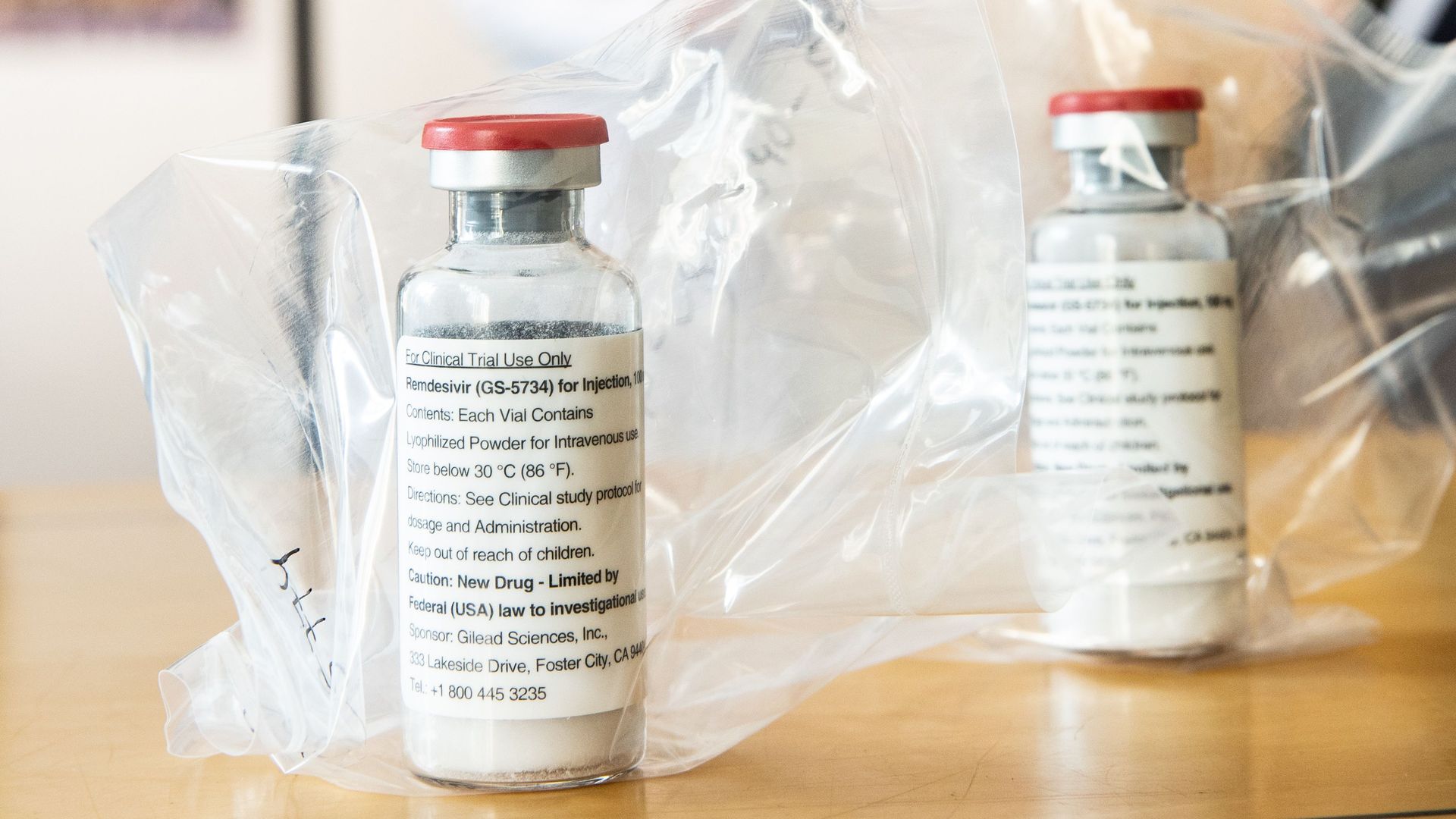
If you feel like you’re suffering whiplash from the new, conflicting study data on Gilead Sciences’ experimental coronavirus drug, remdesivir, you’re not alone.

The big picture: Remdesivir could provide some help and lay the groundwork for more research, but this drug on its own does not appear to be any kind of “cure” for the novel coronavirus, Axios’ Bob Herman reports.

What’s happening: Remdesivir helped coronavirus patients get out of the hospital modestly quicker, based on early reads of an important and rigorously designed trial run by the National Institutes of Health,

  • That could be encouraging for those who get sick.

Yes, but: Analysts and experts were cautious about drawing too many conclusions without the full data from NIH — especially considering the primary outcome was changed mid-trial, and a separate randomized trial concluded remdesivir does little, if anything, to combat the virus.

  • “Remdesivir is a real drug for COVID … but again, not a silver bullet,” Umer Raffat, a pharmaceutical analyst at Evercore ISI, wrote to investors on Wednesday.
  • And because the drug has limited efficacy and likely works best before the infection gets too serious, “its availability is not going to move the needle on social distancing relaxation,” tweeted Peter Bach, a physician and drug researcher at Memorial Sloan Kettering.

The bottom line: This near-constant back-and-forth over remdesivir reinforces how strong the science and data need to be for any treatment, or for the world’s best hope: a vaccine.


Crisis begins to hit professional and public-sector jobs once considered safe

https://www.washingtonpost.com/business/2020/04/30/jobless-claims-industry/?utm_campaign=wp_post_most&utm_medium=email&utm_source=newsletter&wpisrc=nl_most

How COVID-19 Is Crashing On The Class Of 2020: Job Offers Already ...

As the novel coronavirus pandemic brought business to a halt, the pain rippled outward, blowing up sector after sector. According to a detailed analysis of unemployment claims, no industry was left untouched.

After that first chaotic week of lockdowns mid-March, as officials scrambled to slow the spread of the deadliest pandemic in more than a century, restaurants and theaters saw job losses slow while losses in other sectors, such as construction and supply-chain work, accelerated. Now, it appears the economic upheaval is hitting professional and public-sector jobs that some once regarded as safe.

The Labor Department doesn’t release jobless claims by industry. So, building on the work of economist Ben Zipperer and his colleagues at the Economic Policy Institute, we analyzed industry-specific new unemployment-benefit claims from 14 states that publish them. (For a full list, see the charts below.)

For that, we need to focus in on the weekly changes in jobless claims to distinguish between industries where claims are falling and those where claims are steady or increasing. The data can also help us estimate how the labor market will change in coming months.

Week 1, March 15 to 21: Full-contact industries

(Highest week-to-week change included: accommodation and food services; arts entertainment and recreation; hairdressers, auto mechanics and laundry workers)

The first week of closures slammed headfirst into industries that require the most face-to-face customer contact — America’s hospitality sector. More than 7 percent of all restaurant, hotel and bar workers filed for unemployment in this first week alone.

For public officials looking to enforce social distancing, bars, hotels and movie theaters were obvious targets: They’re discretionary spending and require significant human interaction. Another category, which the government calls “other services” but is primarily made up of hairdressers, auto mechanics and laundry workers, also suffered swift and significant losses.

The number of newly unemployed filers in all these high-contact industries fell off in subsequent weeks, but they remain the biggest casualties of the crisis. And unemployment claims probably understate the pain of lower-earning Americans. Low-wage workers often don’t qualify for benefits because they haven’t spent enough time on the job, or aren’t being paid enough, Zipperer said.

A survey released Tuesday by Zipperer and his colleague Elise Gould implies unemployment numbers may be significantly worse than government statistics show. For every 10 people who successfully applied for unemployment benefits during the crisis, they show, another three or four couldn’t get through the overloaded system, and two more didn’t even apply because the system is too difficult.

Week 2, March 22 to 28: The producers

(Highest week-to-week change included: manufacturing; construction; retail)

By the second week, the shutdown moved from businesses where the primary danger is interacting with customers to those, like construction and manufacturing, that require in-person interaction with large crews of colleagues.

On March 26, for example, Spokane, Wash.-area custom-cabinet maker Huntwood Industries, laid off around 500 employees, according to Thomas Clouse of the Spokesman-Review. As a manufacturer whose sales depend on the construction industry, it was hit doubly hard by the shutdowns.

“It is a scary time,” Amy Ohms, 37, told Clouse. “It’s kind of unfair. I think construction is essential. There is a lot of uncertainty.”

Manufacturers were among the first publicly traded companies to note travel and supply-chain risks related to the coronavirus outbreak in China in financial filings, according to a separate analysis by Oxford researchers Fabian Stephany and Fabian Braesemann and collaborators in Berlin. By March, manufacturers were noting domestic production issues.

Their analysis also shows that, in the middle of March, concern about the coronavirus and its disease, covid-19, from retail corporations eclipsed that of manufacturers. Indeed, retail struggled mightily in the second week of the crisis. More workers were told to stay home, and folks realized foot traffic was often incompatible with social distancing.

The retail sector wasn’t hit as quickly or as forcefully as food services or entertainment, presumably because the sector includes grocery stores and others who employ workers who were deemed essential.

Week 3, March 29 to April 4: The supply chain

(Highest week-to-week change included: wholesale trade; retail trade; administrative and waste management)

In the third week, the pain worked its way up the supply chain, as wholesale trade — a sector that includes some sales representatives, truck drivers and freight laborers — got slammed.

In theory, the lockdowns created near-perfect trucking conditions: traffic vanished, diesel keeps getting cheaper and the roads are safer than they have been in decades. Only one problem: There’s not much to haul right now.

Don Hayden, president of Louisville trucking firm M&M Cartage, feared he would have to lay off about 70 percent of his 400 employees — drivers, mechanics and office staff — in early April. Orders from his customers in heavy manufacturing evaporated.

But, just in time, he got a Payroll Protection Program loan through his local bank. He was shocked at how rapidly his loan was approved and the money arrived, and he said the Treasury Department had done an outstanding job.

“We’re good through May and into June,” he said. “We have a good workforce. We’re proud of them. We sure would like to retain them.”

At this point in the crisis, the focus shifted from huge, industry-eviscerating swings in jobless numbers to gradual weekly trends that help us guess where the jobless claims will settle in the weeks and months to come.

As industries fall like dominoes, policymakers need to realize the damage isn’t contained to a few specific sectors, said University of Tennessee economist Marianne Wanamaker, a former member of Trump’s Council of Economic Advisers.

She said there may be a temptation to extend benefits for difficult-to-reopen industries such as food service and hospitality, but “it doesn’t comport with the data because the damage is so widespread. It’s not fair to say, ‘Hotel and restaurant workers, you get these really generous packages and everybody else has to go back to work.’ ”

Week 4, April 5 to 11: White-collar workers

(Highest week-to-week change included: management; finance and insurance; public administration)

White-collar industries have been shedding jobs since mid-March, albeit at a much lower rate than lower-income sectors. But as losses in low-income sectors subsided, white-collar jobless claims stayed flat or even intensified. By week four, categories that contain managers, bookkeepers, insurance agents and bank tellers saw some of the worst weekly trends of any sector.

On April 9, the online review site Yelp laid off 1,000 workers and furloughed 1,100 more (about a third of its workforce) as traffic on the site plunged while businesses were locked down.

“The physical distancing measures and shelter-in-place orders, while critical to flatten the curve, have dealt a devastating blow to the local businesses that are core to our mission,” CEO Jeremy Stoppelman wrote at the time.

Jane Oates, president of the employment-focused nonprofit organization WorkingNation, used to oversee the Labor Department wing that coordinates unemployment claims and training. “The big difference between coronavirus and the Great Recession is that this has completely stopped the economy across so many sectors,” she said.

During the Great Recession, she and her team had the luxury of flooding support into areas that were being hit hardest in a particular week or month. They went from state to state and industry to industry, putting out fires as they arose.

The Labor Department can’t address individual problems like that during the coronavirus recession, she said, because everybody’s getting shellacked simultaneously.

Week 5, April 12 to 18: The public sector

(Highest week-to-week change included: oil, gas and mining; utilities; public administration)

In the week ending April 18, the most recent for which we have data, we can no longer avoid one of the most ominous trends in the entire analysis: a rise in public-sector layoffs. Utilities, public administration and education services — all of which have close implicit or explicit ties to state and local government, were among the worst-faring sectors on a weekly basis.

To stem the tide of what could be millions of job losses and furloughs, the National League of Cities is pushing for a $250 billion bailout of cities throughout the country, colleague Tony Romm reports.

In Broomfield, Colo., a Denver-area suburb of about 70,000 residents, 235 city and county employees were furloughed on April 22, according to Jennifer Rios in the Broomfield Enterprise.

“The impact of the COVID-19 coronavirus is more significant than any of us could have ever expected for our well-being, as well as our municipal financial stability,” Rios reports that officials wrote in a letter to furloughed employees.“

State and local governments are typically required to balance their budgets. Now that they’re staring down the barrel of a huge tax-revenue shortfall, “these revenue losses are going to cause government budgets to fall and they’re going to lay people off,” Zipperer said.

“You’re seeing the beginnings of a big contraction in the public sector,” he said. “That’s going to be the next huge thing.”

The public sector used to be the bulwark that kept the economy going while the private sector pulled back during a recession, Zipperer said. “Over the last couple of recessions, the public sector hasn’t played that traditional role,” Zipperer said. “As a result, we’ve seen steeper recessions and slower recoveries.”


Iowa tells workers to return to their jobs or lose unemployment benefits, despite warnings that reopening could lead to a 2nd wave of infections

https://www.businessinsider.com/iowa-tells-workers-return-to-work-or-lose-unemployment-benefits-2020-4?fbclid=IwAR3OghoKRKsPt9JVz4TIsn_Qv5im_ZPaCmzPenmsEFgJR80YXbFJ2QWrxpE

Iowa tells workers to return to work or lose unemployment benefits ...

  • Iowa is preparing to partially reopen 77 counties on Friday.
  • The state said furloughed employees who refuse to return to work that they would lose their unemployment benefits — and Gov. Kim Reynolds said it could disqualify them from future unemployment benefits.
  • However, a group of experts advised the governor last week not to loosen restrictions and said the state has not reached its peak of infections and deaths.

As Iowa prepares to partially reopen on Friday, the state has told furloughed workers that they will lose their unemployment benefits if they refuse to return to work.

The Des Moines Register reported that businesses like restaurants, bars, retail stores, and fitness centers would be allowed to reopen at half capacity starting on May 1. Gov. Kim Reynolds said the 77 reopening counties either have no cases or are on a downward trend.

Iowa Workforce Development, a state agency that provides employment services for individual workers, said an employee’s refusal return to work out of fear would be considered a “voluntary quit” — which would mean they could no longer receive unemployment benefits. The announcement applies to workers across the state.

Ryan West, the deputy director of Iowa Workforce Development, told Radio Iowa that there were some exceptions, such as workers diagnosed with COVID-19.

The Iowa Workforce Development website prompts employers to fill out what it calls a Job Offer Decline Form for employees who refuse to return to work. The governor has said that opting not to go back to work could disqualify employees from future unemployment benefits.

Business Insider’s Andy Kiersz reported that 232,913 Iowans filed for unemployment between March 15 and April 18, which is 13.5% of the state’s labor force.

Last week, seven epidemiology and biostatistics professors from the University of Iowa advised the governor not to loosen social-distancing restrictions, KWWL reported. They wrote a research paper for the governor after they were commissioned by the Iowa Department of Public Health.

“We observe a huge range of possible outcomes, from relatively low fatalities to catastrophic loss of life,” the paper said.

The scientists said there was still “considerable uncertainty” over how many deaths the state may eventually have; the projections range from 150 to over 10,000 deaths.

“We have found evidence of a slowdown in infection and mortality rates due to social distancing policies, but not that a peak has been reached,” the paper said. The professors said that did not mean measures should be eased: “Therefore, prevention measures should remain in place. Without such measures being continued, a second wave of infections is likely.”