Across industries, 4.54 million Americans quit or changed jobs in March, the highest level since December 2000, according to seasonally adjusted data released May 3 by the Bureau of Labor Statistics.
The count is up from 4.38 million in February. In the healthcare and social assistance sector, 542,000 Americans left their jobs in March, compared to 561,000 the previous month, according to the bureau.
The number of job openings in the U.S. also hit a record high of 11.55 million in March, up from 11.34 million in February, according to the bureau. Job openings in the healthcare and social assistance sector remained similar in February and March, at around 2 million.
During the pandemic, hospital CEOs are among those who have joined the list of workers quitting. Additionally, older, tenured employees in America are part of the trend.
Although there continues to be churn in the labor market, Fitch Ratings projects the U.S. labor market will recover jobs lost during the pandemic by the end of August.
The number of registered nurses plunged by 100,000 in 2021, representing the steepest drop in the RN workforce in 4 decades, according to a new analysis.
From 2019 to 2021, the total workforce size declined by 1.8%, including a 4% drop in the number of RNs under the age of 35, a 0.5% drop in the number of those ages 35 to 49, and a 1.0% drop in the number of those over 50, reported David Auerbach, PhD, of the Center for Interdisciplinary Health Workforce Studies at Montana State University College of Nursing, and colleagues in Health Affairs Forefront.
“The numbers really are unprecedented,” Auerbach told MedPage Today.
“But … given all that we’ve been hearing about burnout, retirement, job switching, and shifting,” and all of the ways the pandemic disrupted the labor market, including healthcare, “I am not super surprised either,” he added.
While Auerbach said he and his co-authors can’t definitively say what caused this shift, he does not think it’s merely a problem of “entry and education” — in other words, fewer people choosing nursing as a career.
There have been no “major changes” in the enrollment and graduation rates reported by the American Association of Colleges of Nursing (AACN), and the number of RNs completing the National Council Licensure Examination actually increased in 2020 versus 2019, according to the National Council of State Boards of Nursing, Auerbach said.
This suggests that the decline in younger RNs is more likely due to nurses “either pausing or leaving nursing. What we really don’t know is whether this is a temporary or more permanent phenomenon,” he added.
The overall decline was not spread evenly across sites, but instead was “entirely due” to a 3.9% reduction in hospital employment, offset by a 1.6% increase in nursing employment in other settings, the authors said.
For decades, the RN workforce grew steadily, from 1 million nurses in 1982 to 3.2 million in 2020. Though the profession saw a rocky period in the late 1990s, during which growth looked less certain, millennials reversed this temporary downward trend in the early 2000s, Auerbach and team explained.
In a prior Health Affairs analysis, Auerbach and colleagues found that the labor market for nurses had “plateaued” during the first 15 months of the pandemic.
Auerbach’s team had previously projected that the supply of nurses would grow 4.4% from 2019 to 2021.
The data may reflect a mix of RNs leaving “outright” and those shifting to non-hospital jobs. The authors were unable to follow the same people from pre-pandemic to now, Auerbach noted. “Based on taking a snapshot of the world in 2019 and then taking another snapshot of the world in 2021, we’re inferring from what we see what we think might have happened.”
Auerbach said that he and his colleagues are close to ruling out childcare problems as a core reason for younger nurses departing. “We didn’t see some huge reduction in nurses with kids at home,” he explained.
However, if that had been the case, then the decline might be seen as something temporary that could be “ironed out,” compared to more deeply rooted structural problems, like poor working conditions, he said.
Auerbach and colleagues stressed that more needs to be done to help early-career nurses who have endured a “trial by fire” during the pandemic, and that “more effective strategies” must be leveraged to reward nurses who have stayed on the front lines and to bring back those who have left.
On a hopeful note, Auerbach pointed to recent AACN data, which showed a “big jump” in the number of applications to nursing schools. Additionally, prior research found that “times of natural disaster or health crisis could increase interest in RN careers,” the authors noted.
“That doesn’t sound like people are just going to abandon nursing altogether,” Auerbach said.
UPDATE: April 14, 2022: Nurses will begin striking April 25 if they are unable to reach a deal with the system by then, according to a Wednesday statement from the union. The two sides have met with a federal mediator three times, and the strike would be open-ended.
Dive Brief:
Unionized nurses at Stanford hospitals in California voted in favor of authorizing a strike Thursday, meaning more than 4,500 nurses could walk off the job in a bid for better staffing, wages and mental health measures in new contracts.
Some 93% of nurses represented by the Committee for Recognition of Nursing Achievement voted in favor of the work stoppage, though the union did not set a date, according to a union release. It must give the hospitals 10 days notice before going on strike.
Nurses’ contracts expired March 31 and the union and hospital have engaged in more than 30 bargaining sessions over the past three months, including with a federal mediator, according to the union.
Dive Insight:
As the COVID-19 pandemic has worsened working conditions for nurses, some unions have made negotiating contracts a priority. Better staffing is key, along with higher wages and other benefits to help attract and retain employees amid ongoing shortages.
The California nurses’ demands in new contracts focus heavily on recruitment and retention of nursing staff “amid an industry-wide shortage and nurses being exhausted after working through the pandemic, many in short-staffed units,” the union said in the release.
They’re also asking for improved access to time off and more mental health support.
Nurses say their working conditions are becoming untenable and relying on travel staff and overtime shifts is not sustainable, according to the release.
The hospitals are taking precautionary steps to prepare for a potential strike and will resume negotiations with the union and a federal mediator Tuesday, according to a statement from Stanford.
But according to CRONA, nurses have filed significantly more assignment despite objections documents from 2020 to 2021 — forms that notify hospital supervisors of assignments nurses take despite personal objections around lacking resources, training or staff.
And a survey of CRONA nurses conducted in November 2021 founds that as many as 45% were considering quitting their jobs, according to the union.
That’s in line with other national surveys, including one from staffing firm Incredible Health released in March that found more than a third of nurses said they plan to leave their current jobs by the end of this year.
The CRONA nurses “readiness to strike demonstrates the urgency of the great professional and personal crisis they are facing and the solutions they are demanding from hospital executives,” the union said in the release.
No major strikes among healthcare workers have occurred so far this year, though several happened in 2021 and in 2020, the first year of the pandemic.
Those who left their jobs during the Great Resignation did so out of more than just frustration, but instead used it as an opportunity to follow their dreams and aspirations, writes Whitney Johnson, CEO of Disruption Advisors, a talent development company, in the Harvard Business ReviewApril 6.
The pandemic forced many people to reevaluate many facets of their lives, from where to live to how to spend more time with family. Ms. Johnson argues that workers’ thoughts on changing the way they work is a good thing, giving workers agency to discover new aspirations and proactively seek them.
“The Great Resignation appellation is, I believe, mistaken. Most workers are not simply quitting. They are following a dream refined in pandemic adversity. They are aspiring to grow in the ways most important to them,” she writes.
Even for those who have been forced out of the workforce, like working mothers and caregivers, Ms. Johnson argues that it will lead to a boom of innovative new businesses, created by those resourceful workers who find another way to work outside the realms of traditional industry.
She also states that this “great aspiration” is beneficial for employers too, who can make the most of a fresh pool of talent, full of newly motivated employees who are dedicated and searching for meaning.
The number of departing hospital CEOs is on the rise as C-level executives are grappling with challenges tied to the COVID-19 pandemic.
Twelve hospital CEOs exited their roles in January, double the number who stepped down from their positions in the same month a year earlier, according to a report from Challenger, Gray & Christmas, an executive outplacement and coaching firm.
While some hospital and health system CEOs are retiring, others are stepping down from their posts into C-level roles at other organizations. At least eight hospital and health system CEOs have stepped down from their positions since mid-February.
The increase in CEO departures isn’t unique to healthcare. More than 100 CEOs of U.S.-based companies left their posts in January, up from 89 in the same month a year earlier, according to the Challenger, Gray & Christmas report.
The uptick in executive exits shouldn’t be surprising given the challenges presented by the COVID-19 pandemic, experts told NBC News. CEOs and other executives aren’t immune to the pressures that are prompting people to leave their jobs.
“It’s many factors — the burnout, the pandemic, the school closures, the need to take stock of life,” Julia Pollack, chief economist at ZipRecruiter, told NBC News in January. “It’s a whole wide range of shocks.”
The US healthcare sector added 64K jobs in February, an increase from recent months, but the gains were concentrated in provider offices and home health companies. Hospitals and nursing facilities, which have both struggled with widespread staffing shortages, saw more anemic job growth. In particular, nursing homes have lost 15 percent of their workforce, remaining significantly understaffed even though resident occupancy rates still lag pre-pandemic levels. This week, nursing home groups pushed back against President Biden’s call for minimum staffing levels, calling them unrealistic without federal funding.
The Gist: Hospital and nursing facility workers have taken on some of the most taxing and dangerous jobs during the pandemic, caring for the sickest patients while personally risking COVID infection.
Healthcare workers are increasingly opting for safer, less intense jobs in outpatient care settings like physician offices, or are exiting direct patient care entirely. Even as the pandemic subsides, recruitment and retention of nurses and other caregivers will be of paramount importance, given rising vacancy rates and unabating staff shortages.
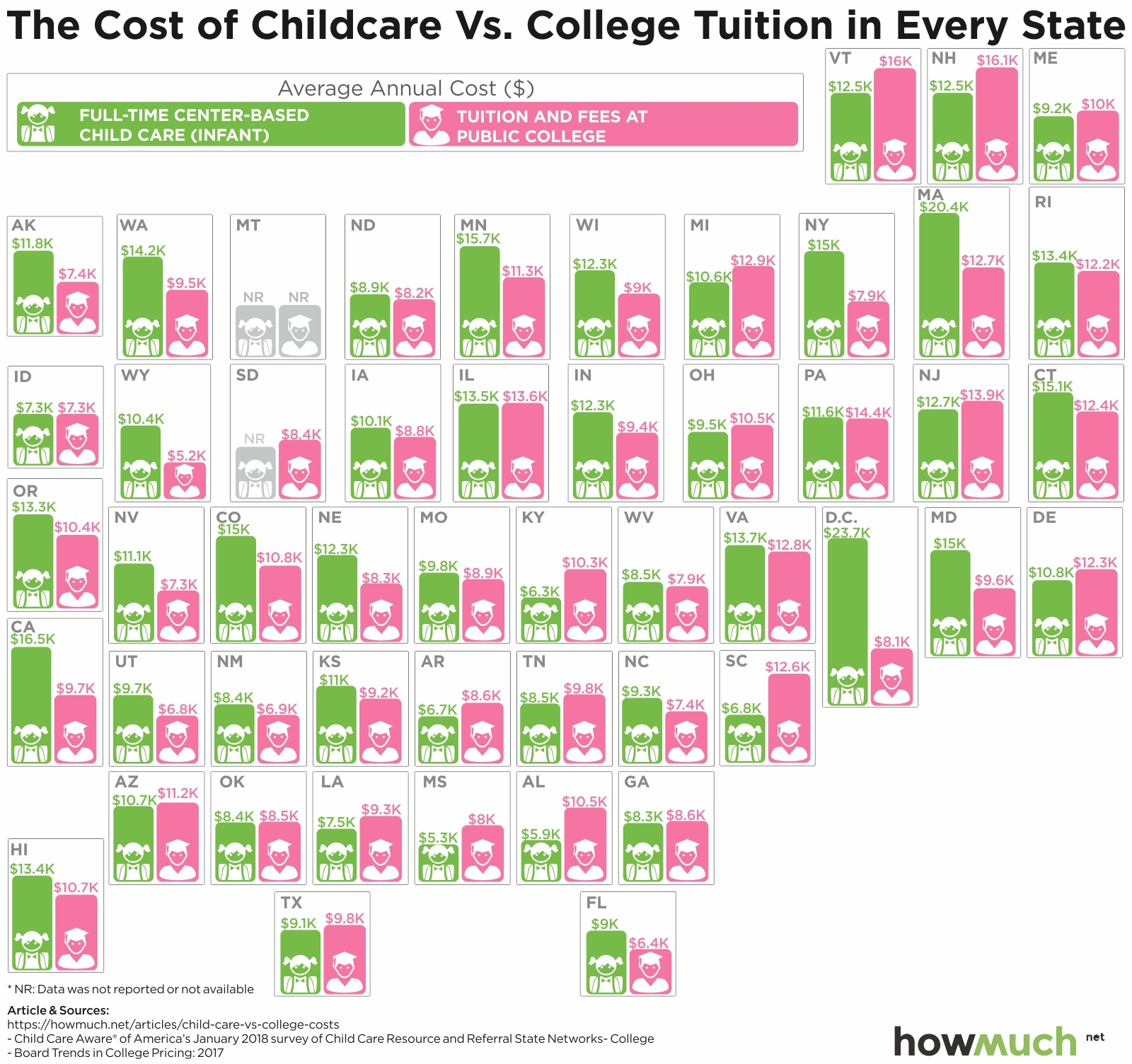
The annual expense of child care for an infant exceeds the annual cost of in-state tuition at a public four-year university in 34 states, according to the most recent data from the Economic Policy Institute.
At this point in the pandemic, healthcare is among the top three industries when it comes to people quitting or changing jobs. The quality and cost of child care is top of mind for healthcare decision-makers given its strength as a determining factor to push people from the U.S. labor force. Mothers continue to shoulder the majority of family caregiving responsibilities, making child care a heavier tip of the scale for healthcare, where women make up the majority of the front-line workforce (66 percent) and managers (59 percent), according to research from McKinsey.
Infant care expenses exceed college tuition in 34 states and Washington, D.C. Below is each state ranked by how much infant care costs exceed or compare to the cost of tuition at a four-year public university, along with the median family income in each state and infant care as a share of income.
Despite the gains, employment in healthcare is down by about 378,000 jobs (2.3%) from where it was in February 2020.
After a rough end to 2021 in terms of job losses,healthcare appears to be on the rebound – for now. The latest jobs report from the U.S. Bureau of Labor Statistics showed hospitals gaining jobs in January, though the industry is still below the levels seen before the COVID-19 pandemic.
In total, the healthcare sector saw a gain of 18,000 jobs last month. It lost 3,100 jobs in December; the prior month, November 2021, was the last time the sector saw job gains, when it posted a net gain of 2,100.
Hospitals made up for some, but not all, of the job losses seen during the tail end of 2021. They gained 3,400 jobs in January, after losing 5,100 jobs in December and 3,900 in November.
The last time hospitals gained jobs was in October, when 1,100 were added. Hospitals lost 8,100 jobs in September.
The biggest increase was in ambulatory healthcare services, which gained 14,700 jobs during the month. Physicians’ offices added 9,700 jobs. Nursing and residential-care facilities lost about 100 jobs in January.
Despite the gains, employment in healthcare is down by about 378,000 jobs (2.3%) from where it was in February 2020, at the dawn of the pandemic, according to BLS.
The broader U.S. economy added 467,000 jobs in January, after gaining 199,000 jobs in December, while the unemployment rate held fairly steady at about 4%.
WHAT’S THE IMPACT?
In a preview of the jobs report by economic research firm Glassdoor, researchers predicted that job losses in healthcare and leisure and hospitality would drag down overall payroll employment. Other coronavirus-sensitive sectors, such as retail and education, were also impacted, though seasonal factors helped mute job losses in those sectors.
Over the course of the pandemic, new COVID-19 cases have been somewhat predictive of job market data, but current record levels represent a situation without precedent, and there are few good comparisons, Glassdoor found. Since September 2020, each new 1,000 daily cases has been correlated with 4,000 fewer job gains, but the level of cases seen in January is unlike any other previous point in the pandemic, leading to uncertainty heading into the BLS jobs report.
The Bureau of Labor Statistics’ preliminary benchmark estimates forecast a modest downward revision in payroll employment of 166,000 for March 2021.
THE LARGER TREND
The Great Resignation hit the healthcare sector hard in November. BLS released job numbers in January showing that healthcare is among the top three industries cited in a 3% rise in the monthly “quits rate,” matching a high from September. The number of quits surged to 4.53 million for the month.
The numbers coincide with an already-strapped healthcare staffing market. Shortages and burnout among healthcare staff are a pervasive issue.
Multiple factors are contributing to labor pressures, including staff burnout stemming from the enduring pandemic and an overall shortage of qualified help, which has resulted in higher costs to hire temporary staff, as well as wage inflation.
Further, a Fitch Ratings report in November noted that lack of staff is forcing some in-patient behavioral health and senior housing operators to lower admission rates.








 HENRY KOTULA