Is a ‘cash pay revolution’ coming for hospitals?

https://www.advisory.com/daily-briefing/2022/10/19/cash-pay-hospitals

Amid new price transparency laws and growing consumer demand, more hospitals are adding cash pay options for certain health care services instead of just accepting insurance, Nora Tepper writes for Modern Healthcare—and some hospital officials say these offerings are “only going to go up” in the future.

How an ‘anomaly’ is becoming more common

Providers advertising cash pay rates for their services used to be considered an “anomaly,” Tepper writes. Now, the No Surprises Act, the federal price transparency law, and changing consumer expectations may make cash-only payments for health care services more common.

“The market is going there,” said Larry Van Horn, associate professor of management, law, and health policy and executive director of health affairs at Vanderbilt University. “You’ve got direct primary care, you’ve got physicians going and moving into cash pay. You’re gonna have to sit there at some point and say, ‘Wait a minute, they’re taking my business.'”

Although some hospitals and health systems that serve certain populations—such as Pomerene Hospital in Ohio with Amish and Anabaptist patients and the University of Texas MD Anderson Cancer Center with medical tourists—have long had cash-pay systems, it is still a relatively new concept for most providers in the United States.

According to data from Medscape, which surveyed more than 17,000 clinicians, just 17% of clinicians used cash-only, concierge, or direct-pay primary care models in 2020. Primary care providers (PCPs) made up the largest proportion of providers accepting cash pay, with 10% of practices charging patients a flat monthly fee for unlimited services.

“[S]ome providers embracing the cash pay revolution say their bottom line benefits from faster reimbursement, lower administration costs and higher patient retention,” Tepper writes.

In a 2020 report from the Society of Actuaries, almost all PCPs who operated under self-pay models reported “better or much better” personal and professional satisfaction compared to those under a traditional fee-for-service system. In addition, 34% of respondents reported “better or much better” earnings under a direct payment model.

How patients could benefit from cash-pay systems

According to Tepper, hospitals generally offer self-paying patients, who have typically been uninsured individuals or those with high-deductible health plans, lower rates for services compared to commercial insurers since they don’t have to handle administrative work or collections.

In a 2021 study published in JAMA Network Open, researchers analyzed rates for “shoppable” services at 922 hospitals and found that the proportion of hospitals that had lower cash prices than their median commercial negotiated rate ranged from 38.4% for liver tests to 68.5% for C-sections.

During the pandemic, more insured patients began to inquire about what services they could pay cash for, leading some health systems to create new payment models for certain procedures.

For example, Deaconess Health System launched an in-house bundled payment program, which includes cardiology, radiology, and urgent care services, in July 2020. The first year, the health system sold 130 bundled services, which increased to 351 in 2021, and 489 as of August 2022.

For any services not covered by the program, Deaconess offers a 50% discount on cash payments compared to its insurer rate. However, self-paying patients are required to pay the full cost of a procedure upfront.

“The patient has decided to take a bet on themselves,” said Steve Russell, VP and chief revenue cycle officer at Deaconess. “They have a high deductible, they don’t think they’re going to reach that threshold and their thought is, ‘If I don’t use my insurance, what kind of discount can you give me?'”

Separately, CommonSpirit Health‘s Catholic Health Initiatives (CHI) launched its own bundled cash price program in 2018 after noticing that many patients with high-deductible plans would defer care due to affordability concerns. The health system also advertises and sells its services on MDsave, an online marketplace that allows consumers to shop for health care procedures.

“With the No Surprises Act and the price transparency regulations, this has to be something that we offer,” said Jeanette Wojtalewicz, SVP and CFO at CHI Health’s Midwest division. “You’ll see more of this coming.”

The future of cash-pay systems in hospitals

According to Aaron Miri, SVP and chief digital and information officer at Baptist Health South Florida, although few patients are currently paying directly for health care services, the industry is heading towards that direction, which means health systems need to be prepared to meet the demand.

“When you look at the directionality of demand, this is only going to go up,” Miri said. “Patients are going to start seeing their total estimated bill and say, ‘I want to spend my $500 at a health system that was really transparent with me, and made me feel comfortable, versus the health system down the road that I’ve always gone to, but that simply can’t tell me what my actual amount due is.”

To make it easier for patients to directly pay for procedures, some health systems, including Baptist Health, have updated their payment options by adding Apple Pay, Google Pay, or other online payment systems instead of just accepting payment in-person or by phone.

However, even as direct payment models become more common, some insurers are “using their leverage to slow adoption of cash pay,” Tepper writes.

Kimberly Scaccia, VP of revenue management at MercyHealth, said some of the health system’s contracts with insurers prohibit it from offering cash discounts to insured patients.

“Some of the smaller payers, they’re fine with removing [cash pay restrictions],” Scaccia said. “Some of the very, very large payers, they simply will not allow it.”

In addition, Matthew Fiedler, a senior fellow of economic studies at the USC-Brookings Schaeffer Initiative for Health Policy, said clinicians may also be concerned about insurers asking to pay the lower cash rate during contract renewals or jeopardizing a provider’s network position.

“An insurer could say, ‘We’re gonna put this provider out-of-network, but we’re gonna put them in a preferred out-of-network position in our benefit design, where the cost-sharing is not that onerous, because we know they have this really good cash price,'” Fiedler said.
Insurers under fire for Medicare Advantage billing practices

https://mailchi.mp/4587dc321337/the-weekly-gist-october-14-2022?e=d1e747d2d8

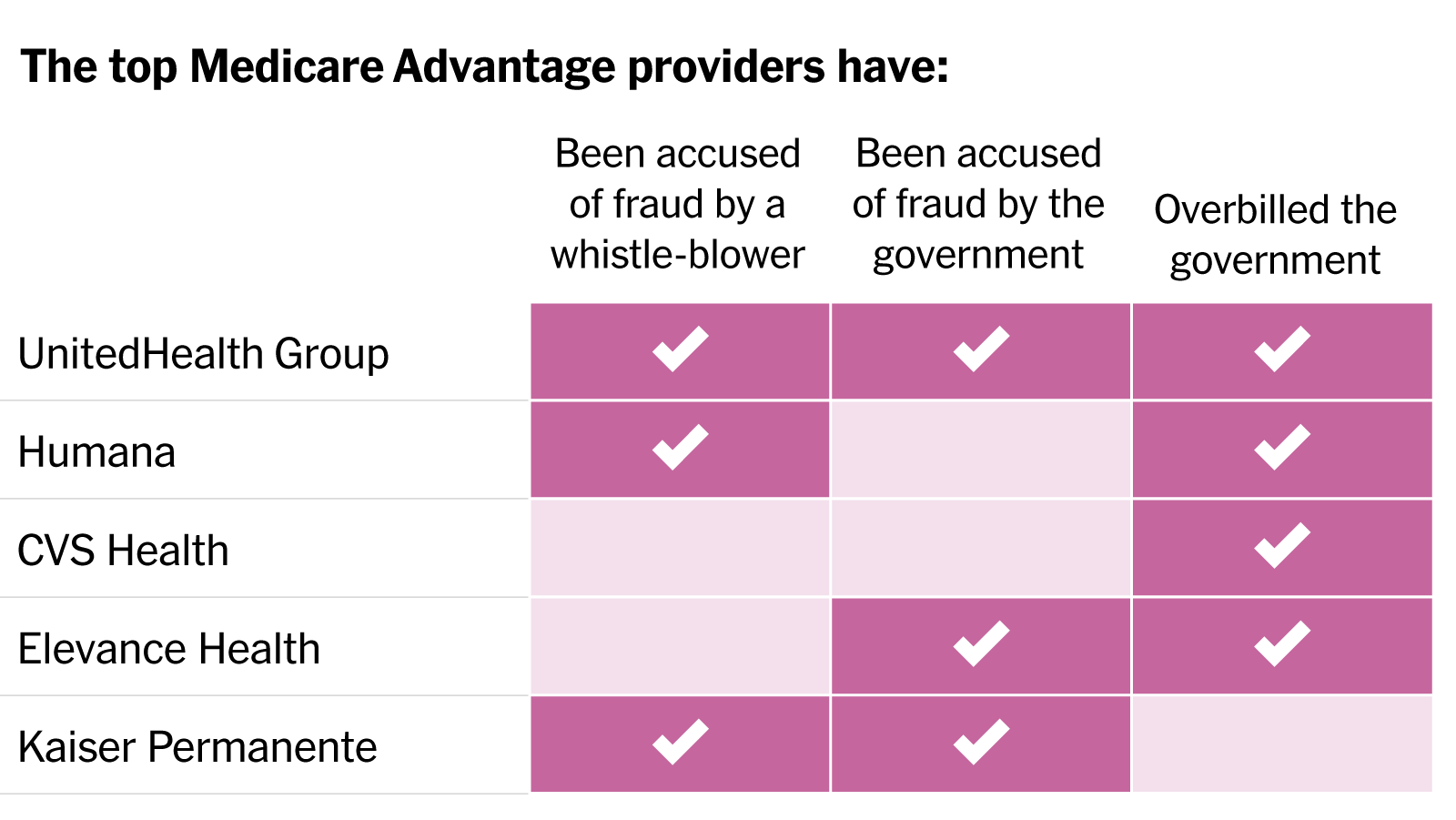
 In a blistering article published in the New York Times, reporters Reed Abelson and Margot Sanger-Katz detail widespread fraud allegations involving the nation’s largest MA insurers. Nine of the ten largest plans have been accused by the government of fraud or overbilling, generally for upcoding practices that exaggerate the disease burden among their beneficiaries, without providing them more care. Insurers have disputed most allegations, and regulators have been slow to punish known infractions. As a growing steam of seniors continue the enter the program, aggressive risk adjustment has significantly increased the government’s costs. The Centers for Medicare and Medicaid Services has yet to reduce payments in response to overbilling, despite having the power to do so.

The Gist: While these practices were well known to many in the healthcare industry, MA’s growth—set to overtake traditional Medicare enrollment next year—has added a spotlight worthy of national attention. While many beneficiaries report being satisfied with their MA benefits, the program was also intended to improve the cost efficiency of senior care.

With payers gaming the system to garner record profits, the government has seen higher per-enrollee spending in MA compared to traditional Medicare. There are some signs that the strings are starting to tighten for insurers, as many of the largest are losing Medicare star bonuses in 2023, impacting both plan revenue and ability to market throughout the year. However, reduced quality bonuses change nothing about the underlying MA payment structure, and could even drive insurers to more profit-seeking behavior.

Large health systems accused of valuing “profits over patients.”

https://mailchi.mp/b1e0aa55afe5/the-weekly-gist-october-7-2022?e=d1e747d2d8

In an explosive two-part series published late last month, New York Times reporters Jessica Silver-Greenberg and Katie Thomas cast a spotlight on the revenue collection tactics used by two of the nation’s largest not-for-profit health systems, Renton, WA-based Providence and Cincinnati-based Bon Secours Mercy Health.

The articles detail how Providence leveraged help from consulting firm McKinsey & Company to collect sums as small as $2 from patients pressured to pay anything they could for their care, even if many were actually eligible for free care under state law. Bon Secours was scrutinized for conduct in its Richmond, VA market, where it was portrayed as leveraging safety-net facility Richmond Community Hospital for its 340B license, while stripping out essential services needed by the surrounding lower-income community.

Both health systems have responded to the Times investigation, Providence by refunding payments collected from hundreds of low-income patients, saying they were charged due to an “unintended error,” and Bon Secours by claiming the allegations in the article were “baseless” and stating that it has invested millions into its Richmond Community Hospital.    

The Gist: Providence and Bon Secours Mercy Health are far from the only health systems accused of pursuing patient collections though any means available, which makes these articles especially worrisome to many system executives: the tactics deployed by the two systems are relatively common across the industry.

Given current margin pressures, health systems are already beginning to double down on aggressive revenue cycle management. But as most are also not-for-profit organizations who anchor their missions in providing community benefit, their tactics must also pass muster when judged in the court of public opinion. 

Senator has questions for Providence CEO on billing practices

U.S. Senator Patty Murray of Washington is seeking answers from Renton, Wash.-based Providence’s CEO following a Sept. 24 New York Times report detailing the system’s alleged debt collection practices. 

“According to recent reports, over the past several years, Providence has increasingly extracted payments from low-income patients, even when patients qualified for free or discounted care,” Ms. Murray said in a Sept. 28 letter to CEO Rod Hochman. “The reports allege several disturbing practices, including high-pressure billing conversations at hospital beds when patients are vulnerable, the use of extraordinary collection actions by debt collectors, and patients eligible for free or discounted care being billed for outstanding balances. As a result, patients have gone without food or heat, have seen their credit scores plummet, and have been afraid to seek out further medical care due to the cost—all as a result of practices that potentially violate both state and federal laws.”

Ms. Murray said in the letter she is seeking answers on how many patients Providence has served in recent years who qualified for free or discounted care and how many it referred to debt collection services. She is also seeking information about the system’s billing and debt collection policies, and how much it paid consulting firm McKinsey & Co. for a program designed to increase its revenue. She is seeking answers by Oct. 12. 

Washington state’s attorney general filed a lawsuit against Providence in February, alleging that 14 of its hospitals engaged in aggressive tactics to collect payment, failed to ensure discounts for eligible low-income patients, and steered poor patients to debt collectors. 

A Providence spokesperson expressed discontent and disagreement with the attorney general’s charges in a statement shared with Becker’s.

“The Providence family of organizations is extremely disappointed that the Office of the Washington State Attorney General has chosen to file inaccurate and unfair charges against us regarding our charity care and financial assistance practices,” the spokesperson said. “Serving every person who comes to us, regardless of ability to pay, is a central tenet of our mission as a not-for-profit organization. We take this responsibility seriously.”

Massachusetts nurse pleads guilty in $100M fraud scheme

A Massachusetts nurse has pleaded guilty in federal court in Boston in connection with a $100 million healthcare fraud scheme, the Justice Department announced Sept. 13. 

Winnie Waruru, a licensed practical nurse, pleaded guilty Sept. 8 to conspiracy to commit healthcare fraud, healthcare fraud – aiding and abetting, conspiracy to pay and receive kickbacks, making false statements and making a false statement in a healthcare matter. 

Ms. Waruru was employed by Chelmsford, Mass.-based Arbor Homecare Service. She was charged in February 2021 alongside Faith Newton, who was part owner and operator of the home healthcare company from 2013 to 2017. Ms. Newton has pleaded not guilty, according to the Justice Department. 

Prosecutors allege that the duo used Arbor to defraud MassHealth and Medicare of at least $100 million by committing fraud and paying kickbacks to get referrals. Specifically, prosecutors allege that Arbor billed payers for home health services that were never provided or weren’t medically necessary. Arbor billed MassHealth for Waruru’s skilled nursing visits, many of which she did not perform, according to the Justice Department. 

Ms. Waruru is slated to be sentenced in January.

Healthcare CEO, physicians sentenced to prison for $27M fraud

Thirteen people involved in a $27 million healthcare fraud scheme have been sentenced to a combined 84 years in federal prison, the Justice Department announced Aug. 31. 

The defendants allegedly participated in a fraud scheme that involved Novus Health Services, a Dallas-based hospice agency. The defendants allegedly defrauded Medicare by submitting false claims for hospice services, providing kickbacks for referrals and violating HIPAA to recruit beneficiaries. Novus employees also dispensed controlled substances to patients without the guidance of medical professionals, according to the Justice Department. 

Novus CEO Bradley Harris admitted to the fraud and testified against two physicians who elected to go to trial. Mr. Harris pleaded guilty to one count of conspiracy to commit healthcare fraud and one count of healthcare fraud and aiding and abetting. He was sentenced to 159 months in federal prison in January. 

The 12 others convicted in the scheme include three physicians, four nurses and several executives. 

Read more here

Biden Administration Releases Final Surprise Billing Rules

 The Biden Administration has released final surprise billing rules implementing the No Surprises Act, a federal law enacted in January 2021 that protects patients from out-of-network medical bills when they seek care at in-network facilities.

The new surprise billing rules detail the process for payers and providers to settle on payment for those out-of-network services. Previously, payers and providers would submit payment rates to an independent arbiter, selected by the government. The arbiter would choose the rate closest to the area’s median in-network payment for the services, otherwise known as the qualifying payment amount (QPA), while considering other factors, such as provider training and experience, the provider’s market share, and how difficult it was to provide the service, after the fact.

Provider groups have criticized the use of the QPA as the primary factor in an arbiter’s decision, arguing that the added weight to the QPA amount favors payers over providers.

Notably, the Texas Medical Association challenged the surprise billing arbitration process over the QPA issue and won. A district court vacated the requirement that arbiters select payment offers closest to the QPA unless the additional information warrants a closer review.

The American Hospital Association (AHA) and the American Medical Association (AMA) have also filed a lawsuit challenging the interim final rule implementing the dispute process, arguing that lawmakers did not intend for rules implementing the No Surprises Act to place that much emphasis on the QPA. The lawsuit is ongoing.

In light of the district court’s decision, the latest final surprise billing rules roll back the “rebuttable presumption” that favors the QPA. The rules state that arbiters are to consider the QPA “and then must consider all additional information submitted by a party to determine which offer best reflects the appropriate out-of-network rate.”

The final rules specify that arbiters “should select the offer that best represents the value of the item or service under dispute after considering the QPA and all permissible information submitted by the parties.”

The final rules also cover situations where payers have “downcoded” a claim. According to previous rulemaking, downcoding occurs when payers change service codes or change, add, or remove a modifier, which can lower the QPA for the service code or modifier billed by a provider.

The rules will create new requirements related to what information payers must share with providers when downcoding occurs. The information includes a statement that the service code or modifier was downcoded, an explanation of why the claim was downcoded, and the amount that would have been the QPA had the service code or modifier not been downcoded.

The Biden Administration—through the Departments of Labor, Health and Human Services, and Treasury, which officially released the final surprise billing rules—said that the rules “will help providers, facilities and air ambulance providers engage in more meaningful open negotiations with plans and issuers and will help inform the offers they submit to certified independent entities to resolve claim disputes.”

But whether the updated language is enough to tip the balance for providers remains to be seen. AHA said in a news release late last week that it is closely reviewing the final surprise billing rules.