Financial Literacy: A Leadership Prerequisite

https://www.kaufmanhall.com/insights/blog/financial-literacy-leadership-prerequisite

In last month’s blog, we discussed the importance of financial planning, both for internal audiences—including the leadership team and the board of trustees—and for external audiences—including prospective students and their families, rating agencies, alumni and other stakeholders. This month, in the first of a series of blogs focused on key finance-related issues, we’re turning our attention to a broader and deeper internal audience, asking the question, “What is your institution’s financial literacy?”

The terms described in this blog will be very familiar to members of college and university finance teams and to many institutional leaders as well.

The point is that these terms should be familiar to as many individuals as possible throughout the institution: they form the foundation of a basic financial literacy that every college and university should foster across its faculty and staff.

What is financial literacy?

Financial literacy is the ability to understand where an institution stands at any given time with respect to key elements of its balance sheet and income statement. To state it simply, financial literacy means an understanding of the vital signs that describe the financial health of the institution. In medicine, the basic vital signs are body temperature, pulse rate, respiration rate, and blood pressure. In finance, the vital signs include measures of unrestricted cash, revenue, expenses, debt, and risk.

In medicine, there are professionals whose job is to dig deeper if any of the body’s vital signs are deteriorating. Similarly in finance, it is the job of the CFO and finance team to monitor the vital signs of the institution’s financial health and to seek causes and solutions of current troubles or to use changes in the vital signs to address potential future issues. For most of us—in medicine or finance—the goal should be a basic understanding of what the vital signs measure and whether they point to good health.

There are some key considerations for each financial vital sign:

  • Unrestricted Cash. The critical question related to unrestricted cash (also termed liquidity) is whether the institution has enough accessible liquidity to meet its daily expenses if its cash flow was unexpectedly interrupted. Days cash on hand is a balance sheet metric that is typically used to assess this issue: days cash on hand literally measures how long unrestricted cash reserves could cover the institution’s operating costs if its cash flow suddenly stopped. 

    The emphasis on “accessible liquidity” is an important element of this financial vital sign: it speaks to the ability to distinguish between institutional wealth versus liquidity. In higher education, an endowment can be an important source of the institution’s wealth, but many of the funds within an endowment cannot be easily accessed—they are, by and large, not liquid funds or are highly restricted as to their use. Readily available, unrestricted cash reserves are what an institution must rely on to meet its day-to-day expenses should cash flow be interrupted or reduced.
     
  • Revenue. Because an institution needs to maintain or grow its cash reserves and allocate them sparingly, the amount of revenue coming in—from tuition and fees and from other sources of additional income (see below)—is also an important vital sign. An institution should obviously be taking in enough revenue to cover its expenses without drawing on its cash reserves. 

    Additionally, however, given continued growth in expenses, revenue growth (through enrollment growth, student mix, and/or program mix) is a significant measure of ongoing vitality.

    Financial health is also enhanced if an institution does not rely too heavily on a single revenue source. For schools with an endowment, for example, the amount of income the endowment can generate to support operations is an important source of additional income. More generally, additional income can come from such auxiliary revenue sources as residential fees, fundraising, special events, concessions, and a host of other sources. These additional revenue sources, while potentially small on an individual basis, can be material on a cumulative basis.
     
  • Expenses. How much does it cost to produce the education that a college or university provides to its students? If that cost is approaching—or worse, surpassing—the net tuition revenue and additional income that the institution brings in, what is being done—or could be done—to reduce those costs? Expenses are perhaps most similar to body temperature in medical vital signs; if they get too high, they must be brought down before the health of the institution begins to decline. And the measure of expenses should be viewed overall for the institution as well as on a per student basis to communicate the “value” of different student types to the organization.
     
  • Debt. Debt is an essential component of the funding of significant capital projects that colleges and universities must undertake to maintain updated and competitive facilities. Just as most people need to take out a mortgage to afford a home purchase—spreading the cost of the home over a multiyear payment period—so too do institutions often need debt to finance large capital expenditures. But the amount of debt (also termed “leverage”) can also be an indicator of the institution’s financial health. That health begins to decline if the amount of debt relative to an institution’s assets or annual income grows too large, or if the amount required to pay for the debt (i.e., to meet the scheduled principal and interest payments—the debt service) puts too much of a burden on the cash flow generated from the institution’s day-to-day operations. If the debt service becomes too high relative to cash flow, the institution may face onerous legal requirements, or even default, which may severely constrain its ability to provide the range of programs desired and expected by its student population.
     
  • Risk. Risk is an indicator that identifies potential weaknesses in any of the preceding indicators that could jeopardize the institution’s financial health. For basic financial literacy, only the most significant risks need to be identified: over-reliance on tuition revenue in a market with declining enrollments, for example, or over-reliance on endowment income in the event of market instability. Once an institution consistently measures its risks, it can begin to determine what level of risk is appropriate and address strategies to manage that risk.

Why does financial literacy matter?

Promoting financial literacy throughout an institution cultivates a common understanding of financial health that provides context for leadership’s decisions and a common language to address issues. If tuition revenue is declining, for example, financially literate faculty members should better understand the need to prioritize academic programs that not only meet the academic needs of their students, but also can draw more students or produce healthier margins. If cost-cutting measures are required to reduce expenses, financially literate staff should understand the genesis of the need for reductions and why the institution cannot simply draw on its endowment to close the gap. Furthermore, acknowledging and describing the most significant risks an institution faces using a common language makes clear the need for action if one or more of those risks begins to materialize.

Financial literacy is also an important tool for cultivating the next generation of faculty leaders. When faculty members rise to leadership positions, it is essential that they understand that academic growth and strategic initiatives cannot succeed without sufficient resources to support them, or if they cannot generate the revenue needed to cover—or exceed—their costs.

By promoting financial literacy across the institution, the institution can help ensure that future leaders are acquiring the foundation needed for them to grow into informed decision-makers who understand the need to maintain the institution’s financial health.

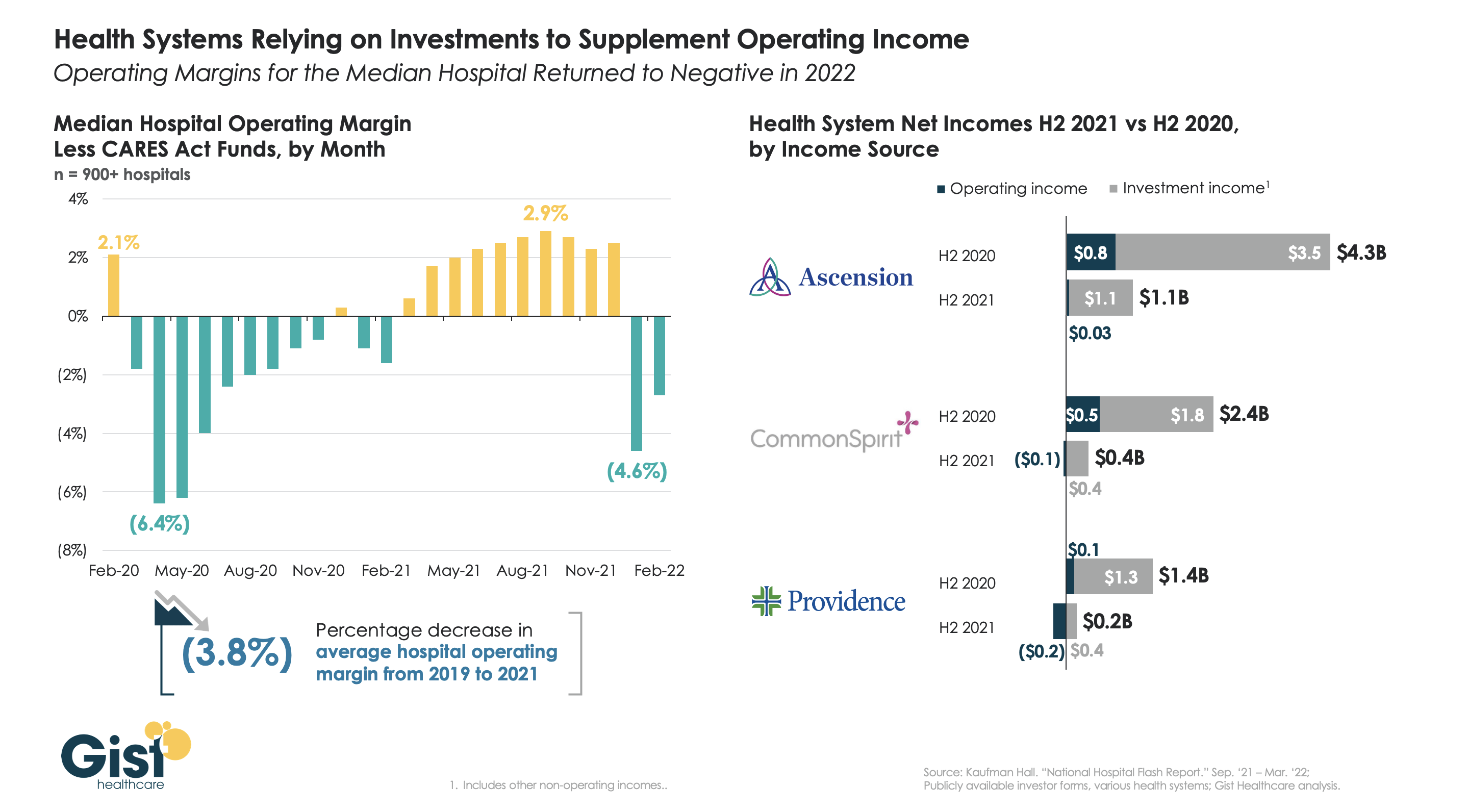
Investment gains masking health system operating margin difficulties 

The combination of the Omicron surge, lackluster volume recovery, and rising expenses have contributed to a poor financial start of the year for most health systems. The graphic above shows that, after a healthier-than-expected 2021, the average hospital’s operating margin fell back into the red in early 2022, clocking in more than four percent lower than pre-pandemic levels. 

Despite operational challenges, however, many of the largest health systems continue to garner headlines for their sizable profits, thanks to significant returns on their investment portfolios in 2021.

While CommonSpirit and Providence each posted negative operating margins for the second half of 2021, and Ascension managed a small operating profit, all three were able to use investment income to cushion their performance.

A growing number of health systems are doubling down on investment strategies in an effort to diversify revenue streams, and capture the kind of returns from investments generated by venture capital firms. However, it is unlikely that revenue diversification will be a sustainable long-term strategy.

To succeed, health systems must look to reconfigure elements of the legacy business model that are proving financially unsustainable amid rising expenses, shifts of care to lower-cost settings, and an evolving, consumer-centric landscape.    

From insurer to diversified services business

https://mailchi.mp/3e9af44fcab8/the-weekly-gist-march-26-2021?e=d1e747d2d8

Large health insurers no longer just provide coverage, but are instead repositioning themselves as vertically integrated healthcare organizations that span the care continuum.

The graphic above shows five-year total revenue growth by segment for the top five health insurance companies.

Some, like Anthem and Humana, are still in the early stages of revenue diversification, leveraging partnerships and investments to fill service gaps—in Humana’s case, these are mainly centered on the Medicare Advantage population.

On the other hand, the insurance revenue of Cigna and CVS Health is already dwarfed by pharmacy benefit management (PBM) revenue (as well as retail clinic revenue for CVS).

UnitedHealth Group (UHG) is clearly leading the pack, with a robust revenue diversification and vertical integration strategy. 

Its Optum subsidiary grew 62 percent over the last five years, nearly double the rate of its UnitedHealthcare insurance business. Already the largest employer of physicians in the country, Optum recently announced plans to acquire Massachusetts-based 715-physician group, Atrius Health. It also announced its intent to acquire Change Healthcare, one of the largest providers of revenue and payment cycle management solutions.

Given the outsized role of the Optum division in driving UHG’s growth and profitability, it may soon face a dilemma that other publicly traded, diversified companies have had to confront: shareholder demands to unlock value by spinning off the business into a separate company.

Central to fending off that kind of activism by shareholders: demonstrable steps to integrate the myriad businesses the company has acquired into a functional whole. Just as Amazon’s hugely profitable Web Services business has become a target of spin-off demands, so too, eventually, may UHG’s Optum.

After decades as a hospital operator, Tenet shifts its focus to surgery centers

The company’s surgery centers far outnumber its hospital portfolio, and its ambulatory earnings will account for nearly half of overall earnings next year.

Tenet Health got its start as a major hospital operator in the U.S. and can trace its hospital business roots as far back as 1969. But it may be time to think of the Dallas-based company as an ambulatory surgery center operator, first, and a hospital chain, second.

Following its latest acquisition, Tenet’s ASC footprint will be nearly five times larger by the number of facilities than its hospital portfolio, and its ambulatory earnings will account for nearly half of the company’s overall earnings next year, executives recently said. That’s a significant leap from about six years ago when ambulatory represented just 4% of the company’s earnings.

“From a stock perspective, I think they’re going to get more credit now for that ownership of the surgery center business than ever just because of the size contribution,” Brian Tanquilut, an analyst with Jefferies, said.

Still he noted they will likely retain their image as a hospital provider first given that half its business (and earnings) are subject to the dynamics of the hospital space.

Tenet will now operate up to 310 ASCs in 33 states following its $1.1 billion cash deal to buy up to 45 centers from SurgCenter Development.

Tenet has billed its purchase from SurgCenter Development as a transformative deal, crowning itself the leading musculoskeletal surgical platform.

SurgCenter Development is one of the larger ASC operators in the country. The Towson, Maryland-based firm has developed more than 200 centers since the company was officially established in 2002. SCD’s business model calls for its physician partners to maintain majority ownership while SCD provides consulting and capital.

In fact, Tenet will pull ahead of the pack and will operate the most ASCs compared to its competitors, according to various public data.

Amsurg, an ASC operator under private equity-owned Envision, controls more than 250 surgery centers, according to its website, followed by Optum’s 230 centers under its Surgical Care Affiliates brand.

OwnerNumber of ASCs (fully or partially owned)
Tenet Health310
Amsurg (Envision) 250
Surgical Care Affiliates (Optum) 230
SurgCenter Development122
HCA121
Surgery Partners111
Total Medicare-certified ASCs in U.S.5,700

Still, those large players only control a sliver of the overall market. There are more than 5,700 Medicare-certified ASCs operating in the U.S., according to MedPac’s latest March report.

The market is so fragmented because, historically, a handful of doctors could come together and open up a small surgery center with a few operating rooms, Todd Johnson, a partner at Bain and Company, said. Johnson noted there are not that many deals like this out there, which is why it’s significant that Tenet was able to gobble up 45 centers in one swoop.

“We’re a long way from this being a market where any individual operator’s got 30% of market share. There’s just so many of these out there,” Johnson said.

What’s so attractive?

Regulatory and reimbursement changes and patient preference continues to fuel certain procedure migration away from hospitals.

“For payers, typically, the surgery rates are 30 to 40% less than the same procedure that’s done in a hospital outpatient department. So, payers certainly value the economic value proposition of ASCs,” Johnson said.

Just recently, regulators cleared the way for more procedures to be done in ASCs. CMS is eliminating the list of procedures that must be performed in a hospital, drawing ire from the hospital lobby. The inpatient-only list will be completely phased out by 2024, creating even more growth potential for surgery centers. Come Jan. 1, total hip replacements will be covered if performed in an ASC, a huge win for ASC operators.

It’s why hospital operators like Tenet have been keen to expand their surgery center footprint. The centers attract relatively healthy patients for quick procedures — eating into hospitals’ revenue and margin.

“This further move only solidifies the fact that they are trying to diversify their revenue streams, and, frankly move into a more attractive economic profile of procedure types — not trauma and COVID but rather scheduled surgeries they can run in and out like a factory but with really good clinical outcomes,” Johnson said.

To this point, Tenet leaders said the new SurgCenter Development centers generate higher margins and have minimal debt.

Patients also tend to prefer ASCs, Johnson said. Plus, as a lower cost option it can be persuasive for patients, especially those with high-deductible health plans.

Long-term strategy

Tenet has continued to bet on the shift from inpatient to outpatient services following its purchase of USPI in 2015.

The purchase set Tenet up to be a serious competitor in the space, establishing a portfolio of 244 surgery centers when the deal was announced. It illustrated Tenet’s intent to build a broader portfolio.

At the same time, it has whittled down its hospital portfolio, divesting in markets where it isn’t the No. 1 or No. 2 player as it seeks to hone its most competitive segments and markets.

Just last year, it announced plans to largely exit the Memphis, Tennessee, market with the sale of a number of assets including two hospitals, urgent care centers and the associated physician practices.

In 2018, Tenet shed all of its operations in the U.K. and eight hospitals across the U.S. 

That long-term strategy was made clearer last week when Tenet announced its sale of its urgent care business to FastMed. By selling off its 87 CareSpot and MedPost centers, Tenet said it will allow the company to further focus on its surgery center business.

Tenet has been keen to tout its position of musculosketel procedures — a high growth area compared to other procedure types such as gastroenterology. A 2019 report from Bain and Company expects that orthopaedic and spine procedure volumes will increase the fastest over the next few years.

With the SCD centers in the mix, CEO Ron Rittenmeyer said, “this transaction ensures Tenet will essentially double down and further deepen our concentration in these high growth areas of the future.”