What they don’t teach in school – Decision Making

https://interimcfo.wordpress.com/2021/01/04/what-they-dont-teach-in-school-decision-making/

Evidence-Based Decision Making. In our efforts to evolve our research… | by  Matthew Godfrey | Ingeniously Simple | Medium

Abstract:  This article is a continuation of the theme of ‘What they don’t teach in school.’ The subject of this article is the importance of the development of your decision-making skill.

In my article on career advancement, I observed the correlation between decision-making ability, career, and income level.  So how do you improve your decision making or cognitive ability?  Several strategies have proven successful for many people.  Unfortunately, most of them require doing something that can be very hard – exercising and expanding your brain.  Ziglar, Foreman others have argued that most of us rarely use more than 10% of our intellectual capacity at any given time so we have plenty of unexploited potential.  So how do you develop your cognitive capability?  One thing for me was taking courses in software development.  The most challenging course I encountered in college was a computer programming course that I took as an elective!  Computers do not do what you intend; they do exactly what you tell them.  Computer programming requires the development of precise and highly structured instruction sets.  The skillset required to develop computer code has excellent application to problem-solving that goes along with improved decision making.

One day, I was sitting in a conference room in a Catholic hospital listening to debate about whether or not to buy upgraded lights for neurosurgery operating rooms or continue pouring money into a failed clinical program.  The longer this discussion went on, the more frustrated I became.  Finally, when I could take no more, I accused the leadership team of decision making on a scale that ran from the Ouija Board to a Magic Eight Ball.  The reaction that provoked surprised me.  I had no idea Catholics did not like Ouija Boards, and I had heard about being excoriated by a Nun, but I had not yet had the experience.  I asked the Nun whether or not she thought it was important for a neurosurgeon to be able to see what he was doing in the OR?

Interestingly, some of the young people in the room had no idea what a magic eight ball was.  In the ensuing discussion, I reminded the leadership team that their continuing, collective engagement in non-evidence-based, politicized, expeditious decision-making was too often focused on non-strategic initiatives or lost causes instead of pursuing the best interests of the institution and its patients.  I told the group that this type of reasoning was one of the primary reasons the organization had come to make my acquaintance in the first place.  I am lucky I did not get fired on the spot, but everyone in that room that day learned something.  For the leadership team, the lesson was that they had to resolve to do a better job making decisions.  I have argued that an organization’s performance, however that is measured, is a direct function of the efficacy of the leadership team’s decision-making.  To this day, I keep a Magic Eight Ball on my desk.  It reminds me of my innocent dispassion about Catholics’ sensitivity to something as simple as an Ouija Board and my admonition to that leadership team and myself never to stop improving decision-making capability.

Another of the things that have helped me a lot is the study of ‘sadistics.’ I know.  The mediocre performance of my first and second articles on this topic is sufficient evidence of how well accepted this idea is.  I will not try to sell you on this idea again other than observing that statistics arose from the need for an objective structure to analyze and interpret data.  If this is not improved decision making, I do not know what is.

Self-study helps decision making.  There are books, articles, and other resources available for research to better understand topics that you do not comprehend as well as you envision.  Two of my favorite resources are Wikipedia and YouTube.  What you can find is amazing.  While some concepts can be hard to read and grasp at first, academic articles can be beneficial, especially if you understand the underlying statistical analysis.  In an earlier post, I referenced an article on Normative Decision Theory by Chua.  This research looks into how people make decisions in the absence of complete information.  When was the last time you had complete information at the point you had to make a decision?  There is never enough time or information. Decisions regularly occur in situations where data is incomplete and may be inaccurate.  Improving your ability to make better calls in this fog is crucial to leadership at higher levels.

To be sure, collegiate courses help improve your cognitive abilities, although plenty of University programs fall way short of achieving cognitive gains in decision-making ability among their graduates.  I think the issue is not so much with what you know but how well you learn to apply academic and theoretical intelligence to real-world problems and challenges.  Everyone would be better served if more university programs offered courses focused on applied decision making.  My practice has convinced me that one of the critical factors that lead to unacceptable organizational performance is a consistent track record of decision making that does not produce the expected results.

In undergraduate school, I took an elective course on logic.  I can’t remember what I was thinking when I made this decision, but like many of my electives, this one ended up requiring a disproportionate amount of time and energy.  However, the return on investment has been immense.  Not only did I learn a lot about disciplined decision making, I learned how to spot flaws in arguments whose logic is not sound.  The study of logic is vital if you ever intend to spend time developing computer code.

Since college, I discovered philosophy, which most liberal arts students have in their core curriculum.  You could spend a lifetime studying Socrates, Aristotle, and other philosophers that advanced society by advocating for the cause of beneficial argument and probing assumptions.  If you haven’t already done so, I highly recommend you pick up a copy of Plato and let me know if it changes your life.

Finally, the University of Alabama at Birmingham’s Doctorate in Healthcare Administration program mantra is, ‘Evidence-Based Decision Making in Healthcare Administration.’ As is the case in other disciplines, academics worldwide are conducting research in healthcare administration and continually publishing learning that is beneficial to practitioners.  Sadly, I cannot remember a case where a leader stopped a team in the process of making a decision and sent them to the literature to find all available evidence on the topic before committing to a course of action.  Then they are surprised when things do not work out as they expect?

One of the ironies of healthcare is that physicians and other clinicians are deeply ingrained with objective, evidence-based decision-making theory and practice.  One of the reasons that clinicians get so frustrated with healthcare administrators is when they see what appears (accurately) to them be malaise in organizational decision-making.  A couple of one-liners come to mind.  The road to failure is paved with good intentions.  The road to disaster is littered with run-over squirrels.

The upshot of all of this is that your preparation for higher stakes decision making supports career advancement aspirations.  I promise you that anything you do to improve your decision-making ability will serve you very well long into the future.

Contact me to discuss any questions or observations you might have about these articles, leadership, transitions, or interim services.  I might have an idea or two that might be valuable to you.  An observation from my experience is that we need better leadership at every level in organizations.  Some of my feedback comes from people who are demonstrating an interest in advancing their careers, and I am writing content to address those inquiries.

The easiest way to keep abreast of this blog is to become a follower.  I will notify you of all updates as they occur.  To become a follower, click the “Following” bubble that usually appears near each web page’s bottom.

I encourage you to use the comment section at the bottom of each article to provide feedback and stimulate discussion.  I welcome input and feedback that will help me to improve the quality and relevance of this work.

This is an original work.  This material is copyrighted by me, with reproduction prohibited without attribution.  I note and provide links to supporting documentation for non-original material.  If you choose to link any of my articles, I’d appreciate a notification.

If you would like to discuss any of this content, provide private feedback or ask questions, You may reach me at ras2@me.com


Large Numbers Of Health Care And Frontline Workers Are Refusing Covid-19 Vaccine

Large Numbers Of Health Care And Frontline Workers Are Refusing Covid-19  Vaccine

TOPLINE

Despite the Covid-19 death count in the United States rapidly accelerating, a startlingly high percentage of health care professionals and frontline workers throughout the country—who have been prioritized as early receipts of the coronavirus vaccine—are reportedly hesitant or outright refusing to take it, despite clear scientific evidence that the vaccines are safe and effective.

KEY FACTS

Earlier this week, Ohio Gov. Mike DeWine said he was “troubled” by the relatively low numbers of nursing home workers who have elected to take the vaccine, with DeWine stating that approximately 60% of nursing home staff declined the shot. 

Dr. Joseph Varon, chief of critical care at Houston’s United Memorial Medical Center, told NPR in December more than half of the nurses in his unit informed him they would not get the vaccine.

Roughly 55 percent of surveyed New York Fire Department firefighters said they would not get the coronavirus vaccine, the Firefighters Association president said last month.

The Los Angeles Times reported Thursday that hospital and public officials in Riverside, Calif., have been forced to figure out how best to allocate unused doses after an estimated 50% of frontline workers in the county refused the vaccine.

Fewer than half of the hospital workers at St. Elizabeth Community Hospital in Tehama County, Calif., were willing to be vaccinated, and around 20% to 40% of L.A. County’s frontline workers have reportedly declined an opportunity to take the vaccine. 

Dr. Nikhila Juvvadi, the chief clinical officer at Chicago’s Loretto Hospital, said that a survey was administered in December, and 40% of the hospital staff said they would not get vaccinated.

KEY BACKGROUND:

recent survey by the Kaiser Family Foundation found that 29% of healthcare workers were hesitant to receive the vaccine, citing concerns related to potential side effects and a lack of faith in the government to ensure the vaccines were safe. Frontline workers in the United States are disproportionately Black and Hispanic. The pandemic has taken an “outsized toll” on this segment of the population, which has reportedly accounted for roughly 65% of fatalities in cases in which there are race and ethnicity data. A study published by the journal The Lancet over the summer found “healthcare workers of color were more than twice as likely as their white counterparts” to test positive for the coronavirus. According to a Pew Research Center poll published in December, vaccine skepticism is highest among Black Americans, as less than 43% said they would definitely/probably get a Covid-19 vaccine. Dr. Juvvadi told NPR that “there’s no transparency between pharmaceutical companies or research companies — or the government sometimes — on how many people from” Black and Latino communities were involved in the research of the vaccine. Dr. Varon said that “the fact that [President] Trump is in charge of accelerating the process bothers” those individuals who refuse to be immunized, adding “they all think it’s meant to harm specific sectors of the population.” In an op-ed published in the New York Times earlier this week, emergency physicians Benjamin Thomas and Monique Smith wrote that “vaccine reluctance is a direct consequence of the medical system’s mistreatment of Black people” and past atrocities, such as the unethical surgeries performed by J. Marion Sims and the Tuskegee Syphilis Study, best exemplifies “the culture of medical exploitation, abuse and neglect of Black Americans.” 

CRUCIAL QUOTE: 

“I’ve heard Tuskegee more times than I can count in the past month — and, you know, it’s a valid, valid concern,” said Dr. Juvvadi.

WHAT TO WATCH FOR:

Dr. Anthony Fauci, the director of the National Institute of Allergy and Infectious Diseases, said in a Friday interview that it’s “quite possible” the Covid-19 vaccine could be required for international travel and to attend school at some point in the future.

BIG NUMBER:

40 million. In early December, government officials said they planned to have 40 million doses available by the end of 2020, which would be enough to fully vaccinate 20 million Americans. However, according to the Centers for Disease Control and Prevention, less than 3 million Americans have received the first dose of the vaccine, with 14 million doses have been distributed.

Operation Warp Speed at a crawl

Boise's Leading Local News: Weather, Traffic, Sports and more | Boise,  Idaho | KTVB.com | ktvb.com

The Centers for Disease Control and Prevention reported on Monday that 2.1 million doses of coronavirus vaccines have been administered in two weeks. While this might sound like an impressive number, it should set off alarms.

Let’s start with the math. Anthony S. Fauci, the government’s top infectious-disease doctor, estimates that 80 to 85 percent of Americans need to be vaccinated to reach herd immunity. Both the Pfizer and Moderna vaccines require two doses. Eighty percent of the American population is around 264 million people, so we need to administer 528 million doses to achieve herd immunity.

At the current rate, it would take the United States approximately 10 years to reach that level of inoculation. That’s right — 10 years. Contrast that with the Trump administration’s rosy projections: Earlier this month, Health and Human Services Secretary Alex Azar predicted that every American will be able to get the vaccine by the second quarter of 2021 (which would be the end of June). The speed needed to do that is 3.5 million vaccinations a day.

There’s reason to believe the administration won’t be able to ramp up vaccination rates anywhere close to those levels. Yes, as vaccine production increases, more will be available to the states. And Brett Giroir, assistant secretary for health at HHS, argued on Sunday that the 2.1 million administered vaccines figure was an underestimate due to delayed reporting. So let’s be generous and say the administration actually administered 4 million doses over the first two weeks.

But even that would still fall far short of the 3.5 million vaccinations needed per day. In fact, it falls far short of what the administration had promised to accomplish by the end of 2020 — enough doses for 20 million people. And remember, the first group of vaccinations was supposed to be the easiest: It’s hospitals and nursing homes inoculating their own workers and residents. If we can’t get this right, it doesn’t bode well for the rest of the country.

Here’s what concerns me most: Instead of identifying barriers to meeting the goal, officials are backtracking on their promises. When states learned they would receive fewer doses than they had been told, the administration said its end-of-year goal was not for vaccinations but vaccine distribution. It also halved the number of doses that would be available to people, from 40 million to 20 million. (Perhaps they hoped no one would notice that their initial pledge was to vaccinate 20 million people, which is 40 million doses, or that President Trump had at one point vowed to have 100 million doses by the end of the year.) And there’s more fancy wordplay that’s cause for concern: Instead of vaccine distribution, the administration promises “allocation” in December. Actual delivery for millions of doses wouldn’t take place until January, to say nothing of the logistics of vaccine administration.

The vaccine rollout is giving me flashbacks to the administration’s testing debacle. Think back to all the times Trump pledged that “everyone who wants a test can get one.” Every time this was fact-checked, it came up false. Instead of admitting that there wasn’t enough testing, administration officials followed a playbook to confuse and obfuscate: They first attempted to play up the number of tests done. Just like 2 million vaccines in two weeks, 1 million tests a week looked good on paper — until they were compared to the 30 million a day that some experts say are needed. The administration then tried to justify why more tests weren’t needed. Remember Trump saying that “tests create cases” or the CDC issuing nonsensical testing guidance?

When that didn’t work, Trump officials deflected blame to the states. Never mind that there should have been a national strategy or that states didn’t have the resources to ramp up testing on their own. It was easier to find excuses than to admit that they were falling short and do the hard work to remedy it.

Instead of muddying the waters, the federal government needs to take three urgent steps. First, set up a real-time public dashboard to track vaccine distribution. The public needs to know exactly how many doses are being delivered, distributed and administered. Transparency will help hold the right officials accountable, as well as target additional resources where they are most needed.

Second, publicize the plan for how vaccination will scale up so dramatically. States have submitted their individual plans to the CDC, but we need to see a national strategy that sets ambitious but realistic goals.

Third, acknowledge the challenges and end the defensiveness. The public will understand if initial goals need to be revised, but there must be willingness to learn from missteps and immediately course-correct.

I remain optimistic that vaccines will one day end this horrific pandemic that has taken far too many lives. To get there, we must approach the next several months with urgency, transparency and humility.

Biden to address nation on pandemic as Fauci says coronavirus surge ‘has just gotten out of control’

Fauci: U.S. may see “surge upon surge” of coronavirus in weeks ahead – The  Denver Post

President-elect Joe Biden plans to deliver an address on the coronavirus pandemic as the nation experiences what his chief medical adviser on the issue, Anthony S. Fauci, described Tuesday as a surge in cases “that has just gotten out of control in many respects.”

Biden’s remarks, planned Tuesday afternoon in Wilmington, Del., are expected to be his most extensive comments to date since early this month, when he laid out a plan for his first 100 days in office that included imploring all Americans to wear masks.

Fauci, appearing on CNN on Tuesday morning, lamented what he expects to be a post-holiday increase in cases and the strong possibility than January’s caseload will exceed even that of December. “You just have to assume it’s going to get worse,” Fauci said.

Fauci also acknowledged that the rollout of vaccines was not reaching as many Americans as quickly as the 20 million that Trump administration had pledged by the end of the month.

“We certainly are not at the numbers that we wanted to be at the end of December,” said Fauci, director of the National Institute of Allergy and Infectious Diseases. “We are below where we want to be.”

But Fauci, who accepted Biden’s invitation to play an expanded role in his administration, expressed hope that by “showing leadership from the top,” Biden could make an impact — comments that appeared to be implicit criticism of President Trump, who has said little publicly about the crisis since Election Day.

“What he’s saying is that let’s take at least 100 days and everybody, every single person put aside this nonsense of making masks be a political statement or not,” Fauci said of Biden. “We know what works. We know social distancing works. We know avoiding congregant settings works. For goodness sakes, let’s all do it, and you will see that curve will come down.”

Separately Tuesday, Vice President-elect Kamala D. Harris plans to get vaccinated in Washington. Biden received his first shot last week.

In remarks earlier this month, Biden also pledged to distribute 100 million vaccine shots in his first 100 days in office and said he wanted to open as many schools safely during the period as possible. He has also promised to sign an executive order requiring masks to be worn on federal property.

On Monday, Celine Gounder, a member of Biden’s covid-19 advisory board, said during a television appearance that Biden is also considering invoking the Defense Production Act to increase production of coronavirus vaccines,

Appearing on CNBC’s “Squawk Box,” Grounder said Biden could invoke the wartime-production law “to make sure the personal protective equipment, the test capacity and the raw materials for the vaccines are produced in adequate supply.”

During his CNN appearance, Fauci said that getting children back to school safely should remain an imperative, despite rising caseloads.

“You can’t have one size fits all, but the bottom line, what I call default position, should be that wherever we are, try as best as we can to get the children back to school and to keep them in school and to have a plan to try and keep them as safe as possible,” he said.

About 200,000 new coronavirus cases have been reported daily in recent weeks, with a record high of 252,431 on Dec. 17.

The nation’s overall caseload surpassed 19 million Sunday, even as the holidays were expected to cause a lag in reporting. Hospitalizations have exceeded 100,000 since the start of December and hit a peak of 119,000 on Dec. 23. Deaths are averaging more than 2,000 a day, with the most ever reported — 3,406 fatalities — on Dec. 17.

The deadliest year in U.S. history didn’t have to be so deadly

If you decided to read the names of every American who is known to have died of covid-19, the disease caused by the novel coronavirus, at a rate of one per second starting at 5 p.m. Tuesday, you would not finish until a bit after 10 a.m. Saturday. Except, of course, that’s only including the deaths known as of writing; by then, we can expect 8,000 more deaths, pushing the recitation past noon.

Preliminary federal figures indicate that more than 3.2 million Americans will die over the course of 2020, the highest figure on record. It’s just a bit shy of 1 percent of the total population as of July 1, and about 1 in 10 of those deaths will be a result of covid-19.

That’s the primary context in which any discussion about how the pandemic has affected the United States should occur. Secondarily, we should consider how the number of new coronavirus infections correlates to that figure. At the moment, nearly two people are dying of covid-19 each minute, a function of a massive surge in the number of new infections that began in mid-September.

The surge and the deaths are inextricable. For months, the number of new deaths on any given day has been about 1.8 percent of new cases several weeks prior. Allowing the virus to spread wildly means allowing more Americans to die.

In an opinion piece for the Wall Street Journal, one of the architects of the decision to let the virus spread, former White House adviser Scott Atlas, blames the scale of the pandemic on the media. It’s the “politicization” of the virus, he argues, that has led to the dire outcomes we see, and that’s largely due to “media distortion.”

It’s hard to overstate both how dishonest Atlas’s argument is and how ironic it is that he should point the blame elsewhere. He makes false assertions about where states have been successful and suggests that mitigation efforts that weren’t 100 percent effective shouldn’t be used. He boasts that the effort to combat the spread of the virus was left to states — which is precisely the criticism aimed at President Trump’s administration. When Trump (and Atlas) undercut efforts to slow the spread of the virus, Trump supporters — including state leaders — picked up on that approach, contributing to the current spread.

Trump and Atlas shared the view that allowing the virus to spread was beneficial, as doing so increased population immunity. That another result would be surging deaths was met with a shrug or silence.

At the end of March, Trump offered one of his only forceful endorsements of slowing the spread of the virus. Having been presented with research indicating that as many as 2.2 million Americans would die of the virus if no effort was taken to limit its spread, he endorsed stay-at-home measures aimed at preventing new infections. His team suggested that implementing such mitigation efforts would keep the death toll under 240,000, with the added benefit of preventing hospitals from being overwhelmed.

This was one of Atlas’s arguments, too: Let the virus spread but backstop hospitals to prevent them from being flooded. The government accomplished the first goal, at least.

So we’ve raced past the 240,000-death mark, passing 300,000 deaths this month.

It’s important to remember, too, how often Trump himself promised this wasn’t going to be the country’s future. As the virus was spreading without detection — in part thanks to the Centers for Disease Control and Prevention’s failure to develop a working test — Trump repeatedly downplayed how bad things would get. There were thousands of deaths around the world, he noted in early March, but less than a dozen in the United States. He compared the coronavirus to the seasonal flu and to the H1N1 pandemic in 2009, an event that had the politically useful characteristic of having occurred while Trump’s eventual opponent in the presidential election was vice president.

Over and over, Trump predicted a high-water mark for coronavirus deaths. Over and over, the country surged past his predictions. As the election approached, he began simply comparing the death toll to that 2.2-million-death figure he’d first introduced in March.

The United States will not reach 2.2 million coronavirus deaths over the course of the pandemic. We probably won’t reach 500,000, assuming that the national vaccination effort — the far-safer way to spread immunity — progresses without significant problems.

Right now, though, thousands of people are dying every day and tens of thousands more are on an inevitable path to the same result. More robust efforts to prevent new infections could have reduced these numbers, as robust efforts did elsewhere (contrary to Atlas’s theories). A consistent, forceful message from a president whose base is devoutly supportive of him would unquestionably have reshaped the virus’s spread. Had Trump embraced the expertise of government virologists, instead of a radiologist he saw on Fox News, it would have perhaps pushed the curve depicting the number of deaths each day back down instead of driving it higher.

This was the deadliest year in American history. Perhaps it would inevitably have been, given the size of the population (particularly the elderly population) and the emergence of covid-19. But it unquestionably didn’t have to be as deadly as it was.

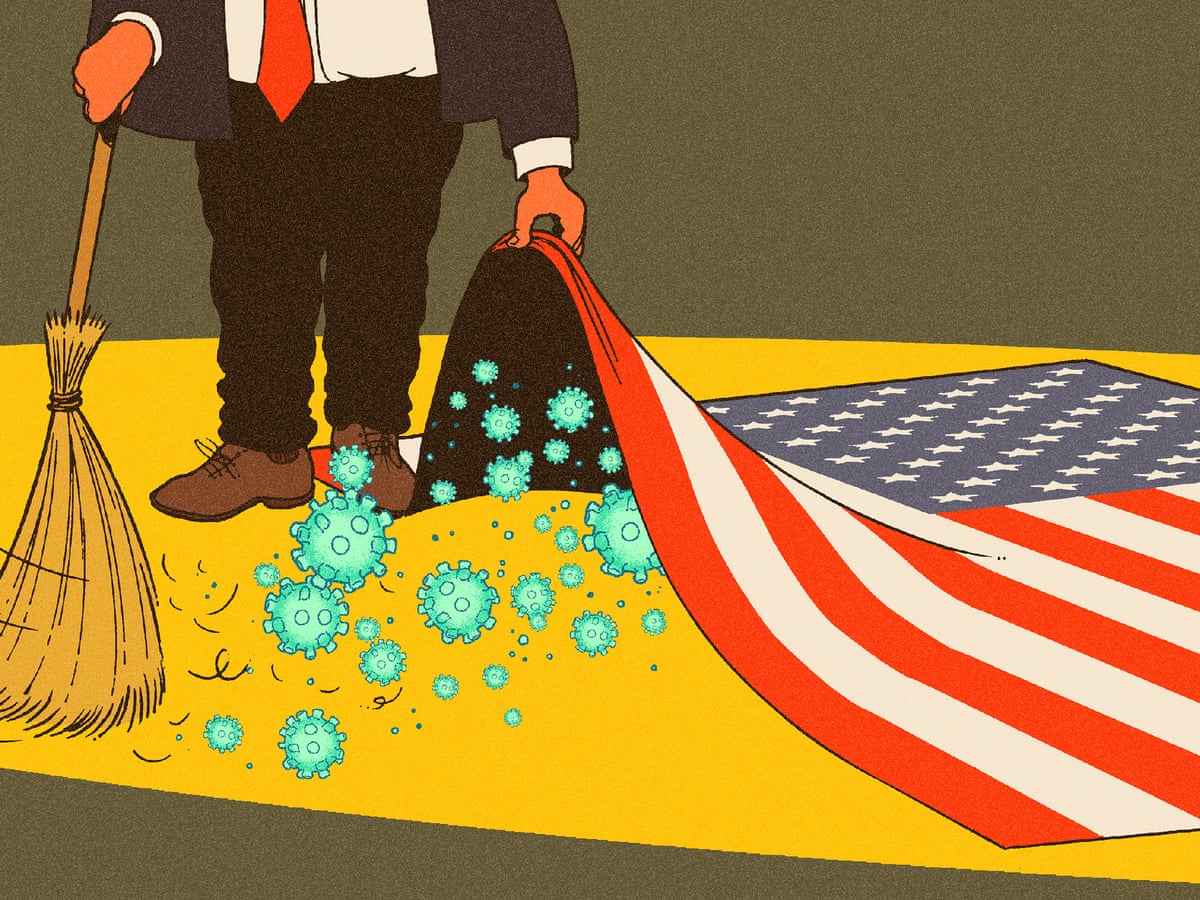
Cartoon – War on the Truth

Donald Trump's war on coronavirus is just his latest war on truth |  Jonathan Freedland | Opinion | The Guardian

Cartoon – Do You Believe in Magic?

There's much blame for Florida teen's COVID death | COMMENTARY - Baltimore  Sun