

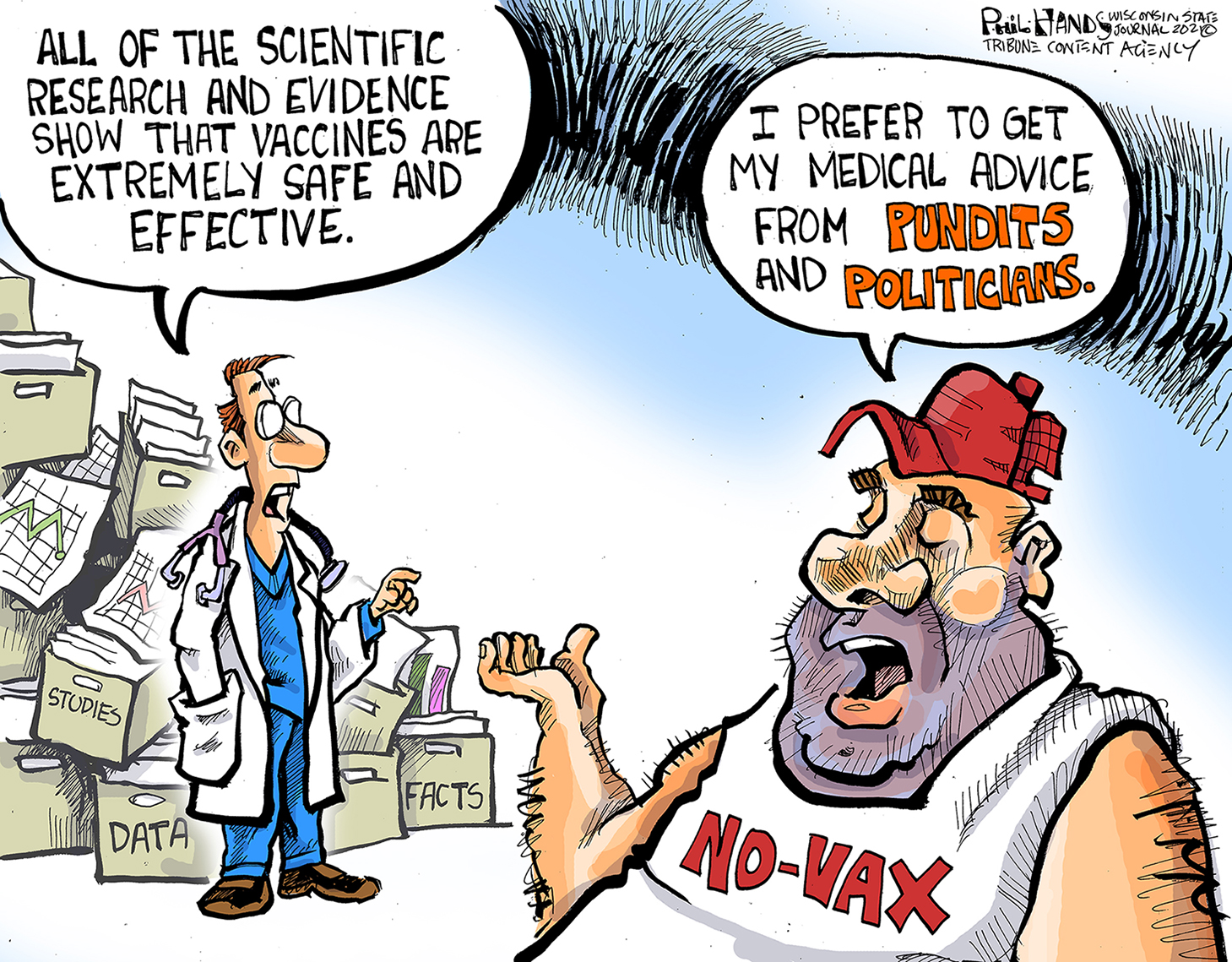
State of Union on Vaccines
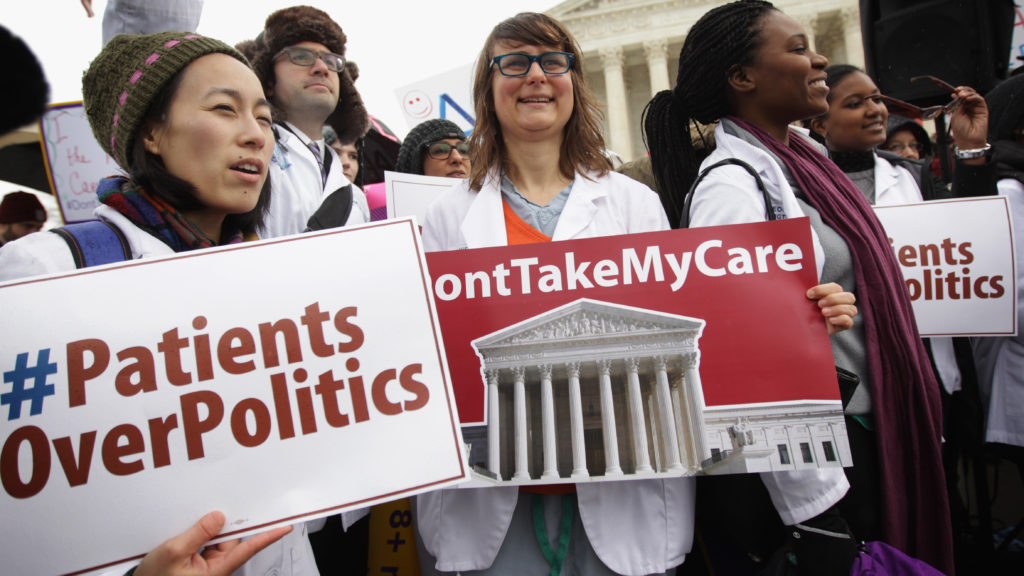
Last week, during the U.S. Senate and House recess and back-to-school rush, media attention to healthcare was negligible. Healthcare trade media noted impressive earnings for Moderna and Bon Secours and the WSJ Journal announced a Medicare Advantage partnership between Costco and SCAN. No major Executive Orders from the White House or CMS rule changes. No major clinical breakthroughs, vaccine policy changes or lawsuits. But a couple of new reports frame the existential risk facing the industry: spending.
The common theme in both is the steady growth of healthcare spending—faster than wages, higher than inflation and GDP growth and increasingly the result of higher prices for drugs, specialty services, facility modernization, technology and administrative overhead.
The industry’s aversion to transparency, protection of its business-to-business economics and dependence on private investment perpetuate four myths that justify its proclivity for uncontested spending:
As the midterm election November 3 nears, affordability and costs of living will be prominent in campaign rhetoric. Polling indicates healthcare costs, especially insurance premiums, prescription drug costs and hospital care, factor heavily in how voters assess promises on the campaign trail. Both parties espouse the need for systemic change in healthcare citing affordability for their reasoning. Three general solutions have found their way into this election cycle:
The reality is none of these is without risk, and voters are wildly misinformed about all. But there’s no doubt they’ll be on the table as a majority consensus forms around a better system. They’re sick of the status quo. They see little difference between not-for-profit and for-profit operators and want something better. They see healthcare spending increases as the product of an industry that cares about its profit first and everything else second.
Healthcare spending—contributing factors and mitigation– is a topic every organization in healthcare must address candidly and holistically. There should be no delusion that interest will subside anytime soon. Just as consumers are rewarding organizations in financial services, retail, higher education and organized religion that offer “newer, better” alternatives, the healthcare landscape will be re-defined by those that do more than opine about affordability and conduct business as usual.
As the nation pivoted to its Back-to-School routines last week while the Senate and House were recessed, the new cycle paid attention to familiar stories:
On page one…
On page two…
I am a news junkie. I depend on real-time news feeds across the spectrum from conservative to progressive thru traditional and unconventional sources.
I am a healthcare guy: I study the health system to monitor trends, emergent themes and credible studies that influence its policies, performance and winners and losers.
And I am a consumer: I live a relatively normal life hoping to take care of my family and spend time on matters that matter. Increasingly, that involves the health and wellbeing of those I love.
Last week was inconsequential in the big scheme of healthcare: media attention was limited. The 3 court proceedings carried underlying themes of mental health. Reporting about the economy centered on costs of living sans household health costs chronically overlooked in business reporting. And posturing for the November 3 general election sparked commentary about Democratic socialism and Republican intent to make political points on healthcare.
This week will be no different. Healthcare news will largely be subordinate to Page One headlines unless a pandemic at home is declared or a celebrity’s personal health challenge is disclosed on a slow news day.
National media with few exceptions cover healthcare incompletely and inconsistently. In-depth coverage is rare. Investigative reporting is pre-wired toward misdeeds and corporate greed. Local media is equally inclined but budget limitations limit local coverage.
And social media are all over the place: misinformation, inadequate verification/validation of primary sources, and bias are systemic.
I believe the U.S. health system’s loss of trust and confidence is a direct result of its inadequacy in communicating. That’s not to say it hasn’t tried but it’s strategies and tactics have failed for obvious reasons:
The future of the U.S. health system is uncertain. It faces huge barriers to sustaining its “too big to fail” big brands. Its biggest hurdle will be public support.
The entire industry is now on the defensive. Old playbooks used to tell its stories no longer work. It’s a challenge for most.
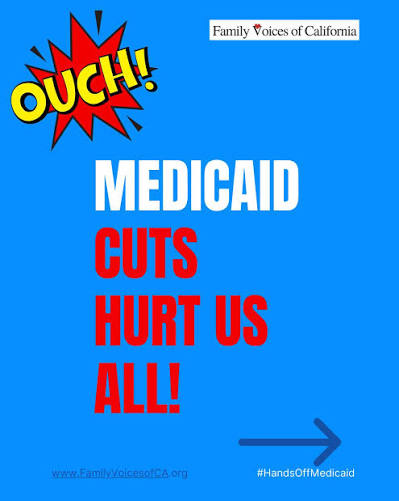
I was in the 10th grade at Tyner High School in Chattanooga when Medicaid passed as Title XIX of the Medicare and Medicaid Act of 1965. It was the cornerstone of President Johnson’s War on Poverty providing federal funding to states to facilitate access to the health system Americans along with dependent children, seniors, blind, and disabled individuals with insufficient income.
Medicaid, then as now, was the understudy to Medicare. It was understandable: per capita costs for caring for seniors were three times those in Medicaid, and aging was the tsunami health officials saw. In the 60-years since, Medicare has become the arbiter for federal reimbursement in every setting where seniors received services. It has enabled hospitals and specialty care to expand and limited preventive and primary care to the bare minimum. And its version of managed care, Medicare Advantage plans, now enroll over half its 70 million enrollees. It’s ridden on the back of federal policy, while states have been left to fend for themselves in Medicaid. But that’s changing.
While Medicare has gotten the majority of attention from hospitals, physicians, insurers and drug companies historically, it is Medicaid that’s taking center stage in the U.S. health system. Here’s why:
Much of this can be traced to deep-seeded beliefs about Medicaid that span generations. In my focus groups with working age adults, the majority believe the U.S, economic system is more challenging for lower-income, uneducated and non-white populations. A significant number associate Medicaid with ‘welfare’ and believe waste and fraud prevalent though the intensity of these views varies widely.
In my surveys, Medicaid enrollees are slightly more likely to agree the health system is broken and favor government intervention than other groups. And the majority in every insurance, age, household income and region agree the system’s unnecessarily expensive and significantly more focused on profits than patient care. They see Medicaid as part of a complex system that’s unfair, unaffordable and unnavigable.
My take:
The public’s views about Medicaid are complicated: the majority believe everyone regardless of income or insurance status should have access to the system, and there’s consensus the system in its current form will not survive. The majority of voters regardless of party label believes Medicaid needs to be fixed but no consensus on how or by whom.
Results from Medicare’s cost containment efforts—accountable care organizations, alternative-payment models, value-based purchasing, price transparency et al—have been mixed. By contrast, Medicaid initiatives in states ranging from payment integrity programs to changes in state directed payment policies have produced significant savings necessary to surviving the $1 trillion, 10-year cut to federal Medicaid funding in the Big Beautiful Bill.
Medicaid is the health system’s most important platform for applying evidence to care cost-effectively from cradle to grave.
New STAT reporting reveals the IRS is seeking back taxes from UnitedHealth Group over foreign subsidiary transactions — adding to the conglomerate’s growing list of federal headaches.
In a big scoop this week, STAT’s Bob Herman revealed that the Internal Revenue Services is investigating UnitedHealth Group over what the agency says was an underpayment of taxes between 2017 and 2020 involving transfers of money to a foreign subsidiary.
According to STAT, the IRS is “seeking to significantly increase taxable income” reported by the company during those four years, and the dispute could extend to tax years after 2020. UnitedHealth disclosed in a recent regulatory filing that it received notices from the IRS in March.
The piece notes that this is not a routine tax audit. Investigations like this (involving what is known as “intercompany transfer pricing”) are exceedingly rare and typically examine how large multinational corporations allocate profits and expenses among subsidiaries in different countries. Which could lead one to assume there is a significant amount of money involved.
UnitedHealth disputes the IRS’ findings and says it intends to “vigorously contest” the proposed adjustments. It is not yet known which of the company’s many foreign subsidiaries is involved.
Herman also got an unusual glimpse behind the curtain: STAT was copied on internal emails about how UnitedHealth should respond to his questions, including one in which spokesperson Tyler Mason said he left out an explanation for withholding IRS documents because it “sounded too defensive.”
Last year, the Center for Health & Democracy released the Sunlight Report on UnitedHealth Group which documented – for the first time – 2,694 subsidiaries and affiliated entities tied to the health care titan. That vast corporate structure shows that UnitedHealth has become so much more than the insurance company folks recognize from a card in their wallet. These days, through its subsidiaries UnitedHealthcare and Optum, this giant corporation’s reach stretches far beyond traditional health insurance. It has branched into physician practices, pharmacies, pharmacy benefit management, data analytics and numerous other corners of the health care system – and the world – with more than 150 international entities in the Sunlight Report’s tally.
And many of UnitedHealth’s international entities, as of late, have become thorns in the company’s side.
Last summer, HEALTH CARE un-covered wrote about the company’s desire to unload its subsidiary Banmédica (a Latin American health insurer and health care provider that operates hospitals and medical centers) after it racked up more than $8 billion in losses and pressures at home mounted. By November 2025, UnitedHealth had struck a roughly $1 billion deal to sell Banmédica to a Brazilian private equity firm.
UnitedHealth Group, the behemoth health insurer that has steadily transformed itself into a global health care conglomerate, is now looking to offload part of that empire to appease shareholders.
While that deal has continued moving toward completion, the latest we know is that the agreement is still awaiting final regulatory approval. There is no indication that Banmédica is the foreign subsidiary at the center of the IRS investigation but the two stories underscore the sheer complexity of UnitedHealth’s corporate structure and global reach.
Financially, at least, the company appears to have regained its footing after one of the most turbulent stretches in its history. It wowed Wall Street when it announced that its profits increased a whopping 55% during the second quarter of 2026, from $5.2 billion at the end of 2Q 2025 to $8 billion in 2Q 2026. That puts the company on track to post profits for the year north of $30 billion.
But quarterly success is not the full picture. Make no mistake, UnitedHealth already had some very real problems behind the scenes — and that’s before this latest IRS situation:
None of these investigations or allegations establishes that UnitedHealth broke the law, and the company has disputed allegations of wrongdoing.
But taken together, they make for quite a contrast. UnitedHealth and its web of subsidiaries just reported another multibillion-dollar quarter at the same time that federal authorities are essentially digging through its trash — from its Medicare Advantage business and pharmacy benefit operations to, now, how it may have moved money through a foreign subsidiary for tax purposes.

Last Saturday, while watching the Phillies take on the Minnesota Twins (Phillies won 9–1. Go Phils!) I (Joey) couldn’t help but notice the UnitedHealthcare-branded cushions lining the seats behind home plate. UnitedHealthcare, for those keeping track of the corporate family tree, is the health insurance subsidiary of UnitedHealth Group. UnitedHealthcare is commonly abbreviated as UHC (that’s what was on the seat cushions), while its parent company, UnitedHealth Group, is often shortened to UNH, its stock ticker.
And the joke I’m trying to make here is pretty simple: There’s no escaping UnitedHealth’s reach… not even at a baseball game!🥁
The game was at Target Field in Minneapolis, and Minnesota-based UnitedHealth Group, through its UnitedHealthcare subsidiary, has a longstanding partnership with the Twins. So while the Phillies were busy routing Minnesota on the field, UnitedHealth Group was getting plenty of airtime behind their hometown home plate. (Our premium dollars at work!)

Today, the Center for Health and Democracy updated the Health Insurance Influence Tracker, a publicly available tool examining how the health insurance industry uses political contributions to build power in D.C. Since 1999, the companies captured in the tracker, representing vertically-integrated for-profit corporations like UnitedHealth Group, CVS/Aetna, Cigna, and Elevance and several of the trade associations representing them, have donated more than $100 million to campaigns, including $34.9 million to current members of Congress.
For additional information and analysis on the Health Insurance Influence Tracker, see CHD’s report here.
So far in the 2026 cycle, big insurers and their largest PR and lobbying groups – AHIP, the Blue Cross Blue Shield Association (BCBSA) and the Pharmaceutical Care Management Association (PCMA), which represents insurers’ pharmacy benefit managers – have donated more than $11 million toward campaigns and campaign committees, putting them on track to exceed recent election cycle totals of $15-$17 million. What we found is that the insurance industry is donating strategically to almost every ideological group: bipartisan giving dedicated to strengthening the corporate-friendly branches of each party. With health care shaping up to be one of the biggest issues in the midterms, the industry’s involvement shows the tactics they’re using to stop reform momentum before it can take hold in a new Congress.
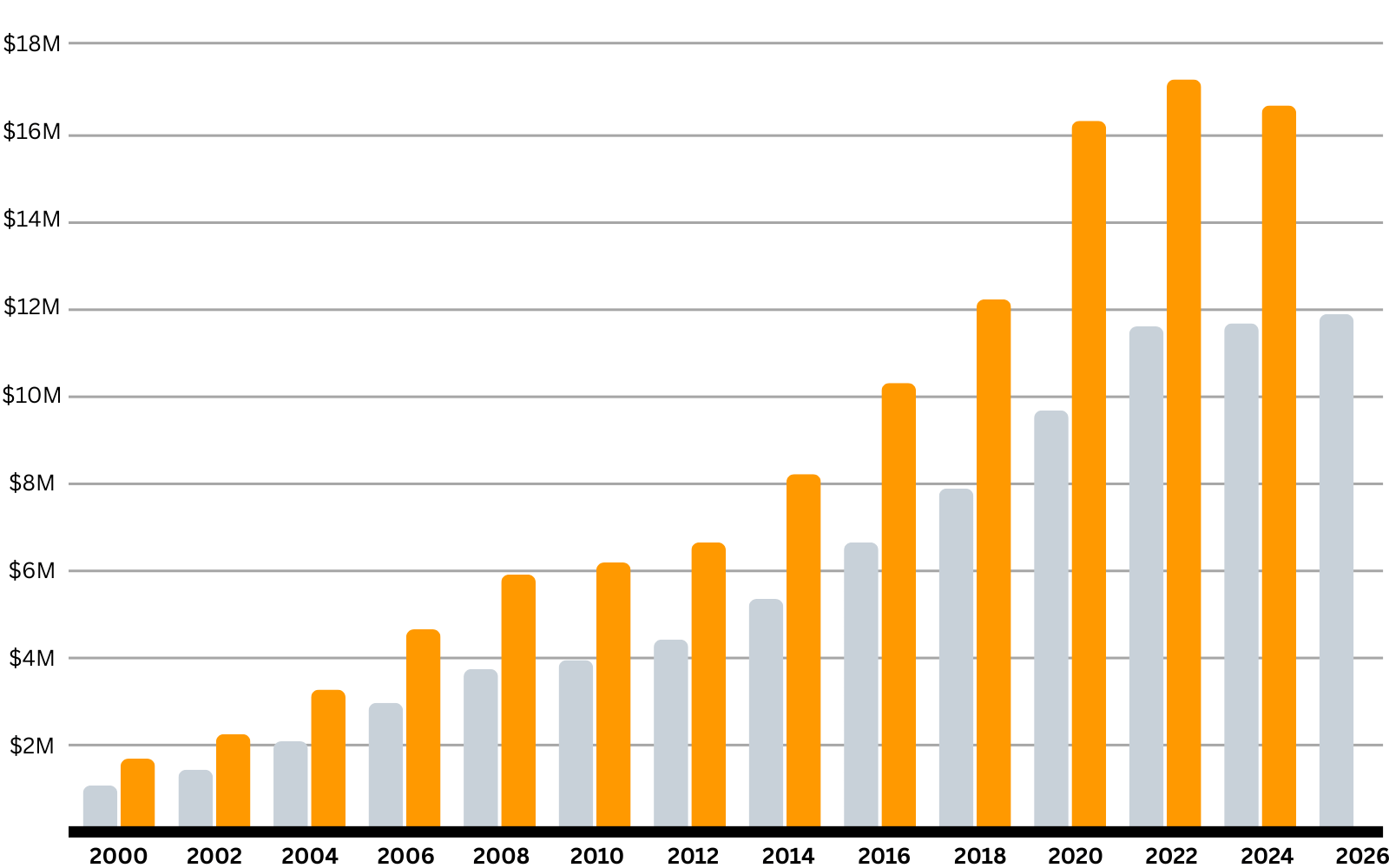
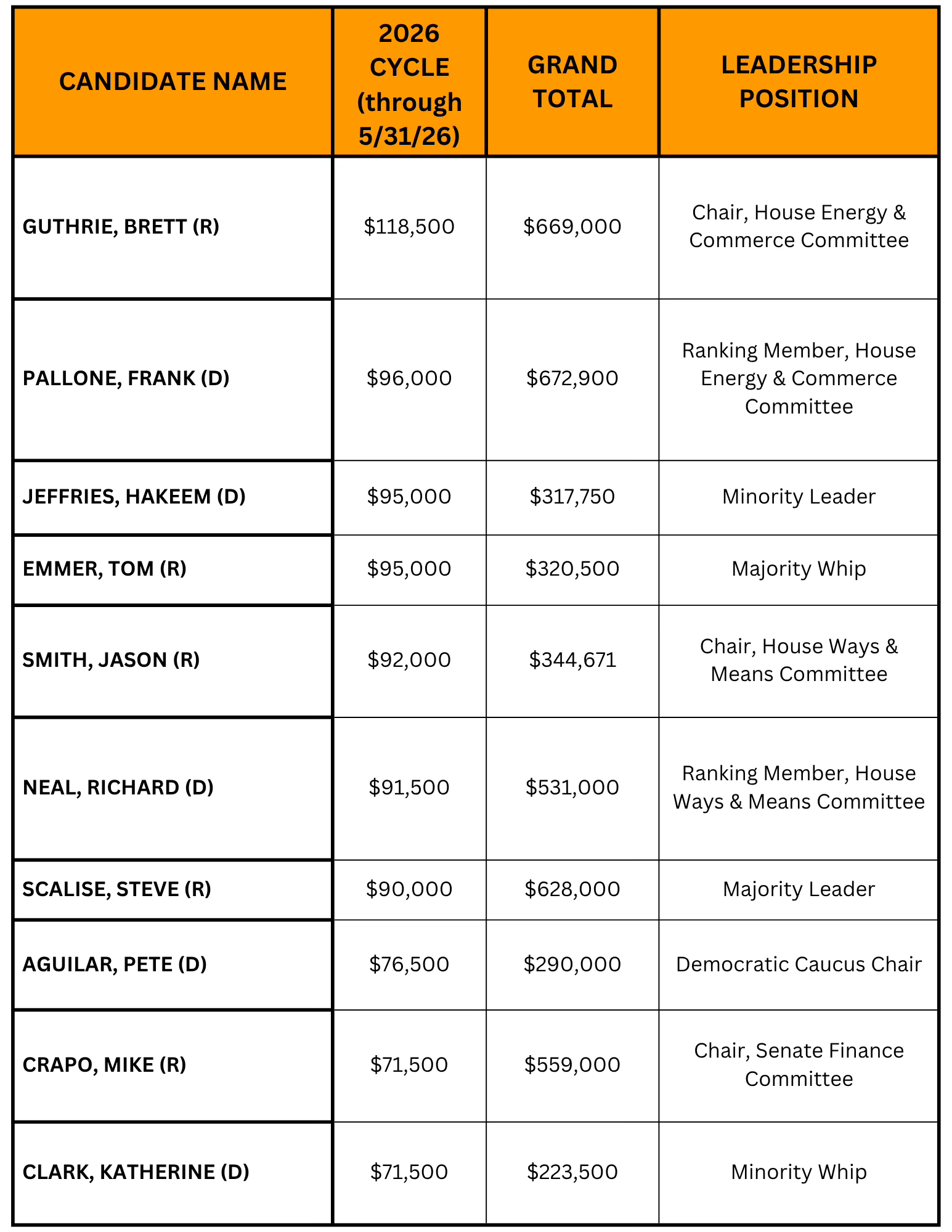
Corporate health insurers have been busy in the 2026 cycle, donating $11.91 million so far, of which $5.73 million went directly to sitting members of Congress. Many of the same patterns from past cycles are repeated here; so far since the 2024 election, ten members have received more than $70,000 from the health insurance companies, all members of Congressional or party leadership.
Similarly, we can see how insurers are making strategic bets on potential future leaders or swing votes. Senators like Maggie Hassan, currently the ranking member on the Senate Finance Committee’s Subcommittee on Health, and Brian Schatz, widely reported to be seeking a higher position in Senate leadership, have seen thousands in donations this cycle, despite not being up for re-election for another two years.
Insurers donated heavily to incumbents in battleground races, but have also quietly poured money into primaries, wading into several intra-party fights this cycle.* Donations to more moderate candidates, like Democrats Haley Stevens in Michigan and Angie Craig in Minnesota, and Republicans John Cornyn in Texas and Kevin Hern in Oklahoma, fit with the overall party giving: moderate party groups, the New Democrat Coalition, Blue Dogs, Republican Main Street, and Tuesday Group are continuing to see disproportionate generosity from these companies.
However, even in primaries with multiple progressives, health insurers are staking out a side, which illustrates an important difference between paying lip service to progressive health policies like Medicare for All and truly fighting for them. In Colorado’s first congressional district, incumbent Representative Diana DeGette, the ranking member of the House Energy & Commerce Committee’s Subcommittee on Health, and her opponent, Melat Kiros, both say they support Medicare for All, with Representative DeGette being a longtime cosponsor of the bill. Theoretically, support of the Medicare for All Act, a bill that would prohibit private insurance from duplicating the medical and prescription coverage offered by Medicare, is an existential threat to the health insurance industry and the candidates would not garner financial or other support from their PACs. Yet in this race, as in many others, the incumbent continued to receive significant donations from insurance PACs, suggesting that the PACs see the incumbent, although they put their name on the Medicare for All bill, as someone they would be able to count on if the legislation were to gain traction. DeGette was ultimately defeated by Melat Kiros, who made rejecting all corporate PAC money a centerpiece of her campaign.
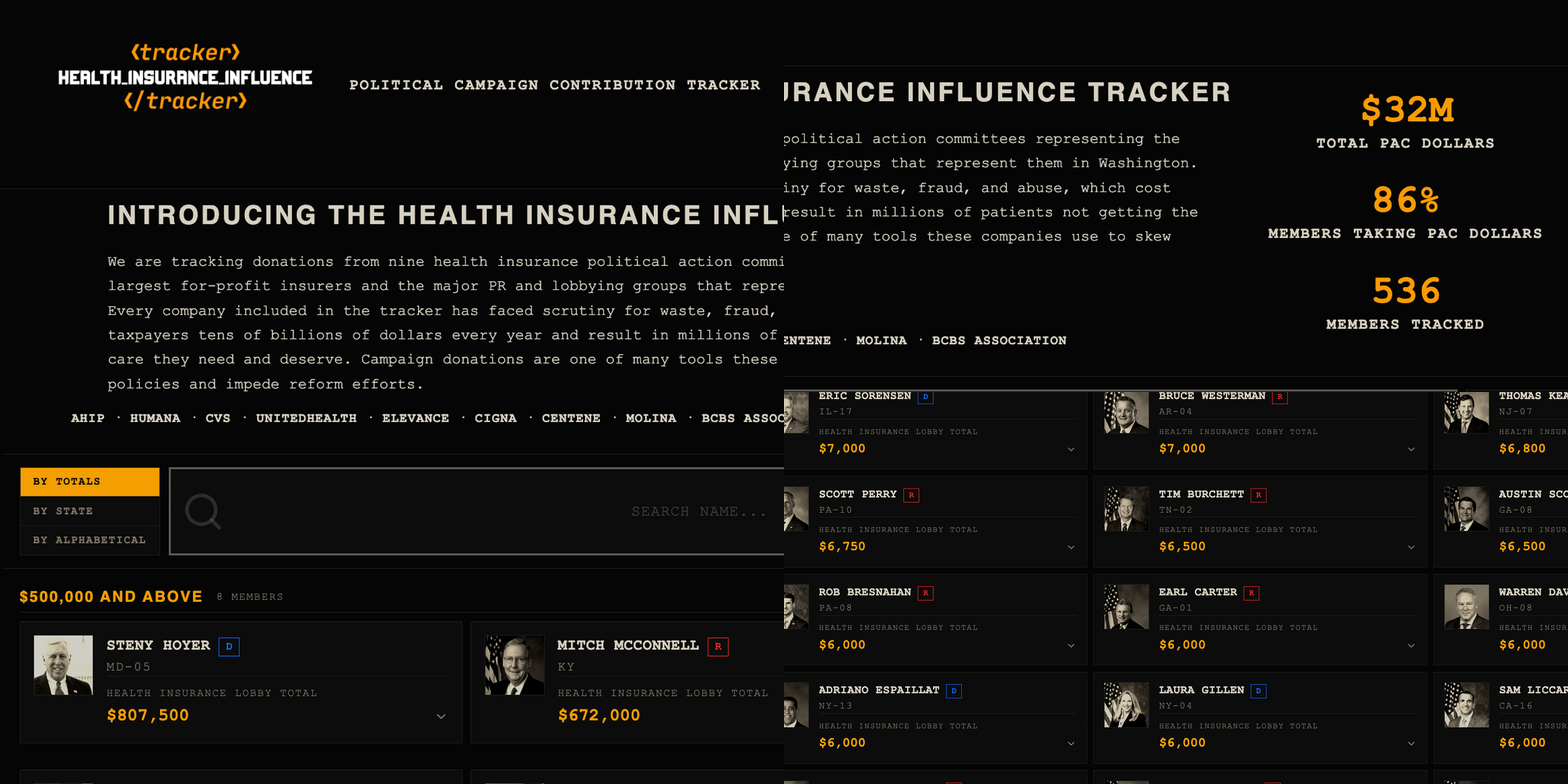
The Center for Health & Democracy Education Fund has released the first campaign contribution tracker covering the health insurance lobby.
Voters in Missouri’s first district faced a similar choice last week. In 2024, when Wesley Bell challenged Cori Bush for the seat, the insurance industry stayed out of the primary altogether, and only two PACs donated a joint $5,000 to Bell’s general campaign in September of that year, standard for a new member without relevant committee assignments. During this cycle, the health insurance lobby poured $31,000 from six different PACs into his campaign (former Representative Bush does not accept any corporate PAC money), a clear signal of which of the two, both co-sponsors of the Medicare for All legislation, insurers believe will least harm their bottom lines. Bell won the primary with 59% of the vote.
The Health Insurance Influence Tracker only includes incumbent members of the 119th Congress. Any analysis of challengers was conducted using Schedule B data sourced from fec.gov
New data finds rapidly declining satisfaction and trust among Medicare Advantage enrollees, particularly around costs and coverage.
Americans enrolled in Medicare Advantage plans are becoming increasingly less satisfied with their coverage (and increasingly skeptical that their insurers are looking out for them) according to the new 2026 U.S. Medicare Advantage Study from JD Power.
The study found that overall satisfaction with Medicare Advantage plans fell for the second year in a row (dropping 12 points) and has dropped 41 points since 2024. On JD Power’s 1,000-point scale, the average Medicare Advantage plan now scores 611.
JD Power surveyed 14,559 Medicare Advantage health plan enrollees across 12 major markets between January and June. Researchers evaluated insurers on eight parts of the enrollees’ experience, including trust, access to health services, whether plans save them time and money, whether coverage meets their needs, customer service and how well complaints are resolved.
Satisfaction with plans’ ability to help enrollees save time and money fell 51 points. Their level of trust fell 49 points, while satisfaction with whether a plan’s coverage actually met their needs dropped 47 points.
And fewer than half — just 43% — of people enrolled in Medicare Advantage plans strongly agreed that their insurer was a “trusted partner” in their health and wellness.
One of the clearest differences between higher- and lower-performing plans came down to something relatively basic: helping people understand the insurance they just bought.
JD Power did not produce one nationwide ranking of every Medicare Advantage insurer. Instead, it compared plans within 12 individual markets. Below the simple version of which insurer scored highest in each:
Tennessee’s Blue Cross Blue Shield plan received the highest score of any market winner, at 690, narrowly ahead of Pennsylvania’s UPMC For Life at 689. The results have also been summarized by Becker’s, which published both the highest-rated plans and lowest-rated plans in each market.
The rankings also show how much people’s experiences with national insurance companies can vary from state to state. UnitedHealthcare, for example, finished first in Florida, Georgia and North Carolina and second in Illinois, Kentucky, Texas and some other markets included in the study. Yet its Michigan plan received a score of just 571, making it the lowest-rated plan JD Power measured in that market.
Humana showed an even wider divide. It finished first in Kentucky and Texas, but its New York plan received a score of 554 — the lowest score reported across all 12 markets.
The federal government has also changed how Medicare Advantage plans are evaluated. Earlier this year, the Centers for Medicare & Medicaid Services (CMS) finalized a significant overhaul of its Star Ratings system, which is supposed to measure the quality and performance of Medicare Advantage and Part D plans. Insurers watch the measures closely because they affect bonus payments they receive. CMS claims the changes will simplify the ratings and focus them more heavily on clinical care, health outcomes and patient experience. The changes include eliminating 11 measures — several related to complaints, appeals and call-center performance — and abandoning a planned Health Equity Index reward intended to incentivize better performance for certain enrollees, including people who are low-income, disabled or dually eligible for Medicare and Medicaid. Instead, CMS will retain its older reward system for plans that perform consistently well across measures.
CMS argues that some of the measures being eliminated are administrative, duplicative or do little to distinguish one plan from another, and that trimming them will make Star Ratings more useful to beneficiaries. But the changes have drawn criticism from Democratic lawmakers and Medicare consumer advocates, who argue that CMS is removing some of the very measures that can help hold insurers accountable for how they treat patients.
In an April letter to CMS Administrator Mehmet Oz, Sen. Elizabeth Warren and seven other Democratic senators specifically objected to the removal of administrative measures that track complaints involving the timeliness or accuracy of prior authorization decisions. The senators argued that weakening those measures is particularly concerning at a time when Medicare Advantage insurers are facing scrutiny over care denials and billions of dollars in estimated overpayments from the federal government.
The letter also pointed out that Oz has publicly acknowledged that prior authorization can significantly delay care and erode trust in the health care system, yet CMS is removing some Star Ratings measures related to prior authorization while the administration is simultaneously testing A.I-powered prior authorization in traditional Medicare via the Wasteful and Inappropriate Service Reduction (WISeR) program.
The Medicare Rights Center, an advocacy organization representing Medicare beneficiaries, has criticized CMS’s decision to scrap the Health Equity Index before it ever took effect and return to the previous reward factor. The group also objected to CMS eliminating a requirement that plans notify members midway through the year about supplemental benefits they are eligible for but have not used.
And the rollback extends beyond the Star Ratings themselves. The final rule eliminates requirements for Medicare Advantage utilization-management committees to include a health-equity expert, analyze how their policies affect certain populations and publicly report those analyses.
The Alliance of Community Health Plans, which represents nonprofit regional health insurers, praised CMS for eliminating the Health Equity Index and said the broader Star Ratings changes would shift the program away from “documentation and paperwork” and toward patient experience and health outcomes.
For insurers, there is a lot of money riding on those Star ratings. CMS estimates that Medicare Advantage plans will receive more than $13 billion in additional federal payments next year — even as the government adjusts how plans are scored (and paid) and results like JD Power’s get released. That is in addition to the $76 billion in overpayments that MedPAC, an independent organization that advises Congress on Medicare issues, says the government is paying Medicare Advantage insurers this year alone.
The JD Power results, however, offer another way of looking at the program: not simply whether insurers are meeting government quality metrics, but whether the people enrolled in their plans actually feel that the coverage is working for them. And by that measure, satisfaction is moving fast in the wrong direction.


Big Insurance has hauled in $500B in profits since 2014— enough to cover extending the enhanced ACA subsidies and leave $150B — yet it’s gone to shareholders and executive bonuses instead of patients.
As open enrollment begins and Congress remains deadlocked on whether to extend the ACA’s enhanced premium subsidies, one question looms large: Where does all the money we pay for health coverage actually go?
It’s a fair question. Premiums and out-of-pocket costs have risen relentlessly over the past decade. Since the Affordable Care Act was fully implemented, the average premium for an ACA marketplace plan has doubled, and the average deductible for a Silver plan has increased by 92%. Every year, families pay more, yet the coverage often feels thinner.
Health insurance companies routinely claim these increases simply reflect rising medical costs and higher utilization. For example, when justifying rate hikes in 2024, Cigna of Texas wrote:
“The increasing cost of medical and pharmacy services and supplies accounts for a sizable portion of the premium rate increases.”
But the financial filings of these same companies tell a different story.
As Wendell Potter recently wrote, from 2014 to 2024 the seven largest publicly traded health insurance companies, UnitedHealth Group, CVS/Aetna, Cigna, Elevance (formerly Anthem), Humana, Centene, and Molina, reported that they collectively made more than half a trillion dollars in profits.
That’s money collected from individuals, employers and taxpayers for health coverage — dollars that didn’t go to medical care but instead flowed to corporate shareholders and executive bonuses. To put this in perspective, those profits alone could fund the enhanced ACA premium subsidies for another ten years, at an estimated cost of $350 billion.
Over the same period, these seven companies spent $146 billion buying back their own stock or, in other words, using premium dollars from patients and employers to boost share prices and executive compensation (the CEOs and many other top executives of big insurers are compensated primarily through stock grants and options).
Stock buybacks don’t lower premiums, expand networks, or improve care. They simply make investors and executives richer. If that same money had been reinvested in enrollees, it could have provided premium-free health coverage to more than 5 million families for an entire year, based on the average employer-sponsored plan cost of $27,000 in 2026.
Insurers aren’t just rewarding shareholders, they’re also shaping the political system that protects their profits. Since 2014, the seven largest insurers and their trade association, AHIP, have spent $618 million on lobbying.
That’s money that could have been used to lower out-of-pocket costs or improve patient care, but instead it’s spent to influence Congress and federal agencies to maintain the status quo.
As the cost of health insurance continues to climb, politicians debate how to control those costs and expand coverage. But the truth is, there’s already enough money in the system to cover everyone. It’s just being siphoned off by insurance corporations for profits, lobbying, and stock buybacks.
Though some have been calling for less regulation of Big Insurance, that is not the answer and is partly how we ended up in this situation. Right now, Big Insurance is allowed to use premium dollars and tax dollars on things that do nothing to improve anyone’s health – such as stock buybacks and lobbying – instead of on medical care.
Rather than asking families and taxpayers to pay more, it’s time to demand accountability from insurers. At a minimum, they should not be allowed to use premium dollars, or taxpayer dollars, to enrich shareholders through stock buybacks (which wasn’t even legal until the 1980s) or lobby for policies that drive up costs.
If we want to contain health care costs, the first step is simple: Stop the profiteering by Big Insurance.

New analysis shows hospitals are increasingly closing in poorer communities while new facilities are built in wealthier ones, reshaping access to care along economic lines.
As I wrote a few days ago, 700 rural hospitals are in danger of closing because they’re not getting enough money from either private insurers or Medicare and Medicaid to stay open. That would be on top of the 743 general acute-care hospitals that have closed across the United States since 2000. In that same stretch of years, however, hundreds more hospitals have opened. Taken together, that sounds almost reassuring — a sector in churn, but not in freefall. Yale’s Health Care Affordability Lab, which just published the most comprehensive accounting of this churn to date, even framed it that way: for every ten hospitals that closed, eight opened.
But churn isn’t neutral. It matters enormously where the closing happens and where the opening happens, because, as it turns out, they are not the same places.
I pulled the underlying hospital-level data behind Yale’s new numbers and matched every closure and opening since 2000 to its county, then layered in U.S. Census data on income, poverty, and population density. The pattern that emerged is clear: The hospitals closing serve poorer communities than the hospitals opening. Almost all of the new hospitals were built in zip codes with wealthier residents.
The median household income in counties where hospitals closed was $45,992. In counties where hospitals opened, it was $52,873 — nearly $7,000 higher.
Breathe data into income quintiles and the divide sharpens further. Hospitals closing in the poorest fifth of U.S. counties outnumber hospitals closing in that same tier by three-to-one compared with openings. Meanwhile nearly three-quarters of all new hospitals — 73% — have opened in the richest 40% of counties. The country isn’t just losing hospitals and gaining hospitals. It’s losing them in one America and gaining them in another.
The easy explanation is that this is just population following growth — hospitals close in the declining Rust Belt and open in the booming Sunbelt, and income differences are just a side effect of which regions are growing. I checked for that, because it would matter: if that’s all this is, it’s a story about demographic drift, not about who a health system chooses to serve.
It isn’t just that. I broke the same comparison out by state, and in 23 of the 24 states with enough closures to compare, the hospitals that closed were in lower-income counties than the hospitals that opened — within that same state. Illinois lost hospitals in counties averaging $52,693 in household income while gaining them in counties averaging $65,217. Minnesota: $51,525 versus $72,971. North Carolina: $38,090 versus $49,874. Even in Texas — which added a net 40 hospitals, the best record of any state — the closed hospitals were in counties averaging nearly $10,000 less than the counties where new ones opened. The only state in the sample where this didn’t hold was Arizona, and there it was essentially a wash.
That consistency shows this isn’t primarily a story about regional growth patterns. It’s a story about who health systems — hospital operators, investors, health systems chasing better payer mix — decide is worth building for, and it’s happening inside the same state borders, sometimes inside the same metro areas, at the same time.
It’s important to be somewhat specific about which facilities are closing, because “hospital closure” isn’t one phenomenon. Some of what shows up in this data is the slow bleed familiar to anyone who’s covered rural health care: all too often, the last hospital in a county goes away and with it obstetrics, the ER, and in many cases the last stable employer in town. But some of the closures in dense urban counties are something else — consolidation, where systems fold a facility into a nearby campus.
What both kinds of closures share, though, is the income pattern. Whether it’s the last rural hospital in a county or an urban system trimming a facility in a lower-income neighborhood, the destination for new capital is disproportionately a wealthier community or across the state.
If you live in the county that lost its hospital, the fact that a gleaming new facility opened forty minutes away in a wealthier suburb does not shorten your ambulance ride, doesn’t help you deliver a baby, and doesn’t change the calculation an uninsured or underinsured patient makes about whether a symptom is worth the trip.
Health systems, quite rationally from a balance-sheet perspective, build where the payer mix is better — commercial insurance, higher reimbursement, wealthier patients who can absorb high-deductible cost-sharing. They close or shrink where the payer mix is worse — more Medicaid, more Medicare Advantage, more uninsured, more bad debt. Every individual decision can make business sense. The aggregate effect, repeated in state after state for a quarter century, is a health care system quietly re-sorting itself by income, county by county.

