84% of Execs: Artificial Intelligence Will Transform Healthcare

https://healthitanalytics.com/news/84-of-execs-artificial-intelligence-will-transform-healthcare?elqTrackId=c6140df4d8a94e82a5d7d8437ad150ef&elq=90c2d69c50ef46bd93f5e84b05759130&elqaid=2827&elqat=1&elqCampaignId=2613

Artificial intelligence in healthcare

Artificial intelligence has the potential to completely revolutionize the way healthcare systems interact with their patients.

More than 80 percent of healthcare executives polled by Accenture believe that artificial intelligence is on track to completely revolutionize healthcare, and a similar number believe that the advent of machine learning and digital healthcare is driving a significant restructuring of industry economics.

“AI is the new UI,” proclaims the report. “It’s a new world where artificial intelligence is moving beyond a back-end tool for the healthcare enterprise to the forefront of the consumer and clinician experience.”

“AI is taking on more sophisticated roles, with the potential to make every technology interface both simple and smart – setting a high bar for how future interactions work.”

The report envisions a healthcare environment where AI can take over the majority of processes currently overseen by humans.  Consumer relations and patient engagement are likely to be among the first tasks to undergo the shift.

Eighty-four percent of executives believe that AI will fundamentally alter how they gain information from patients and interact with consumers.  A similar number have prioritized the implementation of centralized platforms that take advantage of messaging bots and other services.

More than three-quarters believe that these decisions will make or break their ability to develop a competitive advantage over their peers in the near future.  Eighty-two percent agree that industry leadership will be defined by how well healthcare organizations architect comprehensive, seamless digital ecosystems that truly understand what motivates the choices of their patients.

“The new frontier of digital experience is technology specifically designed for individual human behavior,” the report asserts. “Healthcare leaders recognize that as technology shrinks the gap between effective human and machine cooperation, accounting for unique human behavior expands not only the quality of the experience, but also the effectiveness of technology solutions.”


Collaboration, Big Data Help Phoenix Children’s Focus on Value-Based Care

https://healthitanalytics.com/news/collaboration-big-data-help-phoenix-childrens-focus-on-value-based-care?elqTrackId=548d952fb9e64232b95d35d69a4fa9dd&elq=90c2d69c50ef46bd93f5e84b05759130&elqaid=2827&elqat=1&elqCampaignId=2613

The exterior of Phoenix Children's Hospital in Arizona

Phoenix Children’s collaborative approach to value-based care relies on community input, big data analytics, and a physician-driven quality measurement program.

Mergers, acquisitions, and new partnerships can be a scary prospect for healthcare organizations, no matter which side of the negotiating table they are occupying.

In addition to potential cultural changes, staffing adjustments, and new workflows to adopt, organizations joining forces in the era of value-based care often have to adopt to new electronic health record systems and accept different strategies for measuring their quality, productivity, and outcomes.

While a successful union can rescue revenue cycles, and bring renewed vitality to flagging providers, healthcare organizations must carefully navigate the delicate acquisition process to ensure that new members of the team have the skills and tools required to reach their full potential.

At Phoenix Children’s, one of the largest pediatric health systems in the country, a desire to offer comprehensive care to the community has led to a firm reliance on big data analytics to gather actionable financial and clinical insights from a rapidly growing provider network.

Over the last three years, Phoenix Children’s has brought more than 100 independent practices into the fold, says Chad Johnson, Senior Vice President and Executive Director of the Phoenix Children’s Care Network – and full data transparency is a fundamental requirement for each and every new member of the team.

The ability to use big data analytics to measure productivity, quality, and financial success within a comprehensive network of care will be vital for Phoenix Children’s as it continues an ambitious move into value-based reimbursements.

“During 2017, we’re moving around 100,000 lives into fully risk-based models,” Johnson explained to HealthITAnalytics.com.  “We’re doing this because we believe that the way to truly influence outcomes is to own the medical management of our populations.  Hospitals will need to have a much larger footprint – a larger, integrated network – that includes independent primary care and specialty groups under one umbrella.”

“We want to move aggressively down this path because we feel that unless you’re willing to take that step, you’re never going to be able to really bend that cost curve,” he added. “We’re confident that we can step up to the plate and succeed in a risk-based environment with the strategies we’re cultivating.”

Number one on the list of challenges as the health network shoulders more financial risk is how to accurately and consistently measure quality across so many disparate locations and provider types.

“We’ve had to integrate data from these practices, which are all using a variety of EHRs, and then figure out how to consume that data and present it so that it can be used for optimizing care and to verify quality improvements across the network,” Johnson said.

“We use this data to target interventions, and to improve the management of our populations, our performance on quality metrics, our utilization, and total cost of care.  That data becomes the number one essential driver of many of the decisions that we’re going to make within our pediatric health enterprise.”

The Secret of Success for Independent and Thriving Hospitals?

https://www.definitivehc.com/hospital-data/the-secret-of-success-for-independent-and-thriving-hospitals?source=newsltr-blog&utm_source=newsletter&utm_medium=email&utm_campaign=06-20-17

Image result for rural hospitals

Consolidation remains a major trend in the healthcare industry, especially among hospitals. In 2016, there were 102 announced partnership and transaction deals, compared to 66 in 2010, according to a Kaufman, Hall & Associates analysis. In the current climate of declining reimbursements and greater emphasis on value-based care, many hospital executives see mergers as a necessary way of reigning in costs and benefiting from economies of scale. Yet, a significant number of acute care hospitals remain independent and even thrive. A recent article highlighted Marin General Hospital, which separated from Sutter in 2008 but has performed well enough on its own to fund construction of a new $400 million replacement hospital. What do high-performing independent hospitals have in common? An analysis of Definitive Healthcare data suggests independent hospitals with consistently strong operating margins have limited competition from other facilities, high discharge volumes, and a greater proportion of private payers.

Under the analysis, a high-performing hospital was classified as a facility with a median operating margin of at least four percent during a five-year period from 2011 to 2015, as four percent is often cited as the traditional minimum necessary for a hospital to be able to raise capital effectively. 143 out of around 1,450 independent hospitals met this condition, according to Definitive Healthcare data. Of them, 67 were non-profit, 56 were proprietary (for-profit) companies, and 30 were government owned.

A favorable payor mix and higher-than-average discharge volume appear to be the most common characteristics among the selected hospitals. The median payor mix for independent hospitals was 38 percent private/other, 6 percent Medicaid, and 51 percent Medicare, compared to 50 percent private, 6 percent Medicaid, and 41 percent Medicare at hospitals with median margins over four percent. The greater percentage of private payors means higher reimbursement rates per procedure and can reflect the presence of a more affluent patient base. The larger volume of discharges compared to the overall median, 1,662 to 792, also helps explain their higher margins. Despite the trend towards outpatient treatment, inpatient care is still necessary and tends to be more profitable for hospitals. Some facilities actually witnessed discharge increases from 2011 to 2015, possibly indicating a growing area population, but they were the minority and the trend did not always coincide with a stable operating margin.

Geography also appears to be an important factor. Isolated hospitals with limited competition have a natural advantage, being the only source of inpatient care within the immediate area. Some independent critical access hospitals, which by definition are geographically isolated, do have strong margins, but so do many regular acute care hospitals. Of the top 10 non-critical access facilities by median operating margin, eight are located at least 15 miles from the next-closest hospital, making them the primary destinations in terms of convenience and emergency care for local residents.

The company status of independent hospitals is also associated with high profitability. While proprietary hospitals constituted only around 10 percent of all independent hospitals, they were 37 percent of all those with median margins over four percent. In addition, they tended to have the highest margins overall. Of the top 30 hospitals by median margin, only three identified as non-profits or government-owned hospitals. Nearly all were specialty hospitals, which are generally more profitable than acute-care hospitals as they usually have more favorable payor mixes and focus on a single high-margin specialty, such as surgery or orthopedics. Non-profits came next, while government-owned facilities were the least likely to have strong margins. Of course, the margin of a government-owned hospital is less significant due to its ability to leverage tax revenues to support operations.

While financially strong independent hospitals appear to benefit largely from circumstances beyond their control, such as patient income, insignificant competition, and fundamental organizational structure, they are not a guarantee of success. Previous research, such as that here, has identified other characteristics that are equally if not more critical to an independent hospitals’ fortunes. Among them are strong business and clinical planning, high levels of cooperation with both local providers and national institutions (such as those covering specialty consults and clinical trials access), and capable leadership. Obviously, such qualities are easier described than achieved, but if attained, could be enough to create a strong, thriving hospital even in spite of unfavorable geography, payor mixes, or organization type.

Humility is the New Smart: Are You Ready?

https://www.leadershipnow.com/leadingblog/2017/06/humility_is_the_new_smart_are.html?utm_source=feedburner&utm_medium=email&utm_campaign=Feed%3A+LeadingBlog+%28Leading+Blog%29

Humility is the New Smart

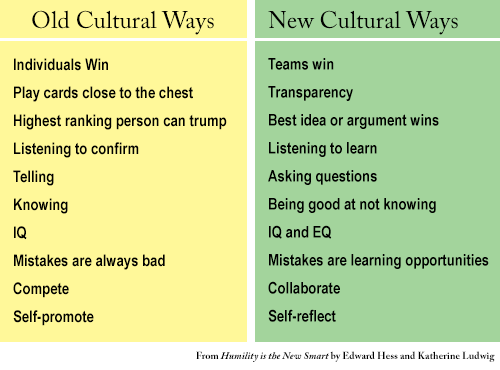
SMART used to be a quantity game. “I know more than you. I get more things right.” But Ed Hess and Katherine Ludwig say that in the new Smart Machine Age, that’s losing game. The new smart is about quality. Specifically, the quality of your thinking, your listening, and your relating and collaborative skills.

Are you ready?

The Smart Machine Age (SMA) will revolutionize how most of us live and work. In Humility is the New Smart, the authors state that “smart technologies will become ubiquitous, invading and changing many aspects of our professional and personal lives and in many ways challenging our fundamental beliefs about success, opportunity, and the American Dream.” This means that the “number and types of available jobs and required skills will turn our lives and our children’s lives upside down.”

New skills will be needed. Uniquely human skills. Those skills, while uniquely human, are not what we are typically trained to do and require a deal of messy personal development. We will need to become better thinkers, listeners, relators, and collaborators, while working to overcome our culture of obsessive individualism in order to thrive in the SMA. Humility is the mindset that will make all of this possible.

Most of today’s adults have had no formal training in how to think, how to listen, how to learn and experiment through inquiry, how to emotionally engage, how to manage emotions, how to collaborate, or how to embrace mistakes as learning opportunities.

In short, say the authors, we need to acquire and continually develop four fundamental NewSmart behaviors:

Quieting Ego

Quieting Ego has always been the challenge for us humans. As they observe, “Even if we don’t consider ourselves part of the ‘big me’ cultural phenomenon, for many of us to feel good about ourselves we have to constantly be ‘right,’ self-enhance, self-promote, and conceal our weaknesses, all of which drive ego defensiveness and failure intolerance that impedes higher-level thinking and relating.” This tendency negatively affects our behavior, thinking, and ability to relate to and engage with others.

Managing Self—Thinking and Emotions

We need to get above ourselves to see ourselves impartially. We all struggle “to self-regulate our basic humanity—our biases, fears, insecurities, and natural fight-flee-or-freeze response to stress and anxiety.” We need to be willing to treat all of our “beliefs (not values) as hypotheses subject to stress tests and modification by better data.”

Negative emotions cause narrow-mindedness. Positive emotions on the other hand, have been scientifically linked to “broader attention, open-mindedness, deeper focus, and more flexible thinking, all of which underlie creativity and innovative thinking.”

Reflective Listening

Because we are limited by our own thinking, we need to listen to others to “open our minds and, push past our biases and mental models, and mitigate self-absorption in order to collaborate and build better relationships.” The problem is “we’re just too wired to confirm what we already believe, and we feel too comfortable having a cohesive simple story of how our world works.” Listening to others helps to quiet our ego.

Otherness

To create these new behaviors and mindsets, it should become obvious that we need to enlist the help of others. “We can’t think, innovate, or relate at our best alone.” As Barbara Fredrickson observed, “nobody reaches his or her full potential in isolation.” Jane Dutton out it this way: “It seems to be another fact that no man can come to know himself except as the outcome of disclosing himself to another.”

The NewSmart Organization

Optimal human performance in the SMA will require an emphasis on the emotional aspects of critical thinking, creativity, innovation and engaging with others. “The work environment must be designed to reduce fears, insecurities, and other negative emotions.”

To do this it means “providing people a feeling of being respected, held in positive regard, and listened to. It means creating opportunities for people to connect and build trust. “It means allocating time and designing work environments that bring people together to relate about nonwork matters.” Finally, it means getting to know employees and helping them to get the “right training or opportunities to develop and provide feedback.”

The NewSmart organization needs to be a safe place to learn. “Feeling safe means that you feel that your boss your employer, and your colleagues will do you no harm as you try to learn.”

The New Smart

Culture Is Not the Culprit

https://hbr.org/2016/04/culture-is-not-the-culprit

hen organizations get into big trouble, fixing the culture is usually the prescription. That’s what most everyone said General Motors needed to do after its recall crisis in 2014—and ever since, CEO Mary Barra has been focusing on creating “the right environment” to promote accountability and head off future disasters. Pundits far and wide called for the same remedy when it came to light that the U.S. Department of Veterans Affairs, deemed a corrosive bureaucracy by federal investigators, kept veterans waiting months for critical health care. Cultural reform has likewise been proposed as the solution to excessive use of force by police departments, unethical behavior in banks, and just about any other major organizational problem you can think of. All eyes are on culture as the cause and the cure.

But the corporate leaders we have interviewed—current and former CEOs who have successfully led major transformations—say that culture isn’t something you “fix.” Rather, in their experience, cultural change is what you get after you’ve put new processes or structures in place to tackle tough business challenges like reworking an outdated strategy or business model. The culture evolves as you do that important work.

Though this runs counter to the going wisdom about how to turn things around at GM, the VA, and elsewhere, it makes intuitive sense to look at culture as an outcome—not a cause or a fix. Organizations are complex systems with many ripple effects. Reworking fundamental practices will inevitably lead to some new values and behaviors. Employees may start seeing their contributions to society in a whole new light. This is what happened at Ecolab when CEO Doug Baker pushed decisions down to the front lines to strengthen customer relationships. Or people might become less adversarial toward senior executives—as Northwest employees did after Delta CEO Richard Anderson acquired the airline and got workers on board by meeting their day-to-day needs.

The leaders we spoke with took different approaches for different ends. For example, Alan Mulally worked to break down barriers between units at Ford, whereas Dan Vasella did a fair amount of decentralizing to unleash creative energy at Novartis. But in every case, when the leaders used tools such as decision rights, performance measurement, and reward systems to address their particular business challenges, organizational culture evolved in interesting ways as a result, reinforcing the new direction.

Revisiting their stories provides a richer understanding of corporate transformation and culture’s role in it, so we share highlights from our conversations here. Most of these stories involve some aspect of merger integration, one of the most difficult transitions for companies to manage. And they all show, in a range of settings, that culture isn’t a final destination. It morphs right along with the company’s competitive environment and objectives. It’s really more of a temporary landing place—where the organization should be at that moment, if the right management levers have been pulled.

Stryker buys Canadian imaging technology firm for $701M

Stryker buys Canadian imaging technology firm for $701M

Stryker announced Monday that it is acquiring a Canadian imaging firm for $701 million.

Novadaq, a public company based in Missisauga, Canada makes fluorescence imaging technology that allows surgeons to see in real time blood flow in vessels, and related tissue perfusion in a variety of surgical procedures including cardiac, cardiovascular, gastrointestinal, plastic, microsurgical, and reconstructive procedures.

“With NVDQ SYK receives what we view as a best-in-class technology that allows for an entry point into the small, but rapidly expanding open visualization segment, and fortifies the company’s overall imaging offering where SYK already has a market leading position in the larger minimally invasive (MIS) endoscopic visualization segment,” wrote Richard Newitter, an analyst with Leerink Research, in a research note Monday.

The $701 million purchase price is a whopping 95.8 percent premium over Novadaq’s current share price and 8.4 times its trailing twelve-month revenue. While steep, the transaction is a smart one by Stryker, analysts believe.

“We believe adding NVDQ’s IP to Stryker will allow [it] to better grow the fluorescence field and we feel SYK is the most equipped company to do so,” wrote Sean Lavin, an analyst with BTIG, in a research note Monday after the deal was announced.

Another analyst provided a different reason for why the deal makes sense.

“While the premium paid is high, we believe the deal price is defensible given NVDQ’s superior topline growth profile (20%+ topline growth) and the large opportunity for SYK to take costs out of NVDQ,” wrote Glenn Novarro, an analyst with RBC Capital Markets, in a research note on Monday.

The Canadian company has been growing its revenue — $80 million in 2016, up from $63.8 million the year before — but isn’t profitable. Other than its Spy and Pinpoint technologies, the company is also the exclusive worldwide distributor of LifeNet Health’s Dermacell products and has a licensing partnership with Intuitive Surgical (ISRG) for the FireFly fluorescence imaging system, according to Novarro.

Novadaq will fit into Stryker’s video imaging business once the deal closes, and that is expected to be at the end of the third quarter.

“This acquisition aligns with Stryker’s focus on enabling our customers to see and do more by enhancing cross-specialty surgical visualization,” stated Timothy J. Scannell, Stryker’s Group President, MedSurg and NeuroTechnology, in a news release. “NOVADAQ’S unique innovative technology complements Stryker’s advanced imaging portfolio and expands our product offerings into open and plastic reconstructive surgery.


Democrats to slow-walk Senate business over health care bill

https://www.usatoday.com/story/news/politics/2017/06/19/democrats-halt-senate-business-over-health-care-bill/103012262/?utm_campaign=KHN%3A%20First%20Edition&utm_source=hs_email&utm_medium=email&utm_content=53324518&_hsenc=p2ANqtz-8NpDGDFUkQIuhKz8d8GWAlDDWC2mqcN0hJfp_LlAcTnc81nyyDtb3Ah782Ee3PptGo5xWZ8yPbj1T7bkeh-DIp55enpQ&_hsmi=53324518

Image result for Democrats to slow-walk Senate business over health care bill

Democrats will begin slow-walking Senate business on Monday as part of their opposition to Republican attempts to overturn the Affordable Care Act.

Senate Minority Leader Chuck Schumer of New York said Democrats will object to requests for “unanimous consent” to set aside rules and expedite proceedings. The procedural move is a tactic the minority party can use to draw out the legislative process for days, forcing Republicans to jump through procedural hurdles to get anything done.

The goal, he said, is to refer the GOP health care bill to a committee where it can be debated and amended publicly. Republicans are writing their bill “under the cover of darkness because they’re ashamed of it,” he said.

“This is a bill that would likely reorder one-sixth of the American economy and have life-and-death consequences for millions of Americans, and it’s being discussed in secret with no committee hearings, no debate, no amendments, no input from the minority,” he said. “This is the most glaring departure from normal legislative procedure that I have ever seen.”

The move coincides with a new #AmericaSpeaksOut campaign Senate Democrats launched Monday urging Americans to “speak out against Trumpcare and share their stories.” They also plan to hold the Senate floor tonight with speeches about health care.

The House passed its Obamacare repeal bill in May, but Senate Republicans have been drafting their own bill behind closed doors.

In a letter, Democrats provided some Senate Republican leaders with a list of all 31 potential Senate rooms “to assist” Republicans in scheduling a hearing.

They wrote that Democrats, by comparison, held about 100 hearings and meetings, accepted more than 150 amendments sponsored or cosponsored by GOP senators and spent 25 days in floor debate during the drafting of the Affordable Care Act.

The move by Democrats to slow Senate business will not impact consideration of President Trump’s nominee to lead the Federal Emergency Management Agency, Brock Long, who is expected to be confirmed Tuesday, according to a Senate Democratic aide. Schumer said Democrats would not object to requests for unanimous consent on honorary resolutions, either.

The greater impact likely will be the interruption of the legislative process and routine Senate business.

Speaking on the Senate floor, Schumer asked Senate Majority Leader Mitch McConnell of Kentucky to hold an all-senators meeting to discuss a bipartisan way forward on lowering the cost of health care, raising the quality of care and stabilizing the insurance marketplaces.

McConnell responded that senators would meet on the Senate floor with an unlimited amendment process. He said there would be “ample opportunity” to read and amend the bill when Schumer asked whether Democrats would have more than 10 hours to review it.

“I rest my case,” Schumer said.

Republicans blame Democrats for refusing to negotiate on a health care bill.

“Democrats for MONTHS have stated they have no interest in working with Republicans on fixing Obamacare,” Michael Reed, the Republican National Committee’s research director and deputy communications director, wrote in a statement. “Now, Democrat efforts to feign outrage over health care negotiations should be seen for what it is — a pure partisan game aimed at placating the far-left.”

McConnell, in a Senate floor speech, said Obamacare has increased costs and reduced choice, causing Americans to drop coverage. He said the entire Senate Republican conference has been “active and engaged” for months on legislation that would stabilize insurance markets, remove mandates to buy insurance, and preserve access to care for those with pre-existing conditions.

“We believe we can and must do better than Obamacare’s status quo,” he said.

The House-passed health care bill, called the American Health Care Act, would lead to 23 million fewer people having health insurance by 2026, according to the Congressional Budget Office. If the Senate is able to pass health care legislation, the two chambers will have to come to a compromise to get a final bill to Trump’s desk.

As Democrats prepared for battle over the Senate bill, conservative House Republicans planned to send a letter to McConnell warning against letting the legislation get too moderate if he wants to keep support from the House after it passed the Senate.

The letter from the Republican Study Committee, which has more than 150 members, states that its members have “serious concerns regarding recent reports suggesting that the Senate’s efforts to produce a reconciliation bill repealing the Affordable Care Act are headed in a direction that may jeopardize final passage in the House of Representatives,” according to a copy of the draft obtained by USA TODAY.