Sen. Bernie Sanders’ “Medicare for All” plan would drastically change not only how health care is paid for, but who ultimately pays for it.
While the wealthy and the poor usually pay the same premium for today’s employer-based insurance, Sanders’ plan would beef up insurance coverage for everyone and pay for it by increasing taxes on the wealthy.
Driving the news: As part of yesterday’s rollout, Sanders released a white paper with several “options” on how to raise the additional revenue it would take for the government to pay for everyone’s health care without any premiums or out-of-pocket costs.
While most people’s taxes would go up, the wealthy would pay for a much greater portion of the nation’s health care system than they currently do.
A 4% “income-based premium” for workers who make more than $29,000 and a 7.5% “income-based premium” on employers (exempting the first $2 million in payroll) are two of the financing options. Most economists assume that the employer tax would get passed onto employees through lost wages.
Other options include increasing the individual tax rate on high earners, taxing “unearned” income at the same rate as earned, and establishing a wealth tax.
What they’re saying: Even if all of these payment options were implemented, they still wouldn’t cover the total cost of Sanders’ plan, said the Committee for a Responsible Federal Budget’s Marc Goldwein.
He said there could also be unintended consequences of such high taxes on the wealthy, such as discouraging investment.
The bottom line: “More progressive tax-based financing of health care is a feature, not a bug, of Medicare for all,” the Kaiser Family Foundation’s Larry Levitt said.
“The idea of financing health care through taxes rather than premiums and out-of-pocket costs would be fairer in some people’s minds, but also disruptive,” he said.
Chattanooga, Tenn.-based Erlanger Health System may have to upend its board of trustees if a bill targeting ties between governing bodies and public hospitals is signed into Tennessee law, according to the Times Free Press.
The bill, which passed the state’s Senate and is moving through its House, aims to protect consumers who live near a county or publicly owned hospital. It would prevent hospital authority trustees and former trustees from signing an employment agreement with an authority until at least 12 months after the trustee’s tenure of service on the board. The bill would not affect private or nonprofit hospitals.
The Times Free Press reviewed a list of current and former trustees from Erlanger to see if anyone would be affected by the bill. A hospital spokesperson told the publication “it would be premature for Erlanger to speculate who this bill impacts at this point.”
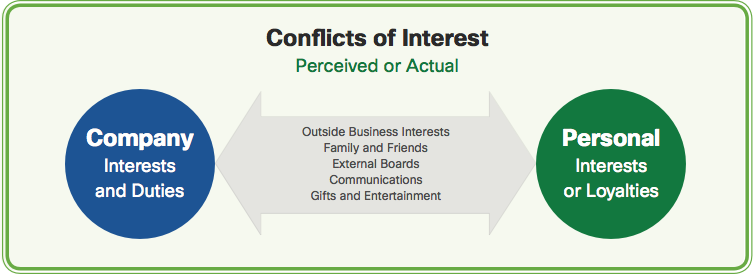
After reviewing conflict of interest disclosures trustees have to complete, the Times Free Press found current physician board members could have to choose between ending any financial ties with Erlanger or staying on the 11-member board.
Erangler’s Board Chairman Mike Griffin told the publication having physicians on the board is “a tremendous asset.” He added, “I am hopeful that the bill, in its final form, will not impact physician participation on Erlanger’s board.”
Citing a staff shortage, Los Angeles-based Pipeline Health announced plans April 9 to suspend services at Westlake Hospital in Melrose Park, Ill. That plan was put on hold after a Cook County Circuit Court judge held that the abrupt closure could have “irreparable harm” to the community, according to the Chicago Sun Times.
In late January, Pipeline acquired Westlake Hospital and two other facilities from Dallas-based Tenet Healthcare. A few weeks after the transaction closed, Pipeline revealed plans to shut down 230-bed Westlake Hospital, citing declining inpatient stays and losses of nearly $2 million a month.
Pipeline said staffing rates have significantly declined in the weeks since it filed the application to close Westlake Hospital.
“Our utmost priority is safety and quality of patient care,” Pipeline Health CEO Jim Edwards said in an April 9 press release. “With declining staffing rates and more attrition expected, a temporary suspension of services is necessary to assure safe and sufficient operations. This action is being taken after considering all alternatives and with the best interest of our patients in mind.”
In addition to announcing the suspension of services, Pipeline also said it gave hospital employees a 60-day notice of closure, which is required by state and federal law.
Pipeline’s plan to immediately suspend services at the hospital was put on hold yesterday evening, when Judge Eve Reilly granted the village of Melrose Park a temporary restraining order to prevent the hospital from closing. The restraining order prevents Pipeline from closing the hospital, cutting services or laying off workers until after the state Health Facilities and Services Review Board considers the application to shut down the hospital on April 30, according to the Chicago Tribune.
The board could postpone the application due a pending lawsuit against Pipeline over the closure, according to the Chicago Tribune.
The village of Melrose Park sued Pipeline in March, alleging Pipeline acquired Westlake Hospital under false pretenses. The lawsuit alleges Pipeline and its owners kept their plans to shut down the hospital secret until after the transaction with Tenet closed to avoid opposition from village leaders and community members.
Pipeline recently filed a motion to dismiss the lawsuit, arguing its application for change of ownership made no promise to keep Westlake Hospital open and that the hospital’s financial troubles were not fully evident at the time the change of ownership was prepared.
“The complete impact of Westlake’s 2018 devastating net operating loss was not known until the year’s end and had not fully occurred in September 2018 when Pipeline submitted its application for change of ownership or even when that application was granted,” Pipeline said in a press release.
Pipeline said Westlake Hospital ended 2018 with a net operating loss of $14 million, and those losses are projected to worsen over time.
The epidemic of rural hospital closures is threatening small towns such as Celina, Tenn. The town of 1,500 has been trying to position itself as a retiree destination but that task has grown more difficult since the March 1 closure of 25-bed Cumberland River Hospital.
KEY TAKEAWAYS
Celina became the 11th rural hospital in Tennessee to close in recent years — more than in any state but Texas. Both states have refused to expand Medicaid in a way that covers more of the working poor.
The closest hospital is now 18 miles away. That adds another 30 minutes through mountain roads for those who need an X-ray or bloodwork. For those in the back of an ambulance, that bit of time could mean the difference between life or death.
When a rural community loses its hospital, health care becomes harder to come by in an instant. But a hospital closure also shocks a small town’s economy. It shuts down one of its largest employers. It scares off heavy industry that needs an emergency room nearby. And in one Tennessee town, a lost hospital means lost hope of attracting more retirees.
Seniors, and their retirement accounts, have been viewed as potential saviors for many rural economies trying to make up for lost jobs. But the epidemic of rural hospital closures is threatening those dreams in places like Celina, Tenn. The town of 1,500, whose 25-bed hospital closed March 1, has been trying to position itself as a retiree destination.
“I’d say, look elsewhere,” said Susan Scovel, a Seattle transplant who arrived with her husband in 2015.
Scovel’s despondence is especially noteworthy given she leads the local chamber of commerce effort to attract retirees like herself. She considers the wooded hills and secluded lake to hold scenic beauty comparable to the Washington coast — with dramatically lower costs of living; she and a small committee plan getaway weekends for prospects to visit.
When she first toured the region before moving in 2015, Scovel and her husband, who had Parkinson’s, made sure to scope out the hospital, on a hill overlooking the sleepy town square. And she has rushed to the hospital four times since he died in 2017.
“I have very high blood pressure, and they’re able to do the IVs to get it down,” Scovel said. “This is an anxiety thing since my husband died. So now — I don’t know.”
She can’t in good conscience advise a senior with health problems to come join her in Celina, she said.
When Seconds Count, Delays In Care
Celina’s Cumberland River Hospital had been on life support for years, operated by the city-owned medical center an hour away in Cookeville, which decided in late January to cut its losses after trying to find a buyer. Cookeville Regional Medical Center executives explain that the facility faced the grim reality for many rural providers.
“Unfortunately, many rural hospitals across the country are having a difficult time and facing the same challenges, like declining reimbursements and lower patient volumes, that Cumberland River Hospital has experienced,” CEO Paul Korth said in a written statement.
Celina became the 11th rural hospital in Tennessee to close in recent years — more than in any state but Texas. Both states have refused to expand Medicaid in a way that covers more of the working poor. Even some Republicans now say the decision to not expand Medicaid has added to the struggles of rural health care providers.
The closest hospital is now 18 miles away. That adds another 30 minutes through mountain roads for those who need an X-ray or bloodwork. For those in the back of an ambulance, that bit of time could mean the difference between life or death.
“We have the capability of doing a lot of advanced life support, but we’re not a hospital,” said Natalie Boone, Clay County’s emergency management director.
The area is already limited in its ambulance service, with two of its four trucks out of service.
Once a crew is dispatched, Boone said, it’s committed to that call. Adding an hour to the turnaround time means someone else could likely call with an emergency and be told — essentially — to wait in line.
“What happens when you have that patient that doesn’t have that extra time?” Boone asked. “I can think of at least a minimum of two patients [in the last month] that did not have that time.”
Residents are bracing for cascading effects. Susan Bailey hasn’t retired yet, but she’s close. She has spent nearly 40 years as a registered nurse, including her early career at Cumberland River.
“People say, ‘You probably just need to move or find another place to go,'” she said.
Bailey and others are concerned that losing the hospital will soon mean losing the only three physicians in town. The doctors say they plan to keep their practices going, but for how long? And what about when they retire?
“That’s a big problem,” Bailey said. “The doctors aren’t going to want to come in and open an office and have to drive 20 or 30 minutes to see their patients every single day.”
Closure of the hospital means 147 nurses, aides and clerical staff have to find new jobs. Some employees come to tears at the prospect of having to find work outside the county and are deeply sad that their hometown is losing one of its largest employers — second only to the local school system.
Dr. John McMichen is an emergency physician who would travel to Celina to work weekends at the ER and give the local doctors a break.
“I thought of Celina as maybe the ‘Andy Griffith Show’ of healthcare,” he said.
McMichen, who also worked at the now-shutteredCopper Basin Medical Center, on the other side of the state, said people at Cumberland River knew just about anyone who would walk through the door. That’s why it was attractive to retirees.
“It reminded me of a time long ago that has seemingly passed. I can’t say that it will ever come back,” he said. “I have hopes that there’s still some hope for small hospitals in that type of community. But I think the chances are becoming less of those community hospitals surviving.”
“UNFORTUNATELY, RURAL HOSPITALS ACROSS THE COUNTRY ARE HAVING A DIFFICULT TIME AND FACE THE SAME CHALLENGES, LIKE DECLINING REIMBURSEMENTS AND LOWER PATIENT VOLUMES THAT CUMBERLAND RIVER HOSPITAL HAS EXPERIENCED.”
The board gave James K. Elrod two more years at the health system’s helm, despite the 81-year-old CEO’s retirement plans announced amid controversy.
KEY TAKEAWAYS
The longtime CEO signaled in 2017, after a push for his ouster, that his likely successor would be recruited to the health system so he could retire.
The board decided keeping the same leader in place for another two years would be ‘our greatest advantage’ in the midst of change.
Eighteen months have passed since the medical executive committee of Willis-Knighton Health System in Shreveport, Louisiana, urged the board to force President and CEO James K. Elrod to either step out of his longtime leadership position voluntarily or be pushed.
The committee’s statement of no confidence in a letter to the trustees complained that Elrod failed to tolerate dissent and hadn’t responded appropriately to changes in the healthcare industry, as the Shreveport Times reported, describing the incident as “an attempted coup.”
Elrod was 80 at the time. He had worked for the organization more than 50 years and turned what was an 80-bed hospital into what became Louisiana’s largest health system. He weathered the criticism with backing from the board. Then he signaled in a letter to hospital staff that a succession planning process for his likely successor was underway.
Despite the controversy, the board announced Friday that it asked Elrod, now 81, to stay at his post for another two years.
“After taking some time to consider our vote, Mr. Elrod graciously agreed to delay his retirement plans,” board president Frank Hughes, MD, said in a statement describing Elrod as “our greatest advantage” in the face of uncertainty and change.
“This is a clear indication of his ongoing dedication and commitment to Willis-Knighton, and we are grateful for this decision,” Hughes added. “While we are pleased with the current senior leadership team assembled during the past 18 months, we felt that the greatest gift we could give them is additional time for mentoring and guidance. We made this decision in support of our physicians, our employees and the larger community.”
“WHILE WE ARE PLEASED WITH THE CURRENT SENIOR LEADERSHIP TEAM ASSEMBLED DURING THE PAST 18 MONTHS, WE FELT THAT THE GREATEST GIFT WE COULD GIVE THEM IS ADDITIONAL TIME FOR MENTORING AND GUIDANCE.”
Collectively, the executives, business owners and medical professionals involved in the conspiracy are accused of causing more than $1 billion in losses for Medicare.
KEY TAKEAWAYS
Two dozen people were indicted in the multistate, international telemarketing and DME scheme, which allegedly occurred in 17 federal judicial districts.
The 130 DME companies submitted more than $1.7 billion in claims to Medicare, were paid more than $900 million, and accounted in total for more than $1 billion in losses for the federal government.
The swindled money was allegedly laundered through international shell corporations and used to purchase exotic automobiles, yachts and luxury real estate in the United States and abroad,
Federal prosecutors are calling it one of the largest healthcare fraud schemes they’ve ever investigated.
Criminal indictments were made public this week against 24 people, including CEOs, COOs, physicians, and other executives at five telemedicine companies, and the owners of 130 durable medical equipment companies across 17 federal judicial districts for their roles in various schemes to bilk Medicare out of $1.2 billion.
Prosecutors said the DME companies allegedly paid kickbacks and bribes in exchange for the referral of Medicare beneficiaries by physicians in cahoots with fraudulent telemedicine companies for unnecessary back, shoulder, wrist and knee braces.
Some of the defendants allegedly controlled an international telemarketing network that lured over hundreds of thousands of elderly and/or disabled patients into a criminal scheme that crossed borders, involving call centers in the Philippines and throughout Latin America, prosecutors said.
The defendants allegedly paid doctors to prescribe DME either without any patient interaction or with only a brief telephonic conversation with patients they had never met or seen.
“The breadth of this nationwide conspiracy should be frightening to all who rely on some form of healthcare,” said Don Fort, Chief of Criminal Investigations at the Internal Revenue Service, one of six federal agencies involved in the probe.
“The conspiracy described in this indictment was not perpetrated by one individual. Rather, it details broad corruption, massive amounts of greed, and systemic flaws in our healthcare system that were exploited by the defendants,” Fort said.
The 130 DME companies submitted more than $1.7 billion in claims to Medicare and were paid more than $900 million, and accounted in total for more than $1 billion in losses for the federal government.
The swindled money was allegedly laundered through international shell corporations and used to purchase exotic automobiles, yachts and luxury real estate in the United States and abroad, prosecutors said.
Court documents allege that some of the defendants lured patients for the scheme by using an international call center that advertised to Medicare beneficiaries and “up-sold” the beneficiaries to get them to accept numerous “free or low-cost” DME braces, regardless of medical necessity.
The international call center allegedly paid illegal kickbacks and bribes to telemedicine companies to obtain DME orders for these Medicare beneficiaries. The telemedicine companies then allegedly paid physicians to write medically unnecessary DME orders. Finally, the international call center sold the DME orders that it obtained from the telemedicine companies to DME companies, which fraudulently billed Medicare.
DEFENDANTS IDENTIFIED
In New Jersey, Neal Williamsky 59, of Marlboro, and Nadia Levit, 39, of Englishtown, New Jersey, owners of 25 DME companies, were indicted for their alleged participation in a $150 million scheme.
Albert Davydov, 26, of Rego Park, New York, was charged for his alleged participation in a $35 million DME scheme.
Creaghan Harry, 51, of Highland Beach, Florida; Lester Stockett, 51, of Deefield Beach, Florida; and Elliot Loewenstern, 56, of Boca Raton, Florida; the owner, CEO and VP of marketing, respectively, of call centers and telemedicine companies were charged for their alleged participation in a $454 million kickback and money laundering scheme.
Joseph DeCoroso, MD, 62, of Toms River, New Jersey, was charged in a $13 million conspiracy to commit healthcare fraud and separate charges of healthcare fraud for writing medically unnecessary orders for DME, often without speaking to patients, while working for two telemedicine companies.
In Florida, Willie McNeal, 42, of Spring Hill, the owner and CEO of two telemedicine companies, was charged for his alleged participation in a $250 million scheme to swap kickbacks and bribes for DME referrals.
In Dallas, Texas, Leah Hagen, 48, and Michael Hagen, 51, of Dalworthington Gardens, owners and operators of two DME companies, were charged for their alleged participation in a $17 million kickback scheme that generated unnecessary DME orders.
In El Paso, Texas, Christopher O’Hara, 54, of Kingsbury, the owner of a telemedicine company, was charged in an $40 million scheme to swap kickbacks and bribes for referrals to DME providers.
In Philadelphia, Randy Swackhammer, MD, 60, of Goldsboro, North Carolina, was charged for an alleged $5 million conspiracy to commit healthcare fraud. Swackhammer allegedly wrote medically unnecessary orders for DME while working for a telemedicine company, often with only brief conversations with patients.
In California, Darin Flashberg, 41, and Najib Jabbour, 47, both of Glendora, and owners of seven DME companies, were charged with alleged participation in a $34 million scheme that paid kickbacks and bribes in exchange for unnecessary DME orders.
In South Carolina, Andrew Chmiel, 43, of Mt. Pleasant, owner of over a dozen companies involved in the scheme, was charged in a $200 million scheme to pay kickbacks and bribes in exchange for unnecessary DME orders.
“THE BREADTH OF THIS NATIONWIDE CONSPIRACY SHOULD BE FRIGHTENING TO ALL WHO RELY ON SOME FORM OF HEALTHCARE. ”
DON FORT, CHIEF OF CRIMINAL INVESTIGATIONS AT THE INTERNAL REVENUE SERVICE
Facilities are faring better in states that expanded Medicaid, according to a new Commonwealth Fund report.
KEY TAKEAWAYS
A year after facing a federal funding cliff, CHCs in expansion states are thriving.
CHCs provide care to 27 million patients each year, according to the Health Resources and Services Administration.
The financial stability of CHCs, which serve medically vulnerable communities, is a benefit for health systems.
Community health centers (CHC) operating in states that expanded Medicaid under the ACA are 28% more likely to report improvements to their financial stability, according to a Commonwealth Fund report released Thursday morning.
CHCs in Medicaid expansion states reported were more likely to report improvements in their ability to provide affordable care to patients, 76%, than their counterparts in non-expansion states, 52%.
More than 60% of CHCs in expansion states reported improved ability to fund service or site expansions and upgrades for facilities, while only 46% of CHCs in non-expansion states said the same.
These facilities reported higher levels of unfilled job openings for mental health professional and social workers, while also implying a greater openness to operating under a value-based payment model.
The success and viability of CHCs are essential for larger health systems, according to Melinda K. Abrams, M.S., vice president and director of the Commonwealth Fund’s Health Care Delivery System Reform program, adding that CHCs act as a strong foundation for providing primary care to medically vulnerable populations in rural communities.
Abrams said that by making sure patients are insured and receiving care up front, rather than delaying treatment and exacerbating their condition, they are less likely to end up in a hospital emergency room and contribute to a rise in uncompensated care for hospitals.
She also told HealthLeaders that populations with higher enrollment rates make it easier for CHCs to innovate, invest in technology, hire new staff, train existing the workforce, and adopt new models of care.
“[Medicaid expansion] makes it a lot easier to provide high-quality comprehensive care when [a CHC’s] patients have health insurance,” Abrams said. “In this particular instance, it’s a lot easier to innovate and have financial stability when you have more paying patients, which means that it is easier if you are [a CHC] in a state that has expanded Medicaid.”
The Commonwealth Fund report provides a welcome note of positivity for CHCs, which serve vulnerable populations primarily composed by the uninsured, but have faced funding challenges in the past.
During the budget battles that produced multiple government shutdowns throughout the early portion of 2018, advocates wondered anxiously whether Congress would provide long term funding to the nearly 1,400 CHCs operating at nearly 12,000 service delivery sites across the country.
The Community Health Center Fund (CHCF), created in 2010 as a result of the ACA, is the largest source of comprehensive primary care for medically underserved communities, according to the Kaiser Family Foundation.
However, Abrams said that Medicaid expansion has also been a beneficial tool for CHCs, as they have begun to see more insured patients while also benefiting from Medicaid reimbursements, even though they are low compared to other reimbursement rates.
CHCs in states that expanded Medicaid have been able to grow the services that are offered while assisting in the ongoing fight against the opioid epidemic, according to the Commonwealth Fund report.
Abrams said that one downside to the growing success of CHCs have been the unfilled positions, mostly for mental health providers, that are falling behind rising demand levels, though she added that this finding is not surprising.
“I think it’s in part because the supply of the workforce is lagging a little bit behind the demand,” Abrams said. “There’s no reason to think that over time that this gap wouldn’t be closed. But we did find that as a challenge, that [CHCs] have a lot of positions open [yet] they’re hiring. A number of these CHCs are in economically depressed areas, so the good news is that there are some jobs available.”
CHCs are much more likely to participate in value-based payment models as a result of Medicaid expansion, with Abrams explaining that changes in payments and delivery models are common during insurance expansions.
She sees the continued progress made on the value-based front by CHCs as a way to “promote better healthcare and save money” over time.
Anyone interacting with the U.S. health care system is bound to encounter examples of unnecessary administrative complexity—from filling out duplicative intake forms to transferring medical records between providers to sorting out insurance bills. This administrative complexity, with its associated high costs, is often cited as one reason the United States spends double the amount per capita on health care compared with other high-income countries even though utilization rates are similar.1
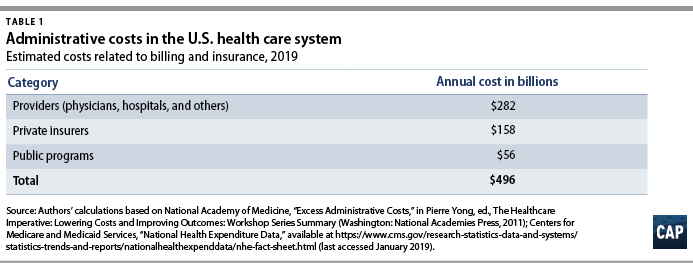
Each year, health care payers and providers in the United States spend about $496 billion on billing and insurance-related (BIR) costs, according to Center for American Progress estimates presented in this issue brief. As health care costs continue to rise, a logical starting point for potential savings is addressing waste. A 2010 report by the National Academy of Medicine (NAM) estimated that the United States spends about twice as much as necessary on BIR costs.2 That administrative excess currently amounts to $248 billion annually, according to CAP’s calculations.
This issue brief provides an overview of administrative expenditures in the U.S. health care system. It first explains the components of administrative costs and then presents estimates of the administrative costs borne by payers and providers. Finally, the issue brief describes how the United States can lower administrative costs through comprehensive reforms and incremental changes to its health care system. Many of the universal health care plans being discussed to expand coverage and lower costs would lower administrative costs through rate regulation, global budgeting, or simplifying the number of payers.3 Each of these financing changes deserves consideration—even in the absence of major systemwide reform.
Components of administrative costs
The main components of administrative costs in the U.S. health care system include BIR costs and hospital or physician practice administration.4 The first category, BIR costs, is part of the administrative overhead that is baked into consumers’ insurance premiums and providers’ reimbursements. It includes the overhead costs for the health insurance industry and providers’ costs for claims submission, claims reconciliation, and payment processing. The health care system also requires administration beyond BIR activities, including medical record-keeping; hospital management; initiatives that monitor and improve care quality; and programs to combat fraud and abuse.
To date, few studies have estimated the systemwide cost of health care administration extending beyond BIR activities. In a 2003 article in The New England Journal of Medicine, researchers Steffie Woolhandler, Terry Campbell, and David Himmelstein concluded that overall administrative costs in 1999 amounted to 31 percent of total health care expenditures or $294 billion5—roughly $569 billion today when adjusted for medical care inflation.6 A more recent paper by Woolhandler and Himmelstein, which looked at 2017 spending levels, placed the total cost of administration at $1.1 trillion.7
Billing and insurance-related costs
Many studies of administrative costs limit their scope to BIR costs. The BIR component of administration is most relevant to systemwide reforms that seek to reduce the expenses related to claims processing, billing rates, or health insurance. The largest share of BIR costs is attributable to insurance companies’ profits and overhead and to providers8where BIR costs include tasks such as record-keeping for claims submission and billing.
The costs associated with BIR administration can extend beyond the chief parties involved in receiving and submitting claims. The process of claims denials has become an industry unto itself, with private firms squeezing dollars out of Medicaid programs.9 One study estimated that the aggregate value of challenged claims ranges from $11 billion to $54 billion annually.10 Claims can also be manipulated to boost providers’ or insurers’ profits by recording services rendered in maximum detail and exaggerating the severity of patients’ conditions—a practice known as upcoding.11 Upcoding costs Medicare Advantage billions of dollars in excess expenditures,12 and in many cases the practice constitutes fraud.13
The NAM published one of the most thorough reports on U.S. administrative costs related to billing and insurance in 2010. In a synthesis of the literature on administrative costs, the NAM report concluded that BIR costs totaled $361 billion in 2009—about $466 billion in current dollars—among private insurers, public programs, and providers, amounting to 14.4 percent of U.S. health care spending at the time. The NAM estimated that BIR costs account for 13 percent of physician care spending; 8.5 percent of hospital care spending; 10 percent of spending on other providers; 12.3 percent of spending on private insurance; and 3.5 percent of public program spending, including Medicare and Medicaid.14
Applying the NAM’s percentages of BIR costs to recent projections of national health expenditures from the Centers for Medicare and Medicaid Services (CMS), CAP estimates that BIR costs will amount to $496 billion for 2019.15 (see Table 1) According to CAP’s calculations, this includes $158 billion in overhead for private insurance; $56 billion for administration of public insurance programs; and $282 billion for the BIR costs of hospitals, physicians, and other care providers. CAP’s estimate does not include the administrative costs associated with retail sales of medical products, including prescription drugs and durable medical equipment.
Even the most inclusive studies of administrative costs have not included at least one key piece of the U.S. health care system, namely, patients.16 The administrative complexity of the U.S. system also burdens patients, whether they are deciphering bewildering bills or shuttling records between providers. Three-quarters of consumers report being confused by medical bills and explanations of benefits.17 A Kaiser Family Foundation survey of people newly enrolled in the health insurance marketplace found that many were not confident in their understanding of the definitions of basic terms and concepts such as “premium,” “deductible,” or “provider network.”18 Insurers and employers spend an estimated $4.8 billion annually to assist consumers with low health insurance literacy, according to the consulting firm Accenture.19
Excess administrative costs
While U.S. administrative care spending is indisputably higher than that of other comparable countries, it’s unclear how much of the difference is excess and how much of that excess could be trimmed. The NAM report estimated that excess BIR costs amount to $190 billion—$245 billion in current dollars—or roughly half of total BIR expenditures in a year.20 The NAM report estimated that 66 percent of BIR costs for private insurers and 50 percent of BIR costs among providers are excess.21Based on these percentages, $248 billion of the total $496 billion BIR costs in CAP’s updated estimate are excess administrative costs.
Most studies that have attempted to identify excess costs in the American health care system rely on comparisons between the United States and Canada.22 In their 2010 review of the literature on the difference between the two countries’ health expenditures, economists Alexis Pozen and David M. Cutler looked at the sources of the gap between U.S. and Canadian health spending. They found that 62 percent of the difference between the two countries was attributable to prices and intensity of care, and 38 percent was linked to administrative costs.23Compared with Canada, the United States has 44 percent more administrative staff, and U.S. physicians dedicate about 50 percent more time on administrative tasks.24 Inflated to current dollars and today’s population, Pozen and Cutler’s estimate of per capita administrative excess in the United States, when compared with Canada, translates into a gap of $340 billion.25
Woolhandler and Himmelstein estimate that the United States currently spends $1.1 trillion on health care administration, and of that amount, $504 billion is excess.26Woolhandler and Himmelstein rely on surveys of physicians’ time use and utilized physician income data to translate the share of time physicians spend on administrative tasks into monetary value; their estimate of excess costs is the difference between U.S. and Canadian administrative spending27 Woolhandler and Himmelstein’s original 2003 article estimated that Canada spent $307 per capita on health system administration, compared with $1,059 per capita in the United States. Assuming this difference is excess requires an assumption that a Canadian-style health care system would achieve an identical level of administrative costs in the United States.
A separate criticism of the original 2003 Woolhandler and Himmelstein estimates, as articulated by Henry J. Aaron, an economist at the Brookings Institution, is that their methodology failed to account for differences in prices.28 Woolhandler and Himmelstein arrive at their national total administrative costs by tallying up costs in each country for items such as rent and salaries. As a consequence, the U.S.-Canada comparison captures not just the differences in the quantity of resources devoted to administration—such as physician time or office space—but also the differences in office rates, wages, and salaries. Taking Woolhandler and Himmelstein’s estimate of total administrative costs as a given and then making standard adjustments for price differences, Aaron argues that the two researchers exaggerated U.S. administrative spending in their 2003 report and that the true portion of excess would be about one-quarter less than what they estimated.
All estimates of administrative costs are inherently sensitive to what portion of health care spending one considers administrative.29 For example, time spent recording diagnosis or prescription information used in billing may also be vital for patient care, allowing medical teams to share up-to-date information or avoid harmful drug interactions. A recent study of an electronic health records (EHR) system estimated that on average, half of a primary care physician’s day is spent on EHR interaction, including billing, coding, ordering, and communication.30 Such tasks, however, can fall into a gray area between administrative and clinical. In a separate study, economist Julie Sakowski and her fellow researchers reported finding varying attitudes among physicians about whether interaction with electronic medical records—a subset of EHR—represented administrative or clinical time. As Sakowski and co-authors wrote, “Some felt they spent extra effort adding documentation that was needed only for billing. Others seemed to feel that nearly all of that information was needed for accurate clinical records.”31
Administrative costs for payers
Within the U.S. system, the share of expenditures that are attributable to administrative costs varies greatly by payer. The BIR costs for traditional Medicare and Medicaid hover around 2 percent to 5 percent, while those for private insurance is about 17 percent.32Some public finance experts, including Robert Book, have argued that the low levels of Medicare overhead are deceptive. Because seniors have relatively high health expenditures, the argument goes, administrative costs make up a relatively small share of their total health care spending. However, Medicare’s per capita administrative expenditures are higher than those in other forms of insurance.33 Even if one compares higher-end estimates of Medicare administrative costs to low-end estimates of costs for private insurance, the gulf between administrative costs for Medicare and private coverage is large.34 Organisation for Economic Co-operation and Development (OECD) data also show that other nations are able to achieve low levels of administrative costs while maintaining universal coverage across all ages of the population.35
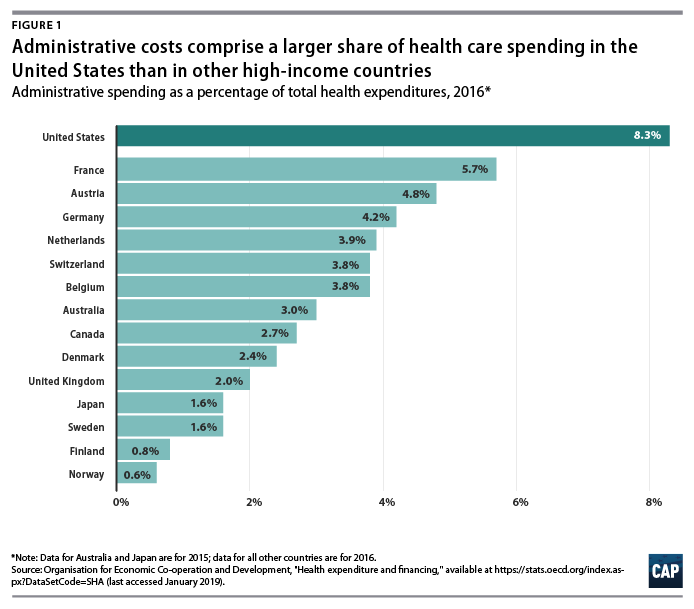
International health system data demonstrate that the United States is a clear outlier on administrative spending. And while the OECD’s definition includes administrative costs to government, public insurance funds, and private insurance, but not those borne by hospitals, physicians, and other providers, the stark difference is still informative. In 2016, administration accounted for 8.3 percent of total health care expenditures in the United States—the largest share among comparable nations. (see Figure 1) Countries with single-payer systems are among those with the lowest administrative costs. For example, administrative spending accounts for just 2.7 percent of total health care expenditures in Canada.36 OECD data also show that within a country, administrative costs are higher in private insurance than in government-run programs.37
Countries that have multipayer systems with stricter rate regulation also achieve much lower administrative costs than the United States. Administrative expenditures account for 4.8 percent of total health care expenditures in Germany, 3.9 percent in the Netherlands, 3.8 percent in Switzerland, and 1.6 percent in Japan, according to the OECD. If the United States could reduce administrative costs down to Canadian levels, it would save 68 percent of current administrative expenditures; reducing to German-level administrative costs would save 42 percent of current administrative expenditures. However, to assume that by simply adapting another country’s health care system—whether it is Canada’s single-payer Medicare, Germany’s sickness funds, or Switzerland’s heavily regulated private plans—the United States would automatically achieve the same level of administrative costs may ignore other fundamental differences between countries, including the market power of health care providers, political systems, and attitudes toward health care. Nevertheless, the experience of other multipayer systems such as those in Germany and Switzerland suggests that the United States could substantially reduce both administrative expenditures and overall health care spending by bringing down reimbursement rates and regulating insurance—even while continuing to allow multiple payers and private health care providers.
The lowest possible level of administrative spending for the U.S. health care system is not necessarily the optimal level of spending. As researchers Robert A. Berenson and Bryan E. Dowd have noted, administrative spending in Medicare may in fact be too low; the program would be more efficient with greater investment in initiatives to lower costs and improve quality.38 Many reforms that could generate overall savings require administrative resources to design and implement. Innovations such as bundled payments—the practice of paying providers a lump sum for an episode of care such as a knee replacement or childbirth rather than reimbursing each individual component—involve upfront investment in development. Increasing resources to combat fraud and abuse would also lower overall spending. While the U.S. Department of Health and Human Services (HHS) boasts that it sees a $5 return on every $1 it puts toward fraud and abuse investigations, that number indicates that the government may be underinvesting in those efforts.39
Administrative costs for health care providers
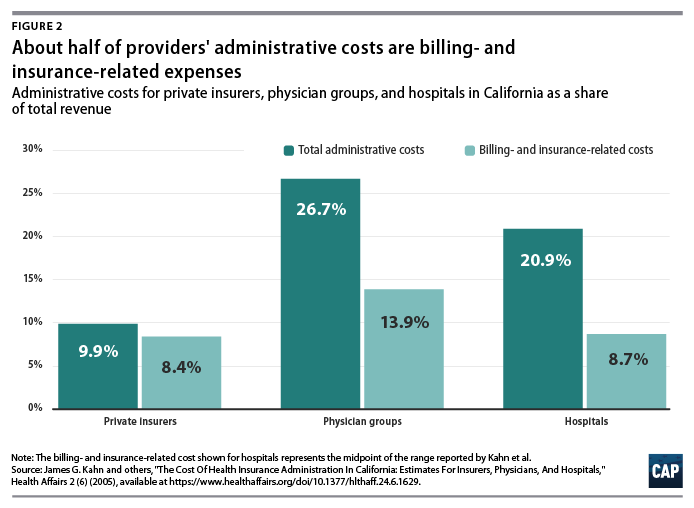
A number of studies have focused on the administrative costs borne by providers. Beyond BIR expenses, hospitals, physician practices, and other health care institutions house departments that are complementary to clinical services such as medical libraries, public relations, and accounting.40 A study of administrative costs in California found that administrative costs represented about one-quarter of physician revenue and one-fifth of hospital revenue, and BIR costs accounted for roughly half of administrative expenditures for physician and hospital services covered by private insurance.41 (see Figure 2) In a separate study, Himmelstein and others reported that one-quarter of U.S. hospital spending went toward administration; they found little difference between nonprofit hospitals and for-profit institutions, where administrative spending was 25 percent and 27.2 percent of total spending, respectively.42
On a per-encounter basis, BIR costs vary as a proportion of overall cost depending on the type of visit. In a 2018 study of an academic health care system, Phillip Tseng and others found that professional billing costs amounted to $20.49 for a primary care visit, $61.54 for an emergency department visit, and $124.26 for a general inpatient stay.43 Relative to the professional revenue associated with each encounter studied, the emergency department visit ranked the highest, with billing costs equal to 25.2 percent of revenue. Inpatient visits were the lowest, at 8 percent of a general inpatient stay and 3.1 percent for inpatient surgery.44 Encounters involving hospital care incurred additional facility-level billing costs. (see Figure 3)
In addition to the dollar cost of BIR activity, the study also reported the time spent on administration for typical encounters. The average processing time was 13 minutes for a primary care visit, 32 minutes for an emergency department visit, and 73 minutes for a general inpatient stay.45
Among other research on provider BIR costs, a 2009 study by Larry Casalino and others estimated that the cost of the time physicians spend on interactions with health plans is about $23 billion to $31 billion per year.46 A 2011 study by Dante Morra of the University of Toronto and others estimated that interaction with payers costs the equivalent of $22,205 per physician annually in Canada and $82,975 per physician annually in the United States, suggesting that the United States would save $27.6 billion annually if U.S. administrative costs could be brought down to Canadian levels.47
As with BIR costs, provider administrative costs in the United States are higher than those in other comparable countries. Hospital administrative costs in the United States far exceed those of other nations. In their comparison of hospital administrative costs among eight Western nations, Himmelstein and co-authors found that the United States had the highest levels, at 25.3 percent of total hospital expenditures.48 They conclude that in nations where hospital administrators have minimal responsibilities for procuring financing and where the hospital reimbursement system is least complex, administrative costs can be reduced to 12 percent of expenditures.49 These findings suggest that reforms that introduce global budgeting or limit the need to bargain with multiple payers could potentially bring down excess hospital administrative costs in the United States.
Lower administrative costs in single-payer and multipayer systems
Although administrative costs contribute to the high expenditures in the United States, they are not the primary reason for the health care spending gap. As economist Uwe Reinhardt and others candidly put it, “It’s the prices, stupid.”50 The United States pays more for care than other countries do—both for administrative services and for other components of health care.
Policies that target administrative costs alone would not necessarily bring overall U.S. health care expenditures in line with other countries. As economists Sherry Glied and Adam Sacarny observed, “there are very substantial variations in administrative costs among countries with universal health insurance, which do not translate directly into variations in overall costs.”51Comparative evidence from U.S. states also suggests that America’s multipayer system explains some, but by no means all, of the discrepancy between the United States and other developed nations. Harvard University researchers Joseph P. Newhouse and Anna Sinaiko observe that “there is considerable variation across the states in spending levels, with the lowest quintile of states spending approximately the same percentage as the higher spending OECD countries other than the U.S. This implies that the [United States’] pluralistic financing system may not be an important cause of the large percentage of GDP that the U.S. devotes to health care.”52
Systemwide reforms to lower administrative costs
Health care financing experts believe that changes to how Americans pay for coverage could dramatically reduce administrative costs. Researchers simulating the effects of single-payer programs have assumed that administrative costs would be brought down substantially. The Urban Institute set administrative costs at a “plausible” 6 percent of health care claims for their simulation of the single-payer plan proposed by Sen. Bernie Sanders (I-VT), noting that they “do not believe that administrative costs can fall far below this level; far too many administrative functions must be conducted.”53 In its analysis of a single-payer system for New York state, the RAND Corporation assumed administrative costs at 6 percent of total health expenditures in its base case, representing a reduction from 18 percent among commercial insurers and 7 percent in New York’s Medicaid program. RAND specified administrative costs at 13 percent and 3 percent in its alternative scenarios. 54 In a separate column, however, RAND researcher Jodi Liu cautioned that achieving the administrative expenditure levels of other countries “may be aspirational and is not guaranteed” under a single-payer system.55
Exactly how such lower costs could be achieved is another question. Reducing BIR costs requires simplifying the billing and payment process, which could be accomplished in a number of ways. Two avenues for reducing administrative costs as well as overall health costs are global budgeting and uniform rate-setting.56 These two concepts are central to health systems around the world and are also responsible for keeping administrative costs lower, whether a country has a multipayer or single-payer system. Another paperwork-reducing option would be a centralized claims clearinghouse to allow providers to submit all claims to a single entity, as they do in Germany and Japan. 57
All-payer rates and global budgeting
Setting all-payer reimbursement rates would eliminate the need for providers to negotiate rates with individual private insurers, while also giving policymakers better leverage for controlling overall health care cost growth. In the current U.S. system, providers charge different rates to different payers, and the billing process is complicated and opaque. The list prices that hospitals are now required to publish bear little connection to what individual patients—or those patients’ insurers—actually pay.58 Setting all-payer rates would simplify billing and improve transparency by establishing a single set of rates for each provider, while also giving regulators a tool to protect consumers from exorbitant rates.59
Global budgeting—the practice of paying providers revenue based on their expected costs—also holds promise for both lowering administrative spending and overall costs. As opposed to traditional fee-for-service payments, which reward providers for doing more, global budgeting incentivizes providers to deliver care more efficiently.60 Global budgeting is a feature of many countries with much lower health care administrative costs, including Scotland, Wales, and Germany.61 As Woolhandler, Campbell, and Himmelstein point out in their 2003 article, “The existence of global budgets in Canada has eliminated most billing and minimized internal cost accounting, since charges do not need to be attributed to individual patients and insurers.”62 As Germany shows, both single-payer and multipayer systems can use global budgets.
A system combining all-payer rates and global budgeting is already partially in place in the state of Maryland, where each hospital has a single set of rates it bills to Medicare, Medicaid, commercial insurers, and other payers. Maryland’s system is keeping overall cost growth lower than the national trend.63 According to RAND analysis of hospital costs, Maryland hospitals have administrative costs that are 9 percent lower than the national average and not far off from the 13 percent savings RAND assumed providers would achieve under a single-payer system. 64
Centralized claims processing
Germany and Japan both have multiple payers but centralized claims processing.65Despite having more than 3,000 health plans,66 Japan’s administrative expenditures were a stunningly low 1.6 percent of overall health care costs in 2015, one of the lowest among OECD member nations.67
In their analysis of three universal health care options for Vermont, including single payer, researchers William C. Hsiao, Steven Kappel, and Jonathan Gruber estimated substantial savings from administrative simplicity from each option. The two single-payer options they examined would result in even greater administrative savings of between 7.3 percent and 7.8 percent, depending on the rate-setting mechanism.68 The group estimated that a third scenario, which would establish a centralized claims clearinghouse while allowing multiple payers, could generate savings equal to 3.6 percent of total expenditures.69This suggests that about half of the total administrative savings from a single-payer system could be obtained within a regulated multipayer system.
Policy proposals directed at administrative costs
While major changes to the U.S. health care system have the greatest potential to bring down costs, more incremental changes could reduce administrative waste. A recent bill proposed by Sens. Bill Cassidy (R-LA) and Tina Smith (D-MN) would direct the HHS secretary to set goals to cut “unnecessary costs and administrative burdens” throughout the health care system by 50 percent over the next 10 years. It would also provide grant money for state-based efforts to bring down administrative costs.70Some possible avenues for achieving those kinds of reductions include changes to payment rules, improvements to facilitate electronic record-keeping and information exchange, and simplification of public insurance programs.
In their 2009 article in TheNew England Journal of Medicine, David Cutler, Elizabeth Wikler, and Peter Basch proposed one such package of reforms. The authors estimated that providers could save $17.9 billion to $23 billion annually with several, more incremental changes to the system, including greater adoption of EHR systems; integrated administrative and clinical systems; national and standardized reporting requirements and credentialing of providers; streamlined enrollment in public insurance programs; and greater automation.71 In a separate report, the same authors proposed additional reforms that they estimated could reduce excess administrative costs by $40 billion, or 25 percent of total health care expenditures.72
In a 2010 study published in Health Affairs, Bonnie B. Blanchfield and other Massachusetts researchers concluded that the administrative burden on physician organizations could be reduced by a “single transparent set of payment rules for a system with multiple payers.” The authors recommended that the United States adopt “a standard set of payment requirements, increased payment-rule transparency, standardized forms, and a standard set of data exchange requirements.” Doing so could save $7 billion in billing costs for physician and other clinical services, according to the authors’ estimates.73
Conclusion
Although estimates vary, a large body of evidence shows that the United States is spending about twice as much as needed on the administration of health care. Other nations enjoy world-class health care systems while spending a fraction of what the United States does on governance, billing, and insurance.
A structural overhaul of how health care is financed and priced that includes key features of other countries’ systems—whether one payer or many—would go a long way toward eliminating excess administrative costs. Simplifying the payment system should be an essential part of future health reform and would make the U.S. system work better for taxpayers and patients alike.
Here are nine hospitals and health systems with strong operational metrics and solid financial positions, according to recent reports from Moody’s Investors Service and Fitch Ratings.
1. South Bend, Ind.-based Beacon Health System has an “AA-” rating and stable outlook with Fitch. The health system has a strong financial profile, and is the acute care leader in its market, according to Fitch.
2. Los Angeles-based Cedars Sinai Medical Center has an “AA-” rating and stable outlook with Fitch. The hospital has a solid market presence in a competitive service area and strong profitability and liquidity, according to Fitch.
3. St. Cloud, Minn.-based CentraCare Health has an “AA-” rating and stable outlook with Fitch. The health system has a strong operating risk profile and a leading market position over a broad service area, according to Fitch.
4. Wauwatosa, Wis.-based Children’s Hospital and Health System has an “Aa3” rating and stable outlook with Moody’s. The health system has a strong financial profile and is the dominant provider of tertiary and quaternary pediatric services in southeastern Wisconsin, according to Moody’s.
5. Children’s Hospital of Philadelphia has an “Aa2” rating and stable outlook with Moody’s. The hospital has a strong market position and exceptional financial resources to support high capital needs, according to Moody’s.
6. Concord (N.H.) Hospital has an “AA-” rating and stable outlook with Fitch. The hospital has a strong financial profile and a leading market share position, according to Fitch.
7. Portland-based Oregon Health and Sciences University has an “Aa3” rating and stable outlook with Moody’s. The health system has solid operating performance, strong clinical offerings and includes the only academic medical center in Oregon, according to Moody’s.
8. Clermont, Fla.-based South Lake Hospital has an “AA-” rating and stable outlook with Fitch. The hospital’s operating performance has improved in recent years due to its partnership with Orlando (Fla.) Health, according to Fitch.
9. Iowa City-based University of Iowa Hospitals & Clinics has an “Aa2” rating and stable outlook with Moody’s. The system’s strong brand and position as the only academic medical center in Iowa will continue to translate into strong market share and high patient demand, according to Moody’s.