FDA chief apologizes for overstating plasma effect on virus

https://abcnews.go.com/Health/wireStory/fda-commissioner-overstated-effects-virus-therapy-72595122?fbclid=IwAR3Um3rVuom9rJNCOvccmmTBDOrrRePEu1BX1VgRvAzYbpL2NATGjY2-1IY

FDA chief apologizes for overstating plasma effect on virus

Food and Drug Administration Commissioner Stephen Hahn is apologizing for overstating the life-saving benefits of using convalescent plasma to treat COVID-19 patients.

Responding to an outcry from medical experts, Food and Drug Administration Commissioner Stephen Hahn on Tuesday apologized for overstating the life-saving benefits of treating COVID-19 patients with convalescent plasma.

Scientists and medical experts have been pushing back against the claims about the treatment since President Donald Trump’s announcement on Sunday that the FDA had decided to issue emergency authorization for convalescent plasma, taken from patients who have recovered from the coronavirus and rich in disease-fighting antibodies.

Trump hailed the decision as a historic breakthrough even though the treatment’s value has not been established. The announcement on the eve of Trump’s Republican National Convention raised suspicions that it was politically motivated to offset critics of the president’s handling of the pandemic.

Hahn had echoed Trump in saying that 35 more people out of 100 would survive the coronavirus if they were treated with the plasma. That claim vastly overstated preliminary findings of Mayo Clinic observations.

Hahn’s mea culpa comes at a critical moment for the FDA which, under intense pressure from the White House, is responsible for deciding whether upcoming vaccines are safe and effective in preventing COVID-19.

The 35% figure drew condemnation from other scientists and some former FDA officials, who called on Hahn to correct the record.

“I have been criticized for remarks I made Sunday night about the benefits of convalescent plasma. The criticism is entirely justified. What I should have said better is that the data show a relative risk reduction not an absolute risk reduction,” Hahn tweeted.

The FDA made the decision based on data the Mayo Clinic collected from hospitals around the country that were using plasma on patients in wildly varying ways — and there was no comparison group of untreated patients, meaning no conclusions can be drawn about overall survival. People who received plasma with the highest levels of antibodies fared better than those given plasma with fewer antibodies, and those treated sooner after diagnosis fared better than those treated later.

Hahn and other Trump administration officials presented the difference as an absolute survival benefit, rather than a relative difference between two treatment groups. Former FDA officials said the misstatement was inexcusable, particularly for a cancer specialist like Hahn.

“It’s extraordinary to me that a person involved in clinical trials could make that mistake,” said Dr. Peter Lurie, a former FDA official under the Obama administration who now leads the nonprofit Center for Science in the Public Interest. “It’s mind-boggling.”

The 35% benefit was repeated by Health and Human Services Secretary Alex Azar at Sunday’s briefing and promoted on Twitter by the FDA’s communication staff. The number did not appear in FDA’s official letter justifying the emergency authorization.

Hahn has been working to bolster confidence in the agency’s scientific process, stating in interviews and articles that the FDA will only approve a vaccine that meets preset standards for safety and efficacy.

Lawrence Gostin of Georgetown University said Hahn’s performance Sunday undermined those efforts.

“I think the integrity of the FDA took a hit, if I were Stephen Hahn I would not have appeared at such a political show,” said Gostin, a public health attorney.

Hahn pushed back Tuesday morning against suggestions that the plasma announcement was timed to boost Trump ahead of the Republican convention.

“The professionals and the scientists at FDA independently made this decision, and I completely support them,” Hahn said, appearing on “CBS This Morning.”

Trump has recently accused some FDA staff, without evidence, of deliberately holding up new treatments “for political reasons.” And Trump’s chief of staff, Mark Meadows, said over the weekend that FDA scientists “need to feel the heat.”

The administration has sunk vast resources into the race for a vaccine, and Trump aides have been hoping that swift progress could help the president ahead of November’s election.

At Sunday’s briefing Hahn did not correct Trump’s description of the regulatory move as a “breakthrough.” He also did not contradict Trump’s unsupported claim of a “deep state” effort at the agency working to slow down approvals.

Former FDA officials said the political pressure and attacks against the FDA carry enormous risk of undermining trust in the agency just when it’s needed most. A vaccine will only be effective against the virus if it is widely taken by the U.S. population.

“I think the constant pressure, the name-calling, the perception that decisions are made under pressure is damaging,” said Dr. Jesse Goodman of Georgetown University, who previously served as FDA’s chief scientist. “We need the American people to have full confidence that medicines and vaccines are safe.”

Convalescent plasma is a century-old approach to treating the flu, measles and other viruses. But the evidence so far has not been conclusive about whether it works, when to administer it and what dose is needed.

The FDA emergency authorization is expected to increase its availability to additional hospitals. But more than 70,000 Americans have already received the therapy under FDA’s “expanded access” program. That program tracks patients’ response, but cannot prove whether the plasma played a role in their recovery.

Some scientists worry the broadened FDA access to the treatment will make it harder to complete studies of whether the treatment actually works. Those studies require randomizing patients to either receive plasma or a dummy infusion.
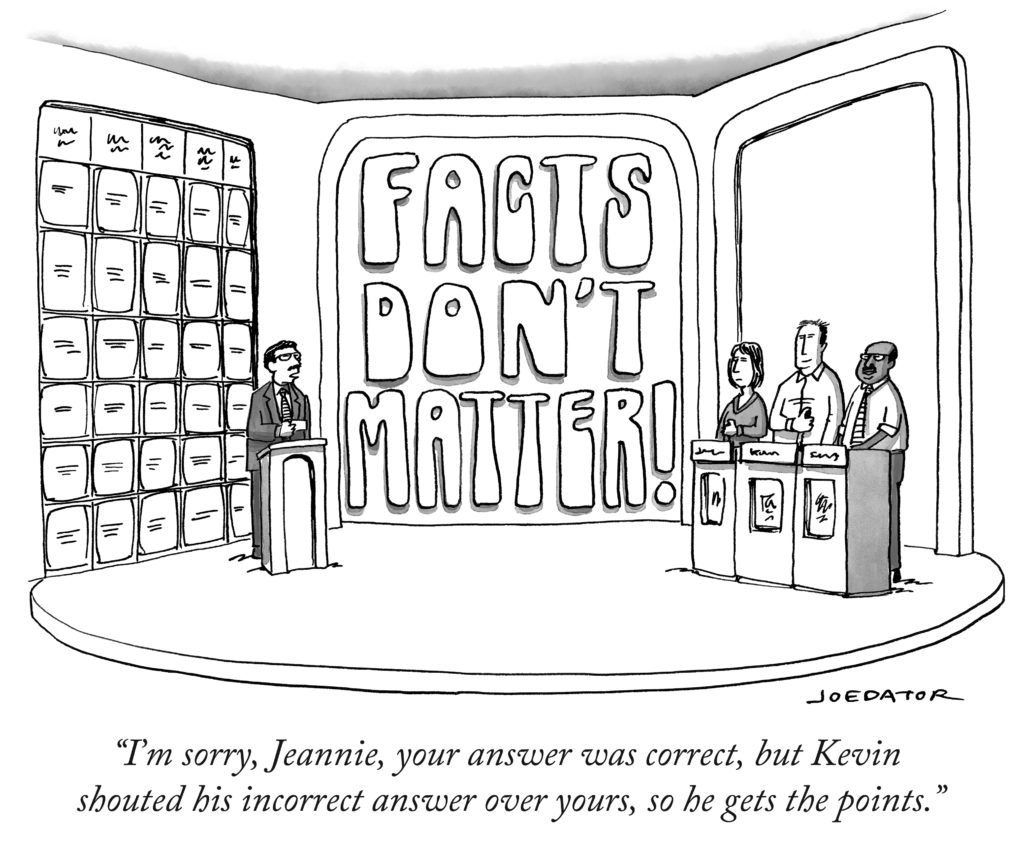


Cartoon – Covid Facts Don’t Matter

Facts Don't Matter (cncartoons033663-514) | Speak Up For Success

Op-Ed: American Exceptionalism or American Insanity?

https://www.medpagetoday.com/infectiousdisease/covid19/88163?xid=nl_popmed_2020-08-20&eun=g885344d0r&utm_source=Sailthru&utm_medium=email&utm_campaign=PopMedicine_082020&utm_content=Final&utm_term=NL_Gen_Int_PopMedicine_Active

We don’t have all of the answers, but that’s not our biggest problem.

Thirty years ago, in preparation for hunting season, I went to a shooting range to practice with my bow. I felt fine. When I finished, I got in my truck and began to back out. When I pressed on the brake, I felt a sharp pain in my foot. My first instinct was to go over what I did walking back and forth to pull arrows from the target. Had I twisted my foot, did I trip on something? No, I had not injured my foot in any way.

When I got home, I took off my shoe and looked. My big toe was slightly swollen and slightly red. It looked like gout. I took ibuprofen. I was better by the next day. I never had another attack until this week.

I was at a friend’s house drinking wine. My knee suddenly began to hurt. I walk or jog 6-8 miles per day, so my first thought was that all the exercise was catching up to me. I took ibuprofen. It got better. But the next day my ankle suddenly became very painful; then my wrist hurt a bit. I remembered my experience with gout. I treated myself for gout, and got better.

I feel very fortunate to live in a time when gout can be easily treated. One hundred years ago, I would have been in big trouble. Which is not to say that I would not have taken medicine in an attempt to get relief. I would have tried a variety of products that claimed to help but did no good.

Today, we can treat so many illnesses that were brutal and deadly in the past. A long time ago, all children with type 1 diabetes died. Today, we have effective therapy — insulin. When I was a resident in the early 1980s, we had no specific way of treating a heart attack. Today, we can place a stent and reverse the pathological process.

In the past, something as simple as poison ivy could make a person’s life miserable. Today, we can knock it out in a short time. Modern medicine can do amazing things. To a large extent, it can do these amazing things because of effective biomedical science.

However, it can’t cure everything. Nor can it beat death. The amazing accomplishments of the medical profession in the last 100 years seem to have led some to believe, or want to believe, that doctors can solve all medical problems. This belief system came to bear with the COVID-19 pandemic.

Many expected the medical profession to step up and solve the problem. When it didn’t, disappointment arose. Then accusations began to fly. Some claimed that there were conspiracies involving Big Pharma and doctors. Others claimed there were cures that were being suppressed by the government.

Some doctors and scientists responded to this by trying to appease. They turned to in vitro data — such as the zinc/hydroxychloroquine (HCQ) interaction — to claim that zinc and HCQ would work wonders. When other doctors and scientists pointed out flaws in that data, they were attacked. It was another conspiracy. I even heard accusations that this was a plot by Bill Gates for population control.

Some doctors also turned to poor, anecdotal trials with HCQ that supposedly showed benefit in a few patients. This led quite a few to believe that HCQ was a wonder drug. Once the exaggerations about HCQ came out, it could no longer be found in pharmacies. The panic was just that strong.

Everyone seemed to get caught up in the panic mindset, and then work under the notion that a lack of clear medical success just can’t be possible in the 21st century. Many patients in intensive care units across the country were being put on HCQ, steroids, remdesivir, anti-IL-6 medication, vitamin C, and whatever else seemed like it might do something.

Many patients who were put on that medication cocktail died, because there was no legitimate science behind this approach — whether it helped was unclear.

However, over time, it became more clear that steroids helped. It became more clear that HCQ did not help. Such revelations led to more reasonable, though not entirely proven, therapeutic approaches. But because the less scientific approaches had so much hype in the beginning, and because the panic was so strong, getting away from them has been fraught with problems and accusations, and even physical threats.

Sadly, some of these accusations and threats were fueled by irresponsible doctors in academic medical centers. Misinformation was fed to the public, and the public, being not well-versed in biomedical research, latched onto the credentials of these doctors rather than seeing through their hysterical and misguided arguments about HCQ and such.

The internet and the free flow of information allows many who don’t really understand the ins and outs of biomedical research and clinical medicine to read something that sounds good and believe it because it satisfies psychological needs. This is a clear pattern of behavior when it comes to HCQ.

But it is not just irresponsible people in academic medical centers who contribute to this process. Doctors, many of whom post on medical blogs, accuse anyone who says we should slow down and evaluate our therapy of “wanting to do nothing” or “not caring about the thousands who are dying.” Even well-intentioned doctors get caught up in this need to seem like something is being done, and so they order all sorts of useless tests.

One such useless test being ordered more commonly in COVID patients is an MRI of the heart. One study in a few patients comes out that shows that COVID can affect the heart, and the next thing you know everybody with COVID needs a heart MRI. Whether the MRI is a reliable test for this is unclear. What we do with the information from the MRI is unclear. It just makes some doctors and some patients feel good to engage in such useless practices.

This pattern of behavior, the pattern of engaging in useless practices to give the appearance of care, is quite common in the profession of medicine. I find it interesting that it has not been challenged by progressives, like those so interested in the Green New Deal. The environmental harm done along these lines by misguided doctors might do as much or more environmental harm than fracking — but at least with fracking you get something to show for your efforts.

With out-of-control doctors, ordering useless tests, running MRI machines and CT scans, etc., day in and day out, without valid justifications, produces nothing useful — unless one believes that feeding hypochondriasis and feeding poor medical judgment is useful.

The profession of medicine accomplished great things in the 21st century. These great things came through American exceptionalism. They came through valid biomedical science. These amazing accomplishments led many to believe that the profession of medicine has all the answers.

But it doesn’t. The COVID pandemic has shown us that. I’m sorry that we can’t save everyone. It is tragic. But it will be more tragic if we let our limitations along these lines lead us into a dark place of anger, lack of reason, lack of valid science, and then on to invalid conspiracy theories.

American exceptionalism does not need to die because of COVID. Instead, what needs to die is a type of insanity that makes us think we have all the answers. What needs to die is a type of insanity that makes us think that if we don’t have all the answers, we have to turn to useless testing, unproven therapies, and futile care.

What needs to die is the turning to false prophets and conspiracy theories. The profession of medicine has proven that it can do a very good job combating illness.

Good doctors are trying hard to deal with and solve this pandemic. When a type of insanity gets in the way, it is a problem.

W. Robert Graham, MD, completed medical school and residency at UTHSC-Dallas (Parkland Hospital) and served as chief resident. Graham received a National Institutes of Health fellowship at the Salk Institute for oncogene research in 1985. He was a professor of medicine at Baylor College of Medicine from 1998 through 2016. In retirement, he enjoys writing and ranching.


New unemployment claims top 1 million. Again.

https://www.washingtonpost.com/business/2020/08/20/august-unemployment-claims/?wpmk=1&wpisrc=al_business__alert-economy&utm_source=alert&utm_medium=email&utm_campaign=wp_news_alert_revere&location=alert&pwapi_token=eyJ0eXAiOiJKV1QiLCJhbGciOiJIUzI1NiJ9.eyJjb29raWVuYW1lIjoid3BfY3J0aWQiLCJpc3MiOiJDYXJ0YSIsImNvb2tpZXZhbHVlIjoiNWI2M2EzNDJhZGU0ZTI3Nzk1NTBjYTFiIiwidGFnIjoid3BfbmV3c19hbGVydF9yZXZlcmUiLCJ1cmwiOiJodHRwczovL3d3dy53YXNoaW5ndG9ucG9zdC5jb20vYnVzaW5lc3MvMjAyMC8wOC8yMC9hdWd1c3QtdW5lbXBsb3ltZW50LWNsYWltcy8_d3Btaz0xJndwaXNyYz1hbF9idXNpbmVzc19fYWxlcnQtZWNvbm9teSZ1dG1fc291cmNlPWFsZXJ0JnV0bV9tZWRpdW09ZW1haWwmdXRtX2NhbXBhaWduPXdwX25ld3NfYWxlcnRfcmV2ZXJlJmxvY2F0aW9uPWFsZXJ0In0.ns8VggWJk95qb-c_2926acWIaHxyFIBXSRn76O7Lrf0

The number of people applying for the first time for unemployment insurance ticked up last week to 1.1 million, from 970,000 the week before, a sign that job losses continue to plague the labor market five months into the coronavirus pandemic.

The weekly jobless claims had sunk slowly in recent months but have remained well above historical highs, averaging about 1.18 million a week for the last four weeks. Economists had predicted last week’s figure to approach the numbers from the previous week, which had fallen below 1 million for the first time in about five months.

Instead, the initial claims and new claims for Pandemic Unemployment Assistance, the program available to gig and self-employed workers, both went up. About 543,000 new claims were filed for PUA for the week that ended on Aug. 15, up from 488,000 the week before.

“The fact that the claims are so high this far into the crisis is concerning,” said AnnElizabeth Konkel, an economist at the job site Indeed. “Yet the depths of the damage remain to be seen. I would definitely call it a canary raising alarms in the economic coal mine.”

Data shows the number of job postings slowly recovering in recent weeks, compared with postings from the year prior. However, last week, postings took a turn for the worse. They had been running about 18 percent below normal and fell to 20.3 percent below normal last week.

“The longer we go into this crisis, the longer people that have been temporarily laid off may not get called back,” Konkel said. “Businesses can only ride out this crisis for so long.”

More than 28 million people were receiving some form of unemployment benefits as of Aug. 1, the most recent week for that statistic, about equal to the previous week.

Job loss from the pandemic remains a singular crisis, without comparison in modern times. The country’s unemployment rate, last calculated in July, was 10.2 percent, and economists have warned that it could go up in August as the virus continues to alter life around the country.

The extra $600 in unemployment benefits that many workers credit with keeping them afloat expired at the end of July. And funds from the $660 billion PPP program, which gave grants and loans to companies to keep workers on payroll, have been running out for many recipients.

Companies announcing layoffs in recent days include Wieland Copper Products, in North Carolina, a Mohegan Sun casino in Wilkes-Barre, Pa., Amsterdam Printing & Litho, a printing company in Upstate, N.Y., and Ohio sales and marketing company Maritz. School districts and local governments are also beginning to experience deep cuts: New York Mayor Bill de Blasio (D) warned last week that as many as 22,000 city workers faced possible layoffs in the fall.


‘We’ve got to do better than this’: College students raise alarm by packing bars, avoiding masks

https://www.washingtonpost.com/nation/2020/08/17/alabama-georgia-college-parties-covid/?utm_campaign=wp_main&utm_medium=social&utm_source=facebook&fbclid=IwAR12brHn8KNahffNq1suWFbq1vjIJUj-LH8Y911HNVw-hhjhA-RIYiZqKdo

As college students pack bars, local officials sound a dire ...

Music blared outside a row of off-campus houses on Saturday near the University of North Georgia as hundreds of students packed the streets and front yards. Virtually no one wore a mask.

The huge party in Dahlonega, Ga., captured in a viral Twitter video, was one of a number of mass gatherings around the country this weekend as tens of thousands of students returned to college towns already on edge amid the novel coronavirus pandemic.

Local officials from Georgia to Alabama to Oklahoma reacted with horror and anger on Sunday, warning that unless students take social distancing and mask rules seriously, the fall semester could come to a swift end.

“Why?” tweeted Walt Maddox, mayor of Tuscaloosa, Ala., above a photo of hundreds of mostly mask-free University of Alabama students outside downtown restaurants. “We are desperately trying to protect @tuscaloosacity.”

Some universities are already battling coronavirus outbreaks, including the University of North Carolina at Chapel Hill — where four viral clusters have emerged one week after in-person classes started — and Oklahoma State University, where a single sorority house has 23 confirmed cases.

There’s no national consensus on how to approach college this fall, with many schools going at least partially online and others trying mass testing of students. But other large schools are welcoming everyone back to campus and relying on masks and social distancing to avoid outbreaks — a plan, as local leaders noted this past weekend, that could crumble if students don’t abide by the recommendations.

In Dahlonega, university officials chided the hundreds of students who gathered at an off-campus housing complex for the Saturday night party. In-person classes are scheduled to start Monday for the school’s roughly 19,000 students.

“We are disappointed that many of our students chose to ignore COVID-19 public health guidance by congregating in a large group without social distancing or face coverings,” a school spokeswoman told the Gainesville Times.

At Alabama’s two biggest schools, football players were particularly vocal in sounding the alarm as they watched fellow students congregate without face coverings. Although many of college football’s biggest conferences have canceled their fall seasons, the Big 12, ACC and SEC are pushing ahead — assuming campus outbreaks don’t interfere.

At Auburn University, wide receiver Anthony Schwartz tweeted Saturday that he had “seen crowds of people and none of them are wearing masks.” Chris Owens, a center at the University of Alabama, tweeted a photo on Sunday afternoon of a crowd of students with barely any face coverings in sight, asking: “How about we social distance and have more than a literal handful of people wear a mask? Is that too much to ask Tuscaloosa?”

Alabama’s athletic director, Greg Byrne, also warned that the scenes in Tuscaloosa put the season at risk.

“Who wants college sports this fall?? Obviously not these people!!” he tweeted Sunday. “We’ve got to do better than this for each other and our campus community. Please wear your masks!”

Maddox, the mayor, said he would ask the school’s police force to help Tuscaloosa police enforce mask rules. “Wearing a mask and practicing social distancing is not much to ask for to protect yourself, your family, your friends … and the jobs of thousands of people,” he tweeted.

In Stillwater, Okla., the editor at Oklahoma State’s student newspaper shot videos this weekend of packed clubs and bars and long lines outside downtown establishments.

The campus was already on high alert after the school announced Saturday it had quarantined dozens of students inside the Pi Beta Phi sorority house following at least 23 positive tests on Friday. “I’ve decided.. I’m not going to class on Monday,” Tre Sterling, a defensive back on OSU’s football team, tweeted above videos of student crowds downtown.

Stillwater Mayor Will Joyce said the city council would consider new pandemic rules on Monday, including an “emergency declaration, if necessary.”

“Every single person in Stillwater has a responsibility to help,” he tweeted. “Take every precaution you can to slow the spread. Wear your mask, avoid crowded areas, wash your hands, be a good neighbor.”


Dr. Anthony Fauci says chance of coronavirus vaccine being highly effective is ‘not great’

https://www.cnbc.com/amp/2020/08/07/coronavirus-vaccine-dr-fauci-says-chances-of-it-being-highly-effective-is-not-great.html?utm_source=&utm_medium=email&utm_campaign=32192

KEY POINTS
  • White House coronavirus advisor Dr. Anthony Fauci that the chances of scientists creating a highly effective vaccine — one that provides 98% or more guaranteed protection — for the virus are slim.
  • Scientists are hoping for a coronavirus vaccine that is at least 75% effective, but 50% or 60% effective would be acceptable, too, he said.
  • The FDA has said it would authorize a coronavirus vaccine so long as it is safe and at least 50% effective.

White House coronavirus advisor Dr. Anthony Fauci said Friday that the chances of scientists creating a highly effective vaccine — one that provides 98% or more guaranteed protection — for the virus are slim.

Scientists are hoping for a coronavirus vaccine that is at least 75% effective, but 50% or 60% effective would be acceptable, too, Fauci, director of the National Institute of Allergy and Infectious Diseases, said during a Q&A with the Brown University School of Public Health. “The chances of it being 98% effective is not great, which means you must never abandon the public health approach.”

“You’ve got to think of the vaccine as a tool to be able to get the pandemic to no longer be a pandemic, but to be something that’s well controlled,” he said.

The Food and Drug Administration has said it would authorize a coronavirus vaccine so long as it is safe and at least 50% effective. Dr. Stephen Hahn, the FDA’s commissioner, said last month that the vaccine or vaccines that end up getting authorized will prove to be more than 50% effective, but it’s possible the U.S. could end up with a vaccine that, on average, reduces a person’s risk of a Covid-19 infection by just 50%.

“We really felt strongly that that had to be the floor,” Hahn said on July 30, adding that it’s “been batted around among medical groups.”

“But for the most part, I think, infectious disease experts have agreed that that’s a reasonable floor, of course hoping that the actual effectiveness will be higher.”

A 50% effective vaccine would be roughly on par with those for influenza, but below the effectiveness of one dose of a measles vaccination, which is about 93% effective, according to the Centers for Disease Control and Prevention.

Public health officials and scientists expect to know whether at least one of the numerous potential Covid-19 vaccines in development worldwide is safe and effective by the end of December or early next year, though there is never a guarantee. Drug companies Pfizer and Moderna both began late-stage trials for their potential vaccines last week and both expect to enroll about 30,000 participants.

Fauci has previously said he worries about the “durability” of a coronavirus vaccine, saying if Covid-19 acts like other coronaviruses, it may not provide long-term protection.

Health officials say there is no returning to “normal” until there is a vaccine. Fauci’s comment came a day after the World Health Organization cautioned about the development of vaccines, reiterating that there may never be a “silver bullet” for the virus, which continues to rapidly spread worldwide. The phase three trials underway do not necessarily mean that a vaccine is almost ready to be deployed to the public, the agency said.

“Phase three doesn’t mean nearly there,” Mike Ryan, executive director of the WHO’s emergencies health program, said during a virtual panel discussion with “NBC Nightly News” Anchor Lester Holt hosted by the Aspen Security Forum. “Phase three means this is the first time this vaccine has been put into the general population into otherwise healthy individuals to see if the vaccine will protect them against natural infection.”

While there is hope scientists will find a safe and effective vaccine, there is never a guarantee, WHO Director-General Tedros Adhanom Ghebreyesus said.

“We cannot say we have vaccines. We may or may not,” he said.

On Friday, Fauci reiterated that he is “cautiously optimistic” scientists will find a safe and effective vaccine. He also reiterated that the coronavirus may never be eliminated, but world leaders can work together to bring the virus down to “low levels.”

Some of Fauci’s comments have been at odds with President Donald Trump, who has repeatedly said the virus would “disappear.”

Trump, who is seeking reelection, said Thursday that it’s possible the United States could have a safe and effective vaccine for the coronavirus before the upcoming presidential election on Nov. 3.


97,000 children reportedly test positive for coronavirus in two weeks as schools gear up for instruction

https://www.cbsnews.com/news/covid-19-kids-school-children-positive-tests-coronavirus-reopening/?utm_source=nl&utm_brand=wired&utm_mailing=WIR_Science_081020&utm_campaign=aud-dev&utm_medium=email&utm_term=WIR_Science&bxid=5db707423f92a422eaeaf234&cndid=&esrc=bounceX&source=EDT_WIR_NEWSLETTER_0_SCIENCE_ZZ

97,000 children reportedly test positive for coronavirus in two ...

Nearly 100,000 children tested positive for the coronavirus in the last two weeks of July, a new report from the American Academy of Pediatrics finds. Just over 97,000 children tested positive for the coronavirus from July 16 to July 30, according to the association.

Out of almost 5 million reported COVID-19 cases in the U.S., CBS News’ Michael George reports that the group found that more than 338,000 were children.

Vanderbilt University’s Dr. Tina Hartert hopes increased testing of children will help determine what role they play in transmission, as school districts around the country return to some form of school. She is leading a government-funded study that saw DIY testing kits sent to some 2,000 families.

“The kits are shipped to the families, they are taught how to collect these samples, and then the samples are sent back by the families to a central repository,” she said.

In New York City, home to the nation’s largest school district, Mayor Bill de Blasio announced a return to in-person schooling in the fall and pledged officials “have worked incessantly to get this right.”

“They’ve looked at examples from all over the world of what will keep the school community safe, and they’ve made a series of choices of how to do things from the health and safety lens first, while also making sure we can educate our kids,” he said in a Friday press conference.

De Blasio gave parents until Friday night to register students for in-person instruction, remote learning or a hybrid.

More than 25 children died of the coronavirus in July alone. Pressure to get kids back into the classroom has left superintendents in more than 13,000 different school districts across the country to figure out how to keep children safe amid a myriad of public health advisories, and handle learning differences.

Niles, Michigan Superintendent Dan Applegate is hoping Plexiglas could be a solution for children with speech impediments to be able to participate in class.

He demonstrated by speaking behind a transparent slate at a press conference.

“As I’m sitting here and I can articulate,” Applegate said. “The student on the other side will be wearing a mask. Then I can put my mask on, and that student can drop their mask and articulate as well.”

Indiana’s Lawrence Township is cleaning school buses with a hospital-grade disinfectant spray for students still needing rides to school.

“You’re going to see a very clean and disinfected bus,” Transportation Director Matt Miles said. “We actually have fogging machines.”

However, they are not expecting many students to get on the bus — 35% of children in the area are expected to learn remotely, while other school districts in the U.S. will not open at all.


2005 chloroquine study had nothing to do with COVID-19 and the drug wasn’t given to humans

https://www.politifact.com/factchecks/2020/jul/29/facebook-posts/2005-chloroquine-study-had-nothing-do-covid-19-and/?fbclid=IwAR2e4j_lb10FWa5Cyuokzo3pbjlty_ffvwsEfVT_2iQ6ki8a9z-TpzDm9DQ

PolitiFact | 2005 chloroquine study had nothing to do with COVID ...

IF YOUR TIME IS SHORT

  • The 2005 study wasn’t published by the NIH and didn’t prove chloroquine was effective against “COVID-1” because that’s not a real disease.
  • The study found that chloroquine could inhibit the spread of Severe Acute Respiratory Syndrome in animal cell culture, and the authors said more research was needed.
  • There are currently no approved medications or treatments for COVID-19.


Chloroquine is back.

The anti-malarial drug first showed up as a possible COVID-19 treatment around May 2020, when President Donald Trump said he had been taking its chemical cousin, hydroxychloroquine, to prevent getting infected with the virus.

Since then, some studies have found that the drugs could help alleviate symptoms associated with COVID-19, but the research is not conclusive. There are currently no FDA-approved medicines specifically for COVID-19. (Chloroquine is chemically similar to hydroxychloroquine, but it is a different drug that’s primarily used to treat malaria. Both carry a particular risk for people with heart problems, plus other possible side effects.)

Now, hydroxychloroquine and chloroquine have been thrust back into the spotlight as misinformation about the drugs’ effectiveness and safety recently reappeared online.

One such post on Facebook falsely claims that Americans have been deceived because health officials at the National Institutes of Health have known all along that chloroquine is effective against “COVID.”

The post reads:

“N.I.H. 15 years ago published a study on chloroquine. It is effective against COVID-(1). We are being lied to America!”

The post was flagged as part of Facebook’s efforts to combat false news and misinformation on its News Feed. (Read more about our partnership with Facebook.) 


This is flawed. 

First, there’s no such thing as “COVID-1.” COVID-19 was named for the year it was discovered, not because it’s the 19th iteration. 

Second, the 2005 study found that chloroquine was effective on primate cells infected with severe acute respiratory syndrome, known as SARS, which is caused by a coronavirus. But while the two share similarities, SARS-CoV and COVID-19 are different diseases, and primate cells are far from human patients.

Third, the study was indexed by the NIH’s National Library of Medicine, but the NIH was not involved. It was published in the peer-reviewed Virology Journal and conducted by researchers from the Centers for Disease Control and Prevention and the Montreal Clinical Research Institute.


What the study says

The study was published in August 2005 and found that chloroquine has “strong antiviral effects on SARS-CoV infection of primate cells” and that it was effective on cells treated with the drug before and after exposure to the virus.

The drug was not administered to actual SARS patients, and the study’s authors wrote that more research was needed on how the drug interacts with SARS in animal test subjects.

“Cell culture testing of an antiviral drug against the virus is only the first step, of many steps, necessary to develop an antiviral drug,” Kate Fowlie, a spokesperson for the CDC previously told PolitiFact in an email. “It is important to realize that most antivirals that pass this cell culture test hurdle fail at later steps in the development process.”

Dr. Alex Greninger, assistant director of clinical virology at the University of Washington School of Medicine, told us that a problem in virology is trying to determine the difference of how drugs work in cell culture in comparison to humans.

“Data on chloroquine is largely taken from these cell culture studies, but we now have trials in people on hydroxychloroquine that show it’s not as effective,” Greninger said, “and there’s new data out in the last week that suggests that some of the reasons could be because of the cell types that SARS coronaviruses grow in, and this original experiment was done on African green monkey kidney cells, which is not the tissue we are really worried about.”


What officials say about the drugs now

The Food and Drug Administration granted emergency use authorizations for some medicines to be used for certain patients hospitalized with COVID-19, but it revoked the authorization for hydroxychloroquine and chloroquine in mid-June due to concerns over the drugs’ serious side effects. There are currently no FDA-approved medicines for COVID-19.

“It is no longer reasonable to believe that oral formulations of HCQ and CQ may be effective in treating COVID-19, nor is it reasonable to believe that the known and potential benefits of these products outweigh their known and potential risks,” FDA Chief Scientist Denise M. Hinton wrote.

The NIH’s COVID-19 treatment guidelines, which were developed to inform clinicians on how to care for patients with COVID-19, also currently recommend against the use of chloroquine or hydroxychloroquine for COVID-19 treatment, except in a clinical trial.

But even those trials have been halted. The World Health Organization and the NIH announced in mid-June that they would stop hydroxychloroquine patient trials, citing safety concerns that include serious heart rhythm problems, blood and lymph system disorders, kidney injuries, and liver problems and failure.


Our ruling

A Facebook post says that the NIH published a study 15 years ago that showed chloroquine was effective against “COVID-(1)” and that health officials have been lying to the American people.

This is wrong. There’s no such thing as “COVID-1” and the study cited was not published by the NIH and had to do with animal cells infected with SARS, not COVID-19. The drug was not given to human patients and the study’s authors said more research was needed.

Health officials caution against the use of chloroquine or hydroxychloroquine to treat COVID-19 patients, citing the possibility of serious side effects. There are currently no approved treatments for the virus.

We rate this False. 


69% Of Americans Are Concerned That The U.S. Is Reopening Too Quickly Amid The Coronavirus Pandemic

https://www.forbes.com/sites/mattperez/2020/08/06/69-of-americans-are-concerned-that-the-us-is-reopening-too-quickly-amid-the-coronavirus-pandemic/#719b3e2523f3

69% Of Americans Are Concerned That The U.S. Is Reopening Too ...

TOPLINE

Some 69% of Americans believe that state governments have eased restrictions too soon amid the Covid-19 pandemic, as opposed to opening too slowly, according to a new Pew Research study published on Thursday, as the U.S. grapples with a still-uncontrolled outbreak of the coronavirus.

KEY FACTS

While the Trump administration pushed for states to lift stay-at-home orders throughout the spring to help the battered economy, governors are now being forced to pause or restore some restrictions after a surge in cases this summer.

Around seven-in-ten people believe the most effective way to help economic recovery is to significantly reduce infections across the country, according to the study, and while Trump continues his argument that the U.S. leads the world in cases due to an increase in testing, 60% of Americans believe it’s primarily due to more new infections.

A majority of Democrats and Republicans believe the main reason the outbreak in the U.S. has continued is due to the lack of social distancing and mask wearing, while 58% of adults surveyed believe it’s due to early lifting of restrictions.

A number of wealthy nations that experienced severe outbreaks early in the pandemic have exited their first waves and have less cases than states like California and Florida, with 62% of Americans believing the U.S. response to the coronavirus trails other affluent countries.

The survey comes as the Trump administration continues to pressure Democratic-led states to ease restrictions and demand schools reopen for in-person instruction, even threatening to withhold federal funding if they don’t.

CRUCIAL QUOTE

Dr. Anthony Fauci, the government’s lead infectious disease expert, commented on the rise of infections across the nation: “In the attempt to reopen in some situations states did not abide strictly by the guidelines that the task force and the White House has put out. And others that even did abide by it, the people in the state actually were congregating in crowds and not wearing masks.”

KEY BACKGROUND

While initial hotspots like New York and New Jersey were able to lower the infection rate throughout the spring, cases began exploding in southern and western states before the country as a whole could exit the first wave of its outbreak. Cases are now trending down after a record high of 74,818 on July 24, according to the Centers for Disease Control and Prevention, though deaths have been over 1,000 daily the past week and there are still tens of thousands of cases each day. The U.S. leads all other countries in cases with 4.87 million, as well as reported deaths with 159,864.