

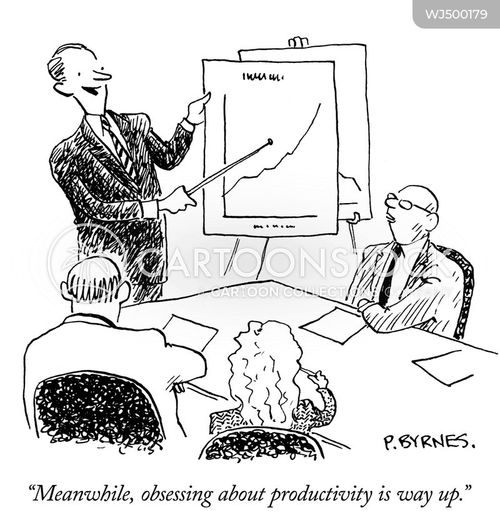
Cartoon – Obsessing about Productivity

In recent weeks, U.S. coronavirus case data — long a closely-watched barometer of the pandemic’s severity — has sent some encouraging signals: The rate of newly recorded infections is plummeting from coast to coast and the worst surge yet is finally relenting. But scientists are split on why, exactly, it is happening.
Some point to the quickening pace of coronavirus vaccine administration, some say it’s because of the natural seasonal ebb of respiratory viruses and others chalk it up to social distancing measures.
And every explanation is appended with two significant caveats: The country is still in a bad place, continuing to notch more than 90,000 new cases every day, and recent progress could still be imperiled, either by new fast-spreading virus variants or by relaxed social distancing measures.
The rolling daily average of new infections in the United States hit its all-time high of 248,200 on Jan. 12, according to data gathered and analyzed by The Washington Post. Since then, the number has dropped every day, hitting 91,000 on Sunday, its lowest level since November.
A former director of the Centers for Disease Control and Prevention endorsed the idea that Americans are now seeing the effect of their good behavior — not of increased vaccinations.
“I don’t think the vaccine is having much of an impact at all on case rates,” Tom Frieden said in an interview Sunday on CNN’s “Fareed Zakaria GPS.” “It’s what we’re doing right: staying apart, wearing masks, not traveling, not mixing with others indoors.”
However, Frieden noted, the country’s numbers are still higher than they were during the spring and summer virus waves and “we’re nowhere near out of the woods.”
“We’ve had three surges,” Frieden said. “Whether or not we have a fourth surge is up to us, and the stakes couldn’t be higher.”
The current CDC director, Rochelle Walensky, said in a round of TV interviews Sunday morning that behavior will be crucial to averting yet another spike in infections and that it is far too soon for states to be rescinding mask mandates. Walensky also noted the declining numbers but said cases are still “more than two-and-a-half-fold times what we saw over the summer.”
“It’s encouraging to see these trends coming down, but they’re coming down from an extraordinarily high place,” she said on NBC’s “Meet the Press.”
Researchers at the University of Washington’s Institute for Health Metrics and Evaluation, publisher of a popular coronavirus model, are among those who attribute declining cases to vaccines and the virus’s seasonality, which scientists have said may allow it to spread faster in colder weather.
In the IHME’s most recent briefing, published Friday, the authors write that cases have “declined sharply,” dropping nearly 50 percent since early January.
“Two [factors] are driving down transmission,” the briefing says. “1) the continued scale-up of vaccination helped by the fraction of adults willing to accept the vaccine reaching 71 percent, and 2) declining seasonality, which will contribute to declining transmission potential from now until August.”
The model predicts 152,000 more covid-19 deaths by June 1, but projects that the vaccine rollout will save 114,000 lives.
In the past week, the country collectively administered 1.62 million vaccine doses per day, according to The Washington Post’s analysis of state and federal data. It was the best week yet for the shots, topping even President Biden’s lofty goal of 1.5 million vaccinations per day.
Nearly 40 million people have received at least their first dose of a coronavirus vaccine, about 12 percent of the U.S. population. Experts have said that 70 percent to 90 percent of people need to have immunity, either through vaccination or prior infection, to quash the pandemic. And some leading epidemiologists have agreed with Frieden, saying that not enough people are vaccinated to make such a sizable dent in the case rates.
A fourth, less optimistic explanation has also emerged: More new cases are simply going undetected. On Twitter, Eleanor Murray, a professor of epidemiology at Boston University School of Public Health, said an increased focus on vaccine distribution and administration could be making it harder to get tested.
“I worry that it’s at least partly an artifact of resources being moved from testing to vaccination,” Murray said of the declines.
The Covid Tracking Project, which compiles and publishes data on coronavirus testing, has indeed observed a steady recent decrease in tests, from more than 2 million per day in mid-January to about 1.6 million a month later. The project’s latest update blames this dip on “a combination of reduced demand as well as reduced availability or accessibility of testing.”
“Demand for testing may have dropped because fewer people are sick or have been exposed to infected individuals, but also perhaps because testing isn’t being promoted as heavily,” the authors write.
They note that a backlog of tests over the holidays probably produced an artificial spike of reported tests in early January, but that even when adjusted, it’s still “unequivocally the wrong direction for a country that needs to understand the movements of the virus during a slow vaccine rollout and the spread of multiple new variants.”
Where most experts agree: The mutated variants of the virus pose perhaps the biggest threat to the country’s recovery. One is spreading rapidly and another, known as B.1.351, contains a mutation that may help the virus partly evade natural and vaccine-induced antibodies.
Fewer than 20 cases have been reported in the United States, but a critically ill man in France underscores the variant’s potentially dangerous consequences. The 58-year-old had a mild coronavirus infection in September and the B.1.351 strain reinfected him four months later.
No matter what’s causing the current downturn in new infections, experts have urged Americans to avoid complacency.
“Masks, distancing, ventilation, avoiding gatherings, getting vaccinated when eligible. These are the tools we have to continue the long trip down the tall mountain,” Caitlin Rivers, an epidemiologist at Johns Hopkins University, said on Twitter. “The variants may throw us a curve ball, but if we keep driving down transmission we can get to a better place.”
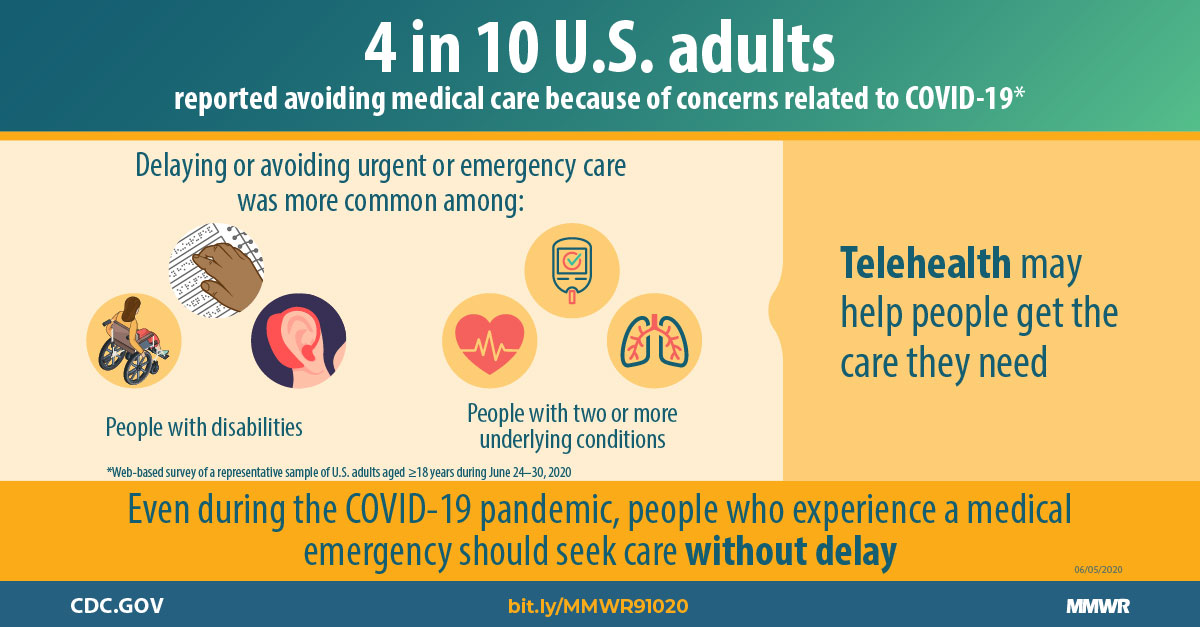
The early days of the pandemic saw widespread halts in non-emergency care, with big hits to provider finances.
In recent months, health systems have emphasized the services can be provided in hospitals and doctors offices safely as long as certain protocols are followed, and at least some research has backed them up. Groups like the American Hospital Association have launched ad campaigns urging people to return for preventive and routine care as well as emergencies.
But patients are apparently still wary, according to the findings based on surveys of about 4,000 adults conducted in September.
The research shows another facet of the systemic inequities harshly spotlighted by the pandemic. People of color are more likely to put off care than other groups. While 34% of Whites said they put off care, that percentage rose to 40% among Blacks and 36% among Latinos.
Income also played a role, as 37% of those with household incomes at or below 250% of the poverty level put off care, compared to 25% of those with incomes above that threshold.
Putting off care has had an impact industrywide, as the normally robust healthcare sector lost 30,000 jobs in January. Molina Healthcare warned last week that utilization will remain depressed for the foreseeable future.
Younger Americans were also impacted, with nearly 30% of parents saying they delayed at least one type of care for their children, while 16% delayed multiple types of care. As with adults, dental care was the most common procedure that was put off, followed by checkups or other preventative healthcare screenings.
The researchers recommended improving communications among providers and patients.
“Patients must be reassured that providers’ safety precautions follow public health guidelines, and that these precautions effectively prevent transmission in offices, clinics, and hospitals,” they wrote. “More data showing healthcare settings are not common sources of transmission and better communication with the public to promote the importance of seeking needed and routine care are also needed.”
https://www.healthcaredive.com/news/molina-expects-utilization-to-remain-depressed-in-2021/594895/

Insurers have largely remained unbruised from the pandemic, unlike some providers, but the fourth quarter was a different story.
The pandemic took a bite out of Molina’s net income in the fourth quarter as the company reported that figure fell to $34 million from $168 million in Q4 2019.
The biggest contributor to the impact on the bottom line was Medicaid refunds to states, including California, Michigan and Ohio. States have clawed back some of the money they pay insurers like Molina as members continue to defer care, which is a benefit to insurers as they then pay out less.
Molina painted a clearer picture of this scenario during Thursday’s conference call with investors.
For the full year, Molina estimated that medical cost suppression amounted to $620 million while direct COVID-19 costs amounted to $200 million. In other words, curbed utilization continued to outweigh direct COVID-19 costs, resulting in a $420 million benefit from the pandemic, which the company characterized as a surplus.
But states took back a total of $565 million through rate refunds. Overall, the net impact of COVID-19 was a $180 million hit to Molina for 2020 when factoring in other costs.
Looking ahead, executives seemed cautiously optimistic for 2021 but noted headwinds from the pandemic will persist. While the forecast reflects future growth, Zubretsky said, “it is a constrained picture” of the company’s potential earnings.
Some of those headwinds include Medicare risk scores that don’t fully capture the acuity of their Medicare members. As seniors put off care in 2020, companies like Molina were unable to capture diagnosis codes to help them determine how sick members are and the ultimate risk they pose.
Still, there are some bright spots. As the public health emergency is likely to be continued throughout the remainder of the year, it means that redeterminations will remain halted, or, in other words, Medicaid members will not be kicked off coverage.
This was a boon for Molina in 2020, as it allowed them to pick up a significant number of new members. Overall, it was a major catalyst for Medicaid membership growth in 2020, Zubretsky said.
Molina expects care utilization to improve this year but not fully return to normal. Instead, it expects utilization suppression to be about one third of 2020 levels.
Molina, which solely focuses its portfolio on government sponsored and marketplace plans, said it expects to pick up as many as 30,000 additional members during the Affordable Care Act special enrollment period.
Opening up a special enrollment period was one of the first moves made by the new administration in the White House. Zubretsky seems enthused by the recent moves through executive orders and the unfolding bill developments in Congress that are looking to raise premium subsidies on the exchanges.
Those early actions “just couldn’t be better for government sponsored managed care, and we’re pleased to see that progress already being made,” Zubretsky said.
https://www.healthcarefinancenews.com/news/aetna-reenter-affordable-care-act-market

The ACA business has improved and Aetna will sell individual coverage in 2022, CEO says.
After a three-year hiatus, Aetna is reentering the Affordable Care Act market.
Karen Lynch, the new president and CEO of CVS Health, said during an earnings call on Tuesday that Aetna will reenter the ACA business. The ACA business has improved, she said, and Aetna will rejoin the ACA marketplace, selling individual coverage in 2022.
“We’ll accelerate the pace of progress via targeted investments that will drive consumer-focused strategy,” Lynch said. “We will create future economic benefit for CVS Health and its shareholders.”
WHY THIS MATTERS
Aetna said in 2017 that it would leave the market in 2018.
Aetna joined other insurers in leaving or downsizing its footprint as premiums rose and insurers lost money.
The ACA market has grown since the exodus and shown strength in 2021, in lower premiums for consumers, steady enrollment numbers and insurers expanding their marketplace reach.
As COVID-19 has cost many their employer-based health insurance, the Biden Administration has opened a new enrollment period that started on February 15 and goes through May 15.
THE LARGER TREND
President Donald Trump and Congressional GOP members attempted to get rid of the Affordable Care Act that was passed into law by his predecessor, President Barack Obama.
Trump’s successor, President Biden, has promised to strengthen the market, even as the Supreme Court considers whether the ACA law remains valid without the individual mandate’s tax penalty. The Supreme Court is expected to hand down a decision by June.
In 2018, Aetna became part of CVS Health in a $69 billion merger.



 HENRY KOTULA