Short-Term Health Plans Hold Savings For Consumers, Profits For Brokers And Insurers

https://www.thelundreport.org/content/short-term-health-plans-hold-savings-consumers-profits-brokers-and-insurers?mc_cid=87537ae734&mc_eid=1d14ffb322

Sure, they’re less expensive for consumers, but short-term health policies have another side: They’re highly profitable for insurers and offer hefty sales commissions.

Driven by rising premiums for Affordable Care Act plans, interest in short-term insurance is growing, boosted by Trump administration actions to ease Obama-era restrictions and possibly make federal subsidies available to consumers to purchase them.

That’s good news for brokers, who often see commissions on such policies hit 20 percent or more.

On a policy costing $200 a month, for example, that could translate to a $40 payment each month. By contrast, ACA plan commissions, which are often flat dollar amounts rather than a percentage of premium, can range from zero to $20 per enrollee per month.

“Customers are paying less and I’m making more,” said Cindy Holtzman, a broker in Woodstock, Ga., who said she gets 20 percent on short-term plan commissions.

Large online brokers also are eagerly eyeing the market.

Ehealth, one such firm, will “continue to shift our focus to selling short-term plans and non-ACA insurance packages,” CEO Scott Flanders told investors in October. The firm saw an 18 percent annual jump in enrollment in short-term plans this year, he added.

Insurers, too, see strong profits from plans because they generally pay out very little toward medical care when compared with the more comprehensive ACA plans.

Still, some agents like Holtzman have mixed feelings about selling the plans, because they offer skimpier coverage than ACA insurance. One 58-year-old client of Holtzman’s wanted one, but he had health problems. She also learned his income qualified him for an ACA subsidy, which currently cannot be used to purchase short-term coverage.

“There’s no way I would have considered a short-term plan for him,” she said. “I found him an ACA plan for $360 a month with a reduced deductible.” (A federal district court judge in Texas issued a ruling Dec. 14 striking down the ACA, which would among other things impact the requirements of ACA coverage and subsidies. The decision is expected to face appeal.)

Short-term plans can be far less expensive than ACA plans because they set annual or lifetime payment limits. Most exclude people with medical conditions, they often don’t cover prescription drugs, and policies exclude in fine print some conditions or treatments. Injuries sustained in school sports programs, for example, often are not covered. (These plans can be purchased at any time throughout the year, which is different than plans sold through the federal marketplaces. The open enrollment period for those ACA plans in most states ends Dec. 15.)

Consequently, insurers providing short-term plans don’t have to pay as many medical bills, so they have more money left over for profits. In forms filed with state regulators, Independence American Insurance Co. in Ohio shows it expects 60 percent of its premium revenue to be spent on its enrollees’ medical care. The remaining 40 percent can go to profits, executive salaries, marketing and commissions.

A 2016 report from the National Association of Insurance Commissioners showed that, on average, short-term plans paid out about 67 percent of their earnings on medical care.

That compares with ACA plans, which are required under the law to spend at least 80 percent of premium revenue on medical claims.

Short-term plans have long been sold mainly as a stopgap measure for people between jobs or school coverage. While exact figures are not available, brokers say interest dropped when the ACA took effect in 2014 because many people got subsidies to buy ACA plans and having a short-term plan did not exempt consumers from the law’s penalty for not carrying insurance.

But this year it ticked up again after Congress eliminated the penalty for 2019 coverage. At the same time, the premiums for ACA plans rose on average more than 30 percent.

“If I don’t want someone to walk out of the office with nothing at all because of cost, that’s when I will bring up short-term plans,” said Kelly Rector, president of Denny & Associates, an insurance sales brokerage in O’Fallon, a suburb of St. Louis. “But I don’t love the plans because of the risk.”

The Obama administration limited short-term plans to 90-day increments to reduce the number of younger or healthier people who would leave the ACA market. That rule, the Trump administration complained, forced people to reapply every few months and risk rejection by insurers if their health had declined.

This summer, the administration finalized new rules allowing insurers to offer short-term plans for up to 12 months — and gave them the option to allow renewals for up to three years. States can be more restrictive or even bar such plans altogether.

Administration officials estimate short-term plans could be half the cost of the more comprehensive ACA insurance and draw 600,000 people to enroll in 2019, with 100,000 to 200,000 of those dropping ACA coverage to do so.

And recent guidance to states says they could seek permission to allow federal subsidies to be used for short-term plans. Currently, those subsidies apply only to ACA-compliant plans.

Granting subsidies for short-term plans “would mean tax dollars are not only subsidizing commissions, but also executive salaries and marketing budgets,” said Sabrina Corlette of Georgetown University Center on Health Insurance Reforms.

No state has yet applied to do that.

For now, brokers are focusing on getting their clients into some kind of coverage for next year. Commissions on both ACA and short-term plans are getting their attention.

After several years of declining commissions for ACA plans — with some carriers cutting them altogether a couple of years ago — brokers say they are seeing a bit of a rebound.

Among Colorado ACA insurers, “it’s gone from about $14 to $16 per enrollee [a month] to $16 to $18,” said Louise Norris, a health policy writer and co-owner of an insurance brokerage.

Rector, in Missouri, said an insurer that last year paid no commissions has reinstated them for 2019 coverage. For her, that doesn’t really matter, she said, because once carriers started reducing or eliminating commissions, she began charging clients a flat rate to enroll.

Norris noted that some states changed their laws so brokers could do just that.

At least one state, Connecticut, ruled that insurers had to pay a commission, which she thinks is protective for consumers.

“Insurance regulators need to step in and make sure brokers are getting paid,” said Norris, or some brokers, “out of necessity,” might steer people to higher-commission products, such as short-term plans, that might not be the best answer for their clients.

Her agency does not sell short-term or some other types of limited-benefit plans.

“I don’t want to have a client come back and say I’ve had a heart attack and have all these unpaid bills,” she said.


Anthem’s Q3 profit jumps 29% to $960M

https://www.beckershospitalreview.com/payer-issues/anthem-s-q3-profit-jumps-29-to-960m.html?origin=ceoe&utm_source=ceoe

Image result for anthem blue cross headquarters address

Anthem posted strong operating results in the third quarter of 2018.

Here are four things to know from the health insurer’s results:

1. Anthem’s operating revenue grew 4 percent in the third quarter of this year to $23 billion, up from $22.1 billion in the same period a year prior. The health insurer said premium increases and the return of the health insurance tax in 2018 positively affected operating revenue, as did growth in its Medicare business.

2. Anthem’s reduced footprint in the individual ACA exchanges, local group and Medicaid plans contributed to a year-over-year decline in membership in the third quarter of this year compared to the same three months in 2017. Anthem lost 753,000 members year over year and now has 39.5 million members. At the same time, Anthem grew its Medicare membership year over year by 267,000 members in the third quarter of this year through acquisitions and organic growth.

3. Anthem trimmed its medical loss ratio, or the amount the health insurer pays toward medical care versus overhead costs, to 84.8 percent in the third quarter of this year. That’s down from 87 percent in the same period last year. Lower taxes and better medical cost performance in its commercial and specialty insurance lines contributed to the improvement.

4. Including expenses and nonoperating gains, Anthem ended the third quarter of 2018 with $960 million in net income, up 29 percent from $747 million recorded in the same period last year.


Health care mega-mergers may get green light from feds

https://www.axios.com/health-care-mega-mergers-justice-department-approval-a48cb213-ae0a-45da-9e99-dfb031957e55.html

The Department of Justice headquarters in Washington, D.C.


Antitrust regulators at the Department of Justice are expected to approve two major health care deals — CVS Health’s $69 billion buyout of Aetna and Cigna’s $67 billion deal for Express Scripts — within a matter of weeks, the Wall Street Journal reports.

Why it matters: The health insurance and pharmacy benefits industries would be even more heavily consolidated than they currently are, which has worried consumer advocates and providers. The WSJ reports the only required antitrust remedies would be for CVS and Aetna to divest overlapping assets in their Medicare prescription drug plans.


Short-term health plans: A junk solution to a real problem

https://theconversation.com/short-term-health-plans-a-junk-solution-to-a-real-problem-101447

Serious illnesses like cancer often are not covered by short-term health insurance policies.


After failing to overturn most of the Affordable Care Act in a very public fight, President Donald Trump has been steadily working behind the scenes to further destabilize former President Barack Obama’s signature achievement. A major component in this effort has been an activity called rule-making, the administrative implementation of statutes by federal agencies like the Department of Health and Human Services.

Most recently, citing excessive consumer costs, the Trump administration issued regulations to vastly expand the availability of short-term, limited duration insurance plans.

While the cost of health care is one of the overwhelming problems in the American health care system, short-term health plans do nothing to alter the underlying causes. Indeed, these plans may cause great harm to individual consumers while simultaneously threatening the viability of many states’ insurance markets. Having studied the U.S. health care market for years, here is why I think states can and should take quick action to protect consumers.

Comparing crab apples and oranges

Short-term, limited duration insurance plans, by definition, provide insurance coverage for a short, limited period. Since being regulated by the Health Insurance Portability Act of 1996 (HIPAA), this has meant for less than one year. Sold at least since the 1970s, they were offered as an alternative to major medical insurance intended for individuals with temporary and transitional insurance needs such as recent college graduates or those in between jobs.

However, after passage of the Affordable Care Act further concerns emerged over the misuse and mismarketing of these kinds of plans. As a result, the Obama administration restricted their duration to three months.

In addition to being shorter in duration, these policies’ benefits tend to also be much skimpier than for those plans sold on the Affordable Care Act’s marketplaces. For example, plans often do not cover crucial services such as prescription drugs, maternity care, or major emergencies like cancer. Equally problematic, even those benefits covered come with high deductibles, strict limitations, and annual and lifetime coverage limits.

It is important to note that short-term health plans are also not subject to any of the consumer protections established by the Affordable Care Act. This means, for example, that insurers can set premiums, or even refuse to sell to an individual, based on a person’s medical history. Moreover, consumers must update their health status every time they seek to purchase coverage.

Crucially, short-term health plans have shown to be particularly discriminatory against women. For one, women are charged higher premiums. Moreover, they are likely to be disproportionately affected by medical underwriting for pre-existing conditions like domestic and sexual abuse and pre- and postnatal treatment.

Because plans are so limited in benefits, and because insurers are able to deny coverage to sicker individuals, short-term health plans come with much lower premiums than standard insurance plans with their more expansive benefits and vastly superior consumer protections. Indeed on average, premiums amount to only one-fourth of ACA-compliant plans.

Too good to be true

While short-term insurance plans are more affordable in terms of premiums, they come with a slew of problems for consumers.

For one, consumers have a tremendously hard time understanding the American health care system and health insurance. Predatory insurance companies have been known to take advantage of this shortcoming by camouflaging covered benefits, something the Affordable Care Act sought to ameliorate. Mis- and underinformed consumers often find themselves surprised when they actually try to use their insurance.

Even for those who are aware of the limitations, problems may arise. Unable to predict major medical emergencies, consumers may be confronted with tens of thousands of dollars of medical bills if they fall sick or face injury.

Moreover, insurers are also able to rescind policies after major medical expenses have been incurred if consumers failed to fully disclose any underlying health conditions. This even applies to health conditions that consumers had not been aware of prior to getting sick.

While some may argue that this is the fault of the those who purchase short-term insurance, it causes problems for all of us.

For one, these individuals may refuse to seek care. This could result in severe consequence for their and their family’s well-being and ability to earn a living.

At the same time, medical providers will shift the costs of the resulting bad debts to other individuals with insurance or the general taxpayer.

Bad for the individual, worse for all of us

Short-term insurance plans are perhaps even more problematic for the health of the overall insurance market than they are for individual consumers.

With a very short implementation time frame, insurance regulators in the states only have until October to prepare for the potentially significant disruptions to their markets. This leaves little time for analysis and regulatory preparation.

Yet long-term consequences are even more concerning. Healthier and younger consumers are naturally drawn to the low premiums offered by these plans. At the same time, older and sicker individuals will value the comprehensive benefits and protections offered by the Affordable Care Act. The result is the continuing segregation of insurance markets and risk pools into a cheaper, healthier one and a sicker, more expensive one. As premiums rise in the latter, its healthiest individuals will begin to drop their coverage, leading to ever more premium increases and larger coverage losses. If left unchecked, eventually the entire insurance market may collapse in this process.

This could be particularly problematic in states with relatively small insurance markets like Wyoming or West Virginia where even one truly sick individual can drive up premiums tremendously.

States have options

The expansion of short-term health plans is one action by the Trump administration that states can counteract relatively simply. Currently, states serve as the primary regulator of their insurance markets. As such, they have the power to make decisions about what insurance products can be sold within their boundaries.

Action can be taken by insurance regulators and legislature to create relatively simple solutions. While the vast majority of states have failed to create consumer and market protections, a small number of states have done just that.

New York, for example, has banned the sale of these plans.

Others, like Maryland, have strictly limited their sale and renewability.

Treating the symptoms, not the cause

Many Americans struggle to access insurance and services despite the Affordable Care Act. While the Affordable Care Act has unquestionably improved access to insurance for Americans, cost control and affordability are truly its Achilles heels. Indeed, some Americans lost their limited benefits, lower cost plans when the Affordable Care Act did not recognize them as viable coverage.

The Trump administration has rightfully highlighted to high costs of the American health care system. However, offering consumers the opportunity to purchase bare-bones insurance at lower costs does nothing to solve America’s health care cost problems.

If access to insurance is truly a concern for the Trump administration, I believe it should seek to convince the remaining hold-outs to expand their Medicaid programs. Also, I think discontinuing its actions to destabilize insurance markets would also go a long way to reducing premiums.

Yet when it comes to altering the underlying cost calculus, there are no simple solutionsAdministrative costs are too highMedical quality is too lowResources constantly get wasted. Consumers could do more to be healthier.

Ultimately, I see it coming down to one crucial problem: Providers, pharmaceutical companies, device makers and insurers are making too much money. And it is these vested interests that make structural reform of the U.S. health care system a truly herculean endeavor.

But unless Americans and policymakers of both parties are willing to address this root cause, any reform effort amounts to nothing more than rearranging the deck chairs on the Titanic.


Health Insurers Had Their Best Quarter in Years, Despite the Flu

https://www.bloomberg.com/news/articles/2018-05-03/health-insurers-had-their-best-quarter-in-years-despite-the-flu

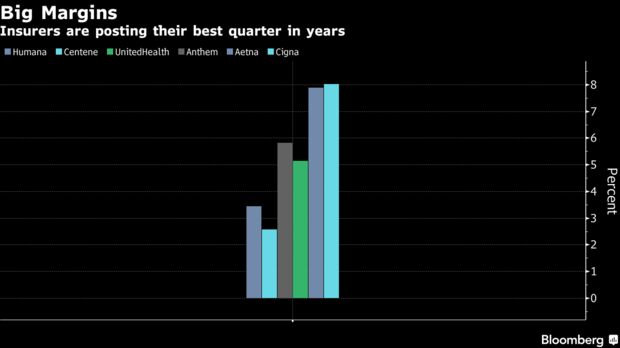
Here’s a look at how the margins of the largest in the quarter, based on data compiled by Bloomberg:

U.S. health insurers just posted their best financial results in years, shrugging off worries that the worst flu season in recent history would hurt profits.

Aetna Inc., for instance, posted its widest profit margin since 2004. Centene Corp. had its most profitable quarter since 2008. And Cigna Corp., which reported on Thursday, had its biggest margin in about seven years.

Analysts at Morgan Stanley, in a research note, said insurers are in the midst of a “hot streak.”

One big reason for the windfall is the tax cuts passed by Congress last year, which in some cases more than halved what the insurers owe the government. Aetna said its effective tax rate fell to 16.8 percent from 39.6 percent, for example. Many insurers also spent less on medical care than analysts had expected, even taking into account increased spending on flu treatments.


Credit rating agency, researchers give vote of confidence to health insurance sector

https://www.fiercehealthcare.com/payer/financial-performance-a-m-best-kaiser-family-foundation-insurers?mkt_tok=eyJpIjoiTjJRNU5qUXlZVEJqWmpjNCIsInQiOiJOR2V2bEp4NkdoeVB3VndhZE43TVBjZXdaTGJcLzk1Z3hBd1wvZ05teDMrcjZ5UzJhb0tzUkpQbWlaSmVvUmJFazVDcERmajBTREhCTXJxR3BBaGtoY1MrZlVtQW5xeXRSbFwvYVhPOE44VE9uYUhNZWNnbGtoR3c3S0xHUlp5SlwvS2kifQ%3D%3D&mrkid=959610

Health insurance, pen and stethoscope

Two new reports offer evidence that policy uncertainty aside, the health insurance industry is doing just fine.

In one report, A.M. Best explains why it decided to change its outlook for the health insurance sector from negative to stable. The credit rating agency said the change “reflects a variety of factors that have led to improvement in earnings and risk-adjusted capitalization.”

While insurers have experienced losses in the individual exchange business, this market segment has improved in 2016 and 2017—in part due to consecutive years of high rate increases, a narrowing of provider networks and a stabilizing exchange population, the report said.

A.M. Best also predicted that Congress won’t make repealing and replacing the Affordable Care Act a high priority in 2018. And even if it does, health insurers will have time to make adjustments, since legislative changes won’t take effect for two or more years.

The rating agency’s findings about the individual market echo those of a new report from the Kaiser Family Foundation, which examined insurers’ financial data from the third quarter of 2017.

It found that insurers saw significant improvement in their medical loss ratios, which averaged 81% through the third quarter. Gross margins per member per month in the individual market segment followed a similar pattern, jumping up to $79 per enrollee in the third quarter of 2017 from a recent third-quarter low of $10 in 2015.

One caveat is that KFF’s findings reflect insurer performance only through September—before the Trump administration stopped reimbursing insurers for cost-sharing subsidies. “The loss of these payments during the fourth quarter of 2017 will diminish insurer profits, but nonetheless, insurers are likely to see better financial results in 2017 than they did in earlier years of the ACA marketplaces,” KFF said.

As promising as these observations about the individual market are, A.M. Best pointed out that this market segment is just a small portion of most health insurers’ earnings and revenues. In fact, health plans largely owe their overall profitability to the combined operating results of the employer group, Medicaid and Medicare Advantage lines of business.

Looking ahead, the agency predicted that Medicare and Medicaid business lines will remain profitable for insurers—though margins will likely compress for both. It said the employer group segment will also remain profitable, but noted that membership will continue to be flat.


Study: ‘Big five’ insurers depend heavily on Medicare, Medicaid business

https://www.fiercehealthcare.com/cms-chip/big-five-insurers-medicare-medicaid-growth-profits?mkt_tok=eyJpIjoiT0RnMFkySXdPV0psWldSaCIsInQiOiJQSllQNlpcL2RhTzBDZFwvZXh5M1ZUSDJyUU5JTGw3dnh1QTVac01rZUFcL2pNUUhhMXBaQjBxK29ScHRrOHhsT3d6aE5pcFRJUWd4Sm0rYXA4S0RYVGE2N0czN2hhc2hsXC9EZk9mSGVLR0V1UFlwVDZpQmdkcll0eTBMNDUzTHlIZDIifQ%3D%3D&mrkid=959610&utm_medium=nl&utm_source=internal

Rising Stocks

Even as they’ve retreated from the Affordable Care Act exchanges, the country’s biggest for-profit health insurers have become increasingly dependent on Medicare and Medicaid for both profits and growth.

In fact, Medicare and Medicaid accounted for 59% of the revenues of the “big five” U.S. commercial health insurers—UnitedHealthcare, Anthem, Aetna, Cigna and Humana—in 2016, according to a new Health Affairs study.

From 2010 to 2016, the combined Medicare and Medicaid revenue from those insurers ballooned from $92.5 billion to $213.1 billion. The companies’ Medicare and Medicaid business also grew faster than other segments, doubling from 12.8 million to 25.5 million members during that time.

All these positive trends, the study noted, helped offset the financial losses that drove the firms to reduce their presence in the individual marketplaces. Indeed, the big five insurers’ pretax profits either increased or held steady during the first three years of the ACA’s individual market reforms (2013-2016). Their profit margins did decline during those three years, but stabilized between 2014 and 2016.

Not only do these findings demonstrate the “growing mutual dependence between public programs and private insurers,” the study authors said, but they also suggest a useful policy lever. The authors argued that in order to help stabilize the ACA exchanges, federal and state laws could require any insurer participating in Medicare or state Medicaid programs to also offer individual market plans in those areas.

Nevada has already done something similar: It offered an advantage in Medicaid managed care contract billing for insurers that promised to participate in the state’s ACA exchange. The state credited that policy with its ability to coax Centene to step in and cover counties that otherwise would have lacked an exchange carrier in 2018.

It’s far less certain, though, whether such a concept will ever be embraced at the federal level during the Trump administration, since its focus has been on unwinding the ACA rather than propping it up.

Either way, recent events underscore the study’s findings about how lucrative government business has become for major insurers. One of the main goals of CVS’ proposed acquisition of Aetna is to improve care for Medicare patients, which would help the combined company “be more competitive in this fast-growing segment of the market,” CVS CEO Larry Merlo said on a call this week.

Aetna CEO Mark Bertolini added that the transaction has “incredible potential” for Medicare and Medicaid members, as the goal is to provide the type of high-touch interaction and care coordination they need to navigate the healthcare system.


Blue Cross Blue Shield insurers are still doing well

https://www.axios.com/the-blue-cross-blue-shield-insurers-are-still-doing-well-2507217868.html

 Blue Cross Blue Shield health insurance companies have more than quintupled their net profits in the first half of this year compared with the same six months of 2016, according to an analysis of financial records by Fitch Ratings.

The bottom line: We reported over the summer that the Blues, which have the most exposure to the Affordable Care Act marketplaces, are making a lot of money despite the Trump administration’s threats and actions against the ACA. Why are profits still growing for the Blues? They raised premiums a lot, people are not going to the doctor or hospital as much, and the federal government modified some enrollment policies to the benefit of insurers.

The details: Fitch analyzed the first-half financial documents of 34 Blue Cross Blue Shield companies, including the publicly traded Anthem as well as other large Blues brands such as Health Care Service Corp. and Blue Shield of California. Almost every company improved its finances year over year, leading to the following aggregate financial data for the first six months of 2017:

  • $135 billion of revenue (up 7%)
  • $7.7 billion underwriting profit, or the amount of money made after subtracting medical costs from premiums paid (up 194%)
  • $6.5 billion net profit (up 441%)
  • 85.9% medical loss ratio, which reflects how much of the premium dollar is spent on medical care (down 0.8 percentage points)

What was true previously is still true now: Most health insurers are not currently losing their shirts on the ACA’s individual marketplaces, although next year could be different depending on what happens to the law’s cost-sharing subsidies. While the higher premium rates have not harmed people who get federal subsidies, they have caused more financial pain for middle-class people who have to pay the full cost of their health insurance.

Looking ahead: Congress delayed the ACA’s health insurer tax throughout 2017 — another reason why companies have done so much better this year. Insurers have conducted a lobbying blitz to get Congress to repeal or delay that fee again, and legislation that would delay the tax for another two years could be folded into a year-end package.

Health insurers working the system to pad their profits

https://www.publicintegrity.org/2015/08/17/17863/health-insurers-working-system-pad-their-profits

Image result for Health insurers working the system to pad their profits

Commentary: taking advantage of Medicare Advantage

One of the reasons the health insurance industry worked behind the scenes in 2009 and 2010 to derail Obamacare was the fear that changes mandated by the law would cut their Medicare Advantage profits. Medicare Advantage plans are federally funded but privately run alternatives to traditional fee-for-service Medicare.

Although the industry’s biggest trade group, America’s Health Insurance Plans, said repeatedly that insurers supported Obamacare, the group was secretly financing the U.S. Chamber of Commerce’s TV campaign against reform. Among the companies most concerned about the law were those benefiting from overpayments the federal government had been making to their Medicare Advantage plans since George W. Bush was in the White House.

Bush and other Republicans saw the Medicare Advantage program as a way to incrementally privatize Medicare. To entice insurers to participate in the program, the federal government devised a payment scheme that resulted in taxpayers paying far more for people enrolled in the Medicare Advantage plans than those who remained in the traditional program. The extra cash enables insurers to offer benefits traditional Medicare doesn’t, like coverage for glasses and hearing aids, and to cap enrollees’ out-of-pocket expenses.

When the Affordable Care Act became law in 2010, the payments to Medicare Advantage plans exceeded traditional Medicare payments by 14 percent. To end what they considered an unfair advantage for private insurers, and to reduce overall spending on Medicare, Democrats who wrote the reform law included language to gradually eliminate the over-payments.  So far, the 14 percent disparity has been reduced to 2 percent.  The final reductions are scheduled to be made next year.

Despite that decrease, the fears by Republicans and insurance company executives that the reductions would lead to a steady decline in Medicare Advantage enrollees have proved to be completely unfounded. In fact, the plans have continued to grow at a fast clip.

In March 2010, the month Obamacare became law, 11.1 million people were enrolled in Medicare Advantage plans—one of every four people eligible for Medicare. That was an increase from the 10.5 million Medicare Advantage enrollees in March 2009. Since then, Medicare Advantage membership has grown by more than 8 percent annually. Now 17.3 million—one in three people eligible for Medicare—are enrolled in private plans.

As Center for Public Integrity senior reporter Fred Schulte has written over the past year, many insurers have discovered that even though the overpayments are being reduced, they can boost profits another way: by manipulating a provision of a 2003 law that allows them to get additional cash for enrollees deemed to be sicker than average.

A risk-coding program was put in place by the government primarily because insurers were targeting their marketing efforts to attract younger and healthier—and thus cheaper— beneficiaries. Under the risk-coding program, insurers are paid more to cover patients who are older and sicker; the idea was to encourage the firms to cover those folks by offering a financial incentive. They get more money, for example, to cover someone with a history of heart disease than they do for someone with no such risk.  Last week Schulte uncovered whistleblower accusations that a medical consulting firm and more than two dozen Medicare Advantage plans have been ripping taxpayers off by conducting in-home patient exams that allegedly overstated how much the plans should be paid.

The Center for Medicare and Medicaid Services has refused to provide information that would enable taxpayers to know just how widespread fraud and abuse in the Medicare Advantage program might be. But CMS announced earlier this year that it will implement plans designed to make it harder for insurers to manipulate the risk scores. As you can imagine, insurers have howled and have put on a full court press to get CMS to scuttle those plans, but so far the agency says it intends to go forward. We’ll see.

This all matters to insurers because more and more of their revenue and profits are coming from the Medicare and Medicaid programs. When Aetna announced a few weeks ago that it planned to buy Humana, which has more than three million Medicare Advantage members—second only to UnitedHealthcare—Aetna and Humana executives said 56 percent of revenues from the combined company would come from the government programs.

Indeed, some of the firms would not be growing at all if it weren’t for their government business. When Aetna announced second quarter earnings earlier this month, the company noted that its membership in Medicare and Medicaid programs was up 8 percent over the same period last year. By contrast, its commercial membership was down from last year.

Despite that dip in commercial membership, Aetna surprised Wall Street with stronger profits than financial analysts had expected.

So don’t expect the Medicare Advantage program to wither on the vine because of Obamacare. If anything, it will continue to grow—as will the profits of the private insurers that participate in the program.