Independence Is Not a Strategy for Health Systems

http://www.healthleadersmedia.com/leadership/independence-not-strategy-health-systems?spMailingID=11725844&spUserID=MTY3ODg4NTg1MzQ4S0&spJobID=1221639238&spReportId=MTIyMTYzOTIzOAS2#

Image result for john gribbin centrastate

There are ways to keep going it alone in the face of massive consolidation, says one health system’s CEO. It’s not a strategy, but a means to end, he says.

Afraid your hospital or health system can’t compete because you lack size and scale?

A merger might help, but it’s not the only possible answer to your problems. Freehold, NJ-based CentraState Healthcare System’s top leader is certain it’s not the best solution for his organization.

Consolidation continues to upend the acute and post-acute healthcare industry. In fact, in a recent HealthLeaders Media survey, some 87% of respondents said that their organization is exploring potential deals, completing deals already under way, or both.

But CentraState isn’t among them, says John Gribbin, its president and CEO.

On a continuum basis, CentraState is already diversified. That’s one of the potential selling points of an M&A deal.

Anchored by the 248-bed CentraState Medical Center in Freehold, NJ, the 2,300-employee organization also contains three senior care facilities—one assisted living, one skilled-nursing facility, and a continuing care retirement community.

It can be argued that CentraState may not possess the scale to compete with multifacility, multistate large health systems that can take advantage of a hub-and-spoke strategy for referrals. Nor may it be able to afford expensive interconnected IT systems.

But there ways other than mergers to achieve scale and collaboration, says Gribbin.

Means to an End

Gribbin insists that he and CentraState’s board, which supports and encourages independence, are not dogmatic about it.

“Independence is not a strategy,” he says. “It’s a means to an end. The moment that ceases to be worthwhile is the moment we’ll consider another way to achieve our mission.”

Change is part of that strategy, he says, adding that healthcare in 2017 needs to be far more collaborative, not only with patients and family, but with other healthcare organizations. That’s a big difference from previous generations.

“Our real strategy is scale and relevancy,” he says.

And there are ways to create scale short of taking on all the legacy costs and “baggage,” as Gribbin calls it, inherent in any merger.

“There’s a lot of costs involved in merging… and while mergers work in some instances, they don’t work in all, and in many communities, they are increasing costs to the consumer,” he says.

In addition to the commonly stated goals of improving the community’s health and wellness, patient costs are extremely important in fulfilling CentraState’s mission, Gribbin argues.

Many mergers involve replacing hospitals and adding patient towers and high-cost equipment. That adds to their cost structure means they have to extract higher pricing, says Gribben.

“That’s the vicious circle you find yourself in. I prefer to create scale in a different manner.”

Focus on the Mission

Gribbin, who has led CentraState for 17 years, prefers to solve that challenge in part through a strong network of physicians unburdened by excessive administrative overhead.

He says the health system has to increasingly take on value-based contracting and financial risk. To be successful under such value-based reimbursement, partnerships with physicians are increasingly important, as is a redefinition of the relationship with the patient.

“We used to look at our relationship with the patient as a typical hospital stay,” says Gribbin. “What we’re preaching now is that hospital stay is a temporary interruption in our relationship. What happens before or after defines the relationship’s success.”

With its physician alliance and clinically integrated network in place, CentraState, unlike many hospitals, has been able to avoid, in large part, expensive physician practice acquisitions that can be a financial challenge.

“I’ve done it in the past, and may do it again, but we’ve tried to avoid it,” he says. Instead, contracts define the relationships and incentives.

As an example of those relationships, CentraState partners with a major patient-centered medical home primary care practice on four performance and three utilization measures.

As a result of the shared savings generated in the first year, which came largely from hospital-based savings, the physicians in that group referred 59% of their patients to CentraState.

This year they’ve referred 71% of their patients to CentraState because of its low costs, which help drive financial reward for both parties under the contract.

“On one hand, we’re keeping people appropriately out of acute care, but on the other hand, they’re sending [more] people here. So we’re experiencing higher but more appropriate volume. In this scenario, everyone wins,” Gribbin says.

A New Deal with Physicians

In order to avoid the need to acquire physician practices, Gribbin says it helps to have a suite of services to offer them as a starting point.

“Most don’t want to sell their practice, but they feel like they have to, he says. “If you give them the opportunity to stay independent, they’ll take it.”

Helping them with access to better revenue cycle management, malpractice insurance, and risk management, and helping them create the ability to enter into risk-based contracts is another big help with defining a new relationship based on shared goals with physicians that ultimately benefit the patient, he says.

Physicians can establish a relationship with CentraState through its independent practice association, or a physician hospital association, and avoid surrendering their autonomy, he says.

“The physicians got paid better, the payer saved money even including the bonus, the hospital won because it’s high value care, and the patient’s winning too,” he says. “It’s a microcosm of what we’re trying to accomplish.”

As a small organization, both Gribbin and the board worry about being frozen out of narrow networks. Much of the energy they’ve expended in being a low-cost organization is wasted, he says, if they can’t get the big payers to include them in contracting.

“As long as the market isn’t rigged against us, we’re OK, because we’re a high-value organization.”

Former director of finance charged with embezzling $1.5M from UNC hospital

http://www.beckershospitalreview.com/legal-regulatory-issues/former-director-of-finance-charged-with-embezzling-1-5m-from-unc-hospital.html

Kimberly R Hobson

The former director of finance for UNC Regional Physicians was charged Tuesday with embezzling more than $1.5 million while she worked at High Point (N.C.) Regional Health, part of Chapel Hill, N.C.-based UNC Health Care.

The former High Point Regional Health employee, Kimberly Hobson, was charged with felonious embezzlement, according to the Winston-Salem Journal.

Hospital officials discovered the alleged embezzlement July 28 and subsequently fired Ms. Hobson.

She is being held at High Point jail on $1 million bail. Her next court date is set for Sept. 15.

The investigation into the alleged embezzlement is ongoing on the state and federal levels, according to the report.

IRS revokes hospital’s tax-exempt status for failure to comply with ACA rule

http://www.beckershospitalreview.com/finance/irs-revokes-hospital-s-tax-exempt-status-for-failure-to-comply-with-aca-rule.html

Image result for IRS

The Internal Revenue Service has revoked the tax-exempt status of an unnamed nonprofit hospital for failure conduct a community health needs assessment, adopt an implementation strategy and make it widely available to the public.

In a letter dated Feb. 14, 2017, and released earlier this month, the IRS said it revoked the hospital’s tax-exempt status for failure to comply with section 501(r) of the Internal Revenue Code.

The ACA added new requirements that hospitals must meet to qualify as a tax-exempt facility under section 501(c)(3) of the Internal Revenue Code. Specifically, the ACA added section 501(r), which imposes four new requirements, one of which requires hospitals to conduct a community health needs assessment at least once every three years and adopt an implementation strategy to address community health needs identified in the assessment.

The IRS revoked the tax-exempt status of the unnamed hospital for what the agency referred to as “egregious failures when reviewed in the context of [section] 501(r).” Although the name of the hospital is not included in the letter from the IRS, previous correspondence from the agency identified the facility as a disproportionate share hospital and a critical care access facility.

The IRS noted a revenue agent met with the hospital’s CEO, CFO and COO during the audit, and the administrators made it clear the organization “had neither the will, the financial resources, nor the staff to follow through with the CHNA process.”

Dignity Health, UCSF Health Announce Bay Area Collaboration

https://www.definitivehc.com/news/dignity-health-ucsf-health-announce-bay-area-collaboration?source=newsltr-news&utm_source=newsltr-news&utm_medium=email&utm_campaign=08-15-17

Image result for ucsf medical center san francisco

Image result for dignity health

Dignity Health and UCSF Health have formalized an affiliation that will combine the best of academic medicine and community-based care, increasing access to high-quality, affordable care and improving the overall health care experience for patients in the San Francisco Bay Area.

The affiliation will bring UCSF Health’s academic medical center expertise to three Dignity Health hospitals in the Bay Area: Sequoia Hospital in Redwood City, and Saint Francis Memorial Hospital and St. Mary’s Medical Center in San Francisco. The organizations also have signed a Letter of Intent for physicians at Dignity Health Medical Group Sequoia and at Dignity Health Medical Group Saint Francis/St. Mary’s, both services of Dignity Health Medical Foundation, to collaborate with UCSF clinical faculty in sharing best practices and improving access, quality, efficiency and coordination of care for shared patients. In addition, these three Dignity Health hospitals have joined the Canopy Health accountable care network, to provide a strong continuum of care as patients’ health needs transition between primary and specialty care.

“Health care works best when we collaborate to offer the best thinking and the latest medical advances to our patients,” said Shelby Decosta, senior vice president and chief strategy officer for UCSF Health. “Dignity Health’s focus on excellent care, as well as the humanity of that care in a community setting, is the perfect balance for UCSF Health’s depth of knowledge and specialty services. Together, we can draw upon each other’s expertise for quality and service improvements, and best practices, and to provide specialty care with shorter wait times and a better patient experience.”

This new affiliation will enhance medical, surgical and related health care services in the Bay Area by bringing together UCSF’s and Dignity Health’s expertise, while providing patients with a more seamless experience between primary and specialized care in a community hospital setting.

“UCSF Health is an excellent partner in the Bay Area, and we are looking forward to a collaboration that provides increased patient access to high-quality care,” said Todd Strumwasser, MD, senior vice president of operations for Dignity Health Bay Area. “We are pleased to welcome UCSF physicians to our community hospitals, and offer patients a continuum of care never before available in the Bay Area.”

The alliance brings together the two longest-serving health providers in San Francisco, and reflects a long-standing and evolving relationship between Dignity Health and UCSF Health – two health systems known for their clinical excellence and missions to provide quality, affordable care to all, including the underserved. Dignity Health and UCSF Health have previously collaborated to improve pediatric burn care, acute rehabilitation, and cardiac arrhythmia, among other conditions.


Trump administration, HHS stepping away from Affordable Care Act promotion, bundled payments

http://www.healthcarefinancenews.com/news/trump-administration-hhs-stepping-away-affordable-care-act-promotion-bundled-payments?mkt_tok=eyJpIjoiWlRsaE56QTFZMk00WVdVdyIsInQiOiJPV2NZVXpmSXoxY2s2blNFdG9DYmt0UHh1bnkzc0NcL0R3YnpCcEhqdm5lWVwvNlJrN2xDVlwvUFZ5ZFBzOElGY253OGFMZWVKVnh5a3dTSDM1RFwvdFN3cklQTGd0NmN0YzFrQjIrK21WUW5UTWhaUXVUdUhZZU41dGNwcUtvYmZUaEMifQ%3D%3D

New bundled payment models for cardiac care may be on chopping block, along with changes to joint replacement.

Lacking a repeal and replacement bill for the Affordable Care Act, President Trump appears to be following through on his Twitter promise to “let Obamacare implode.”

The Trump administration and the Department of Health and Human Services is distancing itself from several groups which in the past have helped market open enrollment, according to talkingpointsmemo.

HHS has not reached out to the Latino Affordable Care Act Coalition, the United Methodist Church, the American Congress of Obstetricians and Gynecologists, the American Medical Student Association, the National Urban League, the National Latina Institute for Reproductive Health, the National Hispanic Medical Association, and the National Partnership for Women and Families, according to the report.

Open enrollment in the ACA marketplace starts November 1.

The new bundled payment model for cardiac care coordination and cardiac rehabilitation may also be on the chopping block, along with unspecified changes to the joint replacement model, according to a proposed rule published August 10 in the Office of Management and Budget.

The models were introducted by the Centers for Medicare and Medicaid Services’ Innovatoin Center, or CMMI, run by Patrick Conway, MD, who last week announced he was leaving CMS to head Blue Cross Blue Shield North Carolina.

HHS Secretary Tom Price, an orthopedic surgeon appointed by the president, has consistently voiced his opposition to mandatory bundled payment programs.

Chinese billionaire Tianqiao Chen makes big stock buy in CHS, brings stake to 22.1%

http://www.healthcarefinancenews.com/news/chinese-billionaire-tianquo-chen-makes-big-stock-buy-chs-brings-stake-221?mkt_tok=eyJpIjoiWlRsaE56QTFZMk00WVdVdyIsInQiOiJPV2NZVXpmSXoxY2s2blNFdG9DYmt0UHh1bnkzc0NcL0R3YnpCcEhqdm5lWVwvNlJrN2xDVlwvUFZ5ZFBzOElGY253OGFMZWVKVnh5a3dTSDM1RFwvdFN3cklQTGd0NmN0YzFrQjIrK21WUW5UTWhaUXVUdUhZZU41dGNwcUtvYmZUaEMifQ%3D%3D

Image result for Chinese billionaire Tianqiao Chen

The purchases were made through Chen’s various Shanda affiliates, documents showed.

Chinese billionaire Tianqiao Chen is once again raising eyebrows in the healthcare sector, after significantly increasing his stake in struggling healthcare organization Community Health Systems, which is based in Franklin, Tennessee.

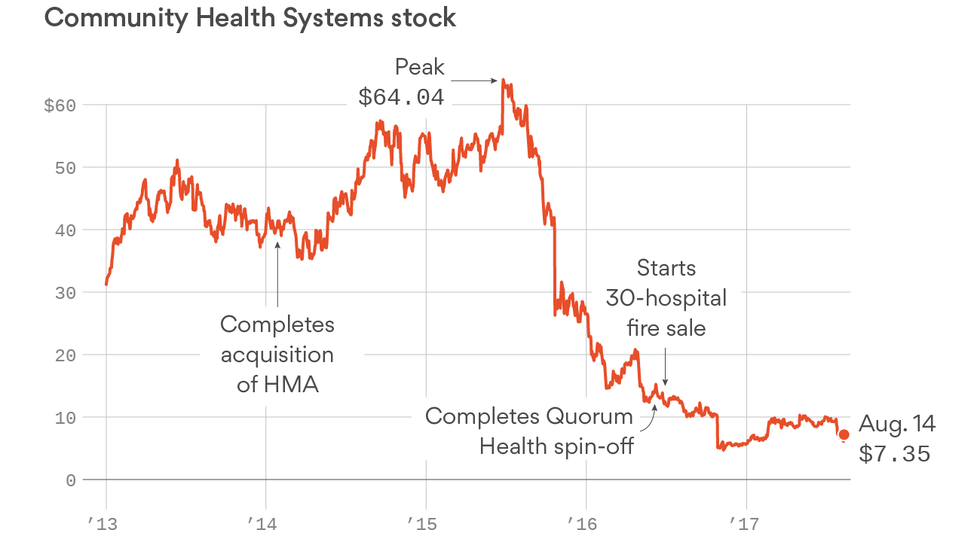
According to a filing with the Securities and Exchange Commission, now owns 22.1 percent of CHS‘ outstanding shares of common stock after buying up roughly 9.8 million additional shares over the last week. The price per share varied from $6.1 to $8 per share.

The purchases were made through Chen’s various Shanda affiliates, documents showed.

The big stock buy will inevitably be viewed by at least some as a move to take a bigger interest in the struggling company, something that has been speculated about in the past when Chen first came on the scene and bought a large block of stock in the company last year.

A spokesperson for Shanda Group issued the following statement. “Shanda maintains a good relationship with the CYH management team and intends to engage with them regarding business and operations, and the status of CYH’s ongoing turnaround strategy.”

CHS has been in the news lately as it forges ahead with its ambitious divestiture plan to offload 30 hospitals in hopes of alleviating its billions-large debt load and tightening up its operations. So far the company has sold 20 of those hospitals and has plans in the works to unload the remaining ten. It has also said in a recent earnings call that they are entertaining plans to sell even more, but no definitive details have been released.

What Will You Do When One of Your Employees Is Outed Online For Their Activism?

https://www.eremedia.com/tlnt/what-will-you-do-when-one-of-your-employees-is-outed-online-for-their-activism/?utm_source=Marketo&utm_medium=Email&utm_campaign=TLNT%20Daily-2017-08-17T05:30:00.000-07:00&mkt_tok=eyJpIjoiTUdRek5UTTVaREpoTWpnMyIsInQiOiJRSTl0K210V003czlJRDJ3bmtzNW9IbVBiSHhcL3BvbzdFK0pGMlBOK2E0YUFhRmlaTElCWmYxV2hGV1VVMEpHTm43Wm1GMHlUekl0SnZ5cHA0QUdaUXJRVExJNkIzcWhhWDhlbjAzUXA5K3hoU0prTHZITnhDbGd0S1l1bFBicTUifQ%3D%3D

It should be no secret to anyone that political activity and tensions are currently high in the US. And by now, everyone in HR has heard about the Top Dog restaurant employee who resigned as a result of his participation in the Charlottesville turmoil and the Google employee who was fired because of his controversial “diversity manifesto.”

Rather than just being news items, these cases should be treated as illustrative examples of the recent dramatic increase in political sensitivity in and around the corporate world. Executives and HR should treat them as a wake-up call and begin asking themselves a question that has become extremely pertinent. And that question is:

Does our firm have a formal plan of action covering what to do and how to limit the damage if one of our employees is publicly ridiculed as a result of what is known as Internet shaming?

If you’re not familiar with the term “Internet shaming” in the corporate world, it is when a firm’s employee is publicly exposed and ridiculed on the Internet for something they did that was controversial.

The need for a social controversy plan

The need for a policy and an action plan relating to political and social controversy increases every day for a variety of reasons. They include the combined impact of a higher number of public marches, the proliferation of mobile phone videos of these protests and the rise of Internet and social media websites (e.g. YesYoureRacist Twitter account) that actively use pictures/videos to shame individuals and their employer. Unfortunately, this shaming often results in the public making the connection (fairly or not) between an individual’s actions and the company that employs them. And that becomes a major corporate issue when that employee shaming leads to on-site protests, a loss of customers and damage to your firm’s product and employer brand image.

In the past, at least in the US, many firms have been operating under the legal principle that activities outside of work and that an employee’s personal beliefs are none of an employer’s business. However, when an employee’s actions or publicly exposed beliefs hurt the company or its employees, in my view a firm must at least consider revisiting its existing approach to employee activities.

Top 10 “Should I fire a controversial employee” action steps to consider

You should of course always consult with legal counsel before taking any action. But as part of your policy review process, here are 10 steps you should consider.

  1. Make a strong business case – You can’t expect executives to take action until they fully understand the dollar consequences of an action. So start by working with the CFO’s office to identify and then quantify in dollars all of the possible negative consequences that may result when an employee is publicly shamed. These consequences should include on-site protests, boycotts, employee turnover, employee brand/recruiting damage and damage to product sales and your product brand image.
  2. Consult with your corporate counsel – There are many complex legal issues involved so work closely with legal counsel. Also be aware that some states (e.g. California) specifically prohibit the firing of employees for lawful activities outside of work. And it’s also true that the laws and employee expectations are completely different in each country around the world. If you have a union, you should also consider involving them.
  3. Be aware that every available solution has negative consequences – Be aware from the start that, unfortunately, there are no perfect solutions to political controversies surrounding your employees. And that means that whatever solution you select will have many negative downsides. Prevention is the highest impact action, so begin by warning your employees to avoid controversy. Ignoring the problem is the solution with the highest negative consequences. However, firing or releasing controversial employees can also result in a backlash (e.g. marches are planned this weekend on Google headquarters and elsewhere protesting the firing of the employee who wrote the diversity manifesto).
  4. Educate your employees and applicants – Because your employees will likely be thinking about this issue already. It’s critical that you quickly let them know your expectations and provide them with illustrative examples of activities that they should avoid. You should also have a process for answering anonymous questions in this area. And if your policy extends to job applicants, you may want to add a social media check to your hiring process so that you don’t hire already controversial employees.
  5. Clearly define the activities that are prohibited/questionable – Perhaps the most difficult task is clearly defining what is acceptable behavior and what is not. Start by assuring employees that you are politically neutral and that you will look at damaging behaviors across the political spectrum. Whatever boundaries you set, it’s critical that you pretest them to ensure that they are clear to your employees. In most cases, it is easier to legally terminate an employee if violence or illegal activities are involved. It is also sometimes easier to terminate if the controversial employee is highly visible or if they are a manager.
  6. Specify the possible outcomes – If you are going to sanction or even fire employees for controversial beliefs or actions, you need to make those punishments crystal-clear. Some possible actions include: asking the employee to disavow, suspension, encouraging them to resign, or termination. In some cases, it may be wise to simply provide the employee with a severance package if they voluntarily leave and agree not to sue and if they stay out of the public limelight.
  7. Monitor what’s happening – As long as the political climate is highly charged, your social media employees could be asked to pass on any possible social media issues in this area. Internal employee forums and affinity groups could also be monitored. You might also encourage your employees to make HR aware when they spot potential issues.
  8. React quickly – No one that I have encountered has ever suggested that a delay is a good thing. So be able to react within a day or two if you want to minimize the damage to your firm.
  9. Reveal the actions that you take – The company’s image may continue to be damaged if you fail to make the public aware of the corporate actions that you took to resolve the controversy.
  10. Learn from each event – Finally, because this problem will be continually evolving, it’s important to learn from your errors and those made by other firms. And then, continually update your policies and processes to reflect the latest best practice approach.

Final thoughts

The free-speech article of the Constitution only protects citizens against government actions. So if you are a private employer, rather than the Constitution, you need to consider other elements including local employment laws and the best interests of your employees, customers and shareholders.

Because this is a highly complex and risky area, I expect many firms to do nothing. However, that can be a major mistake because in the near future you are likely to see many more protests that are videoed, an increase in Internet shaming and many more controversial tweets and Internet exchanges covering your employees and contractors. As a result, in my view, the time to at least begin the conversation on how to improve your reaction is today.

CBO: Ending cost-sharing reduction payments will increase premiums, federal deficit

http://www.fiercehealthcare.com/aca/cbo-ending-cost-sharing-reduction-payments-will-increase-premiums-federal-deficit?mkt_tok=eyJpIjoiTVdKa1pEazNOMll5WVRreiIsInQiOiJkaVJDVnRHOXNNXC9ENmt6WFpTTFwvZGVQeThhQVRjZHR2VE9jUEVQQUtlZ3BxUFg0akRMM0FOK2hWZUc4ajJ4WVdzOUV3Z21GM1cyU1VVOWNDekZ2aVwvZG11VnFVVDQ3WEJvejBQU3ZVZTM4bjZyK3A1VjlcL3Q0Mmtsc3VJUTErS0wifQ%3D%3D&mrkid=959610&utm_medium=nl&utm_source=internal

Image result for congressional budget office

If the Trump administration stops funding cost-sharing reduction payments, silver-plan premiums on the Affordable Care Act exchanges will rise considerably and the federal deficit will increase, the Congressional Budget Office said Tuesday.

Officially, the administration remains undecided about how long it will continue making CSR payments, which are at the center of a federal court case that challenges their legality. Many insurers have had to factor this uncertainty into their preliminary rate filings.

To map out the consequences of one possible move by the administration, the CBO examined what would happen if federal officials announced at the end of August that they would continue CSR payments through the end of the year but discontinue them after that.

That policy would result in silver-plan premiums rising by an average of 20% in 2018 and 25% by 2020, the CBO estimates. Because tax credits rise in tandem with premiums, most eligible enrollees would not pay higher rates than they would if CSR payments continued—though the report also notes that overall, “the share of people facing slight increases would be higher during the next two years.”

Since more people would likely receive premium tax credits and in greater amounts, the CBO predicts that ending CSR payments would raise the federal deficit by $6 billion in 2018, $21 billion in 2020 and $26 billion in 2026.

The CBO also predicts that ending CSR payments would cause some insurers to exit the individual marketplaces, leaving about 5% of people living in areas that have no ACA exchange insurer in 2018. However, the agency predicts that more insurers would likely return to the exchanges in 2020 after having adjusted to the new policy.

Overall, the number of uninsured people would be slightly higher in 2018 but slightly lower starting in 2020 under the scenario the CBO examined, per the report.

A snapshot into why some providers are eliminating positions

http://www.healthcaredive.com/news/healthcare-workforce-growth-cuts/446182/

Employment in the healthcare industry has risen since the ACA was passed, but many health systems have been trimming their workforce under financial pressure.

It’s clear there have been a fair amount of hospital and provider layoffs in 2017.

In the past few months, hospitals of all sizes, and in all parts of the country, have said they are cutting jobs or eliminating open positions. Major providers affected have included Memorial HermannBrigham and Women’s HospitalNYC Health + HospitalsSumma Health and Hallmark Health. In May, Becker’s Hospital Review listed 48 layoffs across the industry the publication had reported on in 2017.

The layoffs come in contrast with the sharp rise in hiring in the healthcare sector ever since the Affordable Care Act (ACA) was enacted. While the hiring growth is a long-term trend — though it’s yet to be determined at what rate in 2017 — these layoffs are due in part to the short-term trends of softening admissions and flattening reimbursements. Many providers cited similar problems: declining reimbursements, lower admissions and shrinking operating incomes. Layoffs aren’t the only play for struggling organizations, but hospital expenses are rising on multiple fronts, and executives have to make some hard choices.

Big drivers of the growth are the aging population and the pending retirement of many registered nurses. It’s unclear how or when the layoff and healthcare job growth trends will change, but the underlying themes are not going away. The Bureau of Labor Statistics (BLS) is scheduled to release 2016-2026 occupational projections in October, while layoffs will continue to be tracked throughout the year.

Then there’s the elephant in the room over the buzzword of 2017: Uncertainty. Whether it be in Congress or in the executive branch, uncertainty over U.S. healthcare policy is making providers nervous as the insurance open enrollment period nears with no clear ACA reform or repeal in sight.

Healthcare hiring still on the rise, but the pace may be slowing

To date, the healthcare employment bubble hasn’t burst. Healthcare jobs, including hospital jobs, still are on the rise. While job growth is a different metric than layoffs and require different considerations, both underscore the themes affecting the industry’s workforce.

Ani Turner, co-director of Altarum Institute’s Center for Sustainable Health Spending, told Healthcare Dive there have been some clear trends in hospital job growth in recent years. In 2013, there was little job growth but the expanded coverage affect — where more individuals gained health insurance for the first time under the ACA — helped spur hospital job growth in 2014.

This expanded coverage helped hospitals experience new revenue opportunities thanks to more people entering the care delivery space, especially in states that expanded Medicaid. In addition, since the implementation of the ACA, the level of uncompensated care nationwide has gone down from $46.4 billion in 2013 to $35.7 billion in 2015.

Since that time, hospitals experienced great growth from a jobs perspective. In a 2015 Forbes article, Politico’s Dan Diamond noted that healthcare job growth surged at its fastest pace since 1991 starting in July 2014 up through May of 2015. In fact, healthcare practitioners and healthcare support positions are expected to be among the fastest growing jobs from 2014 to 2024. BLS notes the aging population and expanded insurance coverage will help fuel this growth as demand for healthcare services increases.

The recent surge is “somewhat unexpected,” Turner says. “One would think hospitals would be conservative in their hiring. Everything I’m seeing is flat or slightly declining volumes, especially on inpatient side.”

“The data don’t always cooperate with the story that makes sense,” Turner added.

Brian Augustian, principal at Deloitte, believes the job growth is going to continue to slow this year in part because there will be a push for greater automation and productivity. “As organizations are able to use machine learning, artificial intelligence and better utilize technology to get tasks done, it will not only result in…needing fewer people but also different types of people,” he told Healthcare Dive.

The rate of job growth will be an issue to watch throughout the year. As shown above, just two months worth of data changes the story from a narrative of “slowing growth” to “continuing to soar.” The looming retirement of registered nurses and the aging population do point to hospitals and providers arming themselves to smooth the transition of both the workforce as well as the pending flood of baby boomers entering into the care space.

Job growth doesn’t stop financial troubles for providers

However, as seen in the job cut announcements and recent quarterly earnings for hospital operators, providers are facing challenges that are affecting their bottom lines.

One of the biggest challenges for providers is declining or flattening admissions. In 2010, all hospital admissions totaled 36.9 million admissions. By 2013, admissions had dropped by 1.5 million; 35 million patients were admitted in 2015.

In the latest rounds of quarterly earnings, most for-profit hospital operators took a lashing, all acknowledging softening markets and weaker-than-expected patient volumes. Community Health Systems (CHS) reported it underperformed in Q2 2017 and is exploring more divestitures while HCA Healthcare reported it missed Q2 estimates due in part to higher expenses and lower-than-expected patient admissions. On Monday, Tenet Health reported a 4.5% decline in total admissions for the first six months of 2017.

Indiana University Health’s operating income suffered a 46% loss while seeing less individuals coming into the facilities, Modern Healthcare reported.

As seen in HCA Healthcare’s Q2 earnings call, lower acuity visits declined in the last quarter. At CHS, emergency department volume declined on the outpatient side, which Tim Hingtgen, president and COO of CHS, attributed to “industry dynamics, including urgent care growth, freestanding ED competition in select markets.” As Turner notes, the average person seeking a care setting visit is likely going to a physician’s office. This puts pressure on operators to rethink their lower acuity setting strategies and not rest on the strength of organic patient growth seen in previous years.

Another major issue for providers are expenses. More jobs equals more expenses, for example. Facility maintenance, equipment, electricity, telephone lines, internet, etc. all add up. According to the American Hospital Association, expenses for all U.S. registered hospitals are currently $936 billion, up from $859.4 billion in 2013. In addition to these changes, turning toward value-based care exposes providers more to risk-based contracts which can affect reimbursement formulas.

Hospitals know they need to lower cost structures, and personnel changes is one means

Ben Isgur, director of PricewaterhouseCoopers’ Health Research Institute, adds that squeezing costs isn’t a new concept for hospitals. There are many options for executives to manage out costs from its overhead. Supply chain, infrastructure and third party contracts are all go-to areas for such efforts. If two systems merge, departments can be streamlined or share services. In some cases, third-party contractors may be more beneficial to a provider than hiring for internal positions.

Igor Belokrinitsky, healthcare strategist at Strategy&, a member of the PwC network of firms, told Healthcare Dive in March many administrators faced with financial challenges tell their departments during the budgeting process to budget for zero cost increases or even for a reduction. “In the longer run, we are seeing and are working with health systems to take out pretty significant amounts of cost out of their operations, both clinical and nonclinical, and setting targets like 15-20%, which is a transformative change,” he said. “When talking about a 20% cost improvement, you’re questioning, ‘Do we need this facility? Do we need to provide this service at this location? Does this service need to be provided by a physician?'”

The current political landscape isn’t helping matters either

Isgur tells Healthcare Dive that healthcare industry layoffs should be watched closely and agrees with Turner that one of the biggest reasons is uncertainty in the industry.

As an example, he points to the Congressional Budget Office’s figure that 15 million individuals could have lost health coverage in 2018 if the Senate ACA repeal bill had become law. “Providers look at that and have to be ready for an environment where they have potentially fewer paying patients,” Isgur told Healthcare Dive.

During the heady time when ACA repeal-and/or-replace was on Congress’ plate this summer, many projections showed healthcare jobs would’ve been affected. One analysis of the House ACA bill estimated 725,000 jobs across the entire industry would be lost by 2026 if it had become law. The primary cause of the job disappearances and state economic downturns would have been attributable to cuts to healthcare funding, such as more than $800 billion to Medicaid, and lower premium subsidies.

Moody’s Investor Services projected the Senate ACA repeal bill would have caused uncompensated care costs to rise at hospitals.

The fight over healthcare policy is likely now headed to the executive branch, as Congress has failed to pass a bill that repeals or replaces the ACA. President Donald Trump has cost-sharing reduction payments to insurers hanging in the balance, and hasn’t publicly stated if the White House will continue to make these payments.

If these payments are discontinued, Fitch Ratings found in a new report that premiums could increase to the point where customers won’t be able to pay for coverage, thus increasing the chance for uncompensated payments to rise.

In addition, state Medicaid waivers will have to be looked at. Some applications, such as the Maine’s, could include work requirements, mandatory premiums and asset testing. It would be one of the most conservative state programs, and some health policy experts warn that the restrictions would push out many low-income adults who would otherwise qualify.

“When you add uncertainty to what’s already been going on in the reimbursement environment around how many more uninsured there may be going forward, that’s not the cause of [layoffs] but it’s certainly going to accelerate the thinking of executive teams to make sure [their organizations] are efficient and ready for anything,” Isgur said.

Isgur does think the industry will see more layoff announcements this year, but that it is an important trend to watch, especially as more decisions come out of Washington.


The collapse of Community Health Systems

https://www.axios.com/the-collapse-of-community-health-systems-2471839258.html

Image result for The collapse of Community Health Systems


Just three years ago, Community Health Systems was the largest for-profit operator of hospitals with more than 200 facilities scattered in rural and suburban areas with growing populations. Now, the company is hemorrhaging money, sitting atop a mountain of debt and teetering on the edge of bankruptcy — all major reasons why CHS has lost almost 90% of its market value.

“I think the company has a nontrivial chance of defaulting,” said one CHS investor who asked to be unnamed because of the sensitivity of the issue. Tomi Galin, a CHS spokeswoman, did not make any company officials available for an interview, but said the company is confident it will have “a stronger core group of hospitals that are better positioned for long-term growth.”

Why it matters: CHS sits in a massive hole after a string of missteps, according to industry insiders. And it’s not likely to get better for CHS, or the local communities that rely on a CHS facility, as more people get treated in lower-cost outpatient centers instead of the hospital.

The collapse: It began in 2013 and continued into January 2014. That’s when CHS completed its acquisition of Health Management Associates, a for-profit hospital chain that had a slew of financial and legal problems. The deal was worth $7.6 billion, including debt, and made CHS the largest for-profit hospital company by number of facilities.

“That was the death knell,” a health care investment banker said. “HMA was a troubled company, and (CHS) thought bigger would be better.”

Here’s what has happened at CHS since then:

  • A market cap that crumbled from roughly $7.5 billion in 2015 to less than $800 million today.
  • Net losses of almost $1.9 billion from the start of 2016 through the second quarter of this year.
  • A ballooning debt load totaling $14.7 billion as of June 30.
  • Larry Robbins, a prominent hedge fund manager, dumped his entire portfolio of CHS stock. Paul Singer of Elliott Management did the same earlier this year.
  • A fire sale of 30 hospitals to get cash to pay down debt.
  • Some of those sold hospitals were HMA remnants, while others were considered CHS’ better, more profitable hospitals. “It’s almost like they’re burning the furniture,” the banker said. An investor said CHS was “selling off the fine china” to meet debt payments.
  • A completed spin-off of Quorum Health that, in essence, threw many struggling rural hospitals off CHS’ books. Quorum isn’t faring well either.
  • High amounts of uncompensated care. CHS owns many hospitals in the South, and most of those states did not expand Medicaid under the Affordable Care Act. That means CHS has absorbed more uncompensated care than hospitals in Medicaid expansion states.

Looking ahead: CHS plans on divesting even more hospitals, executives said during their latest earnings call. They likely will be profitable hospitals, as buyers won’t touch money-losing inpatient facilities with dwindling admissions.

But large debt payments are due in 2019 through 2022. Short-term cash from transactions appears to be a bandage, and a subsequently smaller profit base won’t solve the big debt picture, making bankruptcy a real possibility, an investor said.

Galin, the CHS spokeswoman, said the money from the hospital sales “are being used to reduce our debt” and that “cash flow generation remains strong.”

Leadership questions: Many CHS executives have retired or left in the past two years, including longtime CFO Larry Cash. Wayne Smith, the CEO of the hospital chain since 1997, remains in his position. Smith is one of the highest earners among hospital executives and reaped more than $1 million in bonuses alone the past two years even though CHS’ stock price tanked.

Numerous sources would not go on the record to talk about CHS. One hospital industry analyst said this when asked how Smith still had his job despite the company’s problems: “Your question is very valid.”