Moody’s: 3 ways the GOP tax bill will hurt nonprofit hospitals

https://www.beckershospitalreview.com/finance/moody-s-3-ways-the-gop-tax-bill-will-hurt-nonprofit-hospitals.html

Image result for Tax Bill implications for nonprofit hospitals

The Republicans’ tax overhaul plan, which is expected to become law soon, has negative credit implications for nonprofit hospitals and health systems, according to Moody’s Investors Service.

Here are three ways the tax bill will hurt nonprofit hospitals and health systems.

1. The tax bill will repeal the ACA’s individual insurance mandate. This will cause the uninsured population to rise and raise uncompensated care costs, which will negatively affect healthcare organizations’ operating margins and cash flow, according to Moody’s.

2. The tax plan’s limits on tax-exempt refundings is negative for all issuers of tax-exempt debt, including nonprofit hospitals and health systems, as these financings have been used to reduce long-term borrowing costs and take advantage of lower interest rates, according to Moody’s.

3. The tax bill will slash the corporate tax rate to 21 percent from 35 percent. This change has negative implications for nonprofit hospitals and health systems, as it “makes tax-exempt bonds a less attractive investment for banks and other financial institutions, which will weaken demand, especially for direct bank loans and private placements,” according to Moody’s.

Illinois hospitals’ financial struggles likely to continue into 2018

http://www.chicagotribune.com/business/ct-biz-hospital-financial-struggles-20171215-story.html

Image result for Illinois hospitals' financial struggles likely to continue into 2018

he list reads like a who’s who of hospital systems in the Chicago area: Advocate Health Care, Edward-Elmhurst Health, Centegra Health System.

But it’s a list of hospitals systems that cut jobs this year to deal with financial pressures — not a list any hospital is eager to join.

Hospitals in Illinois and across the country faced financial stresses this year and are likely to continue feeling the squeeze into 2018 and beyond, experts say. Those pressures could fuel more cuts, consolidation and changes to patient care and services.

“We have many hospitals doing their best just to survive,” said A.J. Wilhelmi, president and CEO of the Illinois Health and Hospital Association.

Moody’s Investors Service recently downgraded its outlook for not-for-profit health care and public health care nationally from stable to negative, with the expectation that operating cash flow will fall by 2 percent to 4 percent over the next 12-18 months. About three-fourths of Illinois hospitals are not-for-profit.

“(For) almost every hospital and health system we talk to, (financial pressure) is at the top of their list in terms of ongoing issues,” said Michael Evangelides, a principal at Deloitte Consulting.

A number of factors are to blame.

Leaders of Illinois systems say reimbursements from government insurance programs, such as Medicaid and Medicare, don’t cover the full cost of care. And with baby boomers growing older, many hospitals’ Medicare populations are on the rise. It doesn’t help that payments to hospitals from the state were delayed amid Illinois’ recently resolved, two-year budget impasse, Wilhelmi said.

Unpaid medical bills, known as bad debt, are also increasing as more patients find themselves responsible for large deductibles. Payments from private insurers are no longer helping hospitals as much as they once did. Though those payments tend to be higher than reimbursements from Medicare and Medicaid, they’re not growing as fast as they used to, said Daniel Steingart, a vice president at Moody’s.

Growing expenses, such as for drugs and information technology services, also are driving hospitals’ financial woes. And hospitals are spending vast sums on electronic medical record systems and cybersecurity, Steingart said.

Many also expect that the new federal tax bill, passed Wednesday, may further strain hospital budgets in the future. That bill will do away with the penalty for not having health insurance, starting in 2019. Hospital leaders worry that change will lead to more uninsured people who have trouble paying hospital bills and wait until their conditions become dire and complex before seeking care.

With so much going on, it can be tough for hospitals to meet revenue goals.

“You’re talking about a phenomenon taking place across the country,” said Advocate President and CEO Jim Skogsbergh. Advocate announced in May that it planned to make $200 million in cuts after failing to meet revenue targets. In March, Advocate walked away from a planned merger with NorthShore University HealthSystem after a federal judge sided with the Federal Trade Commission, which had challenged the deal. Advocate is now hoping to merge with Wisconsin health care giant Aurora Health Care, although the hospital systems say financial issues aren’t driving the deal.

“Everybody is seeing declining revenues, and margins are being squeezed. It’s a very challenging time,” Skogsbergh said.

Hospitals in Illinois have responded to the pressures in a number of ways, including with job reductions. Advocate laid off about 75 workers in the fall; Centegra announced plans in September to eliminate 131 jobs and outsource another 230; and Edward-Elmhurst laid off 84 employees, eliminating 234 positions in all, mostly by not filling vacant spots.

Hospitals also are changing some of the services they offer patients and delaying technology improvements, said the Illinois hospital association’s Wilhelmi.

Centegra Hospital-Woodstock earlier this year stopped admitting most overnight patients, one of a number of changes meant to save money and increase efficiency. As a result, the system “achieved our goal of keeping much-needed services in our community,” spokeswoman Michelle Green said in a statement.

Many Illinois hospitals have also cut inpatient pediatric services, citing weak demand, and are instead investing in outpatient services.

The challenge is saving money while improving care and patient outcomes, said Evangelides of Deloitte. Hospitals are striving to do both at the same time.

Advocate, for example, opened its AdvocateCare Center in 2016 on the city’s South Side to treat Medicare patients with multiple chronic illnesses and conditions. The clinic offers doctors, pharmacists, physical therapists, social workers and exercise psychologists. It has helped reduce hospital admissions and visits among its patients, said Dr. Lee Sacks, Advocate executive vice president and chief medical officer.

Advocate didn’t open the clinic primarily to help its bottom line. The goal was to improve patient care while also potentially reducing some costs.

But such moves are becoming increasingly important to hospitals.

“It really does impact everyone,” Evangelides said of the financial pressures facing hospitals. “We all have a giant stake in helping and hoping that the systems across the country … can ultimately survive and thrive.”


Penn State Health, Highmark Health sign $1B value-based care network deal

https://www.fiercehealthcare.com/finance/penn-state-health-highmark-health-new-partnership?mkt_tok=eyJpIjoiTkRNMlpEbGlNRE14TkRBMSIsInQiOiJqOUkyVmdwaVwvZGVYODBOK2h5ZHhIT1UxS1owUTdheXJXU1pkeU1VQVNXTTFjOWpCNTlwNml1Uk81YlBjb2FjWkVtd21CMjJFR3pneURrN0NvdXlWbG5reFh5Y2VpUXVsbDZKRVRMeUtxVnFhNEFvWHlIdXkwSUtKMzVQU1BFVEQifQ%3D%3D&mrkid=959610

Business executives shaking hands

Penn State Health and Highmark Health have inked a $1 billion deal to form a value-based community care network that aims to improve population health and protect market share by keeping more patients in the region, especially for complex care.

Anchored by the Milton S. Hershey Medical Center, the plan also calls for collaboration with community physicians and will include new facilities and co-branded health insurance products.

The move doesn’t affect existing agreements: Penn State Health can still partner with other health insurance companies, and Highmark will continue to partner with other providers.

“Penn State Health will offer more primary, specialty and acute care locations across central Pennsylvania so that [patients] will have easier access to our care, right in the communities where they live,” A. Craig Hillemeier, CEO of Penn State Health, said in an announcement. “Our two organizations share the belief that people facing life-changing diagnoses should be able to get the care they need as close to home as possible.”

Highmark Health will join Penn State as a member of Penn State Health with a minority interest. The payer will get up to three seats on the 15-member board of directors.

“We want to collaborate with forward-thinking partners who, like us, are committed to creating a positive healthcare experience for members and patients,” Highmark Health CEO David Holmberg said in the announcement.

Value-based care and population health continue to drive deals such as this one, including in the competitive Pennsylvania market. Earlier this year, PinnacleHealth announced that it would partner with the University of Pittsburgh Medical Center, the state’s largest integrated health system, and also agreed to acquire four Central Pennsylvania hospitals from Community Health Systems.


Keep Harmful Cuts in Federal Medicaid Disproportionate Share Hospital Payments at Bay

http://www.commonwealthfund.org/publications/blog/2017/dec/harmful-cuts-in-federal-medicaid-dsh?omnicid=EALERT1329977&mid=henrykotula@yahoo.com

Image result for Medicaid Money

  • While the ACA has had a major impact on reducing hospitals’ uncompensated care burdens, compensated care remains a challenge for many hospitals in poor communities
  • The White House and Congress have a final shot at once again ensuring that the poorest communities are not left without vital health care resources

Congress may delay a funding reduction for state Medicaid disproportionate share hospital (DSH) payments — direct, supplemental payments to hospitals serving high numbers of low-income patients — as part of end-of-year legislation. Although protecting the poorest communities from the loss of DSH funds has emerged on a short list of must-dos, final passage is far from certain. It may hinge on finding a funding strategy other than the one originally chosen by the House of Representatives — a more than $6 billion cut in critical public health funding from the Prevention and Public Health Trust Fund.

For nearly four decades, DSH payments have been a crucial part of Medicaid policy. But in light of the major gains in coverage anticipated for the poor under the Affordable Care Act’s adult Medicaid expansion, Congress scheduled a substantial reduction in federal Medicaid DSH payments beginning in 2014. Lawmakers assumed, not unreasonably, that the coverage expansions would translate into additional hospital revenue, thereby alleviating the need for as much direct DSH payment supplementation.

The relatively rosy scenario for DSH hospitals — especially those serving the poorest communities — changed dramatically in 2012 when the United States Supreme Court made Medicaid expansion optional; as of the end of 2017, nearly 3 million poor adults in 19 states continue to go without the Medicaid coverage they should be receiving.

To be sure, the ACA has had a major impact on reducing hospitals’ uncompensated care burdens. The Medicaid and CHIP Payment and Access Commission (MACPAC), which advises Congress on federal Medicaid policy, reports that between 2013 and 2014, hospital uncompensated care spending dropped by $4.6 billion, a 9 percent decrease, with the greatest declines occurring in Medicaid expansion states. But uncompensated care remains a crucial issue for many hospitals, especially those located in the poorest communities, and, in particular, hospitals serving poor communities in Medicaid nonexpansion states.

Additionally, even in Medicaid expansion states, a considerable number of low- and moderate-income adults who qualify for subsidized marketplace coverage remain uninsured. Even among those with subsidized marketplace plans whose incomes also are low enough to qualify for cost-sharing assistance (250 percent of poverty, or an annual income of about $30,000, and below), unpaid medical bills continue to add to hospitals’ uncompensated care burdens.

Should final congressional action before the holiday include a DSH cut delay, it would be the latest in a line of postponed Medicaid DSH cuts enacted by Congress over several years. Without another postponement, hospitals will lose $2 billion of the almost $12 billion federal allotment for fiscal year 2018. If this last-minute effort to stop the cuts once again as part of the spending bill does not succeed, then over 10 years, the cuts would reduce DSH payments by some $43 billion according to MACPAC.

For many reasons — the number of states that have failed to expand Medicaid; the number of Americans who continue to report that insurance coverage is unaffordable; high deductibles and other patient cost-sharing even among those with private health insurance — continuing to push back the day of reckoning on federal DSH funding reductions is a matter of high importance, not only for individual hospitals but for the communities whose health care systems these hospitals help anchor. The situation facing hospitals in nonexpansion states is especially grim; according to one estimate, failure of 19 states to implement the ACA Medicaid expansion can be expected to translate into an additional loss of $81.5 billion by 2026.

The White House and Congress have a final shot at once again ensuring that the poorest communities are not left without vital health care resources — and doing so in a way that does not pit health care against public health.


When hospitals merge, you pay the bill

https://www.usatoday.com/story/opinion/2017/12/17/when-hospitals-merge-you-pay-editorials-debates/953998001/

Image result for large hospital mergers


Mega medical chains could be hazardous to your health: Our view

Health insurers are not the most beloved companies. They deny claims, bury people in paperwork, and generally make life more difficult.

But a good case can be made that America’s health care woes lie more with its providers than its insurers. Some communities are served by a single hospital or group of specialists. Some patients are reliant on a single drug. That gives these businesses enormous leverage to hike prices.

In theory, insurance companies hold down costs by driving hard bargains with providers. In reality, they find it difficult to do so.

OPPOSING VIEW: Health care mergers benefit patients

UnitedHealth Group is the largest private health insurer, with about 11% of the overall market. Everyone else is less than 10% (though in local and regional markets there is more concentration).

That makes these insurers plenty big enough to beat up on consumers, but too small to take on powerful providers.

The result: In the USA, 18 cents of every dollar spent goes to health care each year. In other developed countries, health care expenditures are much less, in the range of 10 to 12 cents per dollar.

Which makes recent trends in the hospital industry all the more troubling. Two major hospital chains, Ascension and Providence St. Joseph Health, are in talks to merge, a move that would create a 191-hospital colossus operating in 27 states.

This comes on top of a raft of other hospital mergers and announced mergers. That they have been in the non-profit space, including a proposed chain of 139 Catholic-run hospitals, does not change the economics.

These massive businesses run much as their for-profit brethren — and will put pressure on for-profits to merge as well. That won’t be good for consumers, or the ridiculously high premium the American economy pays for a health care system that lacks effective cost controls.

Not all mergers in health care are problematic. The proposed combination of CVS, the owner of drug stores and walk-in clinics, with Aetna, a major insurer, holds intriguing possibilities for efficiencies and more comprehensive tracking of health care decisions.

It could also be argued that there should be more consolidation among insurance companies. This might not be a hugely popular concept, but it would give them more leverage to say no to costly increases demanded by hospitals and other potent health care providers.

At the very least, it’s time to take a critical eye to the mega hospital empires being erected. They could be very hazardous to your health.

Johns Hopkins favored out-of-state patients over locals to increase revenue, lawsuit claims

http://www.baltimoresun.com/health/bs-hs-hopkins-lawsuit-20171213-story.html

Image result for priority treatment


A former supervisor in the patient appointments department at the Johns Hopkins Health System Corp. has accused the medical system in a lawsuit of prioritizing out-of-state patients over Maryland residents to boost revenue.

Anthony C. Campos said in the lawsuit filed Wednesday in U.S. District Court that his department was directed with the task of “filling the plane” with patients from outside Maryland. The directive to bring in more of these patients came from the highest ranks at the medical system, the lawsuit contends.

In Maryland, hospitals are required under an agreement with the federal government to operate under global budgets assigned to them by the state that limit how much revenue they can make in a given year. The budgets were put in place as part of a broader effort to cut soaring health costs and improve care.

But the budgets only apply to patients who live in Maryland. Any money brought in by treating out-of-state patients is additional revenue for the hospital.

The lawsuit contends that Hopkins is violating a clause in its budget agreement with the state that says hospitals can’t deny services to patients for inappropriate financial reasons. The medical system is also required to provide care that focuses on the community, something the lawsuit contends can’t be done if the emphasis is on patients from elsewhere. The medical system also hid what it was doing from the Centers for Medicare and Medicaid, which oversees payments through public health programsand the Health Services Cost Review Commission, which sets the hospital’s global budgets, according to the lawsuit.

An attorney representing Campos said he was not available for comment.

“I think Maryland residents will find it highly offensive that Hopkins is pushing out-of-state residents to the front of the treatment line while Maryland residents are forced to the back of the line all in the interest of profits,” said the attorney, Lindsey Ann Thomas, with the law firm of Conti Fenn & Lawrence LLC.

In a statement Wednesday night, Johns Hopkins said the “the complaint is without merit. Safe and high quality care for all patients, regardless of where they live, is our number one priority. Our census shows that the majority of our patients are from Maryland and that the number has steadily increased over the past several years.” ​

The medical institution began pushing for more out-of-state patients in 2015, Campos said in the lawsuit. He pushed back and told his bosses his team was getting complaints and concerns from doctors about the preference being given to out-of-state patients. Campos’ supervisors responded that they were following the orders of senior management, according to the lawsuit.

Priority was sometimes given without taking into consideration which patients were sicker, the lawsuit said.

The tactics to attract these patients became more aggressive over time, the lawsuit said. Johns Hopkins USA, a medical concierge service, was enlisted to help prioritize out-of-state appointments. The medical system began targeting the most profitable departments, including neurosurgery, oncology, otolaryngology, pediatrics and surgery. In some departments, a supervisor was ordered to intervene if an out-of-state patient could not get an appointment within 30 days, and those patients were also given priority on wait lists, the lawsuit said.

In May 2016, the Department of Patient Access was told that 250 to 350 additional out-of-state cases were needed that fiscal year to reach profit targets of $5 million to $7 million, according to the suit.

Campos is asking that the government be awarded damages and Johns Hopkins fined under the False Claims Act. He is also asking for a “percentage of any recovery allowed to him.”

California, North Carolina and New York hit hardest by 340B cuts

http://www.modernhealthcare.com/article/20171213/NEWS/171219953

Image result for 340b drug pricing program


The CMS’ planned $1.6 billion in Medicare cuts to 340B hospitals across the nation will disproportionately impact providers in California, North Carolina and New York, according to a new study.

Slashing the 340B drug discount program, which is intended to lower operating costs for hospitals to give its low-income patients access to drugs, would result in large funding cuts across California, North Carolina and New York hospitals, ranging from $62 million to $126 million, researchers for consultancy Avalere found. Overall, six states will see drug payment cuts of more than $50 million next year.

About 62% of Medicaid disproportionate-share hospitals will experience less than a 5% reduction in Medicare Part B revenue due to the drug cuts, while 6% of impacted hospitals will experience cuts greater than 10%.

But the concurrent increase in non-drug payments will mean that most hospitals will have very minimal changes to their revenues, according to the study. Because the drug-related cuts will disproportionately impact 340B hospitals while the non-drug payment increases will be distributed evenly across facilities, some hospitals would see increased payments while hospitals with high 340B volumes will likely see decreases.

Still, any reduction to the already thin margins of hospitals could spell trouble for providers.

Consumers stand to benefit from the cuts, researchers said. Since Medicare beneficiaries are responsible for a portion of the total drug reimbursement, consumers in California, North Carolina and New York would save a range of $15 million to $32 million. Ten states will have aggregated Medicare beneficiary savings greater than $10 million in 2018.

“The 340B program has become a big business for hospitals,” Avalere President Dan Mendelson said. “As a result, all hospitals in the program have to think about this carefully going into next year.”

Beginning in 2018, Medicare intends to reduce 340B payments from average sales price (ASP) plus 6% to ASP minus 22.5%, which the CMS estimates to be closer to the hospitals’ acquisition cost. With the proposed changes, if a drug costs $84,000, the CMS would pay just over $65,000, instead of the current $89,000. Hospital groups have sued to prevent those cuts and litigation is ongoing.

About half of the hospitals across the country participate in the 340B program, which has been criticized because it does not restrict how hospitals spend 340B money. Critics say that some hospitals use the program to pad profits while rural and critical access hospitals maintain that it’s a vital revenue source and helps support preventive services.

In a House Energy and Commerce Committee hearing on the pharmaceutical supply chain on Wednesday, U.S. Rep. Dr. Larry Bucshon (R-Ind.) said that some hospitals manipulate the program. A financially stable hospital could acquire a physician practice in a rural community and get a 340B distinction for it, he said.

Mandating more transparency on how hospitals use 340B money would prevent abuse, Bucshon said.

“The rules allow the hospitals to pursue these mechanisms aggressively,” said Mendelson. “Some members of Congress believe the rules diverge from the original intent of the program as a way for low-income individuals to access drugs.”


Hospital Distress to Grow If Congress Closes Door to Muni Market

https://www.bloomberg.com/news/articles/2017-12-08/hospital-distress-to-grow-if-congress-closes-door-to-muni-market

  • Small, lower-rated facilites could see costs rise 1-2 percent
  • At least 26 non-profit hospitals already in default, distress

As Congress moves to assemble the final version of its tax plan, projects like Spooner, Wisconsin’s 20-bed hospital hang in the balance.

The rural community, about 110 miles (177 kilometers) northeast of Minneapolis, sold tax-exempt bonds to build the $26 million facility it opened last May. The hospital’s chief executive officer said that if its access to such low cost financing had been cut off it would have paid over $6 million more in interest.

That may soon be an expense that other hospitals across the country will have to shoulder. The House’s tax legislation revokes non-profit hospitals’ ability to raise money in the municipal market, where investors are willing to accept lower interest rates because the income is exempt from federal taxes. That’s threatening to saddle health-care providers with higher borrowing costs at a time when their finances are already under pressure.

“Should tax-exempt financing not be available in the future, it may really harm our ability to build affordable senior housing and assisting living facilities,” said Michael Schafer, Spooner Health’s CEO.

For small, rural hospitals across the country, labor, drug, and technology costs are increasing faster than the revenue and patients’ unpaid debts are on the rise. Higher financing costs would be one more challenge.

David Hammer, head of municipal bond portfolio management for Pacific Investment Management Co., said the loss of the tax-exemption could raise borrowing costs by 1 to 2 percentage points at small facilities with a BBB rating or below. That “could have a meaningful impact on their balance sheets,” he said.

At least 26 non-profit hospitals are already either in default or distress, meaning they’ve notified bondholders of financial troubles that make bankruptcy more likely, according to data compiled by Bloomberg. That includes falling short of financial terms set by their debt agreements and having too little cash on hand.

Many of them are based in rural communities where the populations tend to be “older, poorer and sicker,” according to Margaret Elehwany, the vice president of government affairs and policy at the National Rural Health Association. She estimates that about 44 percent of rural hospitals operate at a loss. There have been at least seven municipal bankruptcy filings by hospitals since last year, the most of any municipal sector excluding Puerto Rico.

The risk that Congress will prevent hospitals from accessing the municipal market worries Dennis Reilly, the executive director of the Wisconsin Health & Educational Facilities Authority, an agency that issues debt for non-profits such as Spooner Health.

“All of us in the industry were completely blindsided by the House proposal,” Reilly said in an interview from Washington, where he was meeting with members of Congress about the proposed bill.

“Without tax-exempt financing, not-for-profits across the country will have increased borrowing costs of 25 to 35 percent because they’ll have to access the taxable market,” he said. “For many of the rural providers like Spooner, much of their project they would not have been able to do with the higher cost of capital.”

A Rush to Beat the Clock

Hospitals are among those rushing to issue tax-exempt debt while they still can. Mercy Health, a Catholic health-care system that operates in Ohio and Kentucky, is scheduled to sell $585 million tax-exempt bonds next week. The deal, originally planned for early next year, was moved up after the release of the House proposal.

Spending more on debt would cut into the funds available for facilities, equipment and charitable outreach, like programs for opioid addiction, according to Jerome Judd, Mercy’s senior vice president and treasurer. “Things like that are impacted,” he said.

At least some members of Congress share the hospital executives’ concerns. Last month, some Republican lawmakers sent a letter to leadership pushing for the final plan to preserve the ability of hospitals and other entities, like affordable housing agencies and universities, to issue tax-exempt bonds.

“Private activity bonds finance exactly the sort of private public partnerships of which we need more of, not less,” they wrote. “These changes are incompatible with President Trump’s priority for infrastructure investment in the United States.”

It’s Tough to be Small

Some hospitals already opt to sell their bonds in the taxable municipal market to avoid disclosures and restrictions over how the proceeds are used, though they are typically larger entities that can secure advantageous rates because of the size of their deals. Patrick Luby, a municipal analyst at CreditSights, said smaller clinics with only a few million of bonds to sell would have a hard time accessing that market, which attracts corporate debt investors accustomed to big issues.

“Even what we would consider a large deal in the muni market is almost an odd lot in corporate bonds,” he said. “Very large hospital chains, large household name universities — global investors will buy those names, but they’re not going to buy a $15, $25, $50 million local hospital.”

If the House plan is enacted, hospitals “will have a really difficult time accessing the market,” he said.


Will Getting Bigger Make Hospitals Get Better?

https://tincture.io/will-getting-bigger-make-hospitals-get-better-d3c565223670

Image result for Will Getting Bigger Make Hospitals Get Better?


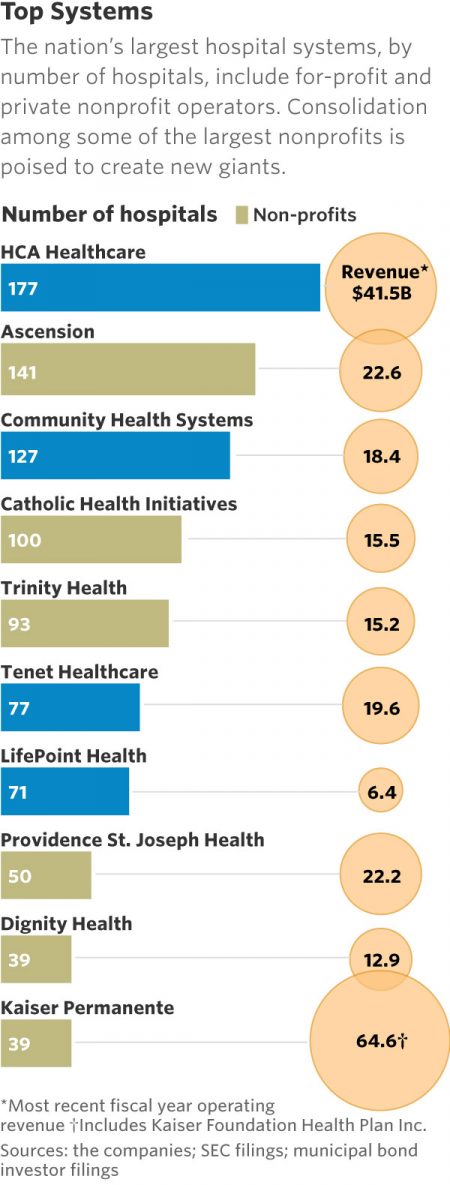
This month, two hospital mega-mergers were announced between Ascension and Providence, two of the nation’s largest hospital groups; and, between CHI and Dignity Health.

In terms of size, the CHI and Dignity combination would create a larger company than McDonald’s or Macy’s in terms of projected $28 bn of revenue. (Use the chart of America’s top systems to do the math).

For context, other hospital stories this week discuss layoffs at Virtua Health System in southern New Jersey. And this week, the New Jersey Hospital Association annual report called the hospital industry the “$23.4 billion economic bedrock” of the state.

Add a third important item to paint the state-of-the-U.S. hospital-industry picture: Moody’s negative ratings outlook for non-profit hospital finances for 2018.

So will getting bigger through merger and consolidation make the hospital business better?

In the wake of the CVS-Aetna plan to join together, the rationale to go big seems rational. Scale matters when it comes to contracting with health insurance plans at the front-end of pricing and financial planning for the CFO’s office, and to managing population health by controlling more of provider elements of care from several lenses: influencing physician care; crafting inpatient hospital care; doing smarter, cheaper supply purchasing; and leaning out overhead budgets for things like marketing and general management.

But the Wall Street Journal warned today the “serious condition” of U.S. hospitals, despite these big system mergers.

Health Populi’s Hot Points: In the past two years, I’ve had the amazing opportunity of speaking about new consumers and patients growing into healthcare payors with leadership from hospitals in over 20 states, some more rural, some more urban, and all in some level of financial crisis mode.

After describing the state of this consumer in health and healthcare, and how she/he got here, I have challenged hospital leadership to think more like marketers with a fierce lens on consumer experience and values. That equal proportions of U.S. consumers trust large retail and digital companies to help them manage their health is a jarring statistic to these hospital executives. The tie-up between CVS and Aetna marries the retail health/healthcare segments and responds to this consumer trust issue.

But then, I remind them that nurses, pharmacists, and doctors are the three most-trusted professions in America.

These three professional clinicians are the human capital that comprise the heart of a hospital in a community.

Hospitals should be mindful that trust is necessary for patient/health engagement. And the trust is with hospitals if the organization chooses to leverage that goodwill for a value-exchange. Hospitals are economic engines in their local communities — often, the largest employer in town. “Everyone” in most communities knows someone who works in a hospital.

And hospital employees spend money in communities, bolstering local employment and tax bases.

Partnering with patients means empathizing with them as both clinical subjects and consumers. For the latter, refer to the sage column from JAMA which recommends that Value-Based Healthcare Means Valuing What Matters to Patients. This means thinking about the value-chain of the patient journey, from keeping people well in their communities through to managing sticker-shock in the financial office. The financial toxicity of healthcare is one risk factor threatening the hospital-patient relationship with the patient-as-payor.

As Mufasa told Simba in The Lion King, “You are more than what you have become. Remember who you are.”


Top Ambulatory EHR Systems by Hospital Implementation

https://www.definitivehc.com/news/top-ambulatory-ehr-systems?source=newsltr-blog&utm_source=newsletter&utm_medium=email&utm_campaign=12-12-17

ambulatory ehr vendors market share


EHR system implementation has been on the rise over the past 10 years. This is, at least in part, attributed to the Centers for Medicare and Medicaid Services (CMS) Meaningful Use initiative that began in 2011. Under the Health Information Technology for Economic and Clinical Health (HITECH) Act, eligible providers who demonstrated meaningful use of Electronic Health Record (EHR) technology received incentive payments. The intent was to encourage healthcare providers to utilize electronic data recording and sharing technology to improve clinical quality and care transparency.

More than 92 percent of hospitals in the U.S. use an EHR system, according to Definitive Healthcare data. The implementation rate is even higher among acute care hospitals, with over 95 percent of long- and short-term facilities using EHR systems. Vendors Epic and Cerner dominate the EHR market, holding a combined 52 percent market share. There are two varieties of EHR systems: inpatient and ambulatory. Inpatient EHR is designed for use on patients staying at a facility for at least one night and is therefore primarily used by hospitals. Ambulatory EHR is designed for outpatient facilities and small physician practices, where patient visits do not include an overnight stay.

Top 5 Ambulatory EHR System Vendors

  1. Epic
  2. Cerner
  3. Meditech
  4. CPSI (Evident and Healthland)
  5. Medhost

An EHR is the digital version of a patient’s medical history. Generally, a patient’s EHR includes demographic information, diagnosis history, prescription data, laboratory results, vital signs, immunizations, progress notes, and more. Digital records allow providers to quickly and easily share patient data with providers in other facilities, regardless of whether the facility is in-network. Electronic record sharing can improve patient care and experience by allowing providers anywhere to access and understand an individual’s medical history. This is particularly useful in cases where a patient may be unconscious or unable to communicate upon arrival to a facility, when a patient is visiting a facility out-of-state, or if a patient visits a retail clinic or freestanding urgent care clinic.