Storm Harvey could financially hurt already strained Houston hospitals

http://www.reuters.com/article/us-storm-harvey-healthcare/storm-harvey-could-financially-hurt-already-strained-houston-hospitals-idUSKCN1B92T2

Image result for houston hospitals under water


Structural improvements over the last decade to Houston hospitals have helped them so far to avoid devastation like Hurricane Katrina in New Orleans in 2005, but the pounding it is receiving from Tropical Storm Harvey is expected to financially hobble many already strained Texas medical centers.

The storm has forced hospitals to cancel surgeries, evacuate patients and contend with food and supply shortages. Even bigger challenges are expected in coming months when people who have lost homes and jobs avoid medical treatment or seek charitable care.

“A lot of hospitals already were burdened by uncompensated care…they were already struggling, and this will make things much harder,” said Vivian Ho, a healthcare economist at Rice University.

Rice has been temporarily closed because of the slow-moving storm that has killed at least 11 people since Friday and paralyzed Houston, the fourth most-populous city in the United States with a U.S.-census estimated 2.3 million.

Houston’s healthcare industry includes some of the most prestigious institutions in the country and has grown to accommodate a rising population in recent years.

But uncertainty about changes to U.S. health insurance policy, the region’s shrinking energy sector and Texas’ high percentage of uninsured have forced several Houston hospitals to cut thousands of jobs this year and post millions of dollars in losses, even before the storm.

Investment bank Jefferies warned in an Aug. 28 note that Harvey could have a significant impact on Texas healthcare providers, especially HCA Healthcare Inc, which has “11 percent of its beds in the areas impacted by severe weather.”

Texas Hospital Association spokesman Lance Lunsford said medical centers made significant improvements after buildings were damaged by Tropical Storm Allison in 2001.

Harvey broke rainfall records for the continental United States, with one site south of Houston recording 49.2 inches (1.25 meters) of precipitation.

Flooding prompted MD Anderson on Monday to cancel appointments and surgeries until Wednesday at the earliest, St. Luke’s Hospital closed one of its branches, and flooding at Ben Taub Hospital shut its food service.

MD Anderson on Monday told employees not part of its storm “ride out” team to stay home.

Roads around the cancer center’s main hospital were impassible, and a doctor posted photos of flooding that reached into the hospital lobby.

MD Anderson’s economic impact to the area is about $35 billion, according to its web site. Its 21 hospitals and affiliated institutions employ more than 106,000 people.

A snapshot into why some providers are eliminating positions

http://www.healthcaredive.com/news/healthcare-workforce-growth-cuts/446182/

Employment in the healthcare industry has risen since the ACA was passed, but many health systems have been trimming their workforce under financial pressure.

It’s clear there have been a fair amount of hospital and provider layoffs in 2017.

In the past few months, hospitals of all sizes, and in all parts of the country, have said they are cutting jobs or eliminating open positions. Major providers affected have included Memorial HermannBrigham and Women’s HospitalNYC Health + HospitalsSumma Health and Hallmark Health. In May, Becker’s Hospital Review listed 48 layoffs across the industry the publication had reported on in 2017.

The layoffs come in contrast with the sharp rise in hiring in the healthcare sector ever since the Affordable Care Act (ACA) was enacted. While the hiring growth is a long-term trend — though it’s yet to be determined at what rate in 2017 — these layoffs are due in part to the short-term trends of softening admissions and flattening reimbursements. Many providers cited similar problems: declining reimbursements, lower admissions and shrinking operating incomes. Layoffs aren’t the only play for struggling organizations, but hospital expenses are rising on multiple fronts, and executives have to make some hard choices.

Big drivers of the growth are the aging population and the pending retirement of many registered nurses. It’s unclear how or when the layoff and healthcare job growth trends will change, but the underlying themes are not going away. The Bureau of Labor Statistics (BLS) is scheduled to release 2016-2026 occupational projections in October, while layoffs will continue to be tracked throughout the year.

Then there’s the elephant in the room over the buzzword of 2017: Uncertainty. Whether it be in Congress or in the executive branch, uncertainty over U.S. healthcare policy is making providers nervous as the insurance open enrollment period nears with no clear ACA reform or repeal in sight.

Healthcare hiring still on the rise, but the pace may be slowing

To date, the healthcare employment bubble hasn’t burst. Healthcare jobs, including hospital jobs, still are on the rise. While job growth is a different metric than layoffs and require different considerations, both underscore the themes affecting the industry’s workforce.

Ani Turner, co-director of Altarum Institute’s Center for Sustainable Health Spending, told Healthcare Dive there have been some clear trends in hospital job growth in recent years. In 2013, there was little job growth but the expanded coverage affect — where more individuals gained health insurance for the first time under the ACA — helped spur hospital job growth in 2014.

This expanded coverage helped hospitals experience new revenue opportunities thanks to more people entering the care delivery space, especially in states that expanded Medicaid. In addition, since the implementation of the ACA, the level of uncompensated care nationwide has gone down from $46.4 billion in 2013 to $35.7 billion in 2015.

Since that time, hospitals experienced great growth from a jobs perspective. In a 2015 Forbes article, Politico’s Dan Diamond noted that healthcare job growth surged at its fastest pace since 1991 starting in July 2014 up through May of 2015. In fact, healthcare practitioners and healthcare support positions are expected to be among the fastest growing jobs from 2014 to 2024. BLS notes the aging population and expanded insurance coverage will help fuel this growth as demand for healthcare services increases.

The recent surge is “somewhat unexpected,” Turner says. “One would think hospitals would be conservative in their hiring. Everything I’m seeing is flat or slightly declining volumes, especially on inpatient side.”

“The data don’t always cooperate with the story that makes sense,” Turner added.

Brian Augustian, principal at Deloitte, believes the job growth is going to continue to slow this year in part because there will be a push for greater automation and productivity. “As organizations are able to use machine learning, artificial intelligence and better utilize technology to get tasks done, it will not only result in…needing fewer people but also different types of people,” he told Healthcare Dive.

The rate of job growth will be an issue to watch throughout the year. As shown above, just two months worth of data changes the story from a narrative of “slowing growth” to “continuing to soar.” The looming retirement of registered nurses and the aging population do point to hospitals and providers arming themselves to smooth the transition of both the workforce as well as the pending flood of baby boomers entering into the care space.

Job growth doesn’t stop financial troubles for providers

However, as seen in the job cut announcements and recent quarterly earnings for hospital operators, providers are facing challenges that are affecting their bottom lines.

One of the biggest challenges for providers is declining or flattening admissions. In 2010, all hospital admissions totaled 36.9 million admissions. By 2013, admissions had dropped by 1.5 million; 35 million patients were admitted in 2015.

In the latest rounds of quarterly earnings, most for-profit hospital operators took a lashing, all acknowledging softening markets and weaker-than-expected patient volumes. Community Health Systems (CHS) reported it underperformed in Q2 2017 and is exploring more divestitures while HCA Healthcare reported it missed Q2 estimates due in part to higher expenses and lower-than-expected patient admissions. On Monday, Tenet Health reported a 4.5% decline in total admissions for the first six months of 2017.

Indiana University Health’s operating income suffered a 46% loss while seeing less individuals coming into the facilities, Modern Healthcare reported.

As seen in HCA Healthcare’s Q2 earnings call, lower acuity visits declined in the last quarter. At CHS, emergency department volume declined on the outpatient side, which Tim Hingtgen, president and COO of CHS, attributed to “industry dynamics, including urgent care growth, freestanding ED competition in select markets.” As Turner notes, the average person seeking a care setting visit is likely going to a physician’s office. This puts pressure on operators to rethink their lower acuity setting strategies and not rest on the strength of organic patient growth seen in previous years.

Another major issue for providers are expenses. More jobs equals more expenses, for example. Facility maintenance, equipment, electricity, telephone lines, internet, etc. all add up. According to the American Hospital Association, expenses for all U.S. registered hospitals are currently $936 billion, up from $859.4 billion in 2013. In addition to these changes, turning toward value-based care exposes providers more to risk-based contracts which can affect reimbursement formulas.

Hospitals know they need to lower cost structures, and personnel changes is one means

Ben Isgur, director of PricewaterhouseCoopers’ Health Research Institute, adds that squeezing costs isn’t a new concept for hospitals. There are many options for executives to manage out costs from its overhead. Supply chain, infrastructure and third party contracts are all go-to areas for such efforts. If two systems merge, departments can be streamlined or share services. In some cases, third-party contractors may be more beneficial to a provider than hiring for internal positions.

Igor Belokrinitsky, healthcare strategist at Strategy&, a member of the PwC network of firms, told Healthcare Dive in March many administrators faced with financial challenges tell their departments during the budgeting process to budget for zero cost increases or even for a reduction. “In the longer run, we are seeing and are working with health systems to take out pretty significant amounts of cost out of their operations, both clinical and nonclinical, and setting targets like 15-20%, which is a transformative change,” he said. “When talking about a 20% cost improvement, you’re questioning, ‘Do we need this facility? Do we need to provide this service at this location? Does this service need to be provided by a physician?'”

The current political landscape isn’t helping matters either

Isgur tells Healthcare Dive that healthcare industry layoffs should be watched closely and agrees with Turner that one of the biggest reasons is uncertainty in the industry.

As an example, he points to the Congressional Budget Office’s figure that 15 million individuals could have lost health coverage in 2018 if the Senate ACA repeal bill had become law. “Providers look at that and have to be ready for an environment where they have potentially fewer paying patients,” Isgur told Healthcare Dive.

During the heady time when ACA repeal-and/or-replace was on Congress’ plate this summer, many projections showed healthcare jobs would’ve been affected. One analysis of the House ACA bill estimated 725,000 jobs across the entire industry would be lost by 2026 if it had become law. The primary cause of the job disappearances and state economic downturns would have been attributable to cuts to healthcare funding, such as more than $800 billion to Medicaid, and lower premium subsidies.

Moody’s Investor Services projected the Senate ACA repeal bill would have caused uncompensated care costs to rise at hospitals.

The fight over healthcare policy is likely now headed to the executive branch, as Congress has failed to pass a bill that repeals or replaces the ACA. President Donald Trump has cost-sharing reduction payments to insurers hanging in the balance, and hasn’t publicly stated if the White House will continue to make these payments.

If these payments are discontinued, Fitch Ratings found in a new report that premiums could increase to the point where customers won’t be able to pay for coverage, thus increasing the chance for uncompensated payments to rise.

In addition, state Medicaid waivers will have to be looked at. Some applications, such as the Maine’s, could include work requirements, mandatory premiums and asset testing. It would be one of the most conservative state programs, and some health policy experts warn that the restrictions would push out many low-income adults who would otherwise qualify.

“When you add uncertainty to what’s already been going on in the reimbursement environment around how many more uninsured there may be going forward, that’s not the cause of [layoffs] but it’s certainly going to accelerate the thinking of executive teams to make sure [their organizations] are efficient and ready for anything,” Isgur said.

Isgur does think the industry will see more layoff announcements this year, but that it is an important trend to watch, especially as more decisions come out of Washington.


The collapse of Community Health Systems

https://www.axios.com/the-collapse-of-community-health-systems-2471839258.html

Image result for The collapse of Community Health Systems


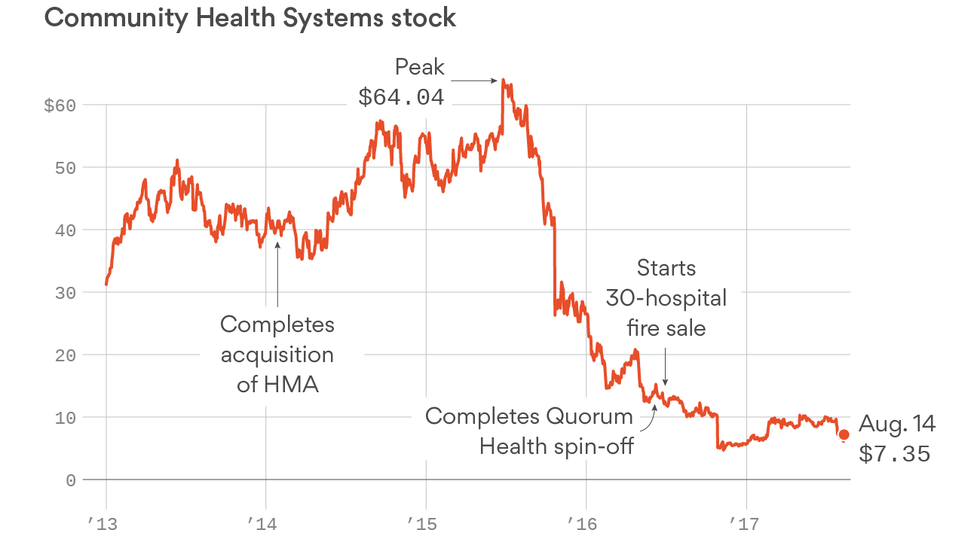
Just three years ago, Community Health Systems was the largest for-profit operator of hospitals with more than 200 facilities scattered in rural and suburban areas with growing populations. Now, the company is hemorrhaging money, sitting atop a mountain of debt and teetering on the edge of bankruptcy — all major reasons why CHS has lost almost 90% of its market value.

“I think the company has a nontrivial chance of defaulting,” said one CHS investor who asked to be unnamed because of the sensitivity of the issue. Tomi Galin, a CHS spokeswoman, did not make any company officials available for an interview, but said the company is confident it will have “a stronger core group of hospitals that are better positioned for long-term growth.”

Why it matters: CHS sits in a massive hole after a string of missteps, according to industry insiders. And it’s not likely to get better for CHS, or the local communities that rely on a CHS facility, as more people get treated in lower-cost outpatient centers instead of the hospital.

The collapse: It began in 2013 and continued into January 2014. That’s when CHS completed its acquisition of Health Management Associates, a for-profit hospital chain that had a slew of financial and legal problems. The deal was worth $7.6 billion, including debt, and made CHS the largest for-profit hospital company by number of facilities.

“That was the death knell,” a health care investment banker said. “HMA was a troubled company, and (CHS) thought bigger would be better.”

Here’s what has happened at CHS since then:

  • A market cap that crumbled from roughly $7.5 billion in 2015 to less than $800 million today.
  • Net losses of almost $1.9 billion from the start of 2016 through the second quarter of this year.
  • A ballooning debt load totaling $14.7 billion as of June 30.
  • Larry Robbins, a prominent hedge fund manager, dumped his entire portfolio of CHS stock. Paul Singer of Elliott Management did the same earlier this year.
  • A fire sale of 30 hospitals to get cash to pay down debt.
  • Some of those sold hospitals were HMA remnants, while others were considered CHS’ better, more profitable hospitals. “It’s almost like they’re burning the furniture,” the banker said. An investor said CHS was “selling off the fine china” to meet debt payments.
  • A completed spin-off of Quorum Health that, in essence, threw many struggling rural hospitals off CHS’ books. Quorum isn’t faring well either.
  • High amounts of uncompensated care. CHS owns many hospitals in the South, and most of those states did not expand Medicaid under the Affordable Care Act. That means CHS has absorbed more uncompensated care than hospitals in Medicaid expansion states.

Looking ahead: CHS plans on divesting even more hospitals, executives said during their latest earnings call. They likely will be profitable hospitals, as buyers won’t touch money-losing inpatient facilities with dwindling admissions.

But large debt payments are due in 2019 through 2022. Short-term cash from transactions appears to be a bandage, and a subsequently smaller profit base won’t solve the big debt picture, making bankruptcy a real possibility, an investor said.

Galin, the CHS spokeswoman, said the money from the hospital sales “are being used to reduce our debt” and that “cash flow generation remains strong.”

Leadership questions: Many CHS executives have retired or left in the past two years, including longtime CFO Larry Cash. Wayne Smith, the CEO of the hospital chain since 1997, remains in his position. Smith is one of the highest earners among hospital executives and reaped more than $1 million in bonuses alone the past two years even though CHS’ stock price tanked.

Numerous sources would not go on the record to talk about CHS. One hospital industry analyst said this when asked how Smith still had his job despite the company’s problems: “Your question is very valid.”

CMS gives $2.4 billion boost to inpatient hospitals for fiscal year 2018 with final uncompensated care rule

http://www.healthcarefinancenews.com/news/cms-gives-24-billion-boost-inpatient-hospitals-fiscal-year-2018-final-uncompensated-care-rule?mkt_tok=eyJpIjoiTXpOa01qUXhaVGd5TnpkaiIsInQiOiJudFozOHVLS1VVNXZZRE42Y0RmTWdIZHpkOU0yNERUSmlXU0VCMlJDMEFyMmVTUUc4aVwvcXRVc0gzXC9ndUdJVjhHT1drZkkzdDhBVFhHZ3BHVjI1NmhIVHY1RmNXSENVdWtwb3RVVnVtaFNWbXNFdnBzb0JVenRcL1ZuR1p0MW0zRyJ9

Inpatient hospitals will see increase of $800 million over the previous year, but long-term care facilities face $110 million cut in payments.

CMS Final Rule for the 2018 Medicare Inpatient Prospective Payment System will give hospitals an overall $2.4 billion raise in fiscal year 2018, the agency said.

Due to the combination of payment rate increases, other policy changes and adjustments acute care hospitals will see $6.8 billion in payments for uncompensated care, an increase of $800 million over the previous year, CMS said.

Medicare payments to inpatient psychiatric facilities will rise by $45 million, or roughly one percent. However, long-term care hospitals will decrease by $110 million in fiscal year 2018.

The changes will affect 3,330 acute care facilities and roughly 420 long-term care hospitals for discharges happening after October 1, 2017. The new rule incorporates CMS’ finalized proposal to use data from its National Health Expenditure Accounts in its estimate of the rate of uninsurance, which is used in calculating the total amount of uncompensated care payments available.

Long-term care hospitals will be facing a cut. Under the 2018 final rule, CMS projected payments will drop roughly 2.4 percent, or $110 million in FY 2018, which is “due in large part to the continued phase in of the dual payment rate system.” However, this amount is actually smaller than the previously projected cut of 3.75 percent, which was first proposed back in April.

CMS has also finalized its proposal for a one-year regulatory moratorium on the payment reduction threshold for patient admissions for long-term care hospitals in FY 2018 while they continue to evaluate the policy, CMS said.

Fitch: Failed ACA replacement efforts add to healthcare sector uncertainty

http://www.beckershospitalreview.com/finance/fitch-failed-aca-replacement-efforts-add-to-healthcare-sector-uncertainty.html

Image result for negative credit outlook fitch

As ACA repeal and replace efforts stall, significant uncertainty remains surrounding how federal policy will affect nonprofit healthcare organizations, leading to a negative sector outlook for healthcare, according to Fitch Ratings.

The uncertainty and negative outlook comes as the Trump administration looks for ways to weaken the ACA even if the health reform law is not repealed.

Nonprofit hospitals experienced declines in uncompensated care under the ACA because of an increase in healthcare coverage due to Medicaid expansion, rollout of healthcare exchanges and allowing children to stay on their parent’s health insurance plan until age 26.

While repeal efforts cause uncertainty for hospitals, current discussions regarding a bipartisan healthcare bill could be beneficial for nonprofit hospitals. A bipartisan effort could potentially reduce the insurance premium price hikes, according to Fitch.

Trump is threatening a move that could make Obamacare implode — here’s which states have the most to lose

http://www.businessinsider.com/obamacare-cost-sharing-reductions-states-benefit-2017-8

Image result for Trump is threatening a move that could make Obamacare implode — here's which states have the most to lose

The Trump administration is threatening a move that could make Obamacare implode.

On Tuesday, the administration is expected to make a decision on whether it will stop payments  to insurers that that help offset healthcare costs. President Donald Trump referred to these payments as “bailouts” in a a tweet on Saturday.

“If a new HealthCare Bill is not approved quickly, BAILOUTS for Insurance Companies and BAILOUTS for Members of Congress will end very soon!” Trump tweeted.

If the Trump administration does decide to end the payments, known as cost-sharing reductions, it could lead to higher premiums and fewer insurance plan choices in the exchanges. CSRs are paid to insurance companies to help offset the cost of discount health plans they provide to Americans making 200% of the federal poverty limit.

Deadline for 2018 coverage

Insurance companies have until late September to raise rates and finalize their coverage areas for 2018. Not receiving CSRs in 2018 could have a serious impact on what those look like.

Already, the market is in flux. On Wednesday, Anthem, the second-largest insurer in the US, said it might leave more markets in 2018. And on Monday, Ohio said it had managed to find insurers for 19 of the 20 counties that had no insurance plans on the exchanges. Ultimately, without the CSRs, many Americans could lose their health insurance.

How hospitals got richer off Obamacare

http://www.politico.com/interactives/2017/obamacare-non-profit-hospital-taxes/

After fending off challenges to their tax-exempt status, the biggest hospitals boosted revenue while cutting charity care.

decade after the nation’s top hospitals used all their advertising and lobbying clout to keep their tax-exempt status, pointing to their vast givebacks to their communities, they have seen their revenue soar while cutting back on the very givebacks they were touting, according to a POLITICO analysis.

Hospitals’ behavior in the years since the Affordable Care Act provided them with more than 20 million more paying customers offers a window into the debate over winners and losers surrounding this year’s efforts to replace the ACA. It also puts a sharper focus on the role played by the nation’s teaching hospitals – storied international institutions that have grown and flowered under the ACA, while sometimes neglecting the needy neighborhoods that surround them.

And it reveals, for the first time, the extent of the hospitals’ behind-the-scenes efforts to maintain tax breaks that provide them with billions of dollars in extra income, while costing their communities hundreds of millions of dollars in local taxes.

One example of the hospitals’ efforts to remain tax-free: the soaring, minutelong TV commercial that popped up on stations across Western Pennsylvania in 2009 by the University of Pittsburgh Medical Center, the area’s flagship hospital and one of the largest teaching hospitals in the country.

“UPMC is proud to be part of our city’s past, present and, more importantly, its future,” the narrator enthuses, as the camera pans around Pittsburgh scenes of priests, grocery-store workers, even a ballet dancer before coming to rest on the sprawling medical campus — one of the five largest in the world.

At the time, Congress was considering not only whether to remove tax-exempt status for teaching hospitals, a cause of Sen. Chuck Grassley (R-Iowa), but also whether to add requirements forcing hospitals to do more for the low-income, urban communities in which so many of the top hospitals are located. And local leaders in many states were attempting to claw back billions of dollars in forgone tax revenue — a battle that would soon break out between UPMC and the mayor of Pittsburgh, too.

But the hospitals, aided by their good-neighbor initiative, prevailed. The ACA did nothing more to force the hospitals to share their revenue with their neighbors or taxpayers generally.

The result, POLITICO’s investigation shows, is that the nation’s top seven hospitals as ranked by U.S. News & World Report collected more than $33.9 billion in total operating revenue in 2015, the last year for which data was available, up from $29.4 billion in 2013, before the ACA took full effect, according to their own financial statements and state reports. But their spending on direct charity care — the free treatment for low-income patients — dwindled from $414 million in 2013 to $272 million in 2015.

To put that another way: The top seven hospitals’ combined revenue went up by $4.5 billion per year after the ACA’s coverage expansions kicked in, a 15 percent jump in two years. Meanwhile, their charity care — already less than 2 percent of revenue — fell by almost $150 million per year, a 35 percent plunge over the same period.

Revenue up, charity care down

While operating revenue increased under Obamacare for not-for-profit hospitals like the Cleveland Clinic and UCLA Medical Center, the amount of charity health care they provided fell. For example, while UCLA saw operating revenue grow by more than $300 million between 2013 and 2015, charity care fell from almost $20 million to about $5 million.

In Senate Health Care Bill, A Few Hidden Surprises

http://healthaffairs.org/blog/2017/07/13/in-senate-health-care-bill-a-few-hidden-surprises/

Image result for surprises

A low-income person, eligible for Medicaid but not enrolled, is hit by a car or a bullet. Gravely injured, she arrives at the hospital unconscious. Thanks to expert, intensive care that lasts for days or weeks, she gradually recovers. Eventually, her health improves to the point where she can complete the paperwork needed to apply for Medicaid.

Such a hospital can be paid today, thanks to Medicaid’s “retroactive eligibility.” Even if the combination of medical problems and bureaucratic delays prevents an application from being filed and completed for several months, Medicaid will cover the care if the patient was eligible when services were provided.

The newest version of the Senate health bill—the Better Care and Reconciliation Act, or BCRA—would end this longstanding feature of the Medicaid program for beneficiaries who are neither elderly nor people with disabilities. If services are received in one calendar month and the application is completed the following month, the hospital would be denied all payment, even if the patient was eligible and the services were both essential and costly.

It does not matter if the state is led by a governor who understands the devastating impact of this change on hospital infrastructure, especially in rural areas where many hospitals are hanging on by a thread. Today, states have the flexibility to seek waivers that limit retroactive eligibility. Under the BCRA, that flexibility would disappear, as states are forced to end retroactive coverage, whether they like it or not.

Almost certainly, this provision would come as a surprise to most senators who are being asked to support the BCRA. It is only one of many unpleasant surprises lurking largely undiscovered throughout the bill. Following are other selected examples.

A Massive Expansion In Federal Power Over State Budgets

The BCRA grants the federal government startling new power over state Medicaid programs and state budgets. Federal dollars per person would be capped, based on state data about prior spending. But in setting the initial cap for each state, the secretary of Health and Human Services (HHS) could change the amount to rectify what the secretary views as problems in the “quality” of state data. In later years, many states could have their caps adjusted up or down by as much as 2 percent per year. That may sound like a small number, but when applied to billions of federal Medicaid dollars going to a state, it could make or break a state’s entire budget. Medicaid costs triggered by a public health emergency are exempt from the cap, but only if “the Secretary determines that such an exemption would be appropriate.” No statutory limits bound the Secretary’s use of this decision-making authority, which can have an extraordinary fiscal impact on states experiencing an epidemic or other public health crisis.

These provisions would give HHS remarkable new leverage over states, which current or future administrations could use to compel state policy changes in any desired direction. The aggressive use of available leverage has been an unfortunate feature of past administrations’ relationships to state Medicaid programs, but it could become substantially more pronounced with the increased federal authority granted by the Senate bill.

Adding To Uncertainties Surrounding State Expenditures

One recurring theme in Medicaid’s history involves state efforts to claim federal matching funds without spending the requisite state dollars. The Senate bill appears to increase this risk. Under Section 207 in the Senate bill, new opportunities emerge for states desperate to counteract the loss of billions of federal dollars. The bill authorizes unprecedented waivers involving federal funding for tax credits that help consumers buy private health insurance. So long as officials complete a form explaining how the waiver’s replacement of federal safeguards would provide an “alternative means” of increasing “access to comprehensive coverage, reducing average premiums, and increasing enrollment,” a state arguably could convert some or all of this federal money into so-called “pass-through” funds that can be used for purposes unrelated to health care. Unlike the Senate bill’s new public health emergency provisions, which require federal audits of state expenditures, states’ use of pass-through dollars has no statutory audit requirement. A state could convert subsidies meant for health insurance to other uses, or simply use the money to close a budget shortfall. As the Congressional Budget Office (CBO) explained about the virtually identical prior version of this section, the Senate health care bill would “substantially reduce the number of people insured” if states “reduced subsidies, received pass-through funds, and used those funds for purposes other than health insurance coverage.”

Medicaid Treatment For Mental Health And Substance Use Disorders

The bill repeals the current requirement that Medicaid programs must cover all “essential health benefits,” including treatment of mental health and substance use disorders. CBO found that, as the per capita limits in the Senate bill grow progressively tighter, federal Medicaid funding would eventually decline by more than a third, compared to current law. States facing such an enormous drop in federal support may see themselves as having no alternative but to cut services classified as optional, which the Senate bill redefines to include mental health and substance abuse treatment.

A Disordered Process

These problems could have been averted had the legislative process followed regular order, with hearings, legislative staff explaining the bill’s provisions, expert testimony, a public markup, and opportunities to address policy and drafting anomalies. Embedded in a measure with underlying policy goals that the authors of this blog post find fundamentally questionable, the picture that emerges is extraordinarily troubling—a legislative effort to divert more than a trillion dollars away from health care for people who are sicker, poorer, older, and indigent, while leaving states with such massive funding deficits and federal leverage that some states may attempt to stem their losses in ways that harm their vulnerable residents even more.

Even people sympathetic to the bill’s core aims, however, have good reason to oppose the Senate making such consequential decisions without taking the elementary legislative steps needed to detect and avoid terrible mistakes. Continuing to shun all the protections of regular order, the Senate appears poised to act on a bill that almost certainly includes additional unpleasant surprises going beyond those discussed here. With legislation that governs one-sixth of the US economy and that directly affects the health and economic security of millions of constituents, Senators are being asked to vote largely in the dark.

How the American Health Care Act’s Changes to Medicaid Will Affect Hospital Finances in Every State

http://www.commonwealthfund.org/publications/blog/2017/jun/how-changes-to-medicaid-will-affect-hospital-finances-in-every-state

Image result for How the American Health Care Act Changes to Medicaid Will Affect Hospital Finances in Every State

The American Health Care Act (AHCA), as passed by the U.S. House of Representatives, will reduce federal spending on Medicaid by more than $834 billion over the next 10 years. And the recently released Senate bill appears to cut Medicaid even more deeply. In addition to repealing the Medicaid expansion, the bills place caps on the federal dollars that states receive to provide health insurance to millions of low-income Americans, including the elderly, disabled, and people with opioid addiction.

We modeled the impact of this loss of Medicaid funding on U.S. hospitals and found that, over the next 10 years, hospitals in all states, but especially hospitals in Medicaid expansion states, will see an increase in uncompensated care—a treatment or service not paid for by an insurer or patient. We also saw declines in hospitals’ operating margins, particularly among hospitals in expansion states. Rural hospitals in nonexpansion states also would face marked operating margin decreases.

In the interactive state-by-state maps below, we present the estimated impact of the Medicaid provisions in the House-passed AHCA on the finances of all U.S. hospitals. The hospitals in the District of Columbia and the 31 states that expanded Medicaid are projected to see a 78 percent increase in uncompensated care costs between 2017 and 2026. Eleven of these states will see uncompensated care costs at least double between 2017 and 2026. For example, Nevada hospitals will see a 98 percent increase, West Virginia a 122 percent increase, and Kentucky a 165 percent increase.

In addition to growing uncompensated care, our projections indicate that under the AHCA, hospitals in most states will experience a decline in Medicaid revenues, even though the law restores Medicaid disproportionate share hospital (DSH) payments. Hospitals in Medicaid expansion states may experience a 14 percent drop in Medicaid revenues between 2017 and 2026, compared to a 3 percent anticipated reduction among hospitals in the 19 states that did not expand. Some states may see more dramatic drops. Arkansas hospitals, for example, are estimated to see a 31 percent decline in Medicaid revenue over the next 10 years.


Senate health bill a ‘death sentence’ for rural hospitals

http://www.fiercehealthcare.com/healthcare/senate-health-bill-a-death-sentence-for-rural-hospitals?utm_medium=nl&utm_source=internal&mrkid=959610&mkt_tok=eyJpIjoiWVRKa1kyRmhOemN6TXpOaSIsInQiOiI2U1oxdXAzN2xlRmx3S2lLSGc0aHpWWk5JZ2ducVduYTF6emxLR0JLOEdRQ2lLbHhTTFBcL0VPYjREUkVcLzJKS1BCV3U3NFdBN3NoZnRmUFV2bXJQUElwMGFUamxiTTN4QjhNdGlsV0x1U0lZZWxDdEhZcFVISFBBd2J0enliWkhqIn0%3D

costs

The Senate’s healthcare bill, if passed, could spell doom for some cash-strapped rural hospitals, many of which are already vulnerable to closure, experts say.

Much of the concern is centered on cuts to Medicaid in the bill—a proposal that is also worrying to large hospitals and health systems—which could leave millions more uninsured and significantly increase uncompensated care costs.

“These hospitals are hanging on by their fingernails,” Maggie Elehwany, vice president of government affairs for the National Rural Health Association, told CNN. “If you leave this legislation as is, it’s a death sentence for individuals in rural America.”

The cuts wouldn’t only hurt patients, according to a new report. Some of the bill’s proposals could also lead to thousands of rural healthcare workers losing their jobs. The Chartis Center for Rural Health, a part of strategic planning firm The Chartis Group, estimated that the BCRA, if passed as is, could cause 34,000 rural healthcare jobs to be eliminated.

Under the Senate’s bill, the cuts could cost rural hospitals $1.3 billion in lost revenue. Much of this would be felt in reduced Medicaid payments; expansion states, this would be about $442,000 lost each year per facility, while it would equal about $224,000 in lost revenue. It would likely push nearly 150 more rural facilities into the red, according to the analysis.

One such vulnerable facility is Lincoln Community Hospital, the small, regional hospital in Hugo, Colorado. The 50-bed hospital serves the the town of about 825, according to an article from National Public Radio, with many of its patients on either Medicare or Medicaid.

The funding cuts proposed in the Better Care Reconciliation Act have given leaders at Lincoln pause, and if the hospital were to close it would leave local residents in a “medical desert,” as it’s more than 100 miles to the next nearest hospital.

The facility was nearly shut down several decades ago, and former board member Ted Lyons said that, though the Affordable Care Act is far from perfect, he hopes that members of Congress work to protect rural hospitals if they intend to move forward with a repeal.

“You don’t drown the duck to get the feather out of him,” Lyons told NPR.

Rural healthcare leaders in Pennsylvania expressed similar concerns. Washington Health System operates two hospitals, one with 260 beds and one with 49 beds, in the western part of the state. CEO Gary Weinstein told WESA that if its smaller Waynesburg hospital closed, patients would have to travel at least 30 minutes for care.

The Waynesburg facility is located in Greene County, which is ranked 60th out of 67 Pennsylvania counties in per capita income, so many of its patients are Medicaid recipients. If a patient without insurance comes into the hospital, it recoups just 5% of its costs, Weinstein said.

“We don’t make money when somebody is insured by Medicaid, but at least we get something,” Weinstein said. “But when somebody has no insurance at all, a lot of times they just aren’t able to pay any part of the bill.”

Weinstein said he has spoken to Sen. Pat Toomey, R-Pennsylvania, one of the 13 senators involved in crafting the Senate’s bill, about that possibility, asking him to make additional changes to the legislation.