Health Insurance Coverage Eight Years After the ACA

https://www.commonwealthfund.org/publications/issue-briefs/2019/feb/health-insurance-coverage-eight-years-after-aca

Fewer Uninsured Americans and Shorter Coverage Gaps, But More Underinsured

What does health insurance coverage look like for Americans today, more than eight years after the Affordable Care Act’s passage? In this brief, we present findings from the Commonwealth Fund’s latest Biennial Health Insurance Survey to assess the extent and quality of coverage for U.S. working-age adults. Conducted since 2001, the survey uses three measures to gauge the adequacy of people’s coverage:

  • whether or not they have insurance
  • if they have insurance, whether they have experienced a gap in their coverage in the prior year
  • whether high out-of-pocket health care costs and deductibles are causing them to be underinsured, despite having continuous coverage throughout the year.

As the findings highlighted below show, the greatest deterioration in the quality and comprehensiveness of coverage has occurred among people in employer plans. More than half of Americans under age 65 — about 158 million people — get their health insurance through an employer, while about one-quarter either have a plan purchased through the individual insurance market or are enrolled in Medicaid.1Although the ACA has expanded and improved coverage options for people without access to a job-based health plan, the law largely left the employer market alone.2

Survey Highlights

  • Today, 45 percent of U.S. adults ages 19 to 64 are inadequately insured — nearly the same as in 2010 — though important shifts have taken place.
  • Compared to 2010, many fewer adults are uninsured today, and the duration of coverage gaps people experience has shortened significantly.
  • Despite actions by the Trump administration and Congress to weaken the ACA, the adult uninsured rate was 12.4 percent in 2018 in this survey, statistically unchanged from the last time we fielded the survey in 2016.
  • More people who have coverage are underinsured now than in 2010, with the greatest increase occurring among those in employer plans.
  • People who are underinsured or spend any time uninsured report cost-related problems getting care and difficulty paying medical bills at at higher rates than those with continuous, adequate coverage.
  • Federal and state governments could enact policies to extend the ACA’s health coverage gains and improve the cost protection provided by individual-market and employer plans.

The 2018 Commonwealth Fund Biennial Heath Insurance Survey included a nationally representative sample of 4,225 adults ages 19 to 64. SSRS conducted the telephone survey between June 27 and November 11, 2018.3 (See “How We Conducted This Study” for more detail.)

WHO IS UNDERINSURED?

In this analysis, we use a measure of underinsurance that accounts for an insured adult’s reported out-of-pocket costs over the course of a year, not including insurance premiums, as well as his or her plan deductible. (The measure was first used in the Commonwealth Fund’s 2003 Biennial Health Insurance Survey.*) These actual expenditures and the potential risk of expenditures, as represented by the deductible, are then compared with household income. Specifically, we consider people who are insured all year to be underinsured if:

  • their out-of-pocket costs, excluding premiums, over the prior 12 months are equal to 10 percent or more of household income; or
  • their out-of-pocket costs, excluding premiums, over the prior 12 months are equal to 5 percent or more of household income for individuals living under 200 percent of the federal poverty level ($24,120 for an individual or $49,200 for a family of four); or
  • their deductible constitutes 5 percent or more of household income.

The out-of-pocket cost component of the measure is only triggered if a person uses his or her plan to obtain health care. The deductible component provides an indicator of the financial protection the plan offers and the risk of incurring costs before someone gets health care. The definition does not include other dimensions of someone’s health plan that might leave them potentially exposed to costs, such as copayments or uncovered services. It therefore provides a conservative measure of underinsurance in the United States.

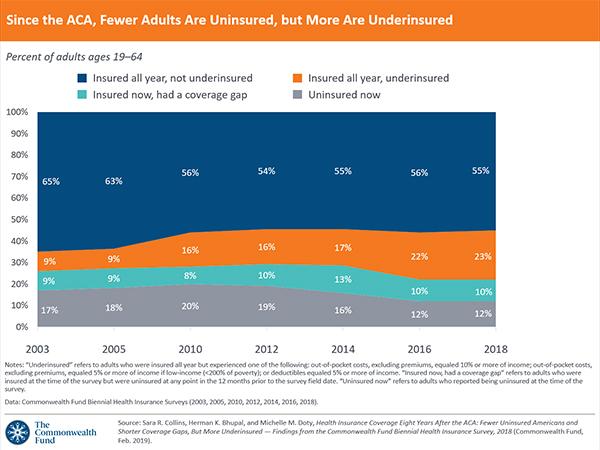
Compared to 2010, when the ACA became law, fewer people today are uninsured, but more people are underinsured. Of the 194 million U.S. adults ages 19 to 64 in 2018, an estimated 87 million, or 45 percent, were inadequately insured (see Tables 1 and 2).

Despite actions by the Trump administration and Congress to weaken the ACA, our survey found no statistically significant change in the adult uninsured rate by late 2018 compared to 2016 (Table 3). This finding is consistent with recent federal surveys, but other private surveys (including other Commonwealth Fund surveys) have found small increases in uninsured rates since 2016 (see “Changes in U.S. Uninsured Rates Since 2013”).

While there has been no change since 2010, statistically speaking, in the proportion of people who are insured now but have experienced a recent time without coverage, these reported gaps are of much shorter duration on average than they were before the ACA. In 2018, 61 percent of people who reported a coverage gap said it has lasted for six months or less, compared to 31 percent who said they had been uninsured for a year or longer. This is nearly a reverse of what it was like in 2012, two years before the ACA’s major coverage expansions. In that year, 57 percent of adults with a coverage gap reported it was for a year or longer, while one-third said it was a shorter gap.

There also has been some improvement in long-term uninsured rates. Among adults who were uninsured at the time of the survey, 54 percent reported they had been without coverage for more than two years, down from 72 percent before the ACA coverage expansions went into effect. The share of those who had been uninsured for six months or less climbed to 20 percent, nearly double the rate prior to the coverage expansions.

Of people who were insured continuously throughout 2018, an estimated 44 million were underinsured because of high out-of-pocket costs and deductibles (Table 1). This is up from an estimated 29 million in 2010 (data not shown). The most likely to be underinsured are people who buy plans on their own through the individual market including the marketplaces. However, the greatest growth in the number of underinsured adults is occurring among those in employer health plans.

WHY ARE INSURED AMERICANS SPENDING SO MUCH OF THEIR INCOME ON HEALTH CARE COSTS?

Several factors may be contributing to high underinsured rates among adults in individual market plans and rising rates in employer plans:

  1. Although the Affordable Care Act’s reforms to the individual market have provided consumers with greater protection against health care costs, many moderate-income Americans have not seen gains. The ACA’s essential health benefits package, cost-sharing reductions for lower- income families, and out-of-pocket cost limits have helped make health care more affordable for millions of Americans. But while the cost-sharing reductions have been particularly important in lowering deductibles and copayments for people with incomes under 250 percent of the poverty level (about $62,000 for a family of four), about half of people who purchase marketplace plans, and all of those buying plans directly from insurance companies, do not have them.4
  2. The bans against insurers excluding people from coverage because of a preexisting condition and rating based on health status have meant that individuals with greater health needs, and thus higher costs, are now able to get health insurance in the individual market. Not surprisingly, the survey data show that people with individual market coverage are somewhat more likely to have health problems than they were in 2010, which means they also have higher costs.
  3. While plans in the employer market historically have provided greater cost protection than plans in the individual market, businesses have tried to hold down premium growth by asking workers to shoulder an increasing share of health costs, particularly in the form of higher deductibles.5 While the ACA’s employer mandate imposed a minimum coverage requirement on large companies, the requirement amounts to just 60 percent of typical person’s overall costs. This leaves the potential for high plan deductibles and copayments.
  4. Growth in Americans’ incomes has not kept pace with growth in health care costs. Even when health costs rise more slowly, they can take an increasingly larger bite out of incomes.

It is well documented that people who gained coverage under the ACA’s expansions have better access to health care as a result.6 This has led to overall improvement in health care access, as indicated by multiple surveys.7 In 2014, the year the ACA’s major coverage expansions went into effect, the share of adults in our survey who said that cost prevented them from getting health care that they needed, such as prescription medication, dropped significantly (Table 4). But there has been no significant improvement since then.

The lack of continued improvement in overall access to care nationally reflects the fact that coverage gains have plateaued, and underinsured rates have climbed. People who experience any time uninsured are more likely than any other group to delay getting care because of cost (Table 5). And among people with coverage all year, those who were underinsured reported cost-related delays in getting care at nearly double the rate of those who were not underinsured.

There was modest but significant improvement following the ACA’s coverage expansions in the proportion of all U.S. adults who reported having difficulty paying their medical bills or said they were paying off medical debt over time (Table 4). Federal surveys have found similar improvements.8 However, those gains have stalled.

Inadequate insurance coverage leaves people exposed to high health care costs, and these expenses can quickly turn into medical debt. More than half of uninsured adults and insured adults who have had a coverage gap reported that they had had problems paying medical bills or were paying off medical debt over time (Table 6). Among people who had continuous insurance coverage, the rate of medical bill and debt problems is nearly twice as high for the underinsured as it is for people who are not underinsured.

Having continuous coverage makes a significant difference in whether people have a regular source of care, get timely preventive care, or receive recommended cancer screenings. Adults with coverage gaps or those who were uninsured when they responded to the survey were the least likely to have gotten preventive care and cancer screenings in the recommended time frame.

Being underinsured, however, does not seem to reduce the likelihood of having a usual source of care or receiving timely preventive care or cancer screens — provided a person has continuous coverage. This is likely because the ACA requires insurers and employers to cover recommended preventive care and cancer screens without cost-sharing. Even prior to the ACA, a majority of employer plans provided predeductible coverage of preventive services.9

Conclusion and Policy Implications

U.S. working-age adults are significantly more likely to have health insurance since the ACA became law in 2010. But the improvement in uninsured rates has stalled. In addition, more people have health plans that fail to adequately protect them from health care costs, with the fastest deterioration in cost protection occurring in the employer market. The ACA made only minor changes to employer plans, and the erosion in cost protection has taken a bite out of the progress made in Americans’ health coverage since the law’s enactment.

Both the federal government and the states, however, have the ability to extend the law’s coverage gains and improve the cost protection of both individual-market and employer plans. Here is a short list of policy options:

  • Expand Medicaid without restrictions. The 2018 midterm elections moved as many as five states closer to joining the 32 states that, along with the District of Columbia, have expanded eligibility for Medicaid under the ACA.10 As many as 300,000 people may ultimately gain coverage as a result.11 But, encouraged by the Trump administration, several states are imposing work requirements on people eligible for Medicaid — a move that could reverse these coverage gains. So far, the U.S. Department of Health and Human Services (HHS) has approved similar work-requirement waivers in seven states and is considering applications from at least seven more. Arkansas imposed a work requirement last June, and, to date, more than 18,000 adults have lost their insurance coverage as a result.
  • Ban or place limits on short-term health plans and other insurance that doesn’t comply with the ACA. The Trump administration loosened regulations on short-term plans that don’t comply with the ACA, potentially leaving people who enroll in them exposed to high costs and insurance fraud. These plans also will draw healthier people out of the marketplaces, increasing premiums for those who remain and federal costs of premium subsidies. Twenty-three states have banned or placed limits on short-term insurance policies. Some lawmakers have proposed a federal ban.
  • Reinsurance, either state or federal. The ACA’s reinsurance program was effective in lowering marketplace premiums. After it expired in 2017, several states implemented their own reinsurance programs.12  Alaska’s program reduced premiums by 20 percent in 2018. These lower costs particularly help people whose incomes are too high to qualify for ACA premium tax credits. More states are seeking federal approval to run programs in their states. Several congressional bills have proposed a federal reinsurance program.
  • Reinstate outreach and navigator funding for the 2020 open-enrollment period. The administration has nearly eliminated funding for advertising and assistance to help people enroll in marketplace plans.13 Research has found that both activities are effective in increasing enrollment.14 Some lawmakers have proposed reinstatingthis funding.
  • Lift the 400-percent-of-poverty cap on eligibility for marketplace tax credits. This action would help people with income exceeding $100,000 (for a family of four) better afford marketplace plans. The tax credits work by capping the amount people pay toward their premiums at 9.86 percent. Lifting the cap has a built in phase out: as income rises, fewer people qualify, since premiums consume an increasingly smaller share of incomes. RAND researchers estimate that this policy change would increase enrollment by 2 million and lower marketplace premiums by as much as 4 percent as healthier people enroll. It would cost the federal government an estimated $10 billion annually.15 Legislation has been introduced to lift the cap.
  • Make premium contributions for individual market plans fully tax deductible. People who are self-employed are already allowed to do this.16
  • Fix the so-called family coverage glitch. People with employer premium expenses that exceed 9.86 percent of their income are eligible for marketplace subsidies, which trigger a federal tax penalty for their employers. There’s a catch: this provision applies only to single-person policies, leaving many middle-income families caught in the “family coverage glitch.” Congress could lower many families’ premiums by pegging unaffordable coverage in employer plans to family policies instead of single policies.17

REDUCE COVERAGE GAPS

  • Inform the public about their options. People who lose coverage during the year are eligible for special enrollment periods for ACA marketplace coverage. Those eligible for Medicaid can sign up at any time. But research indicates that many people who lose employer coverage do not use these options.18 The federal government, the states, and employers could increase awareness of insurance options outside the open-enrollment periods through advertising and education.
  • Reduce churn in Medicaid. Research shows that over a two-year period, one-quarter of Medicaid beneficiaries leave the program and become uninsured.19 Many do so because of administrative barriers.20 By imposing work requirements, as some states are doing, this involuntary disenrollment is likely to get worse. To help people stay continuously covered, the federal government and the states could consider simplifying and streamlining the enrollment and reenrollment processes.
  • Extend the marketplace open-enrollment period. The current open-enrollment period lasts just 45 days. Six states that run their own marketplaces have longer periods, some by as much as an additional 45 days. Other states, as well as the federal marketplace, could extend their enrollment periods as well.

IMPROVE INDIVIDUAL-MARKET PLANS’ COST PROTECTIONS

  • Fund and extend the cost-sharing reduction subsidies. The Trump administration eliminated payments to insurers for offering plans with lower deductibles and copayments. Insurers, which by law must still offer reduced-cost plans, are making up the lost revenue by raising premiums. But this fix, while benefiting enrollees who are eligible for premium tax credits, has distorted both insurer pricing and consumer choice.21 In addition, it is unknown whether the administration’s support for the fix will continue in the future, creating uncertainty for insurers.22 Congress could reinstate the payments to insurers and consider making the plans available to people with higher earnings.
  • Increase the number of services excluded from the deductible.Most plans sold in the individual market exclude certain services from the deductible, such as primary care visits and certain prescriptions.23As the survey data suggest, these types of exclusions appear to be important in ensuring access to preventive care among people who have coverage but are underinsured. In 2016, HHS provided a standardized plan option for insurers that excluded eight health services — including mental health and substance-use disorder outpatient visits and most prescription drugs — from the deductible at the silver and gold level.24 The Trump administration eliminated the option in 2018. Congress could make these exceptions mandatory for all plans.

IMPROVE EMPLOYER PLANS’ COST PROTECTIONS

  • Increase the ACA’s minimum level of coverage. Under the ACA, people in employer plans may become eligible for marketplace tax credits if the actuarial value of their plan is less than 60 percent, meaning that under 60 percent of health care costs, on average, are covered. Congress could increase this to the 70 percent standard of silver-level marketplace plans, or even higher.
  • Require deductible exclusions. Congress could require employers to increase the number of services that are covered before someone meets their deductible. Most employer plans exclude at least some services from their deductibles.25 Congress could specify a minimum set of exclusions for employer plans that might resemble the standardized-choice options that once existed for ACA plans.
  • Refundable tax credits for high out-of-pocket costs. Congress could make refundable tax credits available to help insured Americans pay for qualifying out-of-pocket costs that exceed a certain percentage of their income.26
  • Protect consumers from surprise medical bills. Several states have passed laws that protect patients and their families from unexpected medical bills, generally from out-of-network providers.27A bipartisan group of U.S. senators has proposed federal legislation to protect consumers, including people enrolled in employer and individual-market plans.

Health care costs are primarily what’s driving growth in premiums across all health insurance markets. Employers and insurers have kept premiums down by increasing consumers’ deductibles and other cost-sharing, which in turn is making more people underinsured. This means that policy options like the ones we’ve highlighted above will need to be paired with efforts to slow medical spending. These could include changing how health care is organized and providers are paid to achieve greater value for health care dollars and better health outcomes.28 The government also could tackle rising prescription drug costs29 and use antitrust laws to combat the growing concentration of insurer and provider markets.30


Since the ACA, Fewer Adults Are Uninsured, but More Are Underinsured

https://www.commonwealthfund.org/chart/2019/aca-fewer-adults-are-uninsured-more-are-underinsured

Image result for Since the ACA, Fewer Adults Are Uninsured, but More Are Underinsured


20% of Americans are deferring healthcare because of cost, poll finds

https://www.beckershospitalreview.com/finance/20-of-americans-are-deferring-healthcare-because-of-cost-poll-finds.html?origin=rcme&utm_source=rcme

Related image

Americans are delaying medical care as they struggle with its affordability, according to the latest NPR-IBM Watson Health poll.   

The survey of more than 3,000 U.S. households in July found about 20 percent of respondents or someone in their household had postponed or canceled a healthcare service due to cost in the prior three months. 

Younger respondents were more likely to put off their healthcare needs. Thirty-four percent of respondents under 35 said they deterred care because of cost, compared with 8 percent of respondents 65 and older.

The poll also found 26 percent of respondents or someone in their household had difficulty paying for some type of healthcare service in the prior three months.

Again, younger respondents were more likely to experience trouble. Forty-one percent of respondents under 35 said they or a member of their household struggled to pay for a healthcare service, compared to 11 percent of respondents 65 and older and 26 percent of respondents ages 35 to 64.

The poll found 66 percent of respondents said they received a prescription in the prior three months, and 97 percent of those respondents had it filled. Of the respondents who said they had a prescription filled, 19 percent reported they had trouble paying for it.

Access the full poll results here.


Federal Subsidies Could Expand to Health Programs That Violate Obamacare

Image result for skinny health plans


 The Trump administration said Thursday that states could bypass major requirements of the Affordable Care Act by using federal funds for a wide range of health insurance programs that do not comply with the law.

Federal officials encouraged states to seek waivers from provisions of the law that specify who is eligible for premium subsidies, how much they get and what medical benefits they receive.

It was “a mistake to federalize so much of health care policy under the Affordable Care Act,” Seema Verma, the administrator of the Centers for Medicare and Medicaid Services, told state officials at a conference in Washington.

The new policy outlined by the administration on Thursday upends a premise of the Affordable Care Act: that federal subsidies can be used only for insurance that meets federal standards and is purchased through public marketplaces, also known as insurance exchanges.

Under the new policy, states could use federal subsidies to help people pay for employer-sponsored insurance. Consumers could combine federal funds with employer contributions to buy other types of insurance.

Under the Affordable Care Act, premium tax credits are available to people with incomes up to four times the poverty level, roughly $83,000 a year for a family of three. With a waiver, states could provide assistance to higher-income families.

The Trump administration laid out templates for state programs — waiver concepts — that could significantly depart from the model enacted by Congress in 2010.

Alex M. Azar II, the secretary of health and human services, said states could use the suggestions to “create more choices and greater flexibility in their health insurance markets, helping to bring down costs and expand access to care.”

Democrats assailed the initiative as an audacious effort to undermine the Affordable Care Act. And they said the administration was ignoring the midterm election success of Democrats who had promised to defend health care that they said was threatened by President Trump and Republicans in Congress.

“The American people just delivered an overwhelming verdict against Republicans’ cruel assault on families’ health care,” said the House Democratic leader, Nancy Pelosi of California. “But instead of heeding the will of the people or the requirements of the law, the Trump administration is still cynically working to make health insurance more expensive and to leave more Americans without dependable coverage.”

Senator Ron Wyden of Oregon, the senior Democrat on the Finance Committee, said the administration was creating a fast lane for swift approval of “junk insurance.”

The Affordable Care Act prohibits insurers from denying coverage or charging higher premiums to people with pre-existing medical conditions. At campaign rallies this fall, Mr. Trump repeatedly promised: “We will always protect Americans with pre-existing conditions. Always.”

Ms. Verma said Thursday that “the A.C.A.’s pre-existing condition protections cannot be waived.

But states could use federal funds to subsidize short-term plans and “association health plans,” in which employers band together to provide coverage for employees. Such plans are free to limit or omit coverage of benefits required by the Affordable Care Act, such as mental health care, emergency services and prescription drugs.

A provision of the Affordable Care Act allows waivers for innovations in state health policy. The federal law stipulates that state programs must provide coverage that is “at least as comprehensive” as that available under the Affordable Care Act and must cover “at least a comparable number” of people.

Two powerful House Democrats said the new guidance issued by the Trump administration was illegal because it did not meet the standards for waivers set forth in the Affordable Care Act.

“It is contrary to the plain language of the statute, and it appears to be part of the administration’s ideologically motivated efforts to sabotage the Affordable Care Act,” said a letter sent to Mr. Azar by Representatives Frank Pallone Jr. of New Jersey and Richard E. Neal of Massachusetts.

In issuing the guidance, they said, Mr. Azar also violated the Administrative Procedure Act, which generally requires agencies to provide an opportunity for public comment before adopting new rules.

Republican governors have been pleading with federal officials to give states more authority to regulate health insurance.

Paul Edwards, a deputy chief of staff to Gov. Gary Herbert of Utah, a Republican, said, “Utah welcomes all efforts that give us maximum flexibility to structure our health care programs to the unique needs of our citizens.” State officials “will look closely at how these new rules could benefit Utahns,” he said.

Brenna Smith, a spokeswoman for Gov. Kim Reynolds of Iowa, a Republican, said the governor “has a proven track record of expanding health care options for Iowans and is eager to see the new opportunities this proposal might open up.”

Iowa tried last year to get a waiver under Obama-era guidance, seeking essentially to opt out of the Affordable Care Act marketplace by offering customers a single plan with lower premiums and a high deductible.

Ms. Reynolds ultimately withdrew the request in frustration, saying at the time that “Obamacare’s waiver rules are as inflexible as the law itself.”

One option for states is to take federal funds and put the money into accounts that consumers could use to pay insurance premiums or medical expenses.

Likewise, Ms. Verma said: “States can develop a new state premium subsidy structure and decide how premium subsidies should be targeted. States can set the rules for what type of health plan is eligible for state premium subsidies.”

She was speaking Thursday at a conference of the American Legislative Exchange Council, a conservative group that promotes limited government and drafts model legislation.


New insurance guidelines would undermine rules of the Affordable Care Act

https://www.washingtonpost.com/national/health-science/new-insurance-guidelines-would-undermine-rules-of-the-affordable-care-act/2018/11/29/ff467f46-f357-11e8-aeea-b85fd44449f5_story.html?utm_term=.c279fcb895a6&wpisrc=al_news__alert-hse–alert-national&wpmk=1

Image result for aca

The Trump administration is urging states to tear down pillars of the Affordable Care Act, demolishing a basic rule that federal insurance subsidies can be used only for people buying health plans in marketplaces created under the law.

According to advice issued Thursday by federal health officials, states would be free to redefine the use of those subsidies, which began in 2014. They represent the first help the government ever has offered middle-class consumers to afford monthly premiums for private insurance.

States could allow the subsidies to be used for health plans the administration has been promoting outside the ACA marketplaces that are less expensive because they provide skimpier benefits and fewer consumer protections. In an even more dramatic change, states could let residents with employer-based coverage set up accounts in which they mingle the federal subsidies with health-care funds from their job or personal tax-deferred savings funds to use for premiums or other medical expenses.

If some states take up the administration’s offer, it would undermine the ACA’s central changes to the nation’s insurance system, including the establishment of nationwide standards for many kinds of health coverage sold in the United States.

Another goal of the ACA, the sprawling 2010 law that was President Barack Obama’s preeminent domestic accomplishment, was to concentrate help on the individual insurance market serving people who do not have access to affordable health benefits through a job. Prices were often out of control and discrimination against unhealthy people was more prevalent before the ACA imposed required benefits, prohibited insurers from charging more to people with preexisting conditions and created a federal health exchange and similar state-run marketplace in which private insurance companies compete for customers.

The ACA health plans have been the only ones for which consumers can use the subsidies, designed to help customers with incomes up to the middle class — 400 percent of the federal poverty line — afford the premiums.

The new advice, called “waiver concepts” because they are ideas for how states could get federal permission to deviate from the law’s basic rules, stray from both of those goals. And it would allow states to set different income limits for the subsidies — higher or lower than the federal one.

The day before they were released by Seema Verma, administrator of the Department of Health and Human Services’ Centers for Medicare and Medicaid Services, an analysis by the Brookings Institution questioned the legality of the content and method of these concepts. The analysis by Christen Linke Young, a Brookings fellow and HHS employee during the Obama administration, contends that “there are serious questions” about whether the changes are allowable under the law and that “at the very least, it is likely invalid” for CMS to issue the advice to states without going through the formal steps to change federal regulations.

In a statement Thursday, HHS Secretary Alex Azar said: “The Trump administration is committed to empowering states to think creatively about how to secure quality, affordable healthcare choices for their citizens.” He said the four recommendations issued Thursday, including new accounts in which consumers could pool federal subsidies and other funds, are intended to “show how state governments can work with HHS to create more choices and greater flexibility in their health insurance markets, helping to bring down costs and expand access to care.”

In a midday speech before a gathering of the conservative American Legislative Exchange Council, Verma delivered a broadside against the health-care law in explaining the rationale for freeing states to rework health policies on their own. “It was such a mistake to federalize so much of health care in the ACA,” said Verma, who worked as a consultant to states before becoming one of Trump’s senior health-care advisers. While the law sought to make health coverage more available and affordable, she said, “the insurance problem has not been solved. For many Americans it’s even been made worse.”

In urging states to consider the changes, CMS is renaming a provision of the law, known as 1332, which until now has mainly been used to give states permission to create programs to ease the burden on insurers of high-cost customers. CMS is switching the name to “State Relief and Empowerment Waivers,” emphasizing the administration’s desire to hand off health-care policies to states.

The changes go beyond a variety of other steps Trump administration health officials have taken in the past year to weaken the ACA, which the president has opposed vociferously.

Until now, they have focused on bending the ACA’s rules for health plans themselves. The administration has rewritten regulations to make it easier for Americans to buy two types of insurance that is relatively inexpensive because it does not contain all the benefits and consumer protections that the ACA typically requires.

The new steps go further by undercutting the basic ACA structure of the individual insurance marketplaces created for those who cannot get affordable health benefits through a job.

During a conference call with journalists, Verma said that no state would be allowed to retreat from a popular aspect of the ACA that protects people with preexisting medical conditions from higher prices or an inability to buy coverage.

She said that, in evaluating states’ proposals, CMS would focus on several considerations, including whether changes would foster comprehensive coverage and affordability and would not increase the federal deficit. She said federal officials would favor proposals that help, in particular, low-income residents and people with complex medical problems.

Verma reiterated an administration talking point that insurance rates have escalated since the ACA was passed and that health plan choices within ACA marketplaces have dwindled. However, the current ACA enrollment period, lasting until mid-December, is different from the previous few because prices for the most popular tier of coverage have stabilized in many places and more insurers are taking part in the marketplaces.


ACA Slow Enrollment as Uninsured Rate Remains Steady

https://www.healthaffairs.org/do/10.1377/hblog20181120.831184/full/

Image result for ACA Slow Enrollment as Uninsured Rate Remains Steady

In most states across the country, the open enrollment period for 2019 began on November 1 and will end on December 15, 2018. As we near the halfway point for enrollment—at least for the states with a federal marketplace—recent federal data suggests that enrollment in Affordable Care Act (ACA) marketplace plans is lagging relative to last year.

In its “week 2” enrollment snapshot, the Centers for Medicare and Medicaid Services (CMS) announced that nearly 1.2 million consumers selected a plan between November 1 and November 10 in the 39 states that use HealthCare.gov. Of these consumers, about 275,000 were new consumers while about 901,000 were renewing their coverage from last year. This reflects a significant increase from the first three days of open enrollment when about 371,000 consumers selected a plan.

“Week 2” plan selections are down by about 302,000 consumers relative to last year. This can be read as between an 8 to 13 percent decline in plan selections compared to last year, when a total of 11.8 million consumers in all 50 states and DC selected or were automatically reenrolled in a marketplace plan. Enrollment remained largely stable from 2017 to 2018 despite a shortened open enrollment period and significant cuts to advertising and navigator funding.

This year, however, brings additional changes that could be contributing to what is, at least so far, depressed enrollment through HealthCare.gov. These changes include repeal of the individual mandate penalty; 2019 is the first year that consumers will no longer pay a penalty for being uninsured under the ACA. In addition, new federal rules are enabling expanded access to non-ACA plans (such as short-term, limited-duration insurance and association health plans). These non-ACA plans typically have a much lower premium than ACA plans and could lure consumers away from the marketplace.

It is too early to tell if the reduced enrollment trend will hold and if this pattern will continue. Enrollment may increase significantly before the December 15 deadline, and millions of Americans will enroll in coverage before the end of the year.

The declines are, however, significant. The former chief marketing officer for HealthCare.gov recently noted that the data “should be a wake-up call to everyone who cares about people having health care … on the need to step up efforts to raise awareness.” CMS intends to release enrollment snapshots on a weekly basis. Each snapshot also includes point-in-time estimates of call center activity and visits to HealthCare.gov and CuidadoDeSalud.gov, among other data.

The new open enrollment data comes at a time when the uninsured rate continues to remain steady. Data from the National Center for Health Statistics—in reports both from late August and November—shows that the uninsured rate of about 8.8 percent for 2018 remains largely unchanged from 2017. Although there was not a significant shift from 2017 to 2018, there has been a sizable drop in the uninsured rate since the ACA was enacted in 2010. Between 2010 and the first six months of 2018, the uninsured rate dropped from 16 percent (48.6 million people) to 8.8 percent (28.5 million people).


Americans are still struggling with drug costs

https://www.axios.com/americans-struggling-drug-costs-goodrx-0b487b1b-a362-4776-8f43-8b118651d606.html?utm_source=newsletter&utm_medium=email&utm_campaign=newsletter_axiosvitals&stream=top

Image result for Americans are still struggling with drug costs


More than 2 out of 5 Americans say paying for their prescription drugs in the past year was difficult, even though most have health insurance, according to a new survey from GoodRx, a consumer site that compares drug costs.

Why it matters: Drug prices are a top public concern because many people take medications every day and see the toll on their wallets. The survey shows people aren’t really feeling any relief amid the political promises to address the issue.

By the numbers: The GoodRx survey, which mirrors other public tracking polls, found:

  • A third of people have skipped filling a prescription in the last year due to the cost. Rising coinsurance rates and deductibles often are the culprits.
  • Almost 20% of Americans said they’ve had to use money from their savings to pay for their drugs. (Separately, another 12% said they didn’t have any savings to draw from.)
  • The survey got responses from more than 1,000 people, 70% of whom take at least one medication.


Doctors Are Fed Up With Being Turned Into Debt Collectors

https://www.bloomberg.com/news/articles/2018-11-15/doctors-are-fed-up-with-being-turned-into-debt-collectors

Highlighting a key implication of the rise in high-deductible health plans, both on the ACA exchanges and in employer-sponsored insurance, the article describes a question now commonly faced by doctors and hospitals—how best to collect their patients’ portion of the fees they charge? As one Texas doctor tells Bloomberg, reflecting the experience of the Maldonados from the other side of the equation, “If [patients] have to decide if they’re going to pay their rent or the rest of our bill, they’re definitely paying their rent.” He reports that the number of people dodging his calls to discuss payment has increased “tremendously” since the passage of the ACA. Another Texas doctor reports that his small practice had to add an additional full-time staff member just to collect money owed by patients, adding further overhead to his practice’s costs and making it more likely that he, like many other doctors, will eventually seek shelter by being employed by a larger delivery organization. That trend, as has been repeatedly shown, further increases the cost of care, exacerbating the increase in insurance costs for families like the Maldonados. This Gordian knot of increasing costs, rising deductibles, and growing premiums has left us with a healthcare system that’s forcing difficult decisions at every turn, for patients and providers.

Physicians, hospitals and medical labs are grappling with the rise in high-deductible insurance.

Doctors, hospitals and medical labs used to be concerned about patients who didn’t have insurance not paying their bills. Now they’re scrambling to get paid by the ones who do have insurance.

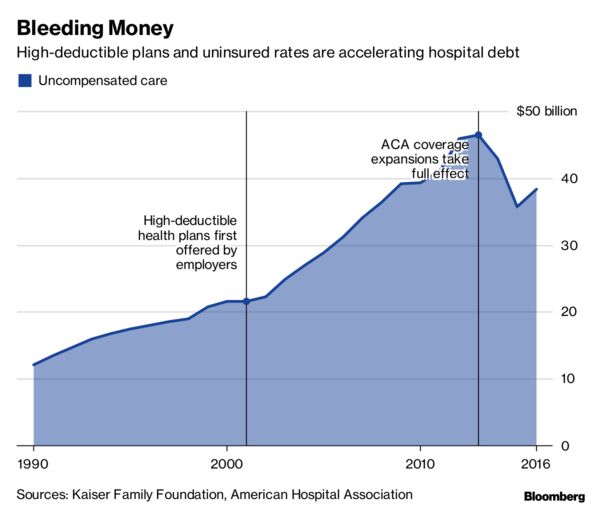
For more than a decade, insurers and employers have been shifting the cost of care onto their workers and customers, tamping down premiums by raising patients’ out-of-pocket costs. Last year, almost half of privately insured Americans under age 65 had annual deductibles ranging from $1,300 to as high as $6,550, government data show.

Now, instead of getting paid by insurance companies on a predictable schedule, health-care providers have to engage in an awkward dance. One moment they’re removing a pre-cancerous skin mole. The next, they’re haranguing patients to pay what’s become a growing portion of the total medical bill.

“It’s harder to collect from the patient than it is from the insurance,” said Amy Derick, a doctor who heads a dermatology practice outside Chicago. “If the plans change to a higher deductible, it’s harder to get the patients to pay.”

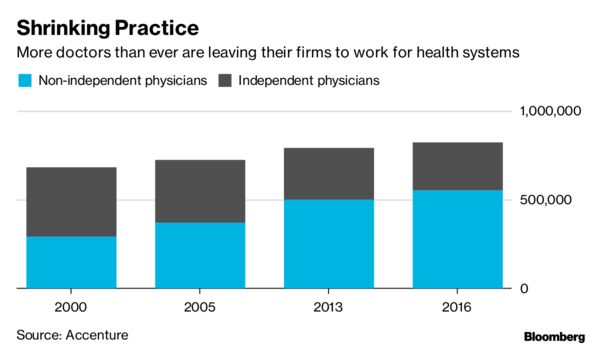
Independent physicians cited reimbursement pressures as their biggest concern for staying in business, according to a report by Accenture Plc in 2015.

“If they have to decide if they’re going to pay their rent or the rest of our bill, they’re definitely paying their rent,” said Gerald “Ray” Callas, president of the Texas Society of Anesthesiologists, whose Beaumont, Texas, practice treats about 40,000 people annually. “We try to work with the patient, but on the other hand, we can’t do it for free because we still maintain a small business.”

Accenture

In 2016, Callas introduced payment options that allow patients with expensive plans to pay a portion of the bill upfront or on a monthly basis over several years. Even so, Callas said the number of people avoiding his calls after surgery has increased “tremendously” each year since the Affordable Care Act passed in 2010.

Derick instituted a “time-out” option a few years back that gives patients the billing codes before a procedure, allowing them to call their insurance companies for estimates. Even with the program, collection rates are slower, especially at the beginning of the year when insurance plan deductibles reset.

Even large medical companies with national operations are facing the problem. Quest Diagnostics Inc., the lab-testing giant, said 20 percent of services billed to patients in the third quarter of this year went unpaid, costing the company about $80 million in lost revenue.

“We certainly have a high bad-debt rate for the uninsured,” Chief Financial Officer Mark Guinan said in a telephone interview. “But really the biggest driver is people with insurance. It’s their coinsurance and their high deductibles, and they don’t always pay their bills.”

Another testing company, Laboratory Corp. of America Holdings, reported its first year-over-year uptick in unpaid bills in the first quarter of 2016. At the time, Chief Executive Officer David King said high-deductible plans, higher copays and greater incidences of non-covered services led to more dollars being shifted to patients. LabCorp declined requests for comment.

Northwell Healthcare Inc., a network of more than 700 hospitals and outpatient facilities, lost $106.9 million to unpaid services in 2015. Others have reported the same: Acute-care and critical-access hospitals reported$55.9 billion in bad debt for 2015, according to data compiled by the American Hospital Directory Inc. 

“High-deductible plans have had a very big impact,” said Richard Miller, Northwell’s chief business strategy officer.

Kaiser Family Foundation, American Hospital Association

When it comes to reimbursement, a common denominator across the health-care industry is the archaic process through which bills are processed — a web of medical records, billing systems, health insurers and contractors.

High deductibles only add to the red tape. Providers don’t have real-time, fully accurate information on patient deductibles, which fluctuate based on how much has already been paid. That forces providers to constantly reach out to insurance companies for estimates.

Tarek Fakhouri, a Texas surgeon specializing in skin cancer, had to hire an additional staff member just to reason through bills with patients and their insurers, a big expense for an office of six or seven employees. About 10 percent of Fakhouri’s patients need payment plans, delay their skin-cancer surgeries until they’ve met their deductibles, or have to choose an alternative treatment.

According to a study earlier this year by the Journal of American Medical Association, primary-care physicians at academic health-care systems lose about 15 percent of their revenue to billing activities like calling insurance companies for estimates.

“It’s an unnecessary added cost to the health-care system to have to hire staff just to sit there on hold with insurance companies to find out what a patient’s deductible status is,” said Fakhouri.

Callas, Derick, and Fakhouri said they all know physicians who have left private practice altogether, some for the sole purpose of ending their dual roles as bill collectors. According to a study by the American Medical Association, less than half of doctors were self-employed as of 2016 — the lowest total ever. Many left their own practices in favor of hospitals and large physician groups with more resources.

To cope with the challenge, labs and hospitals are investing millions in programs designed to help patients understand what they owe at the point of care. Northwell has been implementing call centers and facilities where patients can ask questions about their bills.

“There’s a burden on both sides,” said Callas. “But health-care providers get caught in the middle.”


With Divided Congress, Health Care Action Hightails It to the States

https://www.rollcall.com/news/policy/divided-congress-health-care-action-states

Image result for With Divided Congress, Health Care Action Hightails It to the States

Medicaid expansion was the biggest winner in last week’s elections.

Newly-elected leaders in the states will be in a stronger position than those in Washington to steer significant shifts in health care policy over the next couple of years as a divided Congress struggles with gridlock.

State Medicaid work requirements, prescription drug prices, insurance exchanges and short-term health plans are among the areas with the potential for substantial change. Some states with new Democratic leaders may also withdraw from a multistate lawsuit aimed at killing the 2010 health care law or look for ways to curb Trump administration policies.

But last week’s biggest health care winner is undeniably Medicaid expansion, with upwards of half a million low-income Americans poised to gain insurance coverage following successful expansion ballot initiatives and Democratic victories in key governors’ races.

“In state health policy, it was a big election,” said Trish Riley, executive director of the nonpartisan National Academy for State Health Policy. “It was a year when many candidates had pretty thoughtful and comprehensive proposals.”

Boost for Medicaid expansion

Voters in three deep-red states — Nebraska, Idaho and Utah — bucked their Republican lawmakers by approving ballot initiatives to extend Medicaid coverage to more than 300,000 people.

Meanwhile, Democratic gubernatorial wins in Kansas and Wisconsin boosted the chances of expansion in those states. And Maine’s new governor-elect is expected to act quickly to grow the government insurance program when she takes office in January.

The election outcomes could bring the biggest increase in enrollment since an initial burst of more than two dozen states expanded Medicaid under the 2010 health care law in the early years of the landmark law’s rollout.

“This election proves that politicians who fought to repeal the Affordable Care Act got it wrong,” said Jonathan Schleifer, head of The Fairness Project, an advocacy group that supported the initiatives, referring to the 2010 health care law. “Americans want to live in a country where everyone can go to the doctor without going bankrupt.”

The successful ballot initiatives require state leaders to move quickly toward expansion. In Idaho, the state must submit an expansion plan to federal officials within 90 days of the new law’s approval, while Nebraska must submit its plan by April 1, according to the nonpartisan Kaiser Family Foundation. Utah’s new law also calls for the state to expand beginning April 1.

In Kansas, where Medicaid supporter Laura Kelly prevailed, state lawmakers passed expansion legislation last year only to have it vetoed by the governor. Meanwhile, Wisconsin’s new Democratic governor Tony Evers, who eked out a win over Republican incumbent Scott Walker, has said he will “take immediate action” to expand, though he faces opposition from a Republican-controlled legislature.

Expansions in the five states would bring the number of states that adopted expansion under the health law to 38, plus the District of Columbia.

Still, Democrats fell short of taking one of the biggest Medicaid expansion prizes — Florida — after Andrew Gillum’s defeat. The outcome of Georgia’s tight governor’s race was still unclear as of Monday, with Republican Brian Kemp holding a narrow lead over Democrat Stacey Abrams. Both Abrams and Gillum made health care, and Medicaid expansion in particular, central to their campaigns.

Florida might be a 2020 target for an expansion ballot initiative, along with other states such as Missouri and Oklahoma, according to The Fairness Project.

Expansion supporters also suffered defeat last week in Montana, where voters did not approve a ballot initiative that would have extended the state’s existing Medicaid expansion, which covers nearly 100,000 people but is slated to expire next year. However, state lawmakers have until June 30 to reauthorize the program, according to Kaiser.

In Maine, Democratic gubernatorial winner Janet Mills is expected to expedite expansion implementation. GOP Gov. Paul LePage stymied implementation over the past year, despite nearly 60 percent of voters approving an expansion ballot initiative in 2017.

Medicaid’s future

The midterm results carry other ramifications for Medicaid, including whether states embrace or move away from controversial work requirements backed by the Trump administration.

Gretchen Whitmer, a Democrat who won Michigan’s governor race, opposed the idea and could shift away from an existing plan to institute them that’s awaiting federal approval.

“This so-called work requirement is not for one second about getting people back to work. If it was, it would have been focused on leveling barriers to employment like opening up training for skills or giving people child care options or transportation options,” Whitmer said in a September interview with Michigan Radio. “It was about taking health care away from people.”

Kansas, Wisconsin and Maine also have work requirement proposals that new Democratic governors could reverse.

But experts also say it’s possible some states, including those with Democratic governors, could end up pursuing Medicaid work requirements if that’s what it takes to get conservative legislators to accept expansion like Virginia did earlier this year.

Nebraska Republican state senator John McCollister, who supports expansion, predicted recently that the legislature would fund the voter-approved expansion initiative. But he indicated lawmakers might pursue Medicaid work requirements too.

Marie Fishpaw, director of domestic policy studies at the conservative Heritage Foundation, warned that states expanding Medicaid would face challenges. She called expansion “a poor instrument for achieving the goal that they’re trying to achieve.”

A number of new governors, including Whitmer, could pursue the so-called “Medicaid buy-in” concept.

More than a dozen state legislatures, such as in Minnesota and Iowa, explored the idea in recent years, according to State Health and Value Strategies, part of the nonprofit Robert Wood Johnson Foundation. Nevada lawmakers passed a “Medicaid buy-in” plan last year that was vetoed by the governor.

There are a variety of ways to implement such a program, but the goal is to expand health care access by leveraging the government insurance program, such as by creating a state-sponsored public health plan option on the insurance exchanges that consumers could buy that relies on Medicaid provider networks. Illinois, New Mexico, Maine and Connecticut are among the states that could pursue buy-in programs, Riley said. States are considering the concept as a way to increase affordability and lower cost growth by getting more mileage out of the lower provider rates Medicaid pays, said Katherine Hempstead, a senior policy adviser with Robert Wood Johnson Foundation.

“So many [people] struggle with the affordability of health care,” Hempstead said. “That is an environment in which Medicaid buy-in opportunities could flourish.”

Health care law

This month’s election also carries implications for the future of states’ administration of the 2010 health care law.

States that flipped to Democratic governors could switch to creating their own insurance exchanges rather than relying on the federal marketplace, said Joel Ario, a health care consultant with Manatt Phelps & Phillips and the former head of the federal health insurance exchange office under the Obama administration. The costs of running an exchange have come down in recent years, so it’s potentially cheaper for a state to run its own, Ario said.

Trump administration actions, such as cuts in federal funding for insurance navigators that help consumers enroll and the expansion of health plans that don’t comply with the law, may make states such as Michigan or Wisconsin rethink use of the federal exchange, he said.

“If [the administration] continues to promote policies that really leave a bad taste in the mouth for Democratic governors, I think they’ll be asking questions,” Ario said.

States where governors and attorneys general offices went from red to blue are likely to pull out of a lawsuit by 20 state officials that aims to take down the health care law, he added.

Wisconsin’s Evers vowed that his first act in office will be to withdraw from the lawsuit.

“I know that the approximately 2.4 million Wisconsinites with a pre-existing condition share my deep concern that this litigation jeopardizes their access to quality and affordable health care,” Evers wrote in a letter he said he plans to send to the state attorney general.

Hempstead said that states with both Republican and Democratic leaders will likely continue to pursue reinsurance programs, which cover high-cost patients, to bolster their marketplaces.

Republican governors could also pursue waivers under a recent Trump administration guidance that allows states to circumvent some requirements of the health law under exemptions known as 1332 waivers. But experts say it’s too soon to know exactly what approaches states might take.

“It will be interesting to see what the 1332 guidance means and whether it opens doors for some things and not for others,” Hempstead said. States that shifted to Democratic governors could also look to ban some Trump-supported policies, such as expansions of short-term and association health plans that avoid the health care law’s rules.

States are also likely to take steps to address high prescription drug costs in the coming years, with a number of new governors wanting to improve transparency, explore drug importation from other countries and target price gouging, Riley said.

“There’s a long history of the states testing, fixing, tweaking and informing the national debate,” said Riley.


Trends in Health Policy and the Mid-Term Elections Results

http://avalere.com/expertise/life-sciences/insights/series-trends-in-health-policy-and-the-mid-term-election-results

Image result for Series: Trends in Health Policy and the Mid-Term Elections Results

Tune in to hear Avalere experts discuss potential implications of the mid-term elections on health policy. Director Chris Sloan interviews Senior Vice President Elizabeth Carpenter on the mid-term elections results and what this could mean for the future of healthcare policy.

CS: Hello, and welcome to a special mid-term elections Avalere podcast. This is the last in a three-part series we’re doing on the health policy implications of the mid-term elections, and this time, we actually have results from the mid-term elections! My name is Chris Sloan, I’m a director with the federal and state policy group here at Avalere. Today, we’re going to discuss the results of the mid-term elections and the implications for health policy going forward.

As a reminder for those of you living under rocks, the mid-term elections ended with Democrats taking control of the House while Republicans increased their lead in the Senate. In three states, Medicaid expansion ballot initiative passed, which is likely to lead to about 325,000 new enrollees in Medicaid in Idaho, Nebraska, and Utah. Also, Democratic candidates who campaigned on Medicaid expansion won the governors races in Kansas, Maine, and Wisconsin, potentially leading to another 300,000 Medicaid enrollees in those states if they follow through with expansion.

Joining me today to talk about all of this and what we can expect in healthcare from the new Democratically-controlled House is Elizabeth Carpenter. She’s the senior vice president of our federal and state policy group, and she’s the preeminent expert at Avalere in all things health policy. Thanks for being here.

EC: Thanks for having me.

CS: The exit polling for the elections showed that healthcare again was one of the top issues for voters in the elections, eight years after the passage of the ACA. Can you talk about why this issue has continued to be such a big part of campaigns and elections in U.S. politics?

EC: I think this election marked a new high in some ways in terms of how Americans thought and voted on health care. If you had asked me this question leading up to 2016, I would have focused on Americans talking about jobs and the economy, and I would have linked healthcare to jobs and the economy. People often talk about being worried about their job because they are worried about affording their health insurance and their healthcare. This year, from a domestic policy perspective, we saw healthcare at the top of the list, and when you look under the hood, what you see is that people were focused on healthcare costs and not necessarily those costs that are predictable—premiums ranked somewhat low on the list. People were very focused on surprise medical bills and certain areas where we’ve seen increased deductibles and coinsurance that are leading people to be more exposed to system costs. It’s clear that people were focused on healthcare, but they were really focused on having a surprise or unexpected healthcare expense where they were going to have to go out of pocket quite a bit at one time. As the economy has stabilized, people seem to be zeroing on the healthcare front. What I would say is, in all of our policy discussions of healthcare costs, you have to ask yourself, what is the policy doing to address that question? In many cases, I would opine that the policy is not doing much. So it is quite likely that we may see this issue continue as we head towards 2020.

CS: In that vein, a lot of the Democratic candidates this election cycle were campaigning on expansions of public programs, like Medicare for All, Medicare for More. Do we expect that to continue now that Democrats have taken control of the House? How big of an issue do you think recent campaign promises have been?

EC: I would say the Democrats face a choice in this moment about what they want their next step of health reform to look like in advance of 2020. In general, I would very much expect Democrats to use the next year or two to offer thought leadership and position their party in advance of the presidential race. What that looks like, I don’t think we know at this moment. There were a number of candidates, interestingly at the state and federal level, who embraced a Medicare for All or Medicare for More type of approach. Some of those candidates won and some didn’t, and it’s hard to pinpoint what role their position on this circular policy had in those results. But I think it is fair to say that there will be continued debate over what role Medicare and other public programs play in covering our citizens and that Democrats will need to land on something in advance of 2020.

CS: So that was one big issue in the campaign, and another big issue that was on both sides was pre-existing conditions protections that made its way into the campaign season this year. There is still a lawsuit in Texas challenging the Affordable Care Act and the pre-existing conditions now that the individual mandate is gone. Do you see this as an option for some sort of bipartisan consensus coming out of the divided congress? What do you see happening with this issue going forward?

EC: This is another issue where when you look under the hood, even people who say the same things mean potentially very different things. We had candidates on both sides of the isle running ads that talked about their desire to protect pre-existing condition protections, despite the fact that some of those candidates voted to uphold the Affordable Care Act and others voted to repeal it. You asked what might happen if we see the core go down this path where pre-existing conditions projections will be null and void and would Congress sweep in and produce a solution. On face, you could say both parties to some degree do want to maintain protections for some pre-existing conditions. In practice, how you do that gets complicated. Once you open up this particular issue, you’re going to have people on one side of the isle wanting to use it as an opportunity to do certain kinds of reforms, and you have people on the other side of the isle who want to change the insurance market in another way. We’ve heard already from Democrats, for example, who are interested in potentially pursuing limitations on some of the short-term plans, including association health plans and other types of plans that don’t meet all Affordable Care Act requirements. People have already said they want to pursue this in this congress. So you can imagine there being a real need to do something, but at the same time, you can envision how this gets complicated and partisan really quickly. The closer we get to 2020, the more complicated any kind of healthcare debate gets.

CS: Given those realities of a divided government and partisanship, are we in a holding pattern for health policy until 2020 and the next election?

EC: I think a TBD there. Based on what we’ve seen so far, I don’t think anyone holds out a lot of hope for kumbayah and bipartisan progress. At the same time, we’ve seen over the past 24-48 hours various lawmakers on both sides of the isle talking about, for example, the drug pricing issue. The important thing to remember here is that we have a president who is non-traditional in some of his thinking and not necessarily aligned with the positions of the historic Republican party, so to the degree that Congress can reach some kind of alignment, it’s quite possible the President would sign something that another president might not. But it really is up to Congress to decide if they can and want to work together. Both sides at this point are making a calculation about working together and governing is good for them heading into the next election or if fostering gridlock and highlighting differences is a better political path.

CS: Great. Well, thank you so much for being with us. That wraps up our final episode of our three-part Avalere mid-term elections podcast series. As always, watch for more updates and analysis from Avalere over the coming weeks. Feel free to reach out to us with any questions. You are listening to Avalere Podcasts.