Another 6.6 million jobless claims filed last week amid coronavirus crisis

https://www.axios.com/coronavirus-unemployment-filings-6cb04d2d-9cc4-45b4-a473-9acbf4c99d43.html?stream=top&utm_source=alert&utm_medium=email&utm_campaign=alerts_all

Another 6.6 million jobless claims filed last week amid ...

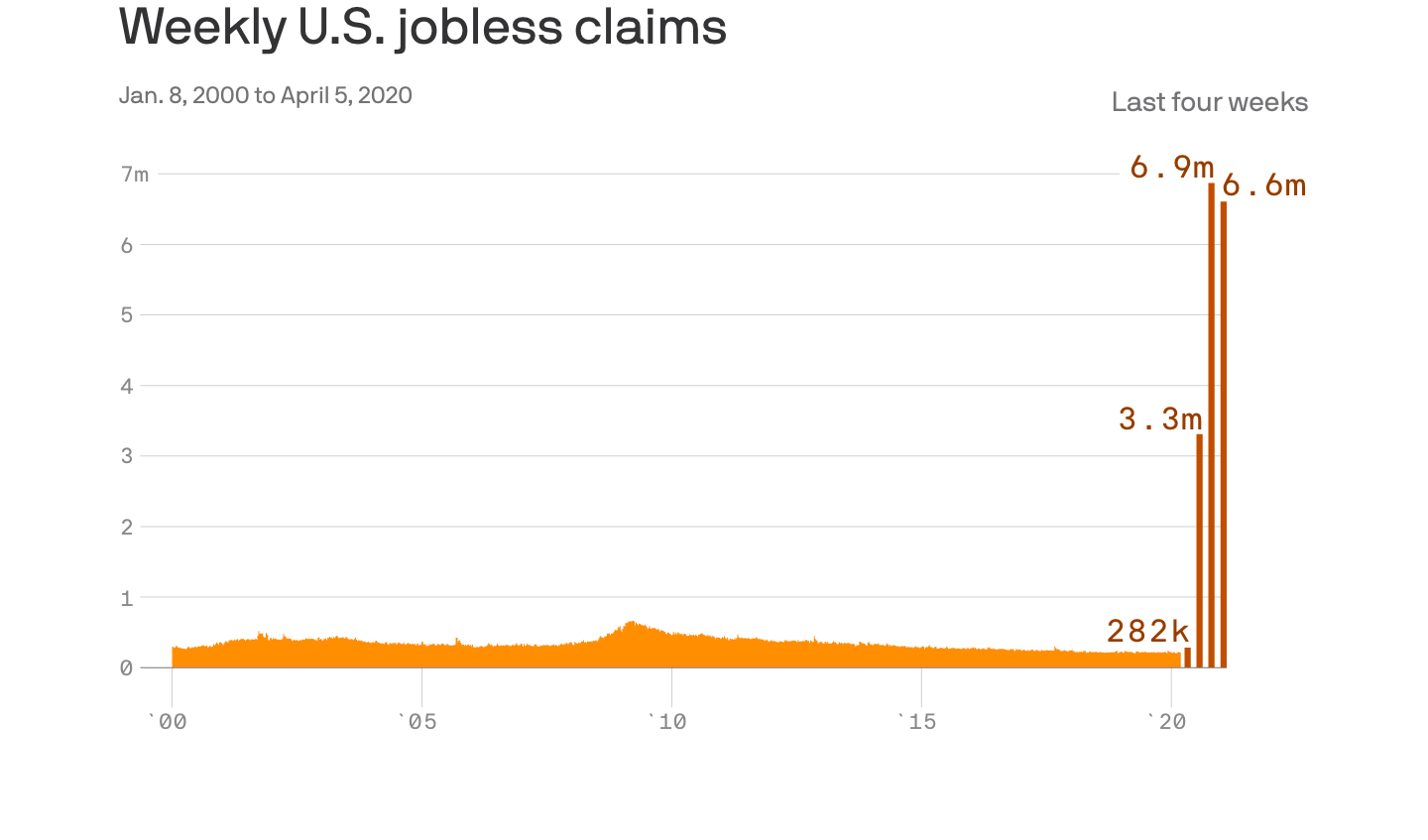
Another 6.6 million Americans filed for unemployment last week, the Labor Department announced Thursday.

Why it matters: It adds to the staggering 10 million jobless claims in recent weeks — by far the sharpest spikes in American history — as the world economy has ground to a halt in an effort to contain the coronavirus outbreak.

  • The once-again colossal number of filings was worse than the 5 million that Wall Street had expected.
  • Last week’s unemployment claim numbers, which government data had pegged at 6.65 million, were revised upward to 6.87 million — the highest ever recorded.

The big picture: The data lags by a week, so while a large portion of the economic shutdown is now evident over the last three weeks, there may still be more huge numbers yet to come.

  • The $2.2 trillion coronavirus stimulus package opened the door to a surge of new unemployment filings, allowing the self-employed and independent contractors to claim benefits.


Pay Cuts, Furloughs, Redeployment for Doctors and Hospital Staff

https://www.medpagetoday.com/infectiousdisease/covid19/85827?xid=nl_mpt_investigative2020-04-08&eun=g885344d0r&utm_source=Sailthru&utm_medium=email&utm_campaign=InvestigativeMD_040820&utm_term=NL_Gen_Int_InvestigateMD_Active

Pay Cuts, Furloughs, Redeployment for Doctors and Hospital Staff ...

— Health systems see massive disruption from COVID-19

In Michigan, Trinity Health is furloughing 2,500 of its 24,000 employees. In Florida, Sarasota Memorial Health Care is taking “immediate steps to reduce costs, including temporary furloughs and reduced hours” for workers.

In less than 1 month, COVID-19 has made swift, deep cuts in hospital billings. Despite high volumes in the first 2 weeks, March revenue plunged by $16 million at Sarasota Memorial. Surgery cases fell by more than 50%, and volumes dropped by 45% at two emergency care centers and by 66% at seven urgent care centers.

Squeezed by plummeting income and climbing COVID-19 expenses, hospitals and health systems are bracing themselves for system-wide disruption by announcing temporary layoffs, reassignments, and pay cuts.

Many changes, like Trinity’s furloughs in Michigan, affect mainly non-clinical workers. Some alter compensation or duties for doctors, nurses, and other healthcare providers.

“In all parts of the country, physicians are being asked to sign agreements or acknowledgments for pay cuts ranging from 20% to 75%, depending on what their specialty is, where they are, and what the institutions are doing,” said Scott Weavil, JD, a California lawyer who counsels physicians nationwide about employment contracts.

“Many of these providers are not on the front lines of COVID, but they are still working,” Weavil noted. “Babies are being born. People are having accidents and visiting emergency departments. Urgent surgeries are happening. Physicians are at work or on call and ready to help if needed. And in most of these environments, there are patients who have tested positive for COVID-19,” he told MedPage Today.

“Ob/gyns aren’t doing a lot of elective procedures like hysterectomies, but they are delivering babies for COVID-positive patients, wearing donated cloth masks that may or may not be effective,” Weavil added.

In some cases, doctors have been sidelined and face the prospect of dwindling income as patient volumes fall. “We have 2,600 physicians and advanced-practice providers,” said Mark Briesacher, MD, senior vice president and chief physician executive of Intermountain Healthcare in Salt Lake City. “About 800 of them are on a patient volume-related type of contract, similar to what you would have in private practice.”

Because non-urgent and elective procedures are being delayed, some of these clinicians now see 30% to 50% fewer patients and could face big income drops, Briesacher told MedPage Today. “But we’ve put a floor in place,” he said: these providers will receive their usual pay until May 30, then 85% of that amount until normal patient volumes resume.

Redeployment can help practitioners make up lost income, Briesacher added. “A general surgeon often has critical care training,” he noted. “When this increase in patient care needs due to COVID-19 does come to Utah, we can deploy that surgeon to work in our ICUs with a critical care doctor, and if they’re working fulltime, they’ll get paid the same as they were before.”

Reassignment does not stop with doctors at Intermountain: hospital nurses can be deployed to screening desks, drive-through testing sites, or telehealth centers and will keep their current rate of pay, spokesperson Daron Crowley said.

“I recently reviewed a COVID-19 compensation plan of a health system in Florida that would give physicians their base or draw, or a midpoint between their 2019 base and their 2019 overall compensation,” noted Weavil, the attorney. “That seemed pretty good, but it came at a cost: the physicians had to agree to practice outside of their normal setting, as long as they were credentialed for the work.”

“At first blush, the credentialing requirement sounded like a protection; if you are a psychiatrist, you’d think ‘they’re not going to send me to the ICU,’ and normally, that’s correct,” Weavil continued.

But hospitals are adopting emergency credentialing provisions during COVID-19 and “doctors can be forced to practice pretty far afield of their specialty,” he said. In some ways, the situation resembles residency, he pointed out: “You have an attending physician who knows what she’s doing directing fish-out-of-water physicians who have been conscripted into service beyond their specialties.”

The list of hospital systems announcing major changes — including pay cuts for hospital executives, as Trinity Health in Michigan has done — grows each day. Boston Medical Center Health System has furloughed 700 employees; Cincinnati-based Bon Secours Mercy Health has announced it will do the same. Kentucky’s Appalachian Regional Healthcare will furlough about 500 staff members. South Carolina’s Prisma Health will lay off an undisclosed number of clinical, corporate, and administrative workers. Tenet Healthcare in Dallas has furloughed 500 fulltime positions.

Furloughing staff “was an extremely difficult decision, and one that we did not make lightly,” Sarasota Memorial CEO David Verinder wrote in a letter to employees.

“Staff have gone above and beyond to care for our patients throughout this crisis, even as they have been anxious about the health and well-being of themselves and their families,” he continued. “But as the health care safety net for the region, we must do all we can to continue fulfilling that critical role in the weeks ahead and for the long-term.”


The Most Appalling COVID-19 Lie

https://www.medpagetoday.com/infectiousdisease/covid19/85741?xid=nl_mpt_investigative2020-04-08&eun=g885344d0r&utm_source=Sailthru&utm_medium=email&utm_campaign=InvestigativeMD_040820&utm_term=NL_Gen_Int_InvestigateMD_Active

The Most Appalling COVID-19 Lie | MedPage Today

— Doctor breaks down the worst fallacy

Please forgive the basic nature of this video. I’ve enjoyed spending some time with my family finally after my quarantine expired. I wasn’t planning on making a video this weekend, but everybody’s in bed now and I felt that this was important.

I have done a few interviews recently and I’ve been asked the same question every time, which is what is the worst piece of misinformation you’ve heard about coronavirus. The first time I answered I said one of those conspiracy theories that we’ve all heard, but I quickly realized actually that isn’t the most damaging misconception about the current virus at all. The most harmful perception about COVID-19 is that it’s a disease that only affects the very old or the infirm.

The Intensive Care National Audit and Research Centre is a body that collects information from all the intensive care units in the U.K. and they’ve been publishing data about the COVID-19 patients here. I briefly mentioned one of their results in a previous video and I’ve been posting updates on Twitter. The most recent, which is about the first 775 patients admitted with COVID-19 to intensive care units in the U.K., came out a couple of days ago. I put it up on Twitter and it got quite a lot of attention, and so I felt it was useful to talk about that here as well.

The European Society of Intensive Care Medicine (ESICM) has published some preliminary results — I don’t have the full data set yet — for an even bigger group of patients — I think something like 1,800 patients. But from what I have seen, the results are very comparable.

The first headline is that the average age of patients admitted is 60 years old. Now, that doesn’t mean the average age of people getting coronavirus is 60. It’s just that out of the patients admitted to intensive care units with COVID-19 in the U.K., the average age — both mean and median — is around 60. The reason I say it like that is because admissions to ITU [intensive treatment unit] are prioritized for those that have the best chance of survival.

The right-hand column is quite useful here. It shows results for admissions to ITU over the last couple of years in the U.K. for patients with non-COVID viral pneumonia to act as a comparator. We can see immediately that in comparison to the usual viral pneumonia admissions, COVID admissions have a better baseline in that 91% are fully independent compared to 73% normally and fewer have pre-existing comorbidities or medical problems.

You can also see they are much more likely to be mechanically ventilated — i.e., intubated on a breathing machine, a ventilator — which is reflective of the profound hypoxia or low oxygen levels that we’re seeing in COVID-19 and the guidance that these patients deteriorate fast, and so doctors should intubate early.

An interesting pattern that’s emerged from every country’s cohorts is that men are more affected by this than women; 70% of severe infections requiring ITU are male, and perhaps most sobering is that out of all the patients admitted to ITU so far in the U.K., almost half have died — 48%. Comparing that with the usual admissions we see in ICU for viral pneumonia, like say influenza, only 22% of those died. If it needs to be repeated again, this is not “just like the flu.”

If you look at just 16- to 49-year-olds, although numbers are low at the moment, a quarter of them admitted to ITU have died. It remains true that 80% of people that get COVID-19 will have a self-limiting illness, the way I did, that does not require hospital admission. Your risk goes up with increasing age and the pre-existence of medical conditions.

However, overall one in five people that get this will have a severe infection, perhaps requiring hospital admission. Out of that, a quarter will require admission to intensive care. As these figures show, the average age for that subgroup is only 60, and half of those patients die.

Something that’s not captured in these figures is that death is just one marker. If you spend a week on a ventilator and 2 weeks in the hospital overall and then go home alive, that’s hardly what I’d call a mild infection. As I’ve said before, the main risk for most of us is not from the virus itself, but the effect that it’ll have on how healthcare functions in our respective countries.

On the subjects of healthcare, we’ve now seen three doctors here in the U.K., several in America, and 51 in Italy lose their lives directly because of COVID-19 — many or perhaps even most of whom were fit and well beforehand. To my sisters and brothers in healthcare, especially those going into battle like this without the appropriate armor — which is something that I just cannot believe is happening in developed countries, it shouldn’t be happening — I salute you.

That’s it. That’s the video. This isn’t aimed at any particular age group nor political affiliation. I find it remarkable I even have to say that second point because somehow this has become a partisan issue, which again I can’t understand.

Perhaps, if this does have an intended audience, it’s the middle-aged politicians who maybe also think that they’re too young for this disease and promote this appalling fallacy that COVID-19 is only killing patients who would have died sooner or later otherwise. Just stop f**king around.


COVID-19 Update: The N̶e̶w̶s̶ Data is Mostly Good

COVID-19 Update: The N̶e̶w̶s̶ Data is Mostly Good

First off, it’s time to call a spade a spade. When the Trump administration publicly projected 100,000 to 240,000 deaths in the U.S. last week, we couldn’t come up with a model that aligned with these numbers. Either they are/were seeing something in the data that we are not, or…they were managing expectations. This is an election year, after all. Even in the daily briefings since that forecast, the number of new cases reported have generally been lower than feared.

According to our forecasts, which were based on Italy and other countries leading virus-progressions (which were intentionally overestimated when compared to the probable U.S. trajectory), the U.S. would likely never plateau at rates above 50,000 new cases a day. The U.S. has 5.5 times as many people than Italy. Even if we overestimated that Italy was a model for the U.S. (which, as we projected, peaked two weeks ago at less than 7,000 cases a day), it was hard to model the U.S. peaking at more than 50,000 cases a day and likely that number will be closer to 40,000 or less. Italy maintained 85% of peak for nearly three weeks before declining. If we ascribe that to 40,000 new cases a day, the U.S. will likely add less than 750,000 new cases before meaningful decent. We believe we are already into that peak phase (currently with 400,000 cases). By our models, the U.S. will reach a total of approximately 1.5 million cases (or less), using the Italian infection model. With an above average fatality rate of 5% (we expect it will be lower), you would anticipate less than 75,000 deaths in the U.S., with the bulk of those coming in the next 4 weeks.

Importantly, Italy has one of the oldest populations in the developed world with an average age over 7 years older than the U.S. at 45.5 and a meaningful population in the most susceptible zone of the virus (above 70). Societally, they also live multi-generationally, which increases cross spread within families. Italy also failed to take protective measures until there was a considerable outbreak. They continued to allow flights in from China, their key textile trade partner, for over a week longer than the U.S., despite cases coming into Northern Italy directly through China. Further, Italy’s hospitals in the north were overrun with cases, which is not anticipated in most of the U.S. (see state by state data here). As such, we expect and hope that our estimates for U.S. data for the virus will prove to be higher than reality when the virus is eventually suppressed…at least this go around.

popitaly

With expectations that Italy’s progression may represent the worst pattern to date, we again look to Italy (and its close neighbors) to see if our indicators have continued on their paths of peak, plateau, and eventual decline. So far, with each new data point, we continue to be encouraged – with one troublesome outlier. Italy continues to report fewer and fewer new cases, as do their immediate neighbors to the north, Austria and Switzerland. In fact, Austria and Switzerland are already seeing the number of active cases in their countries decline.

germanydailyspain

daily fran

Most of the other European countries we are following are exhibiting similar patterns, although earlier in their progression. The outlier is France. France has posted up some alarming and quite possibly anomalistic numbers in the last several days. North Pier will investigate this data in more detail in our full weekly update. We hope that this will prove to be atypical and that we will see the virus’s trajectory in France moderate soon.

The U.S. stock market seems to have turned its attention to this new phase of virus-related data. For the time being, the fear of the abyss seems to have abated. Ultimately, the real test will come when we finally turn our attention to the economy, and what the post-virus world will look like. However, those days are far off. There will likely be bouts of fear and euphoria between now and then. Along the way, we will do our best to keep you informed.